


Privacy Technology · Monetary Sovereignty & Digital Money
Beyond the Hybrid: Zcash’s Crosslink Divide and Ryo’s Private PoS Path
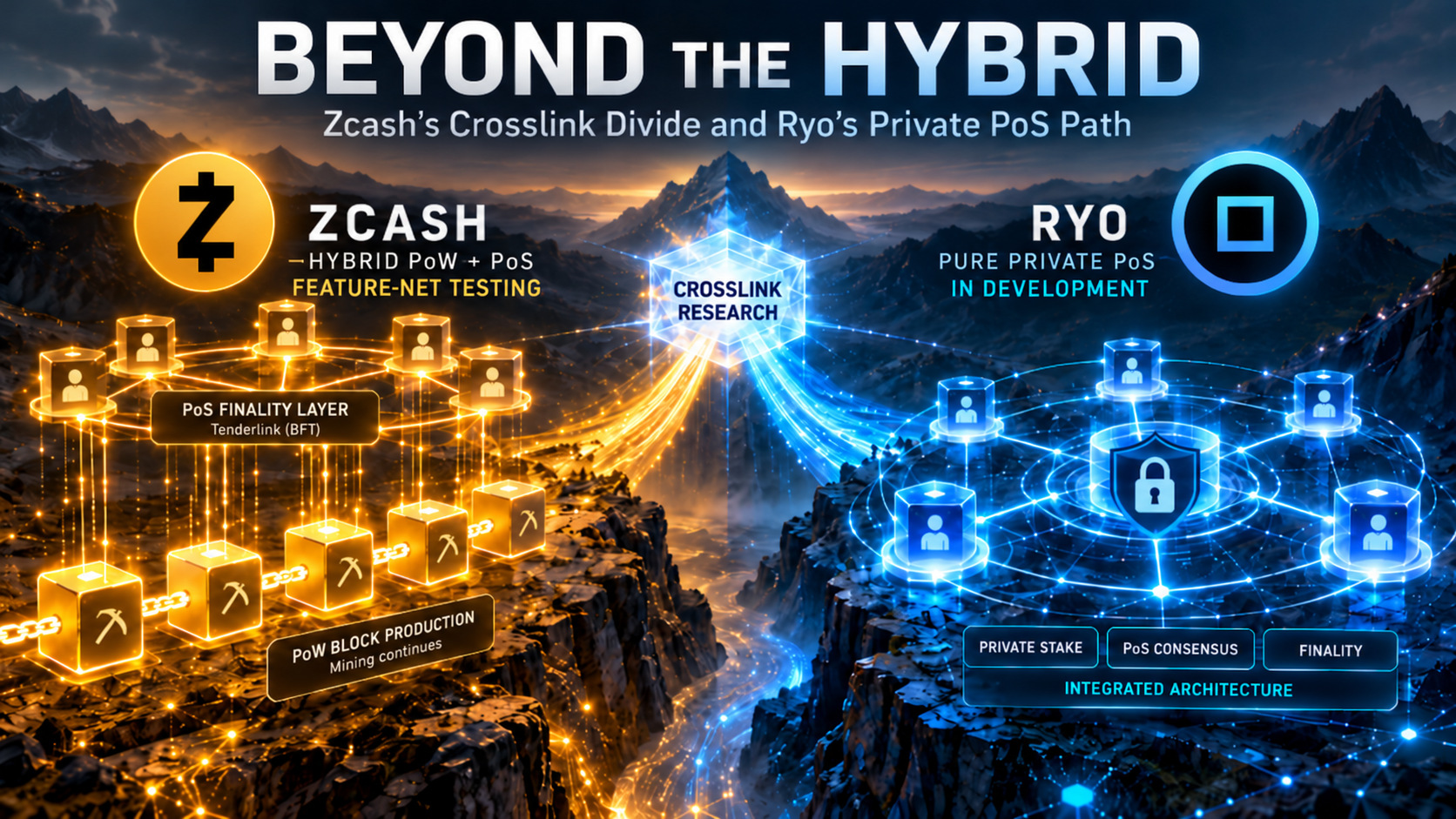
Zcash is debating whether Proof-of-Stake finality is worth adding to its mining-based blockchain. Ryo plans to adapt Crosslink for a different destination: pure, private Proof-of-Stake. The distinction reveals what each network hopes to gain, what it risks, and what a cleaner consensus architecture must still prove.
Evidence boundary: Research reviewed through October 26, 2026. Crosslink is not active on Zcash mainnet, and Ryo’s intended pure private PoS adaptation is not represented here as a published, audited or deployed consensus implementation. Project statements establish development intentions; protocol specifications and test reports establish narrower technical claims.
Previously on ryo.news: Private Money or Private Tokens? examined Zcash, Ryo and default privacy; Beyond the Private Key analyzed authority and final settlement; and The Anatomy of a Network State explored future private institutions. This article examines the consensus architecture beneath those possibilities.
The argument unfolding inside the Zcash community is easily mistaken for a fight over staking rewards. It is considerably more important than that. At issue is how a privacy cryptocurrency should decide that a payment is final, who participates in that decision, and how much new complexity a network should accept in the pursuit of stronger settlement guarantees.
On October 23, Zcash’s public account described a privacy feature of Crosslink, a proposal developed by Shielded Labs to add stake-based finality to Zcash’s existing Proof-of-Work (PoW) chain. That explanation helped reignite a disagreement between prominent developers and supporters. Josh Swihart, founder of Zcash Open Development Lab (ZODL) and former Electric Coin Company chief executive, argued against the additional consensus machinery. Jason McGee of Shielded Labs defended the legitimacy of researching and testing the design, while emphasizing that it was not awaiting imminent activation.[3, 4, 5]
Neither a developer’s objection nor a working feature network is a binding network decision. Crosslink is not active on Zcash mainnet, and a future adoption would require technical specification, testing, governance and broad support. Shielded Labs says that Zcash would continue to use PoW if its version of Crosslink were adopted.[1]
There is, however, a third path worth examining. Ryo intends to adapt Crosslink for a pure, private PoS architecture, rather than permanently operate mining alongside a staking-based finality layer. Ryo’s official roadmap and public comments from developer Fireice_UK establish the direction, although they do not constitute a completed consensus specification or independent security review.[18, 19] The distinction matters: the same body of consensus research can inform two very different systems.
The question is not which community can produce the loudest argument. It is whether the security objectives being pursued through Crosslink are best achieved, for a given network, by maintaining two linked consensus mechanisms or designing one integrated PoS system.
I. What Crosslink Actually Does
Under Zcash’s current Nakamoto-style PoW consensus, miners compete to produce valid blocks. More accumulated work generally makes an older block harder to replace, but the assurance is probabilistic: a sufficiently strong alternative chain can, under the relevant consensus rules, cause a reorganization.
Crosslink proposes a second mechanism alongside that familiar process. Miners would still produce and validate the transaction-carrying blocks. Separately, stake-weighted finalizers would agree on certificates establishing that sufficiently confirmed portions of the PoW history should not be reorganized. Shielded Labs uses Tenderlink, a maintained Tendermint-derived Byzantine fault-tolerant (BFT) consensus component, for this finality process.[1, 2]
It is useful to distinguish three jobs that are often compressed into the word consensus. Validation asks whether a transaction obeys the rules. Block production determines who proposes the next part of the ledger’s history. Finality determines when participants should no longer accept a conflicting history. Crosslink adds a new answer to the third question without replacing Zcash’s PoW answer to the second.
That can offer exchanges, bridges and ordinary recipients more explicit settlement assurances. But BFT finality depends on assumptions about the participating stake, network conditions and the finality protocol’s safety. A certificate is not magic: its meaning depends on the rules that created and verified it. Nor does finality prove that a transaction-verification circuit or monetary rule was correctly specified.
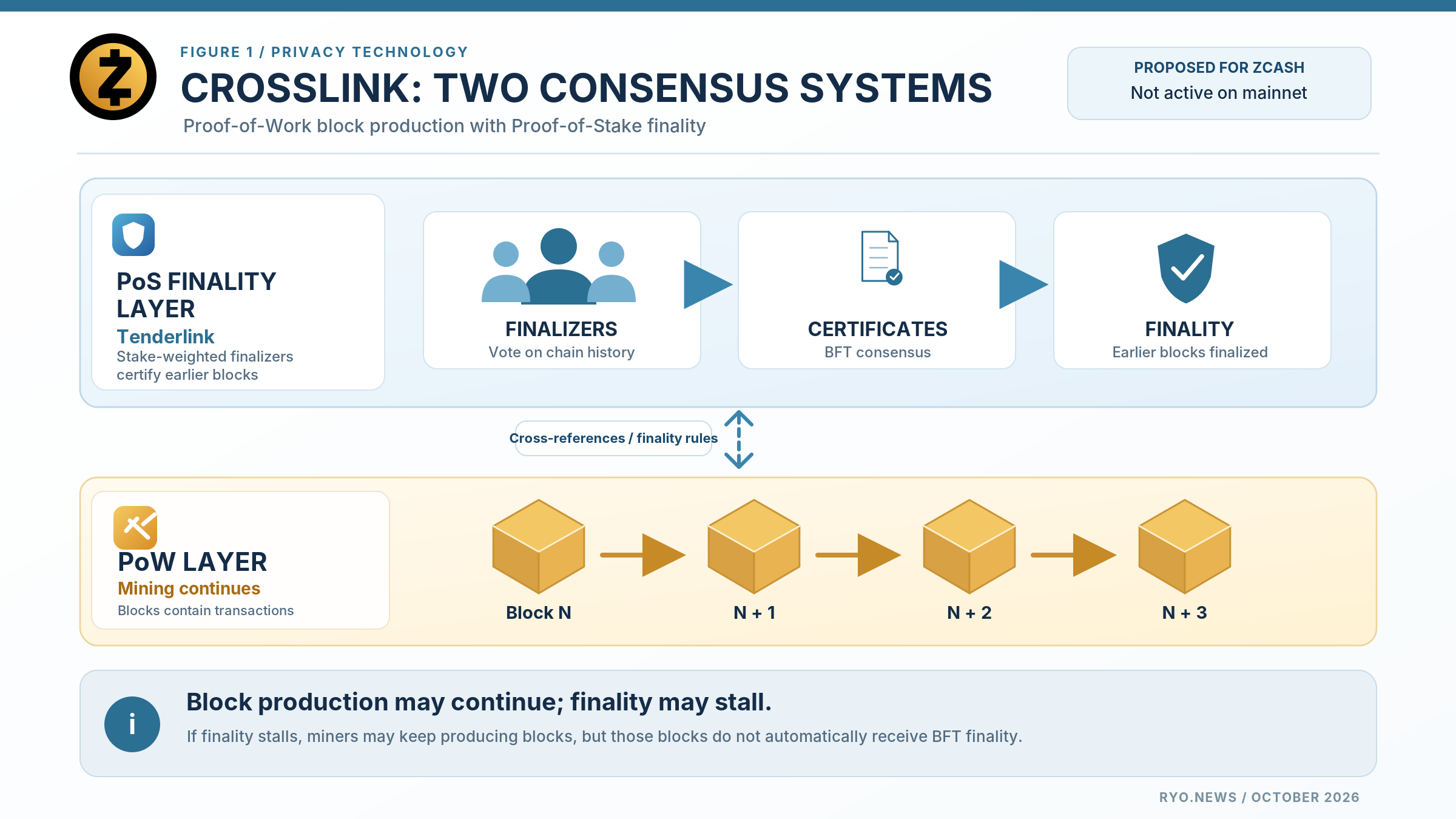
The design is therefore hybrid in a precise sense: it gives mining and staking different, interacting responsibilities. It is not a planned Zcash switch to pure PoS. Shielded Labs says there is currently no indication that such a full transition would follow.[1]
II. Two Serious Positions, Not Simply Two Camps
Supporters of Crosslink argue that a second source of security can strengthen a system without discarding its existing foundation. PoW continues to supply block production, while stake-weighted finalizers add a way to resist deep rollbacks. A hybrid can preserve properties of the present network during a gradual transition, and it lets ZEC holders participate in security without becoming miners. In an adverse scenario, the design aims to allow mining to continue even when finality temporarily stops.[1, 6]
Those are legitimate objectives. More explicit settlement assurance may improve how a network is integrated into payment infrastructure. Retaining PoW can also provide continuity during a BFT disruption. Shielded Labs’ public work, including incentivized feature networks, is an attempt to test whether those objectives can be realized safely in software rather than assumed from a white paper.[6]
Swihart’s objection is a different kind of security argument. He believes that attaching staking to Zcash introduces new assumptions and enough protocol complexity to outweigh the benefit of stronger finality. He also argues that the proposal lacks the broad support needed for a consensus change. His preferred outcome is to retain Nakamoto consensus, not to replace it with pure PoS.[4]
Josh Swihart on Crosslink, October 25, 2026
Read Swihart’s explanation of why he favors retaining Nakamoto consensus.
For a long-lived monetary network, simplicity is not merely an aesthetic preference. Every additional rule has to be implemented consistently, maintained, tested against unusual network states, and understood well enough for independent node operators to judge the chain they are following. There is a burden of proof on any proposal that changes that foundation.
McGee’s response supplies an important counterweight: research is not activation. Shielded Labs can test a proposal, accept criticism and improve it without presuming the rest of the ecosystem must eventually accept it. The team has said that a future mainnet proposal would require substantially more work and demonstrated community support.[5, 6]
Jason McGee on Crosslink research, October 25, 2026
Read McGee’s clarification about prototype status, the burden of proof and community evaluation.
The most useful conclusion from this disagreement is not that one side opposes security while the other supports it. Both are concerned with security. They assign different weights to a trade-off: How much additional protocol machinery should a network accept to achieve stronger finality?
III. Pure PoS Was Already Part of the Research Lineage
One detail has been largely lost in the current argument. Crosslink’s lineage includes the earlier Trailing Finality Layer (TFL) research, which expressly examined a possible path from Zcash PoW to hybrid PoW/PoS and then to pure PoS. That is not Zcash’s present roadmap. It is part of the historical research record.[7]
The original TFL documentation asked why a network should pass through an intermediate hybrid stage instead of moving directly to PoS. It identified an important potential benefit of a direct transition: if the destination were an existing, proven PoS protocol, the node design and the explanation of the migration could be simpler. But the authors also saw risks in changing everything in a single step. A hybrid could let the network test staking while retaining much of its existing consensus environment.[7]
In 2021, the Electric Coin Company publicly considered a full PoS transition. Its discussion acknowledged the role PoW had played in distributing ZEC, while making the case for a different long-term participation model. The article remains a useful historical source, although its present host explicitly notes that it does not necessarily reflect ZODL’s current position.[8]
This history does not establish that pure PoS is automatically safer, or that a hybrid was merely a temporary mistake. It establishes something more limited and more relevant: Crosslink-related research was never conceptually confined to a permanent hybrid as the only possible future. Different networks can start from similar research and choose different endpoints.
IV. What the Testing Has Revealed About Complexity
The difficult parts of a hybrid design are not captured by saying that it has “two layers.” Its components must agree about the same history, even when messages arrive late, nodes go offline, or one mechanism advances while the other does not.
A September 2026 Crosslink working draft describes interdependent PoW and BFT structures: mining blocks reference finality certificates, while certificates reference PoW history. This creates work for chain selection, synchronization, finalizer rosters and recovery procedures. The draft also documents unresolved questions and specific limitations of its current fork-choice approach. It is a living engineering document, not a finished protocol specification.[2]
In May, Shielded Labs reported crashes, synchronization difficulties and stalled finality during its early incentivized feature network. The team was explicit about the underlying distinction. A PoW network tends to keep producing blocks while accepting reorganization risk; a BFT finality mechanism may stop finalizing when it cannot safely obtain agreement. In its feature net, mining continued even when BFT finality stalled.[12]
That should not be presented as evidence that Crosslink is broken. Discovering failure modes during testing is the point of testing. Nor is it evidence that every issue reported in May remained unresolved in October. It does show why continuing block production and achieving final settlement are two different guarantees.
An independent January 2026 mechanism-design review reached a similarly qualified conclusion about the version it examined: finality safety was structurally strong under stated BFT assumptions, while the incentives supporting continued finality were fragile in the baseline design. The author proposed changes to rewards, monitoring and recovery. The review did not assess all cryptographic or implementation security and expressly described itself as an input to an evolving design, not a final verdict.[11]
There is no free lunch here. A hybrid may offer a valuable PoW fallback during finality disruption, but it also introduces the need to reconcile the two processes. A pure PoS design may remove that reconciliation problem, but cannot inherit the hybrid’s mining fallback. It has to demonstrate its own recovery and availability properties.
V. From Accessible Mining to the Question of Who Secures the Next Era
Mining history helps explain why this debate matters, but it should not become a referendum on hardware brands.
Zcash launched in 2016 using Equihash, with GPU mining an important early participation route. Specialized Zcash ASICs arrived in 2018 and made general-purpose GPU mining commercially uncompetitive. The original ECC discussion of PoS explicitly connected that shift to questions about distribution and participation.[13, 8]
Ryo followed a different mining strategy. Its CryptoNight-GPU algorithm was designed for consumer graphics hardware and resistance to specialized mining hardware. Its existing network remains PoW-secured, and the extended mining period forms part of its coin-distribution history.[14, 15]
Neither GPU mining nor ASIC mining guarantees decentralization by itself. Electricity pricing, hardware access, pools, and accumulated ownership all matter. Mining distribution also does not prove that the eventual stakes of a PoS network will be widely dispersed. But the design choices illustrate different long-term roles for mining: Zcash’s Crosslink proposal would retain it indefinitely; Ryo’s planned transition would eventually retire it as the consensus mechanism.
VI. Privacy Involves More Than Hiding a Payment
Privacy is another reason Ryo’s proposal cannot be described as an uncomplicated copy of Crosslink.
Shielded Labs’ proposed staking design uses the Orchard shielded pool, rounded staking denominations and batching to reduce the ability to link staking activity with particular users. But the design deliberately makes aggregate stake information available so that finalizer voting weight can be checked. A 2025 design update described more fully shielded staking as an option considered but not selected for the first iteration because of the added complexity and associated trade-offs.[9]
That is a meaningful privacy engineering choice, not evidence that Crosslink ignores privacy. A protocol cannot simply conceal every consensus input and expect participants to agree on voting power without additional proofs and accounting rules.
For a privacy network, three separate questions must be answered. Can observers trace payments? Can they connect stakes, balances, delegations or validator activities to particular people? And can network surveillance identify participants from their traffic and timing? These are transaction privacy, staking privacy and network privacy; progress on one does not automatically solve the others.
Ryo currently uses live RingCT-based transaction privacy. Its transition to default Halo 2-based zero-knowledge proofs is in testing and deployment preparation: the team reported core coding largely complete, while testing and deployment coordination remained. Its private Proof-of-Stake adaptation is planned, with Crosslink to be modified for a native private PoS architecture. The high-latency mixnet remains planned on the roadmap. These are separate development tracks, and the cited update did not announce a Halo 2 mainnet activation date.[14, 15, 17, 18]
Halo 2 is a framework for constructing and verifying proofs about private information under specified constraints. It is not a consensus protocol. Using it for payments does not automatically hide validator identities or stake weights, and a valid proof cannot repair an incorrectly defined protocol rule.[10]
As earlier ryo.news analyses of privacy-by-default versus shielded assets and cryptographic migration have emphasized, stronger transaction privacy does not remove the need to verify the monetary and consensus rules around it.
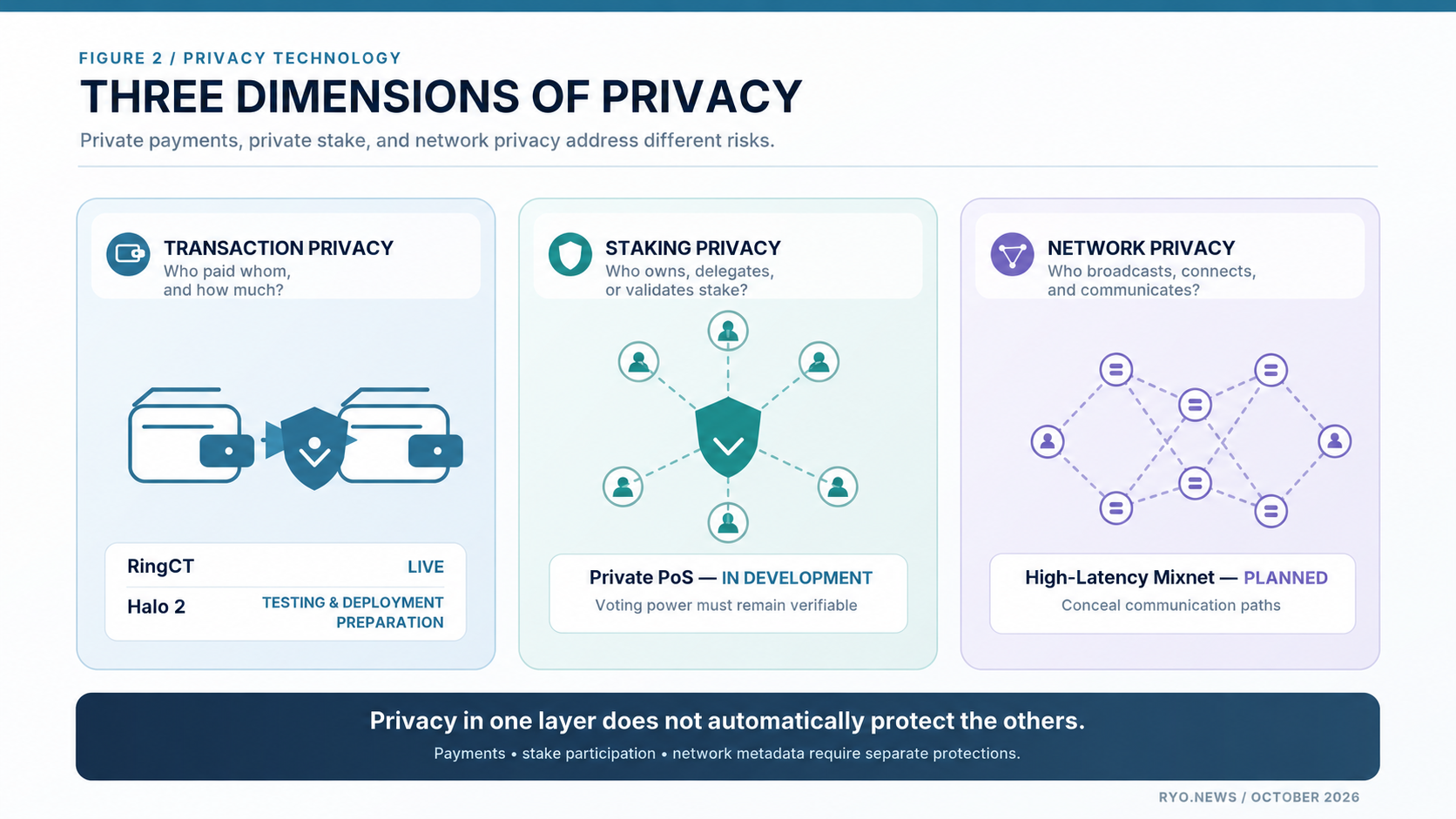
Ryo’s goal of private participation is therefore an opportunity to design staking privacy into the architecture, not proof that the challenge has already been solved. The exact representation of voting power, validator accountability and private delegation must be specified and tested.
VII. Ryo’s Proposal: Adapt Crosslink, Remove the Permanent Hybrid
Ryo’s intended destination is a pure, private PoS system. The proposed Crosslink adaptation is planned, while the detailed Ryo consensus specification has not been published. The project’s official roadmap identifies Proof-of-Stake as a future network stage; its intended adaptation of Crosslink would replace the permanent hybrid with native PoS rather than reproduce Zcash’s mining-plus-finality arrangement.[18]
There is a public trail behind that direction. On July 18, 2025, Ryo developer Fireice_UK asked where active Zcash PoS code could be found. Jason McGee directed him to Shielded Labs’ Crosslink repository and roadmap. The following day, in the public Ryo Telegram group, Fireice_UK wrote: “That’s the roadmap for what I want to port over to Ryo.”[16, 19] The forum exchange establishes his interest in the Crosslink work; the subsequent statement establishes his intention to bring that roadmap to Ryo. Neither specifies exactly which Crosslink or Tenderlink components will be reused, or how the future pure-PoS rules will be implemented.
This is more than exchanging mining equipment for staking deposits. Crosslink as currently specified assumes a PoW chain that produces the ledger, with a BFT system certifying parts of that chain. A pure PoS adaptation must supply its own block-production rules, validator or proposer selection, stake accounting, finality rules, fork-choice and recovery procedures. It may be informed by Tenderlink’s BFT machinery, but it cannot simply remove miners from the existing Zcash proposal and claim the rest is complete.
That engineering burden is substantial. The attraction lies in what the finished architecture need not carry indefinitely.
First, it would no longer require a continuing mining system and a separate finality system to coordinate two histories. Second, the protocol could define block production and settlement together, instead of adding finality to a ledger produced under a different resource model. Third, staking rewards and security incentives could be assessed within a unified PoS design rather than divided between miners and finalizers. Fourth, the rules for private participation could be evaluated as first-class consensus requirements.
These are potential simplifications, not guaranteed reductions in total complexity. Native PoS introduces its own problems: long-range attacks, weak-subjectivity or checkpoint assumptions, concentrated stake, validator censorship, liveness loss and the security of transitions between validator sets. Some hybrid-specific machinery disappears; other machinery has to be built well.
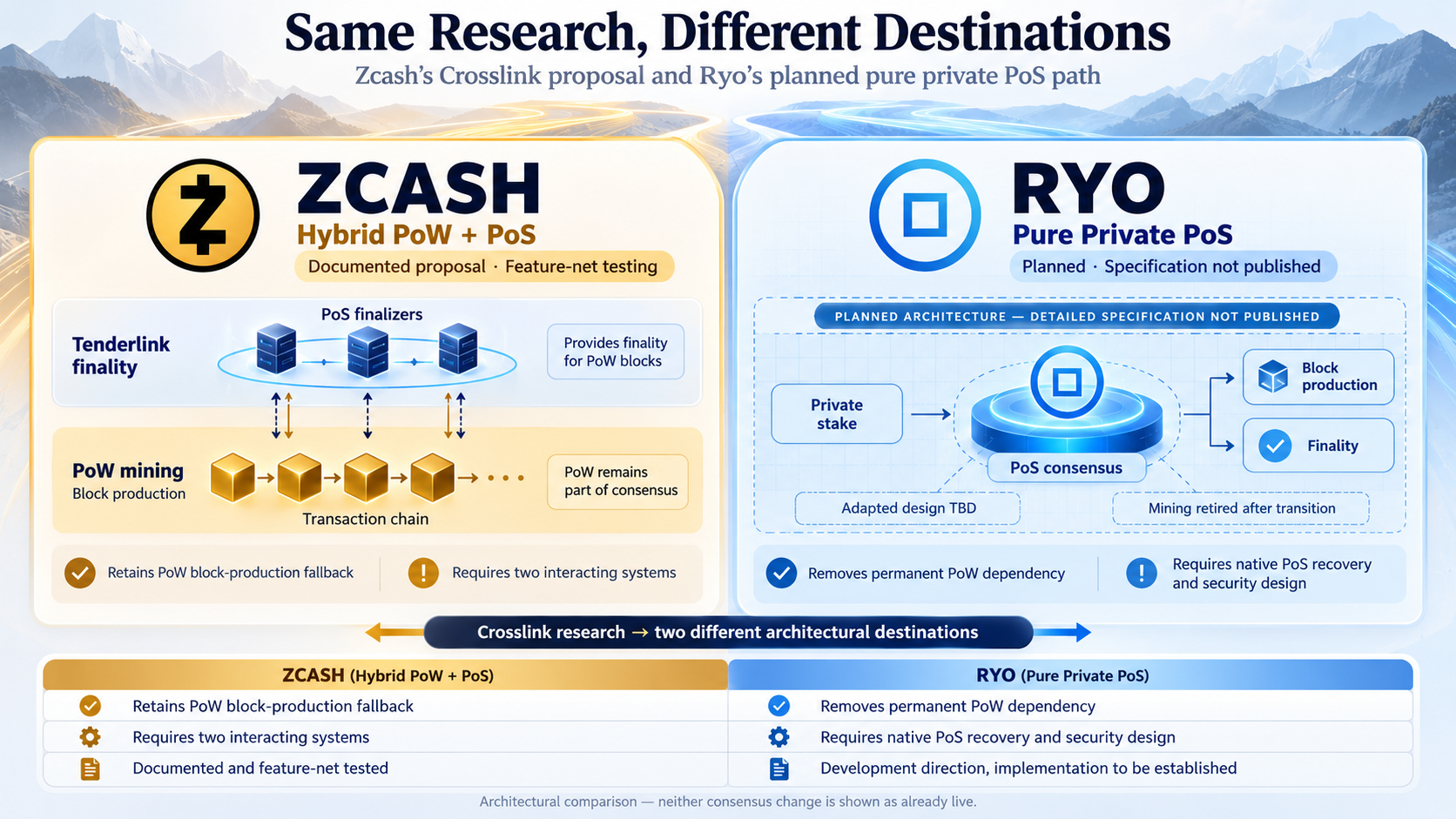
The case for Ryo is strongest when framed in those terms. The objective is not to put an untested PoS mechanism on a pedestal. It is to avoid permanently supporting two linked consensus processes when the project’s chosen destination is native PoS.
That choice also has a cost. In Crosslink, continued PoW block production can be an availability fallback during a BFT finality stall. Ryo’s architecture would not have that fallback by default. It therefore needs explicit, well-tested rules for how validators recover after a prolonged disruption without risking conflicting histories or allowing a small coalition to decide the chain’s fate.
Beyond Consensus: The Possibility of Private Institutions
There is a longer-term reason to care about private staking beyond validator rewards. If Ryo eventually combines confidential payments, private consensus participation and separately developed governance tools, communities could explore private DAOs, shared treasuries and voluntary digital communities that aspire to become network states. Such organizations might need to prove that an expenditure was authorized or a vote was valid without turning every donor, member or political relationship into a public transaction graph. That broader institutional possibility has also been examined in ryo.news’s network-state governance analysis.[21]
But private PoS does not, by itself, create a private DAO or a functioning treasury. Private ballots need verifiable eligibility and tallying; treasuries need custody, authorization and accounting rules; durable communities need institutions and procedures that code alone cannot supply. Research such as MACI’s privacy-preserving voting system illustrates how governance privacy is its own engineering challenge, not an automatic consequence of staking.[20] For Ryo, this is a future design opportunity, not an existing protocol capability.
VIII. The Tests That Separate Architectural Elegance from Security
A clean diagram is not a proof of safety. The serious test of a Crosslink-derived pure-PoS protocol is whether its assumptions can be written down, independently checked and exercised under adversarial conditions.
Private stake accounting. Can nodes verify eligibility, voting weights, rewards and exits while respecting Ryo’s chosen privacy guarantees? If some information must remain public, what exactly is exposed and why? Concealment must not make unauthorized issuance or counterfeit voting power possible.
Finality and continuity. Under what threshold of honest stake are conflicting finalizations impossible? How does the network behave during partitions, validator outages or withheld votes? What conditions permit resumption after a stall, and who has authority to coordinate exceptional recovery?
Incentives and accountability. What makes a validator keep participating when doing so is costly, and what happens if it equivocates or obstructs progress? Crosslink’s evolving Zcash design discusses social rather than automatic slashing. Ryo should not be assumed to use the same sanctions or evidence rules without a published specification.[2]
Concentration and censorship. Does a modest amount of economic stake become disproportionate control over block proposals or finalization? Can smaller participants delegate without exposing relationships that the protocol intends to protect? Can validators selectively suppress transactions while retaining rewards?
Safe migration. How are existing PoW-era balances preserved at activation? Can offline wallets safely return? Can a newly joining node distinguish the authentic historical chain without relying on an unexamined source of checkpoints? A migration is not merely a change in how the next block is made.
Independent scrutiny. A protocol adapted from public research gains a useful starting point, not an inherited audit certificate. Modified block production, privacy circuits, accounting and recovery rules require evaluation as a new integrated system.
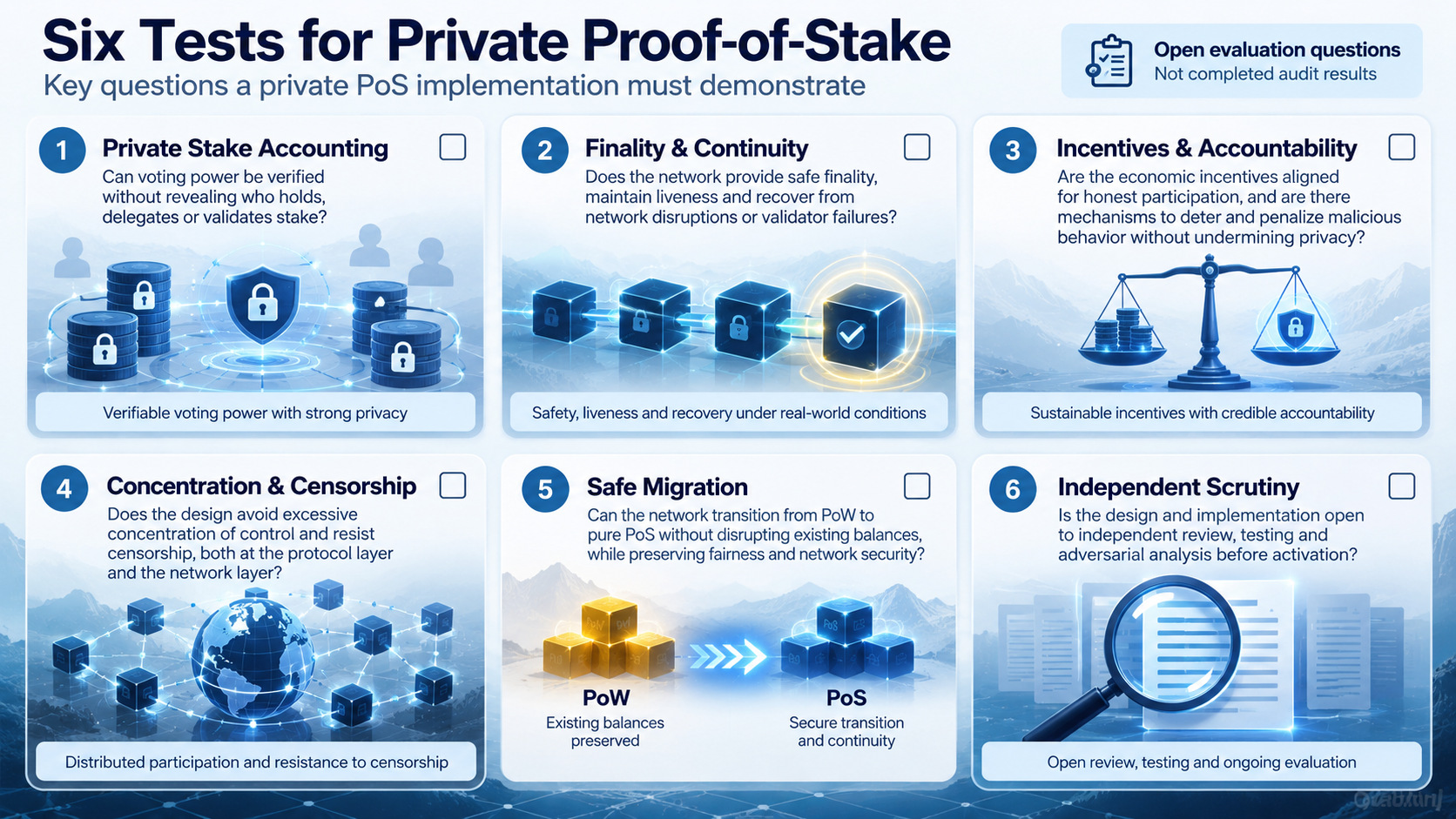
The relevant standard is the security of the entire system under explicit, independently testable assumptions, not the apparent simplicity of its schematic.
IX. Beyond the Hybrid
Zcash and Ryo are approaching different engineering decisions. Zcash is being asked whether retaining PoW while adding stake-based finality justifies the additional mechanisms, incentives and governance obligations. That decision belongs to Zcash’s community; continued research does not predetermine the answer.
Ryo’s path is more direct in its destination. It intends to use Crosslink research in a design that eventually replaces mining with pure private PoS, following years of GPU-oriented distribution. For a network that has deliberately chosen that future, it is reasonable to argue that integrating block production, finality and private participation is a cleaner architectural objective than permanently coupling mining to a separate finality layer.
But “cleaner” is a hypothesis about design coherence, not a security rating. The modified protocol must still show how privacy, stake accountability, monetary integrity, finality and recovery work together in deployed software.
The strongest future for private money will not be decided by how many security mechanisms a blockchain can stack together. It will be decided by whether its chosen mechanisms work reliably as one.
Further Reading from ryo.news
- Private Money or Private Tokens? Dash, Zcash, and Ryo at the Halo 2 Crossroads — A comparison of deployed privacy and planned upgrades.
- Beyond the Private Key: Crypto’s Hidden Control Plane — Why settlement security involves more than private-key ownership.
- The Anatomy of a Network State: From Club to Constitution — The governance questions beyond private payments.
References
Primary specifications and project statements are prioritized below. Working drafts and test reports describe the versions and dates stated in their titles. X posts document participants’ views, not settled protocol facts.
- Shielded Labs, Crosslink FAQ. Project architecture, Tenderlink, proposed staking and governance requirements.
- Shielded Labs, Zebra Crosslink Design Overview, September 14, 2026. Living engineering draft; unsettled items explicitly marked.
- Zcash on X, October 23, 2026. Crosslink and privacy-preserving staking-bond denomination explanation.
- Josh Swihart on X, October 25, 2026. Opposition to Crosslink as a Zcash consensus upgrade. Contemporaneous reproduced text.
- Jason McGee on X, October 25, 2026. Crosslink R&D status and the burden of proof before any activation proposal.
- Shielded Labs, Crosslink: Incentivized Feature Nets, April 2, 2026. Test-network process and participation.
- Zcash Trailing Finality Layer Book, A Path to Proof-of-Stake Zcash. Historical hybrid-to-pure-PoS research and transition trade-offs.
- Electric Coin Company, Should Zcash Switch from Proof of Work to Proof of Stake?, August 3, 2021. Archived historical position; not necessarily ZODL’s current position.
- Shielded Labs, Crosslink: Updated Staking Design, October 27, 2025. Bond quantization, batching and privacy trade-offs.
- The Halo 2 Book, Proof Systems. Public/private inputs, circuits and proof properties.
- Nicolás Della Penna, Mechanism Design Audit of Crosslink Zebra, January 2026 (PDF). Version-specific review of liveness incentives and safety assumptions.
- Shielded Labs, Crosslink Feature Net: Reflections on the First Six Weeks, May 29, 2026. Early testing and stalled-finality behavior.
- Zcash Community, Zcash Mining Guide. Equihash, GPU-era mining and the 2018 ASIC transition.
- Ryo Currency, official website. Current CryptoNight-GPU/RingCT foundations and planned cryptographic upgrades.
- ryo.news, Ryo Currency: Privacy Coin, Wallets & Roadmap. First-party editorial overview of active features and future milestones, not independent corroboration of security properties.
- Zcash Community Forum, Status of PoS Code in 2025, July 18, 2025. Public exchange between Fireice_UK and Jason McGee.
- Privacy Coin Report / ryo.news, Private Money or Private Tokens?, October 21, 2026. First-party reporting of Ryo’s October Halo 2 development update and mainnet status.
- Ryo Currency, official roadmap FAQ. Primary project source for the planned Proof-of-Stake development path.
- Fireice_UK, public Ryo Telegram group, July 19, 2025. First-person statement about the roadmap he wanted to port to Ryo; read together with the July 18 Zcash Community Forum exchange. Telegram may require opening the group to view message context.
- Privacy & Scaling Explorations, What is MACI? Independent example of private, verifiable voting infrastructure; not part of Ryo.
- k1ngVV / ryo.news, The Anatomy of a Network State: From Club to Constitution, September 28, 2026. First-party editorial framework for private capital and durable institutional governance.