



Mining & Network Infrastructure · Privacy Technology · Monetary Sovereignty & Digital Money
Beyond the Private Key: Crypto’s Hidden Control Plane
Bitget says its private keys were not compromised. MetaMask exited validators while holding no client withdrawal keys. NEAR Intents reported a failure where cross-chain infrastructure met contract execution. Together, the cases reveal how much authority can live between an owner’s intention and a blockchain’s final state.
By Dr. Max Anon · October 1st, 2026
Executive Summary
Cryptocurrency taught its users to locate power by locating the private key. That remains an essential test of custody. It is an increasingly incomplete map of control.
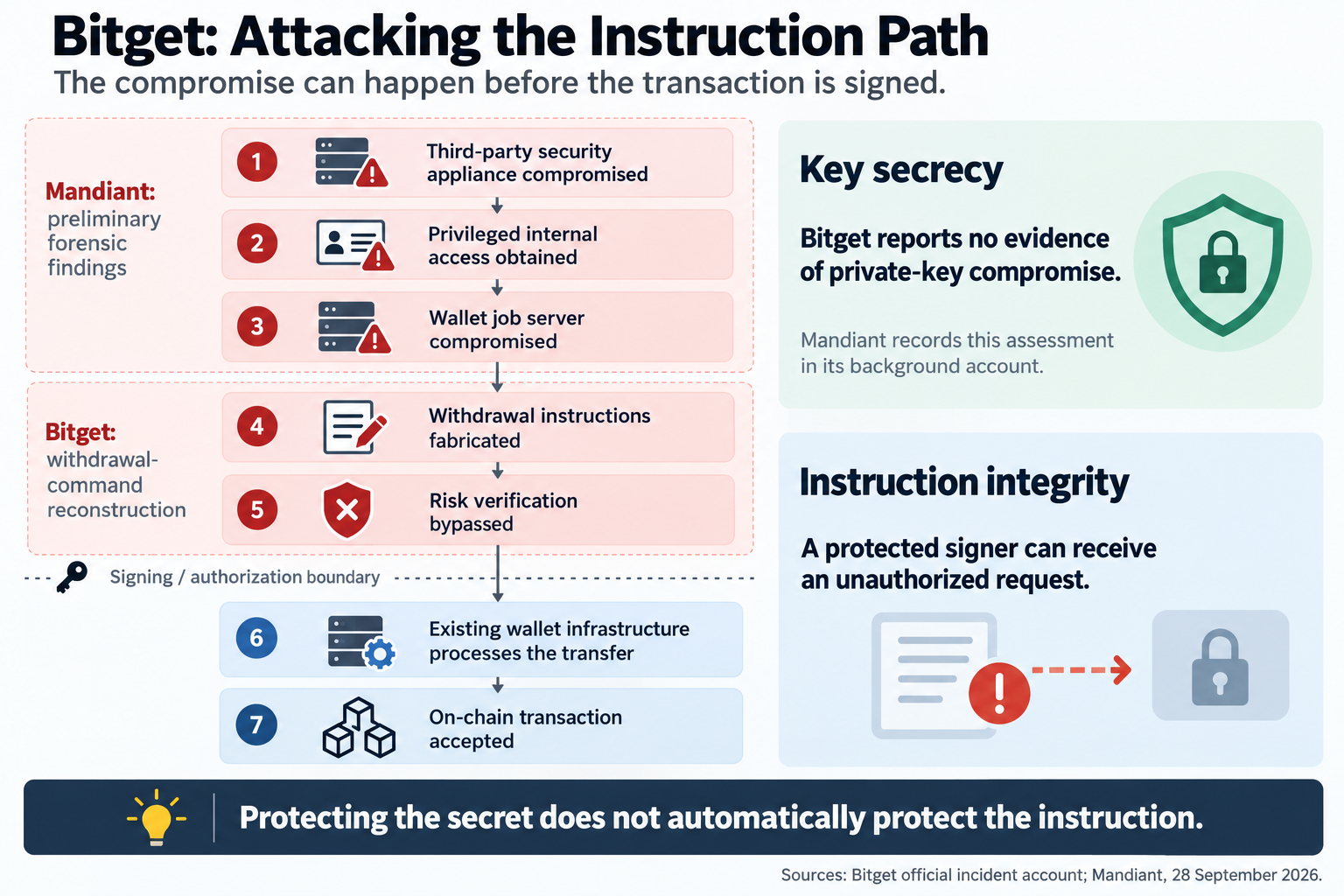
Bitget’s September 24 theft, affecting almost $388 million, illustrates the gap. The exchange attributes the withdrawals to forged instructions reaching its wallet system. Mandiant independently describes a route from compromised security appliances to the production wallet job server. Its report records Bitget’s assessment that there was no evidence of private-key compromise; that assessment should not be mistaken for an independently proven negative.[1][2]
MetaMask’s September 30 disclosure illustrates a different division of power. Its staking operation could initiate precautionary validator exits without managing clients’ withdrawal keys. On October 1, it said its investigation had found no indication that wallets or customer funds were affected. Ethereum deliberately separates validator operation from withdrawal authority.[3][5][6]
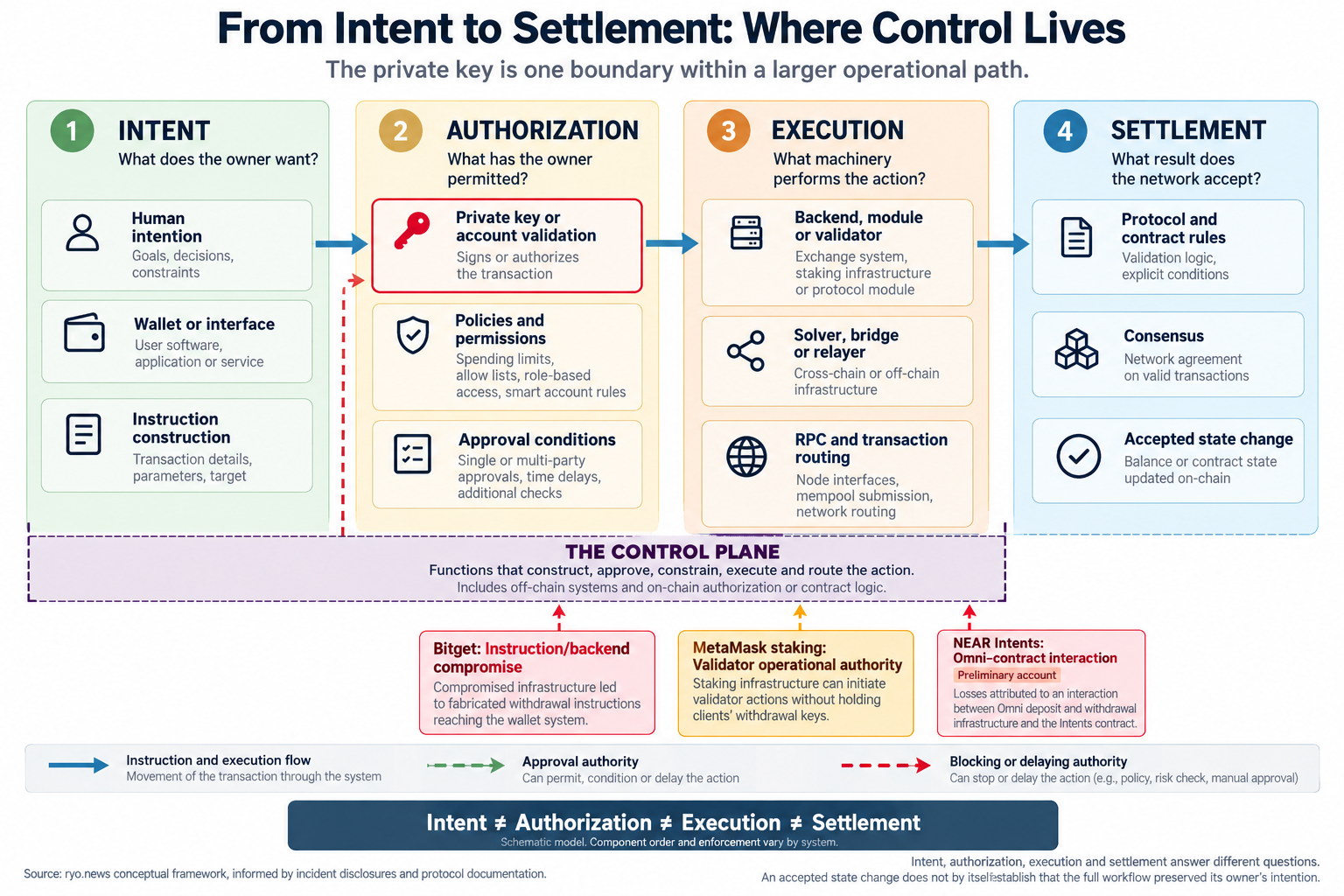
NEAR Intents adds the execution boundary. Its October 1 preliminary statement attributes approximately $3.8 million in losses to an interaction between Omni deposit and withdrawal infrastructure and the Intents contract. A detailed technical account remains pending. The relevant lesson is about the dependencies introduced when users authorize an outcome and infrastructure supplies the route.[4][8]
This article calls the surrounding machinery the hidden control plane: the software, permissions, policies and services that turn an instruction into an accepted action. Its authority topology is the map of who can instruct, sign, constrain, route, operate and recover. Path sovereignty asks whether the owner retains an independently usable route from verified intent to settlement under the protocol’s rules.
Keys establish cryptographic authority. The path from intent to settlement determines how much practical power that authority retains.
Key Takeaways
- A protected secret can authorize a corrupted instruction. Key extraction and manipulation of the legitimate signing workflow are different failure modes.
- Control is divisible. Validator operation, asset withdrawal, account policy and transaction routing can belong to different actors.
- Abstraction relocates complexity. A simpler interface can depend on a more elaborate execution system whose trust boundaries remain consequential.
- Programmable accounts make authority explicit. Modules, guards and delegated permissions can add execution paths or restrictions around owner keys.
- A service refusal is not automatically a protocol veto. The important question is whether a practical alternative route exists.
- Security and sovereignty measure different things. Protective controls can reduce loss while increasing dependence. Their powers, limits and recovery paths should be visible.
Conceptual continuity: Who Gets the Red Button? examined the capacity to assemble emergency intervention. The Permission Layer examined institutional exclusion. From Account KYC to Wallet KYC examined identity at financial gateways. This article follows authority through ordinary operation: who can cause an action, shape it or prevent it before consensus receives the result.
I. The Keys Were Reportedly Not Stolen
Crypto taught a generation to ask one question: Who holds the private key?
It was the right question. It was never the last one.
When almost $388 million leaves an exchange, the obvious explanation is that somebody obtained its signing secrets. Bitget’s account of the September 24 incident points elsewhere: an attacker exploited a third-party security product, obtained privileged access and injected fabricated withdrawal commands that the wallet system accepted while bypassing risk checks.[1]
Mandiant’s September 28 status report supplies a narrower forensic chain. An attacker gained privileged access to two security appliances, established persistent access on one, moved laterally to the production wallet job server and deployed malicious packages. The report’s background attributes the no-evidence-of-key-compromise assessment to Bitget; Mandiant describes its investigation as ongoing.[2]
The distinction matters. An ongoing investigation cannot establish that an unobserved event never occurred. Nor do the public reports disclose every detail of the signing architecture. But the documented backend compromise and the exchange’s withdrawal-command account identify a failure that key secrecy alone would not prevent.
The attacker could become the source of instructions trusted by the wallet system without first becoming the independent holder of its private keys.
From the blockchain’s perspective, an accepted transfer must satisfy the relevant authorization and validity rules. Those rules do not reconstruct an exchange’s internal approval process. A transfer can be legitimate to the protocol and illegitimate to the organization whose infrastructure produced it.
Featured in the Ryo Directory
Businesses accepting RYO
II. The Signer and the System Around It
A private key is a secret used to authorize a precisely defined message. A wallet is a system that decides which message should be authorized. Those are different security problems.
Hardware protection, distributed signing and restricted key access can make extraction much harder. Some implementations also enforce transaction policies. None should be assumed to verify an owner’s intention merely because it protects the secret. The relevant questions are what the signer independently checks and which upstream components it trusts.
Key compromise and instruction compromise
In a key compromise, an attacker acquires signing capability outside the intended authorization process. In an instruction compromise, the attacker manipulates that process so legitimate infrastructure authorizes an unwanted action. The mechanisms can overlap, but conflating them hides where the defense must operate.
Consider a signer that accepts an approved withdrawal object from a backend. If an attacker can produce an object the signer regards as approved, secrecy of the key does not settle authenticity of the request. Independent destination verification, tightly bounded permissions and approval controls can change the result. The architecture determines whether those controls are genuinely independent.
A secure key can become an obedient signer for an insecure instruction path.
The settlement plane and the control plane
The settlement plane answers whether the network should accept a state transition: signatures, balances, contract rules and consensus validity. The control plane answers the questions that led to that transition: who constructed the request, which policy applied, which approvals counted and which route delivered it.
This is an analytical distinction. Some control logic runs on-chain, and contracts can enforce exact destinations, limits or conditions. The boundary is about function, not simply whether a component is a server or a blockchain.
Once a conventional transaction is signed, a relay cannot change its signature-covered fields and preserve validity. Its powers may instead concern access, withholding or the information shown before signing. A module authorized to execute a different operation possesses a different power again. A serious control map must distinguish them.
III. The Keys Were Not Held
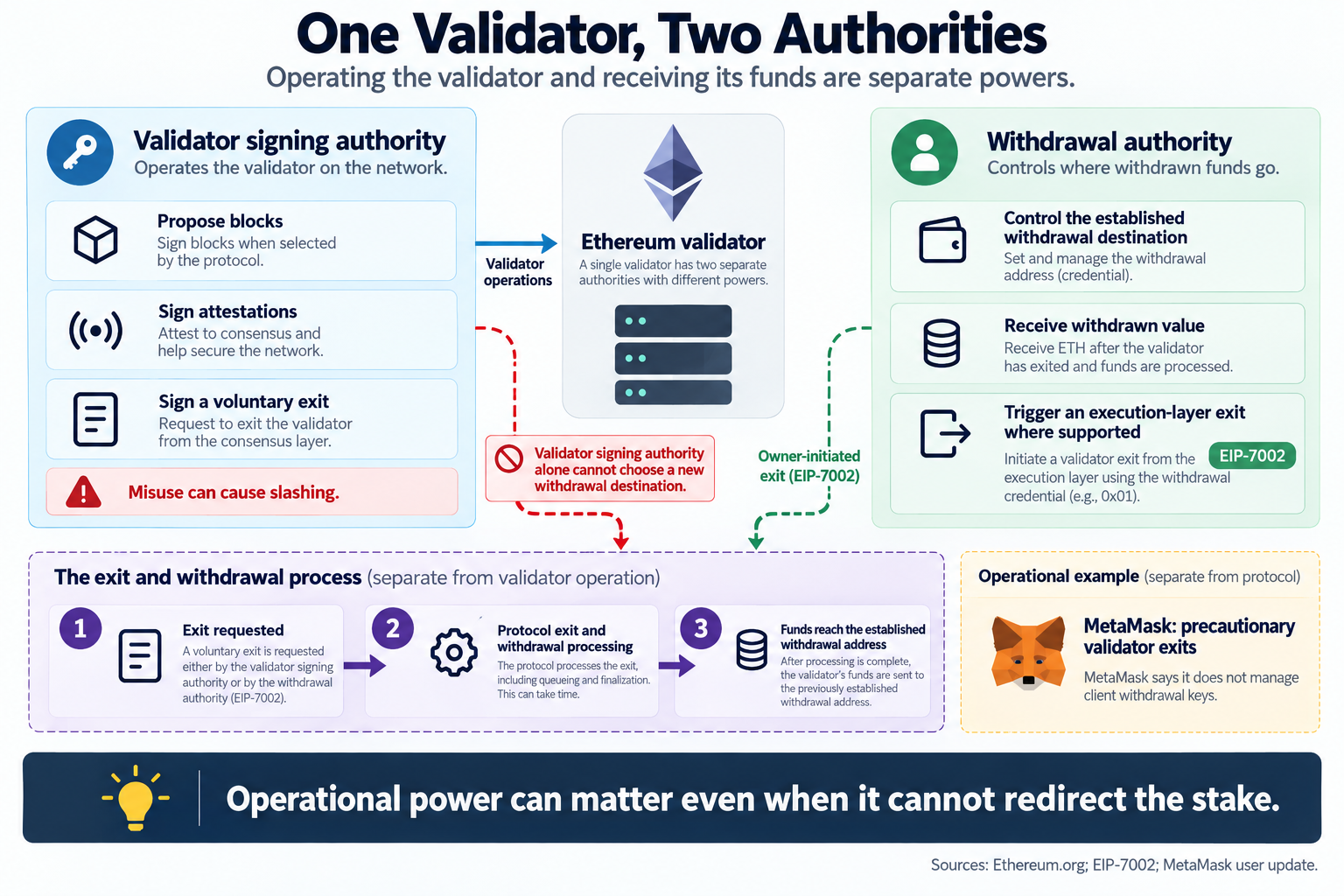
MetaMask presents the opposite-looking case. Its September 30 notice said it was exiting affected staking validators as a precaution while emphasizing that it did not manage client withdrawal keys. Its October 1 update said there was no indication that wallets or customer funds had been affected.[3]
The announcement describes a defensive operational response. It does not establish that an attacker stole stake or independently triggered those exits.
Ethereum makes the response intelligible. A validator signing key authorizes consensus duties and can sign a voluntary exit. Withdrawal credentials establish the destination for withdrawn value. A validator operator therefore need not control the receiving account to possess authority over participation.[5][6]
That separation protects the destination of the stake. It does not make validator operation economically irrelevant. Misuse of signing authority can create slashing exposure; interruption or exit can change participation and rewards. The inability to redirect the principal is a meaningful boundary, but it is not the absence of consequential power.[5][6]
Ethereum also supports an owner-side exit route through execution-layer withdrawal credentials. EIP-7002 addresses the dependency that otherwise arises when the operator controls the active key while somebody else owns the withdrawal destination.[6][7]
An operator can lack the authority to take the money while retaining authority to change what the infrastructure securing that money does.
IV. The User Expressed an Intent
The third case concerns a service designed to hide the route itself.
NEAR describes Intents as an execution system in which solvers compete to fill orders while cross-chain complexity is abstracted from the user. The user specifies a desired result; the surrounding system organizes how to achieve it.[8]
On October 1, the team’s preliminary disclosure attributed a security incident to “a bug in the Omni deposit and withdrawal infrastructure interaction with NEAR Intents smart contract.” It put losses at approximately $3.8 million, said affected funds would be compensated and reported that the contract-side vulnerability had been patched.[4]
That account is a preliminary team statement, reproduced in contemporaneous reporting, rather than a completed forensic explanation. It does not establish every exploit step, the full distribution of losses or whether any keys were compromised. Those questions should remain open until the technical report answers them.
Its architectural relevance is already clear. Cross-chain execution must reconcile events, permissions and balances across components that do not share one simple local transaction boundary. A user can authorize an outcome correctly while the system handling deposits, withdrawals or accounting fails to preserve the intended relationship between them.
Abstraction removes complexity from the interface. The system still has to carry it.
This does not mean a solver can arbitrarily disregard a properly enforced signed constraint. Well-designed intent systems bind execution to explicit conditions. The question is which conditions are enforced, where they are enforced and which components must remain correct for those guarantees to hold.
The four stages should therefore remain separate: intent is what the person wants; authorization is what the person has permitted; execution is how the action is performed; settlement is the accepted result. Faithful execution has to connect all four.
V. Smart Accounts Make the Control Plane Visible
These divisions of power are also deliberate design choices. Smart accounts make them explicit.
Modules: another route to execution
A basic Safe can require an owner-signature threshold. An enabled module adds a separate execution route governed by the module’s logic. Safe’s documentation describes allowances, recurring actions and recovery uses, and warns that a malicious module can take over an account.[9]
Imagine a three-of-five owner threshold alongside a module that permits a designated automation key to spend within a daily limit. Counting five owner keys and a threshold of three no longer describes every authorized action. The module’s permissions belong on the same control map.
This example is hypothetical, but the additional execution path is part of the documented design. An owner-approved delegation can be useful and carefully bounded. Its existence must remain visible when the account is described to its users.
Guards: authority to refuse
Safe guards can inspect transactions and impose restrictions beyond the owner threshold. The documentation warns that a broken guard can block execution and stresses the importance of recovery mechanisms.[10]
A guard need not own the money to affect its use. A module need not possess every owner key to execute a permitted action. Coverage depends on the account version, enabled components and execution route; one should not assume that every protection applies to every path.
The owner-key list describes one part of the account. The permissions around it describe the rest.
VI. The Private Key Becomes a Rule-Making Authority
EIP-7702 extends this logic to externally owned Ethereum accounts by allowing a key-authorized delegation to code. Its stated motivations include batching, sponsored transactions and restricted sub-key permissions.[11]
The root key can authorize a change in how the account operates. Subsequent activity can then follow the delegated code’s rules. A narrow permission might let an application perform a defined task without receiving unrestricted authority over the whole account.
That is a substantial shift in the meaning of key ownership. The key remains foundational, but understanding everyday control also requires understanding the delegation. A signature that establishes future authority is different from a signature for one immediately intelligible transfer.
The specification itself warns that a poorly implemented delegate can give an attacker extensive control, and identifies risks such as replay, insufficiently bound call parameters and unsafe initialization.[11]
The promise is less exposure of broad authority. The obligation is a clearer account of what was delegated, to whom, for how long and with what means of revocation.
A transaction becomes a workflow
ERC-4337 packages actions as UserOperations. Bundlers submit them through an EntryPoint contract, while the account implements authorization logic. An optional paymaster can sponsor execution costs and decide whether to fund a particular operation.[12]
A bundler may refuse a request it receives; a paymaster may refuse sponsorship. That does not automatically confer a monopoly over the user’s account. Another submission route or self-funded operation may remain available, depending on the implementation.
The useful distinction is between a service choosing not to cooperate and a service whose cooperation is unavoidable. Programmable authorization can improve security without imposing the latter. The deployment, rather than the architecture’s label, determines which dependencies the user actually inherits.
VII. Institutions Already Built a Control Plane
Professional custody systems have long treated key protection as one element of transaction governance.
Fireblocks describes policies covering destinations, amounts, roles and approval requirements, together with automated workflows and administrator quorums for policy changes. These are vendor descriptions of intended capabilities, not a guarantee that any deployment is immune to compromise.[13]
The distinction is nevertheless instructive. Producing a signature and deciding that a request deserves a signature are separate jobs. Institutional infrastructure attempts to govern both.
A threshold alone also tells us little about independence. In a hypothetical deployment, several approvals might all depend on the same transaction parser, identity system or administrative domain. A compromise of that shared dependency could undermine the apparent separation without defeating the mathematics of the signature scheme.
The relevant question is therefore where independent verification survives a compromised component. Who checks the destination? Who interprets the action? Who can change the policy? Which credentials can reach the request queue? What evidence does the final approval process actually verify?
NIST’s zero-trust architecture supplies an established security parallel: authentication and authorization are distinct functions, and internal network location does not itself justify trust. Applied here, a request’s arrival from inside the wallet environment cannot be the whole reason it is permitted.[14]
Protecting the key protects the cryptographic root. Protecting the authorization path determines what that root is asked to approve.
VIII. The Same Controls Can Protect and Constrain
NEAR Intents’ SHIELD documentation illustrates the dual role of this machinery. It describes a security-policy layer in which integrated services evaluate requests against incident information. Live capabilities include quote-time decisions; wider adoption across execution surfaces is described as an ongoing rollout.[15]
The documented model includes scoped permissions and modes that can introduce delay or pause affected functionality. It distinguishes current implementation from a broader vision, so these powers should not be projected onto every route or described as one universal asset-freezing mechanism.[15]
Those controls can buy time, contain a compromised integration and protect users. They also require a policy service, authorized incident producers and consumers that act on its decisions. Their permissions and failure behavior become part of the system’s security boundary.
This establishes a general architectural tension. It does not establish that SHIELD caused the October 1 exploit or failed in a particular way.
Every additional defense creates questions of its own. Can an incident producer suspend more than intended? Can a faulty classification become a prolonged restriction? What happens when the policy service becomes unreachable? Who can reverse a decision, and which paths remain available meanwhile?
A control can defend the execution path and still become another dependency within it.
The answer is not to discard protective controls. It is to identify their scope, expose their authority and test how the system behaves when they fail.
IX. Map Powers, Not Labels
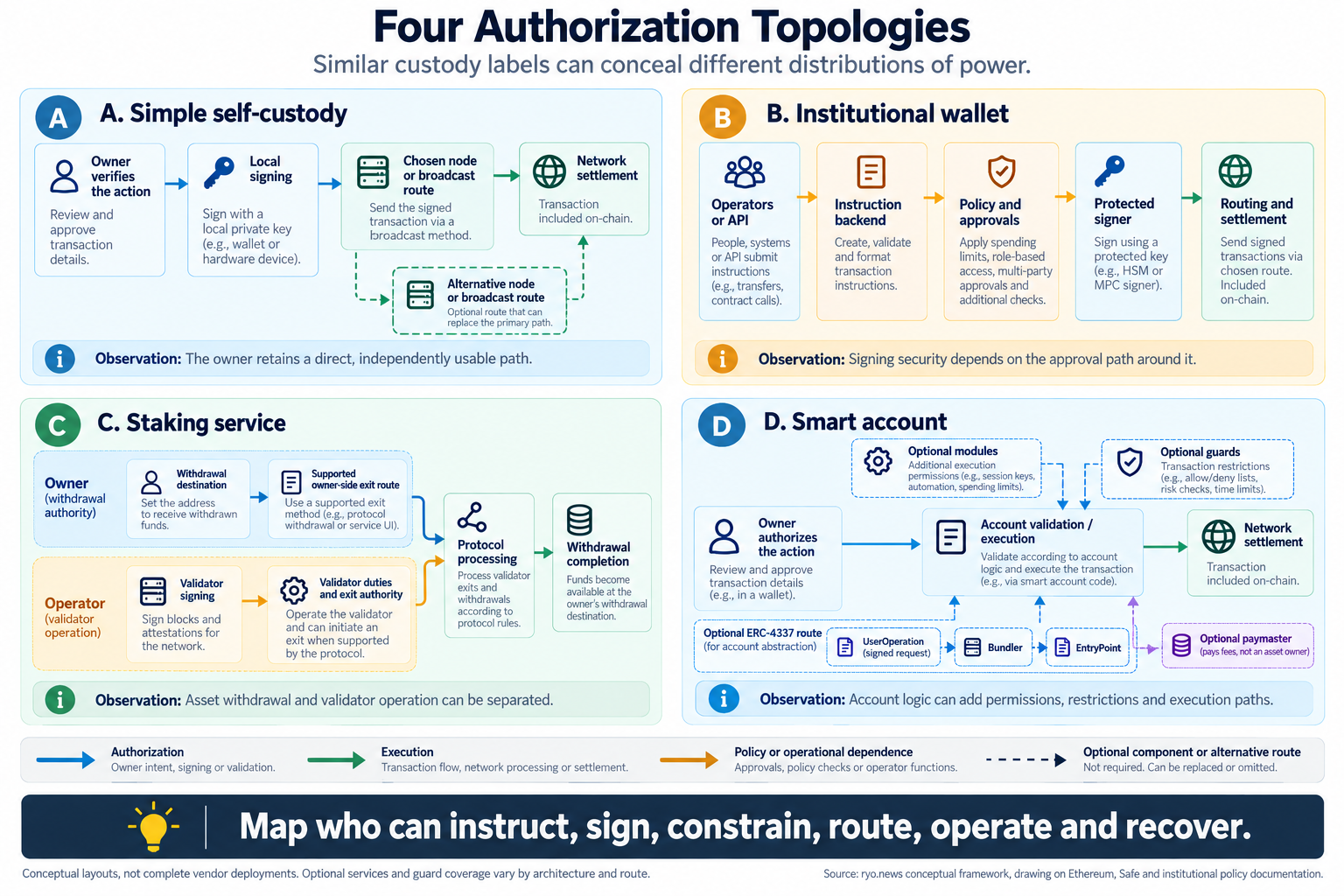
“Custodial,” “non-custodial” and “decentralized” compress too many questions into too few words. A capability map is more useful.
| Authority | Question to ask | Why it matters |
|---|---|---|
| Asset control | Who can transfer the asset, select a withdrawal destination or recover control? | Identifies the ultimate authorization boundary for the relevant asset or position. |
| Instruction | Who constructs the request presented for approval? | A compromised constructor may substitute an action before it is signed. |
| Signing | Which key, quorum or contract rule authorizes the request? | Reveals the cryptographic or programmed approval condition. |
| Policy | Who defines, changes or enforces permitted actions? | Restrictions can protect assets while creating veto or rule-changing powers. |
| Routing | Who transmits the action, and what alternatives exist? | A replaceable relay and an unavoidable gateway create different dependencies. |
| Participation | Who operates, pauses or exits the relevant protocol position? | Operational control can affect availability or economic exposure without redirecting funds. |
| Recovery | Who can restore access, rotate authority or remove a failed dependency? | A recovery path can constrain delegated power or create an additional override. |
Not every wallet contains every role. Some powers are held by the same person; some belong to immutable contract logic; others are distributed across independent actors. The map should also record who can install or replace each component.
A publicly inspectable permission may be less dangerous than a hidden one. A delegated operator may have sharply limited powers. Conversely, decentralization of one role says little about another: open participation in consensus does not tell us who controls an account’s recovery mechanism.
X. Path Sovereignty
We can now give the missing relationship a name.
Path sovereignty is the owner’s ability to originate, independently verify, authorize and transmit an intended action through a viable route to settlement, without unavoidable dependence on another actor able to substitute the instruction, redirect its result or veto that route.
This is a proposed analytical framework, not an established protocol metric or a promise of guaranteed inclusion. An owner still faces consensus rules, fees, network availability and legitimate constraints voluntarily built into the account. The question is which additional dependencies remain, and whether the owner can leave or replace them.
A strong independent path
The owner can verify the action, use independently available signing tools, reach the network through a chosen node or alternate broadcast route, and continue without the current service provider. Necessary account data, permissions and recovery procedures are available outside that provider’s interface.
The owner does not have to operate every component personally every day. Independence can mean retaining a practical alternative that has actually been documented and tested.
A partly delegated path
The owner controls ultimate asset authority while delegating some operational powers. A validator operator, permissioned application key or hosted interface may change participation, perform limited actions or mediate access. The strength of the arrangement depends on bounded permissions, independent verification and an exit route.
A provider-dependent path
A provider constructs the instruction, controls approvals, manages signing and mediates withdrawal. The customer may possess a contractual claim and see an account balance without possessing an independently usable path to the on-chain assets.
These are conditions to investigate rather than three scores to print on every wallet. A system can have a strong withdrawal path and a dependent trading path. A replaceable RPC endpoint can create modest friction; an unavailable proprietary recovery service can create a much more serious dependency.
Practical exit also has a cost. A theoretically open fallback that requires unavailable software, undisclosed account state or days of specialist intervention is weaker than a documented route the user can exercise. Sovereignty must be evaluated in the conditions under which it is likely to be needed.
XI. Security and Sovereignty Are Different Questions
An unrestricted key can provide broad unilateral authority while offering poor protection against theft, mistakes or coercion. A carefully designed policy system can reduce those risks while requiring several people to act together.
Neither observation establishes that one arrangement is universally superior.
A corporate treasury may reasonably choose quorum approval, destination restrictions and independent verification over a single executive’s freedom to move everything immediately. A person may reasonably prioritize a portable bearer asset with minimal administrative dependence.
The design obligation is to explain the bargain accurately. Who can say no? Who can change the conditions? Which restrictions were chosen by the owner? Can the owner revoke them? What happens if the party enforcing them disappears?
The old maxim remains useful: not your keys, not your coins. As a custody warning, it points toward a real distinction between possession of cryptographic authority and reliance on an intermediary. It should not be stretched into a complete account of every smart contract, issuer power or operational dependency.
A holder of every required owner key may still face an enabled guard. A staking client may control withdrawals while another actor operates the validator. A user may sign a valid intent while cross-chain execution remains dependent on other software.
The system became larger than the maxim. The control map must become larger too.
More controls can mean less unilateral power and more security. Fewer controls can mean fewer dependencies and more exposure. The useful comparison identifies the failure each design prevents, the authority it introduces and the recovery available when that authority is misused.
XII. Privacy Does Not Secure an Instruction
Privacy adds another necessary distinction. Concealing a transaction from observers and ensuring that it expresses the owner’s intention are different guarantees.
A private transfer to the wrong recipient remains the wrong transfer. A compromised interface can misdescribe an action before signing. An exchange using a private asset still has its own instruction and approval infrastructure. Transaction confidentiality does not independently authenticate those components.
Ryo’s official site describes a privacy-focused, GPU-oriented Proof-of-Work network using RingCT and a default ring size of 25, with a planned transition toward Halo 2. The proposed zero-knowledge architecture should not be presented as a capability already deployed on mainnet.[16]
For a privacy-first network, the control-plane lesson therefore extends beyond the ledger. Users need understandable authorization, verifiable software, available node access and realistic recovery. Applications built around the asset should explain what they can observe, what they can authorize and which services remain necessary.
Privacy can reduce the information available for persistent financial profiling. It cannot substitute for protecting the machine that asks the owner to sign. Conversely, an impeccable signing workflow does not make a publicly exposed transaction graph private.
The End of the Ring examined sovereignty as a stack of privacy and infrastructure questions. The hidden control plane adds a related test: can the systems around the private asset preserve the intended use of it?
Private money needs both: limits on what outsiders can learn, and clarity about what operators can do.
XIII. The Sovereignty Audit
The most revealing audit begins with an ordinary action rather than a marketing label. Choose a transfer, withdrawal, validator exit or contract interaction. Follow it from the person’s decision to the accepted result.
- Who creates the instruction? Identify the interface, backend and transaction constructor.
- Who verifies its meaning? Determine whether destination, amount, contract action and permissions can be checked independently.
- What exactly is authorized? Separate a single transfer from an allowance, delegation, module installation or recovery change.
- Which mechanism approves it? Locate keys, signature thresholds and contract validation rules.
- Who can cause that mechanism to act? Examine API credentials, automated jobs, modules and delegated keys.
- Who can block the action? Identify guards, policy engines, service refusals and protocol constraints separately.
- Who can change those rules? Follow administrator, upgrade and recovery authority.
- Which route reaches the network? Check whether a node, relay, bundler or execution service is mandatory.
- Can the owner use another route? Include the software, account state and funding needed to do so.
- Who controls participation? For staking or other active positions, distinguish operation, exit and withdrawal.
- Where does recovered value go? Verify the destination and the authority that establishes it.
- What survives the provider’s disappearance? Test the documented fallback while the network itself remains operational.
A missing answer is not automatically evidence of misconduct. It is an unresolved dependency. The point of the exercise is to replace a broad assurance with a specific map of powers.
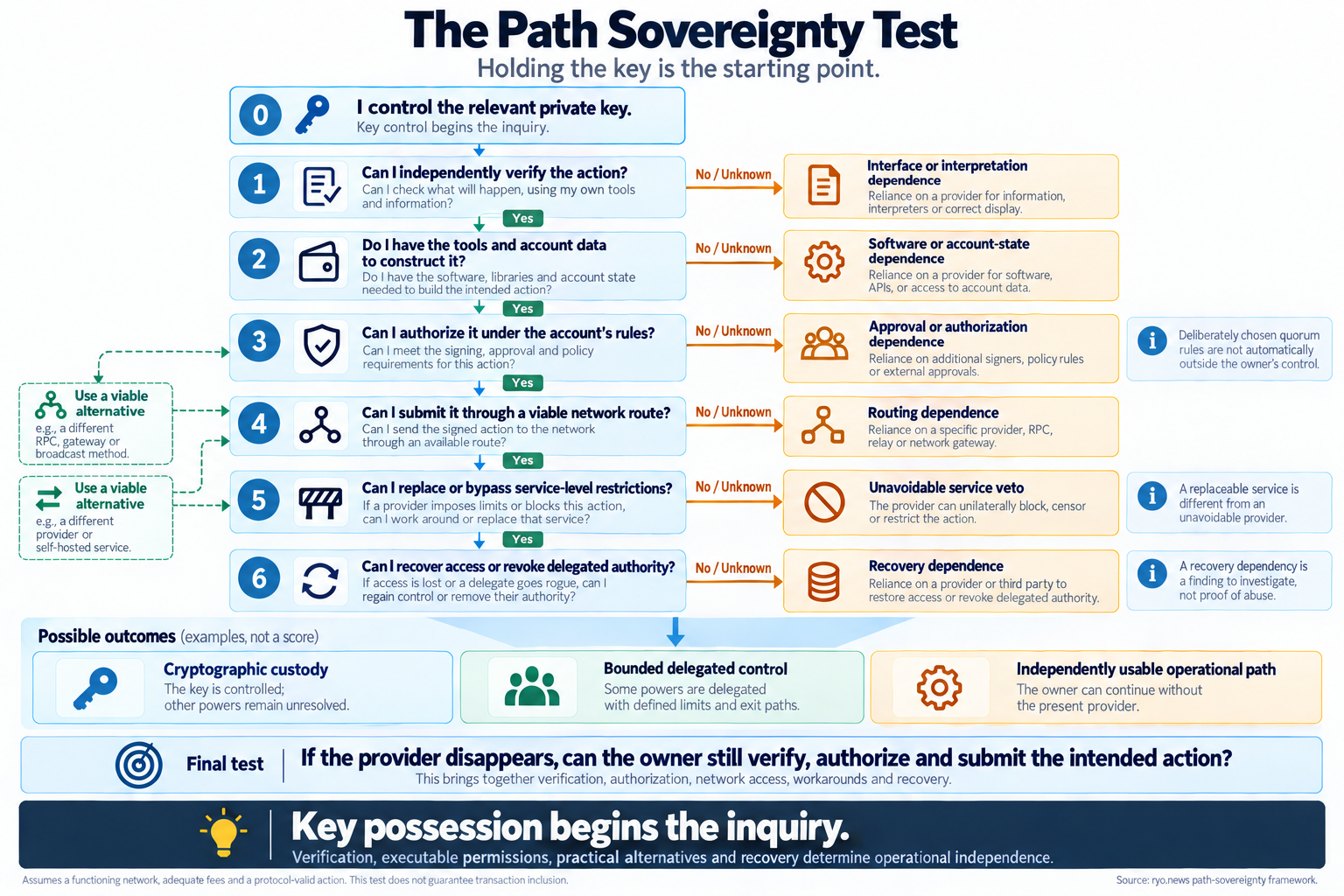
If the present provider disappears while the network remains functional, can the rightful owner still verify, authorize and submit the intended action through a viable route?
If the answer is no, identify whose cooperation is still necessary and what power that dependency confers. That actor or component belongs on the control map.
XIV. The Key Is the Beginning
Cryptocurrency made authorization independently verifiable. It gave people a way to hold and transfer digital value without requiring a conventional institution to keep the authoritative ownership ledger.
The systems built around that achievement now contain much more machinery.
A protected signer can receive a fabricated request. A staking operator can exercise consequential powers without controlling the withdrawal destination. A module can create another authorized execution path. An intent can depend on a cross-chain boundary whose correctness the user cannot infer from a wallet signature.
These differences should change how power is described.
Follow the action backwards. Who created it? Who approved it? Who could change its conditions? Who could withhold execution? Who could recover the account? Which of those powers can the owner revoke, replace or bypass?
Key ownership remains foundational. Operational sovereignty depends on what remains possible around it.
The key is where cryptographic ownership begins.
The path is where sovereignty is tested.
Source and scope note: Prepared using information available on October 1, 2026. Incident findings are attributed to the organization or investigator making them. Mandiant’s status report separates Bitget’s background account from preliminary forensic findings. The NEAR Intents section uses the team’s preliminary statement as reproduced in contemporaneous reporting; a full technical post-mortem remains pending. Architectural examples and the path-sovereignty framework are analysis, rather than findings that every illustrated component was involved in an incident. Roadmap capabilities are identified as planned.
References
- Bitget. Bitget Security Incident (September 2026): Hack Timeline, Impact, and Latest Official Updates. Official incident account, reviewed October 1, 2026. Withdrawal-command and key-compromise claims are attributed to Bitget.
- Mandiant / Google Cloud Security. Bitget Incident Response Status Report. September 28, 2026; published through Bitget’s September 30 report update. Preliminary findings describe security-appliance compromise and wallet job-server takeover. The background section records Bitget’s assessment concerning private keys.
- MetaMask. User Update. September 30, 2026, with October 1 update. Covers the infrastructure incident and precautionary validator exits; reports no indication of affected wallets or customer funds as of the later update.
- NEAR Intents. Preliminary incident statement. October 1, 2026. The original announcement is linked here. The team’s statement is reproduced in contemporaneous Unchained reporting. The article relies on the team’s preliminary account, not an independently established exploit mechanism.
- Ethereum.org. Keys in Proof-of-Stake Ethereum. Documents validator signing duties, voluntary exits, withdrawal credentials and slashing exposure. For the current owner-side exit route, see references 6 and 7.
- Ethereum.org. Staking Withdrawals. Explains established withdrawal destinations, validator-key exits, execution-layer exits and withdrawal processing.
- Ethereum Improvement Proposals. EIP-7002: Execution Layer Triggerable Withdrawals. Specifies withdrawal-credential-initiated exits and the custody dependency the mechanism addresses.
- NEAR. NEAR Intents. Official overview of solver competition and abstraction of cross-chain execution.
- Safe. Safe Modules. Documents additional execution logic, automation, allowances and the risks of malicious modules.
- Safe. Safe Guards. Documents transaction checks, blocking authority and denial-of-service risk from a broken guard.
- Ethereum Improvement Proposals. EIP-7702: Set Code for EOAs. Delegated execution, restricted permissions and implementation security considerations.
- Ethereum Improvement Proposals. ERC-4337: Account Abstraction Using Alt Mempool. UserOperations, account validation, bundlers, EntryPoint processing and optional paymasters.
- Fireblocks. Governance and Policy Control for Digital Asset Operations. Vendor documentation of intended policy, approval-workflow and administrator-control capabilities; used as an architectural example.
- National Institute of Standards and Technology. SP 800-207: Zero Trust Architecture. August 2020. Distinguishes authentication from authorization and rejects implicit trust based on network location.
- NEAR Intents. SHIELD: Proactive Intents Security. Distinguishes live quote-time controls, scoped permissions, incremental rollout and broader policy-orchestration goals.
- Ryo Currency. Official Project Overview. Current privacy and mining description, Atom wallet information and planned Halo 2 migration; reviewed October 1, 2026.