


Monetary Sovereignty & Digital Money · Geopolitics · Privacy Technology
The Permission Layer: Debanking and the Power to Exclude
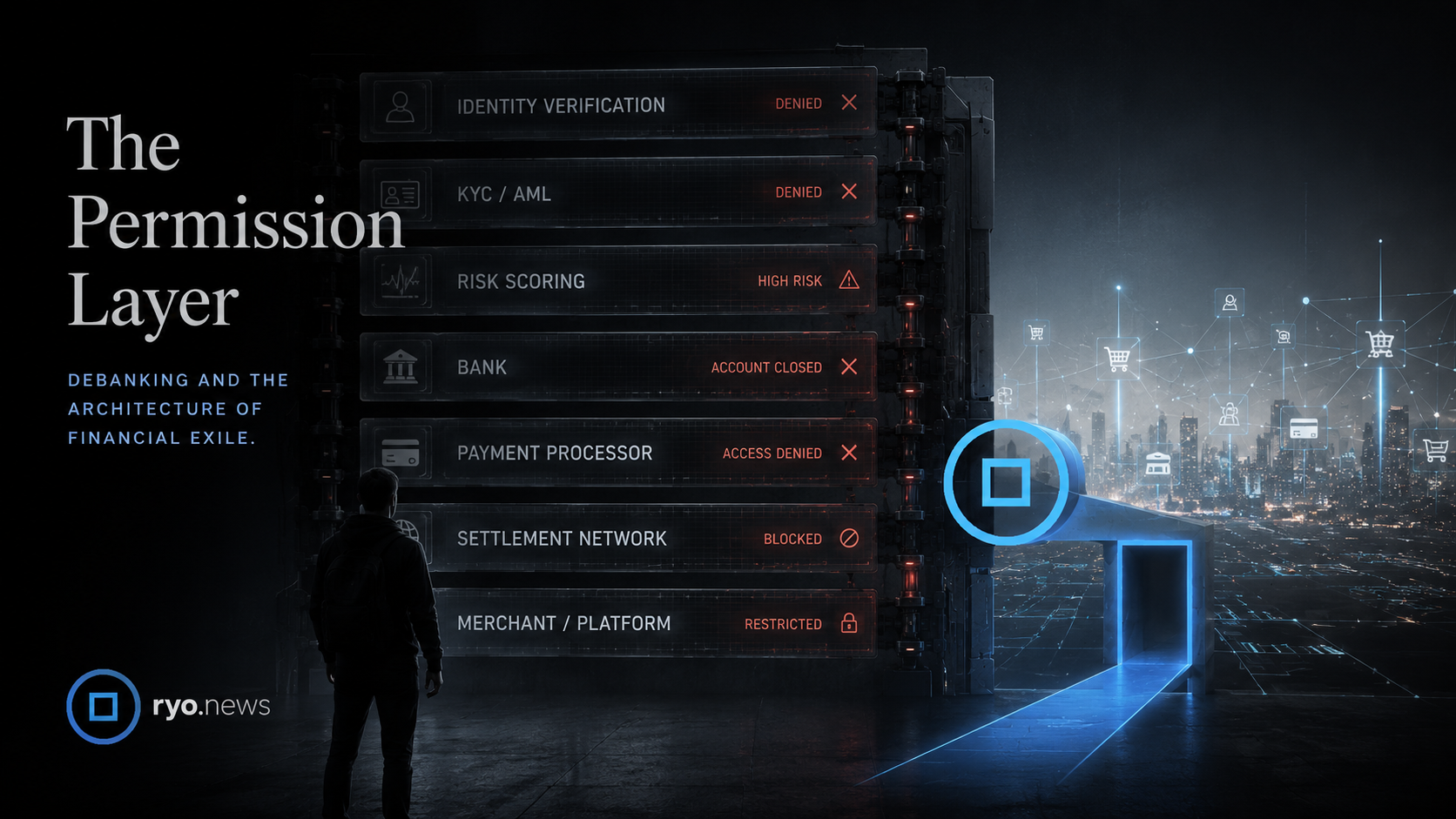
When access to money can be revoked, ownership and economic freedom are no longer the same thing. Debanking exposes a deeper question about modern finance: who ultimately has the power to decide whether you may participate?
By k1ngVV · September 14th, 2026
Executive Summary
Debanking is usually discussed as a dispute between a customer and a bank. That framing is too narrow.
Modern money sits inside a permission layer: identity systems, KYC and AML controls, risk models, banks, payment processors, card networks, sanctions authorities and commercial platforms. Each layer may have defensible reasons to exist. Together, however, they determine whether a person can convert legal ownership of money into practical economic participation.
Not every account closure is political censorship. The UK Financial Conduct Authority found no evidence in the cases it reviewed that customers were being denied or terminated primarily because of lawfully expressed political views.[2] At the same time, regulators themselves increasingly recognise de-risking and financial exclusion as systemic problems. The European Banking Authority ranked de-risking among the three most important issues affecting EU consumers in its 2024/25 Consumer Trends Report.[3]
A useful way to analyse any monetary system is what this article calls The Sovereignty Test: Permission — who must continue saying yes? Observation — who can see enough to classify you? Exit — if someone says no, can you continue without depending on another gatekeeper with the same failure mode?
The last question matters because apparent competition can conceal Correlated Gatekeeping. Ten banks are not ten independent exits if one upstream sanctions designation, identity failure, regulatory instruction or settlement restriction can close all ten routes.
Cryptocurrency does not automatically solve this problem. A stablecoin can be self-custodied while remaining subject to issuer controls. Bitcoin can remove the bank manager while exposing a permanent public transaction graph. Privacy-focused systems such as Ryo attempt to reduce both permission and observation at the protocol layer, while remaining dependent on liquidity, exchanges, merchants and the wider economic ecosystem.
Monetary sovereignty increases as required permission falls, unnecessary observation decreases, and credible exit improves.
Key Takeaways
- Debanking is a stack problem, not only a bank problem. Identity providers, compliance systems, processors, settlement networks and platforms can all become access gates.
- Not every closure is political. FCA evidence does not support treating lawful political expression as the general explanation for UK account closures, while European regulators still identify de-risking and financial exclusion as serious systemic problems.[2][3]
- More providers do not necessarily mean more exits. If multiple institutions share the same upstream rule, data source, sanctions designation or settlement network, their failure modes can be correlated.
- Due process and permissionlessness solve different problems. Better rules constrain gatekeepers; permissionless systems reduce the number of relationships that require continuing approval.
- Crypto remains inside the permission problem at its edges. Stablecoin issuers can freeze assets, Bitcoin exposes a public transaction graph, and exchanges or fiat gateways can still deny access.[29][30]
- The Sovereignty Test asks three questions: who can deny permission, who can observe enough to classify you, and whether a genuinely independent route of exit remains.
- Ryo reduces some protocol-level dependencies but does not eliminate ecosystem dependencies. Exchange access, liquidity, merchants and fiat infrastructure still matter, while Halo 2 remains a future development direction rather than a current mainnet capability.[32]
Conceptual continuity: This analysis extends the framework developed in Everything Is a Chokepoint, The Human Chokepoint, The Capital Control Problem, Private From Washington, Visible to Beijing, and The End of the Ring. Those articles examined concentrated dependency, financial exclusion, state control, surveillance and transaction privacy. This article examines the mechanism connecting them: the permission layer between possession and economic participation.
For most users, the permission layer is almost invisible because it normally works.
A bank opens the account. A processor clears the payment. A card network routes the transaction. A platform accepts the customer.
Debanking becomes revealing precisely when one of those relationships ends.
I. The Message That Removes You From the Economy
The message is usually administrative.
Your account will be closed.
Your relationship no longer fits the institution’s risk appetite.
Your payment processor can no longer support your business.
Your funds have been restricted pending review.
Nothing in those sentences sounds like exile. Yet increasingly, losing access to financial infrastructure means losing the practical ability to receive salary, pay rent, purchase online, subscribe to services, operate a company, accept card payments or move money across borders.
This is where the distinction between owning money and having permission to use financial infrastructure becomes important.
A commercial-bank deposit is not a pile of banknotes stored in a box with your name on it. In the modern monetary system, a deposit is a liability of the commercial bank and an asset — a claim — of the depositor. Banknotes, by contrast, are central-bank money available directly to the public.[1]
That creates a subtle but important difference.
Physical cash makes its possessor a holder.
A bank deposit makes its user both the holder of a claim and the customer of an institution.
The customer relationship is useful. It provides remote payments, fraud controls, credit, transfers, recordkeeping and integration with the wider economy.
It also creates a permission relationship.
If the relationship ends, the money may still legally belong to you. But your ability to participate can change dramatically.
This is why banking access is no longer merely another commercial service.
It is infrastructure.
Featured in the Ryo Directory
Businesses accepting RYO
II. Debanking Is Not One Thing
The word debanking collapses several different phenomena into one emotionally charged label.
They should be separated.
Ordinary risk termination. A bank may close an account because of fraud indicators, unpaid debts, abusive behaviour, inactivity or ordinary commercial considerations.
AML/KYC de-risking. A customer may be rejected because verifying identity, source of funds, ownership structure or transaction activity is considered too costly or risky.
Regulator-induced exclusion. A financial institution may technically make the decision itself while responding to supervisory expectations or perceived regulatory pressure.
Political or ideological debanking. Financial access may be alleged to have been restricted because of lawful beliefs, associations or speech.
Payment-layer deplatforming. A bank account can remain open while a processor, card network, crowdfunding provider or merchant platform disables the user’s ability to transact.
Sanctions enforcement. A financial institution may have no meaningful discretion at all because the law requires it to freeze assets or stop providing financial services.
The distinctions matter because the evidence differs.
In Britain, the FCA examined concerns that customers were being removed for political beliefs or lawfully expressed views. Its follow-up work did not find evidence that such views were generally the reason accounts were being closed. Instead, common issues included financial-crime concerns, reputational risk, identification problems and difficulties satisfying due-diligence requirements.[2]
That finding should not be ignored simply because it complicates the political narrative.
But neither should it end the inquiry.
The European Banking Authority reached a broader conclusion in 2025: de-risking had become one of the three most significant consumer problems in the European Union, particularly affecting migrants, refugees, homeless people, cross-border workers and people with poor financial histories.[3]
The deeper problem is therefore larger than proving that one political faction has been targeted.
It is that access to money increasingly depends on remaining acceptable to a stack of institutions.
III. The Permission Stack
Consider how a person reaches the digital economy:
Identity → KYC/AML → Risk Model → Bank → Payment Processor → Settlement Network → Merchant/Platform → Economic Participation
Each layer solves a real problem.
Identity makes contracts enforceable.
KYC and AML rules attempt to prevent criminal finance.
Risk models protect institutions from fraud and loss.
Banks protect deposits and connect users to payment rails.
Processors make commerce scalable.
Settlement networks allow institutions to trust one another.
Platforms connect buyers and sellers.
But each layer can also say no.
Correlated Gatekeeping
The number of providers is not the same thing as the number of independent exits.
You may have five banks available.
But what happens if all five use the same identity infrastructure?
Or comply with the same sanctions designation?
Or depend on the same card networks?
Or purchase risk intelligence from overlapping data providers?
Or respond to the same regulator?
Ten institutions are not ten independent exits if the same upstream decision can close all ten routes.
This is Correlated Gatekeeping.
A resilient system should therefore be judged not merely by how many alternatives it appears to offer, but by whether those alternatives actually fail independently.
The relevant question is not merely how many alternatives exist. It is how independent those alternatives actually are.
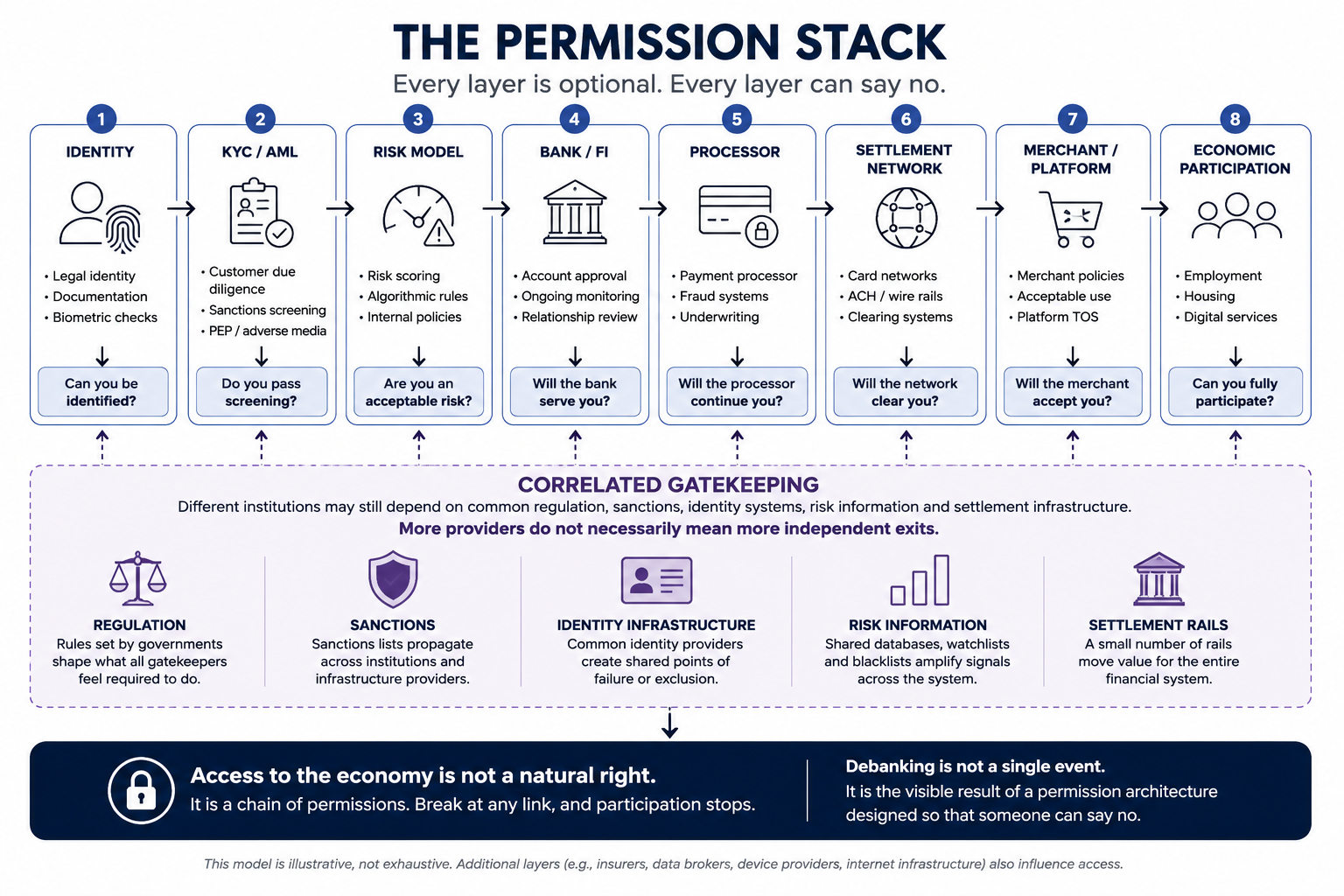
The stack feels frictionless because almost every layer normally says yes.
Debanking makes the permission system visible when one of them says no.
IV. The Secret File
One of the most difficult features of modern financial compliance is that enormous amounts of suspicion are processed through systems the subject may never see.
In the United States, approximately 4.8 million Suspicious Activity Reports were filed with FinCEN during fiscal year 2025.[4]
In the United Kingdom, the UK Financial Intelligence Unit received 866,616 SARs during the April 2024 to March 2025 reporting period.[5]
Those figures do not mean 4.8 million Americans or 866,616 Britons were debanked. A SAR is a report of suspicious activity, not a conviction, and one person or transaction can generate multiple reports.
But the scale matters.
So does secrecy.
In the United States, financial institutions are generally prohibited from disclosing to the person involved that a SAR has been filed.[6]
The rationale is understandable. Informing a money launderer that law enforcement has been alerted could compromise an investigation.
But the system creates a due-process tension when suspicion affects an ordinary person’s access to financial services.
How do you contest a suspicion that the system may be prohibited from telling you exists?
V. When Risk Becomes a Category
The Financial Action Task Force has spent decades building the international standards behind anti-money-laundering and counter-terrorist-financing controls.
In February 2025, FATF made a revealing change.
Its standards were amended to place greater emphasis on proportionality, including replacing the term “commensurate” with “proportionate” and explicitly encouraging simplified measures in lower-risk circumstances.[7]
The context was financial inclusion.
FATF noted that approximately 1.4 billion people worldwide remained without a bank account.[7]
Its subsequent 2025 financial-inclusion guidance went further. The risk-based approach should consider not only money-laundering and terrorist-financing risks, but also the harms created by financial exclusion and the potential benefits of bringing people into regulated finance.[8]
This is an important institutional admission.
Risk management itself can create risk.
If banks decide that entire categories of people are too difficult, expensive or uncertain to serve, legitimate customers can be excluded together with dangerous ones.
The EBA identified exactly this problem among migrants, refugees, asylum seekers, homeless people, cross-border workers and people with poor financial histories.[3]
For the affected person, the taxonomy is irrelevant.
The bank may call it risk appetite.
The regulator may call it de-risking.
The compliance department may call it enhanced due diligence.
The customer experiences the same result:
No account.
A system intended to protect regulated finance can, if applied without proportionality, push legitimate people and activity away from it.
VI. The Political Question
Debanking becomes politically explosive when people believe financial infrastructure is being used to punish lawful beliefs.
This is also where analysis is most likely to become partisan.
The evidence demands discipline.
The FCA’s review did not find evidence that political beliefs or lawfully expressed views were generally driving the account closures it examined.[2]
That finding matters.
But the structural question exists independently of whether a particular political-debanking allegation is eventually substantiated.
Canada: When Political Conflict Reached the Banking Layer
Canada provided a much clearer example in 2022.
The Freedom Convoy protests began in opposition to federal COVID-19 vaccine requirements affecting cross-border truckers and developed into a wider protest against pandemic restrictions and government policy. During the blockades and occupation of central Ottawa, the federal government invoked the Emergencies Act for the first time.
The Emergency Economic Measures Order directed banks and other financial-service providers to cease providing certain financial services to people or businesses participating in the prohibited blockades. Financial institutions could freeze or suspend affected accounts without first obtaining a court order.[9]
The subsequent Public Order Emergency Commission estimated that approximately 290 financial accounts were frozen, affecting fewer than 290 people or entities because some individuals had multiple accounts.[10]
The episode is important regardless of one’s view of the protesters, vaccine mandates or the government’s response.
A political conflict had reached directly into access to money.
The legal story did not end there.
In January 2026, the Federal Court of Appeal upheld the Federal Court’s conclusion that the government’s invocation of the Emergencies Act was unreasonable and ultra vires — beyond its legal authority — and that aspects of the emergency measures infringed Charter protections for freedom of expression and against unreasonable search and seizure.[11]
The federal government subsequently applied to the Supreme Court of Canada for leave to appeal.[12]
The lesson is not that every protest must be financially untouchable.
It is that a state capable of connecting political participation to financial infrastructure possesses an extraordinarily powerful instrument.
Would you still accept the power if it were exercised by people who opposed everything you believed?
That is the political test that matters.
Not whether today’s administrator agrees with you.
Whether the power would remain acceptable when tomorrow’s administrator does not.
Rights that depend on the ideology of the administrator are not durable rights.
VII. When the State Becomes the Gatekeeper
The most complete form of correlated gatekeeping appears when the decision does not originate with the bank at all.
It originates upstream.
Sanctions demonstrate the mechanism clearly.
Once a competent authority designates a person under an asset-freeze regime, banks and other regulated institutions may become legally obligated to stop dealing with that person’s funds and economic resources.
Twenty banks do not represent twenty independent exits when all twenty are subject to the same designation.
Gurpreet Singh Rehal: Designation Before Conviction
In December 2025, HM Treasury designated British national Gurpreet Singh Rehal under the UK’s domestic counter-terrorism sanctions regime. The Treasury alleged that Rehal was involved with Babbar Khalsa and Babbar Akali Lehar and accused him of activities including recruitment, providing financial services and supporting the procurement of weapons and other military material. An asset freeze and director-disqualification sanction were imposed.[13]
The allegations are serious.
But an important legal distinction should not disappear inside the seriousness of the allegations.
The designation was not a criminal conviction, and it did not require a prior finding of guilt by a court.
Under the relevant UK sanctions framework, the standard procedure permits designation where HM Treasury has reasonable grounds to suspect that the person is an involved person and considers designation appropriate in light of the purposes of the regime and its likely significant effects.[14]
That is a different legal threshold from proving a criminal offence beyond reasonable doubt.
It would therefore be wrong for ryo.news to present Treasury’s allegations as if a criminal court had established them as fact.
It would be equally wrong to imply that the designation is beyond review. A designated person can seek variation or revocation and, following the statutory review process, can challenge the relevant government decision in court.[15]
The architectural point lies somewhere else.
Once the designation occurs, financial exclusion is no longer simply a bank assessing whether it wants Rehal as a customer.
The restriction propagates through institutions that are required to implement the sanctions framework.
The bank may appear to be the gatekeeper, while the decision that closes the gate was made somewhere else.
Russia, Iran and the Sanctions Network
The same mechanism extends far beyond counter-terrorism.
Under the UK’s Russia sanctions regime, designated persons can be subjected to asset freezes and prohibitions on making funds or economic resources available to them. Those restrictions can also extend to entities they own or control.[16]
The UK’s Iran sanctions framework uses comparable mechanisms: targeted asset freezes, restrictions on making funds or economic resources available to designated persons, and corresponding obligations on firms that encounter sanctioned property or counterparties.[17]
The legal grounds are different.
The evidence behind individual designations is different.
The geopolitical circumstances are different.
The transmission mechanism is remarkably similar.
An upstream legal decision becomes a downstream financial restriction.
Roman Abramovich: When One Designation Reaches an Entire Institution
The reach of this system became unusually visible in the case of Roman Abramovich.
In March 2022, following Russia’s invasion of Ukraine, the United Kingdom designated Abramovich under its Russia sanctions regime. His UK assets were frozen, transactions with UK individuals and businesses were restricted, and travel and transport sanctions were imposed.[18]
Abramovich happened to own something much more visible than an investment account.
He owned Chelsea Football Club.
Because the government treated Chelsea as an entity owned or controlled by a designated person, the club itself became subject to the asset-freeze restrictions. The government had to issue a special licence allowing Chelsea to continue paying staff, playing fixtures and carrying out specified football operations.[19]
The club was ultimately sold under a government-approved process designed to prevent Abramovich from benefiting from the transaction.
The approximately £2.5 billion in sale proceeds were placed into a frozen UK bank account. In December 2025, the government issued a licence intended to permit their transfer to a charitable foundation for humanitarian purposes in Ukraine and stated that it was prepared to pursue court action if the matter could not be resolved.[20]
Whether Abramovich’s designation was justified is a separate geopolitical and legal question.
The transmission mechanism is the important part.
A legal decision directed at one individual propagated into a football club, corporate entities, bank accounts, commercial transactions and ultimately billions of pounds in sale proceeds.
A financial sanction does not merely close an account. It can change the legal status of an entire network of assets and relationships.
None of this means sanctions are inherently illegitimate.
Some financial restrictions may be lawful, necessary and supported by compelling national-security, criminal or geopolitical evidence.
But that is a different question from the architectural one.
How much of a person’s economic existence should one upstream decision be capable of switching off?
This is Correlated Gatekeeping in its clearest form.
The issue is not whether there are twenty available banks.
The issue is whether all twenty receive the same command.
VIII. Regulators Have Started Moving
The remarkable thing about debanking is that regulators increasingly recognise the tension.
The EBA now describes de-risking as a major consumer issue and has warned that access to payment accounts is effectively a prerequisite for participating in the EU economy.[3]
The European Union already provides legally resident consumers with a right to access a payment account with basic features, subject to requirements including compliance with anti-money-laundering rules.[21]
The United Kingdom has moved toward stronger procedural protection as well.
For relevant new payment-service contracts entered into from 28 April 2026, providers generally must give at least 90 days’ notice before termination and provide sufficiently detailed and specific reasons for the customer to understand why the relationship is being ended, subject to defined exceptions including some AML situations.[22]
The United States
In August 2025, President Donald Trump issued Executive Order 14331, Guaranteeing Fair Banking for All Americans, directing federal banking regulators to remove reputation-risk concepts that could enable politicised or unlawful debanking from supervisory materials where legally permitted.[23]
In April 2026, the FDIC and Office of the Comptroller of the Currency jointly finalised a rule prohibiting those agencies from criticising or taking adverse supervisory action against institutions on the basis of reputation risk, including pressuring institutions to close accounts because of political, social, cultural or religious views, protected speech or lawful but politically disfavoured business activities.[24]
An important limitation deserves emphasis: the rule constrains the regulators. It does not itself impose equivalent obligations on the banks they supervise.[24]
In June 2026, the Federal Reserve, FDIC and OCC jointly removed additional references to reputation risk from interagency supervisory documents.[25]
Beyond Banks
The permission layer extends beyond deposit-taking institutions.
In March 2026, the Chairman of the Federal Trade Commission sent warning letters to PayPal, Stripe, Visa and Mastercard raising concerns about reports of financial services being denied because of political or religious views and reminding the companies of their obligations under the FTC Act.[26]
A warning letter is not a judicial finding of wrongdoing.
But its targets reveal something important.
Financial participation increasingly depends on infrastructure companies that are not banks at all.
IX. Due Process Is Not Permissionlessness
There are two fundamentally different ways to respond to financial exclusion.
Response One: Constrain the Gatekeeper
The first response is procedural.
Require notice.
Require meaningful reasons.
Require appeal mechanisms.
Prohibit discrimination based on protected characteristics or lawful political views.
Require individualised rather than category-based risk assessment.
Develop limited-function accounts for people who present elevated risks but still need access to basic financial infrastructure.
FATF’s 2025 financial-inclusion guidance highlights examples such as Singapore’s Limited Purpose Banking Accounts, which allow individuals assessed as presenting higher financial-crime risks to receive salaries, pay bills and meet basic banking needs while remaining subject to enhanced controls.[8]
These reforms matter.
A society in which banking has become essential infrastructure should demand more from the institutions controlling it.
Response Two: Reduce Dependence on the Gatekeeper
The second response is architectural.
Instead of asking only how the gatekeeper should behave, ask whether every monetary function requires a gatekeeper at all.
Due process constrains discretionary exclusion. Permissionless design reduces the number of relationships through which exclusion can occur.
These are not competing ideas.
They solve different problems.
Better procedural protection matters when a bank account is necessary.
Permissionless monetary design matters when an alternative route can exist without a bank’s continuing consent.
The policy question may eventually become unavoidable:
If due-process protections are justified because payment access has become essential infrastructure, should comparable principles eventually follow financial power rather than institutional labels?
X. Cryptocurrency Was Not Outside the Problem
Cryptocurrency was supposed to route around financial permission.
At the protocol layer, it often can.
At the institutional layer, the story is more complicated.
That split is increasingly visible in real markets. As our September 9 analysis of Zcash financialization showed, an asset can gain regulated brokerage and options-market access in one jurisdiction while direct exchange access contracts in another. Protocol access and institutional access are separate layers.
In February 2025, the FDIC released 175 documents concerning its supervision of banks seeking to engage in crypto-related activities. The agency had previously released 25 so-called “pause” letters sent to 24 institutions. The larger document release showed repeated information requests, long delays and supervisory directions to pause, suspend or refrain from expanding crypto-related activity. The FDIC’s acting chairman said the overwhelming result was that most banks simply stopped trying.[27]
In March 2025, the FDIC reversed course. It rescinded the previous crypto-specific prior-notification requirement and clarified that supervised banks may engage in permissible crypto activities without receiving prior FDIC approval, provided they appropriately manage the risks.[28]
The episode demonstrates the distinction between a permissionless protocol and a permissioned ecosystem.
A protocol can be permissionless while access to it remains permissioned.
A bank can deny the fiat transfer.
An exchange can close the account.
A payment processor can reject the merchant.
An app store can remove an application.
A stablecoin issuer can blacklist an address.
A protocol can survive all of those actions while the user still struggles to reach it.
XI. The Sovereignty Test
This suggests a more useful way to compare forms of money.
1. Permission — Who Can Say No?
What continuing relationships must remain intact for the money to be held and transferred?
2. Observation — Who Can See Enough to Classify You?
Who can observe balances, counterparties, history, identity or transaction behaviour strongly enough to create a dossier?
3. Exit — If Someone Says No, Can You Route Around Them?
Does an alternative exist?
And more importantly, does it have an independent failure mode?
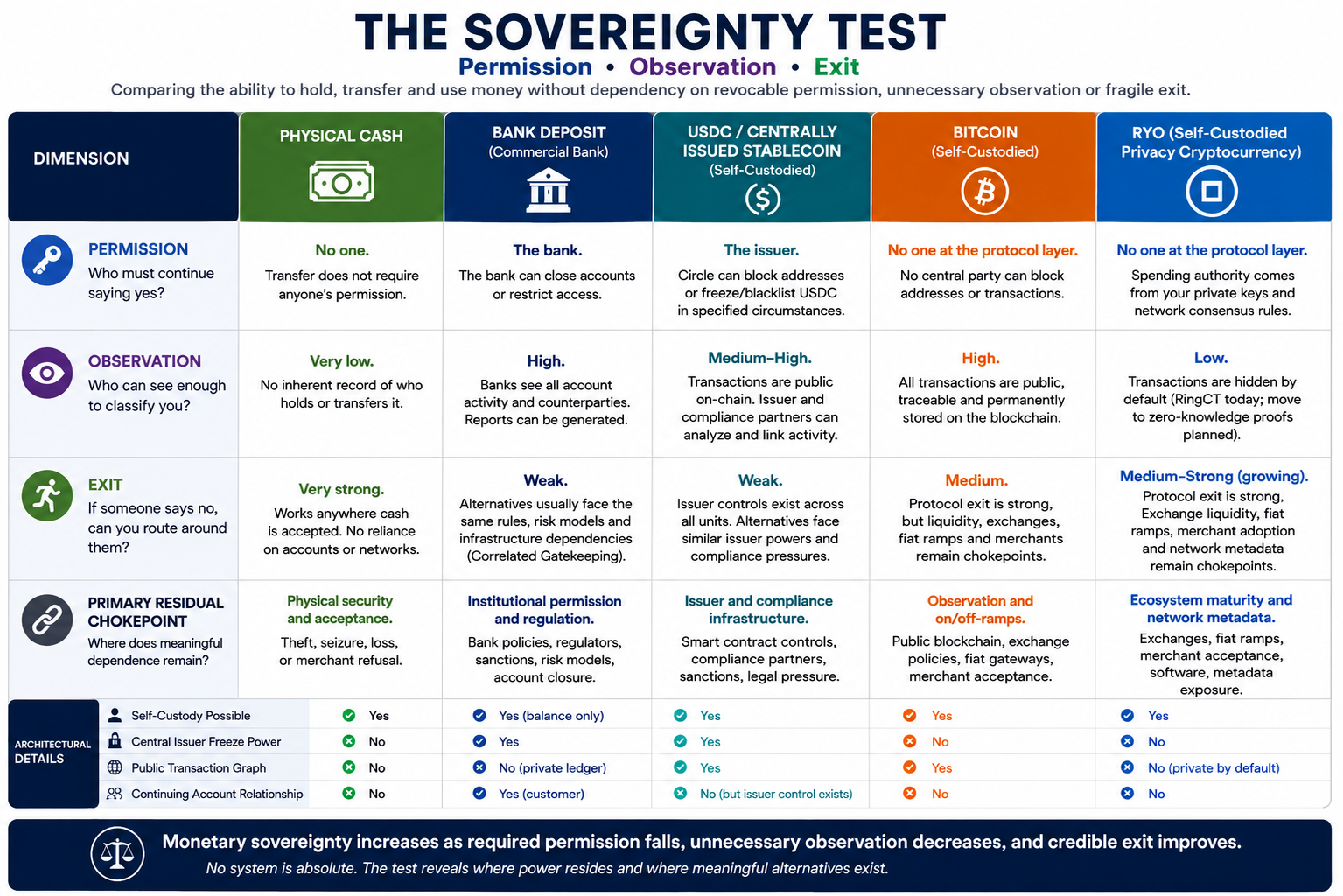
Physical cash performs unusually well on permission and observation in face-to-face exchange. It performs badly for remote digital commerce.
Bank deposits provide enormous convenience and economic integration but depend on the continuing account relationship.
USDC can be held in a self-custodied wallet, but Circle’s terms explicitly provide for address blocking and freezing mechanisms under defined circumstances, including legal orders.[29]
Bitcoin strongly reduces permission at the protocol layer and enables direct self-custody, but its ledger is publicly observable. Bitcoin.org itself describes confirmed Bitcoin transactions as public, traceable and permanently stored on the network.[30]
Ryo attempts to reduce both protocol permission and ledger observation. Its practical exit remains constrained by the maturity of its ecosystem, liquidity, merchant reach and access to fiat infrastructure.
Monetary sovereignty increases as required permission falls, unnecessary observation decreases, and credible exit improves.
XII. Ryo: Money Without an Account Manager
Ryo should not be presented as a magical replacement for banking.
It does not make regulation irrelevant.
It does not guarantee exchange access.
It does not guarantee merchant acceptance.
It does not guarantee fiat liquidity.
It does something narrower and architecturally important.
A self-custodied Ryo wallet is not a customer relationship with Ryo.
There is no Ryo account manager who must continue approving the existence of the wallet.
Ryo’s Atom wallet also illustrates the distinction between observation and spending authority. A view-only wallet can monitor relevant wallet activity but lacks the private spend key required to sign transactions.[31]
The comparison with a commercial-bank deposit is therefore useful.
The bank customer holds a claim and maintains an institutional relationship.
The self-custodied cryptocurrency user controls cryptographic keys and interacts with a protocol.
That does not eliminate the surrounding chokepoints.
An exchange can still refuse Ryo.
A merchant can still refuse Ryo.
A bank can still refuse the fiat leg.
A jurisdiction can regulate service providers.
Liquidity can be inadequate.
But the wallet itself does not disappear because an account manager changes their mind.
The continued consent of an account provider is not required for the wallet itself to exist or for the protocol to recognize valid spending authority.
Current Ryo and Future Ryo Are Not the Same Thing
This distinction must remain explicit.
Ryo currently uses RingCT with a default ring size of 25. The project’s published development direction states an intention to move beyond RingCT toward second-generation zero-knowledge proofs, including the planned Halo 2 architecture.[32]
Those planned features are not the same thing as capabilities already deployed on mainnet.
The future system should be judged by specifications, implementation quality, independent review, adversarial testing and production behaviour — not by roadmap language alone.
That transition is examined in more detail in The End of the Ring: Privacy Coins and the Architecture of Digital Sovereignty.
The objective is therefore not to claim that Ryo has eliminated every intermediary.
It is to reduce the number of external actors whose continuing permission is required to hold, move and privately use money.
XIII. The Financial Censorship Pipeline
Permission is only one half of the problem.
Before somebody can decide that you should be excluded, they often need enough information to classify you.
This produces another useful model:
Observation → Classification → Exclusion
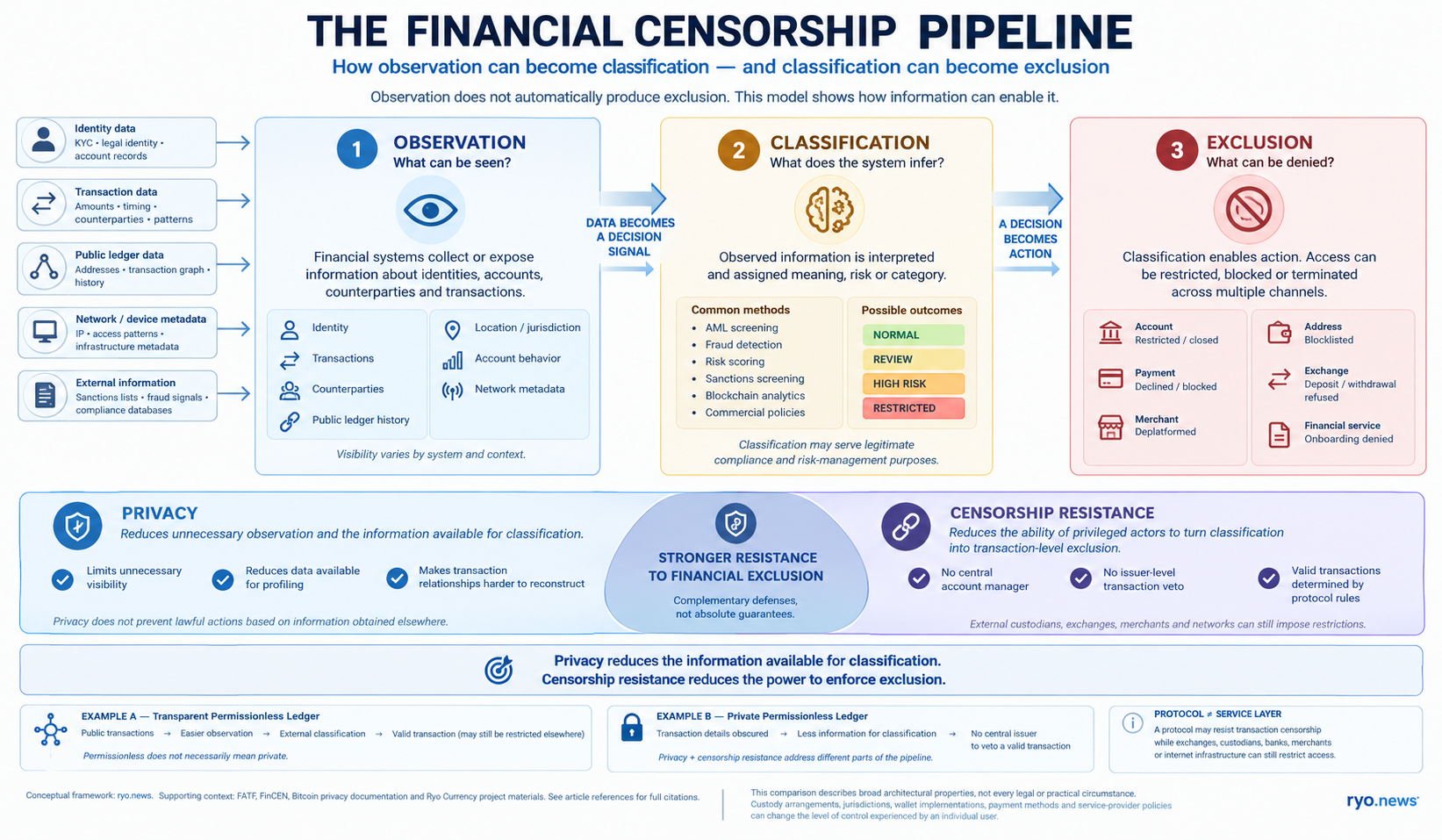
Observation does not automatically produce exclusion.
Most financial information is processed without anyone being censored.
Classification can also be necessary for fraud prevention, credit decisions, sanctions compliance and criminal investigation.
But information creates capability.
A sufficiently complete financial history can reveal counterparties, businesses, political organisations, donors, suppliers, geographical movement and economic relationships.
Bitcoin removes the account manager at the protocol layer but preserves a permanent public graph.[30]
Publicness does not recreate the bank manager. It can recreate the dossier.
This is why privacy and censorship resistance should not be treated as synonyms.
They operate at different points in the pipeline.
Censorship resistance protects the ability to transact after someone wants to exclude you.
Privacy reduces the information from which the decision to exclude you can be constructed.
A mature privacy system should also permit disclosure where the holder chooses it.
The goal is not to make proof impossible.
It is to make unnecessary universal observation unnecessary.
XIV. The Right to Transact
In The Human Chokepoint, we examined the individual as the final endpoint of geopolitical and monetary fragmentation.
The Permission Layer is the institutional version of that problem.
No individual control in this article is inherently absurd.
Identity checks can prevent fraud.
AML rules can detect criminal finance.
Sanctions can impose costs on governments, organisations and individuals whom democratic states judge to threaten their interests.
Risk models can protect depositors.
Payment processors can refuse illegal commerce.
The problem appears when individually defensible controls accumulate into a system in which possession is no longer sufficient for participation.
Four separate ideas then emerge:
The right to possess.
The ability to transact.
The ability to transact without creating an unnecessary permanent record.
The ability to exit when an institution refuses you.
The last one is meaningful only when the exit does not reproduce the same failure mode.
Moving from Bank A to Bank B is useful.
It is not sovereign exit if both must obey the same upstream prohibition.
Physical cash historically supplied one form of exit.
You could hold it without an account.
You could transfer it without requesting authorisation from an intermediary.
You could transact without automatically publishing a permanent ledger entry.
But cash does not scale naturally into a remote global digital economy.
That is why private, permissionless cryptocurrency remains an important experiment.
Ryo’s relevance to the argument is not that it abolishes institutions.
It is that it attempts to recreate some properties of bearer money inside a digital environment:
possession without admission,
payment without an account manager,
privacy without requiring the observer’s consent,
and exit that begins at the protocol rather than the institution.
The regulatory response to debanking attempts to make gatekeepers more accountable.
Permissionless monetary design asks whether every function requires a gatekeeper in the first place.
Better law can constrain institutional power.
Better monetary design can reduce how often that power is required.
Freedom in digital money does not require the absence of rules.
It requires asking whether one revocable relationship should stand between possession and payment.
Can digital money exist for which permission to possess and transact is no longer someone else’s to give?
Further Reading from ryo.news
The Capital Control Problem: Stablecoins, Crypto and the End of the Old Monetary Perimeter
How money acquires alternative routes when control is concentrated at banks, foreign-exchange gateways and other institutional interfaces.
A Privacy Coin Just Got an Options Market. What Exactly Has Been Financialized?
How direct monetary access and regulated financial exposure can move in opposite directions across jurisdictions.
Everything Is a Chokepoint: Hormuz, Helium, Gold and the Architecture of Monetary Escape
The broader framework for understanding concentrated dependencies across energy, logistics, finance, information and money.
The Human Chokepoint: Balaji Srinivasan, Financial Exclusion, and the Refugees of the Digital Bloc Era
The human consequences of conditional financial access and fragmented digital blocs.
Private From Washington, Visible to Beijing: China, Privacy Coins and Financial Sovereignty
Why state monetary sovereignty, individual privacy and institutional visibility are different objectives.
The End of the Ring: Privacy Coins and the Architecture of Digital Sovereignty
Why private money must be evaluated across more than a single transaction-privacy mechanism.
References
- Bank for International Settlements.
Central Bank Digital Currencies — Executive Summary.
BIS discussion distinguishing public central-bank money from private commercial-bank deposits and explaining the balance-sheet character of commercial-bank money. - Financial Conduct Authority.
UK Payment Accounts Access and Closures: Update.
September 4, 2024. Follow-up findings on payment-account access and closures, political-expression concerns, financial exclusion and firms’ use of reputational-risk classifications. - European Banking Authority.
Consumer Trends Report 2024/25.
March 26, 2025. The EBA identified payment fraud, indebtedness and de-risking as major issues affecting EU consumers. - Financial Crimes Enforcement Network.
FinCEN Year in Review.
FY2025 BSA reporting statistics, including approximately 4.8 million Suspicious Activity Reports. - UK Financial Intelligence Unit, National Crime Agency.
SARs Annual Report 2025.
The UKFIU received 866,616 SARs during the April 2024–March 2025 reporting period. - Financial Crimes Enforcement Network.
Guidance on Suspicious Activity Report Confidentiality.
FinCEN guidance concerning the confidentiality of Suspicious Activity Reports and restrictions on notifying their subjects. - Financial Action Task Force.
FATF Updates Standards and Consults on Guidance to Better Promote Financial Inclusion.
February 25, 2025. FATF amended Recommendation 1 and related provisions to strengthen proportionality and simplified measures under the risk-based approach. - Financial Action Task Force.
Guidance on Financial Inclusion and Anti-Money Laundering and Terrorist Financing Measures.
2025. Updated guidance on proportionality, financial exclusion and access to regulated financial services. - Department of Finance Canada.
Canada Invokes the Emergencies Act to Limit Funding of Illegal Blockades and Restore Public Order.
February 15, 2022. Description of the Emergency Economic Measures Order and financial-account restrictions. - Public Order Emergency Commission.
Report of the Public Inquiry into the 2022 Public Order Emergency, Volume 3: Analysis (Part 2) and Recommendations.
2023. The Commission reports that approximately 290 financial accounts were frozen, affecting fewer than 290 people or entities. - Federal Court of Appeal.
Attorney General of Canada et al. v. Canadian Civil Liberties Association et al., 2026 FCA 6.
January 16, 2026. The Court confirmed that the invocation of the Emergencies Act was unreasonable and ultra vires and found Charter infringements. - Supreme Court of Canada.
Docket 42261 — Attorney General of Canada, et al. v. Canadian Civil Liberties Association, et al.
Supreme Court case information concerning the application for leave to appeal. - HM Treasury.
UK Sanctions Imposed on a Person and Organisation Involved in Terrorism in Landmark Action.
December 4, 2025. Official announcement of sanctions against Gurpreet Singh Rehal and Babbar Akali Lehar. - UK Government.
The Counter-Terrorism (Sanctions) (EU Exit) Regulations 2019.
SI 2019/577. Statutory framework governing designation criteria, asset freezes and related counter-terrorism sanctions. - UK Parliament / UK Government.
Sanctions and Anti-Money Laundering Act 2018 — Explanatory Notes on Reviews and Court Challenges.
The framework provides administrative mechanisms for requesting variation or revocation and subsequent court review of relevant sanctions decisions. - UK Government.
Russia Sanctions: Statutory Guidance.
Current guidance concerning asset freezes, prohibitions on making funds or economic resources available, and entities owned or controlled by designated persons. - UK Government.
Iran Sanctions: Statutory Guidance.
Current guidance concerning targeted asset freezes and restrictions on funds and economic resources. - Foreign, Commonwealth & Development Office.
Abramovich and Deripaska Among 7 Oligarchs Targeted in Estimated £15 Billion Sanction Hit.
March 10, 2022. - Department for Digital, Culture, Media & Sport.
Chelsea FC Granted Licence to Continue Operating.
March 10, 2022. Government licence permitting specified football-related activities following Abramovich’s designation. - HM Treasury.
Government Gives Abramovich Final Chance to Pay £2.5 Billion to Ukraine or Risk Court Action.
December 17, 2025. Update concerning the frozen proceeds from the sale of Chelsea Football Club. - European Parliament and Council.
Directive 2014/92/EU on Payment Accounts.
The Directive establishes a framework for access to payment accounts with basic features while preserving applicable AML/CFT requirements. - UK Government.
The Payment Services and Payment Accounts (Contract Termination) (Amendment) Regulations 2025.
Relevant provisions apply from April 28, 2026 and include termination-notice and explanation requirements subject to statutory exceptions. - Executive Office of the President of the United States.
Executive Order 14331 — Guaranteeing Fair Banking for All Americans.
August 7, 2025. - Federal Deposit Insurance Corporation and Office of the Comptroller of the Currency.
Agencies Issue Final Rule to Prohibit Use of Reputation Risk by Regulators.
April 7, 2026. The rule restricts specified uses of reputation risk by the agencies and explicitly states that it does not impose requirements or obligations on supervised institutions. - Board of Governors of the Federal Reserve System, FDIC and OCC.
Agencies Remove Additional References to Reputation Risk.
June 2, 2026. - Federal Trade Commission.
Warning Letters to PayPal, Stripe, Visa and Mastercard Regarding Debanking.
March 26, 2026. - Federal Deposit Insurance Corporation.
FDIC Releases Documents Related to Supervision of Crypto-Related Activities.
February 5, 2025. The FDIC released 175 supervisory documents following its earlier disclosure of 25 “pause” letters sent to 24 institutions. - Federal Deposit Insurance Corporation.
FDIC Clarifies Process for Banks to Engage in Crypto-Related Activities.
March 28, 2025. FIL-7-2025 rescinded the previous prior-notification requirement. - Circle Internet Financial.
USDC Terms.
Current terms addressing restricted persons, blocked addresses and circumstances in which USDC may be restricted or frozen. - Bitcoin.org.
Protect Your Privacy.
Documentation explaining that Bitcoin transactions are public, traceable and permanently stored on the network. - Ryo Currency.
Ryo Wallet Atom Documentation.
Official documentation covering view-only wallets, private spend keys and transaction-signing authority. - Ryo Currency.
Official Ryo Currency Project Site.
Current project information concerning Ryo’s privacy architecture and planned development direction. Current RingCT behaviour can also be inspected through the
Ryo Blockchain Explorer mainnet transaction data, including ring-size-25 inputs.
This article is for research and informational purposes only. It does not constitute investment, legal, financial or sanctions advice.