


Privacy Coin Landscape · Markets & Economics · Monetary Sovereignty & Digital Money
A Privacy Coin Just Got an Options Market. What Exactly Has Been Financialized?
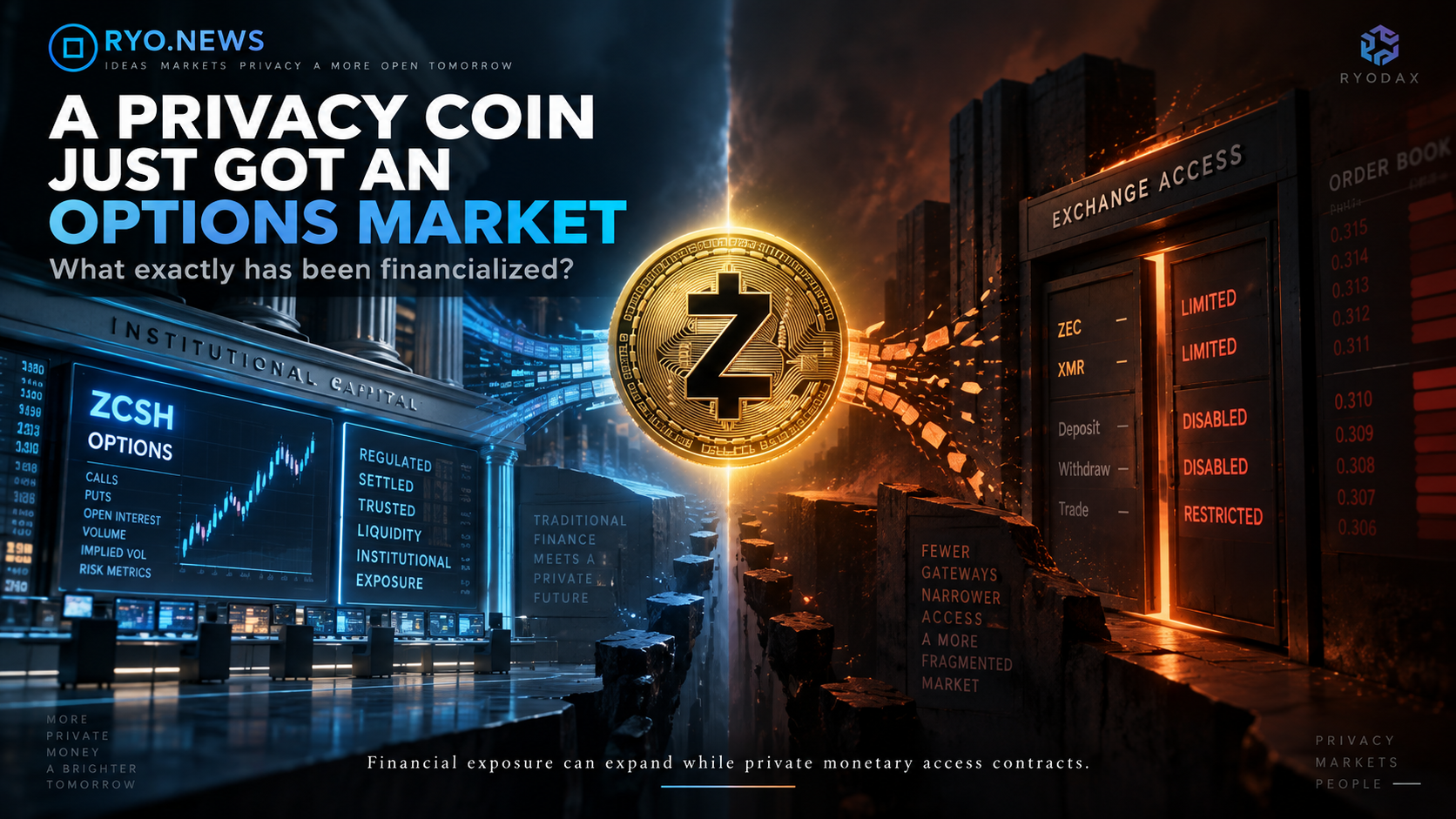
Zcash now has a U.S.-listed exchange-traded product, institutional basket mechanics and an options market. At almost the same moment, Kraken is removing direct ZEC and XMR access for customers in the UAE. Privacy is not moving cleanly toward either acceptance or prohibition. Its distribution is fragmenting.
By Privacy Coin Report · September 9th, 2026
Executive Summary
On September 8, The Zcash ETF announced that ZCSH had passed $500 million in assets under management, two weeks after beginning trading on NYSE Arca. The same day, listed options on ZCSH began trading, adding derivatives and professional hedging infrastructure around one of cryptocurrency’s best-known privacy-oriented assets.[1]
The milestone also included an approximately $100 million transaction involving DCG International Investments Ltd. The mechanics matter: DCG did not spend $100 million buying new ZEC on the spot market. It contributed 85,705.32563297 ZEC it already held through an Authorized Participant and received economically equivalent ZCSH shares. Grayscale separately reported more than $70 million of cumulative ETP inflows since launch.[1]
What has expanded most dramatically is therefore the financial infrastructure around ZEC. A brokerage customer can obtain price exposure and now trade options without running a Zcash wallet, holding private keys or sending a shielded transaction.
At almost exactly the same time, Kraken is completing the opposite process for UAE-resident clients. Trading and deposits for ZEC, XMR and DASH stopped in June. Withdrawals stop on September 14 at 14:00 UTC, with remaining balances scheduled for liquidation between September 15 and September 25.[3]
Kraken includes several stablecoins in the same process and does not state that privacy is the sole reason for the removals. The significance is the access pattern: the same asset can become easier to own through one regulated channel while becoming harder to acquire and withdraw through another.
Privacy-coin distribution is fragmenting by jurisdiction, intermediary and function.
Key Takeaways
- ZCSH began NYSE Arca trading on August 25 and exceeded $500 million in AUM by September 8.[1]
- Options on ZCSH began trading September 8, adding conventional derivatives infrastructure around ZEC exposure.[1]
- DCG’s approximately $100 million transaction was an in-kind contribution of existing ZEC, not $100 million of new spot-market buying.
- The ZCSH structure gives investors economic exposure to ZEC without requiring them to use Zcash as private money.
- Kraken UAE already stopped ZEC, XMR and DASH trading and deposits; withdrawals stop September 14.[3]
- The UAE notice also covers several stablecoins, so it should not be represented as a privacy-coin-only action.
- The emerging divide is less “privacy accepted versus privacy banned” than different access architectures for different users and jurisdictions.
- For privacy projects, self-custody and diversified liquidity infrastructure increasingly look like continuity requirements rather than optional ecosystem features.
Conceptual continuity: This analysis extends the chokepoint framework developed in Everything Is a Chokepoint, the layered privacy model examined in The End of the Ring and ProxyMark and Monero over Tor, and the distinction between state sovereignty and neutral money developed in Private From Washington, Visible to Beijing. The question here moves one layer outward: even when the monetary protocol protects privacy, who controls access to it?
I. What Wall Street Actually Added
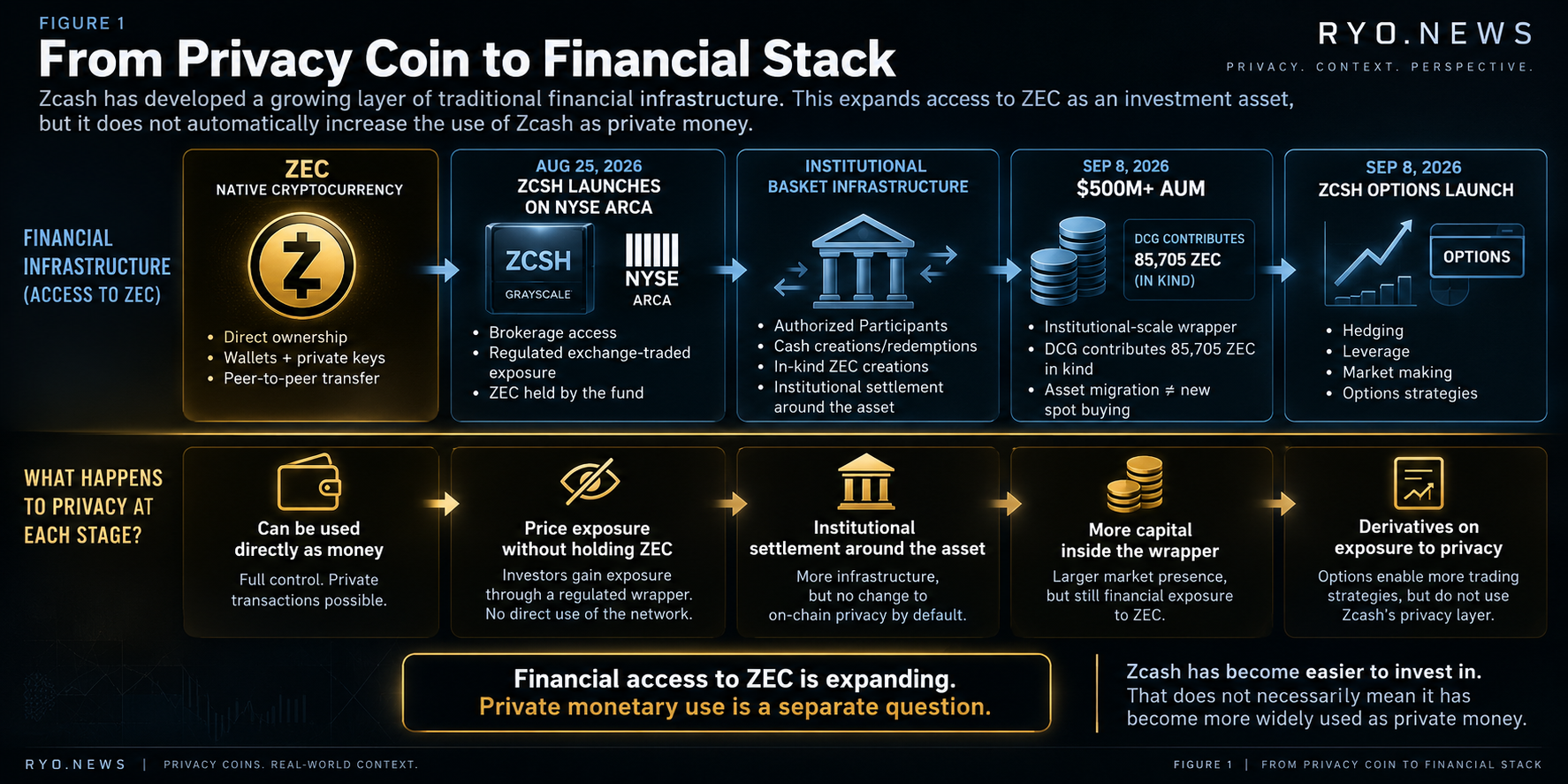
Zcash was designed as a monetary network. ZCSH adds a second structure around it: a conventional securities-market interface.
The fund trades on NYSE Arca and is designed to reflect the value of ZEC held by the trust, less expenses and liabilities. Its SEC registration describes basket-based issuance and redemption through Authorized Participants. Creations can occur through either cash orders or in-kind contributions of ZEC. As of the prospectus date, redemptions are cash-only and in-kind redemptions are not permitted.[2]
Despite its public name, The Zcash ETF, its own disclosure states that it is an exchange-traded product that is not an investment company registered under the Investment Company Act of 1940 and therefore does not receive the same statutory protections as a conventional 1940 Act-registered ETF or mutual fund.[1]
Options add another layer. Investors can hedge ZCSH, express leveraged directional views, write options or make markets using familiar exchange infrastructure.
That changes the financial utility of ZEC exposure.
It does not add a new privacy guarantee.
The financial system has learned how to trade, custody, hedge and package exposure to Zcash without needing to adopt Zcash’s shielded transaction model.
The progression is easiest to see as a stack. Each step adds a conventional market function around the underlying asset while leaving actual use of Zcash’s privacy layer as a separate activity.
Featured in the Ryo Directory
Businesses accepting RYO
II. The $100 Million Headline Needs a Footnote
The September 8 DCG transaction illustrates why market mechanics matter.
DCG International Investments Ltd., an affiliate of the fund sponsor’s corporate group, acquired approximately $100 million of ZCSH shares through an Authorized Participant. The consideration was 85,705.32563297 ZEC that DCG already owned.[1]
Existing ZEC moved into the exchange-traded structure. That increases the amount of ZEC represented inside regulated market infrastructure and enlarges the fund.
It does not establish that $100 million of fresh buying hit the ZEC spot market.
Grayscale’s separately reported cumulative ETP inflows are more relevant when asking whether genuinely incremental investment capital is arriving.[1]
The distinction between asset migration and new capital formation is therefore essential to reading the ZCSH story correctly.
III. Two Zcash Economies
ZEC and ZCSH now provide two materially different ways to participate in the same underlying economic exposure.
| Private-money layer | Financial-market layer |
|---|---|
| ZEC held directly | ZCSH shares and listed options |
| Wallets and private keys | Brokerage and custodial infrastructure |
| Transparent or shielded blockchain transactions | Securities and derivatives transactions |
| On-chain settlement | Exchange and securities-market settlement |
| Viewing keys and selective disclosure | Conventional financial reporting and compliance |
| Peer-to-peer monetary use | Price exposure, hedging and market-making |
The two layers can reinforce each other. Greater market depth can improve price discovery and visibility. The fund also states that, for up to 12 months after registration became effective, the sponsor intends to use 100% of ZCSH management fees to support Zcash ecosystem development and ZCSH marketing; the commitment is voluntary and may be changed or discontinued.[4]
But financial-market growth should not be used as a proxy for shielded monetary activity. Those are different measurements of adoption.
IV. Meanwhile, Kraken UAE Is Moving the Other Way
For Kraken clients residing in the United Arab Emirates, access is contracting.
Kraken’s scheduled process covers Monero (XMR), Dash (DASH), Zcash (ZEC), USDD, Dai (DAI), USDS and USDE (Ethena USD).[3]
Margin positions were closed June 15. Deposits and trading stopped June 16. Withdrawals stop September 14 at 14:00 UTC. Kraken says balances remaining afterward will be liquidated between September 15 and September 25.
The stablecoins on the list matter analytically. Kraken describes the action as part of its regular asset-review process and does not identify privacy as the sole cause.
Still, for a UAE user of ZEC or XMR, the practical sequence is straightforward:
trading → deposits → withdrawals → liquidation.
For a U.S. securities-market participant, ZEC exposure has moved in the opposite direction:
NYSE Arca access → basket mechanics → broader brokerage distribution → options.
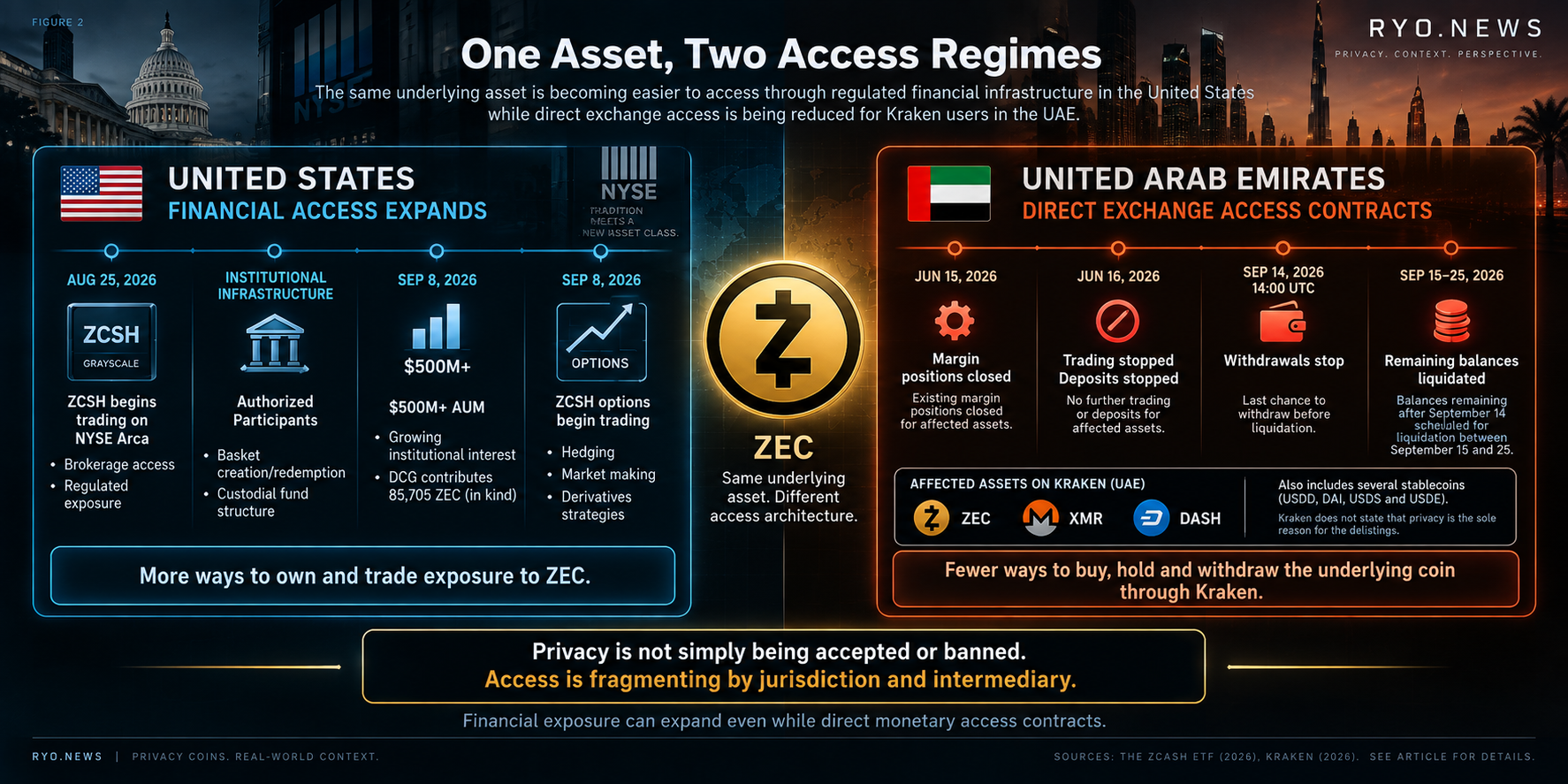
The point is not that the United States has become “pro-privacy” while the UAE has become “anti-privacy.”
The point is that the same underlying asset is being given different interfaces in different markets.
V. There Is No Single Privacy-Coin Market
Privacy regulation is often described as though jurisdictions are converging on one binary judgment: permitted or prohibited.
The emerging structure is more fragmented.
The United States can support a regulated ZEC-linked security without requiring its investors to use shielded Zcash. Kraken can reduce direct ZEC and XMR access for one jurisdiction while operating different markets elsewhere. Russia can avoid an explicit privacy-coin prohibition while building compliance around identity, custody and “digital analysis.” China can pursue geopolitical monetary independence while maintaining extensive domestic control over private cryptocurrency activity, as examined in Private From Washington, Visible to Beijing.
These regimes are not answering exactly the same question.
The useful question is increasingly not “Are privacy coins legal?” but “Through which interface, in which jurisdiction, under whose custody, and for what purpose can they be used?”
VI. What This Means for Users
The fragmentation matters differently depending on what the participant is actually trying to do.
| User | What changes | What does not |
|---|---|---|
| Institutional investor | ZCSH adds familiar brokerage access, professional market infrastructure and listed options without requiring direct custody of ZEC. | Holding the security does not provide ZEC private keys or make the investor a user of Zcash’s shielded monetary layer. |
| Retail trader | Where supported, ZCSH can make ZEC price exposure accessible through a conventional securities account. | A ZCSH share cannot be withdrawn to a Zcash wallet and does not replace direct coin access where a user wants to transact on-chain. |
| Privacy-coin user | Exchange policy and jurisdiction increasingly determine which centralized entry and exit routes remain available. | Protocol privacy alone cannot guarantee access. Self-custody, multiple liquidity routes and direct-use infrastructure remain separate requirements. |
This is why investors, traders and monetary users can look at the same Zcash development and rationally reach different conclusions. ZCSH solves a financial-access problem. Kraken’s UAE process exposes a direct-access problem. Neither tells us by itself how much private money is actually being used.
VII. Distribution Is Part of the Privacy Architecture
Cryptocurrency projects have traditionally treated privacy as protocol engineering and distribution as business development.
That separation becomes less convincing when access itself can be removed.
A currency that cannot be acquired is difficult to use. A currency that cannot be withdrawn cannot be self-custodied through that venue. A currency available only through a financial wrapper can remain investable while becoming irrelevant as bearer money to the wrapper’s holder.
This extends the chokepoint framework developed in Everything Is a Chokepoint. A blockchain can be decentralized while practical access still depends on centralized exchanges, custodians, banking rails, market makers, app stores and regional licensing decisions.
The relevant resilience question is therefore not whether a system can eliminate every intermediary.
It is whether losing one intermediary is survivable.
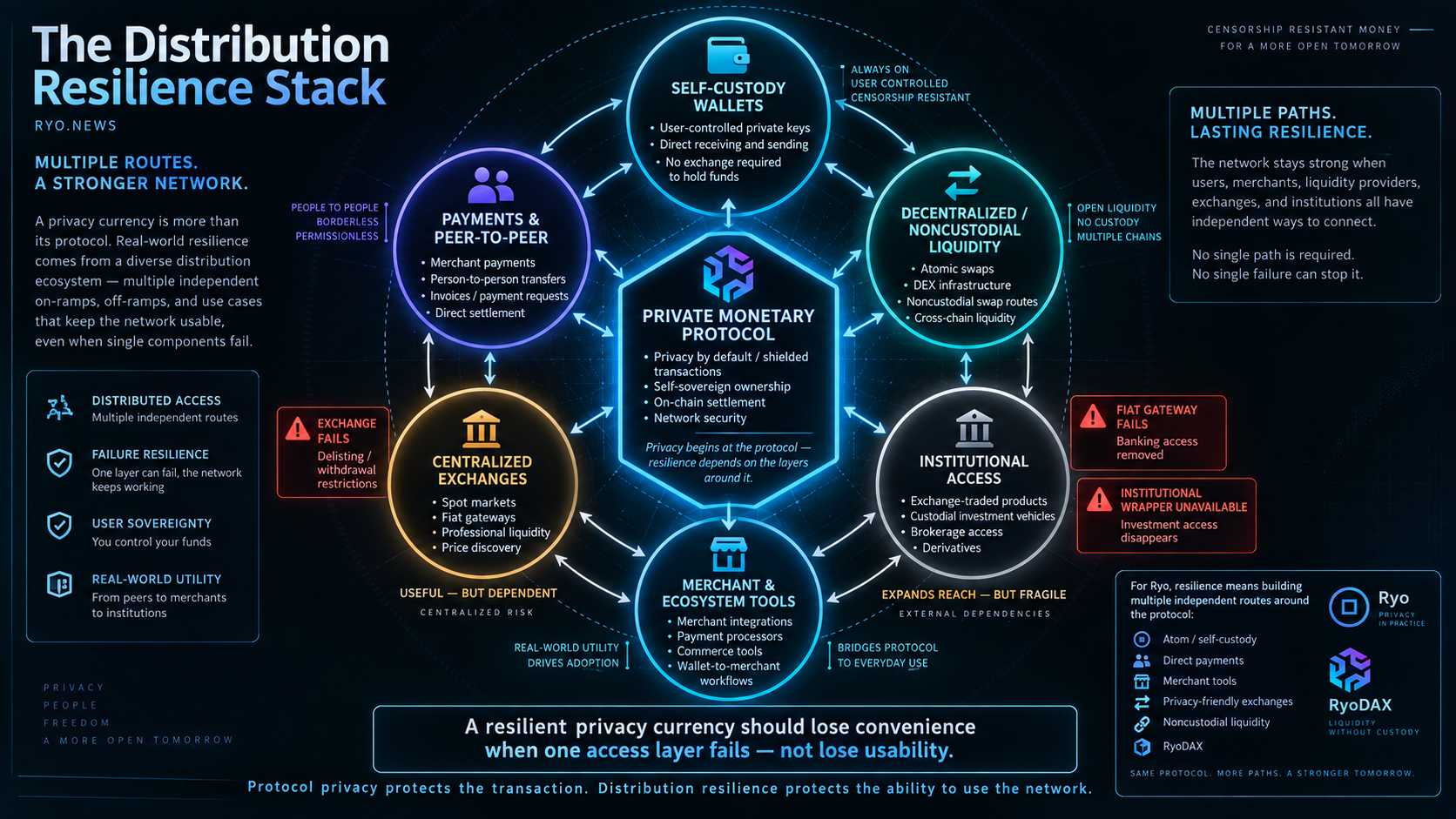
A robust monetary network can have several independent routes into and out of the system: self-custody wallets, centralized exchanges, decentralized or noncustodial liquidity, merchant payments, peer-to-peer settlement and other gateways.
The architecture is easier to understand as a set of redundant access paths around the protocol rather than one dominant pipe.
VIII. What This Means for Ryo Currency
Ryo Currency sits at almost the opposite end of the distribution spectrum from Zcash.
Zcash now has dramatically deeper institutional market access. Ryo remains a much smaller network with relatively thin liquidity and a narrower set of trading venues. That limitation should be stated plainly.
Ryo’s differentiation lies elsewhere. Its current architecture uses privacy by default, while its published roadmap extends toward Halo 2 zero-knowledge proofs, a high-latency mixnet and a future proof-of-stake era. Those roadmap components remain future engineering objectives rather than current mainnet capabilities.[5]
The ZCSH/Kraken split shows why the surrounding distribution layer deserves equal strategic attention.
For Ryo, resilience means maintaining several independent routes: centralized exchanges where available, privacy-oriented trading venues, official self-custody wallets, merchant acceptance, peer-to-peer settlement, swap infrastructure, decentralized or noncustodial liquidity, and the planned RyoDAX layer.[5]
If a privacy currency needs permission from one exchange to remain economically usable, that exchange has become part of its trust model.
Ryo does not need to reproduce Zcash’s institutional strategy to learn from it. Zcash demonstrates what deep financial distribution can accomplish. Kraken’s UAE process demonstrates why monetary distribution cannot safely depend on a single channel.
IX. What Exactly Has Been Financialized?
The answer is now clearer.
ZCSH has financialized access to ZEC’s economic value.
It has placed ZEC exposure inside brokerage accounts, Authorized Participant infrastructure and a listed options market. That can increase liquidity, visibility, hedging capacity and capital formation around the asset.
It does not, by itself, tell us whether more people are using shielded Zcash for payments, holding ZEC in self-custody or relying on it as private money.
Those require different metrics: wallet use, shielded activity, direct ownership, merchant payments, peer-to-peer settlement, private liquidity and resilience when intermediaries disappear.
The privacy-coin sector may therefore be entering a period in which projects become strong on different axes.
Some will be easy to invest in.
Some will be difficult to exclude from direct use.
The strongest monetary systems will eventually need both.
A privacy coin inside an options market is no longer outside the financial system. The harder question is whether private money can enter that system without becoming merely another asset traded inside it.
Further Reading from ryo.news
Everything Is a Chokepoint: Hormuz, Helium, Gold and the Architecture of Monetary Escape
How control migrates toward the narrow points through which energy, finance, information and money must pass.
The End of the Ring: Privacy Coins and the Architecture of Digital Sovereignty
Why the next generation of privacy systems must protect more than one transaction field.
ProxyMark and Monero over Tor: How Privacy Can Fail Between Layers
Why ledger privacy, wallet behaviour, P2P forwarding and transport anonymity have to be evaluated together.
Russia Didn’t Ban Privacy Coins. It Built a Gate Around Them
Why legal permission and practical intermediary access are not the same thing.
Private From Washington, Visible to Beijing: China, Privacy Coins and Financial Sovereignty
The difference between sovereign financial privacy, state visibility and genuinely neutral money.
Ryo Currency: Privacy Coin, Wallets & Roadmap
Current Ryo architecture, wallets, market access and clearly separated roadmap layers.
References
- The Zcash ETF, “The Zcash ETF (Ticker: ZCSH) Grows AUM to More Than $500 Million Following NYSE Arca Debut,” September 8, 2026. Primary announcement for the $500 million-plus AUM milestone, September 8 options launch, DCG’s 85,705.32563297-ZEC in-kind contribution and reported cumulative ETP inflows.
- U.S. Securities and Exchange Commission, Grayscale Zcash Trust (ZEC), Amendment No. 5 to Form S-3, August 21, 2026. Describes the trust structure, NYSE Arca listing plan, Authorized Participant baskets, cash creations and redemptions, in-kind creations, the current absence of in-kind redemptions and the trust’s status outside the Investment Company Act of 1940.
- Kraken Support, “Notice of asset delistings in the UAE,” updated June 1, 2026. Covers XMR, DASH, ZEC and several stablecoins; margin closure June 15, trading/deposit halt June 16, withdrawal cutoff September 14 and liquidation scheduled September 15–25.
- The Zcash ETF, official product page. Product structure and the sponsor’s voluntary commitment, for up to 12 months after effectiveness of the registration statement, to use ZCSH management fees to support Zcash ecosystem development and ZCSH marketing.
- ryo.news, “Ryo Currency | Privacy Coin, Wallets & Roadmap.” Current Ryo architecture and wallets, current market-access context, and separately identified roadmap objectives including Halo 2, the high-latency mixnet, Proof of Stake and RyoDAX.
- Privacy Coin Report, “The End of the Ring: Privacy Coins and the Architecture of Digital Sovereignty,” ryo.news, August 2026.
- k1ngVV, “Everything Is a Chokepoint: Hormuz, Helium, Gold and the Architecture of Monetary Escape,” ryo.news, August 23, 2026.
- k1ngVV, “Russia Didn’t Ban Privacy Coins. It Built a Gate Around Them,” ryo.news, September 1, 2026.
- k1ngVV, “Private From Washington, Visible to Beijing: China, Privacy Coins and Financial Sovereignty,” ryo.news, July 22, 2026.
- Dr. Max Anon, “ProxyMark and Monero over Tor: How Privacy Can Fail Between Layers,” ryo.news, August 6, 2026.
This article is for research and informational purposes only. It does not constitute investment, legal or financial advice.