



Geopolitics · Privacy Technology · Monetary Sovereignty
Russia Didn’t Ban Privacy Coins. It Built a Gate Around Them.
Inside Russia’s new cryptocurrency law, the disappearance of the anonymous-coin ban, the rise of “digital analysis,” and what view keys and selective disclosure could mean for Ryo Currency.
By k1ngVV · September 1st, 2026
Executive Summary
Russia’s new cryptocurrency law began taking effect on September 1, 2026. For privacy coins, the most important development is not an explicit prohibition, but a new regulatory architecture built around investor classification, custody, identity, recordkeeping and a statutory process called “digital analysis.”[1]
The change from proposal to law is striking. In December 2025, the Bank of Russia proposed allowing qualified investors to acquire any cryptocurrency except anonymous cryptocurrencies. By July 2026, after the legislation had passed the State Duma, the Bank said qualified investors would have access to “any cryptocurrencies” without an amount limit. It also said exporters and importers could use all types of wallets and cryptocurrencies for cross-border settlements.[3][4]
That does not mean Russia has embraced privacy coins. Article 35 requires regulated actors to analyze cryptocurrencies, address identifiers and transactions for risk and possible connections to prohibited activity. A privacy-preserving network may therefore remain legally permissible while becoming operationally difficult for a regulated intermediary to support.[1]
Russian law also does not require a CryptoNote-style view key. Ryo nevertheless provides an important case study because its existing architecture supports view-only wallets, transaction proofs, spend proofs and reserve proofs—forms of selective verification that can demonstrate particular facts without making an entire financial history public.[11][12]
The unanswered question is larger than Russia or Ryo: must financial compliance depend on universal transaction visibility, or can cryptography prove what the law legitimately needs to know while keeping everything else private?
Featured in the Ryo Directory
Businesses accepting RYO
Key Takeaways
- Russia’s final framework contains no blanket statutory prohibition on privacy coins.
- The Bank of Russia’s earlier proposal had explicitly excluded anonymous cryptocurrencies.
- Self-custodied addresses remain legally recognized.
- Article 35 “digital analysis” may become the real compliance barrier for private chains.
- Russian law does not presently mandate a Ryo or CryptoNote private view key.
- The long-term regulatory question is whether selective proofs can substitute for permanent public-chain surveillance.
Conceptual continuity: This analysis extends the sovereignty and chokepoint framework developed in Everything Is a Chokepoint, the privacy architecture examined in The End of the Ring and ProxyMark and Monero over Tor, and the distinction between state sovereignty and monetary neutrality developed in Private From Washington, Visible to Beijing.
Russia’s new cryptocurrency law begins with a paradox. Cryptocurrency remains generally prohibited as an ordinary domestic means of payment, yet Russia is simultaneously constructing a legal market around crypto investment, custody and international settlement.
For privacy coins, however, the most revealing part of the story is something that disappeared before the law took effect.
Nine months earlier, the Bank of Russia had proposed allowing qualified investors to buy almost any cryptocurrency.
Almost.
Anonymous cryptocurrencies were supposed to be excluded.[3]
Then Parliament legislated.
By July, the Bank was telling the public that qualified investors could access “any cryptocurrencies”, while exporters and importers could use all types of wallets and cryptocurrencies for cross-border settlement.[4]
The explicit exclusion was gone.
Russia did not replace it with unrestricted freedom. It built something more subtle: privacy at the protocol layer can survive, while regulation concentrates at the points where private money meets institutions.
1. The Ban That Disappeared
The starting point is the Bank of Russia’s December 23, 2025 regulatory concept.[3]
Under the proposal, ordinary investors would have access to a narrow group of highly liquid cryptocurrencies after testing and within a yearly limit. Qualified investors would receive much broader access.
But the Bank placed one explicit boundary around that broader category: qualified investors could buy any cryptocurrencies except anonymous ones.
The regulator described those assets in technically awkward language as cryptocurrencies whose “smart contracts” concealed information about token transfers to recipients.
That description does not accurately capture how systems such as Ryo or Monero achieve privacy. Their transaction privacy is embedded much more deeply in the protocol than an ERC-20-style smart contract hiding a transfer.
But the policy intent was unmistakable: cryptocurrency designed to obscure transaction relationships was being treated as a separate category.
Federal Law No. 282-FZ was subsequently adopted by the State Duma on July 21, approved by the Federation Council on July 24 and signed on August 4, 2026. Its principal provisions began entering into force on September 1.[1]
The enacted statute contains no blanket category prohibiting “privacy coins” or “anonymous cryptocurrencies.”
More significantly, the Bank of Russia’s July 21 explanation says qualified investors will be able to access any cryptocurrencies without an amount limit.[4]
Its language on foreign trade is broader again: exporters and importers may use cryptocurrency directly or through intermediaries with all types of wallets and cryptocurrencies.
What the evidence supports
The Bank of Russia proposed an explicit anonymous-cryptocurrency exclusion in December 2025. That blanket exclusion does not appear in the enacted framework, and the Bank’s July 2026 explanation instead uses the phrase “any cryptocurrencies.” The available primary sources do not establish why the wording changed.
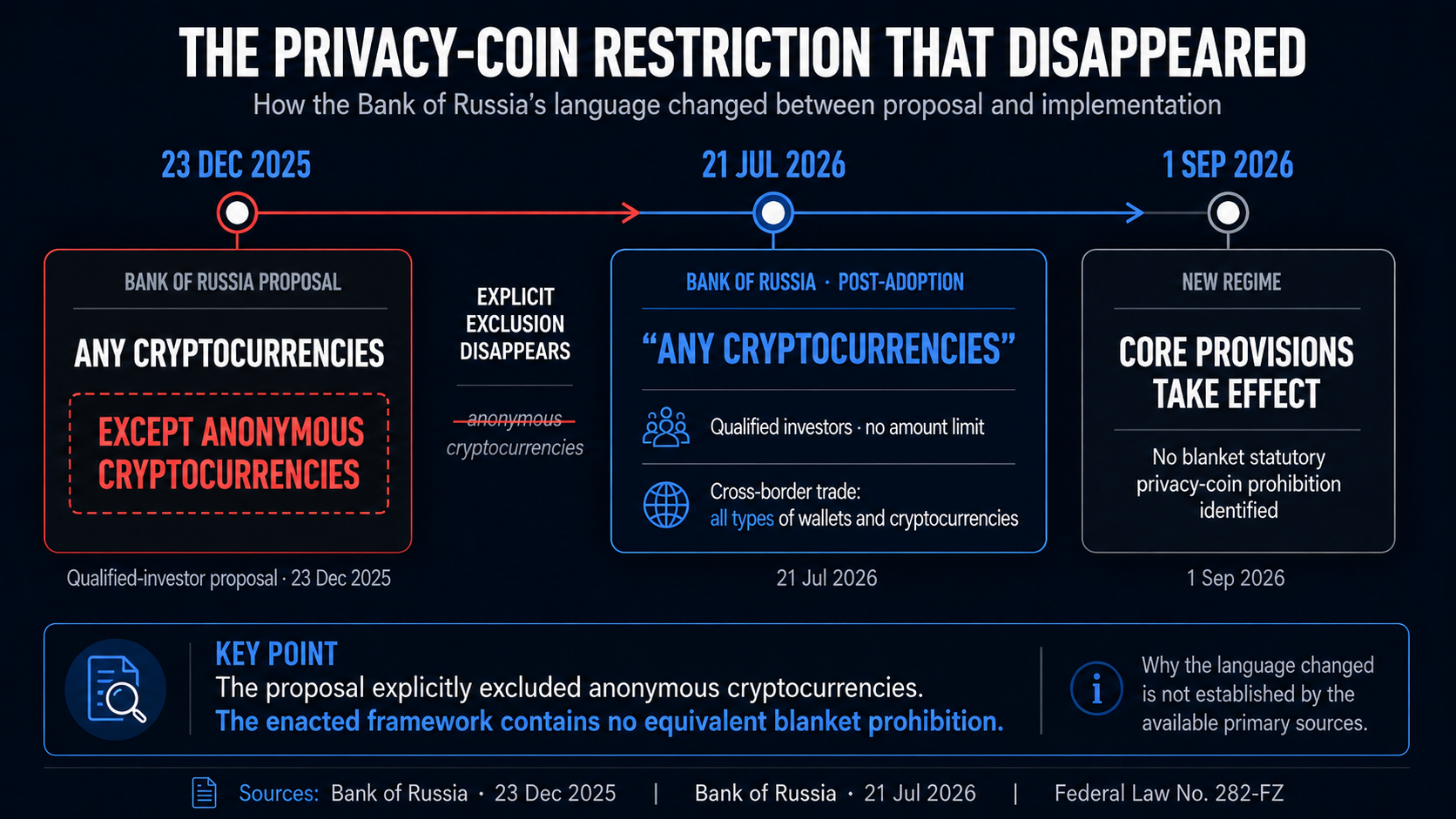
The Bank of Russia’s December 2025 proposal explicitly excluded anonymous cryptocurrencies; the enacted framework contains no equivalent blanket prohibition.
2. Russia Did Not Make Crypto Money. It Built Crypto Infrastructure.
The new framework makes more sense once one stops asking whether Russia “legalized crypto” and asks a more precise question:
Legalized for what?
Federal Law No. 282-FZ continues to prohibit cryptocurrency from functioning as an ordinary domestic means of payment for goods, services and other consideration, subject to statutory exceptions.[1]
At the same time, the legislation creates infrastructure through which cryptocurrency can be acquired, sold, managed, custodied, exchanged and used in specified contexts.
| Function | Regulatory treatment | Underlying logic |
|---|---|---|
| Ordinary domestic payment | Generally prohibited | The ruble remains the protected domestic monetary unit. |
| Investment and trading | Permitted through a regulated, tiered market | Access depends on investor status, testing, liquidity criteria and intermediaries. |
| Cross-border trade settlement | Much more broadly permitted | Crypto becomes useful where international settlement infrastructure matters strategically. |
The same cryptocurrency can therefore be restricted in one context while explicitly permitted in another.
This is not monetary liberalization.
It is legal segmentation.
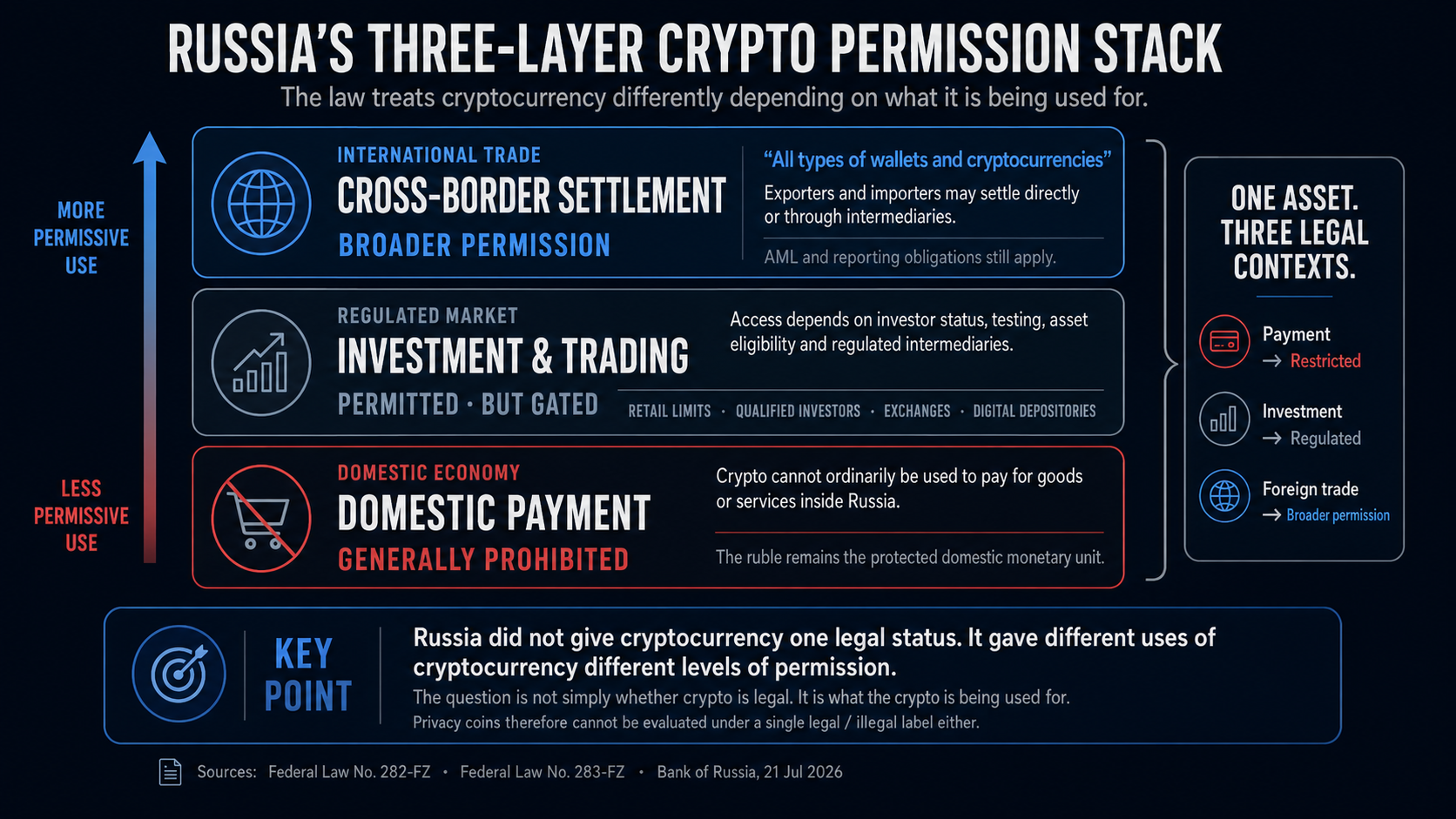
The legal treatment of cryptocurrency changes with its use: domestic payment is generally prohibited, investment is permitted through a gated market, and cross-border settlement receives broader permission.
3. Self-Custody Survives
One provision in the companion legislation is especially important.
Federal Law No. 283-FZ inserts a new Article 12.1 into Russia’s currency-regulation framework. It states that residents may open, without restriction, address identifiers that are not administered by digital depositories.[8]
In ordinary crypto terminology, Russia has explicitly recognized self-custodied or unhosted wallets.
That does not remove reporting, AML or transaction-control requirements when those wallets interact with regulated institutions. But it means the legal architecture does not require every private key to live inside a state-approved custodian.
4. Article 35 Is Where Privacy Becomes a Regulatory Problem
The most consequential phrase in Federal Law No. 282-FZ may be digital analysis.
Article 35 defines digital analysis as a collection of measures used to examine digital currencies, address identifiers and transactions. The process can include assigning characteristics and risk levels based on possible links to activity carrying criminal or administrative liability or other circumstances that would prevent the transaction.[1]
Covered actors must generally perform that analysis before a transaction. Where that is factually impossible, the statute permits later analysis under internal procedures, but no later than three working days.
The Bank of Russia receives authority to define the analytical process. The Government can establish requirements for specialized digital-analysis providers, including their risk criteria, software, systems and databases.
In other words, blockchain analysis is becoming part of the legal infrastructure.
The Article 35 problem
On a transparent blockchain, an analytics provider can attempt to reconstruct transaction histories and address relationships. On a default-private chain, much of that graph is not publicly readable. The legal obligation may be identical. The technical object being analyzed is not.
5. Transparent Chains Give the Analyst a Graph. Privacy Chains Do Not.
Bitcoin does not publish a passport beside every address, but it publishes the transaction graph.
Outputs, spends, amounts, timing and transaction relationships are available to every observer. Analytics firms can then layer intelligence on top of that public data: address clustering, exchange attribution, known thefts, sanctioned entities, marketplace labels and risk scoring.
None of this makes blockchain analytics omniscient. Attribution can be incomplete and heuristics can be probabilistic.
But the raw graph exists.
That assumption quietly underpins much of modern crypto compliance.
Ryo Currency currently follows the CryptoNote/RingCT privacy lineage. Ordinary transactions are designed so that an outside observer cannot simply inspect the ledger and reconstruct recipient relationships, values and deterministic coin histories in the Bitcoin model.[13]
A privacy coin therefore does not merely make blockchain analysis harder.
It changes what the ledger reveals in the first place.
Privacy does not make a user unreachable. Exchanges can know their customers. Banks retain bank-transfer records. Businesses keep invoices. Devices and communications can expose other layers of information.
What changes is the assumption that every innocent transaction must automatically become permanent public intelligence.
6. No, Russia Did Not Mandate a View Key
Russian statutory terminology creates an easy trap for anyone familiar with CryptoNote systems.
Federal Law No. 282-FZ defines a “key of access to an address identifier” as a unique sequence associated with an address and used to obtain access and confirm records concerning the disposition of digital currency or digital rights.[1]
That is not a Ryo private view key.
Ryo’s official Atom documentation describes a view-only wallet as a restricted wallet without spending capability. The private view key can restore that wallet and inspect incoming transactions. Additional key-image information is required for outgoing transaction state to be represented correctly, but those key images still do not provide spending authority.[11]
The spend key remains separate.
As of publication, ryo.news has identified no enacted Russian provision requiring a privacy-coin holder to surrender a CryptoNote-style private view key.
Nor does the law establish a safe harbor saying that providing one automatically satisfies Article 35.
That second point matters just as much.
A view key may help answer:
Did this wallet receive this payment?
Article 35 may require an intermediary to answer something broader:
What risk is attached to this transaction, address or asset, and is there a connection to prohibited activity?
Those are not the same question.
Terminology matters
Russia’s statutory access key and a Ryo private view key are different concepts. A view key provides restricted visibility without spending authority, but it does not reconstruct a universal provenance graph for the network.
7. Selective Disclosure Is Bigger Than the View Key
Ryo’s wallet RPC documentation contains other mechanisms that illustrate a broader concept: prove the necessary fact rather than exposing the entire ledger.[12]
Transaction proofs
Ryo can generate and verify cryptographic evidence relating to a particular transaction and destination.
Spend proofs
The wallet can generate a signature proving a spend without requiring the destination public address to become part of the proof mechanism described by the RPC documentation.
Reserve proofs
A wallet can prove control of a specified quantity of available funds without handing another party its private spend key.
View-only access
A separate viewing capability can expose wallet information without transferring control.
| Question to be proved | Possible Ryo mechanism | What need not become universally public |
|---|---|---|
| Did this wallet receive funds? | View-only wallet / transaction evidence | Unrelated network activity |
| Did this participant make a particular spend? | Spend proof | Unrelated wallet history |
| Does this wallet control sufficient reserves? | Reserve proof | The private spend key |
| Can an auditor inspect incoming transactions? | Private view key / view-only wallet | Spending authority |
| Can the public reconstruct the entire provenance graph? | Not by design | The graph itself remains protected |
These tools do not automatically solve AML compliance.
They demonstrate a different information architecture.
Instead of exposing everything first and searching it later, a cryptographic system can ask:
What fact actually needs to be established?
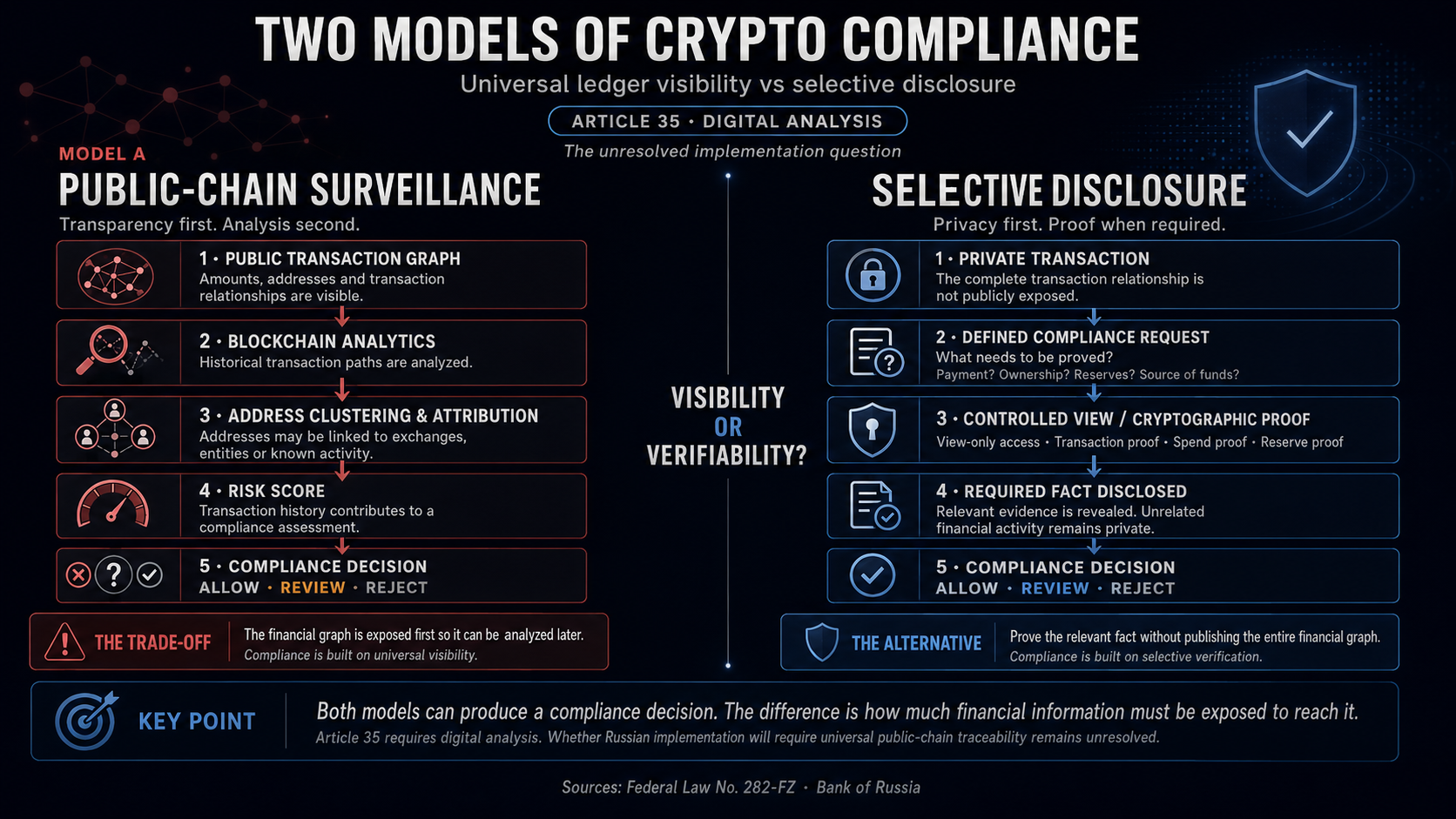
Public-chain surveillance and selective disclosure can both produce compliance decisions, but they differ fundamentally in how much financial information must first be exposed.
8. The Surveillance Layer Still Exists at the Gateways
None of this makes Russia’s framework privacy-first.
Federal Law No. 283-FZ extends customer identification, transaction monitoring and information-transfer requirements into cryptocurrency.[2]
For transfers above 60,000 rubles, regulated actors must ensure the presence, completeness, protected transmission and retention of substantial originator and beneficiary information. Smaller transfers remain subject to a reduced information set.[2]
Cryptocurrency used as consideration under foreign-trade contracts also enters mandatory AML monitoring when operations reach 10 million rubles.[2]
Federal Law No. 282-FZ additionally requires covered intermediaries to preserve extensive client, transaction, account and address-identifier records for at least ten years.[1]
This broadly resembles the global direction promoted by the Financial Action Task Force.
FATF reported in July 2026 that 83% of surveyed jurisdictions had legislated the Travel Rule.[9] Its red-flag guidance also treats anonymity-enhanced cryptocurrencies and privacy coins as factors capable of increasing risk and complicating investigations.[10]
But FATF makes a distinction that is frequently lost in political debate: an anonymity-enhancing feature does not by itself prove that a transaction is illicit.
Risk is not prohibition.
Privacy is not proof of criminality.
Russia’s final architecture currently looks more like an attempt to control the regulated interfaces surrounding private money than a statutory attempt to eliminate private money itself.
9. What Does the Law Actually Mean for Ryo Currency?
Ryo context
Ryo should not be described as formally approved for the Russian market. Nor should it be described as banned merely because it is private. The framework applies separate tests involving investor status, liquidity, intermediary policy and digital-analysis requirements.
Ordinary retail access
For non-qualified investors, Ryo confronts a barrier long before privacy becomes decisive.
Federal Law No. 282-FZ sets extremely high requirements for cryptocurrencies admitted to public organized trading, including average market capitalization above 5 trillion rubles, average daily trading volume above 1 trillion rubles and a qualifying foreign price history of at least five years.[1]
The Bank of Russia’s August 11 draft implementing measure proposed a 300,000-ruble annual purchase ceiling through each intermediary for non-qualified investors and named Bitcoin, Ethereum and Tether USDT under the proposed public-circulation rule.[5][6]
Ryo would not satisfy those liquidity thresholds today regardless of its privacy design.
Qualified investors
The qualified-investor question is more interesting.
The Bank of Russia says qualified investors can acquire any cryptocurrencies available through the relevant exchange and over-the-counter markets without the retail amount limit, after testing.[4][5]
That means there is no obvious categorical rule saying:
Ryo is illegal because Ryo is private.
But a regulated intermediary could still decide that supporting a default-private network is too difficult under its Article 35 procedures.
That would be a compliance barrier, not a privacy-coin ban.
Self-custody and cross-border use
Russia’s recognition of non-depository addresses means the system is not built on the assumption that all crypto must remain inside approved custodians.[8]
And the Bank of Russia’s July statement says exporters and importers may use all types of wallets and cryptocurrencies in cross-border settlement.[4]
That does not override AML rules, counterparty requirements, foreign sanctions law or institutional policies.
It does mean that a self-custodied private cryptocurrency is not categorically excluded by the broad language of the cross-border framework.
| Question | Current assessment |
|---|---|
| Does Federal Law No. 282-FZ explicitly ban Ryo? | No blanket Ryo- or privacy-coin prohibition has been identified. |
| Is Ryo approved for ordinary Russian retail trading? | No. Its market size would fail the public-circulation thresholds regardless of privacy. |
| Are qualified investors categorically prohibited from privacy coins? | The Bank’s post-adoption language instead refers to “any cryptocurrencies.” |
| Must a Russian intermediary list Ryo? | No. |
| Could Article 35 make Ryo difficult to support? | Yes. The implementing rules may be decisive. |
| Does Russia recognize non-depository addresses? | Yes. |
| Does Russian law presently mandate a Ryo private view key? | No such requirement has been identified. |
10. What Would This Look Like in the Real World?
A hypothetical Russian importer
Consider a Russian industrial importer buying equipment from an overseas supplier. The parties agree to settle an invoice in cryptocurrency rather than route the payment through conventional correspondent banking.
Under the new framework, the cryptocurrency itself does not necessarily have to sit inside a Russian digital depository. The importer could, in principle, use a non-depository address, while the Bank of Russia has publicly described cross-border settlements as open to all types of wallets and cryptocurrencies.[4][8]
But if a regulated intermediary participates—for example, to acquire the cryptocurrency, convert proceeds or provide another financial service—the institutional layer now matters.
The intermediary may need to identify the customer, retain the transaction record, transmit originator and beneficiary information where required, conduct digital analysis and document the purpose and risk of the transaction.
On Bitcoin, much of its transaction-risk assessment could be outsourced to public-chain analytics.
On a privacy-preserving network, the institution may instead require evidence directly from the customer: invoice documentation, proof of transaction, source-of-funds evidence, controlled wallet visibility or another mechanism permitted by its eventual compliance procedures.
That is the distinction the new law exposes.
The transaction can be private at the protocol layer while still producing evidence at the legal boundary.
11. Three Regulatory Futures for Privacy Coins
The decisive rules have not all been written.
As of September 1, the Bank of Russia’s legal-acts register already shows new measures connected with the crypto framework, including Regulation No. 890-P of August 27 concerning qualification requirements for personnel at crypto exchange organizations, digital depositories and related operators.[7]
But ryo.news has not identified a final published Article 35 technical standard resolving how a default-private blockchain must be analyzed.
Scenario 1: Public-chain provenance becomes the standard
Regulators could define digital analysis in a way that effectively assumes a traceable transaction history. Privacy coins might remain legally permissible while becoming impractical for regulated intermediaries to support.
That would create de facto exclusion without a statutory ban.
Scenario 2: Selective evidence becomes acceptable
Institutions could be allowed to satisfy risk and verification requirements through customer identification, source-of-funds documentation, transaction proofs, reserve proofs, view-only access, cryptographic attestations and eventually more advanced zero-knowledge systems.
Scenario 3: A hybrid system
Different evidence requirements could apply according to transaction size, customer risk, counterparty, wallet type, institutional involvement and whether the transaction is domestic, investment-related or part of foreign trade.
Privacy would remain a protocol property.
Disclosure would become a gateway condition.
12. Russia Has Moved the Chokepoint
The new framework fits a broader monetary pattern.
Banks, custodians, exchanges and correspondent networks are obvious chokepoints.
Blockchain-analysis providers can become information chokepoints.
Russia’s legislation does not eliminate them. It moves regulatory power outward from the cryptocurrency protocol toward the institutional perimeter.
A person may control a private key outside a digital depository.
But once that person enters the regulated financial system, the state can demand identity, records, risk analysis and transaction information.
For privacy systems, this is the real battleground.
If the protocol cannot be made transparent, regulation migrates to exchanges, fiat conversion, merchants, devices, network metadata and the human being at the edge of the cryptography.
13. State Sovereignty Is Not Individual Sovereignty
There is a deeper contradiction inside Russia’s strategy.
Russia has obvious reasons to reduce dependence on financial infrastructure controlled by geopolitical rivals.
That is monetary sovereignty from the perspective of the state.
Privacy cryptocurrencies pursue another form of sovereignty: reducing the privileged informational position of intermediaries and authorities themselves.
A government can desire sovereign money without desiring sovereign users.
China demonstrates one version of that distinction through a digital-money architecture that seeks independence from foreign monetary infrastructure while preserving domestic supervisory visibility.[14]
Russia’s approach is structurally different.
It allows permissionless assets and self-custodied addresses to remain within the legal architecture, then attempts to reintroduce visibility through regulated interfaces, AML rules and digital analysis.
Privacy coins test how far that model can go.
14. Compliance Without Surveillance
The deepest mistake in the privacy debate is assuming there are only two choices.
One is opacity: no one can establish anything.
The other is universal visibility: everyone’s financial history must remain permanently available for inspection.
Cryptography creates a third possibility.
Prove possession without publishing every asset.
Prove a payment without publishing every payment.
Prove reserves without surrendering spending authority.
Prove that a hidden state satisfies a rule without revealing the hidden state itself.
Ryo’s current transaction, spend and reserve proofs are narrow examples of this principle. Its planned move toward Halo 2 zero-knowledge proofs could make the concept considerably more expressive if and when that architecture is completed and deployed.[12][15]
Halo 2 is not currently Ryo’s mainnet privacy protocol, and zero-knowledge proofs do not automatically solve regulation, wallet security, liquidity or network-layer privacy.
But the direction matters.
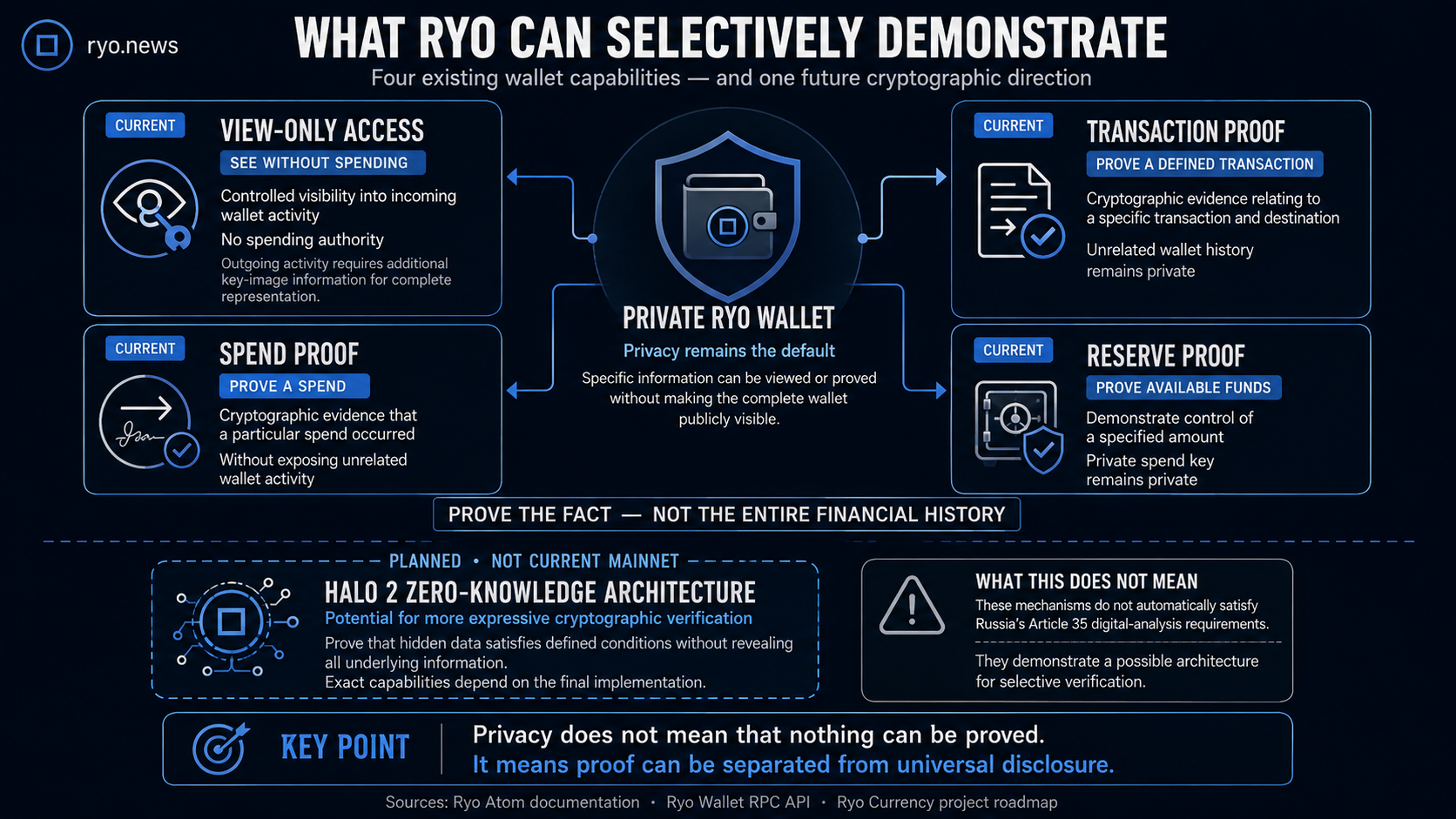
Ryo’s current view-only access, transaction proofs, spend proofs and reserve proofs illustrate selective verification, while the planned Halo 2 architecture is shown separately as a future cryptographic direction.
Russia has already decided who can trade, who can custody, how intermediaries are regulated, how self-custody is treated, where AML obligations attach and how cryptocurrency can enter foreign trade.
The law has not yet fully answered the harder question:
If the eventual answer is that every regulated cryptocurrency must expose a reconstructable provenance graph, privacy coins can be excluded without ever being outlawed by name.
But if regulators learn to distinguish verification from surveillance, another architecture becomes possible.
Identity can be established at the institutional edge.
Transactions can be documented by the parties who actually conduct them.
Specific financial facts can be demonstrated through cryptographic evidence.
Suspicious activity can remain investigable without turning every ordinary payment into permanent public intelligence.
The old model says:
Collect everything, because someday we may need something.
The cryptographic model asks:
Tell us what needs to be proved.
Russia has not chosen between those models yet.
That choice will matter far more to the future of privacy coins than whether the words “anonymous cryptocurrency” appear in a statute.
The real question is not whether the law may know what it legitimately needs to know.
It is whether everyone else must know it too.
Further Reading from ryo.news
- Everything Is a Chokepoint: Hormuz, Helium, Gold and the Architecture of Monetary Escape
— How control migrates toward the narrow points through which energy, finance, information and money must pass. - The End of the Ring: Privacy Coins and the Architecture of Digital Sovereignty
— Why the next generation of privacy systems must protect more than one transaction field. - ProxyMark and Monero over Tor: How Privacy Can Fail Between Layers
— Why ledger privacy, network privacy, wallet behavior and external information cannot be evaluated separately. - Private From Washington, Visible to Beijing: China, Privacy Coins and Financial Sovereignty
— The difference between sovereign money and neutral money. - The Bitcoin Magnet: How Network Assets Create Economic Gravity
— Why protocol design alone does not create a complete sovereign monetary system.
References
- Federal Law of the Russian Federation No. 282-FZ of August 4, 2026, On Digital Currencies and Digital Rights. Official publication:
publication.pravo.gov.ru.
Full text also available through
Rossiyskaya Gazeta. - Federal Law of the Russian Federation No. 283-FZ of August 4, 2026, amendments to Russian AML, currency-control and related legislation.
Rossiyskaya Gazeta — full text. - Bank of Russia, Будущее рынка криптовалют: предложения Банка России (“The Future of the Cryptocurrency Market: Bank of Russia Proposals”), December 23, 2025.
Bank of Russia. - Bank of Russia, Установлено регулирование криптовалют на российском рынке (“Cryptocurrency Market Regulation Established in Russia”), July 21, 2026.
Bank of Russia. - Bank of Russia, Криптовалюты для неквалифицированных инвесторов: правила покупки (“Cryptocurrencies for Non-Qualified Investors: Purchase Rules”), August 11, 2026.
Bank of Russia. - Bank of Russia, draft instruction concerning the annual purchase limit and cryptocurrencies eligible for public circulation, August 2026.
Draft PDF. - Bank of Russia, Legal Acts register, including Regulation No. 890-P of August 27, 2026.
Bank of Russia Legal Acts. - Federal Law No. 173-FZ on Currency Regulation and Currency Control, Article 12.1 as amended by Federal Law No. 283-FZ: address identifiers not administered by digital depositories.
ConsultantPlus. - Financial Action Task Force, Seventh Targeted Update on Implementation of the FATF Standards on Virtual Assets/VASPs, July 16, 2026.
FATF. - Financial Action Task Force, Virtual Assets Red Flag Indicators of Money Laundering and Terrorist Financing.
FATF report. - Ryo Currency, Ryo Wallet Atom — View-Only Wallets / Keys Management.
Official Ryo documentation. - Ryo Currency, Wallet RPC API Reference, including transaction proofs, spend proofs and reserve proofs.
Official Ryo documentation. - The End of the Ring: Privacy Coins and the Architecture of Digital Sovereignty, ryo.news, August 2026.
ryo.news. - k1ngVV, Private From Washington, Visible to Beijing: China, Privacy Coins and Financial Sovereignty, ryo.news, July 2026.
ryo.news. - Ryo Currency, official project overview describing the planned transition toward Halo 2 zero-knowledge proofs.
ryo-currency.com.
This article is an analysis of cryptocurrency regulation and cryptographic architecture, not legal or investment advice. Russian implementing regulations remain under development as of September 1, 2026. References to Ryo’s Halo 2 architecture describe an officially stated development objective and should be distinguished from capabilities currently deployed on the Ryo network.