
In a recent Decrypt article published May 11th 2025, industry leaders argued that traditional financial institutions, such as banks and payment providers, will not fully embrace crypto without robust privacy mechanisms—specifically, zero-knowledge proofs (ZKPs). These cryptographic tools verify transactions without exposing sensitive data, meeting stringent requirements for institutional privacy, compliance, and data protection.

Among emerging projects, Ryo Currency ($RYO) stands out as a privacy pioneer. Ryo democratized mining early on with its CryptoNight-GPU algorithm, ensuring that anyone with a modern GPU could contribute to network security. As of May 2025, over 65% of Ryo’s total supply has already been mined, showcasing its egalitarian emission model. Yet with Halo 2 ZK Proofs now on the horizon, American institutions are eyeing privacy coins—potentially triggering a rush of Wall Street capital toward Ryo’s robust privacy infrastructure.

The Ryo community, however, envisions a different future: one where Ryo remains a coin for regular people—gamers, developers, privacy advocates, and professionals—rather than an institutional playground. The possibility of an institutional influx raises questions about community governance.

What Are Halo 2 ZK Proofs?

Halo 2 is an efficient recursive zero-knowledge proof system that allows blockchains to verify private transactions without trusted setups. By leveraging PLONK-style arithmetization and recursive composition, Halo 2 delivers compact proofs and scalable performance, making it ideal for private-by-default networks.

Ryo’s default integration of Halo 2 ensures every transaction is shielded, immutable, and private—without requiring additional steps from users. This removes statistical weaknesses found in ring signature systems, making transactions effectively untraceable.

Ryo Currency vs. Monero: A Diverging Path

Both Ryo Currency ($RYO) and Monero ($XMR) prioritize privacy, but their designs are increasingly distinct. Below is a comparison of key aspects:

Aspect Monero Ryo Currency
Mining Algorithm RandomX (CPU-focused) CryptoNight-GPU (GPU-friendly)
Emission Curve Quick emission Egalitarian plateau (65%+ mined)
Privacy Protocol FCMP++ (planned) Halo 2 ZK Proofs (upcoming)
Network Anonymity Dandelion++ High-latency mixnet (upcoming)

Ryo’s GPU-friendly mining and egalitarian emission curve promote wider participation and a fair distribution of coins—over 65% of the total supply has already been emitted. Monero’s CPU-centric model and faster emission schedule contrast sharply with Ryo’s inclusive, steady minting process.

Ryo Currency vs. Zcash: A Privacy-First Approach

Zcash ($ZEC) pioneered zk-SNARKs and is now adopting Halo 2, but it shifted its mining ecosystem toward ASICs, reducing decentralization. Moreover, Zcash’s privacy remains opt-in—transparent transactions are still the default.

Ryo, by contrast, has enforced privacy by default since its inception. Every transaction is shielded. With Halo 2 and a planned high-latency mixnet, Ryo offers full-stack anonymity—from wallet to network—setting a new benchmark for privacy coins. Learn more in this deep dive.

Default Privacy with Optional Public View-Keys

Ryo’s architecture meets regulatory requirements. Halo 2 proofs cryptographically shield each on-chain transaction, while the mixnet anonymizes network metadata, ensuring untraceability at every layer.

Importantly, Ryo balances privacy with compliance through public view keys built into its wallet system (Ryo Wallet Atom). Institutions could use these keys to selectively disclose transaction data for audits—a feature discussed in Europe’s Privacy Coin Ban: Impact, Alternatives, and Compliance Strategies.

Explore More on the Ryo News Blog

The Future: Ryo’s Vision for Privacy and Adoption

Ryo is exploring a transition to Proof-of-Stake (PoS) with Halo 2 for private stake validation—the first privately staked privacy coin. While still under development as of May 2025, this evolution could further enhance scalability and energy efficiency, aligning with institutional and community priorities.

Conclusion: Institutional Crypto Eyeing Privacy Coins

Ryo Currency combines default privacy, scalable ZK proofs, and network-layer anonymity with practical compliance tools. Its CryptoNight-GPU algorithm democratized mining, distributing over 60% of supply to everyday contributors. Now, as American financial institutions signal a rush toward compliant privacy coins, a tension emerges: will Ryo remain the people’s coin for gamers, professionals, and Main Street or become dominated by Wall Street capital?

By offering Halo 2 ZK Proofs and a high-latency mixnet, paired with public view keys for audits, Ryo bridges privacy and transparency in a way no other coin does. Whether for small-scale miners or large institutions, Ryo stands ready to deliver robust, private-by-default finance that satisfies regulators and empowers users alike.

Join the Ryo community: https://t.me/ryocurrency

Start mining today: https://ryo-currency.com/#mining


In the ever-evolving world of cryptocurrency, privacy coins stand out by offering enhanced anonymity and security, shielding transaction details from prying eyes. As data privacy becomes a growing concern, these coins have surged in popularity. In this article, we rank four leading privacy coins—Monero, Zcash, Pirate Chain, and Ryo Currency—based on four critical criteria: Privacy-by-Default, Anonymity Set, No Trusted Setup, and Decentralization. By evaluating their performance across these factors, we provide a clear ranking to help you decide which privacy coin best suits your needs.

Evaluation Criteria for Privacy Coins

To fairly assess each coin, we use a consistent set of criteria that reflect their ability to deliver privacy and security. Below, we explain each criterion in detail.

Privacy-by-Default

This criterion measures whether a coin ensures privacy for all transactions automatically, without requiring users to opt in or configure settings. Coins that enforce privacy by default score higher because they guarantee consistent protection across the board.

Anonymity Set

The anonymity set is the size of the group in which a user’s transaction is hidden. A larger anonymity set increases privacy by making it harder to trace individual transactions. Coins with mandatory privacy and higher adoption typically excel here.

No Trusted Setup

Some privacy technologies rely on a “trusted setup”—an initial process that, if flawed or compromised, could undermine the coin’s privacy and deanonymize the entire blockchain. Coins that avoid this requirement are inherently more secure and score higher in this category.

Decentralization

Decentralization assesses how distributed a coin’s network is, factoring in mining algorithms and coin distribution. Highly decentralized networks are more resistant to control or manipulation, earning them higher marks.

Ranking the Privacy Coins

Now, let’s dive into the rankings. Each coin is scored out of 5 for each criterion, and a final average score determines its overall rank.

Coin Privacy-by-Default Anonymity Set No Trusted Setup Decentralization Final Score
Ryo Currency 5/5 3/5 5/5 5/5 4.5/5
Monero (XMR) 5/5 3/5 5/5 2/5 3.75/5
Pirate Chain (ARRR) 5/5 5/5 2/5 1/5 3.25/5
Zcash (ZEC) 2/5 4/5 5/5 2/5 3.25/5

Monero (XMR)

Monero is a household name among privacy coins, celebrated for its robust privacy features and widespread use. Here’s how it stacks up.

Privacy-by-Default: 5/5

Monero ensures all transactions are private by default, leveraging technologies like ring signatures and stealth addresses. Users enjoy automatic privacy without extra effort.

Anonymity Set: 3/5

Recent analyses suggest Monero’s effective anonymity set is smaller than ideal, with a real ring size of about 4.2 due to emerging deanonymization techniques. This limits its score here.

No Trusted Setup: 5/5

Monero’s privacy doesn’t depend on a trusted setup, making it free of this potential vulnerability and earning a perfect score.

Decentralization: 2/5

Monero faces challenges with decentralization. Botnet activity, such as that exposed in Operation Endgame, once controlled 40% of its hashrate, posing a centralization risk.

Final Score: 3.75/5

Calculation: (5 + 3 + 5 + 2) / 4 = 3.75

Zcash (ZEC)

Zcash offers optional privacy through shielded transactions, but this flexibility comes with trade-offs. Let’s break it down.

Privacy-by-Default: 2/5

Zcash’s privacy is not mandatory—users must opt into shielded transactions, and most don’t, leaving the majority of activity transparent. This weakens its privacy-by-default standing.

Anonymity Set: 4/5

With low adoption of shielded transactions, Zcash’s anonymity set is limited, reducing its ability to obscure user activity absolutely.

No Trusted Setup: 5/5

Zcash has upgraded to Halo 2 zk-SNARKs for privacy and no longer requires a trusted setup.

Decentralization: 2/5

Its ASIC-dominated mining concentrates power among those with specialized hardware, undermining network decentralization.

Final Score: 3.25/5

Calculation: (2 + 4 + 5+ 2) / 4 = 3.25

Pirate Chain (ARRR)

Pirate Chain takes an uncompromising stance on privacy, mandating it for all transactions. But how does it fare overall?

Privacy-by-Default: 5/5

Pirate Chain enforces privacy across all transactions using zk-SNARKs, ensuring no transaction is ever transparent.

Anonymity Set: 5/5

With mandatory privacy, every transaction contributes to a large anonymity set, making it nearly impossible to trace individual activity.

No Trusted Setup: 2/5

Like Zcash, Pirate Chain’s use of Groth16 zk-SNARKs relies on a trusted setup, introducing a potential point of failure.

Decentralization: 1/5

An ASIC-friendly mining algorithm and a front-loaded emission schedule concentrate power and coins, severely limiting decentralization.

Final Score: 3.25/5

Calculation: (5 + 5 + 2 + 1) / 4 = 3.25

Ryo Currency

Ryo Currency is a lesser-known gem that emphasizes privacy and decentralization. Here’s its performance.

Privacy-by-Default: 5/5

Ryo enforces privacy by default with ring signatures, ensuring all transactions are private without user intervention.

Anonymity Set: 3/5

Ryo’s smaller user base restricts its anonymity set, reducing its privacy strength compared to coins with larger networks.

No Trusted Setup: 5/5

Ryo avoids a trusted setup, bolstering its security and earning a top score in this category.

Decentralization: 5/5

With a GPU-friendly mining algorithm and an egalitarian emission schedule, Ryo ensures broad participation and fair coin distribution.

Final Score: 4.5/5

Calculation: (5 + 3 + 5 + 5) / 4 = 4.5

Final Ranking of Privacy Coins

After evaluating each coin, here’s how they rank based on their combined scores:

  • #1 Ryo Currency – 4.5/5
  • #2 Monero (XMR) – 3.75/5
  • #3 Pirate Chain (ARRR) – 3.25/5
  • #3 Zcash (ZEC) – 3.25/5

Conclusion: Which Privacy Coin Is Right for You?

Each privacy coin shines in different areas. Ryo Currency tops our ranking with its stellar decentralization and solid privacy features, making it ideal for those who prioritize network security. Monero holds strong as a popular choice with reliable privacy, despite some decentralization hurdles. Pirate Chain offers unmatched anonymity but falters in decentralization, while Zcash trails due to its optional privacy and centralization. With the coming transition to Halo 2 ZK Proofs, we have listed projected changes in total score and rankings.

On March 4, 2025, the U.S. Treasury’s Office of Foreign Assets Control (OFAC) sanctioned 49 cryptocurrency addresses tied to the defunct Nemesis darknet marketplace—44 Bitcoin and 5 Monero ($XMR)—naming Iranian national Behrouz Parsarad as the orchestrator. While Bitcoin’s transparent ledger makes its inclusion predictable, the addition of Monero marks a watershed moment. Long celebrated as the darknet’s untraceable cornerstone, Monero is now showing cracks in its privacy armor, with both academic research and real‑world enforcement exposing traceability. At the same time, Monero’s decentralization has come under fire. Together, these weaknesses signal that the privacy coin throne is up for grabs, with next‑generation projects like Pirate Chain ($ARRR) and especially Ryo Currency ($RYO) emerging to set a new standard.

Monero’s Privacy Erosion: From Early Warnings to Present Reality

Monero’s privacy tripod—ring signatures (mixing the real output with 15 decoys), stealth addresses, and RingCT—has been under assault for years. A 2018 study, “An Empirical Analysis of Traceability in the Monero Blockchain,” showed how poorly chosen decoys dramatically shrink the effective anonymity set. Building on that, Fireice_UK, lead developer of Ryo Currency, demonstrated the Knacc Attack, which exploited the tendency for the real input to be the most recent one, allowing statistical isolation of true transaction origins with high accuracy. Although Monero later raised its ring size to 16, the underlying privacy remains probabilistic, not absolute.

Recent developments have deepened the concern. The OSPEAD report from Monero Research Labs (February 21, 2025) found that decoy age distribution flaws reduce the effective anonymity set from 16 to as low as 4.2, making many transactions traceable in practice. Analysts at Techleaks24 have further exposed weaknesses such as key image clustering and decoy selection biases. Meanwhile, blockchain forensics firms like CipherTrace (CoinDesk) and operations supported by Europol (Europol News) have developed tools to trace Monero transactions. Monero’s promised upgrade to Full-Chain Membership Proofs (FCMP), which would expand the anonymity set to the entire blockchain, remains experimental in 2025, hampered by bloated proofs and slow verification. The Nemesis sanctions are not an isolated incident—they are the culmination of years of eroding trust.

Monero’s Decentralization Failure: Botnets and Centralized Hash Power

Privacy is only half the battle. A truly censorship‑resistant currency must be decentralized, and here Monero is struggling as well. Its RandomX algorithm, designed to be CPU‑friendly, has paradoxically made the network a magnet for botnet mining. Malware‑infected devices now contribute a significant share of the hash rate, concentrating power in the hands of a few illicit operators and raising the specter of 51% attacks. This undermines the egalitarian, distributed ethos that cryptocurrencies were built on, making Monero vulnerable to both technical exploits and regulatory crackdowns—precisely the fate that befell Nemesis. The article “Monero’s Dual Failure” details how these intertwined privacy and decentralization shortcomings are pushing Monero into decline.

The Next Wave: Pirate Chain and Ryo Currency

As Monero falters, two privacy coins have stepped into the spotlight: Pirate Chain and Ryo Currency. Both enforce privacy by default, but they diverge sharply in technology and philosophy.

Pirate Chain: Powerful Privacy, Precarious Decentralization

Pirate Chain employs Groth16 zk‑SNARKs, offering a massive anonymity set that encompasses all shielded transactions—potentially millions. This makes tracing statistically implausible, a clear leap over Monero’s small ring signatures. However, Groth16 requires a trusted setup; if the initial ceremony were compromised, the entire privacy framework could unravel. No breach has been detected, but the risk remains. More pressing is Pirate Chain’s decentralization problem: its Equihash algorithm, once thought to resist ASICs, has been overtaken by specialized hardware, concentrating mining power among well‑capitalized players. Furthermore, 96% of its 200 million supply was mined by 2023, favoring early adopters and creating wealth centralization. While its privacy is robust, these structural flaws limit Pirate Chain’s long‑term viability as a truly permissionless currency.

Ryo Currency: Trustless Privacy and Genuine Decentralization

Ryo Currency takes a different path, directly addressing the weaknesses of both Monero and Pirate Chain. Its upcoming Halo 2 ZK‑SNARKs eliminate the trusted setup entirely—recursive, compact zero‑knowledge proofs deliver absolute cryptographic privacy without any ceremony‑based risk. Paired with a planned high‑latency mixnet, Ryo will obscure network‑level metadata, foiling timing and IP correlation attacks that plague Monero. The result is a privacy model that doesn’t just resist deanonymization—it renders it computationally impossible.

On the decentralization front, Ryo’s Cryptonight‑GPU mining algorithm is engineered to resist both ASICs and botnets. GPUs are widely accessible, ensuring that hash power is spread across a broad, ethical user base rather than concentrated in hidden server farms or malware operations. A 20‑year emission schedule guarantees fair, long‑term reward distribution, avoiding the early‑adopter centralization seen in Pirate Chain. Future additions like private staking could open the door to anonymous DeFi, making Ryo not just a privacy coin but a versatile platform.

Why Decentralization Matters

Decentralization is more than a buzzword—it is the bedrock of security, censorship resistance, and fairness. A distributed network prevents 51% attacks, thwarts transaction blacklisting, and spreads economic rewards equitably. GPU mining, as championed by Ryo Currency, fosters an open, participatory ecosystem that stays true to the cypherpunk vision. By contrast, ASIC‑dominated chains and botnet‑infested networks centralize power in the hands of the few, betraying the promise of cryptocurrency.

Conclusion: A New Era for Privacy Coins

The OFAC sanctions against Nemesis have exposed what many in the research community already knew: Monero’s privacy is no longer absolute, and its decentralization is deeply compromised. Pirate Chain offers a significant privacy upgrade but stumbles on decentralization. Ryo Currency, with its trustless Halo 2 proofs, high‑latency mixnet, and GPU‑centric fair mining, delivers the most complete package—uncompromising privacy paired with a genuinely decentralized network. As regulators sharpen their tools and darknet actors seek safer harbor, the privacy coin landscape is shifting decisively. Ryo Currency stands ready to claim the throne.

Sources: U.S. Treasury OFAC (March 4, 2025), “An Empirical Analysis of Traceability in the Monero Blockchain”, Fireice_UK’s Knacc Attack, Techleaks24, Monero’s Dual Failure, CipherTrace (CoinDesk), Europol, arXiv:2003.01876, Pirate Chain and Ryo Currency documentation.

For years, Monero (XMR) was hailed as the gold standard of privacy coins, a cryptocurrency designed to shield users from surveillance and financial tracking. However, the cracks in its armor have grown too large to ignore. From failing privacy guarantees to botnet-driven mining centralization, Monero is no longer the beacon of anonymity it once was. Even its upcoming “Full Chain Membership Proofs” (FCMP++) proposal does little to address these core issues and may, in fact, make things worse.

But not all hope is lost. Ryo Currency ($RYO) took a decentralized approach from day one, choosing GPU mining with CryptoNight-GPU and a fair, egalitarian emission schedule to ensure widespread coin distribution. Now, Ryo is taking another bold step forward, adopting Halo 2 ZK Proofs and a high-latency mixnet to secure financial privacy while maintaining true decentralization. With a revolutionary Proof-of-Stake (PoS) model on the horizon, Ryo offers a glimpse into the future of private, scalable, and censorship-resistant transactions.

The Failure of Monero’s Privacy Model

Monero’s supposed anonymity has long been its selling point, relying on ring signatures, stealth addresses, and confidential transactions. However, recent research has exposed fundamental weaknesses:

Chainalysis Capabilities

Despite Monero’s privacy claims, blockchain analysis firms and intelligence agencies have demonstrated increasing success in tracing transactions. Unlike ZK-Proof-based systems, Monero’s decoy-based ring signatures have a history of being compromised by statistical heuristics and transaction analysis.

Knacc Attack: Monero’s Early Privacy Failure

The Knacc Attack, first demonstrated by Fireice_UK, the lead developer of Ryo Currency, revealed a major flaw in Monero’s transaction obfuscation. The attack exploits the fact that, in many cases, the real input in a Monero transaction is significantly more likely to be the most recent one compared to the decoys. By using statistical analysis on Monero’s blockchain, researchers were able to strip away decoys and isolate real transaction inputs with high accuracy.

While Monero has since increased its ring size to mitigate this specific attack, the fundamental weakness remains: Monero’s privacy is still probabilistic rather than absolute. Chainalysis and other firms have expanded on this method, refining heuristics to de-anonymize Monero transactions with even greater accuracy.

Real-World Evidence of Monero Tracing

  • In 2020, CipherTrace claimed it had developed Monero-tracing capabilities for the U.S. Department of Homeland Security, despite Monero’s claims of untraceability. (Source)
  • Europol’s 2022 report acknowledged that Monero transactions had been successfully traced, indicating that governments are actively developing Monero-tracking techniques.
  • In the “Breaking Monero” research paper, researchers demonstrated how Monero’s ring signature model could be compromised through transaction graph analysis.

EAE Attack: The Exploit That Bypasses Decoys

The Empirical Anonymity Exploit (EAE) Attack takes advantage of weaknesses in Monero’s transaction selection process, particularly with ring signatures. Monero transactions mix the sender’s real inputs with decoys, but this attack identifies real inputs by analyzing spending habits, network timing, and clustering behaviors.

Researchers have shown that by analyzing the way Monero users select mixins (decoy transactions), a large percentage of transactions can be de-anonymized. The key weaknesses exposed by the EAE attack include:

  • Biased Decoy Selection: Older outputs in a transaction ring are often decoys, while newer outputs are real transactions, making it easier to identify the true sender.
  • Linkability Through Spending Patterns: If a user reuses Monero addresses or consolidates funds, their transactions can be linked over time, further degrading privacy.
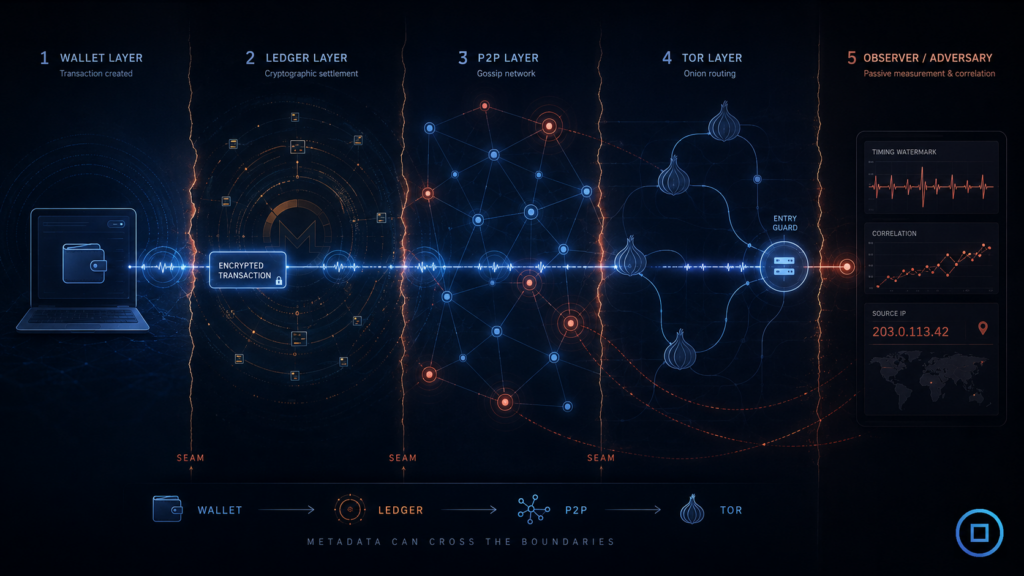
  • Network-Level Surveillance: The EAE attack also shows that when combined with metadata leaks at the network level, an adversary can effectively correlate Monero transactions.

Ring Signature Limitations

Monero’s privacy depends on hiding a real transaction within a set of fake decoys. The problem? Older transactions have been shown to be mathematically predictable, and newer transactions are still vulnerable to timing and spending patterns.

The FCMP Mirage: A Flawed Solution

Full-Chain Membership Proofs (FCMP++), Monero’s latest stab at salvaging its crumbling privacy model, are being hyped as a revolutionary leap. Touted as an upgrade from the original FCMP concept, it promises to drown transaction origins in a sea of every past blockchain output—over 100 million and climbing.Yet, this isn’t a breakthrough; it’s a desperate, bloated patch that amplifies Monero’s weaknesses while papering over its fatal flaws.

Crushing Computational Load & Network Collapse

FCMP++ swaps Monero’s modest 16-decoys ring signatures for a cryptographic behemoth: proofs spanning the entire blockchain. Transactions now swell to around 4 KB— quadruple the size of current ones—bringing a cascade of pain:

  • Wallet Sync Nightmares: Syncing a wallet will crawl as users churn through these massive proofs. New adopters, already wary of Monero’s complexity, will flee at the sight of multi-hour wait times.
  • Node Centralization Spiral: Full nodes, Monero’s decentralized backbone, are already groaning under a 200 GB+ blockchain. FCMP++ jacks up CPU and storage demands, pushing resource-strapped hobbyists out and leaving the network in the hands of well-funded hubs—a privacy coin’s death knell.
  • Unsustainable Bloat: The blockchain’s growth, already a sore point, accelerates with FCMP++. At this rate, Monero risks becoming a bloated relic, impractical for anyone without industrial-grade hardware.

Developers wave off these concerns, claiming testnet trials (slated for mid-2025) will smooth things out. But the math doesn’t lie: bigger proofs mean bigger problems, and Monero’s scaling woes are only getting uglier.

Privacy Promises That Don’t Hold Up

FCMP++’s grand pitch—an anonymity set of millions—sounds impressive until you dig into what it doesn’t fix:

  • Timing Attacks Still Bite: Transaction propagation remains unchanged. Sophisticated observers, like chain analysis firms, can timestamp when transactions hit the network, linking them to real-world activity. FCMP++’s bigger haystack doesn’t hide the needle—it just delays the inevitable.
  • Metadata Bleeding Continues: IP leaks via flawed Tor integration and transaction merging (where multiple outputs tie back to one wallet) still expose users. FCMP++ ignores these gaping holes, focusing on sender obscurity while the network screams metadata to anyone listening.
  • Statistical Erosion: Sure, 100 million decoys sound uncrackable—until statistical analysis enters the chat. Patterns in spending habits, output ages, and network traffic chip away at the anonymity set. Research from 2024 already showed Monero’s privacy crumbling under sustained statistical assault; FCMP++ just gives analysts more data to chew on.

Even the much-hyped “forward secrecy” (quantum resistance) feels like a gimmick when today’s adversaries—governments and botnets alike—don’t need quantum tech to deanonymize you. They’re already doing it with timing and metadata.

FCMP++: Trading Usability for a False Shield

The cruel irony? FCMP++ doesn’t just fail to plug Monero’s leaks—it makes the user experience worse. Longer syncs, pricier nodes, and a fatter blockchain erode what little usability Monero had left.

This isn’t progress; it’s a mirage. Monero’s sinking ship—riddled with traceable transactions (some estimate 30%+ are partially deanonymized)—can’t be saved by a fancier bucket. FCMP++ heaps technical debt onto a network already buckling under scrutiny from chain analysis tools like CipherTrace, which cracked Monero cases in 2024. Users cling to a false sense of security while adversaries sharpen their knives.

FCMP: A Solution That Makes Monero Worse

The worst part? FCMP not only fails to fix Monero’s privacy issues—it actually makes things worse. By adding heavier cryptographic proofs and slowing down transaction validation, Monero is sacrificing usability without actually solving its privacy leaks. Users will suffer longer wait times, higher resource costs, and reduced efficiency, only to remain vulnerable to blockchain analysis techniques that have already been proven effective.

This is the true FCMP Mirage—a mirage of improved privacy that disappears the moment you examine its technical shortcomings. Instead of making Monero more private, it is only delaying the inevitable collapse of Monero’s anonymity. Monero users are left with a false sense of security, while adversaries continue to refine their de-anonymization techniques. The sinking ship of Monero privacy cannot be patched—it is going down, and FCMP is nothing more than a bucket trying to bail out water from a collapsing hull.

Operation Endgame & Stary Dobry: The Unraveling of Monero

Operation Endgame and Stary Dobry are two examples of global efforts targeting illicit cyber activities, including Monero transactions.

  • Operation Endgame: A collaborative effort by law enforcement agencies to track and shut down cybercriminal networks using privacy coins like Monero. Blockchain forensics, combined with timing attacks and metadata analysis, have been used to trace Monero transactions back to individuals.
  • Stary Dobry: A European cybercrime investigation that revealed the use of Monero in illegal marketplaces, leading to increased scrutiny and efforts to break its anonymity.

To understand the severity of Monero’s botnet problem and its implications for privacy and decentralization, watch this video:

These operations prove that Monero’s so-called untraceable transactions are, in fact, vulnerable to sophisticated tracking techniques.

Monero’s Decentralization Problem: The Botnet Curse

Beyond privacy failures, Monero’s mining ecosystem has become centralized in the worst possible way: through botnets. Instead of large mining farms, Monero’s mining algorithm—RandomX—has enabled a different kind of centralization where infected computers and compromised systems contribute hash power unknowingly.

How Botnets Control Monero Mining

  • Massive Hidden Hashrate: Monero’s botnet mining problem has led to malware-infected computers contributing substantial portions of the network hashrate. Infected machines unknowingly mine for hackers, further centralizing control over Monero’s blockchain.
  • Reduced Real-World Participation: Honest miners cannot compete with botnets running on thousands of compromised machines. As a result, real users who wish to participate in securing the network are disincentivized, further consolidating mining power in the hands of attackers.
  • No Real Decentralization: While Monero avoids ASIC domination, the trade-off has been an environment where shadowy actors—rather than a healthy, distributed miner base—control the network. This is a centralization nightmare wrapped in the illusion of “egalitarian mining.”

Ryo Currency: Designed for True Decentralization from the Start

Unlike Monero, Ryo Currency built its foundation on decentralization from day one.

  • GPU Mining for Everyone: By using CryptoNight-GPU, Ryo ensured that mining was open to a broad range of users rather than favoring botnets or a narrow group of high-end CPU miners.
  • Egalitarian Emission Schedule: Unlike Monero, which launched with a stealthy premine benefiting early adopters, Ryo Currency followed a fair emission schedule that allowed organic distribution.

This commitment to fairness ensured that Ryo’s coin supply was widely distributed, rather than being concentrated in the hands of a select few.

Enter Ryo Currency: The Future of Private Transactions

With Monero failing both in privacy and decentralization, where does that leave the future of private cryptocurrencies? Ryo Currency has stepped up with an innovative approach that will redefine privacy, scalability, and fairness in the crypto space.

Halo 2 ZK Proofs: The End of Transaction Traceability

Unlike Monero’s flawed decoy-based privacy, Ryo Currency is implementing Halo 2 Zero-Knowledge Proofs (ZKPs)—a cryptographic advancement that removes the need for decoys entirely.

  • Absolute Anonymity: ZKPs provide full transaction privacy without the need for rings, eliminating statistical weaknesses.
  • Scalability: Unlike Monero, where larger anonymity sets increase computational complexity, Halo 2 allows for privacy without compromising efficiency.
  • No More Decoy Attacks: Because Halo 2 doesn’t rely on misleading transaction outputs, adversaries cannot exploit heuristics to de-anonymize users.

High-Latency Mixnet: The Ultimate Privacy Shield

Monero transactions are susceptible to timing attacks and network-level surveillance. Ryo Currency’s high-latency mixnet solves this issue by obscuring the origins and destinations of transactions at the network level.

  • Breaking Metadata Analysis: Transactions are relayed through multiple nodes with high latency, making traffic analysis nearly impossible.
  • Defeating Global Adversaries: Even if an entity controls a large portion of the network, the mixnet ensures that no single observer can link sender and receiver.

Proof-of-Stake: Security Without Botnets

To break free from the mining centralization that plagues Monero, Ryo Currency is preparing for a transition to a Proof-of-Stake (PoS) model.

  • Eliminating Botnets: PoS removes the incentive for malware-driven mining, securing the network with honest participation.
  • Energy Efficiency: Unlike Monero’s CPU-heavy mining, which wastes power and fuels botnet expansion, PoS provides security without massive computational waste.
  • Network Governance: PoS allows for on-chain decision-making, reducing the risk of contentious hard forks that have split Monero’s community multiple times.

Conclusion: A New Era of Privacy is Here

Monero’s mission of financial privacy and decentralization has been undermined by its own outdated technology and vulnerability to malicious actors. The failure of its privacy model—combined with the botnet-driven centralization of its mining network—means that Monero is no longer the privacy solution it once claimed to be.

Ryo Currency, built from the start with GPU mining and a fair emission schedule, has proven that true decentralization is possible. Now, with its adoption of Halo 2 ZK Proofs, a high-latency mixnet, and a transition to Proof-of-Stake, Ryo is poised to take privacy cryptocurrency to the next level. The time for broken decoys and centralized botnets is over. The future belongs to truly private, scalable, and decentralized cryptocurrencies—Ryo Currency is leading the way.

On January 2025, cybersecurity giant Kaspersky uncovered a large-scale cyberattack campaign dubbed StaryDobry, which exploited game torrents to secretly mine Monero ($XMR) cryptocurrency. This stealthy malware operation infected thousands of gaming PCs globally, turning unsuspecting gamers into unwilling participants in Monero’s mining network. The alarming discovery once again highlighted how vulnerable traditional Proof-of-Work (PoW) cryptocurrencies like Monero are to botnet exploitation.

But while Monero continues to struggle with such threats, new-generation privacy coins like Ryo Currency ($RYO) offer a far more secure alternative — one that resists botnet infiltration by design.

The StaryDobry Cyberattack Explained

According to Kaspersky’s official report (tweet link: Kaspersky X Post), the StaryDobry campaign began seeding malware-laden torrents of popular games like Garry’s Mod, Dyson Sphere Program, and Universe Sandbox as early as September 2024. These cracked game installers included hidden payloads that installed the XMRig mining software — a common tool for mining Monero — without the user’s knowledge.

The malware only activated on PCs with eight or more CPU cores, ensuring that only high-performance gaming rigs were exploited. Once activated, the software ran in the background, quietly siphoning off CPU power to mine Monero for the hackers.

By the time the malware was detected in January 2025, thousands of gaming PCs had been compromised — most notably in Russia, but also in Brazil, Germany, and Belarus.

How Monero’s Mining System Enables Botnet Exploitation

The StaryDobry campaign is not an isolated incident. A major 2023 report called Operation Endgame previously revealed that at least 40% of Monero’s global mining hashrate is powered by botnets — massive networks of infected computers controlled by cybercriminals.

Monero’s Cryptonight-R algorithm is CPU-friendly, making it highly susceptible to mass infections on consumer PCs. While this was originally intended to promote decentralization, it has ironically resulted in a highly centralized mining network controlled by a handful of bad actors.

Ryo Currency: The Privacy Coin That Resists Botnets

Unlike Monero, Ryo Currency has taken a proactive approach to resisting botnet exploitation from day one.

Ryo uses the Cryptonight-GPU algorithm — a mining algorithm specifically designed to favor GPU mining while making CPU mining inefficient. Since botnet malware like XMRig primarily targets CPUs, Cryptonight-GPU renders such attacks economically unviable.

This innovation ensures that Ryo’s mining network remains truly decentralized, powered by individual GPU miners rather than hijacked computers.

Why Cryptonight-GPU Matters for Privacy and Decentralization

By resisting CPU-based botnets, Ryo Currency provides several critical advantages:

  • Decentralization: No large-scale botnet can control a significant portion of the network.
  • Security: Lower risk of network attacks and malicious mining.
  • Privacy: Honest miners power the network, not nefarious actors.

For those concerned with true financial privacy, Ryo Currency’s technological choices make it a safer option than Monero.

Conclusion: The Future of Secure Private Money

The StaryDobry cyberattack highlights how vulnerable Monero’s CPU-friendly mining system is to exploitation by cybercriminals. As long as Monero remains a target for botnet operators, its decentralization and privacy will continue to be compromised.

New-generation privacy coins like Ryo Currency and Conceal Network are paving the way for a more secure future. With the Cryptonight-GPU algorithm, Ryo Currency provides a botnet-resistant, decentralized alternative — one that protects both the network and its users.

Watch our full breakdown of the StaryDobry cyberattack and how Ryo fights back:

💬 Join the Ryo Currency Community: Telegram
🌐 Official Website: ryo-currency.com
📰 Latest News: ryo.news
🐦 Follow Us on X: @ryonews_

#CryptoNews #Monero #StaryDobry #CryptonightGPU #PrivacyCoins #RyoCurrency #ConcealNetwork #Cybersecurity #Botnets #Mining