



Monetary Sovereignty & Digital Money · Markets & Economics
The Stablecoin Currency War: Who Buys America’s Debt in the Digital Dollar Age?
Dollar stablecoins can offer an escape from domestic monetary instability while connecting users to U.S. government debt and private issuer controls. Bolivia’s experience reveals the bargain, and privacy coins show which dependencies a different monetary design can reduce.
By Dr. Max Anon · October 4th, 2026
Executive Summary
America’s creditors increasingly include reserve managers serving people who want a dollar token rather than a government bond. As demand expands, reserve-backed stablecoins can connect payments and savings around the world to short-term U.S. debt. The connection is consequential, but its size depends on net issuance, portfolio choices and what users would otherwise have held.[1]
For the receiving country, the bargain extends beyond payment convenience. A household can gain a useful exit from domestic currency weakness while remaining exposed to U.S. monetary conditions, private issuer administration and observable financial activity. Bolivia makes this tension concrete: individual access and national monetary discretion can move in different directions.
Freezing powers reveal another division of authority. Holding the wallet key can leave the holder subject to restrictions embedded in the token system. Circle documents on-chain access denial, while Tether reports large enforcement-related freezes. Successful blockchain settlement does not guarantee continuing spendability or unconditional redemption.[15][16][17]
Privacy coins address a different combination of dependencies. Native assets such as Ryo can provide transaction confidentiality without representing a private issuer’s dollar reserve claim. Their usefulness still depends on software, network access, liquidity and acceptance. Confidentiality and issuer independence do not create dollar price stability.
The currency war now includes a contest over who distributes money, earns on its reserves, observes its use and can restrict it after it reaches the wallet.
Key Takeaways
- Dollar access can expand Treasury exposure. Net issuance and reserve allocation matter; secondary token transfers need not change the issuer’s balance sheet.
- New issuer holdings are not always new demand. Some adoption redistributes exposure already held through other intermediaries.
- Monetary sovereignty has several layers. Citizen exit, state policy, settlement, censorship and information require separate examination.
- Self-custody leaves issuer powers visible. A private key can remain secure while the associated stablecoin becomes restricted.
- Privacy changes the information available to observers. Issuer independence, confidentiality and usable exit are distinct properties.
- Reserve income and reserve stress belong in the same analysis. Growth can support bill demand; redemptions can change funding and liquidity conditions.
Conceptual continuity: Bolivia, USDT and the Battle for Monetary Sovereignty examined the receiving country’s dependencies. The Permission Layer examined observation and exclusion. Beyond the Private Key followed authority from intent to settlement. This article connects those questions to the assets backing digital dollars and the institutions financing America’s debt.
I. The Creditor Who Never Intended to Buy a Bond
Consider a hypothetical merchant in Bolivia. A supplier wants dollars. The merchant’s immediate problem is obtaining a usable means of payment, preserving enough purchasing power and settling the invoice before the goods become unavailable. A dollar token offers one possible route.
The merchant buys USDT, transfers it to a wallet and pays the supplier. There is no decision about Treasury auctions, Washington’s budget or the appropriate maturity of American public debt. The choice concerns commerce. Yet the instrument belongs to a system whose reserve managers invest in dollar assets, including government securities.
The local policy background is real. Bolivia’s central bank reopened electronic payment channels for buying and selling virtual assets through its June 25, 2024 resolution. In June 2025, it reported broad virtual-asset transaction volumes of $294 million for the first half of that year, compared with $46.5 million in the first half of 2024.[3][4]
Those figures measure transaction activity. They do not measure USDT supply created for Bolivians or identify Treasury purchases attributable to the country. The merchant is an illustration, not a reported interview. Buying an existing token can simply move it from one holder to another.
The larger connection emerges when aggregate demand leads issuers to expand token supply and reserves. The person seeking practical dollar access can then support a distribution system with an investment portfolio on the other side. The reserve manager selects the assets. The issuer and its partners receive the associated income. The user holds the transferable token.
A wallet therefore deserves two maps: the payment path visible to its owner, and the balance sheet that makes the dollar promise possible. Monetary power can move through both.
When people leave a weak monetary system, the destination acquires more than customers. It can acquire funding, income and authority.
Featured in the Ryo Directory
Businesses accepting RYO
II. Currency Competition Reaches the Wallet
James Rickards’s Currency Wars places monetary arrangements within strategic competition between states. Its enduring usefulness here is the insistence that money affects bargaining power, trade and international influence. The contemporary extension concerns how monetary units reach their users.[5]
Exchange-rate policy, central-bank reserves and international banking still matter. Token networks add another distribution channel. A foreign household can encounter a dollar instrument through an exchange, a payment application or another person’s wallet rather than through a domestic bank offering a conventional foreign-currency account. The ease of that encounter changes the practical menu of monetary choices.
It also changes who organizes the relationship. A government issues the monetary unit. A private company issues a claim designed to track it. Exchanges and payment services distribute that claim. Blockchain networks process transfers. Banks and asset managers help maintain the backing. Each participates in the economic reach of the dollar without exercising the same power.
Banks already intermediate savings into public debt. Stablecoins do not invent indirect government financing. Their significance lies in the geography and portability of the product, its reserve structure and the combination of open transaction networks with privately administered tokens.
Kenneth Rogoff’s Our Dollar, Your Problem supplies a useful caution about treating dollar dominance as permanent. Eswar Prasad’s The Dollar Trap examines the forces that sustain demand for dollar assets even amid dissatisfaction with the United States. Together, they keep the question open: a new technology can extend an incumbent currency while leaving its long-term position dependent on institutions and policy.[6][7]
The resulting competition includes both units and routes. People may continue choosing dollars while changing the institutions through which they obtain them. Washington can benefit from that choice without directing every transaction. Private firms can gain from the same demand while creating dependencies that users experience as monetary infrastructure.
This creates a narrow but consequential form of what might be called the privatization of part of America’s exorbitant privilege: the sovereign monetary unit retains its global reach, while private firms can capture reserve income, distribution power and customer relationships around the infrastructure that carries it. The phrase does not mean that stablecoin issuers replace the Federal Reserve or the Treasury. It identifies the commercial layer that can emerge between global demand for dollars and the public assets supporting a private dollar claim.
III. America Needs Buyers with Different Time Horizons
The financing requirement remains much larger than any one new payment technology. CBO’s February 2026 baseline projected a $1.9 trillion deficit for fiscal year 2026 and debt held by the public equal to 101 percent of GDP. Those are dated projections, not a live debt counter.[2]
A deficit is a flow of additional borrowing over a period. A portfolio is a stock of assets at a particular date. Comparing the two without identifying that difference can make an emerging buyer appear capable of financing far more than its holdings establish.
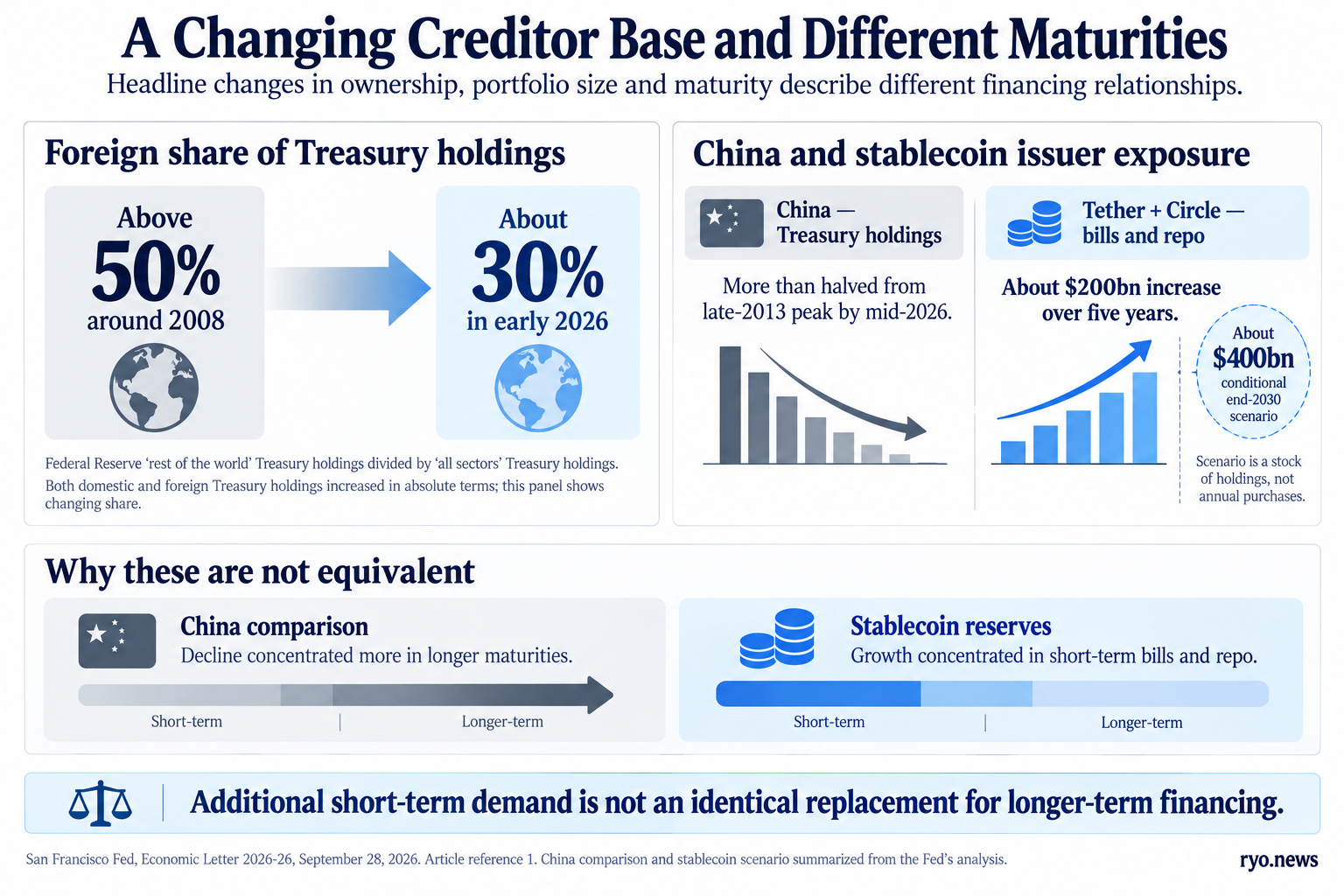
The San Francisco Fed’s September 28 analysis reports that foreign investors’ share of Treasury holdings fell from above 50 percent around 2008 to about 30 percent in early 2026. It also reports roughly $200 billion growth in Tether and Circle’s Treasury-bill and repo holdings over five years. China’s decline involved more longer-maturity securities. The letter’s approximately $400 billion end-2030 stablecoin projection depends on continuation of the trend.[1]
The changing share describes the composition of ownership. It does not establish that every foreign investor reduced absolute holdings. Nor does an increase in bills and repo replace longer-term financing on identical terms. The relevant question includes the maturity and reliability of demand, not simply the identity attached to a large number.
A short-term creditor is a particular kind of creditor
Reserves supporting a redeemable token need liquidity. A government borrowing over decades also needs investors willing to hold duration. More demand at the front end can improve one part of the financing picture while leaving the long end dependent on a different group of buyers.
This distinction becomes consequential when debt managers decide how much to borrow at short maturities and how often to refinance. A large pool of liquid reserves may be valuable, but it carries a different relationship to the sovereign from a portfolio designed to hold long bonds through changing market conditions.
Stablecoin growth therefore belongs in the creditor story without becoming a fiscal rescue narrative. The useful claim concerns an additional channel through which worldwide demand for digital dollars can reach short-term government-security markets. The budget still depends on revenue, spending, economic growth and the terms demanded by the wider investor base.
IV. Follow the Balance Sheet
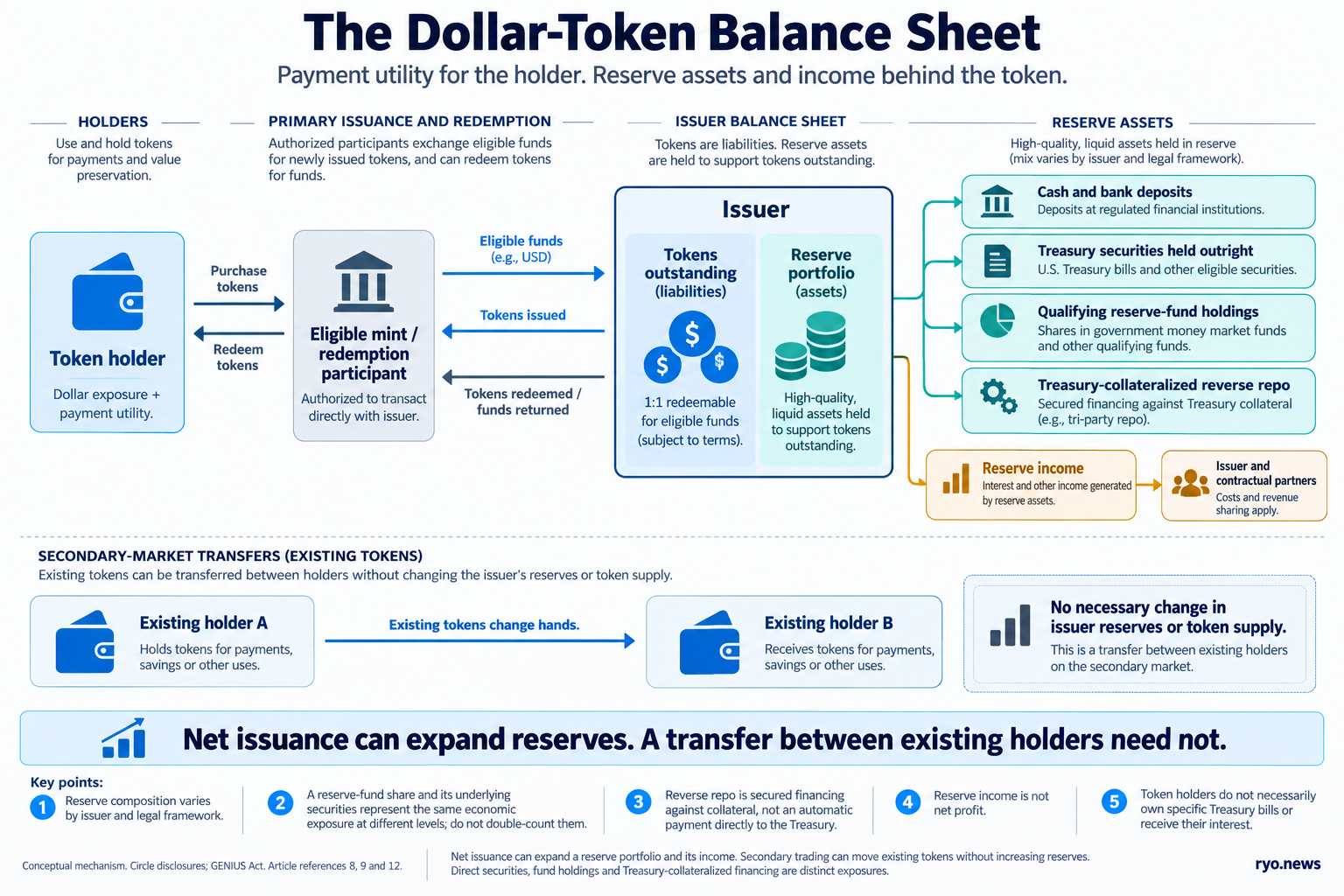
The basic mechanism begins with an issuer accepting eligible funds and creating tokens. The token is a liability or redemption obligation within the applicable legal structure. The reserve portfolio supplies assets intended to support that obligation. Transfers between existing holders can occur without either side of this balance sheet growing.
A rise in the market’s desire to hold tokens may eventually generate net issuance. If issuance exceeds redemptions, the reserve portfolio expands. Its composition determines whether the additional demand reaches bank deposits, outright government securities, fund shares or secured money-market transactions.
Circle states that USDC reserves combine cash with holdings in the Circle Reserve Fund, which invests in short-dated Treasuries, overnight Treasury repurchase agreements and cash. This structure illustrates why the phrase backed by Treasuries can conceal several distinct exposures.[8]
Ownership, collateral and income
An outright bill is a government obligation held by the investor. A Treasury-collateralized reverse repo is a secured financing position with a counterparty; the collateral is part of its protection. A fund share represents exposure through another investment vehicle. Counting the fund holding and its underlying securities as separate backing would count the same economic exposure twice.
Reserve expansion can support Treasury-market demand through these routes, but a repo transaction does not automatically send its proceeds directly to the government. Likewise, purchasing an outstanding bill differs from purchasing newly issued debt. Secondary-market demand can support financing conditions without every trade itself financing a fresh deficit.
Income makes the architecture commercially attractive. Circle reported $668 million of reserve income for the second quarter of 2026 and $412 million in distribution, transaction and other costs. The latter is a combined cost category, not a pure distribution figure. Gross reserve income is not net profit.[9]
The numbers identify a business model: maintain and distribute a widely used monetary instrument while earning on the assets associated with it. Growth in token demand can increase earning assets, while interest rates, contractual sharing and operating costs determine how much income the issuer retains.
The holder receives a different package. Payment utility, portability and dollar exposure do not automatically confer ownership of specific bills or their interest. Some intermediaries offer rewards or separate investment products; those arrangements require their own analysis. A transferable payment token and an interest-bearing investment share should not be treated as the same instrument.
This is the point at which monetary access becomes a question about the distribution of benefits. The user may be satisfied with the service. The issuer may be compensated for providing it. The sovereign whose securities support the reserves can receive financing advantages. Those benefits can coexist while remaining unequal and conditional.
V. How Much Treasury Demand Is Actually New?
The strongest test asks what would have happened without the token. An issuer’s rising portfolio shows where assets are now held. It does not, by itself, show how much additional demand the financial system created.
Consider two stylized users. One obtains dollar exposure that was previously difficult to access. Another sells shares in a government money-market fund to hold a stablecoin. Both can increase the issuer’s reserves. The second user may largely change the intermediary holding government securities; the first can introduce a different source of demand.
A third user withdraws a bank deposit. The payment sent to the issuer may become a deposit at another bank before reserve investment, and payments for securities can transfer deposits again. The system does not necessarily lose a dollar of bank funding for every dollar of stablecoin issuance. The location, concentration and price of that funding can nevertheless change.
These examples are accounting scenarios, not estimates of how much adoption follows each route. Measuring the aggregate effect requires evidence about users, counterparties, reserve composition and the assets displaced. The same headline market capitalization can correspond to different counterfactual demand.
BIS research on stablecoins and safe-asset prices finds that inflows can affect short-term Treasury yields, with limited transmission to longer maturities. The result supports a marginal market effect within the study’s scope. It does not establish a uniform reduction in every part of America’s borrowing costs.[10]
A yield effect also differs from a fiscal solution. Demand can alter prices at the margin while remaining small relative to the borrowing requirement. Lower short-term funding costs do not eliminate rollover exposure, and private reserve managers retain reasons to prioritize liquidity and redemption over a sovereign’s long-term financing preferences.
For Washington, the most useful adoption may therefore be demand that broadens dollar use and draws in funds that would not otherwise have sought Treasury exposure. For an analyst, the harder task is establishing how much of that adoption occurred. The distinction separates an attractive policy narrative from a measured financing contribution.
VI. Washington and the Private Reserve Business
The policy ambition is explicit. In July 2025, Treasury Secretary Scott Bessent connected stablecoin development to greater global dollar demand and demand for Treasury bills. That statement identifies an objective. The eventual scale of the benefit remains an empirical question.[11]
The GENIUS Act, enacted on July 18, 2025, defines a reserve framework built around eligible liquid assets, including qualifying government securities with remaining maturities of 93 days or less, bank deposits and permitted repo arrangements. It also requires technological capability to comply with lawful orders. The statute defines such orders to include restrictions on transfers and other specified actions.[12]
Implementation deserves a date. The Act’s general effective-date provision uses the earlier of 18 months after enactment or 120 days after relevant final implementing regulations. The Federal Reserve’s September 29, 2026 publication is a proposed implementing rule. An enacted framework, a proposal and an operative requirement are different legal stages.[12][13]
The Act also prohibits an issuer from paying interest or yield solely for holding, using or retaining a payment stablecoin. This issuer restriction does not establish a blanket prohibition on every third-party reward arrangement. It does, however, make the separation between payment utility and the reserve’s earning capacity especially consequential.[12]
Who captures the distribution advantage?
Part of the dollar’s international advantage is demand for instruments denominated in it. A private issuer can organize that demand into a reserve portfolio and monetize the service of distributing a convenient claim. Contractual partners can share in the economics, as Circle’s reported costs demonstrate.
Calling this the privatization of part of exorbitant privilege is an interpretation with a narrow meaning: private firms can capture reserve income and distribution power around a sovereign monetary unit. The Federal Reserve remains the issuer of central-bank dollars. The Treasury remains the borrower on its securities. A token company acquires a profitable position between demand for the unit and the assets supporting its promise.
The institutional consequences follow from that position. Reserve managers have investment preferences. Distributors influence which instrument becomes convenient. Compliance systems determine who can use it under which conditions. A public monetary advantage can thus be extended through private infrastructure whose priorities overlap with the state’s in some respects and differ in others.
The dollar can travel farther while the power to distribute, observe and restrict it becomes more concentrated at particular intermediaries.
VII. Bank Funding and Redemption Stress
The reserve-income story has a balance-sheet counterpart. Tokens promise liquidity to their holders. The backing has to supply it under the conditions in which redemptions occur. Expansion and contraction can therefore affect both the issuer and the markets supporting its reserves.
A BIS macroeconomic model identifies opposing bank-lending and fiscal-space channels. Adoption can increase demand for government bills while changing deposit funding and credit supply. Its estimated net effects depend on reserve rules, foreign demand and fiscal conditions. These are conditional model results, not evidence that bank lending is contracting in every country where stablecoins are used.[22]
For banks, deposit location and concentration matter. Retail balances moving to a reserve structure can become concentrated wholesale funding or be used to purchase other assets. Even where money returns elsewhere in the banking system, its stability and cost to a particular bank can change. Aggregate accounting does not make the distribution of funding irrelevant.
A reserve portfolio must meet a redemption schedule
During expansion, an issuer can invest additional funds. During redemptions, it may use cash, the proceeds of maturing bills or the unwinding of repo positions before selling securities. The pressure depends on the portfolio’s liquidity, the timing of withdrawals and the depth of the relevant market.
BIS research on stablecoin stability models the risks associated with demandable liabilities backed by cash and bonds. It examines how capital and liquidity buffers can reduce default and market spillovers, and why the design of regulatory thresholds matters. Its stress mechanism is conditional; it does not mean every redemption immediately forces a distressed sale.[23]
The market consequence can nevertheless become important at sufficient scale. A concentrated reserve sector may add demand during growth and need liquidity during contraction. Portfolio similarity, common counterparties and simultaneous changes in user confidence are relevant questions for the financing system.
Keep that risk separate from a targeted freeze. An administratively restricted token can retain its market peg. A freely transferable token can face a liquidity shock. Reserve solvency, convertibility, market price and permission to transfer are different properties, even when a single product is marketed as stable money.
The same distinction governs the Treasury story. Stablecoins can be an attractive pool of short-term demand while also requiring careful attention to how that demand reverses. A new creditor matters both when it buys and when its obligations require it to obtain cash.
VIII. Bolivia Reveals the Receiving Side of Dollar Power
The same reserve system looks different from La Paz. A monetary instrument that appears to Washington as additional dollar reach can appear to a merchant as immediate commercial relief. Both perspectives can be valid. The sovereignty question begins by identifying whose choices improve and whose authority remains.
Our July Bolivia article treated proposed USDT integration as a policy discussion rather than established legal-tender adoption. Reopening electronic channels for virtual assets is a separate action. Neither should be used as shorthand for the state acquiring authority over the dollar or over a foreign issuer’s token.[3]
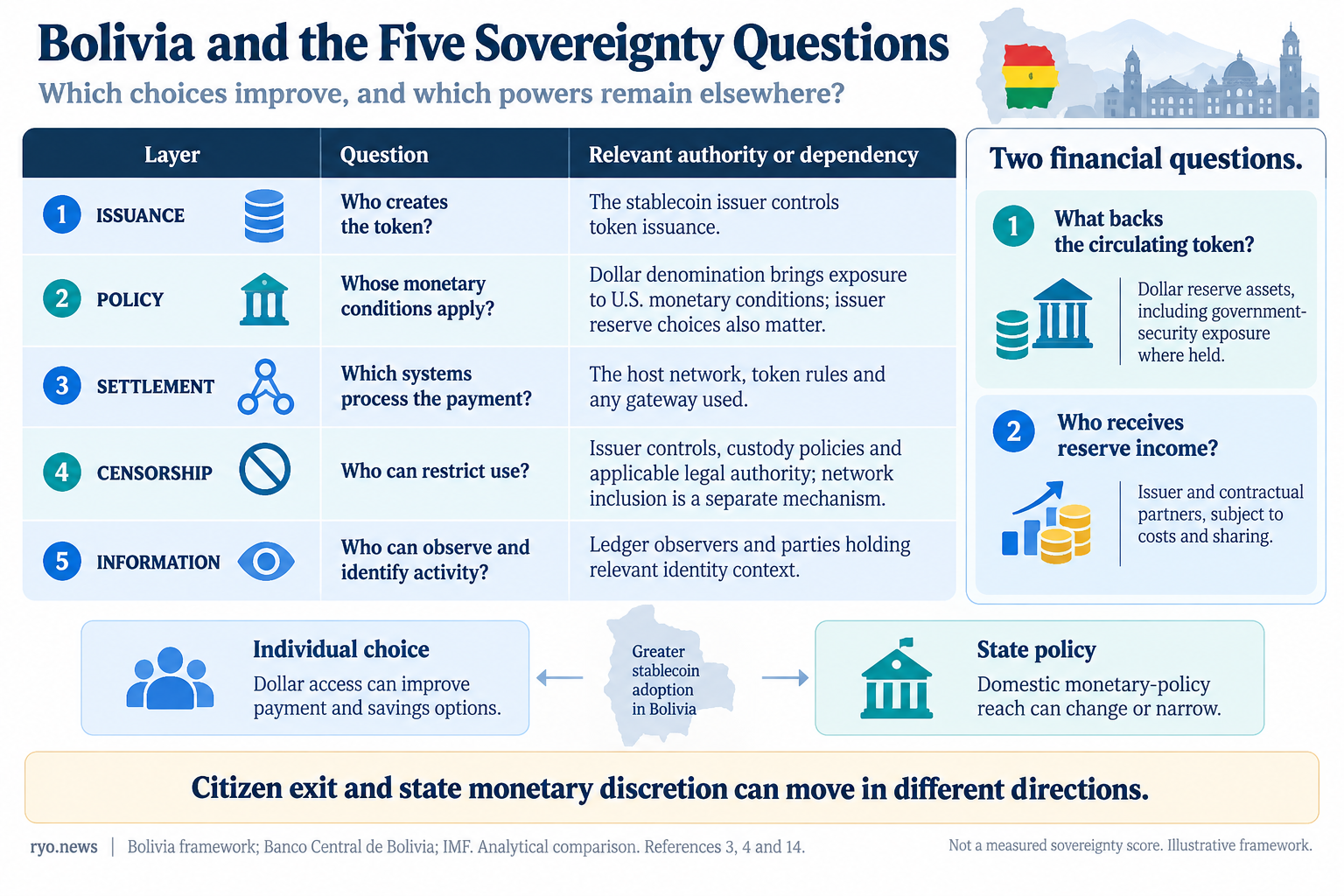
The earlier framework separated issuance, policy, settlement, censorship and information. Issuance asks who can create the instrument. Policy asks who determines the monetary conditions behind it. Settlement asks which systems must accept a payment. Censorship asks which actors can restrict use. Information asks who can observe and interpret activity. Each layer can change independently.
Citizen exit and state discretion
For a household, an external monetary option can reduce dependence on domestic policy. For the government, greater use of that option can reduce the effectiveness of some domestic monetary tools. A person’s increased ability to choose need not mean an increased ability of the central bank to steer the economy.
This is why monetary sovereignty should not be measured solely by whether citizens remain inside the national currency. Preserving an issuer’s discretion is a state objective. Preserving the individual’s freedom to choose is another objective. A serious account must recognize the possibility of conflict rather than treating either as the automatic meaning of sovereignty.
IMF analysis stresses that country effects depend partly on whether stablecoins substitute for foreign-currency instruments already in use or induce additional currency substitution. The counterfactual matters here as much as it does for Treasury demand. A digital wrapper can change access and enforcement even when the underlying preference for dollars predates it.[14]
The financial consequence beside the five layers
The new question is whose assets circulate behind the token and who receives the income. Reserves invested in dollar securities connect the receiving country’s monetary choices to another state’s financing system. This adds a financial lens to the five-layer framework; it does not prove that Bolivia’s reported transaction volumes financed an identifiable amount of American debt.
Businesses still need usable money today. Emergency access may preserve trade and protect household choices. The longer-term concern is dependence becoming infrastructure: accounting practices, suppliers, payment services and cash-out routes organized around an instrument whose monetary conditions and administrative powers remain elsewhere.
A privacy coin can change some of those dependencies, but it would not return discretionary monetary policy to Bolivia’s central bank. National policy autonomy and individual monetary independence require different answers. Keeping that distinction visible makes the privacy discussion more precise.
IX. Self-Custody and the Issuer Veto
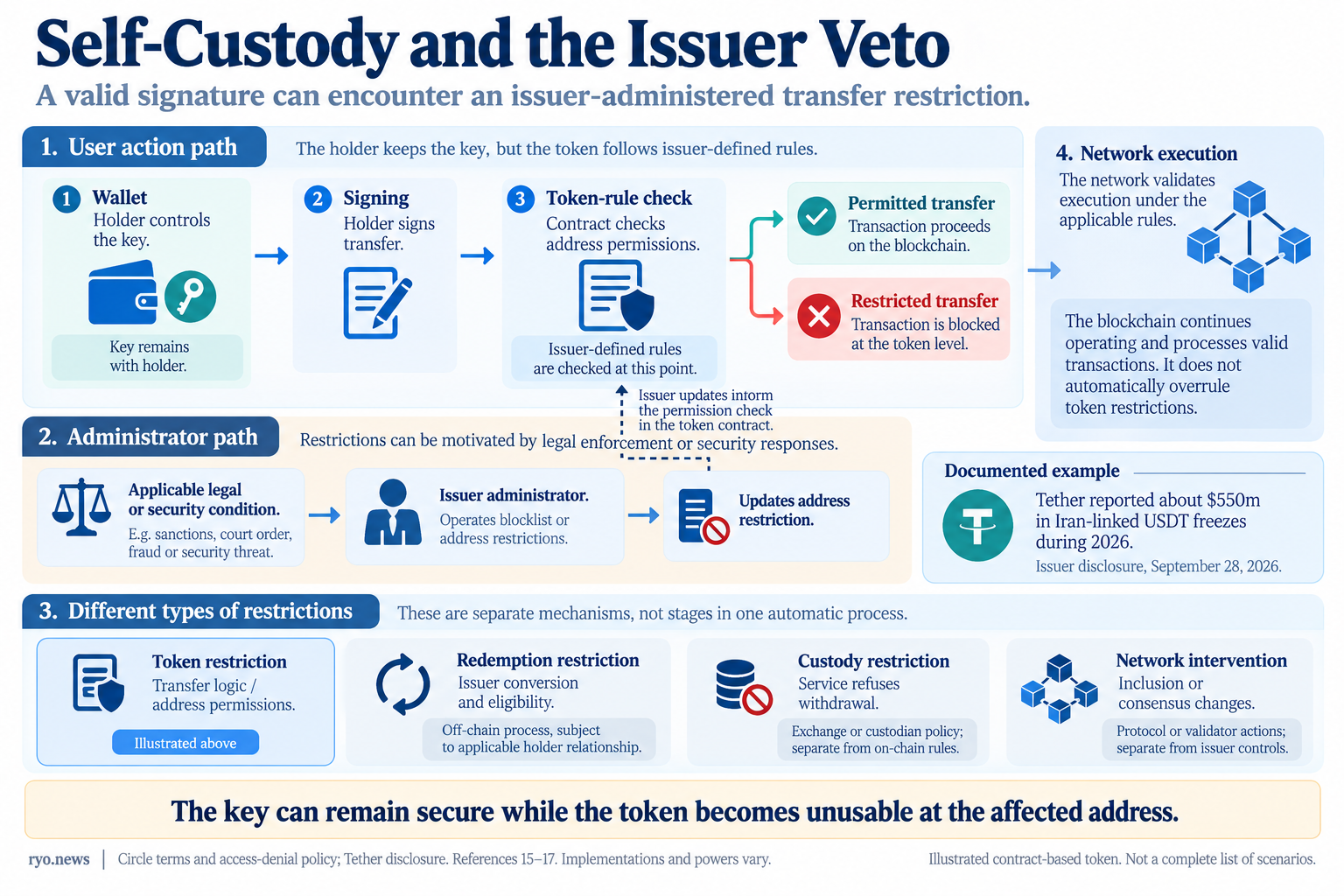
A stablecoin holder can possess the private key, construct a valid instruction and still encounter an issuer-controlled restriction. The key answers who can sign. The token’s rules help determine whether the signed transfer can execute. These are different boundaries of authority.
Circle’s access-denial policy describes an address-level power: a blocked address cannot send or receive its stablecoin, and the balance at that address cannot be transferred on-chain. The policy identifies legal and security exceptions and conditions under which access denial may be lifted. It does not describe blocking individual serially identified tokens.[16]
An affected holder need not lose the key. Earlier transfers need not be reversed. The blockchain can continue processing other activity while the token contract refuses the relevant operation. Decentralization of the host network therefore does not establish independence from the administrator of an asset issued on it.
Four restrictions, four control maps
- A token restriction changes whether the asset’s transfer logic permits an operation at a particular address.
- A redemption restriction changes whether the issuer will convert an eligible holder’s token into the promised off-chain money.
- A custody restriction changes whether a service controlling the keys or account will honor a withdrawal instruction.
- A network intervention changes transaction inclusion, chain operation or consensus behavior through the relevant participants and rules.
These powers can coexist. They should be identified separately because the possible alternatives differ. Changing a wallet interface may bypass one service refusal while leaving the same token restriction in place. Moving to another chain may alter network conditions while preserving dependence on the issuer or on a bridge.
Redemption also has an eligibility boundary. Circle’s cited terms distinguish holders with registered Circle Mint access from other holders and make direct redemption conditional; separate terms apply in the European Economic Area. A token’s widespread transferability does not give every owner an identical relationship with its issuer.[15]
The power is already exercised
In its September 28, 2026 disclosure, Tether reported approximately $550 million in Iran-linked USDT freezes during the year. It said U.S. authorities had identified the wallets as connected to the Central Bank of Iran and sanctions-related networks. These are attributed issuer and enforcement claims, not an independent adjudication of each holder’s conduct.[17]
The example establishes the practical relevance of administrative cooperation. It also requires a fair account of purpose. Freeze capabilities can assist lawful enforcement and recovery for victims. The existence of those benefits does not remove the need to examine who exercises the power, under which jurisdiction and with what route to challenge or reverse a restriction.
Who Gets the Red Button? examined how a network can assemble emergency intervention. An issuer’s standing token powers are another arrangement. The distinction is between a mechanism already authorized in ordinary operation and an intervention requiring coordination among participants. Their thresholds, scope and checks can differ substantially.
For the user, the result can be stark: the market price still tracks a dollar, the reserve assets still exist, and the wallet still holds the key. The money is nevertheless unavailable to that address. Price stability measures one promise. Continuing access measures another.
The peg can survive while the holder’s ability to use the token disappears.
X. Public Money Creates Information Power
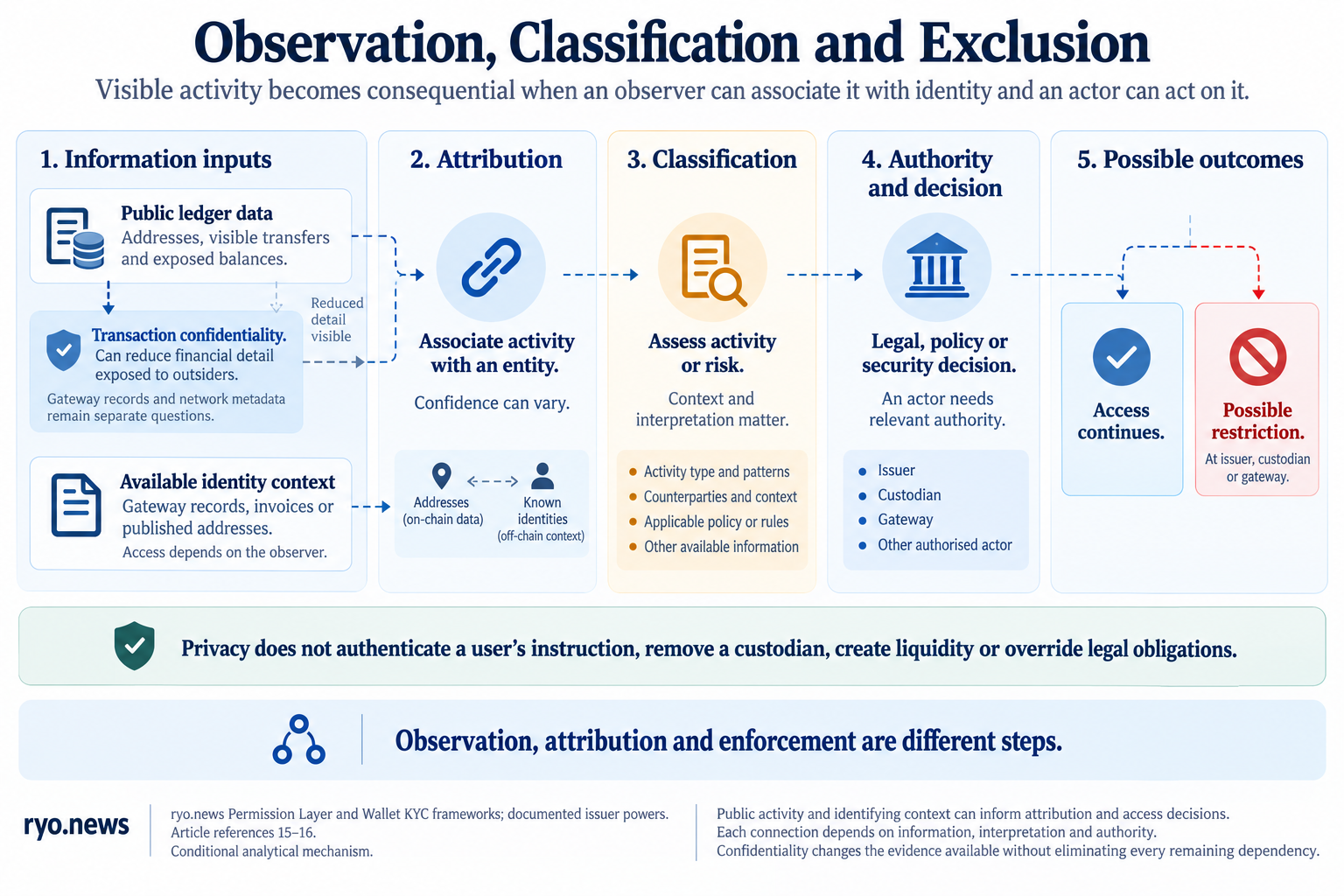
Administrative control becomes more effective when the relevant activity can be identified. On a public ledger, addresses and transfers can remain visible beyond the immediate payment. Their significance changes when an observer obtains context linking an address to a person, business or institution.
That context can come from a regulated gateway, a published payment address, an invoice or the counterparty to a transaction. Pseudonymity concerns the label shown on-chain. Confidentiality concerns what an observer can learn about the activity. The two should not be treated as equivalent.
The analytical sequence is observation, attribution, classification and possible action. A transfer graph can inform a risk assessment. That assessment can influence an issuer, exchange or other gateway. Each step requires a mechanism and can contain uncertainty. A public address alone does not establish a known identity, and a classification does not automatically produce a restriction.
The Permission Layer’s framework helps identify where this sequence becomes consequential. Permission concerns access, observation supplies information, and exit asks whether another usable route exists. Applied to stablecoins, the framework links the publicly processed payment to institutions capable of deciding how the asset can subsequently be used.
From Account KYC to Wallet KYC examined identity conditions moving toward wallets and financial gateways. A privately controlled wallet can remove a custody dependency while retaining identity conditions at purchase, conversion or redemption. The transaction path matters more than the privacy implied by a simple interface.
For a business, exposed activity can concern suppliers, commercial relationships and cash positions. For a public institution, it can concern operational spending. The receiving country’s information interests extend beyond the source of the currency unit. A payment system can change who has the practical means to assemble a picture of economic activity.
Privacy protections can reduce the information available to support persistent profiling. Their effect belongs at the information stage. They do not automatically remove a custodian, invalidate a lawful obligation or create a liquid alternative. Understanding that limit makes the case for privacy stronger: confidentiality is a specific protection whose value should be described accurately.
XI. Apply Sovereignty Tests Across the Whole Path
The practical audit begins with an intended action. A user wants to pay a supplier, move savings, redeem tokens or change monetary instruments. Follow the action through its required participants rather than assigning sovereignty to the wallet as a whole.
Beyond the Private Key followed verified intent through authorization, execution and settlement. A stablecoin adds continuing spendability and redemption to that inquiry. An accepted transfer can establish a current balance without settling every future question about using or converting it.
Permission, observation and exit
Permission: identify the parties whose cooperation remains necessary. The wallet provider, network, token issuer, custodian and redemption institution may possess different powers. A refusal by one does not automatically establish a refusal by all.
Observation: identify what each party can learn. A wallet service may obtain metadata; a public ledger may expose transfers; a gateway may know identity. Combining those views can be more consequential than any one view in isolation.
Exit: identify an alternative that can function when the relevant dependency fails. It must have enough software availability, access and liquidity to serve the actual purpose. An alternative icon in an application is a weak guarantee if it depends on the same unavailable institution.
Correlated gatekeeping matters. Several wallets or chains can distribute claims on the same issuer, while different issuers may still depend on overlapping jurisdictions, banks or conversion services. Interface diversity can therefore coexist with concentrated authority. The strongest alternative depends on the failure being addressed: another node may solve a service outage, another issuer may change one administrative dependency, a native asset can remove the reserve-redemption relationship, and a confidential transfer can reduce observation. Each solves a particular problem and introduces different costs.
Privacy and monetary independence are therefore separate axes. A confidential dollar token could preserve issuer powers and dollar denomination. A native asset with a transparent ledger could remove the issuer while exposing its transaction history. A useful comparison specifies both properties before asking whether the resulting money is convenient enough to use.
XII. Where Privacy Coins and Ryo Currency Fit
Privacy coins enter this argument through the authority and information they change. A native monetary asset does not require a dollar reserve manager to maintain a redemption promise. A protocol designed for transaction confidentiality can also reduce the financial detail available to observers. These are architectural differences with economic consequences.
The category contains different implementations. Monero describes private transactions by default. Zcash supports shielded and transparent paths, making the path chosen consequential to the privacy of the payment. Treating all privacy coins as one uniform system would conceal the properties the comparison is supposed to reveal.[20][21]
Ryo’s relevant properties today
Ryo Currency’s official repository documents RingCT with a ring size of 25 and CryptoNight-GPU proof of work. Its present design uses default transaction privacy. Native RYO is a monetary asset on its own network rather than a transferable claim on a company’s portfolio of dollar reserves.[18]
That changes the authority map. Ordinary native RYO spending is governed by the network’s consensus rules rather than a standing blacklist administered by a dollar-token issuer. There is no stablecoin reserve manager to decide whether RYO can be redeemed for its promised dollar, because RYO makes no such promise. Miners can influence transaction inclusion, consensus rules can change through coordination, and custodians can restrict withdrawals.
Privacy changes the information map as well. The objective is to conceal transaction detail from outsiders while allowing the network to verify validity. A private payment can reduce the usefulness of a public transaction graph for routine financial profiling. The repository itself acknowledges limits to RingCT’s protection against tracking. Default privacy is a design property whose practical strength depends on implementation and transaction conditions.[18]
The project’s planned Halo 2 transition, high-latency mixnet and private proof-of-stake direction remain development claims until release and mainnet activation establish them as deployed capabilities. Code readiness, testing and activation are different stages. The argument for Ryo’s current role should rest on current properties.[18][19]
The entire sovereignty stack remains relevant
The End of the Ring examined ledger privacy alongside networking, consensus, distribution and governance. That broader test applies here. Confidential balances do not establish confidential network metadata. GPU-oriented mining does not independently demonstrate dispersed ownership or hash power. A private asset held on an exchange still depends on the exchange’s custody and withdrawal policies.
The economic limits matter just as much. RYO does not supply a dollar price target or a guarantee of purchasing power. A supplier may require a currency the merchant can obtain only through a conversion market. Market depth, spreads, wallet usability and merchant acceptance determine whether the alternative functions at the moment it is needed.
This is especially relevant to the Bolivian merchant. A confidential, issuer-independent asset may protect one part of the payment or savings path. Volatility or an unavailable conversion route may weaken another. Its usefulness has to be assessed against the invoice, time horizon and available counterparties rather than inferred from its technical label.
A globally used private asset also would not give Bolivia’s central bank discretionary authority over its supply. It can offer individuals a different form of monetary independence while leaving state policy objectives unresolved. The substantial claim is narrower and more defensible: privacy coins can reduce dependence on particular reserve issuers and observers when their actual architecture and usability support that outcome.
Private money needs confidentiality that works, authority that can be understood and an exit that can be used.
XIII. Currency Competition Becomes Architecture Competition
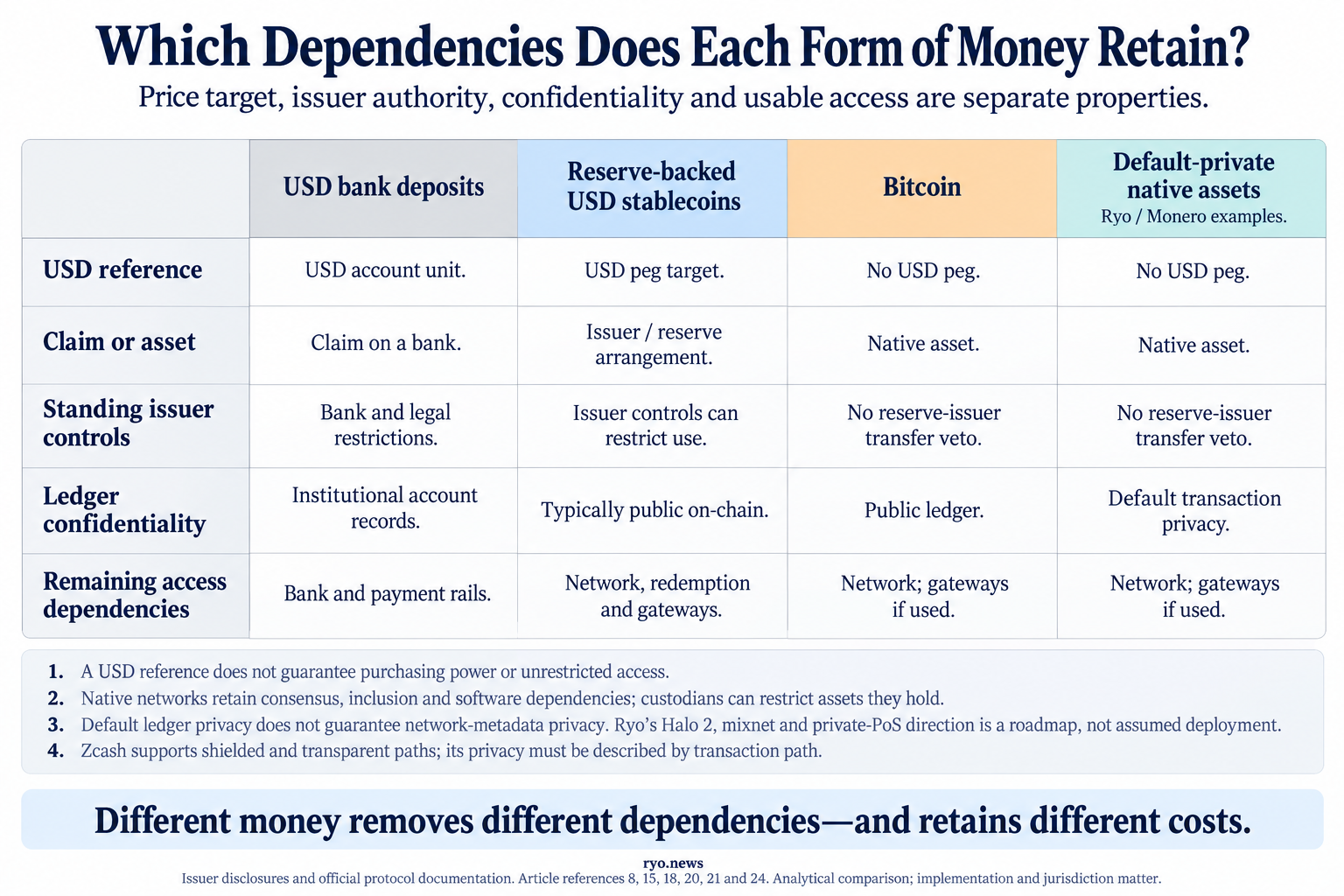
The first choice concerns the unit people want to hold: dollars, a national currency or a non-sovereign asset. The second concerns the arrangement through which they hold it. A familiar denomination can sit inside very different systems of ownership, observation and permission.
A bank deposit is a claim on a bank operating within a legal and payment framework. A reserve-backed dollar token adds an issuer’s backing, redemption and token-administration structure. Bitcoin’s original design provides a publicly verifiable peer-to-peer transaction system without a dollar reserve issuer. Default-private native assets seek another combination of independent monetary rules and transaction confidentiality.[8][15][24]
Each arrangement should be compared across the properties a user actually needs: a price target, reserve dependence, transfer authority, confidentiality, access to counterparties and practical exit. Tokenized deposits, central-bank digital liabilities and tokenized investment shares introduce further arrangements; their legal claims and income rights require their own descriptions.
A dollar-stable payment instrument and a volatile private asset can therefore be useful for different parts of the same economic life. Their coexistence is a more plausible analytical starting point than assuming that one feature determines every monetary use.
For states, the contest concerns monetary reach and policy discretion. For issuers, it concerns distribution and reserve economics. For users, it concerns purchasing power, payment reliability, privacy and the ability to leave a failing arrangement. Those interests can overlap without becoming identical.
Rickards’s currency-competition lens remains relevant as the institutional route changes. The reserve manager and the token administrator now belong beside the central bank and the sovereign creditor on the map of monetary power. The outcome depends on adoption, institutions and usable alternatives as well as the technical properties of the ledger.
XIV. Who Owns the Bills, and Who Controls the Money?
Return to the merchant. Obtaining a usable dollar instrument can be a rational decision. It may keep trade moving, preserve choices and reduce exposure to a weak domestic monetary arrangement. Those benefits deserve to be taken seriously.
The reserve system surrounding the choice deserves equal attention. Its investment managers are an emerging category of short-duration creditor. Its distribution partners can earn income. Its administrators can retain powers that key custody alone does not remove. Its payment activity can become information useful to actors beyond the immediate transaction.
Bolivia makes the national and individual interests visible. Freezing powers make the administrative interest visible. Privacy coins make alternative combinations of authority and confidentiality visible. Together, they turn a story about who buys American debt into a fuller account of who benefits from monetary adoption and who governs its use.
Stablecoins can extend the dollar’s reach while encouraging demand for more independent forms of money. The two developments can arise from the same experience: people value the convenience of a dominant unit and also encounter the conditions attached to the route through which they hold it.
The issuer holds the reserve assets. The user supplies the demand for digital dollars. The harder question is who has the final say over the money in the wallet.
Source and scope note: Prepared using information available on October 4, 2026. The principal stablecoin claims concern reserve-backed dollar payment tokens such as USDT and USDC; other designs can have different backing and control mechanisms. Fiscal figures are dated CBO projections. The San Francisco Fed comparison includes Treasury-bill and repo exposure and a conditional holdings projection. Bolivia’s reported volumes concern broad virtual-asset transactions. Freeze disclosures are attributed to their issuers. Statutory provisions are distinguished from proposed implementing regulations. Ryo roadmap features are identified as planned. The merchant and counterfactual examples are illustrative; the sovereignty frameworks are analysis.
Further reading: The Capital Control Problem examines the movement of enforcement toward issuers, liquidity and gateways. Private From Washington, Visible to Beijing separates state autonomy from individual financial privacy.
References
- Federal Reserve Bank of San Francisco. Stablecoin Issuers’ Growing Appetite for Treasury Securities. Sylvain Leduc, Luiz Edgard Oliveira and Aleisha Sawyer. Economic Letter 2026-26, September 28, 2026. Creditor composition, bill-and-repo exposure, maturity differences and conditional projection.
- Congressional Budget Office. The Budget and Economic Outlook: 2026 to 2036. February 2026 baseline. The article identifies fiscal-year projections separately from holdings and transaction flows.
- Banco Central de Bolivia. Normativa en torno a los activos virtuales. June 26, 2024 announcement of Resolution 082/2024, dated June 25. Electronic channels for buying and selling virtual assets.
- Banco Central de Bolivia. Virtual-asset operations release. June 27, 2025. Reported first-half transaction volumes; broad virtual-asset activity, not a measure of USDT issuance or attributable Treasury demand.
- James Rickards. Currency Wars: The Making of the Next Global Crisis. Originally published in 2011. Used for attributed geopolitical framing, not as evidence for current stablecoin reserve mechanics.
- Kenneth Rogoff. Our Dollar, Your Problem. Yale University Press, 2025. Dollar dominance and the institutional and geopolitical conditions shaping its future.
- Eswar S. Prasad. The Dollar Trap: How the U.S. Dollar Tightened Its Grip on Global Finance. Princeton University Press, 2014. Publisher chapter excerpt; framing for persistent demand for dollar assets.
- Circle. Transparency and Stability. Reserve structure and the Circle Reserve Fund. Reviewed October 4, 2026; reserve composition should be tied to dated disclosures when numerical balances are used.
- Circle. Circle Reports Second Quarter 2026 Results. Quarter ended June 30, 2026. Reserve income and combined distribution, transaction and other costs; gross income is not net profit.
- Bank for International Settlements. Stablecoins and safe asset prices. Working Paper 1270. Current page reviewed October 4, 2026. Evidence on short-term Treasury yields; the article does not extrapolate its findings across all maturities.
- U.S. Department of the Treasury. Secretary Bessent statement on enactment of the GENIUS Act. July 18, 2025. Stated policy ambition concerning dollar reach and Treasury demand.
- United States Congress. GENIUS Act, Public Law 119-27. Enacted July 18, 2025. Sections 2, 4 and 20: definitions, eligible reserves, lawful-order capabilities, issuer interest restriction and general effective date.
- Board of Governors of the Federal Reserve System. Implementing the Federal Reserve Board’s Responsibilities Under the GENIUS Act. Proposed rule published September 29, 2026. Cited as a proposal, not a final operative regulation.
- International Monetary Fund. Stablecoins: Promise, Risks, and Policy Choices for Emerging Markets. Dan Katz, August 7, 2026. Country-specific currency substitution, access and policy tradeoffs.
- Circle. USDC Terms. Reviewed October 4, 2026. Blocklisting, redemption eligibility and operational conditions; EEA holders are subject to separate terms.
- Circle. Circle Stablecoin Access Denial Policy. Two-page policy linked from the USDC terms. Address-level access denial, legal and security exceptions, and reversal conditions.
- Tether. Tether Has Supported Nearly $550 Million in Iran-Linked USDT Freezes as U.S. Expands Sanctions Campaign. September 28, 2026. Freeze amounts and wallet characterizations are attributed to Tether and the authorities it cites; earlier actions are included in the reported total.
- Ryo Currency. Official source repository. Reviewed October 4, 2026. RingCT, ring size of 25 and CryptoNight-GPU; used for current protocol description.
- Ryo Currency. Official Project Overview. Reviewed October 4, 2026. Privacy and mining description and development direction. Roadmap features are not presented as activated capabilities.
- Monero. What is Monero?. Official overview of transaction privacy and the network’s monetary architecture.
- Zcash. What is the difference between shielded and transparent Zcash?. Official explanation of the confidentiality differences between shielded and transparent transaction paths.
- Bank for International Settlements. The macroeconomics of stablecoins. Working Paper 1363, June 23, 2026. Conditional bank-lending and fiscal-space channels in a quantitative model.
- Bank for International Settlements. Making stablecoins stable(r): can regulation help?. Working Paper 1355, June 2, 2026. Model of reserve liquidity, capital, redemption risk and market spillovers.
- Satoshi Nakamoto. Bitcoin: A Peer-to-Peer Electronic Cash System. 2008. Original transaction, verification and peer-to-peer network architecture; no claim of dollar price stability.