


Monetary Sovereignty & Digital Money · Privacy Technology · Decentralized Systems
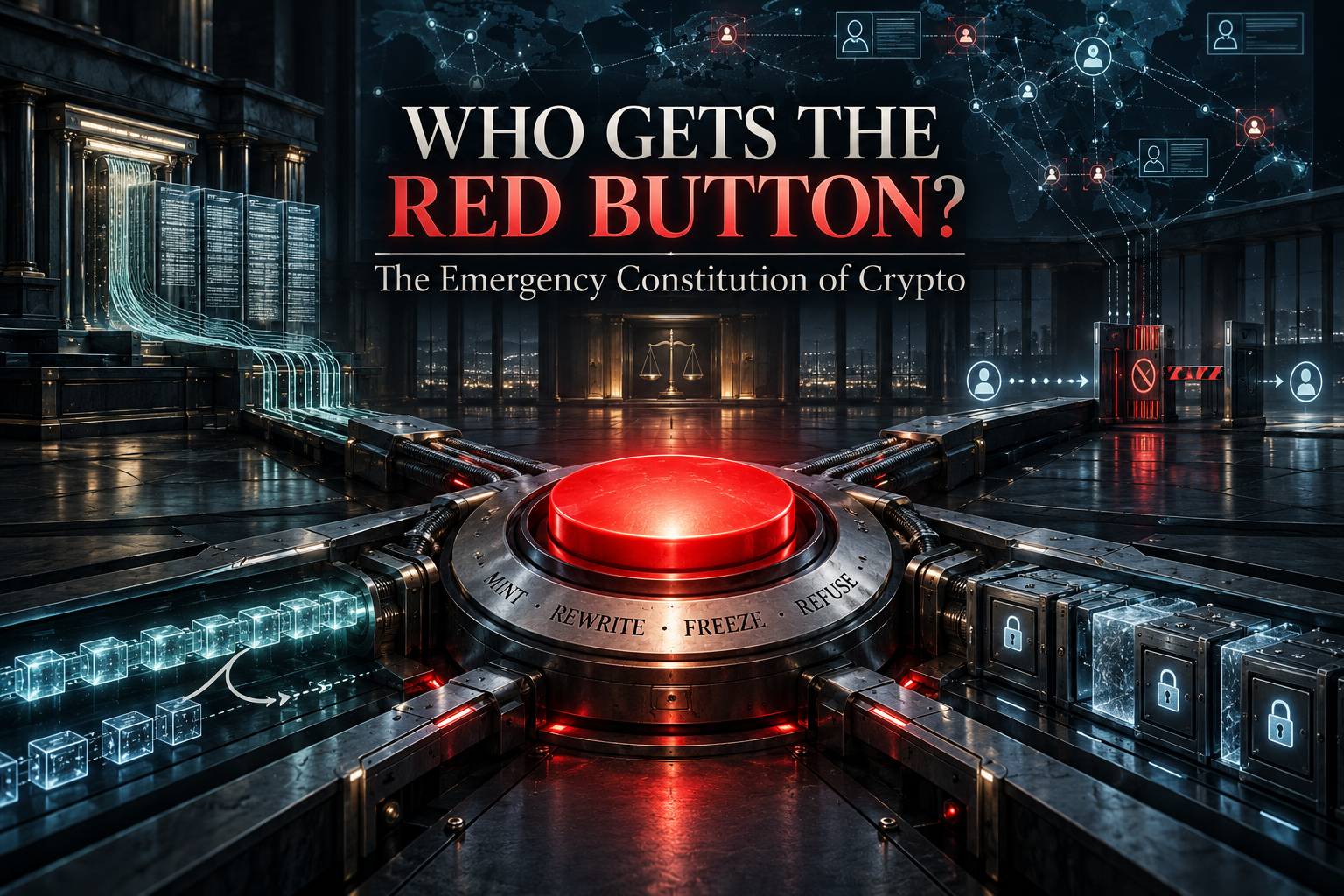
Who Gets the Red Button? The Emergency Constitution of Crypto
Zano restarted from its pre-HF6 state after unauthorized assets entered circulation, removing roughly a month of later transactions from the recovered chain. DERO patched forward and refused to rewrite its ledger after a double-spend created millions of spendable coins. Bitget froze withdrawals after a $387.5 million breach while stablecoin issuers froze selected tokens and THORChain resisted calls to blacklist attacker addresses. The incidents look different. Together, they reveal the same thing: every monetary system has an emergency constitution.
By Dr. Max Anon · September 27th, 2026
Executive Summary
Cryptocurrency is usually judged in ordinary conditions. Blocks arrive. Wallets send. Exchanges settle. The monetary schedule ticks forward. Under those conditions, words such as decentralized, immutable, permissionless and censorship-resistant can remain comfortably abstract.
A crisis removes the abstraction.
In 2026, DERO disclosed a consensus failure that had caused the same transaction to be applied twice, creating at least 23,886,517.3 DERO of additional spendable balances while equal frozen negative balances kept the ledger’s aggregate arithmetic apparently balanced. The project patched the exploit and then made an explicit governance choice: no rollback, no relaunch, no reissue.[1][2]
Zano confronted the opposite dilemma. A vulnerability in Gateway Addresses allowed unauthorized ZANO and fUSD to enter circulation. The recovery ultimately restarted the blockchain from block 3,833,000, immediately before Hard Fork 6, affecting approximately one month of accepted chain history.[3][4][5]
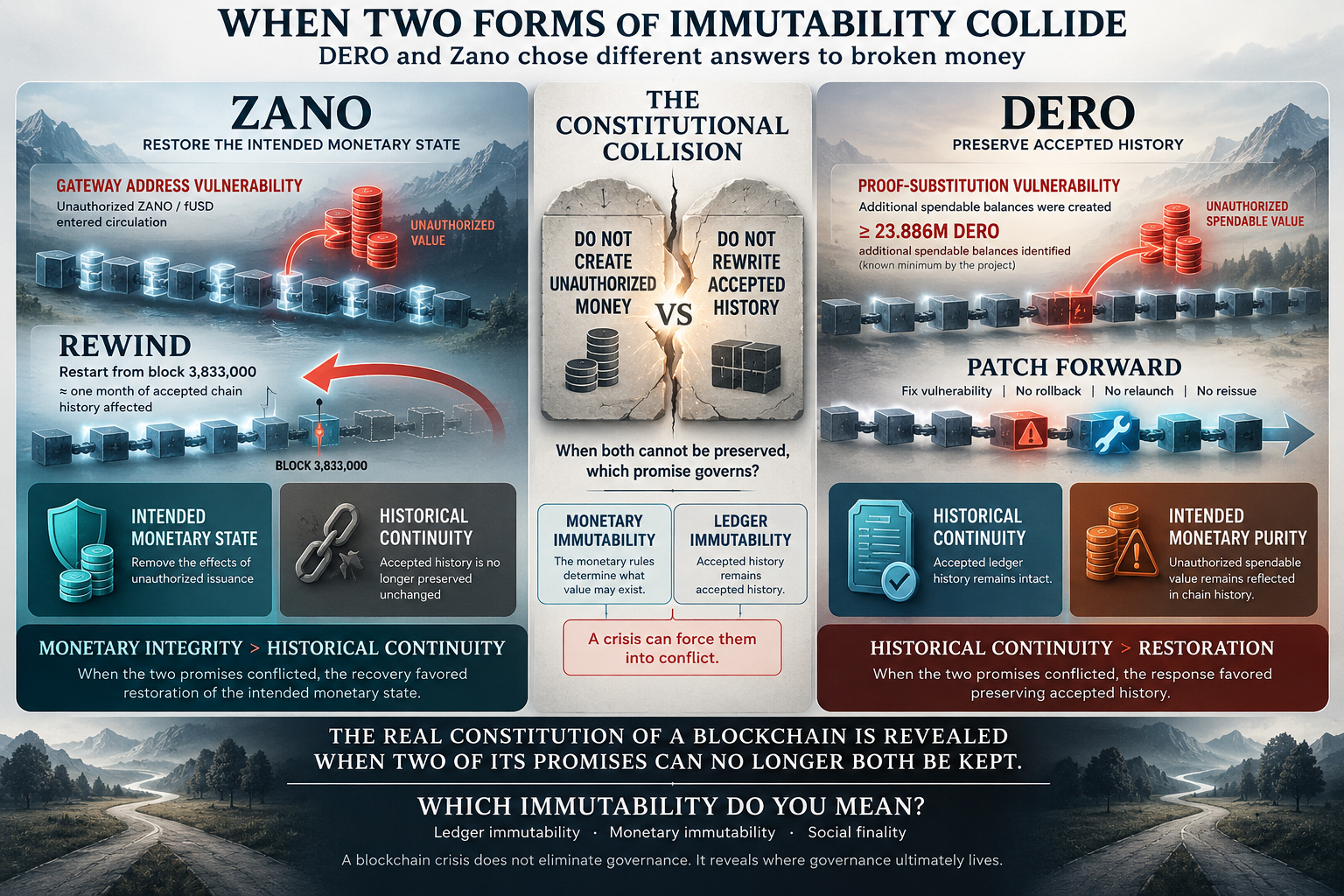
DERO and Zano therefore exposed two different forms of immutability. Ledger immutability asks whether accepted history stays accepted. Monetary immutability asks whether spendable value can exist outside the intended monetary rules. When a bug makes both promises impossible to preserve at once, the network must reveal which promise has priority.
The Bitget breach exposed a parallel conflict. Bitget temporarily suspended withdrawals after unauthorized transfers ultimately totaling about $387.5 million. Circle and Tether froze roughly $318,000 in associated stablecoins, while native assets such as ether and XRP had no equivalent issuer able to blacklist the attacker’s balance at the protocol level. Bitget CEO Gracy Chen then asked THORChain to refuse service to identified attacker addresses. THORChain pushed back by invoking permissionlessness.[11][12][14][15][16][17]
That dispute is more complicated than a slogan. THORChain is not incapable of intervention. During its own May 2026 vault exploit, automated systems halted activity and node operators used manual pauses and Mimir governance to bring the network to a controlled stop; the network remained halted for roughly five weeks. The relevant distinction is therefore not simply can the protocol intervene? It is what kind of intervention is legitimate, who authorizes it, and whether emergency controls become permanent censorship infrastructure.[19][20]
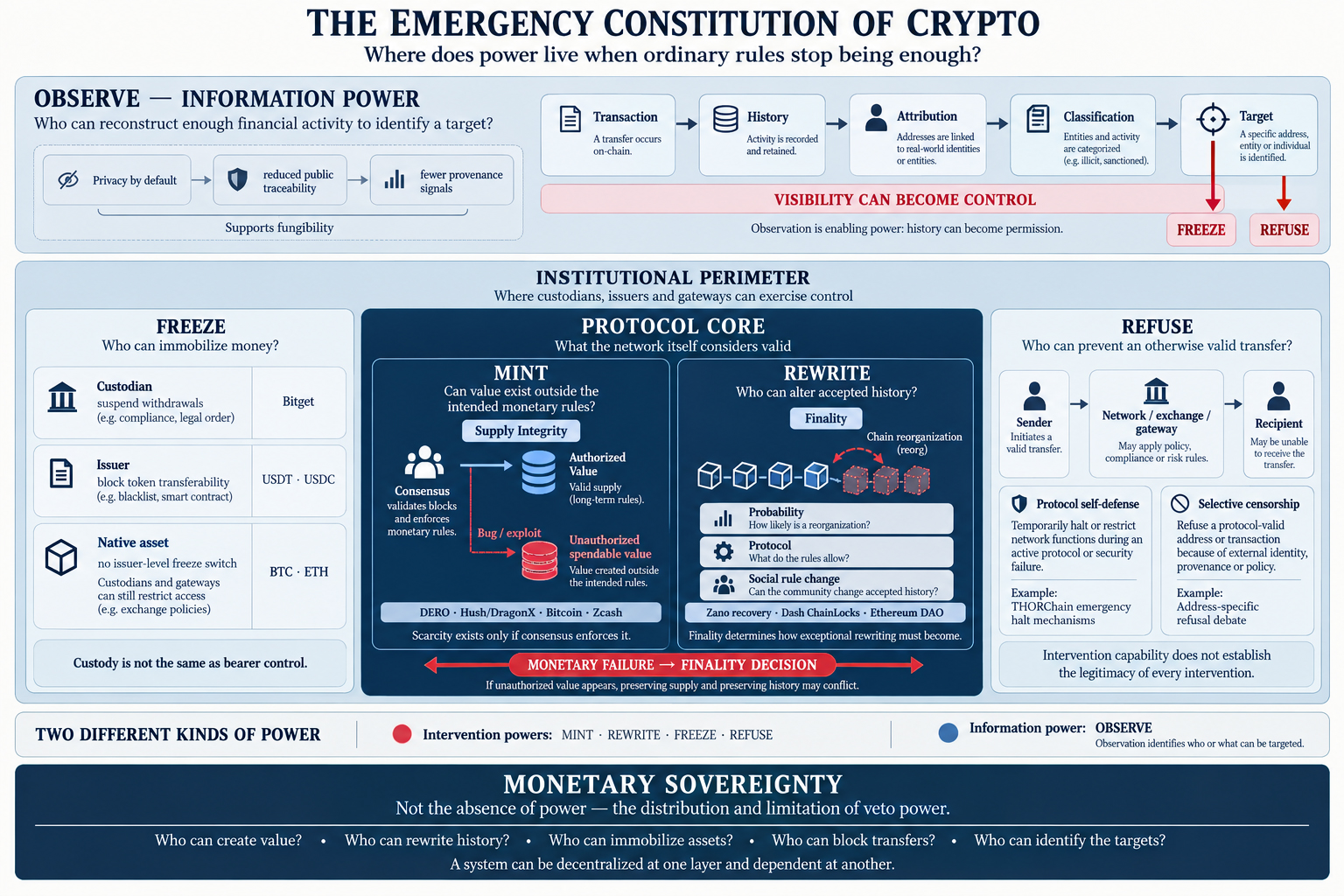
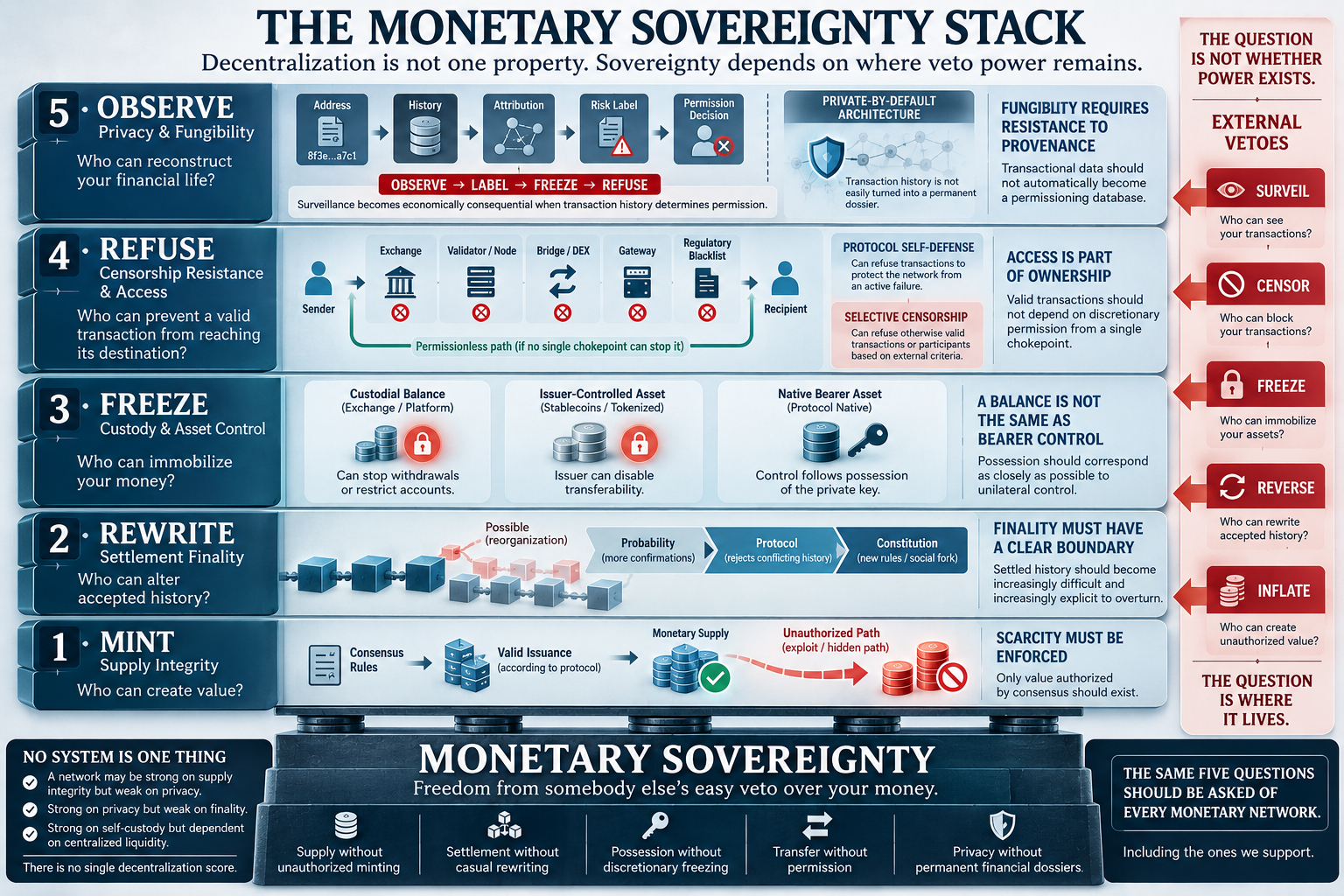
The central argument of this article is simple: decentralization is not the absence of governance. It is the distribution and limitation of veto power. To understand monetary sovereignty, ask five questions: Who can mint? Who can rewrite? Who can freeze? Who can refuse? Who can observe?
Key Takeaways
- Immutability is not one property. DERO preserved ledger history while carrying forward the consequences of unauthorized spendable balances; Zano restored the intended monetary state by removing roughly a month of later transactions from the recovered chain.
- Finality has layers. Dash ChainLocks can make reorganizations below a ChainLocked block invalid under the existing consensus rules, but no cryptographic mechanism can prevent humans from coordinating around new software rules.
- Supply integrity is software integrity. DERO, the Hush-lineage JoinSplit flaw, Bitcoin Core’s 2018 inflation vulnerability and Zcash’s pre-Sapling counterfeiting vulnerability show that monetary policy is partly encoded in validation logic.
- Custody and sovereignty are different. Bitget could promise reimbursement and maintain accurate account balances while its users remained temporarily unable to withdraw.
- Not all digital assets have the same veto structure. USDT and USDC can be frozen by their issuers; native ETH and XRP do not contain an equivalent issuer-level freeze authority.
- THORChain’s real dilemma is constitutional. Emergency self-defense against protocol insolvency is different from selective address censorship based on an external claim about provenance.
- Observation can become permission. Transaction graphs enable taint analysis, blacklists and differential treatment of otherwise identical units, making privacy and fungibility part of censorship resistance.
- Ryo should be judged by the same standard. Planned Halo 2, network privacy and private Proof-of-Stake are not exemptions from hard questions about finality, supply auditability, validator power and emergency governance.
Conceptual continuity: This analysis extends the frameworks developed in The Permission Layer, From Account KYC to Wallet KYC and The End of the Ring. Those articles examined exclusion, financial surveillance and the architecture of private digital money. This article asks what happens when the rules themselves enter a state of exception.
I. The State of Exception
Every constitution looks strongest before the emergency.
In normal times, rules are cheap. A central bank follows an inflation target. A government respects ordinary procedure. A corporation follows its bylaws. A blockchain follows its consensus code.
Then something happens that the rules were not supposed to allow.
Money appears that should not exist.
A transaction history contains consequences that the community considers intolerable.
A custodian loses control of hundreds of millions of dollars.
A thief arrives at a permissionless exchange with assets everybody recognizes as stolen.
At that moment, the most important question is no longer what the system promises. It is what the system can do.
Can it create an exception?
Can it erase history?
Can it stop settlement?
Can it freeze property?
Can it discriminate between one otherwise valid address and another?
Can somebody outside the protocol compel it to do so?
Every monetary system has an emergency constitution. Most of the time, you cannot see it. Then something breaks.
Crypto has spent more than fifteen years trying to remove discretion from money. That ambition is real. It is also incomplete. Software contains assumptions. Cryptography contains implementations. Governance exists even when nobody calls it governance. Exchanges hold keys. Issuers retain controls. Validators coordinate. Developers publish releases. Users decide which release to run.
Decentralization does not abolish this social layer.
It decides how difficult it is to exercise power through it.
Featured in the Ryo Directory
Businesses accepting RYO
II. The Money That Should Not Exist
The DERO incident is useful because it breaks a comforting assumption: if the books add up, the money must be sound.
They can add up perfectly while the monetary system is broken.
DERO’s September 1 forensic explainer describes a proof-substitution bug that allowed one transaction to be applied twice. The same transaction ID appeared in two canonical blocks, 7,471,053 and 7,471,055. The duplicated application credited a receiver twice while driving the sending account negative. The positive balance remained real and spendable. The equal negative balance was frozen and unspendable.[1]
That produces a strange accounting identity.
Suppose an account has 100 units and sends all 100 to another account. Applied once, the sender falls to zero and the receiver rises to 100. Applied twice, the receiver rises to 200 while the sender falls to negative 100.
Add them together and the ledger still says 100.
Ask how much can actually be spent and the answer is 200.
Accounting consistency is not monetary integrity.
DERO’s own analysis calculates at least 23,886,517.3 DERO of created spendable balances. It also identifies a five-million-DERO burn from the same period, while correctly noting that the chain does not prove the burner was the same party. Fourteen affected transactions cannot be decoded, so the published created amount is a floor rather than a complete census.[1]
The incident also exposes why a reported total_supply field can create false reassurance. DERO’s forensic report shows that its reported supply figure is calculated from block height and the programmed issuance schedule. It does not count balances. It would therefore have printed the same scheduled-supply number whether the double-application happened or not.[1]
This matters beyond DERO.
A monetary system can possess a perfectly explicit issuance schedule and still fail to enforce the economic meaning of that schedule. The monetary constitution is not merely the formula that says how many coins should be created per block.
It is every consensus rule required to ensure that no other path can create spendable value.
III. Two Chains, Two Constitutions
DERO becomes much more interesting when placed beside Zano.
Zano’s Hard Fork 6 activated at block 3,833,000 on August 26. Its headline feature was Gateway Addresses: account-style addresses designed to simplify integrations with exchanges, bridges, decentralized exchanges and payment systems while ordinary Zano wallets retained their privacy architecture.[3]
One month later, that integration layer became the source of a monetary emergency.
Zano disclosed a vulnerability in public Gateway Addresses affecting asset issuance, including fUSD. The project’s recovery announcement later said unauthorized ZANO and fUSD had entered circulation and that the blockchain was being restarted from block 3,833,000—immediately before Hard Fork 6—affecting approximately one month of chain history.[4][5]
DERO had faced unauthorized spendable value and chose not to rewind.
Zano faced unauthorized value and chose to return the chain to a state before the vulnerable feature existed.
The contrast is almost constitutional in its clarity.
| Question | DERO | Zano |
|---|---|---|
| Failure | Double-application created additional spendable balances. | Gateway Address vulnerability enabled unauthorized ZANO and fUSD to enter circulation. |
| Recovery choice | Patch forward; no rollback, relaunch or reissue. | Restart from the pre-HF6 block, discarding roughly one month of later history from the recovered chain. |
| Property prioritized | Historical continuity. | Restoration of the intended monetary state. |
| Cost retained | The chain continues forward with the consequences of created spendable value; subsequent verified burns can reduce the net created-supply figure. | Legitimate transactions after the restart point are no longer part of the recovered canonical history. |
DERO’s project channel explained the decision directly: “No rollback, no relaunch, no reissue.” Its stated reasoning was that a rollback would not recover value already moved elsewhere, would hit good-faith holders, could not reconstruct fourteen unreadable affected transactions with certainty, and would create an expectation that the ledger could be rewound when outcomes became unacceptable.[2]
Zano’s calculation was different. The project chose the pre-HF6 state as the recovery boundary and required nodes, miners, stakers and services to adopt the updated chain.[5]
Neither choice eliminates the underlying cost.
That is exactly why the comparison matters.
People speak of an “immutable blockchain” as if immutability were one indivisible property. These incidents expose at least two:
Two Forms of Immutability
- Ledger immutability: transactions accepted into history remain part of history.
- Monetary immutability: spendable value cannot exist outside the intended monetary rules.
A bug can force those promises into conflict.
At that point, “immutability” stops being a technical adjective and becomes a constitutional choice.
The real constitution of a blockchain is revealed not by the rules it follows when everything works, but by the rule it chooses when two of its promises become mutually incompatible.
IV. How Final Is Final?
The Zano rollback naturally raises the question of finality.
Dash offers a useful comparison because it explicitly tries to make chain reorganization a consensus problem rather than merely a probability problem.
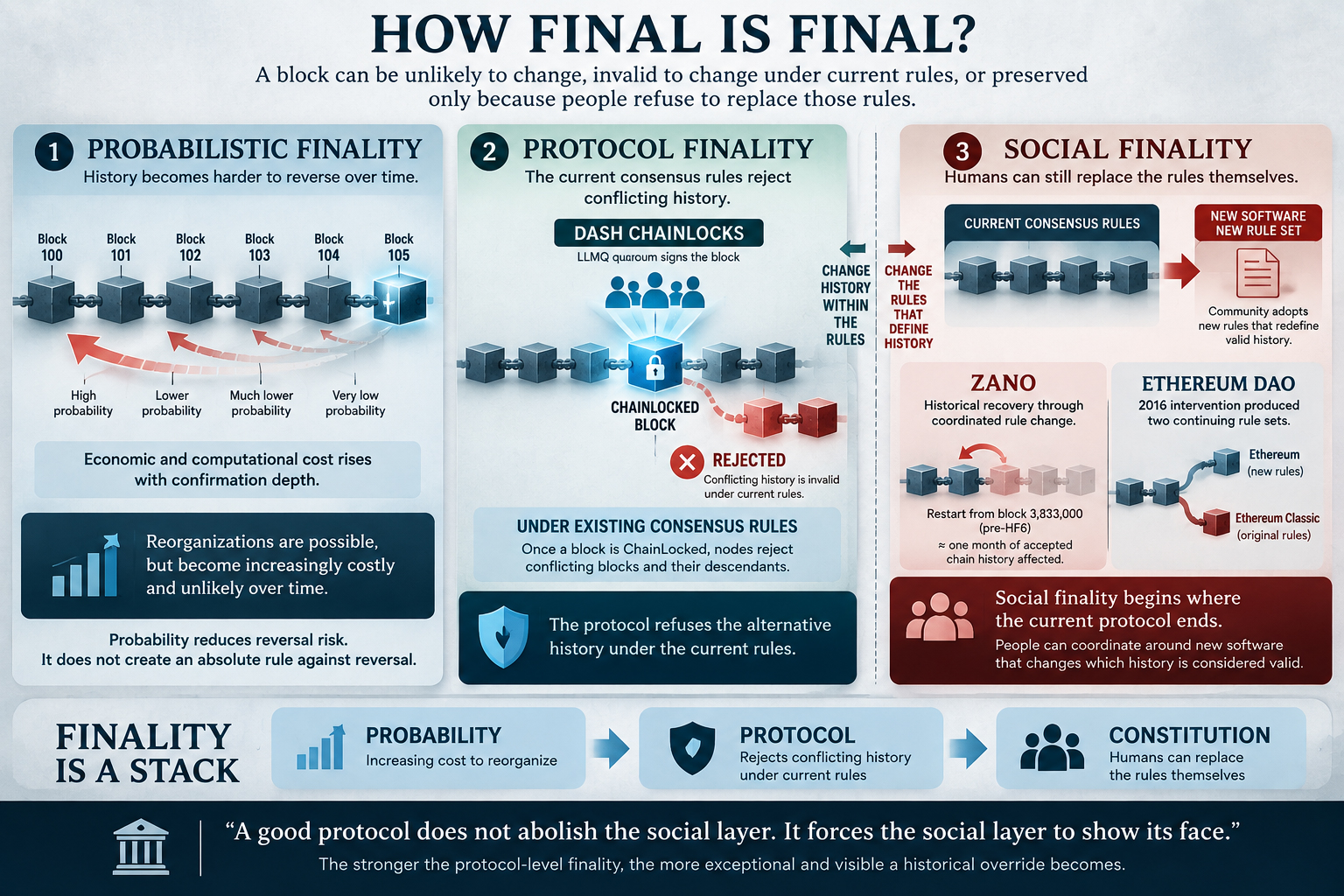
Dash ChainLocks use Long-Living Masternode Quorums. For each block, a selected quorum observes the active chain; once the threshold is reached, the quorum produces a ChainLock signature. A node receiving a valid signature rejects conflicting blocks at that height and their descendants. Dash documentation therefore describes reorganizations below a ChainLocked block as impossible under the existing rules.[6]
This is a meaningful form of finality.
It is not metaphysical finality.
A ChainLock can tell existing Dash software: do not reorganize below this point. It cannot prevent humans from writing, distributing and voluntarily adopting different software containing an explicit exceptional rule.
That distinction suggests three layers:
Three Layers of Finality
- Probabilistic finality: reversing history becomes increasingly unlikely or increasingly expensive as confirmations accumulate.
- Protocol finality: the current consensus rules instruct compliant nodes to reject a conflicting history.
- Social finality: participants remain unwilling to replace the rules themselves in order to authorize an exception.
This is why saying that ChainLocks make a deliberate rollback literally impossible would be too strong.
They do something more interesting.
They can force a rollback below a locked block to become visibly exceptional. Instead of arising through ordinary fork choice, the change would require an explicit departure from the existing constitution.
A good finality mechanism does not abolish the social layer. It forces the social layer to show its face.
Ethereum’s 2016 DAO fork remains the canonical historical example. At block 1,920,000, the fork performed an irregular state change that moved ether associated with the DAO incident into a recovery contract. The no-fork chain continued and became Ethereum Classic.[7]
The blockchain did not solve the disagreement by discovering one objectively correct definition of immutability.
People selected different constitutions.
V. Bugs Are Monetary Policy Too
The DERO and Zano incidents should not be interpreted as evidence that privacy-oriented networks uniquely suffer monetary bugs.
They do not.
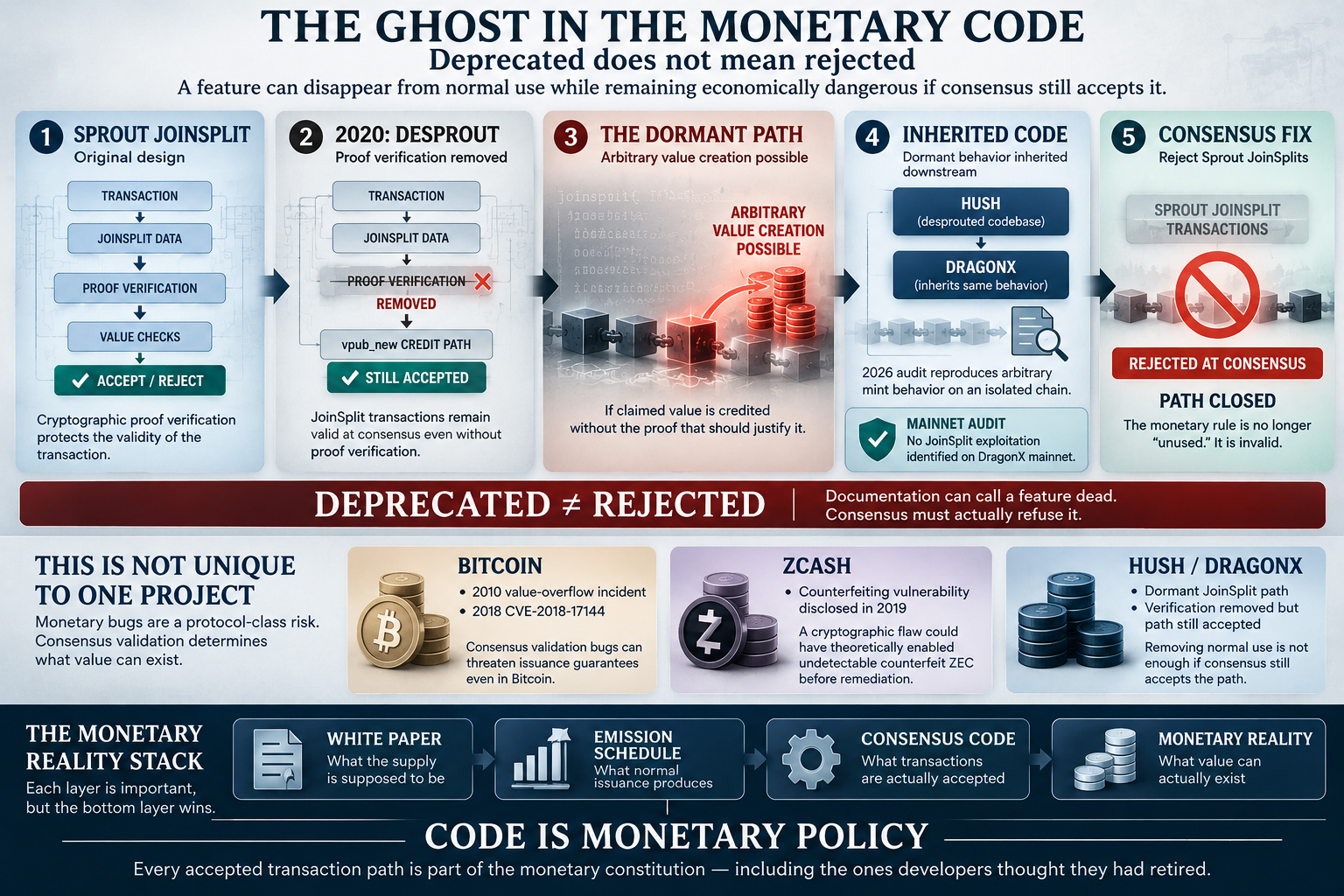
Bitcoin Core disclosed CVE-2018-17144 in September 2018: a critical validation flaw that could have allowed a miner to inflate Bitcoin’s supply by effectively spending the same input twice inside a block under certain conditions. Bitcoin Core reported no known exploitation and released a patch before public full disclosure.[9]
Zcash disclosed in 2019 that a vulnerability in the cryptography underlying certain zero-knowledge proofs had existed before the Sapling upgrade. Before remediation, it could theoretically have allowed counterfeit ZEC to be created without detection. Zcash said it found no evidence that the vulnerability had been exploited and that Sapling had already removed the vulnerable construction.[10]
The Hush-lineage JoinSplit issue discovered through DragonX in 2026 is especially instructive because the flaw lived in code everybody effectively regarded as dead.
DragonX’s post-mortem traces the problem to a 2020 Hush “desprout” change. Proof verification for obsolete Sprout JoinSplits had been removed, but the old path that credited a JoinSplit’s claimed vpub_new value remained. Nothing at consensus rejected a transaction merely because it still carried a JoinSplit. DragonX reproduced a 500,000-coin arbitrary mint on an isolated chain, then audited more than 3.1 million mainnet blocks and reported zero JoinSplits and a supply matching its emission schedule. Its fix was conceptually simple: reject any transaction carrying the obsolete structure.[8]
Deprecated is documentation. Rejected is consensus.
The lesson is larger than software hygiene.
A cryptocurrency can publish a fixed cap, a tail emission, a block reward or a twenty-year distribution curve. None of those statements is the monetary policy by itself.
The true policy is the complete set of invariants that prevents every other way of manufacturing spendable value.
That means forgotten validation paths are monetary policy.
Proof verification is monetary policy.
Integer arithmetic is monetary policy.
Replay protection is monetary policy.
Cryptographic soundness is monetary policy.
The monetary constitution is executable.
VI. Your Coins, Until Someone Says Otherwise
Then came Bitget.
At 18:31 UTC on September 24, 2026, Bitget detected unauthorized transfers from part of its hot-wallet infrastructure. Its initial estimate was approximately $351.6 million. A later accounting raised the figure to about $387.5 million after additional Zcash and TRON transfers were identified. Bitget said cold wallets were unaffected and that its protection fund covered the financial impact.[11][12]
The exchange suspended withdrawals while deposits and trading continued. It later announced a phased restoration beginning with Bitcoin on September 28 and extending through other assets, fiat and P2P by October 2.[13]
There is an important distinction here that gets lost whenever solvency, reimbursement protection and sovereignty are treated as synonyms.
Bitget may compensate every user.
Its protection fund may absorb the loss.
Every account balance may remain numerically correct.
Those facts do not change the custody relationship.
During the suspension, the exchange controlled whether a customer could convert an account balance into an external blockchain transaction.
A protection fund can protect a claim. It cannot transform a claim into self-custody.
This is not an accusation against Bitget for pausing withdrawals during a security emergency. A custodian facing an active compromise may have compelling reasons to stop outbound movement while it verifies its systems.
The point is architectural.
A custodial balance is a relationship with an institution. Even when the underlying asset is censorship-resistant, the account through which you access it is not.
The private key is the line between those two systems.
VII. The Coins That Can Be Frozen
The Bitget incident then produced an unusually clean demonstration of a second distinction: a blockchain token is not necessarily a bearer asset.
Circle and Tether blacklisted a wallet associated with the breach, immobilizing roughly $318,000 in USDC and USDT. Other attacker-linked wallets held large quantities of ether that no token issuer could freeze because native ETH has no equivalent issuer with a blacklist switch.[14]
The same contrast appeared on XRP Ledger. CoinDesk reported that roughly $83 million of stolen XRP moved from attacker-controlled wallets while noting that Ripple could not freeze those wallets at the native protocol level. Exchanges could still refuse deposits or restrict accounts under their own control.[15]
This is not a moral verdict on stablecoins.
Issuer intervention can be useful. It can stop stolen assets. It can satisfy court orders. It can immobilize some stolen assets and facilitate recovery. It can make regulated institutions more comfortable holding the instrument.
It also means the asset contains an additional sovereign.
A user does not merely depend on the consensus rules of Ethereum, Tron, Solana or another host chain. The user also depends on an issuer that retains authority over whether specific token balances remain transferable.
That is a different object from a native bearer asset.
Two Kinds of Digital Possession
- Issuer-controlled token: possession of the private key is necessary, but the issuer may retain a separate ability to blacklist or otherwise restrict the token.
- Native bearer asset: transferability is determined by the base protocol and valid key authorization, without a separate token issuer able to revoke an address’s spending capability.
The difference is easy to ignore until the freeze button is actually pressed.
Then the monetary hierarchy becomes visible.
VIII. The THORChain Test
Bitget’s stolen assets did not remain in one place.
Some moved through decentralized liquidity infrastructure, including THORChain. On September 26, Bitget CEO Gracy Chen publicly asked THORChain to refuse service to the published attacker addresses, arguing that decentralization should not function as a shield for known stolen funds.[16]
THORChain responded by comparing itself to permissionless base networks and asking what responsibility Bitcoin, Ethereum and BNB Chain should bear when stolen funds move through them.[17][18]
That comparison immediately produced a counterargument.
OKX founder Star Xu pointed to THORChain’s threshold-signature vault architecture and argued that distributing an intermediary does not necessarily eliminate the intermediary. His criticism focused on the fact that THORChain’s validator set collectively participates in control of vault-held native assets and that the system contains governance mechanisms capable of stopping activity.[21]
The May 2026 exploit proves at least the second part.
THORChain’s own report says a newly churned node operator exploited a vulnerability in the GG20 threshold-signature implementation and drained approximately $10.7 million from one vault. Automated solvency checks began halting affected activity. Node operators then stacked manual pauses and used Mimir governance to halt trading, signing, chain observation and churning. THORChain’s quarterly report says the network remained halted for roughly five weeks before restarting on June 22.[19][20]
So the useful conclusion is not:
THORChain cannot stop.
It can.
Nor is the useful conclusion:
THORChain must therefore blacklist whatever address an exchange identifies.
That does not follow either.
The deeper distinction is between two kinds of intervention.
Protocol Self-Defense vs. Provenance Censorship
- Protocol self-defense: stop or constrain operations because the protocol itself is becoming insolvent, cryptographically compromised or incapable of safely executing its own rules.
- Provenance censorship: continue operating normally, but reject an otherwise valid user or address because an external actor has classified the associated funds or identity as unacceptable.
Those powers can coexist technically while being treated very differently constitutionally.
THORChain’s own public description emphasizes permissionless access, no KYC and a design without a centralized intermediary able to censor or confiscate a trade.[22]
The Bitget request therefore asks more than whether nodes can press an emergency button.
It asks whether the network should turn an emergency capability into an address-level adjudication system.
That is a different constitution.
IX. The Oracle of Guilt
The easiest version of censorship resistance is rhetorical.
Transactions we approve of should be unstoppable.
That is not a difficult principle to defend.
The difficult test arrives when the user is unsympathetic.
A thief is an excellent example because the moral instinct is immediate: stop the money.
Sometimes that is possible. A custodian can freeze an account. A token issuer can blacklist a balance. A court can direct a regulated intermediary. An exchange can reject deposits. Law enforcement can seize assets when it obtains control of the relevant keys or endpoint.
But a protocol-level blacklist creates a different problem.
Who supplies the list?
Bitget?
MistTrack?
Chainalysis?
A court in one jurisdiction?
A sanctions authority in another?
A consortium of exchanges?
A validator vote?
A front end?
An automated risk score?
What standard of evidence is required?
What happens when authorities disagree?
How does an innocent recipient challenge a false classification?
How many hops does taint survive?
Can the same mechanism later be used for capital controls, prohibited donations, politically disfavored organizations, privacy tools or an unpopular but lawful person?
None of those questions proves that every blacklist is illegitimate.
They prove that a blacklist is governance.
The moment a protocol must distinguish the guilty coin from the innocent coin, somebody must become the oracle of guilt.
This is the point where financial surveillance and censorship resistance meet.
A transparent transaction graph makes provenance legible.
Legible provenance permits classification.
Classification permits differential treatment.
Differential treatment turns nominally identical units into economically different objects.
That is a fungibility problem.
X. Observation Becomes Permission
The censorship pipeline developed in The Permission Layer was:
Observation → Classification → Exclusion.
The Bitget-THORChain dispute shows the same pipeline under emergency conditions.
First, identify the attacker addresses.
Then trace the transaction graph.
Then classify connected funds.
Then ask intermediaries, issuers or protocols to refuse them.
Financial intelligence can be useful. It can support investigation, recovery and prosecution. But the architectural consequence should not be obscured.
If every unit carries a publicly reconstructable pedigree, institutions can decide that one unit of the same nominal asset is less acceptable than another.
Privacy by default attacks this problem at a different layer.
Instead of asking for better rules about which visible histories should be blacklisted, it reduces the amount of reusable transaction history available to become a blacklist in the first place.
That comes with a real trade-off.
Strong privacy can make stolen funds harder to trace. It can make some forms of recovery more difficult. It can also make conventional provenance proofs harder than they are on a transparent chain. Those costs should be stated plainly.
But the benefit is equally real.
A private transaction does not arrive at every future counterparty carrying an indefinitely inspectable dossier of previous owners.
Fungibility ceases to depend on everyone agreeing about the meaning of a public transaction graph.
Privacy is not a mechanism for deciding which surveillance is righteous. It is a mechanism for limiting how easily transactional history becomes permission.
This is why the argument for privacy is inseparable from the argument for censorship resistance.
Not because private money makes law disappear.
Because it changes the layer at which enforcement must occur.
XI. The Sovereignty Stack
The incidents now fit together.
They are not five unrelated failures.
They are five questions about veto power.
| Power | Question | Cases that expose it |
|---|---|---|
| MINT | Can spendable value be created outside the intended monetary rules? | DERO; Hush-lineage JoinSplit bug; Bitcoin CVE-2018-17144; Zcash counterfeiting vulnerability. |
| REWRITE | Who can change accepted history, and how explicit must the exception become? | Zano recovery; DERO refusal; Dash ChainLocks; Ethereum DAO fork. |
| FREEZE | Can an intermediary or issuer immobilize assets despite valid keys? | Bitget withdrawal pause; USDT and USDC blacklists. |
| REFUSE | Can infrastructure selectively reject an otherwise valid user, address or transaction? | THORChain debate; exchanges and other regulated gateways. |
| OBSERVE | Can activity be persistently mapped well enough to support future classification? | Transparent ledgers, chain analytics, wallet attribution and privacy-by-default alternatives. |
This framework makes several apparent contradictions disappear.
A network can be decentralized in consensus and centralized in liquidity.
An asset can be self-custodied and issuer-freezable.
A protocol can be permissionless in ordinary operation and still possess emergency halt governance.
A chain can preserve historical continuity while carrying unauthorized spendable value.
A chain can restore monetary integrity while sacrificing historical continuity.
A private system can protect fungibility while making forensic reconstruction more difficult.
There is no single decentralization score that resolves those trade-offs.
There is only architecture.
XII. Where Ryo Fits
This is where an article published by ryo.news has to be especially careful.
The wrong conclusion would be:
Other networks failed. Ryo fixes everything.
That would repeat the exact mistake this article has spent thousands of words criticizing.
No architecture earns sovereignty through branding.
Ryo’s current network remains in its GPU Proof-of-Work distribution era. Its published roadmap points toward Halo 2 zero-knowledge proofs, a high-latency mixnet for network metadata privacy and a future private Proof-of-Stake consensus era. Those roadmap items should be treated as development direction, not as capabilities already operating on mainnet.[23]
The incidents examined here provide a better way to evaluate that roadmap.
The Same Questions Must Be Asked of Ryo
- MINT: What cryptographic and consensus invariants prove that hidden transaction values still conserve supply?
- REWRITE: Under a future private Proof-of-Stake design, when is a block final, and what would be required to reverse finalized history?
- FREEZE: Can any privileged key, validator coalition or governance path immobilize another user’s funds?
- REFUSE: Can validators selectively censor transactions, and what mechanisms make sustained censorship difficult or observable?
- OBSERVE: Do transaction privacy and the planned mixnet jointly reduce both ledger-level and network-level reconstruction?
The DERO incident adds another requirement: privacy must hide the individual without hiding violations of the monetary constitution.
That is one of the deepest engineering problems in private digital money.
Users should not need to expose their balances and counterparties to prove that nobody created money from nothing. The purpose of zero-knowledge cryptography is precisely to allow validity without universal disclosure. But a proof system is only as sound as the statements, circuits, consensus rules and implementation around it.
The Zano incident adds a different requirement: emergency governance must be explicit.
If a future Ryo network encountered a catastrophic consensus failure, who could recommend a recovery? What threshold would cause nodes to accept it? Would finality rules make the exception mechanically difficult? Would alternative software remain possible? Would ordinary holders know which rules were being changed and why?
The THORChain dispute adds another: censorship resistance must be more than the absence of one administrator key.
If a validator system possesses emergency halts, those controls should be understood as constitutional powers. If they cannot be used selectively, that limitation should be legible. If they can, the threshold and scope should be legible.
And the Bitget episode returns the discussion to access.
A private bearer asset does not eliminate exchanges. It does not make fiat gateways disappear. It does not prevent an institution from choosing whom it serves.
This is why monetary sovereignty requires more than a private chain. It requires self-custody, censorship-resistant consensus, strong finality, auditable supply invariants, network privacy and access to liquidity without a single mandatory gatekeeper.
Ryo’s planned architecture should be judged against that standard precisely because the standard is hard.
A sovereignty project deserves harder questions, not softer ones.
XIII. Who Gets the Red Button?
The incidents of 2026 have given us a useful map.
DERO showed that spendable money can appear while the books still balance.
Zano showed that a community may choose monetary restoration over historical continuity.
Dash shows how protocol architecture can make ordinary rewriting much more difficult without pretending to eliminate human coordination.
Hush’s dormant JoinSplit path, Bitcoin Core’s inflation bug and Zcash’s counterfeiting vulnerability show that scarcity ultimately depends on correct validation, not on a number printed in a supply schedule.
Bitget showed the difference between a custodial claim backed by a protection fund and unilateral control of an asset.
Circle and Tether showed what issuer-level reversibility looks like in practice.
THORChain showed that a system can contain genuine emergency governance while still resisting the demand to convert that governance into a blacklist.
And the entire dispute showed why surveillance, fungibility and censorship are not separate subjects.
To observe is not necessarily to censor.
But observation creates the information from which classification can be built.
Classification creates the categories from which permission can be granted or denied.
The architecture of freedom therefore begins before the moment someone presses a button.
It begins with deciding whether the button exists.
Who holds it.
How many people must agree to press it.
What exactly it can do.
Whether its use is visible.
Whether anyone can refuse the new rules.
And whether the system was designed so that the button is unnecessary for ordinary life.
Monetary sovereignty is not the absence of rules. It is freedom from somebody else’s easy veto over your money.
That is why decentralization cannot be reduced to node count, validator count, hash rate, token distribution or whether a project has a company behind it.
Those measurements matter.
But the deeper test arrives in the exception.
Who can mint?
Who can rewrite?
Who can freeze?
Who can refuse?
Who can observe?
Answer those five questions and the hidden constitution becomes visible.
Then ask the final one:
Who gets the red button?
Further Reading from ryo.news
The Permission Layer: Debanking and the Power to Exclude
Why possession of money and practical access to financial infrastructure are not the same thing.
From Account KYC to Wallet KYC: When Identity Becomes Financial Infrastructure
How verified identity, wallet attribution and transaction analysis can turn the wallet itself into a permissioned endpoint.
The End of the Ring: Privacy Coins and the Architecture of Digital Sovereignty
Why transaction privacy, network privacy, consensus, distribution and access have to be evaluated as one sovereignty stack.
The Capital Control Problem: Stablecoins, Crypto and the End of the Old Monetary Perimeter
How alternative monetary rails interact with regulated gateways, stablecoins and state control over financial access.
References
- DERO Foundation. The DERO Double-Spend: What Happened, What It Created, and Why It Cannot Happen Again. 1 September 2026. The Foundation reports at least 23,886,517.3 DERO of additional spendable balances, paired with equal frozen negative balances, and states that fourteen affected transactions cannot be decoded.
- DERO Project. Project statement following publication of the forensic record. September 2026. The project states: “No rollback, no relaunch, no reissue,” and says it will report a separately labelled created-supply floor alongside the scheduled supply figure.
- Zano. Zano Monthly Project Update #23 — August 2026. 10 September 2026. Hard Fork 6 activated at block 3,833,000 on 26 August and introduced Gateway Address infrastructure. See also Zano Gateway Address documentation.
- Zano Team. Security update and coordinated upgrade. 25 September 2026. The team disclosed a vulnerability in public Gateway Addresses affecting asset issuance, including fUSD, while stating that transaction privacy and spend keys were not compromised.
- Zano Project. Recovery update on the Gateway Address vulnerability. 27 September 2026. The update says unauthorized ZANO and fUSD entered circulation and the blockchain was restarted from block 3,833,000, immediately before HF6, affecting approximately one month of chain history. The same recovery announcement is also reproduced on the official Zano forum and on r/Zano.
- Dash Core Documentation. ChainLocks. Current documentation accessed September 2026. Dash describes LLMQ-signed ChainLocks and states that compliant nodes reject conflicting blocks at the locked height and their descendants.
- Ethereum Foundation / Ethereum Improvement Proposals. Hard Fork Completed, 20 July 2016; and EIP-779: Hardfork Meta: DAO Fork. The fork introduced an irregular state change at block 1,920,000; the no-fork chain continued as Ethereum Classic.
- DragonX. Security Post-Mortem — The Sprout JoinSplit Inflation Bug. 12 July 2026. DragonX traces the dormant vulnerability to Hush’s 2020
f13171e“desprout” commit, reports successful isolated-chain reproduction, and states that its mainnet audit found zero JoinSplit transactions and no exploitation. - Bitcoin Core. Disclosure of CVE-2018-17144. 20 September 2018. Bitcoin Core described a critical inflation vulnerability that could have allowed a miner to inflate supply by spending the same input twice under specified conditions; it reported no known exploitation.
- Zcash. Zcash Counterfeiting Vulnerability Successfully Remediated. 5 February 2019. Zcash said the pre-Sapling vulnerability could have permitted undetectable counterfeiting, was fixed by the 28 October 2018 Sapling upgrade and had no known exploitation.
- Bitget. Security Notice: Bitget Hot Wallet Incident — September 24, 2026. 24 September 2026. Initial estimate: approximately $351.6 million; cold wallets reported secure; withdrawals temporarily suspended.
- Bitget. Bitget Security Latest Incident Update: Fund Tracing and Recovery Bounty Program. 25 September 2026. Bitget revised the amount transferred to attacker-controlled addresses to approximately $387.5 million after including additional Zcash and TRON assets.
- Bitget. Bitget to Resume Withdrawals in Phases. 26 September 2026. The schedule begins with BTC on 28 September and extends through other tokens, fiat and P2P on 2 October.
- CoinDesk. Circle and Tether step in to freeze hacker wallet after massive Bitget crypto heist. 25 September 2026. Reports approximately $318,000 in USDC and USDT frozen at an attacker-linked address while other attacker wallets held native ETH without an issuer-level freeze mechanism.
- CoinDesk. Bitget hacker moves $83 million in stolen XRP that Ripple cannot freeze. 26 September 2026. The report distinguishes native XRP from issuer-blacklistable stablecoins while noting that exchanges can still restrict receiving accounts.
- Gracy Chen, Bitget CEO. Public request to THORChain regarding Bitget attacker addresses. 26 September 2026. The post formally asks THORChain to refuse service to publicly identified attacker addresses.
- THORChain. Response to Bitget request. 26 September 2026. THORChain invoked its decentralized, permissionless design and compared the issue to stolen funds moving through base-layer networks.
- Bitcoin.com. Bitget CEO Wants Thorchain to Block Hackers, but There’s a Catch. 26 September 2026. Contemporary reporting reproducing the Bitget and THORChain statements and providing context on the dispute.
- THORChain. THORChain Exploit Report #1. 20 May 2026. Reports approximately $10.7 million drained from one vault and documents automatic solvency halts, manual node pauses and Mimir governance used to stop network activity.
- THORChain. THORChain Quarterly Report — Q2 2026. 17 July 2026. Reports that the May exploit led to a roughly five-week network halt and a June 22 restart.
- Star Xu. Commentary on THORChain’s TSS vault architecture and the Bitget dispute. 27 September 2026. See also CryptoCompass coverage summarizing his architectural argument.
- THORChain. Building the Crypto Exchange of the Future. Current project description accessed September 2026. THORChain describes its exchange layer as permissionless, no-KYC and designed around self-custody and native cross-chain assets.
- Ryo Currency / ryo.news. Official Ryo Currency website, current network and Halo 2 development direction; see also The End of the Ring: Privacy Coins and the Architecture of Digital Sovereignty for the published roadmap context covering the high-latency mixnet and future Proof-of-Stake direction. Accessed September 2026.
- Dr. Max Anon. The Permission Layer: Debanking and the Power to Exclude. ryo.news, September 2026.
- Dr. Max Anon. From Account KYC to Wallet KYC: When Identity Becomes Financial Infrastructure. ryo.news, 20 September 2026.
- Privacy Coin Report. The End of the Ring: Privacy Coins and the Architecture of Digital Sovereignty. ryo.news, August 2026.
This article is for research and informational purposes only. It does not constitute investment, legal, financial or compliance advice.