



Network States & Digital Polities · Building the Network State
The Anatomy of a Network State: From Club to Constitution
Identity can create a nation and capital can give it economic gravity. Neither is enough to govern. The decisive transition comes when a voluntary network develops institutions that can make rules, resolve disputes, fund common goods, constrain power and travel with its members across geography.
By k1ngVV · September 28th, 2026
Building the Network State · Article 3 of 8
Article 1: Imagined Communities 2.0: How Digital Networks Are Reshaping National Identity
Previous: The Bitcoin Magnet: How Network Assets Create Economic Gravity
Executive Summary
The first two articles in this series described the first two layers of the Network State Stack. Imagined Communities 2.0 examined how dispersed individuals can become a coherent political community. The Bitcoin Magnet examined how a credible network asset can give that community economic gravity: savings, liquidity, infrastructure, treasury capacity and the means to act.
But a community with money is still not a polity. The missing layer is institutional capacity. A network becomes state-like only when it can convert voluntary association into durable collective order: membership rules, rights, public-goods funding, decision procedures, dispute resolution, sanctions, delegation, constitutional limits and mechanisms through which members can challenge decisions without simply abandoning the network.
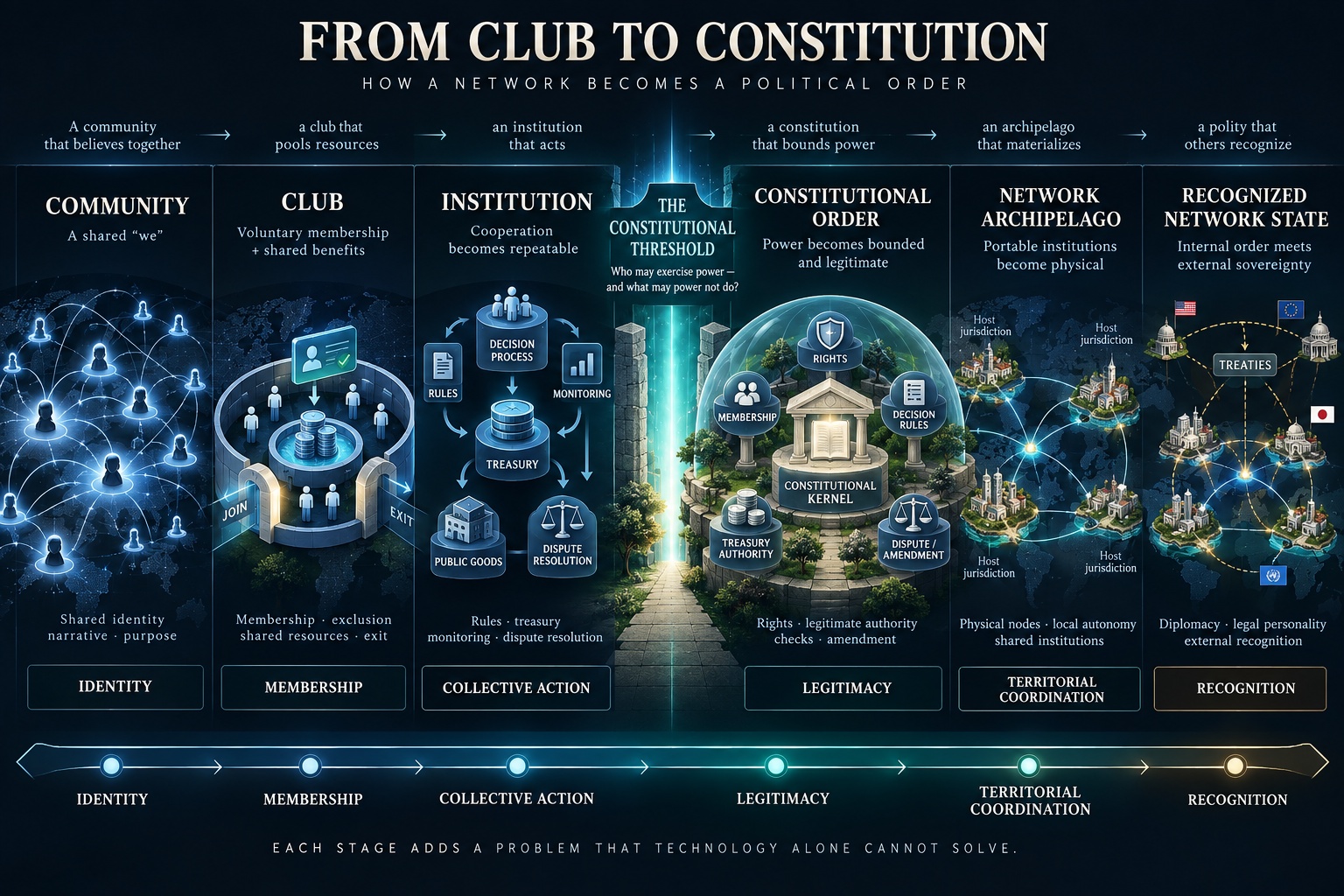
This article argues that the decisive transition is not merely online to offline. It is club to constitution. James Buchanan’s theory of clubs helps explain the early network union: a voluntary membership community that can exclude non-members from shared benefits. Mancur Olson explains why shared interests do not automatically produce collective action. Elinor Ostrom shows how communities can build durable self-governing institutions through clear boundaries, participatory rule-making, monitoring, conflict resolution, graduated sanctions and nested layers of governance.[2][3][13]
History also complicates the fantasy that networks become sovereign by simply escaping states. Medieval merchant coalitions, the Hanseatic world, modern internet institutions, Estonia’s e-Residency programme and experimental crypto governance all point toward a more realistic model: portable institutions developing across and alongside territorial jurisdictions. The institution can become transnational before the territory becomes sovereign.
That creates a final problem. Traditional states gained administrative capacity partly by making populations legible: names, addresses, property, income, transactions and records. A digital polity could become even more legible than a territorial one. The alternative explored here is verifiability without total visibility: institutions capable of proving membership, eligibility or authority without constructing a universal public dossier of the person. That is where privacy technology becomes constitutional infrastructure rather than merely a payment feature.
Key Takeaways
- The real transition is club to constitution. Voluntary membership and a shared treasury can start a network union; durable governance requires institutions that remain legitimate when members disagree.
- Shared identity does not guarantee collective action. Networks must solve free-riding, participation, monitoring, enforcement and public-goods problems as they scale.
- The strongest model is polycentric, not monolithic. A small constitutional kernel can define network-wide rights and responsibilities while local physical nodes retain authority over local conditions.
- Code is coordination technology, not a complete theory of government. A smart contract can execute a decision; it cannot determine whether the rule was legitimate, whether a minority was protected or whether the rule should exist.
- Exit cannot substitute for voice. Forking and leaving are important safeguards, but a durable polity needs ways to repair institutions without requiring members to abandon them.
- Privacy becomes a constitutional question. A digital state may need to verify facts about members without making their finances, identity and political participation universally observable.
Conceptual continuity: Imagined Communities 2.0 asked how a digital population becomes a political “we.” The Bitcoin Magnet asked how that community develops economic gravity. This article examines the next layer: how we becomes an institution. It also connects the network-state thesis to the surveillance questions developed in The Permission Layer, From Account KYC to Wallet KYC and The End of the Ring.
I. The Missing Layer
There is a seductive simplicity to the network-state story.
Find people online. Build a community. Create a treasury. Buy property. Link the properties together. Grow large enough to receive diplomatic recognition.
Balaji Srinivasan’s formulation is deliberately concrete. A network union is a fully digital organization capable of collective action. A network archipelago is a network union that begins acquiring and networking physical properties. A network state is a network archipelago that gains diplomatic recognition from at least one existing state. His fuller definition also includes a consensual government, an integrated cryptocurrency and an on-chain census demonstrating population, income and real-estate footprint.[1]
Those stages are useful because they describe what the network acquires.
But they leave a deeper question open:
What must a network become before owning land means anything politically?
A Telegram group that purchases an apartment has property.
A corporation with offices in five countries has an archipelago.
A cryptocurrency community can have a treasury larger than the budget of a small municipality.
None of those facts creates a polity.
The missing layer is institutional. A political community must be able to make decisions that persist beyond one charismatic founder, one market cycle and one moment of enthusiasm. It must be able to distinguish a member from an outsider, allocate common resources, define authority, resolve disputes and decide what happens when rules are broken. It must also constrain the institutions it creates, because the ability to make decisions is inseparable from the ability to abuse them.
Article 1 gave the Network State Stack its identity layer. Article 2 gave it capital.
The third layer is coordination, but coordination is too weak a word if it means merely voting, messaging or executing transactions.
The real object is an institutional order.
Identity answers: Who are we?
Capital answers: What can we build together?
Institutions answer the harder question:
What happens when we disagree?
Featured in the Ryo Directory
Businesses accepting RYO
II. From Club to Constitution
One way to understand an early network union is not as a proto-state at all, but as a club.
James Buchanan’s 1965 “An Economic Theory of Clubs” examined membership arrangements that occupy the space between purely private goods and fully public goods. Club goods can be shared among members while access remains excludable; the size of the membership affects both costs and benefits.[2]
The analogy to an early digital polity is striking.
Membership is voluntary. Access can be restricted. Members can share services, infrastructure, information and a treasury. Contributions may finance benefits available only to the group. If the club ceases to provide value, members can leave.
A small network union can operate this way for a long time.
It can fund software. Operate communications systems. Negotiate discounts. Run conferences. Maintain shared property. Create member-only services. Pool capital. Even acquire houses or workspaces.
But scale introduces a problem.
Mancur Olson’s The Logic of Collective Action attacked the assumption that people who share an interest will therefore organize effectively to pursue it. When the benefits of collective action are shared, individuals can have incentives to enjoy the result without paying the cost of producing it. Large groups can therefore struggle with participation, funding and free-riding even when almost everyone agrees that the collective good is desirable.[3]
That distinction matters enormously for network states.
Shared identity is not collective capacity.
A million people may share a symbol, an asset and a grievance while remaining incapable of maintaining a road, funding a court, policing a common treasury or agreeing on a constitutional amendment.
The larger the network becomes, the more questions appear that cannot be solved by friendship or founder discretion:
- Who qualifies for membership?
- What rights attach to membership?
- Can membership be revoked, and by whom?
- How are shared costs allocated?
- Who can spend treasury assets?
- What decisions require a simple majority, a supermajority or no vote at all?
- Who decides whether a rule was violated?
- How can an adverse decision be appealed?
- What prevents a wealthy faction from buying control?
- Which rights remain protected even if a majority wants to remove them?
At that point the network has crossed a threshold. It is no longer merely deciding how to distribute club benefits. It is defining legitimate authority.
That is the transition from club to constitution.
III. Institutions Before Territory
The idea that institutions can precede territorial sovereignty is not new.
Long-distance merchants faced a version of the network-state problem centuries before the internet: how do people separated by geography transact with strangers, supervise agents and enforce obligations when no single political authority can observe every interaction?
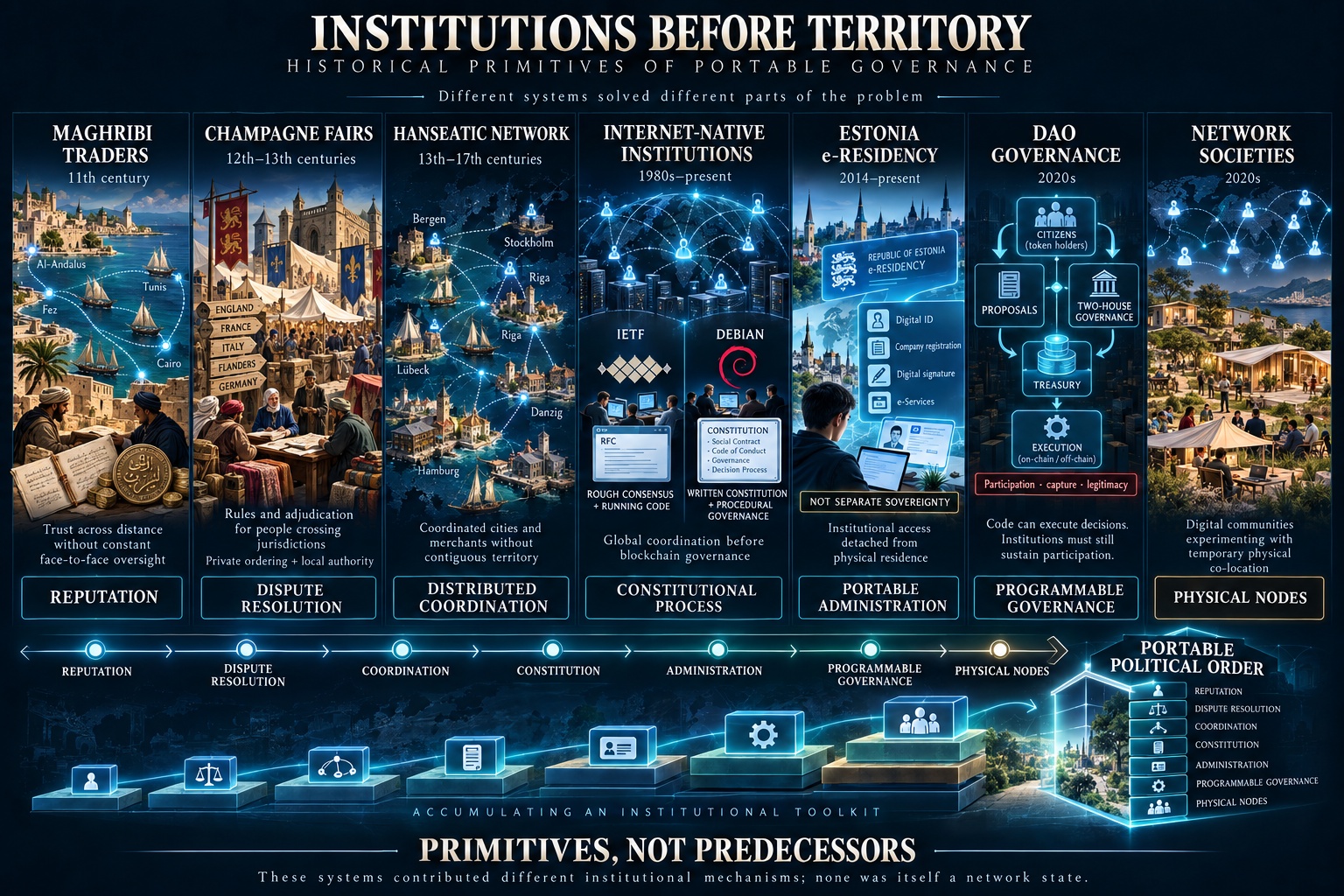
Avner Greif’s work on the eleventh-century Maghribi traders examined a coalition in which reputation helped merchants manage relationships with overseas agents under conditions of asymmetric information and limited legal contract enforceability. Future commercial opportunities could depend on past conduct, making reputation itself part of the enforcement mechanism.[4]
This history is often simplified into a much grander claim: that medieval merchants spontaneously created a universal private “Law Merchant” outside the state.
That version is too neat.
Legal historian Emily Kadens has shown that the famous image of a universal, autonomous medieval lex mercatoria is heavily mythologized. Medieval merchants also depended on municipal law, market authorities, courts, notaries, privileges and territorial governments. Private ordering existed, but it did not float in a legal vacuum.[5]
That correction makes the historical analogy more useful for network states, not less.
Portable institutions do not have to replace territorial institutions before they become consequential.
The Hanseatic League provides an even larger example. It developed from associations of long-distance merchants into a loose network of cities and trading posts spanning the Baltic and North Sea worlds. Hanseatic cities coordinated privileges, legal security and common action without becoming one contiguous territorial state. Its major foreign trading posts in Novgorod, London, Bruges and Bergen acted as durable physical nodes in a wider commercial network.[6]
The Hansa was not a network state in the modern sense. Its membership, political environment and coercive capacities belonged to a very different era.
What matters is the structure.
A translocal community can develop:
- shared identity;
- common privileges;
- rules of participation;
- reputation and enforcement systems;
- physical nodes;
- collective bargaining capacity; and
- institutional continuity across multiple jurisdictions
without first enclosing a single continuous territory.
This suggests a concept more fundamental than the network archipelago itself:
Institutional portability: the ability of a community’s rules, membership and common systems to remain coherent as its members move across geography.
Territory then becomes a place where the institution materializes rather than the source from which the institution derives.
IV. The Internet Was Governing Before the Blockchain
Cryptocurrency culture sometimes speaks as if decentralized governance began with token voting.
The internet has been running large, distributed institutions for decades.
The Internet Engineering Task Force is a particularly important example because its decision culture rejects both simple hierarchy and ordinary plebiscitary voting. RFC 7282 summarizes the famous IETF principle as “rough consensus and running code”: decisions should not be dictated by one ruler, reduced mechanically to a vote or detached from practical implementation. The goal is broad consent that takes serious objections into account while allowing work to proceed.[7]
Debian went further and wrote a constitution.
The Debian Project is a globally distributed association of developers building a free operating system. Its constitution, first ratified in 1998 and subsequently amended, defines decision-making bodies, elections, leadership, delegated authority, a technical committee, constitutional amendment and procedures for overriding decisions.[8]
Neither institution is a state.
Neither controls territory.
Neither needs a blockchain to prove that globally distributed communities can develop rules, offices, precedent, delegation, conflict procedures and durable institutional memory.
This matters because the blockchain solves a narrower problem than governance rhetoric often implies.
A blockchain can make records difficult to alter.
A smart contract can make execution conditional on specified inputs.
A cryptographic signature can demonstrate control of a key.
None of those primitives explains how a community should choose the rule being enforced.
Estonia demonstrates a different piece of the puzzle. Its e-Residency programme provides a state-backed digital identity that allows people around the world to access Estonian business services. As of September 22, 2026, Estonia reported more than 144,000 e-residents and more than 44,000 companies established by e-residents.[9]
Again, the boundary is as important as the achievement.
e-Residency makes parts of administration geographically portable. It does not make the e-resident a citizen of a new sovereign digital nation. The legal authority still comes from Estonia.
But the programme demonstrates that an institutional relationship once assumed to require physical presence can be detached from residence and delivered through a digital interface.
V. Coordination Technology Is Not Governance
Douglass North defined institutions as the humanly devised constraints that structure human interaction: formal rules, informal norms and the characteristics of enforcement. In his Nobel lecture, North argued that institutions form the incentive structure of society and that changing formal rules alone does not automatically reproduce the performance of institutions elsewhere.[10]
That distinction should be written across every DAO dashboard.
A governance token is a mechanism.
It is not a constitution.
Suppose a treasury has ten million dollars and voting power is proportional to token ownership. The system may be technologically decentralized. But the political questions remain untouched.
Why should wealth determine authority?
Should one holder of 30% of the asset possess 30% of political power?
Are some rights outside the reach of a token majority?
What happens when a proposal is technically valid but procedurally abusive?
Who interprets ambiguity?
Can the constitution itself be purchased?
These are not smart-contract questions.
They are constitutional questions.
Optimism provides a useful contemporary case because it experimented explicitly with alternatives to one-house token voting. Its governance architecture created a Token House alongside a Citizens’ House intended to represent a different constituency. But in June 2026, the Optimism Foundation announced that it would pause the Citizens’ House for the indefinite future, citing low and decreasing participation among the represented groups and a reassessment of governance needs. A subsequent operating-manual proposal removed Citizens’ House and joint-house voting while the body was paused.[11]
The lesson is not that bicameral governance failed or that token voting succeeded.
The lesson is more basic:
Inventing governance is easy. Sustaining participation in governance is hard.
The legitimacy problem sits underneath all of it.
Political theory distinguishes effective authority from legitimate authority. An institution can possess the practical ability to issue and enforce a decision without settling whether its authority is justified or accepted as rightful.[12]
This distinction becomes especially stark in code.
A contract may execute exactly as written.
The execution can still be unjust.
The procedure may be formally valid and socially illegitimate.
A majority can be real and a minority can still possess rights.
Code can enforce a decision. It cannot manufacture legitimacy.
VI. The Constitutional Kernel
If a global network should not be governed as one giant token vote, what should replace it?
Elinor Ostrom’s work provides a better starting point than the fantasy of one universal administrative machine.
Ostrom spent decades studying communities that successfully governed shared resources without reducing the solution to either centralized state control or pure privatization. Her research identified recurring characteristics of durable self-governing institutions: clearly defined boundaries; rules adapted to local circumstances; participation by people affected by the rules; monitoring; graduated sanctions; accessible conflict-resolution mechanisms; recognition of the community’s right to organize; and, for larger systems, governance organized in multiple nested layers.[13]
The last principle is especially important for a network state.
A global community with physical nodes in different countries should not attempt to decide every local issue at the global level.
The sanitation system of one settlement is not a network-wide constitutional question.
Neither is the opening time of a shared workspace, a local noise rule, a building-maintenance contract or the allocation of a neighborhood garden.
A durable network polity instead needs layers.
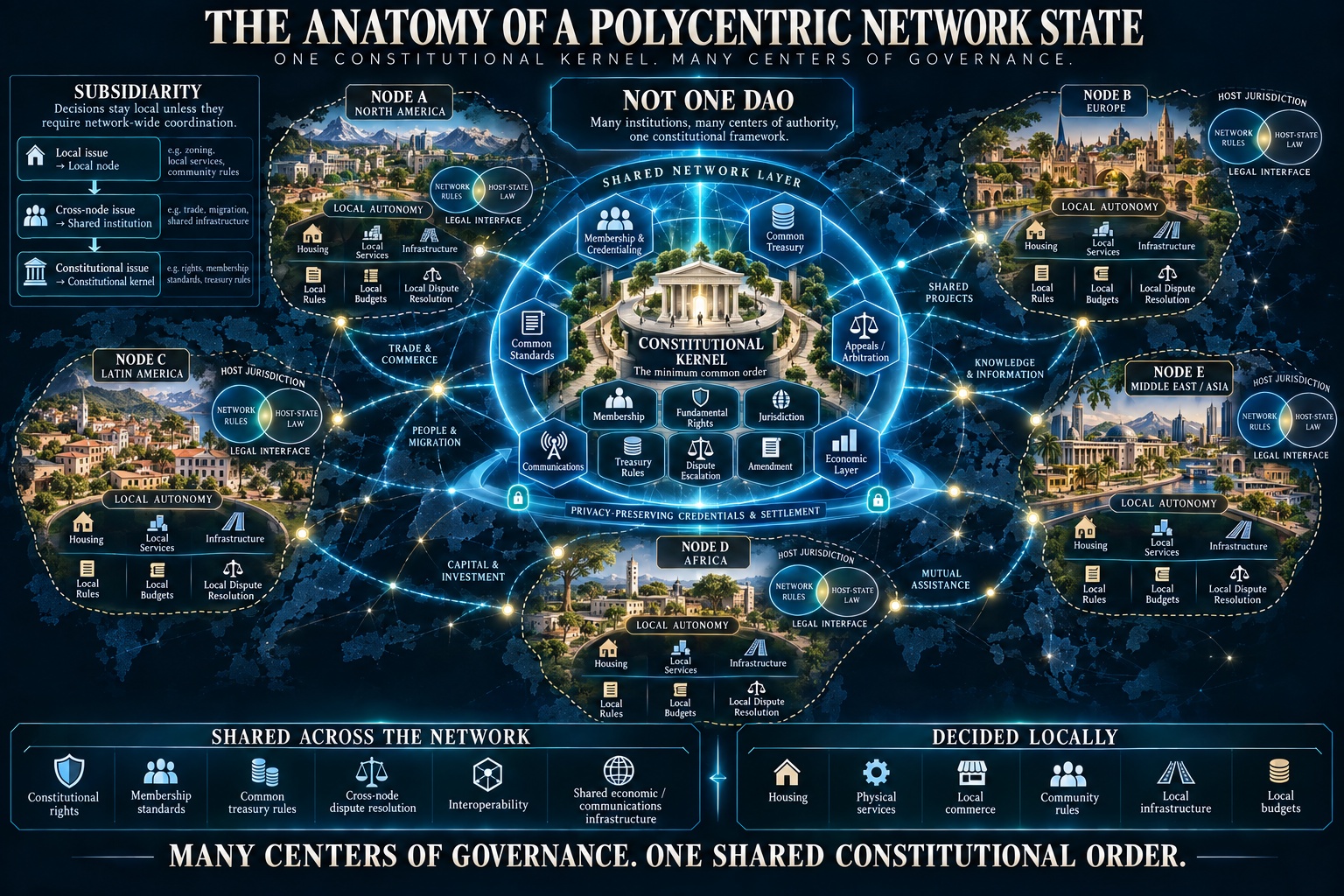
At the center sits what we can call the constitutional kernel: the smallest common layer of rules that must remain portable across the entire network.
A Possible Constitutional Kernel
- Membership: how someone joins, leaves, proves status and can be suspended or removed.
- Rights: protections that cannot be casually overridden by ordinary majorities.
- Treasury: who can authorize common spending and under what constraints.
- Delegation: which powers may be assigned to councils, experts, local nodes or automated systems.
- Dispute escalation: how local conflicts move upward when local procedures fail.
- Amendment: how the constitutional layer itself can change.
- Node relationship: what every physical node owes the network and what autonomy every node retains.
Everything else should face a presumption of local authority.
This produces a very different image of the network state from a global DAO with one treasury and one plebiscite.
It looks more like a polycentric system: multiple centers of decision-making operating with substantial autonomy while sharing a constitutional framework and mechanisms for coordination.
That structure is particularly well suited to an archipelago because the physical nodes will exist inside different legal, economic and cultural environments. A node in Kenya and a node in Portugal may share network citizenship, a treasury standard and constitutional rights while facing completely different zoning, employment, tax and infrastructure rules.
The network does not become coherent by pretending those differences do not exist.
It becomes coherent by deciding which differences are allowed to remain local.
VII. Exit Is Not Governance
Crypto culture has an unusually powerful constitutional weapon:
exit.
If you dislike a protocol, sell the token.
If you dislike the rules, fork the code.
If you dislike a community, leave the server.
If a validator set adopts rules you reject, coordinate around another chain.
Exit matters. The credible ability to leave constrains institutions in ways territorial monopolies often cannot.
But Albert Hirschman’s classic distinction between exit and voice explains why mobility alone cannot substitute for government. Exit means abandoning an organization or switching away from it. Voice means attempting to repair the organization from within.[14]
Healthy institutions require both.
Imagine a physical network node containing homes, families, schools, businesses and common infrastructure. A resident disagrees with a budget decision.
“Fork the community” is not a serious first-line dispute-resolution system.
Property cannot be duplicated with a Git command.
Children cannot fork schools every week.
Roads, water systems, leases, long-term contracts and human relationships create switching costs that software metaphors obscure.
The deeper a network state enters physical life, the more expensive exit becomes.
That makes voice more important, not less.
Members need appeals, representation, deliberation, local councils, constitutional challenges, recall mechanisms or some other credible process for saying:
The institution made the wrong decision, and I want to change it without destroying my membership in the institution.
A fork is the constitutional equivalent of secession. A polity that needs secession to resolve ordinary disagreements has not solved governance.
VIII. The Legibility Paradox
Once a network develops institutions, another problem appears.
Institutions need information.
Who is a member?
Who is eligible to vote?
Who already received a benefit?
Who has authority to spend?
Who owns a property?
Who satisfied a residency requirement?
The traditional answer is administrative legibility.
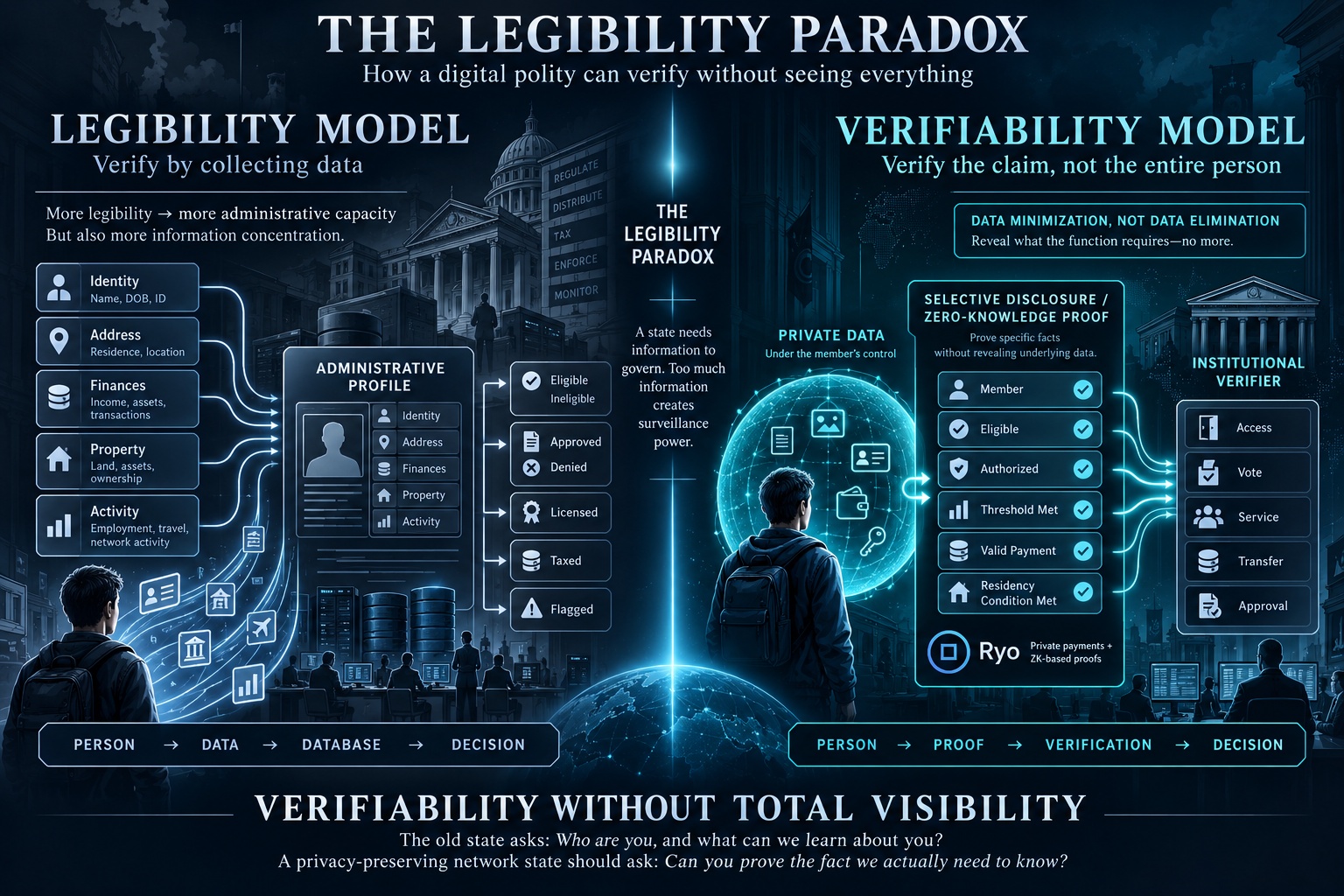
James C. Scott’s Seeing Like a State examined the tendency of large administrative systems to simplify complex societies into standardized categories that can be recorded, compared and governed. Names, addresses, property registers, maps, census records and standardized classifications increase administrative capacity by making populations easier for institutions to “see.”[15]
Digital systems can intensify that process dramatically.
Srinivasan’s network-state definition itself includes an on-chain census proving population, income and real-estate footprint.[1]
The political logic is understandable. A community asking for recognition wants to demonstrate that it is real.
But a public ledger creates a new possibility:
the perfectly legible citizen.
Identity linked to holdings.
Holdings linked to transactions.
Transactions linked to counterparties.
Voting linked to identity.
Identity linked to physical membership.
Physical membership linked to property.
The network state could accidentally build a surveillance system more comprehensive than the bureaucracies it hoped to transcend.
This is the legibility paradox:
The network needs enough information to govern, but the act of collecting that information can create the infrastructure for total observation.
There is another design path.
The W3C’s 2026 Digital Credentials Working Draft treats selective disclosure as a data-minimization technique: a holder should be able to disclose the minimum claims required by a verifier. The same work discusses unlinkable presentations, where repeated credential presentations should not automatically become linkable into one behavioral profile.[16]
Translate that principle into government.
An institution may need to know that:
- you are a valid member;
- you are old enough for a restricted activity;
- you have not already voted in a particular election;
- you satisfy a residency threshold;
- you are authorized to sign for a treasury; or
- you possess enough stake or reputation to perform a defined role.
It does not follow that every institution needs your full identity, complete balance, transaction history, political activity and social graph.
This suggests a constitutional principle for digital polities:
Verify the fact required for the decision. Do not automatically expose the person behind every fact.
That is verifiability without total visibility.
IX. Ryo and the Privacy Layer of Digital Institutions
This is where Ryo becomes relevant to Article 3 in a different way than it was relevant to Article 2.
The Bitcoin Magnet examined Ryo primarily as a potential capital layer: private-by-default money, long GPU distribution and a broader roadmap oriented toward future network-state infrastructure.
The institutional question is more subtle.
Ryo currently operates as a privacy-focused Proof-of-Work cryptocurrency. Its official site describes Ring Confidential Transactions with a default ring size of 25, GPU-oriented CryptoNight-GPU mining and a planned transition toward Halo 2 zero-knowledge proofs. The site explicitly describes that zero-knowledge migration as upcoming rather than current.[17]
That distinction matters. Ryo does not currently provide a finished private constitution for a network state. Nor does a privacy coin, by itself, solve membership, legitimacy, dispute resolution or political participation.
But privacy at the capital and proof layers changes the design space.
A transparent treasury architecture tends to make financial visibility the default and privacy an exception. A privacy-first architecture can reverse that presumption: common institutions disclose what must be public while ordinary personal economic activity remains private.
The same logic can extend beyond payments if future zero-knowledge systems are designed carefully.
The question becomes not merely:
Can the network hide a transaction?
But:
Can the institution establish eligibility without creating a permanent public identity map?
That question links this article directly to From Account KYC to Wallet KYC. That article examined the emerging institutional tendency to join verified identity, wallet control and transaction history into a reusable permission system. A network state that simply reproduces that architecture internally has not escaped the permission layer. It has internalized it.
The constitutional alternative is data minimization by design.
A citizen should not need to publish a balance to prove membership.
A voter should not necessarily need to reveal a permanent political identity to prove eligibility.
A treasury signer should not need to expose unrelated personal transactions to demonstrate authority.
A community should be able to prove aggregate strength without transforming every member into an open database row.
Financial privacy is not separate from constitutional design when the constitution itself is digital.
This is the most important reason Ryo belongs in the network-state discussion.
Not because one coin can substitute for institutions.
Because institutions built on transparent financial rails inherit a transparency assumption before the first constitutional debate even begins.
X. The Institution Before the Territory
We can now return to the network archipelago.
The conventional image is geographical: a distributed collection of houses, campuses, neighborhoods, special zones or other properties owned or inhabited by members of the same digital community.
But a collection of properties is not an archipelago in the political sense simply because the owners share a Discord server.
The meaningful connection is institutional.
Imagine three nodes.
One is an apartment building.
One is a rural campus.
One is a co-working and commercial hub.
They sit in three countries and remain subject to three territorial legal systems.
Yet the residents share:
- a common membership standard;
- a portable credential;
- defined constitutional rights;
- a shared treasury framework;
- a common economic network;
- network-level dispute escalation;
- rules for moving between nodes; and
- a constitutional procedure for changing the common layer.
The three properties have become more than real estate.
They are physical instances of one institutional system.
That is the deeper meaning of a network archipelago.
And it produces a reversal of the conventional state-building sequence.
Two Sequences of Political Order
Traditional territorial sequence:
Territory → Jurisdiction → Institutions → Membership
Network-state sequence:
Membership → Institutions → Distributed Jurisdictional Interfaces → Territory → Recognition
The second sequence does not abolish territorial law. Early network polities will almost certainly live inside overlapping legal orders. A lease remains governed by the law of the place where the property exists. Employment rules, zoning, taxation, criminal law and physical security do not vanish because a community has an on-chain treasury.
That is not a contradiction.
It is legal pluralism.
Members can simultaneously belong to a network institution, a city, a province or state, a nation and multiple private associations. The network becomes increasingly state-like as more functions become portable and internally governed, but sovereignty remains partial until external political systems recognize some portion of that authority.
Estonia’s e-Residency sits near one end of that spectrum: highly portable administration backed entirely by an existing state. A mature network archipelago would move farther in the other direction: internally generated institutions interfacing with multiple host states.
Diplomatic recognition, if it ever comes, is therefore not the magical moment when institutions appear.
It is the moment an outside political system acknowledges institutions that already exist.
XI. From a Network That Coordinates to a Network That Governs
The nation-state taught us to imagine political order beginning with a map.
Draw a border.
Name the territory.
Then determine who belongs inside it.
The network state reverses the order.
First comes the community.
Then capital.
Then institutions.
Only then does territory become politically meaningful.
This is why the anatomy of a network state cannot be reduced to cryptocurrency, land acquisition or a DAO.
A currency can finance the institution.
A blockchain can record parts of it.
A credential can prove membership.
A smart contract can execute defined decisions.
Land can give the network a physical address.
But the political object emerges only when those tools become embedded in a legitimate order that people expect to survive individual decisions, individual leaders and individual locations.
The core problem is therefore constitutional.
A network must decide what authority exists, where it stops, how it is challenged and what remains private from it.
It must solve Olson’s collective-action problem without constructing a bureaucracy incapable of local adaptation.
It must achieve Ostrom’s cooperation without assuming that every local problem requires central control.
It must preserve Hirschman’s exit without abandoning voice.
It must gain enough legibility to operate without turning Scott’s warning into a digital operating system.
And it must remember the lesson of medieval commerce: network institutions are most likely to emerge not in a clean vacuum after territorial states disappear, but in the messy overlap between portable rules and existing jurisdictions.
A network does not become state-like when it buys land. It becomes state-like when its institutions can travel with its people.
That is the institution before the territory.
Article 1 asked who the community is.
Article 2 asked what gives it economic gravity.
Article 3 asks how it governs itself.
The next layer is where this institutional order collides with the physical world: how a network acquires, connects and governs territory without losing the portability that made the network possible in the first place.
References
- Srinivasan, Balaji. On Network States. The Network State. Defines the progression from network union to network archipelago to diplomatically recognized network state and describes the on-chain census concept.
- Buchanan, James M. An Economic Theory of Clubs. Economica, Vol. 32, No. 125, 1965, pp. 1–14. Develops the economic theory of voluntary membership arrangements and shared excludable consumption.
- Olson, Mancur. The Logic of Collective Action: Public Goods and the Theory of Groups. Harvard University Press, 1965/1971 edition. Examines why common interests do not automatically produce effective collective organization.
- Greif, Avner. Reputation and Coalitions in Medieval Trade: Evidence on the Maghribi Traders. Journal of Economic History, Vol. 49, No. 4, 1989, pp. 857–882. Studies reputation-based institutions used in long-distance merchant-agent relationships.
- Kadens, Emily. The Medieval Law Merchant: The Tyranny of a Construct. Journal of Legal Analysis, Vol. 7, No. 2, 2015, pp. 251–289. Challenges the mythology of a universal autonomous medieval Law Merchant and documents the importance of local legal institutions.
- Oxford Bibliographies. Hanseatic League. Oxford Academic. See also the European Hansemuseum’s overview of the League’s development from merchant associations into a network of cities and trading posts.
- Resnick, Pete. RFC 7282: On Consensus and Humming in the IETF. Internet Engineering Task Force, June 2014. Explains the IETF’s “rough consensus and running code” decision culture.
- Debian Project. Constitution for the Debian Project. Version 1.9 ratified March 26, 2022; the original constitution was ratified in 1998. Defines formal decision-making bodies, leadership, delegation, elections and resolution procedures.
- Republic of Estonia e-Residency. e-Residency in Numbers. Updated September 22, 2026. Reports more than 144,000 e-residents and more than 44,000 Estonian companies established by e-residents.
- North, Douglass C. Economic Performance through Time. Nobel Prize Lecture, December 9, 1993. Defines institutions as formal constraints, informal constraints and enforcement characteristics that structure human interaction.
- Optimism Foundation. Governance Update #12. June 2026. Announces the indefinite pause of the Citizens’ House and cites low and decreasing participation among represented groups. See also the Operating Manual Update Proposal.
- Peter, Fabienne. Political Legitimacy. Stanford Encyclopedia of Philosophy, substantive revision December 11, 2023. Surveys descriptive and normative theories of legitimate political authority.
- Ostrom, Elinor. Beyond Markets and States: Polycentric Governance of Complex Economic Systems. American Economic Review, Vol. 100, No. 3, 2010, pp. 641–672. See also Ostrom’s Nobel lecture for the design principles of long-enduring self-governing institutions.
- Hirschman, Albert O. Exit, Voice, and Loyalty: Responses to Decline in Firms, Organizations, and States. Harvard University Press, 1970/1972 edition. Distinguishes leaving an organization from attempting to change it from within.
- Scott, James C. Seeing Like a State: How Certain Schemes to Improve the Human Condition Have Failed. Yale University Press, 1998/1999. Examines state simplification, administrative legibility and the risks of high-modernist social planning.
- World Wide Web Consortium. Digital Credentials. Working Draft, May 4, 2026. Describes selective disclosure as a data-minimization technique and discusses unlinkable credential presentations.
- Ryo Currency. Official Website and Development Overview. Accessed September 27, 2026. Describes Ryo’s current RingCT privacy, CryptoNight-GPU mining and planned migration to Halo 2 zero-knowledge proofs.
- k1ngVV. The Bitcoin Magnet: How Network Assets Create Economic Gravity. ryo.news, August 2026. Article 2 of the Building the Network State series; develops the capital layer and the concept of sovereign gravity.
Building the Network State
Article 1 — Identity: Imagined Communities 2.0: How Digital Networks Are Reshaping National Identity
Article 2 — Capital: The Bitcoin Magnet: How Network Assets Create Economic Gravity
Article 3 — Institutions: The Anatomy of a Network State: From Club to Constitution
This article is for research and informational purposes only. It does not constitute legal, investment or political advice.