
Bolivia positioned between USDT surveillance, Zcash zero-knowledge privacy and the private Ryo Currency network under the headline “Who Controls the Money?”

Monetary Sovereignty · Stablecoins · Privacy Coins

Bolivia, USDT and the Battle for Monetary Sovereignty

Digital dollars can relieve an immediate currency shortage. They can also transfer monetary power to a foreign central bank, a private token issuer and a permanent global surveillance network. Bolivia’s USDT debate reveals why the future of sovereign money will ultimately depend on decentralization, censorship resistance and privacy.

Bolivia is considering a monetary experiment that may soon confront governments across the developing world.

In November 2025, Bolivia’s government announced that it would begin integrating cryptocurrencies into the formal financial system, starting with stablecoins and allowing banks to develop related payment, savings and credit services. By July 2026, the discussion had focused specifically on whether Tether’s dollar-denominated stablecoin, USDT, could be incorporated into the national payment system and circulate alongside the boliviano and the United States dollar. The proposal remained under technical review, and no final framework granting USDT legal-tender status had been enacted.[1]

Only two years earlier, Bolivia had prohibited financial institutions from facilitating cryptocurrency transactions. That restriction was reversed in June 2024, when the Central Bank of Bolivia enabled electronic payment channels for the purchase and sale of virtual assets.[2] During the following twelve months, the central bank reported that transaction volume rose from US$46.5 million in the first half of 2024 to US$294 million in the corresponding period of 2025. Cumulative virtual-asset activity reached approximately US$430 million.[3]

The reason was not ideological enthusiasm for cryptocurrency. Bolivia was experiencing a severe shortage of physical dollars, pressure on foreign-exchange reserves, fuel shortages, inflation and declining confidence in the boliviano. Residents and businesses increasingly used Bitcoin, USDT and cryptocurrency exchanges to preserve savings, settle purchases and acquire the digital dollars that the conventional banking system could not reliably provide.[4]

Even the state entered the discussion. In March 2025, Bolivia authorized its state energy company, YPFB, to develop a system for using cryptocurrency in fuel-import payments when access to conventional dollars became constrained.[5]

Bolivia’s problem is not simply that dollars became scarce. It is that digital technology now allows a foreign currency to enter an economy without arriving through a bank, a suitcase or the national monetary system.

USDT may offer Bolivia an effective short-term pressure valve. It may help families preserve purchasing power, allow businesses to pay foreign suppliers and provide a more efficient settlement mechanism than the impaired domestic banking system.

But the deeper question is not whether USDT works.

The deeper question is who controls the money, who can stop it and who can observe it.

I. What Monetary Sovereignty Means in a Digital Economy

Money is not merely a medium used to purchase goods. It is one of the principal organizing systems of a state.

A national currency allows a government to define the unit in which taxes, wages, debts and public accounts are measured. It supports domestic credit creation, supplies liquidity during financial emergencies and gives the central bank tools to influence interest rates, inflation, employment and exchange conditions.

When confidence in a national currency collapses, the state does not merely lose control over pieces of paper. It begins losing control over the economic language in which the country operates.

Monetary sovereignty can therefore be divided into five distinct layers:

Layer of sovereignty Central question What is at risk?
Issuance sovereignty Who creates the monetary units? Control over supply, seigniorage and the terms under which new money enters circulation.
Policy sovereignty Who determines monetary conditions? Control over interest rates, liquidity, credit conditions and responses to domestic economic shocks.
Settlement sovereignty Who operates the payment infrastructure? The ability to keep commerce functioning independently of foreign banks or technology providers.
Censorship sovereignty Who can approve, block, freeze or reverse a payment? The ability of citizens, companies and the state itself to retain effective control over their assets.
Information sovereignty Who can see the financial activity? Treasury security, commercial confidentiality, citizen privacy and protection from economic intelligence gathering.

A monetary system cannot be considered fully sovereign merely because a country has chosen to use it. Sovereignty depends on control across all five layers.

II. How Cryptocurrency Separates Money From Territory—But Not Necessarily Power

The invention of cryptocurrency broke a relationship that had existed for centuries: the assumption that a currency must be administered within a state, through institutions controlled or licensed by that state.

Bitcoin ($BTC) demonstrated that a monetary network could issue and settle value according to open protocol rules rather than the decisions of a government, central bank or company. Anyone with an internet connection could participate, while the network operated across borders without requiring a central settlement authority.

Stablecoins later introduced a different model. They took existing sovereign currencies—principally the U.S. dollar—and placed digital representations of them on global blockchain networks.

This did not abolish fiat currency. It made fiat currency more portable.

According to a May 2026 paper published by the Bank for International Settlements, approximately 98% of stablecoin value was denominated in U.S. dollars. The researchers concluded that stablecoins were therefore likely to reinforce existing international currency hierarchies rather than displace them.[6]

That distinction is essential. Cryptocurrency infrastructure can weaken the territorial boundaries surrounding money while simultaneously strengthening the global reach of the dollar.

Stablecoins do not necessarily separate money from the state. They can transform the most powerful state currencies into borderless digital products.

The result is a new form of dollarization. Traditional dollarization requires physical banknotes, access to dollar-denominated bank accounts or participation in correspondent banking networks. Digital dollarization can spread through smartphones, peer-to-peer markets and self-custodied wallets.

The International Monetary Fund has warned that foreign-currency stablecoins can intensify currency substitution because they are globally transferable, continuously available and capable of entering an economy faster than physical foreign currency. Widespread adoption can reduce demand for the local currency, weaken domestic monetary-policy transmission and diminish seigniorage revenue.[7]

Countries with unstable currencies are likely to encounter this transition first. Their citizens have the strongest incentive to leave the domestic monetary system, while their governments have the least capacity to prevent the digital alternative from spreading.

III. Why USDT Is a Rational Response to Bolivia’s Dollar Shortage

A serious analysis must acknowledge why Bolivians are turning to USDT.

When a citizen cannot obtain dollars from a bank, cannot trust the purchasing power of the domestic currency and must still pay for imported goods, a dollar-denominated stablecoin can be economically rational.

USDT may provide:

  • A dollar-linked savings instrument when physical banknotes are unavailable.
  • A means of paying foreign suppliers without waiting for scarce banking-system allocations.
  • Faster remittances and international transfers.
  • Twenty-four-hour settlement independent of local banking hours.
  • A more stable short-term unit of account than a depreciating national currency.
  • Self-custody outside a distressed domestic bank.

These are not imaginary benefits. The IMF recognizes that stablecoins may reduce payment friction, lower cross-border costs and improve access for people underserved by conventional finance.[8]

Nor should residents be blamed for protecting themselves. When the official monetary system no longer supplies a reliable store of value or medium of exchange, people will construct an alternative system with the tools available to them.

However, what is rational for an individual during a crisis can still create a strategic vulnerability for a nation.

USDT may solve the citizen’s immediate liquidity problem while deepening the state’s long-term sovereignty problem.

IV. The Strongest Counterargument: Survival Today, Sovereignty Later

A critic could reasonably argue that Bolivia’s dollar shortage is so severe that abstract sovereignty risks must come second. Businesses need to import goods, families need to preserve savings and the state must keep fuel and essential supplies moving. USDT offers an instrument that works today; questions about the ideal monetary architecture can be addressed later.

This is the strongest argument for rapid stablecoin integration, and it should not be dismissed. A non-functioning sovereign currency does not become more useful simply because it is sovereign.

The problem is that monetary infrastructure is path-dependent. Once salaries, invoices, savings products, merchant systems, bank services and treasury operations are built around USDT, switching becomes technically, commercially and politically expensive. Network effects deepen with every new user and institution.

What begins as a temporary emergency measure can therefore become a structural monetary dependency before its consequences are fully recognized. The relevant policy challenge is not to reject USDT outright, but to prevent short-term necessity from becoming permanent surrender of monetary, censorship and information sovereignty.

V. How Digital Dollarization Weakens Monetary Sovereignty

USDT is not an independent digital currency. It is a privately issued token designed to maintain parity with the U.S. dollar.

A country that adopts it widely therefore continues to price economic activity according to a foreign monetary unit. The difference is that access to this unit is now mediated through blockchain infrastructure and a private issuer.

Bolivia would not control:

  • The supply of U.S. dollars.
  • The interest-rate environment influencing dollar liquidity.
  • The monetary-policy response to inflation or recession in the United States.
  • The composition and management of the assets backing USDT.
  • The legal jurisdictions that ultimately influence the issuer.

The Federal Reserve’s Board of Governors is a federal agency accountable to the U.S. Congress, while the regional Reserve Banks combine public and private characteristics. Congress has nevertheless granted the Federal Reserve operational independence in setting monetary policy.[9]

The sovereignty problem does not depend on calling the Federal Reserve private. It is simpler and more consequential:

Bolivia has no representation, vote or policy authority within the institution that determines U.S. monetary conditions.

Federal Reserve decisions are made in pursuit of the economic objectives of the United States. Changes in U.S. rates and dollar liquidity can influence exchange rates, financing costs, capital flows and credit conditions throughout the world, but foreign governments do not participate in those decisions.

If wages, savings, commercial invoices and domestic prices increasingly move into USDT, the Bolivian economy becomes more responsive to dollar conditions and less responsive to policy established by Bolivia’s own institutions.

This is why the BIS describes widespread stablecoin adoption in emerging economies as “digital dollarisation” and warns that it can create acute risks to monetary sovereignty through rapid currency substitution.[6]

USDT does not free Bolivia from the dollar. It makes the dollar easier to obtain while making dollar dependence more deeply embedded in domestic digital commerce.

VI. Why a Freezeable Stablecoin Cannot Be Fully Sovereign

The next vulnerability exists at the asset layer.

USDT can be held in a self-custodied wallet. The user may possess the private key, and no commercial bank may have custody of the account. Yet this does not mean the token is beyond centralized control.

Tether’s legal terms reserve broad powers to freeze tokens, suspend services or restrict wallets under specified legal, regulatory and compliance circumstances.[10] In 2023, the company also announced a policy of voluntarily freezing addresses added to the U.S. Treasury Department’s Office of Foreign Assets Control Specially Designated Nationals list.[11]

This capability is not theoretical.

In April 2026, Tether announced that it had assisted the U.S. government in freezing US$344 million in USDT across two addresses after receiving information from U.S. authorities.[12] In another documented case, the U.S. Department of Justice explained that Tether froze USDT held at self-custodied Ethereum addresses and later transferred reissued tokens to a law-enforcement-controlled wallet pursuant to a federal seizure warrant.[13]

These interventions may involve stolen assets, fraud, sanctions evasion or other alleged crimes. Freezing funds can protect victims and assist legitimate investigations.

But the policy question is not whether every freeze is unjustified. The policy question is whether the technical power exists.

Self-custody of USDT gives the holder control over the wallet key. It does not give the holder ultimate control over the token contract.

Any power capable of freezing criminal proceeds is also a power capable of freezing the assets of a company, citizen, ministry, state-owned enterprise or national treasury when the issuer becomes legally or politically compelled to act.

The relevant standards would not necessarily be written in Bolivia. They could emerge from foreign sanctions, court orders, regulatory decisions, diplomatic conflicts or compliance policies established outside the country.

For an individual, this is counterparty risk.

For a nation, it is a loss of censorship sovereignty.

VII. How Public Ledgers Create a National Intelligence Vulnerability

The greatest long-term risk may not be monetary policy or even freezing. It may be visibility.

USDT commonly circulates on public blockchain networks. Transactions, wallet balances, counterparties, timestamps and historical movement patterns can be observed indefinitely.

Blockchain addresses are pseudonymous rather than automatically identified by legal names. But pseudonymity can disappear when an address interacts with a regulated exchange, appears in a commercial invoice, receives a public payment or becomes associated with a known institution.

The U.S. Department of Justice has described public blockchains as distributed ledgers containing historical records of transactions, addresses and balances. Investigators use blockchain analysis to trace transfers and connect cryptocurrency addresses to exchanges, services and real-world actors.[13]

Once a government treasury address, state-owned company wallet or major corporate address becomes identified, an observer may be able to reconstruct a meaningful portion of its activity.

For a country using transparent blockchain rails at scale, foreign governments, intelligence services, corporations, analytics firms, competitors and criminal organizations could potentially infer:

  • Treasury balances and changes in liquidity.
  • The timing and size of government payments.
  • Fuel, food, defence and infrastructure procurement.
  • Relationships with foreign suppliers.
  • Commercial payment networks.
  • Capital movement between public institutions and private companies.
  • Periods of financial pressure or reserve depletion.
  • The economic behaviour of individual citizens.

This does not mean every observer can instantly identify every address. It means the raw transaction record is continuously available, creating an enduring target for attribution, clustering and intelligence analysis.

Traditional banking systems are not inherently private from banks or governments. They can be heavily surveilled. But their complete transaction databases are not ordinarily broadcast to every government, company and analyst on Earth.

Financial transparency imposed on a nation by foreign observers is not democratic accountability. It is an intelligence vulnerability.

A government can maintain domestic accountability through legislatures, courts, auditors and lawful disclosure requirements. It does not need to publish a permanent, machine-readable map of national economic activity to unknown adversaries.

Information sovereignty is therefore not a secondary concern. It is part of the security architecture of a state.

VIII. Bitcoin Removes the Issuer—but Not Financial Surveillance

El Salvador attempted a different model when it adopted Bitcoin in 2021.

Bitcoin solves several weaknesses of USDT:

  • No company issues it.
  • No issuer maintains a master blacklist of bitcoins.
  • No corporate administrator can arbitrarily increase its maximum supply.
  • Users can transact without obtaining authorization from a token issuer.
  • Settlement is maintained by a decentralized network rather than one company’s contractual promise.

El Salvador’s policy was later narrowed. Reforms approved in January 2025 made private-sector acceptance voluntary, restricted the role of Bitcoin in public finance and required taxes to be paid in U.S. dollars as part of an agreement with the IMF.[14]

Nevertheless, the Bitcoin experiment established an important principle: a state can hold and use a digital monetary asset that is not issued by another state or private corporation.

Bitcoin therefore strengthens issuance sovereignty and censorship resistance relative to a centralized stablecoin.

It does not solve information sovereignty.

Bitcoin’s own documentation states that its transactions are public, traceable and permanently stored on the network.[15] The Bitcoin white paper itself recognizes that transactions must be publicly announced and addresses privacy primarily through the separation of public keys from real-world identities.[16]

That model provides pseudonymity, not complete financial confidentiality. Once a public key or cluster of addresses is connected to an institution, its transaction history can become an open record.

A nation using Bitcoin for treasury operations could avoid the issuer veto embedded in USDT while still exposing its balances, payment flows and counterparties to global observation.

Bitcoin also remains highly volatile relative to national units of account. This does not invalidate it as a reserve asset or censorship-resistant settlement network, but it complicates its immediate use for salaries, short-term budgets, tax accounting and ordinary price stability.

Monetary property USDT Bitcoin Private cryptocurrency
Central issuer Yes No No
Issuer-level freezing Yes No No
Dollar price stability Designed to maintain it No No
Public transaction graph Normally yes Yes No, when privacy is enforced at protocol level
Foreign monetary-policy exposure Directly tied to the dollar Independent monetary policy Independent monetary policy
Default fungibility Limited by freezing and address history Limited by visible transaction history Stronger when transaction histories are concealed by default

IX. Why Financial Privacy Is a Requirement for Sovereign Digital Money

Financial privacy is often discussed as though it were an individual luxury—a preference for people who do not want others looking at their purchases.

At national scale, privacy has a different meaning.

It protects:

  • Strategic procurement.
  • Commercial negotiations.
  • Treasury management.
  • Citizen safety.
  • Business relationships.
  • Political association.
  • Market competition.
  • Defence against foreign economic intelligence.

Cash does not publish a permanent global map of every payment, balance and counterpart. A digital currency should not automatically require society to abandon that property.

Privacy is also inseparable from fungibility—the principle that one monetary unit should be interchangeable with any other unit of the same denomination.

On a transparent ledger, coins and addresses accumulate visible histories. Exchanges, analytics firms or counterparties may label particular funds as high-risk, sanctioned, stolen, suspicious or undesirable. Two units with the same nominal value can therefore be treated differently because of where they previously circulated.

A monetary asset is not completely neutral when each unit carries a permanent dossier.

Money cannot function as neutral public infrastructure if every unit carries a history and every payment becomes an intelligence event.

True digital sovereignty requires more than independence from a central bank. It requires:

  • An issuance policy that no foreign institution can rewrite.
  • A payment network that no single company can terminate.
  • Assets that cannot be selectively frozen by an issuer.
  • Transactions that do not expose the national economy to universal surveillance.
  • Fungible monetary units that do not reveal or inherit their complete histories.
  • A distribution system that remains open to ordinary participants rather than only institutional insiders or specialist hardware operators.

This is where privacy-preserving cryptocurrency becomes relevant not merely as a personal privacy tool, but as sovereign monetary infrastructure.

X. Zcash: Zero-Knowledge Privacy and the Limits of Optional Shielding

Zcash (ZEC) represents one of the most important advances in the history of cryptocurrency privacy.

Launched on October 28, 2016, Zcash was the first major real-world deployment of zero-knowledge proofs for cryptocurrency payments. Its cryptography allows the network to verify that a transaction is valid without revealing the sender, recipient or transaction value in a fully shielded transfer.[17]

This changed the assumptions surrounding blockchain design.

Bitcoin had demonstrated that a decentralized network could verify ownership without a central bank. Zcash demonstrated that a decentralized network could verify ownership without publishing all the financial information being verified.

Zcash later introduced the Orchard shielded protocol, built using the Halo 2 proving system. Halo eliminated the need for the trusted setup required by earlier Zcash proving systems and created a stronger foundation for recursive proofs and future scalability improvements.[18]

Zcash deserves recognition for pioneering this technology. Much of the modern zero-knowledge ecosystem rests on research and engineering advanced through the Zcash project.

From GPU Mining to Primarily ASIC-Based Issuance

Zcash launched as a proof-of-work cryptocurrency using Equihash, a memory-oriented algorithm intended to reduce the advantage of specialized mining hardware. During its early period, ordinary participants could mine ZEC with consumer graphics cards.

Bitmain announced the Antminer Z9 Mini, its first commercial Equihash ASIC, in May 2018—approximately eighteen to nineteen months after the Zcash launch. The Zcash Foundation reported that the first units were scheduled to ship in late June, and broader deployment necessarily took additional time as machines were manufactured, delivered and installed.[19]

The announcement therefore marks the beginning of the ASIC transition rather than the exact day GPU mining ceased to be viable. Nevertheless, specialized machines changed the network’s economics and increasingly shifted new issuance toward ASIC manufacturers, professional mining companies, industrial hosting operations and large mining pools. Zcash’s own educational material now describes profitable mining as an activity conducted with specialized ASIC hardware rather than ordinary computers.[20]

Zcash also directed a share of early issuance through the Founders’ Reward to founders, employees, investors, advisers and the Zcash Foundation. Later development-fund structures continued allocating part of the block reward to ecosystem organizations and grants.[21]

These allocations created a more institutionally mediated distribution pathway, but they also financed substantial public goods. Development funding helped sustain the cryptographic research and engineering that produced advances including Halo, Orchard and the wider Zcash privacy stack.

It would be inaccurate to claim that governments or corporations can be proven to control most ZEC. Beneficial ownership is obscured by exchanges, custodians, investment products and ordinary transfers. Governments may acquire ZEC through seizures, but no comprehensive public dataset establishes government control of the supply.

Zcash pioneered decentralized privacy, but its issuance evolved from an initially accessible GPU-mining network into an ecosystem increasingly shaped by specialized ASIC miners, large pools, exchanges, custodians and protocol-funded institutions.

Powerful Privacy, But Not Universally Enforced

Zcash includes both transparent and shielded value pools. Transparent Zcash transactions have privacy characteristics similar to Bitcoin, while shielded transactions provide substantially stronger confidentiality. Transfers involving transparent pools can expose addresses and transaction values.[22]

Modern Zcash wallets can prioritize shielded use, and the ecosystem has worked to increase shielded adoption. But because transparent activity remains available, privacy can still depend on wallet support, counterparty compatibility and user behaviour.

That creates a fundamental design question:

Should users be required to choose privacy correctly, or should the monetary protocol protect every ordinary user automatically?

XI. Ryo Currency: Default Privacy and GPU-Accessible Distribution

Ryo Currency (RYO) approaches this question from the position that confidentiality should be a property of the currency rather than an optional transaction mode.

Established in April 2017, Ryo launched without a conventional ICO or investor presale. It currently uses Ring Confidential Transactions with a default ring size of 25, stealth addresses and concealed transaction amounts. These protections are applied by default rather than requiring users to enter a separate private pool.[23]

This default matters because privacy is created not only by cryptography, but also by uniformity. When private transactions are unusual, choosing privacy can itself become a signal. When ordinary transactions follow the same privacy standard, users do not stand out merely because they protected their financial information.

Cryptonight-GPU and Broad-Based Distribution

Ryo’s developers introduced Cryptonight-GPU, a proof-of-work algorithm designed around consumer graphics processors and intended to make CPUs, botnets, FPGAs and purpose-built ASICs economically unattractive. The algorithm supports both major consumer GPU ecosystems and allows participants to mine with hardware that retains value for gaming, creative work and general computation.[24]

This has kept RYO issuance accessible to gamers, enthusiasts and small-scale miners for years after practical Zcash mining moved primarily toward specialized ASIC hardware. Large GPU farms and mining pools can still concentrate hash power, and no blockchain can prove what proportion of the present supply remains with individual miners. The verifiable difference is the entry path: ordinary graphics-card owners have remained able to compete for newly issued RYO without buying single-purpose mining equipment.

Zcash’s ASIC transition began approximately nineteen months after launch, although shipments and widespread deployment took additional time. Ryo has preserved GPU-accessible issuance through an algorithm designed around hardware already owned by gamers, enthusiasts and small miners.

Taking Zero-Knowledge Privacy Further

Ryo’s developers have acknowledged the limitations of fixed-size ring-signature systems. The project plans to replace its present RingCT architecture with second-generation zero-knowledge proofs based on Halo 2.[25]

The design objective is to combine the cryptographic advances pioneered within the Zcash ecosystem with a monetary system in which privacy remains universal and enforced by default.

  • Ryo today: private-by-default RingCT transactions, a default ring size of 25, concealed amounts, stealth addresses and GPU-accessible proof of work.
  • Planned privacy evolution: migration from RingCT to Halo 2 zero-knowledge proofs without creating a transparent transaction class.
  • Longer-term network objective: combine private on-chain transactions with a high-latency mixnet designed to conceal network metadata such as IP relationships and timing patterns.
Zcash demonstrated that a blockchain can verify without revealing. Ryo’s design objective is to make that privacy the universal condition of the monetary system.

A Brief Look at Future Consensus

Both projects are also examining how privacy networks should be secured over the long term. Shielded Labs is developing Crosslink, a proposed Zcash upgrade that would retain proof-of-work block production while adding proof-of-stake finalizers. Ryo’s roadmap instead proposes an eventual transition from Cryptonight-GPU to pure proof of stake.[26]

Neither transition is active on mainnet. Both aim to reduce long-term dependence on mining infrastructure and energy availability while introducing stake-based participation and stronger economic finality. Proof of stake can create its own concentration risks through large custodians or major holders, making the distribution of the underlying currency and the accessibility of validation critically important.

Privacy Technology and Distribution Must Work Together

Property Zcash Ryo Currency
Launch year 2016 2017
Maximum supply 21 million ZEC 88,188,888 RYO
Early mining access Consumer GPU mining using Equihash Consumer GPU mining
ASIC development Commercial Equihash ASIC announced approximately 18–19 months after launch; shipments and deployment followed Cryptonight-GPU designed to remain economically resistant to ASICs and FPGAs
Current mining character Primarily specialized ASIC hardware and industrial mining economics Consumer AMD and Nvidia GPUs remain usable
Investor or founder allocation Early private funding and protocol-level Founders’ Reward, followed by development funding No conventional ICO or investor presale
Privacy model Transparent and shielded value pools Privacy applied by default across ordinary transactions
Zero-knowledge technology Halo 2 currently used in Orchard Halo 2 remains a planned migration
Consensus direction Proposed hybrid proof-of-work and proof-of-stake model Planned pure proof-of-stake model

A cryptocurrency may possess highly advanced privacy technology while still developing concentrated issuance pathways. Conversely, a currency may begin with accessible mining but fail to protect transaction confidentiality.

Sovereign digital money requires both.

Its transaction system must protect users from surveillance, while its distribution system must prevent the currency from becoming structurally dependent on privileged insiders, specialist manufacturers or a narrow institutional class.

Zcash demonstrated that zero-knowledge cryptography could protect decentralized financial transactions. Ryo seeks to combine default privacy, GPU-accessible distribution and advanced zero-knowledge proofs within one monetary system.

XII. The Coming Separation of Money and State

Cryptocurrency is often described as separating money from the state. The actual transition will be more complicated.

The state will not disappear from money. Governments will continue issuing currencies, collecting taxes, regulating banks and enforcing financial laws. Central bank digital currencies may give states even more direct influence over domestic payments.

What cryptocurrency changes is the state’s monopoly over monetary choice.

Citizens can now leave a national currency without physically leaving the country. Businesses can settle value through networks that do not originate in the domestic banking system. Communities can organize around monetary protocols rather than national borders. Governments themselves can hold assets whose issuance rules they did not create and cannot modify.

This will produce competition among four distinct monetary systems:

Monetary model Primary controller Central advantage Central risk
National fiat and CBDCs State and central bank Price coordination, taxation and domestic policy tools Inflation, political control and potentially comprehensive state surveillance
Centralized stablecoins Private issuer operating around a sovereign currency Price stability, accessibility and efficient global settlement Issuer dependence, freezing, regulatory exposure and public-ledger surveillance
Transparent decentralized cryptocurrencies Distributed protocol and network Censorship resistance and independent issuance Volatility and permanent transaction visibility
Private decentralized cryptocurrencies Distributed protocol and network Censorship resistance, independent issuance, privacy and fungibility Adoption, liquidity, technical complexity and regulatory pressure

Countries such as Bolivia are likely to experience this competition first because monetary instability forces the issue. When the national currency no longer performs all the functions citizens require, people do not wait for an ideal replacement. They adopt the first instrument that works.

The first phase of this transition will therefore favour stablecoins. They are familiar, dollar-denominated and comparatively easy to understand.

The second phase will begin when governments and citizens recognize that stability does not equal sovereignty.

A digital dollar can still be controlled abroad.

A self-custodied token can still be frozen.

A decentralized network can still expose every transaction.

A privacy currency can still become institutionally concentrated if its distribution is captured by privileged recipients or specialized industrial miners.

A currency can operate beyond the state while remaining subordinate to a foreign central bank, private corporation, institutional custodian or global surveillance industry.

Conclusion: Who Controls the Money?

Bolivia’s interest in USDT is understandable. The country requires access to dollars, functioning payment channels and reliable mechanisms for international commerce. Citizens and businesses cannot be expected to sacrifice their savings while waiting for monetary reform.

USDT can help meet those immediate needs.

But it should not be confused with sovereign money.

It imports the monetary conditions of the U.S. dollar. It depends on a foreign private issuer. It contains an issuer-level freezing mechanism. It normally circulates through transparent ledgers that can expose the financial activities of citizens, companies and public institutions.

Bitcoin removes the private issuer and creates a genuinely independent monetary policy. Yet its open ledger leaves the information-sovereignty problem unresolved.

Privacy-preserving cryptocurrencies complete the argument begun by Bitcoin. They recognize that freedom from monetary intermediaries is incomplete when every transaction remains permanently available for surveillance.

Zcash pioneered the cryptographic technology required to verify private payments. Its history also demonstrates that privacy technology alone does not determine how broadly a currency is distributed. Its early GPU-mining period gave way to primarily specialized ASIC issuance, while part of the supply was directed through designated development allocations.

Ryo Currency is pursuing a different synthesis: privacy applied by default, a supply emitted through years of ASIC-resistant GPU mining and a planned migration to Halo 2.

The decisive monetary question of the twenty-first century will not be whether money is physical or digital. It will be who can issue it, who received it, who can stop it and who is allowed to watch.

Bolivia may be an early case, but it will not be the last. Across countries facing inflation, sanctions, capital controls, weak banks and dollar shortages, citizens will increasingly move toward currencies that function outside the boundaries of the national system.

The first currencies they choose may be stablecoins.

The currencies that ultimately deliver sovereignty will need to offer more: decentralized issuance, broad distribution, censorship resistance, fungibility and privacy.

The separation of money and state will not occur in a single revolution. It will unfold through a global contest between states, corporations, transparent protocols and private decentralized networks.

In that contest, the strongest money will not merely preserve value.

It will preserve the sovereignty of those who use it.

References

  1. Reuters: Bolivia to integrate cryptocurrencies into the formal financial system, starting with stablecoins, November 25, 2025; see also CriptoNoticias: Bolivia technically evaluates USDT for its national payment system, July 13, 2026.
  2. Central Bank of Bolivia: Updated regulation concerning virtual assets, June 26, 2024.
  3. Central Bank of Bolivia: Virtual-asset operations exceed US$430 million, June 27, 2025.
  4. Reuters: Crypto gains foothold in Bolivia as businesses seek currency alternatives, June 26, 2025.
  5. Reuters: Bolivia turns to crypto for energy imports amid dollar and fuel shortages, March 12, 2025.
  6. Bank for International Settlements: The Impact of Stablecoins on the International Monetary and Financial System, May 2026.
  7. International Monetary Fund: Understanding Stablecoins, 2025.
  8. International Monetary Fund: How Stablecoins Can Improve Payments and Global Finance, December 4, 2025.
  9. Federal Reserve: Who owns the Federal Reserve?; and Federal Reserve: Monetary-policy independence and accountability.
  10. Tether: Legal terms and conditions.
  11. Tether: Wallet-freezing policy aligned with the OFAC sanctions list, December 9, 2023.
  12. Tether: Freeze of more than US$344 million in USDT, April 23, 2026.
  13. U.S. Department of Justice: Blockchain tracing and seizure of frozen USDT, October 4, 2024.
  14. International Monetary Fund: El Salvador program and voluntary Bitcoin acceptance, February 26, 2025; see also Reuters coverage of the Bitcoin Law reform.
  15. Bitcoin.org: Protect Your Privacy.
  16. Satoshi Nakamoto: Bitcoin—A Peer-to-Peer Electronic Cash System, 2008.
  17. Zcash: What Are Zero-Knowledge Proofs?; see also the Zcash Protocol Specification.
  18. Zcash Improvement Proposal 224: Orchard Shielded Protocol.
  19. Zcash Foundation: The Zcash Foundation’s Role in the Zcash ASIC Resistance Debate, May 8, 2018.
  20. Zcash: Can I Make Money Mining Zcash?
  21. Zcash Improvement Proposal 214: Establishing a Dev Fund for ECC, ZF and Major Grants; see also Zcash: The Founders’ Reward.
  22. Zcash Protocol Specification; see also Zcash: Shielded and Transparent Transactions.
  23. Ryo Currency official website: April 2017 establishment, launch model and current privacy architecture.
  24. Ryo Currency: Cryptonight-GPU and Fair GPU Mining.
  25. Ryo Currency GitHub repository: Current RingCT implementation and planned second-generation zero-knowledge proofs.
  26. Shielded Labs: Zcash and Staking Economics; see also the Zebra Crosslink implementation repository and the Ryo Currency roadmap.

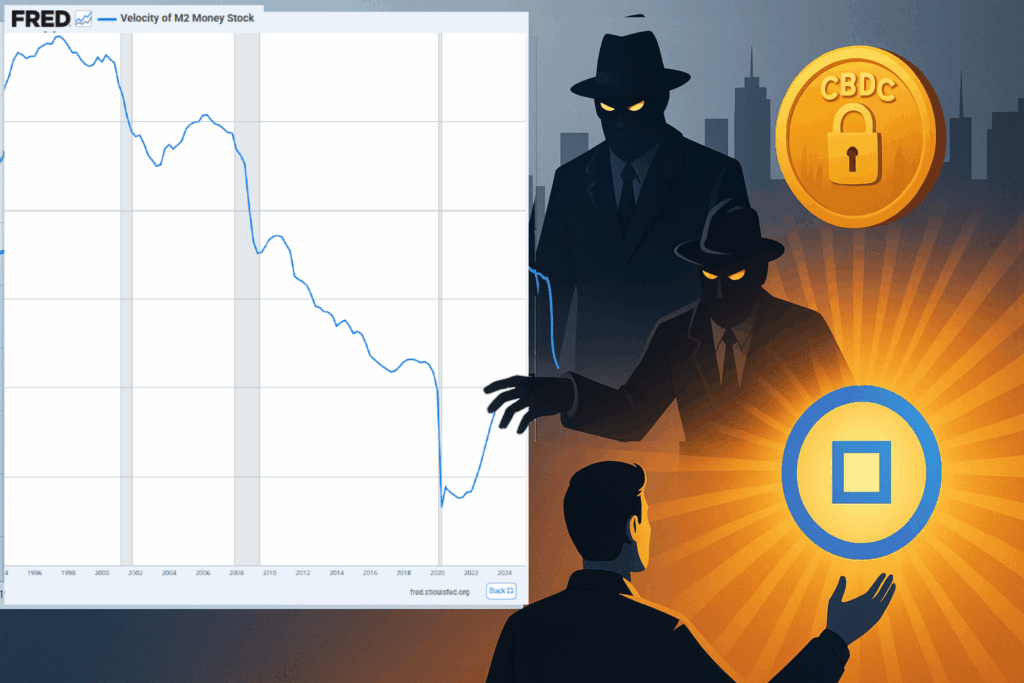
For most of human history, money moved at the speed of trust. People spent, saved, invested, and traded based on their confidence in the future. What economists today call the velocity of money—how fast money circulates through the economy—was never something governments could fully command. Even when kings debased currency or empires decreed fixed prices, they could not force people to spend or hoard. Human psychology always won.

Over time, modern central banks gained immense power over money. They regulate its supply, set interest rates, and shape financial behavior on a global scale. But one thing they have never been able to control is velocity—the collective decision of millions to either spend rapidly or hold tightly. This stubborn limit to central planning has frustrated governments for centuries.

Today, Central Bank Digital Currencies (CBDCs) promise something new—programmable money with expiration dates, forced spending windows, individual spending controls, and limits on saving. For the first time in history, states may gain the ability to manipulate the last uncontrollable variable: how fast people must spend their money.

This raises an urgent question: Have central banks finally achieved total economic control?

Running parallel to this system is a counter-movement of privacy-preserving cryptocurrencies—most notably Ryo Currency, which is preparing to deploy Halo 2 Zero-Knowledge Proofs by default and a high-latency mixnet. This parallel economy represents a radically different vision of the future: an open, decentralized system where individuals—not institutions—decide how they save, spend, and live.

This article explores that clash: the history, the ideology, the technology, and the coming choice facing humanity.


1. The Velocity of Money: The Variable Central Banks Can’t Command

Central banks can print trillions. They can raise or drop interest rates. They can launch quantitative easing programs, buy government bonds, and force new banking rules.

But the velocity of money—the rate at which money moves through the economy—has always been ruled by people’s expectations, trust, fear, and confidence.

Austrian economists like Ludwig von Mises and Friedrich Hayek argued that central planning fails because human actions are too complex to engineer. The economy is a spontaneous order, not a machine with levers.

Historical Proof Across Eras

  • The Great Depression (1930s): The Federal Reserve expanded the monetary base, yet velocity collapsed as people refused to spend.
  • Japan’s Lost Decades (1990s–present): Zero interest rates failed to stimulate consumption; households continued to hoard cash.
  • Global Financial Crisis (2008): Trillions in quantitative easing could not raise velocity—trust had evaporated.
  • COVID-19 Era (2020–2022): Even with direct stimulus payouts, lockdown psychology kept velocity low.

Over 300 years, central banks controlled supply, credit, and interest—but never spending behavior itself.


2. CBDCs: The Technological Solution to an Old Authoritarian Dream

CBDCs fundamentally change the nature of money by introducing programmability. Money becomes a tool of behavioral engineering.

What Programmable Money Enables

  • Expiring currency: Money that vanishes if not spent by a set date.
  • Forced velocity: Stimulus that must be used within 48 hours.
  • Individualized interest rates: Financial rewards for “approved” behavior, penalties for “undesirable” behavior.
  • Savings caps: Limits preventing capital accumulation.
  • Whitelisted/blacklisted merchants: Money spendable only at government-approved outlets.
  • Ideological penalties: Funding opposition groups or causes becomes impossible.
  • Real-time taxation: Automatic tax deduction from every transaction.

CBDCs complete what central banks have always lacked: total control over the velocity of money. For the first time in history, the state can force individuals to spend at a predetermined pace—or prevent them from saving beyond a controlled limit.


3. The War on Inheritance and Gifting

A growing ideological movement sees inheritance and intergenerational gifting as “unearned privilege.” Many governments are actively increasing inheritance and gift taxes, while political organizations promote even stricter controls.

CBDCs give governments unprecedented power over family wealth:

  • Automatic inheritance taxation with no legal workaround.
  • Limits on who can receive gifts or how much can be gifted.
  • Programmable expiry dates on inherited funds.
  • Mandatory approvals for large private transfers.

With CBDCs, inheritance laws become instant, automated, and unavoidable. The state inserts itself directly into family decisions.

Privacy coins like Ryo Currency offer the opposite model: wealth transfers remain private, self-directed, and free from ideological interference. Families—not governments—retain control over generational wealth.


4. Privacy Coins: A Parallel System That Can’t Be Shut Down

While CBDCs represent a system of total surveillance, privacy coins represent voluntary, peaceful resistance. Ryo Currency is a leading example of this vision.

How Ryo is Building a System of Financial Freedom

  • Halo 2 Zero-Knowledge Proofs (by default): Hides sender, receiver, and amount cryptographically.
  • High-latency mixnet: Obscures network metadata and frustrates surveillance systems.
  • Decentralized architecture: No authority can freeze or censor Ryo transactions.
  • Censorship resistance: Users cannot be “turned off” for political views, speech, or beliefs.

In a world where CBDCs allow governments to shut down an individual’s economic life with a click, Ryo Currency ensures the opposite: your ability to transact belongs to you, not an institution.


5. Two Parallel Monetary Systems Are Emerging

Humanity is witnessing a monetary bifurcation unlike anything in history.

CBDCs – Centralized System of Control Privacy Coins – Decentralized System of Liberty
Programmable, surveilled, restricted Permissionless, private, user-controlled
No anonymity or privacy Strong cryptographic privacy by default
Forced spending or forced saving Individual choice without external pressure
Accounts can be frozen instantly Unstoppable, censorship-resistant
Political or ideological compliance required Immune to political coercion

These two systems cannot coexist peacefully in the long term. They represent opposing philosophies of governance and human freedom.


6. The Coming Clash: Inevitable and Irreconcilable

CBDCs and privacy coins embody fundamentally incompatible visions:

  • Centralization vs. decentralization
  • Surveillance vs. privacy
  • Control vs. autonomy
  • Ideological conformity vs. free expression

As more central banks roll out CBDCs under the guidance of the BIS, the clash with privacy-centric currencies will only intensify.

But privacy coins like Ryo Currency give humanity a choice—a parallel economy where financial autonomy, independence, and dignity remain intact.


Conclusion: The Future of Money Will Decide the Future of Freedom

For centuries, central banks sought the same ultimate power: not just to issue money, but to control how people use it. They succeeded in influencing supply, interest rates, and credit—but never the velocity of money itself.

CBDCs give them the final missing piece. For the first time, authorities can force the pace of spending, control saving, restrict gifting, and regulate inheritance with absolute precision.

But privacy coins present the only viable escape.

Ryo Currency—with its coming adoption of Halo 2 ZK proofs and high-latency mixnet—will create an impenetrable shield around personal financial autonomy. It preserves freedom of saving, spending, inheriting, gifting, and supporting causes without fear of surveillance or punishment.

The future is a choice:

  • A world where “money” enforces obedience through surveillance, expiry, and control.
  • Or a world where money remains a tool of human liberty.

The time to choose is now.

The global economy stands at a critical juncture, where technical market patterns, runaway inflation, and technological shifts are converging to reshape the financial landscape. This article explores a potential, but from our analysis a likely scenario of how it might unfold, including the current state of the markets, the looming threat of hyperinflation, the potential collapse of traditional financial systems, the rise of Central Bank Digital Currencies (CBDCs) as a surveillance-heavy solution, and the role cryptocurrencies—particularly privacy coins like Ryo Currency ($RYO)—may play as an alternative in this dystopian future.

The Market’s Last Stand: An Ending Diagonal Pattern

Our technical analysis suggests that most global stock markets are in the final stages of an ending diagonal pattern, a formation that often signals the end of a major market trend. Currently, markets may be in the midst of completing a C wave or already navigating a corrective D wave, characterized by a downward trend. This phase is the precursor to the final E wave, which is expected to manifest as a dramatic blow-off top—a sharp, unsustainable surge in asset prices, usually even breaking out higher than the confines of the ending diagonal triangle.

This last rally will not stem from economic strength but from a desperate reaction to hyperinflation. As inflation spirals out of control, transitioning from high to full-blown hyperinflation, investors will pour into equities and other assets to preserve value, pushing markets to unsustainable heights. However, this surge will mark the tipping point, setting the stage for a devastating collapse.

Hyperinflation and the Bond Yield Trigger

Hyperinflation—where currency value plummets and prices soar—creates a self-reinforcing cycle of economic instability. In this environment, bond yields will spike as investors demand higher returns to offset the rapid erosion of purchasing power. Rising yields will increase borrowing costs for governments, corporations, and consumers, rendering debt unsustainable.

This spike in bond yields will act as the key trigger, igniting a massive sell-off in global stock markets. As equities plummet, the fallout will ripple through the financial system, unleashing contagion that destabilizes banks, investment funds, and other institutions. The result will be a severe liquidity crisis, where access to capital dries up, choking economic activity.

The Collapse of Traditional Finance

With liquidity evaporating, banks will likely impose a credit freeze, halting lending to safeguard their reserves. This will effectively shut down the monetary system, as businesses and individuals lose access to the funds they need to operate. ATMs and bank branches will close, leaving people stranded without cash or digital access to their savings. Confidence in fiat currencies will shatter, sparking social unrest and chaos as desperation mounts.

This breakdown will expose the fragility of the traditional financial system, pushing governments to intervene with radical measures to restore order.

CBDCs: A Surveillance-Driven “Solution”

Amid the turmoil, governments will introduce Central Bank Digital Currencies (CBDCs) as a supposed fix. Marketed as a stabilizing force, CBDCs will be rolled out rapidly, capitalizing on public desperation and the absence of alternatives. The transition will be seamless for most, as fear overrides resistance.

During this shift, existing fiat cash will linger as a stopgap, circulating alongside the new digital currency. However, its role will diminish as the old fiat is redenominated into the CBDC framework. Over time, paper currency will be phased out entirely, and all transactions will migrate to a digital infrastructure, granting governments unparalleled financial oversight and control.

CBDCs as a System of Surveillance

CBDCs are not merely digital versions of cash—they are tools of surveillance. Unlike traditional money, every CBDC transaction can be tracked, recorded, and analyzed in real time. This enables governments to monitor spending habits, enforce compliance, and even manipulate economic behavior through programmable money. Features like expiration dates, spending restrictions, or asset freezes could become standard, eroding personal financial autonomy.

The Digital Israeli Shekel: A Dystopian Example

The planned digital Israeli shekel exemplifies the dystopian potential of CBDCs. Israel’s central bank has been exploring this digital currency, which could include programmable features allowing the state to dictate how funds are used. For instance, the government might restrict purchases to “approved” goods, set expiration dates to force spending, or freeze accounts of dissenters—all without judicial oversight.

Israel’s development of the digital shekel, as highlighted in Cointelegraph’s report, heralds a transformative shift in its financial landscape—one that carries profound dystopian undertones. The push towards a cashless society, as noted in Bitcoin Magazine’s coverage, sets the stage for a financial system where every transaction is digital and, consequently, traceable. The elimination of physical currency amplifies the government’s ability to monitor citizens’ economic activities in real time. Every purchase, donation, or peer-to-peer transfer could be logged, creating a comprehensive profile of individual behavior. This level of oversight evokes a dystopian reality where financial privacy is extinguished, and the state wields unprecedented power over personal lives. The article suggests that this shift, while framed as a modernization effort, could enable authorities to freeze accounts or block transactions deemed undesirable—a tool ripe for suppressing dissent or enforcing compliance.

Reclaim the Net emphasizes the Bank of Israel’s efforts to boost the digital shekel’s adoption, spotlighting both its potential benefits and inherent risks. While the central bank touts efficiency and financial inclusion as key advantages, the article raises red flags about privacy concerns and government overreach. A CBDC like the digital shekel centralizes financial power, placing it squarely in the hands of the state. Unlike decentralized cryptocurrencies such as Bitcoin, which prioritize user autonomy, the digital shekel’s design would likely allow the Bank of Israel to dictate terms of use. This could include programming the currency with smart contracts—features that Cointelegraph notes are being explored in its accelerated development. Programmable money could impose expiration dates, restrict spending to “approved” categories, or penalize certain behaviors, transforming currency into a lever of social control. Imagine a scenario where funds allocated for welfare expire if not spent within a set period, or where purchases of politically sensitive materials are flagged or prohibited—such possibilities underscore the dystopian potential.

Further, Israel’s technical advancements in the digital shekel, including its reliance on blockchain technology, could enhance surveillance capabilities. Each transaction, immutably recorded on a digital ledger, becomes a permanent data point accessible to the state. Coupled with Israel’s existing technological prowess—demonstrated in the CoinGeek report on its successful blockchain-based bond tokenization pilot—this infrastructure could integrate financial data with broader surveillance systems. Israel’s history of leveraging technology for security purposes suggests that the digital shekel could seamlessly plug into a larger apparatus of control, merging economic and personal data into a single, all-seeing framework.

The risks extend beyond surveillance to systemic vulnerabilities. A fully digital currency is susceptible to cyberattacks, technical glitches, or deliberate manipulation by those in power. Centralization amplifies these threats: if the Bank of Israel’s systems are compromised, the entire economy could grind to a halt. Worse, the digital shekel could be weaponized to exclude specific groups—be it political adversaries or marginalized communities—creating a financial underclass unable to participate in the economy. This specter of exclusion, paired with the loss of cash as an anonymous fallback, paints a chilling picture of a society where financial autonomy is a relic of the past.

The Shift Towards a Cashless Society

Israel’s pursuit of the digital shekel is part of a broader global movement towards cashless societies, a trend that amplifies both the promise and peril of digital finance. This section examines this shift, contextualizing Israel’s efforts within worldwide developments and their implications for privacy, freedom, and inclusion.

Globally, nations like Sweden and China have pioneered the transition away from physical currency. In Sweden, cash usage has plummeted, with digital payments dominating everyday transactions; in China, mobile platforms like WeChat and Alipay have largely supplanted cash. Advocates argue that cashless systems enhance convenience, curb crimes like theft and money laundering, and streamline tax collection. Yet, these benefits come at a cost. The disappearance of cash eliminates the option for anonymous transactions, a cornerstone of financial privacy in free societies. Every digital payment feeds into a vast data ecosystem, ripe for exploitation by governments or corporations seeking to monitor or influence behavior.

In Israel, the government is actively accelerating this shift, as Bitcoin Magazine notes in its discussion of plans to go cashless. Legislative measures to restrict cash transactions, combined with the promotion of digital alternatives like the digital shekel, signal a deliberate move towards a fully digital financial system. The state frames this as a strategy to combat tax evasion and illicit activities, but the implications extend far beyond enforcement. A cashless Israel would render every financial interaction visible to authorities, stripping away the anonymity that cash provides. Small, everyday choices—buying a coffee, donating to a cause, or tipping a street vendor—would become data points in a permanent digital record, accessible to the state and potentially to private entities.

This transition poses significant risks. First, it threatens financial exclusion. Not all Israelis have equal access to the digital infrastructure required for a cashless economy—smartphones, reliable internet, or bank accounts may be out of reach for the elderly, low-income individuals, or rural residents. Without cash as a fallback, these groups risk being locked out of the financial system, deepening social inequalities. Second, the loss of cash erodes personal freedom. Anonymous transactions empower individuals to act without scrutiny; their absence subjects every financial decision to potential oversight, opening the door to behavioral manipulation through incentives or penalties.

Moreover, a cashless society concentrates power in the hands of central institutions like the Bank of Israel and the tech companies that support digital payment systems. This centralization introduces systemic risks: a cyberattack, power outage, or policy misstep could disrupt the entire economy. It also demands blind trust in these entities to prioritize public interest over control—a trust often undermined by historical precedent. The CoinGeek report on Israel’s blockchain bond pilot underscores the nation’s technical ambition, but it also hints at a future where financial innovation could tighten the state’s grip on economic life.

Cryptocurrencies: A Double-Edged Sword

As CBDCs dominate, cryptocurrencies could emerge as an alternative for those seeking to escape centralized control. However, their role is complicated by technological advancements in blockchain analytics and artificial intelligence (AI), which are advancing exponentially. These tools can de-anonymize transactions on public ledgers like Bitcoin ($BTC)’s, linking digital wallets to real-world identities. Even coins previously thought to be private, like Monero ($XMR), are increasingly being deanonymized with advancements in AI and machine learning, as discussed in this analysis on Ryo News, highlighting vulnerabilities in its privacy mechanisms.

Pseudonymous cryptocurrencies are becoming systems of surveillance, as governments and corporations harness AI to peel back layers of privacy. This erosion of anonymity undermines the original promise of cryptocurrencies as a bastion of financial freedom.

Privacy Coins: The Last Line of Defense

In this landscape, privacy coins stand apart, engineered to resist surveillance. While Monero has long been a leader in this space, its vulnerabilities to deanonymization have spurred the rise of alternatives that aim to deliver on the promise of true financial privacy. Among them, Ryo Currency emerges as a leading contender for true digital cash, offering robust privacy and decentralization in an increasingly monitored world.

Ryo Currency was developed with a focus on addressing the shortcomings of other privacy coins, prioritizing user anonymity and network decentralization from the ground up. Built on advanced cryptographic principles, Ryo aims to provide a secure and private financial ecosystem that withstands the growing threats posed by AI-driven surveillance and centralized control. Its commitment to privacy and user autonomy makes it a compelling option for those seeking to preserve financial freedom in a world where digital transactions are increasingly scrutinized.

Ryo Currency also fulfills a vision articulated by Nobel laureate economist Milton Friedman, who foresaw the rise of digital cash as a means to reduce government control. In 1999, Friedman predicted the development of a “reliable e-cash” that would enable anonymous transactions online, akin to handing over a $20 bill with no record of the exchange. He stated:

“So that I think that the internet is going to be one of the major forces for reducing the role of government. The one thing that is missing, but that will soon be developed, is a reliable e-cash. A method where buying on the internet, you can transfer funds from A to B, without A knowing B, or B knowing A. The way in which I can take a $20 bill and hand it over to you, and there is no record of where it came from.”

Ryo Currency embodies this vision by providing a digital equivalent of cash—transactions that are private, untraceable, and free from intermediaries—aligning perfectly with Friedman’s prophecy of a decentralized financial future.

Watch Milton Friedman’s prediction in his own words in this video:

Ryo Currency: Privacy and Decentralization Redefined

Ryo Currency leverages the Halo 2 Zero-Knowledge proofs protocol, the most advanced privacy technology available. Unlike other privacy coins that rely on ring signatures or mixers—methods vulnerable to sophisticated analysis—Halo 2 ZK proofs ensure that transactions are verified without revealing the sender, receiver, or amount. This mathematically provable privacy shields users from blockchain analytics, even as AI capabilities grow.

Additionally, Ryo Currency achieves true decentralization through its Cryptonight-GPU algorithm, which is resistant to Asic devices and botnets. This design allows mining with consumer-grade hardware, preventing the concentration of power in the hands of a few and preserving the network’s distributed integrity.

Conclusion: Navigating the Financial Future

The spike in bond yields will likely serve as the final domino, unleashing a cascade of hyperinflation, market collapses, and social disruptions. As traditional financial systems crumble, CBDCs will rise as a government-imposed solution, trading stability for surveillance. The digital Israeli shekel illustrates the dystopian risks of this shift, where programmable money could stifle individual freedom.

Cryptocurrencies offer hope, but their vulnerability to blockchain analytics and AI threatens their viability—except for privacy coins like Ryo Currency. With Halo 2 ZK proofs and the Cryptonight-GPU algorithm, Ryo stands as a beacon of privacy and decentralization, potentially the last refuge for those seeking true digital cash in a world of pervasive control.

As the global economy hurtles toward this tipping point, the choices we make—between centralized surveillance and decentralized freedom—will define the future of money and autonomy.