


Mining & Network Infrastructure · AI & Machine Economies · Monetary Sovereignty
A Megawatt Is Not a Megawatt: AI, Sovereign Power and the Future of Crypto Mining
A megawatt feeding an AI cluster, a Bitcoin mine, a factory or a city is physically identical. Economically and politically, it is not. From Michigan and British Columbia to Ethiopia and Pakistan, the fight for electricity is exposing a new reality for Proof-of-Work—and why Ryo’s planned transition from GPU mining to private Proof-of-Stake matters.
By k1ngVV · September 22nd, 2026
Executive Summary
Crypto mining used to have a pleasantly brutal equation: hardware efficiency, network difficulty, coin price and electricity cost. Find cheap enough power, keep the machines alive, and let arithmetic decide whether the operation survives.
Artificial intelligence is making that equation incomplete. The scarce asset is increasingly not electricity in the abstract, but powered infrastructure: megawatts connected to substations, fiber, cooling, land, permits and reliable transmission. Nscale, spun out from Arkon Energy in 2024, now describes access to reliable, large-scale contiguous power as a primary constraint on AI deployment. Hyperscale Data went further in Michigan: on September 1, 2026, it switched off its Bitcoin miners to prepare the same facility for an AI customer.[1][2]
But markets are only half the story. Ethiopia has cut electricity delivered to Bitcoin miners to 23% of contracted capacity as weaker reservoir inflows force the state utility to protect other demand. Pakistan announced 2,000 MW for Bitcoin mining and AI, yet its proposed concessional mining tariff remains entangled with IMF negotiations. British Columbia has gone further still: BC Hydro has been permanently relieved of the obligation to serve certain new cryptocurrency-mining projects while the province separately allocates 300 MW to AI projects and 100 MW to data centres through a competitive process.[3][4][5][6][7]
Proof-of-Work is permissionless at the protocol layer. Industrial access to electricity is not. That does not make PoW obsolete. Mining remains unusually capable of consuming interruptible, remote, stranded and otherwise difficult-to-monetize power that many AI workloads cannot use economically. AI may therefore push mining away from premium grid infrastructure and toward the energy markets where its flexibility is most valuable.
A different response is to leave the megawatt market. Ryo Currency currently distributes and secures its network through GPU-oriented Proof-of-Work, but its published direction points toward private Proof-of-Stake as the long-term consensus model after years of public GPU distribution. The sequencing matters: before stake can secure a network, the stake must first be distributed. Ryo’s long mining phase therefore serves not only as a security mechanism but as the distribution era that precedes the planned staking era. That transition does not eliminate sovereignty risk. It changes where the risk lives—from energy, hardware and physical infrastructure toward stake distribution, validator structure, participation privacy and protocol governance.[8][9][10]
Key Takeaways
- AI is repricing premium megawatts, not electricity everywhere. Grid-connected sites with fiber, cooling, substations and reliable capacity command a different economic value from stranded or interruptible energy.
- Mining contracts contain sovereign risk. A cheap power agreement matters only while the electricity remains available and the political, regulatory and fiscal environment permits the arrangement to continue.
- British Columbia makes the distinction unusually explicit. Certain new BC Hydro-connected crypto-mining loads are excluded while AI and data-centre projects compete for dedicated allocations.
- Mining still has a structural advantage. Proof-of-Work can often tolerate interruption, remote geography and variable generation in ways high-value AI infrastructure cannot.
- Permissionless consensus can depend on permissioned energy infrastructure. The protocol may accept a miner without asking permission; the utility, grid operator and state may not.
- Ryo illustrates another path. Its long GPU-mining era distributes the monetary base before the planned move to private Proof-of-Stake shifts security away from recurring competition for megawatts—and toward a different set of stake-distribution, validator, privacy and governance risks.
Conceptual continuity: This article develops the argument first examined in BC’s Crypto Mining Ban: The Turning Point for Proof-of-Work and the Future of Decentralization, and connects it to The End of the Ring and The Bitcoin Magnet. The question is no longer simply whether mining consumes energy, but who else wants the power, who controls access, and whether a network intends to compete for megawatts indefinitely.
I. The Old Mining Equation Is Breaking
For most of crypto’s history, miners looked at electricity the way a commodity trader looks at freight: as a cost to be driven down.
A 4-cent kilowatt-hour was better than a 6-cent kilowatt-hour. A newer ASIC was better than an older one. A rising network difficulty squeezed margins. A rising coin price expanded them.
The formula was not sophisticated, but it was honest:
Hardware efficiency + electricity price + network difficulty + coin price = mining economics.
Something important is now missing from that equation: what else could the megawatt be doing?
A megawatt is a unit of power. It does not know whether electrons are feeding an ASIC, an Nvidia GPU cluster, an aluminum smelter or somebody’s kitchen.
The market knows.
So does the state.
The AI infrastructure boom has given certain classes of electricity a new opportunity cost. Reliable power attached to developed land, substations, transmission capacity, cooling and high-quality fiber is no longer merely cheap electricity. It is an infrastructure asset that can host workloads capable of generating far more revenue than many traditional compute uses.
The result is not that every Bitcoin mine should become an AI data centre. Most cannot. It is that every miner occupying premium powered infrastructure now competes against a new benchmark for what that site might be worth.
The old equation therefore needs another variable:
The price of electricity matters. The alternative value of the infrastructure around it may matter more.
Featured in the Ryo Directory
Businesses accepting RYO
II. AI Put a New Price on Powered Land
Nscale provides one of the clearest examples because its history connects the two industries directly.
In its September 18, 2026 registration statement, Nscale says it began assembling powered land in low-cost electricity markets in 2022 and 2023 before becoming independent from Arkon Energy. Nscale was spun out from Arkon in May 2024. It now describes itself as an AI infrastructure company built around a “power-first” strategy and says access to reliable, large-scale contiguous electricity has become a primary constraint on AI deployment.[1]
That wording is revealing. The strategic asset was not originally the GPU. It was the power.
Nscale’s history shows how infrastructure accumulated in the cryptocurrency-mining era can become valuable in the AI era. The land is already there. The interconnection work has been done or advanced. Power is available. The site has moved through some of the slowest and most difficult stages of becoming a high-density compute facility.
Hyperscale Data has made the transition even more literal.
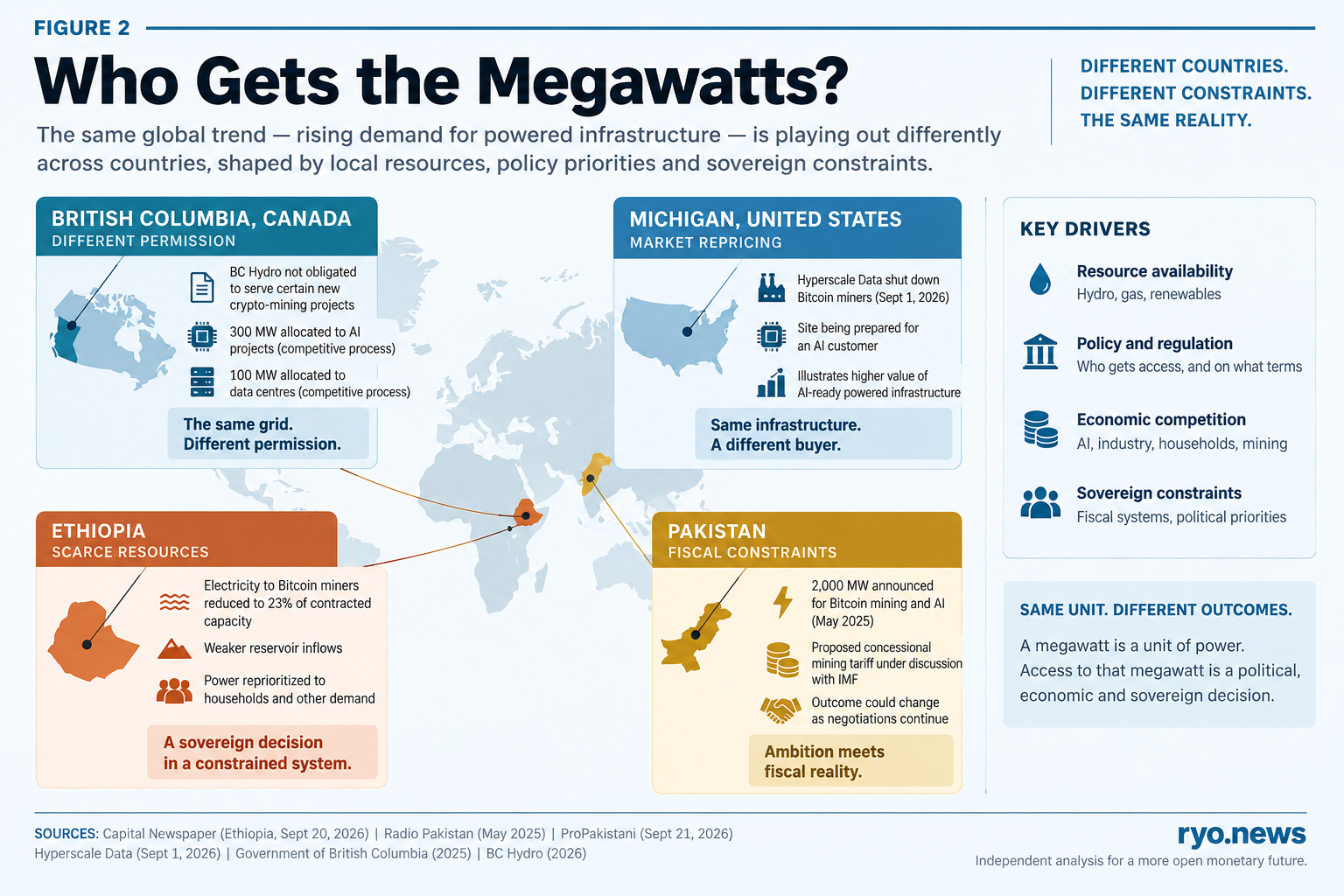
On September 1, 2026, the company switched off all Bitcoin miners at its Michigan facility while preparing the site for a California-based AI customer. The initial agreement covers 20 MW and includes an option to expand to 52 MW. Hyperscale Data says the agreement could generate more than $1.2 billion over its maximum twenty-year term; those figures are company projections, not guaranteed revenue.[2]
The important fact is not the headline contract value. It is that the same physical site was assigned a different economic purpose.
The machines changed. The megawatts did not.
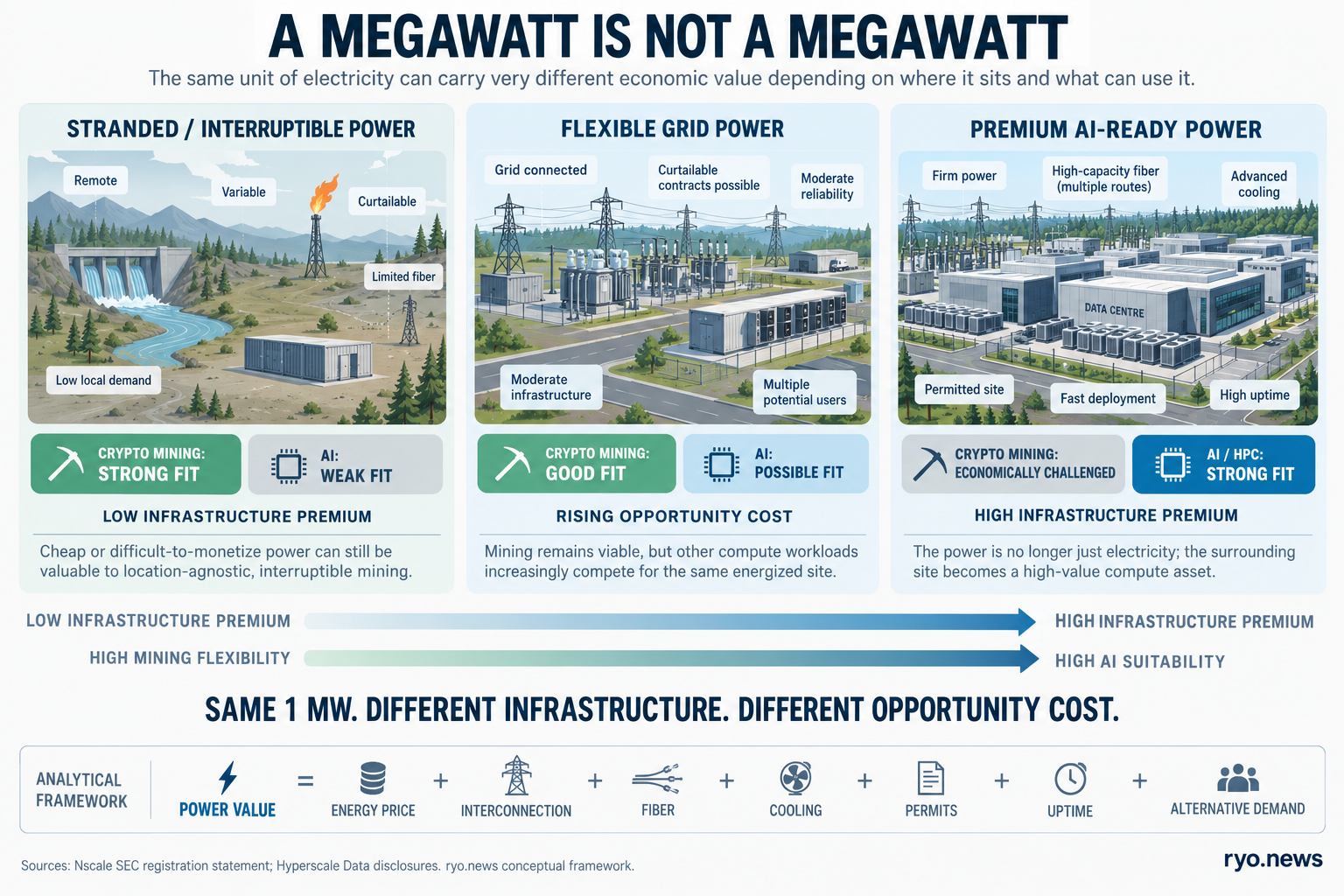
This distinction is easy to lose when energy debates collapse everything into megawatt-hours. An isolated hydro plant with seasonal excess generation, a stranded-gas site and a fully permitted urban data-centre campus may each have 20 MW available, but economically they are different assets.
AI is increasingly bidding for the second layer of the asset: reliability, interconnection, communications infrastructure and speed to deployment. That makes premium sites expensive territory for a workload whose economics are dominated by energy cost.
Which raises the obvious question: if the market increasingly prefers AI on premium infrastructure, where does mining go?
Before answering that, there is another actor in the allocation process: the state.
III. Who Gets the Megawatts?
Electricity does not exist in a politically neutral vacuum. Power systems are built through rights-of-way, regulated monopolies, public utilities, dams, transmission approvals, fuel markets, subsidies, tariffs and long-term planning. Even private generation eventually collides with land, law or infrastructure.
For miners, that creates a form of sovereign risk that does not appear on a mining calculator.
Ethiopia: the contract meets the reservoir
Ethiopia became attractive to Bitcoin miners for an obvious reason: abundant hydroelectric generation and inexpensive power.
Then the water changed.
Ethiopian Electric Power said in September that lower reservoir inflows had forced it to reduce electricity delivered to cryptocurrency miners from 98% of contracted capacity to 23%. The utility said mining had become financially important—accounting for roughly 35% of its corporate revenue in the previous fiscal year—but that domestic consumption, industry and electricity-export commitments would take priority if hydro conditions deteriorated further.[7]
This is not an argument that Ethiopia was wrong to reprioritize scarce electricity. It is a reminder that a mining contract is still downstream of physical reality and sovereign allocation.
A miner can negotiate price.
It cannot negotiate rain.
Pakistan: sovereign electricity meets sovereign finance
Pakistan presents a different version of the same problem.
In May 2025, the government announced an allocation of 2,000 MW of surplus electricity for Bitcoin mining and AI data centres. The stated logic was straightforward: monetize excess generation, attract foreign investment and convert otherwise underused electricity into economic activity and foreign exchange.[5]
By September 21, 2026, however, the proposed concessional electricity rate for Bitcoin mining remained unresolved. Ministry of Energy sources cited by ProPakistani said the government had not secured agreement from the International Monetary Fund and expected the issue to return during talks beginning September 22 under Pakistan’s $7 billion Extended Fund Facility.[6]
The distinction matters. Pakistan controls its power system, but electricity tariffs also sit inside a wider fiscal system involving cost recovery, subsidies, debt and external financing.
Sovereignty is rarely a single switch. It is a stack of constraints.
A miner does not merely buy electricity. It buys exposure to the rules governing that electricity.
IV. British Columbia: The Same Grid, Different Permission
British Columbia makes the political valuation of a megawatt unusually visible.
In 2022, the province paused new cryptocurrency-mining connections to BC Hydro. After consultation and legislative changes, the government moved to a permanent policy. Its current guidance says the Cryptocurrency Power Regulation permanently relieves BC Hydro of its obligation to serve certain new cryptocurrency-mining operations.[3]
The scope needs to be stated carefully. Cryptocurrency mining is not generally illegal in British Columbia. The policy concerns access to new electricity service from BC Hydro for covered operations; existing situations, private generation and other factual circumstances are not all equivalent.
Now compare that treatment with AI.
In February 2026, BC Hydro launched a competitive allocation process that reserves 300 MW for AI projects and 100 MW for data-centre projects during the two-year call. Projects of 10 MW or more compete for the available capacity.[4]
The province therefore has not concluded that large computational loads are inherently undesirable. It has differentiated among computational loads.
The electrons are identical. The permission is not.
That distinction was the central warning in our 2025 analysis of British Columbia’s mining policy.[11] What has changed since then is the competitive environment around the policy.
AI is no longer an abstract future claimant on the grid. It now has an explicit allocation.
The debate therefore moves beyond whether Proof-of-Work uses substantial electricity. The more difficult question is how a society decides which uses of scarce electricity produce enough economic, strategic or social value to deserve grid capacity.
Different jurisdictions will answer that differently. The important point for miners is that the answer may be changed by somebody other than the miner.
V. The Megawatts AI Does Not Want
It would be easy to conclude that AI simply outbids mining until Proof-of-Work disappears. That is too simple: AI and cryptocurrency mining consume electricity, but they do not demand the same infrastructure around it.
High-density AI places enormous value on reliability, high-capacity networking, sophisticated cooling, suitable buildings, specialized electrical equipment and high accelerator utilization. Mining is much less precious.
An ASIC does not care whether the nearest major city is twenty kilometres away or two thousand. It does not need an office district. It does not need low-latency access to a customer database. In many configurations it can be powered down when the grid needs relief and restarted when electricity becomes available again.
That flexibility creates an economic refuge.
Mining can pursue energy that is:
- geographically remote;
- seasonally abundant;
- interruptible or curtailable;
- stranded behind transmission constraints;
- generated where local demand is insufficient;
- associated with gas that would otherwise be flared; or
- too inconsistent to support the uptime assumptions of premium compute.
In other words, AI may not destroy mining’s energy thesis. It may refine it.
If premium grid-connected capacity becomes too valuable for ordinary mining, miners have a stronger incentive to seek the electricity for which their flexibility creates an advantage rather than competing head-on with workloads that can support higher infrastructure costs.
That would be an ironic outcome: the AI boom could push Proof-of-Work away from the very class of electricity over which critics and miners have spent years fighting—not because anyone designed that result, but because price did.
VI. Permissionless Consensus, Permissioned Energy
There is nevertheless a deeper problem that cheap remote electricity cannot solve.
Proof-of-Work is permissionless in one sense and deeply physical in another. The protocol does not ask for a passport before accepting a valid hash; the power system might ask for considerably more.
Industrial mining can depend on:
- generation rights;
- utility contracts;
- grid interconnections;
- transformers and substations;
- land-use permissions;
- equipment imports;
- tax treatment;
- environmental rules;
- financing; and
- continued political tolerance for the load.
None of this invalidates Proof-of-Work.
Bitcoin has demonstrated the extraordinary security that can emerge when economic incentives, specialized hardware and global energy markets converge around one consensus mechanism.
But physical grounding has consequences. Hashrate has to exist somewhere. Machines have to cross borders. Power has to come from somewhere. And somebody usually owns the wires.
Permissionless consensus can still depend on permissioned energy infrastructure.
That does not mean the state can switch off Bitcoin. It means the state can change the geography and economics of participation inside its jurisdiction.
British Columbia can refuse new utility connections.
Ethiopia can curtail contracted supply during hydrological stress.
Pakistan can discover that a proposed tariff exists inside a broader fiscal negotiation.
AI operators can simply offer a more attractive use for the same developed site.
The network survives. The miners move—or the economics move them.
VII. Ryo: What If the Network Leaves the Megawatt Market?
Ryo Currency presents a useful counterexample because its roadmap asks a different question.
What if Proof-of-Work is not required to remain the permanent security model?
Ryo currently uses CryptoNight-GPU, a Proof-of-Work algorithm deliberately optimized around standard consumer GPUs rather than ASIC-dominated industrial hardware. Its official site describes a long GPU-oriented emission schedule and built-in solo-mining tools intended to keep participation accessible beyond specialized mining farms.[8]
That mining history matters. Proof-of-Work has not merely secured Ryo’s chain; it has also served as the distribution mechanism, moving coins into circulation through years of open computational participation.
That distinction becomes more important in a network that eventually intends to secure itself through stake. Proof-of-Stake cannot begin from an ownership vacuum. Before ownership can determine consensus weight, the asset has to be in someone’s hands. A PoS launch can create that starting distribution through sales, allocations, auctions, airdrops or other mechanisms, but every approach has to answer the same prior question: who receives the stake before stake secures the network?
Proof-of-Stake can secure ownership only after ownership exists. The distribution question comes first.
Ryo’s answer is to separate distribution from mature security. Its prolonged GPU-mining phase distributes coins over time through computational participation before ownership itself becomes the consensus resource. That does not make mining perfectly egalitarian: hardware access, electricity cost, geography, timing and technical knowledge still shape who can participate. But it reduces the need for a launch administrator to decide the initial pool of validator capital.
The project’s published direction then changes the role of consensus.
Ryo’s current roadmap materials describe a transition toward private Proof-of-Stake after the GPU-distribution phase, while ryo.news project materials frame private PoS—not a permanent hybrid PoW/PoS arrangement—as the intended long-term consensus destination.[9][10]
This transition remains planned. It is not the consensus model presently operating on mainnet. Conceptually, however, it separates two functions that cryptocurrency debates often treat as inseparable:
- distribution through work; and
- long-term security through stake.
The slogan is simple enough: Mine Now. Stake Later. The architecture underneath it is more important:
Open GPU distribution → distributed monetary base → planned private Proof-of-Stake security.
In that sequence, the mining era is not merely something the network intends to leave behind. It is the mechanism through which the monetary base required by a future staking system is first distributed. The planned staking era would then inherit that distribution while removing the need for an ongoing industrial race for block-production energy. Whether that sequence produces resilient decentralization would still depend on how stake, validators, delegation, privacy and governance are implemented in practice.[9][10]
That does not prove the resulting system will be more decentralized. It changes the problem.
A mature Ryo network operating under pure private Proof-of-Stake would no longer need miners to compete continuously for electricity, grid capacity and mining hardware merely to produce blocks. But the dependency would not disappear: stake distribution, validator structure, governance and participation privacy would become more consequential instead.
The implications may eventually extend beyond block production. Private staking and validator participation could also become building blocks for private governance, including treasuries, voting, delegation and DAO coordination—a direction explored in The Bitcoin Magnet and From Network Union to Network State.[13][14] At the furthest edge, those mechanisms could contribute to digital polities or network-state-style institutions. That remains a design thesis, not a deployed Ryo capability.
The sovereignty surface moves—from access to physical energy toward the distribution and exercise of economic power.
VIII. Proof-of-Work and Proof-of-Stake Have Different Chokepoints
The lazy version of this debate asks whether PoW or PoS is “better.” A more useful question is what each system forces participants to depend on.
The Proof-of-Work sovereignty surface
PoW externalizes security into the physical world.
Participants need hardware and energy. At industrial scale they may need grid access, utility cooperation, land, cooling, logistics and political tolerance. This exposes mining to commodity prices and sovereign infrastructure—but it also gives consensus an anchor outside ownership of the asset itself.
The Proof-of-Stake sovereignty surface
PoS internalizes more of the security system.
Participants do not need industrial energy infrastructure to compete for block production, but consensus weight is tied to economic stake. That means PoS inherits the history of distribution: who obtained the asset, through what process, and how concentrated that ownership became before stake began determining consensus weight. Validator concentration, delegation patterns, staking-pool structure, governance and software implementation then become more consequential.
The first sovereignty question for PoS is therefore not only who validates now? It is also how did the validating stake get there?
Neither system abolishes power. They locate it differently.
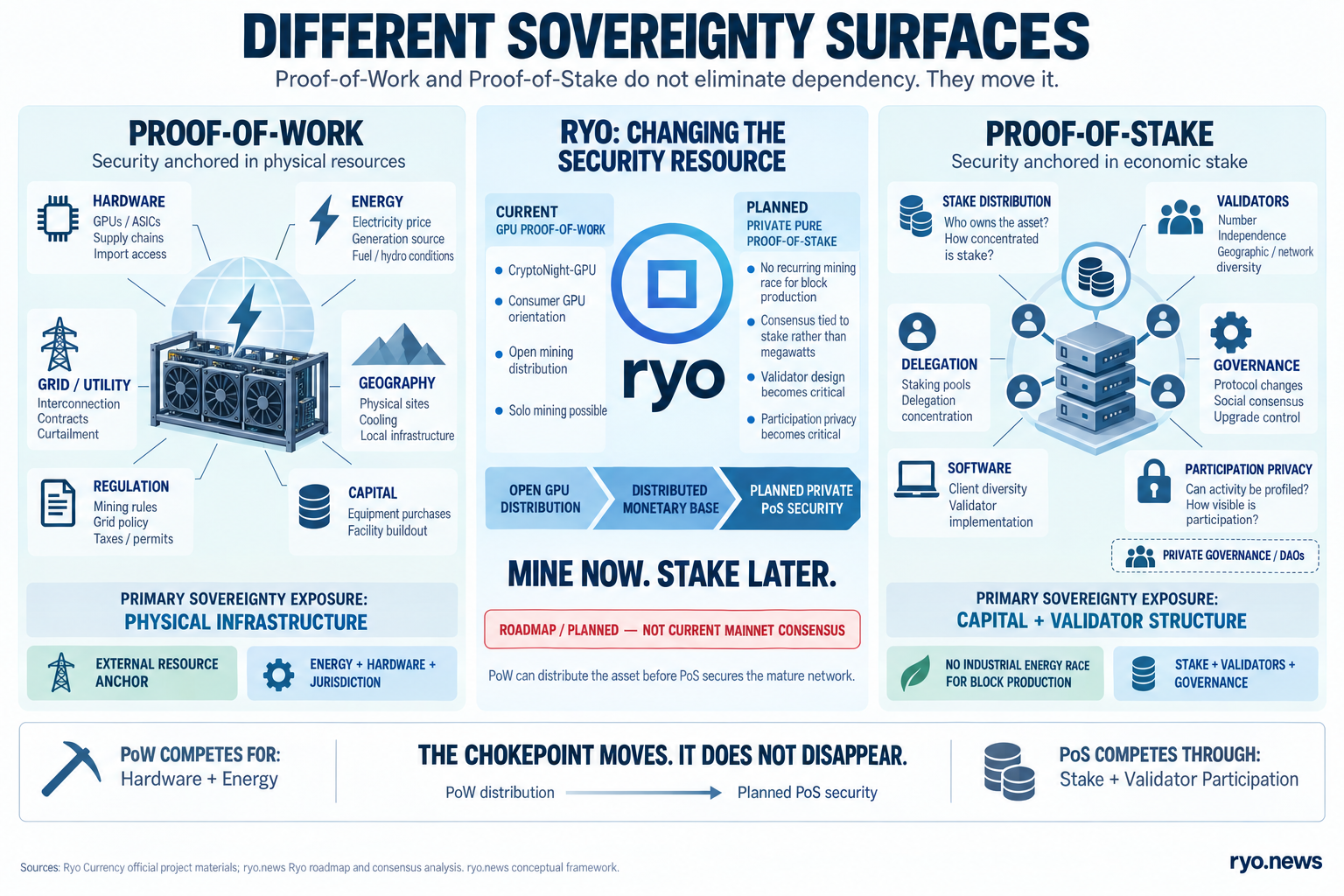
Ryo’s planned transition is therefore interesting not because it settles the PoW-versus-PoS argument, but because it changes the resource against which consensus competes. Mining-era participation competes for GPUs and electricity while simultaneously distributing the asset; staking-era participation competes through ownership and protocol-defined stake. The first is exposed to mining restrictions, grid scarcity and AI’s bid for power; the second inherits the distribution created before it and becomes vulnerable to concentration in different forms.
PoW and PoS do not eliminate sovereignty risk. They move it.
That is the standard by which Ryo’s eventual PoS design should be judged: not whether it sounds cleaner, but whether the final implementation actually produces private participation, broad validator access, resilient governance and resistance to concentrated control.
IX. The New Mining Equation
The original mining equation is not dead. Electricity price, hardware efficiency, difficulty and coin price still matter. They are simply no longer enough.
A more complete version looks something like this:
Power price + infrastructure premium + alternative compute demand + curtailment risk + regulatory permission + sovereign risk = the real cost of a mining megawatt.
That equation points toward several futures at once. Premium grid-connected mining sites may convert toward AI where the economics justify it. Proof-of-Work may specialize further around stranded, flexible, interruptible and geographically difficult energy. Governments will keep prioritizing among competing loads. And some networks may decide that recurring competition for physical energy is no longer necessary to their long-term security model.
Those futures are not mutually exclusive. Bitcoin can remain a global Proof-of-Work network while individual sites become AI campuses; mining can retreat from one jurisdiction and expand around stranded power elsewhere; and a GPU-mined privacy network such as Ryo can use PoW for distribution before attempting a move toward private staking.
The common theme is not energy consumption. It is allocation.
Who gets the power?
Who decides?
What other use is bidding for it?
And does the network still need it?
For years, cryptocurrency mining treated the megawatt as a commodity input. AI is turning some megawatts into premium infrastructure; governments are turning others into policy choices; drought can turn contracted power into unavailable power; and protocol design can eventually decide that block production does not need the megawatt at all.
Same unit.
Different market.
Different permission.
Different sovereignty.
A megawatt is not a megawatt anymore.
Further Reading from ryo.news
BC’s Crypto Mining Ban: The Turning Point for Proof-of-Work and the Future of Decentralization
The earlier analysis of British Columbia’s permanent policy toward new BC Hydro-connected cryptocurrency mining and what it means for Proof-of-Work infrastructure.
The End of the Ring: Privacy Coins and the Architecture of Digital Sovereignty
Why privacy-coin architecture must be evaluated across transaction privacy, network privacy, consensus, governance and access rather than one cryptographic feature.
The Bitcoin Magnet: How Network Assets Create Economic Gravity
How monetary networks create economic gravity around infrastructure, capital and private collective governance.
From Network Union to Network State: How Ryo Currency Powers the Digital Nations of Tomorrow
How private money, DAO governance and collective economic coordination could become infrastructure for digital polities and network-state-style institutions.
References
- Nscale Limited. Registration Statement on Form S-1. U.S. Securities and Exchange Commission, 18 September 2026. Nscale describes its pre-spinout acquisition of powered land, May 2024 separation from Arkon Energy and its “power-first” AI infrastructure strategy.
- Hyperscale Data, Inc. Hyperscale Data Has Ceased Bitcoin Mining Operations in Michigan as It Fulfills the Requirements of the AI Data Center Master Services Agreement. 2 September 2026. Contract-value and expansion figures are company estimates and forward-looking statements.
- Government of British Columbia. Engagement on Cryptocurrency Mining Policy. Updated 12 February 2026. Describes the permanent policy relieving BC Hydro of its obligation to serve certain new cryptocurrency-mining operations.
- Government of British Columbia. Industrial Electricity Allocation Framework. 2026. The two-year competitive process allocates 300 MW to AI projects and 100 MW to data-centre projects.
- Radio Pakistan. Govt allocates surplus electricity for Bitcoin mining. 25 May 2025. Reports the government’s allocation of 2,000 MW for Bitcoin mining and AI data centres.
- ProPakistani. Pakistan Fails to Get Approval for Bitcoin Mining. 21 September 2026. Reports, citing Ministry of Energy sources, that agreement with the IMF on concessional mining electricity rates had not been reached ahead of fourth-review talks beginning September 22.
- Capital Newspaper, Ethiopia. El Niño drought threatens Ethiopian power supply to crypto miners. 20 September 2026. Reports Ethiopian Electric Power’s reduction of mining supply from 98% to 23% of contracted capacity and the utility’s reassessment of mining allocations.
- Ryo Currency. Official project website and current network overview. Accessed September 2026. Describes Ryo’s current CryptoNight-GPU Proof-of-Work architecture, consumer-GPU orientation, solo-mining functionality and long-term emission design.
- ryo.news. Ryo Currency: Privacy Coin, Wallets & Roadmap. 2026. Separates current architecture from planned Halo 2, mixnet and Proof-of-Stake objectives and describes PoS as following the long GPU-distribution phase.
- ryo.news. Ryo Community Art Gallery. Accessed September 2026. Project messaging describes Proof-of-Work as the distribution era and private Proof-of-Stake as the intended future security era, with private PoS presented as the long-term destination rather than a permanent hybrid architecture.
- k1ngVV. BC’s Crypto Mining Ban: The Turning Point for Proof-of-Work and the Future of Decentralization. ryo.news, 28 October 2025.
- Privacy Coin Report. The End of the Ring: Privacy Coins and the Architecture of Digital Sovereignty. ryo.news, 12 August 2026. Examines consensus design as one layer of the broader privacy and sovereignty stack.
- k1ngVV. The Bitcoin Magnet: How Network Assets Create Economic Gravity. ryo.news, August 2026. Discusses infrastructure, capital, private governance and network effects as components of monetary-network and sovereign gravity.
- k1ngVV. From Network Union to Network State: How Ryo Currency Powers the Digital Nations of Tomorrow. ryo.news, 19 March 2026. Explores private DAO governance, treasury coordination and the potential role of Ryo-style private monetary infrastructure in digital polities and network-state development.
This article is for research and informational purposes only. It does not constitute investment, financial, legal or energy-policy advice.