


Monetary SovereigntY · GEOPOLITICS · Privacy Technology
The Capital Control Problem: Stablecoins, Crypto and the End of the Old Monetary Perimeter
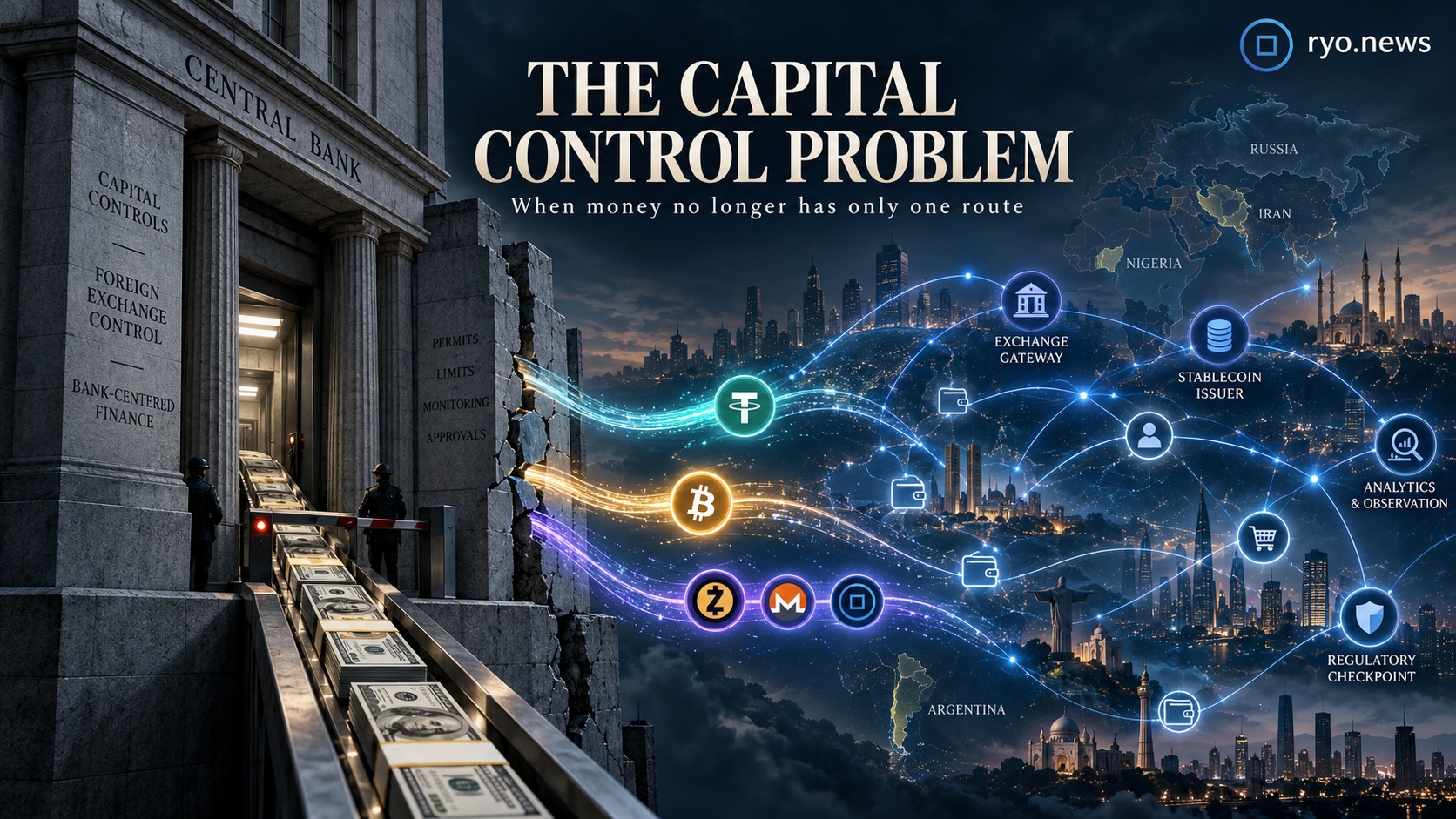
Governments can still restrict banks, foreign exchange, cross-border settlement and the movement of capital. What they can no longer assume is that money has only one route. From Argentina and Nigeria to Russia and now Iran, digital assets are shifting monetary control away from the bank account toward issuers, exchanges, public ledgers, liquidity networks and regulated gateways.
By k1ngVV · September 11th, 2026
Executive Summary
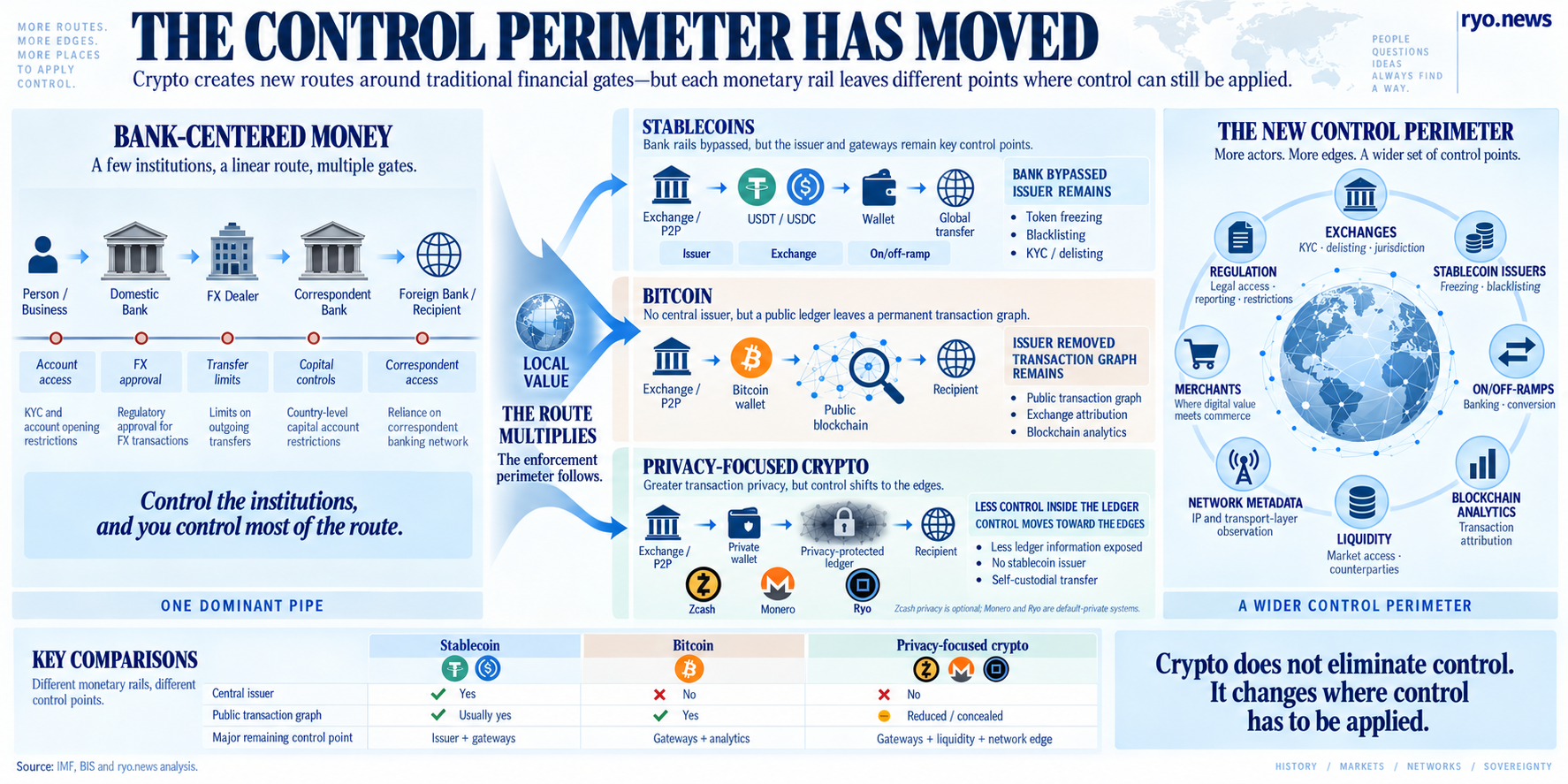
For most of modern finance, capital controls were enforced through identifiable institutions: banks, foreign-exchange dealers, brokers, customs systems and correspondent accounts. Governments did not need to control every person who wanted to move value. They needed to control enough of the routes through which value had to pass.
That architecture is changing.
Stablecoins can give households and firms access to dollar-denominated value without requiring a conventional dollar bank account. Bitcoin removes the centralized token issuer entirely, but leaves a public transaction graph. Default-private cryptocurrencies change the information architecture again by reducing what an outside observer can learn directly from the ledger. None of these systems abolishes state power. Each relocates the points at which power can be applied.
The shift is now visible across very different economies. Argentina demonstrated how digital dollars can become another expression of an older parallel-dollar economy. Nigeria showed how restricting banks from servicing crypto activity can move users toward peer-to-peer routes rather than eliminate demand. Russia has built a framework that permits broad cross-border cryptocurrency settlement while preserving domestic monetary controls. On September 9, the Financial Times reported that Iran had unofficially relaxed some foreign-currency restrictions and was allowing businesses greater use of Tether and bitcoin for cross-border settlement as sanctions pressure intensified.[12]
The conclusion is not that capital controls are obsolete. The International Monetary Fund still regards capital flow management measures as potentially legitimate in limited circumstances, including disruptive outflow episodes, while emphasizing that they are not substitutes for necessary macroeconomic adjustment.[1] The deeper change is structural: money is becoming harder to control by controlling only the institutions through which money used to move.
Capital controls are becoming routing problems.
Key Takeaways
- Capital controls are not inherently irrational or obsolete. They remain part of the policy toolkit, especially during crises, but their effectiveness depends heavily on coverage, credibility and the availability of alternative routes.
- Crypto did not invent capital-control circumvention. Trade misinvoicing, offshore balances, informal foreign-exchange markets and other workarounds existed long before blockchains.
- Stablecoins change the topology. They can move foreign-currency access away from banks and FX dealers toward wallets, exchanges, liquidity pools and peer-to-peer markets.
- Stablecoins are not sovereign money. A centralized issuer can still freeze tokens, while dollar denomination imports another country’s monetary unit and many stablecoin ledgers remain publicly observable.
- Bitcoin removes the issuer, not the observation layer. Its transaction history is public by design; pseudonymity is not the same as transaction confidentiality.
- Privacy coins move the problem again. They reduce protocol-level transaction visibility, but exchanges, liquidity, network metadata, software, counterparties and legal gateways remain potential chokepoints.
- Ryo is relevant as an architectural case study, not a finished escape machine. Its current network uses RingCT with a default ring size of 25 and CryptoNight-GPU proof of work; Halo 2 remains a stated future direction rather than a deployed mainnet privacy system.[18][19]
Conceptual continuity: This article extends the chokepoint framework developed in Everything Is a Chokepoint, the distinction between state sovereignty and monetary neutrality developed in Private From Washington, Visible to Beijing, and the gateway model examined in Russia Didn’t Ban Privacy Coins. It Built a Gate Around Them.
For most of modern finance, a capital control had an address.
A bank.
An FX desk.
A customs declaration.
A correspondent account.
A securities broker.
If a government wanted to slow money leaving the country, preserve foreign-exchange reserves or force transactions through an official exchange rate, it did not need to inspect every private economic decision. It could regulate the institutions that converted, transmitted, cleared and settled the money.
That model was never perfect. It was powerful because the number of important financial routes was comparatively small.
Digital assets do not erase the border.
They increase the number of ways value can reach it.
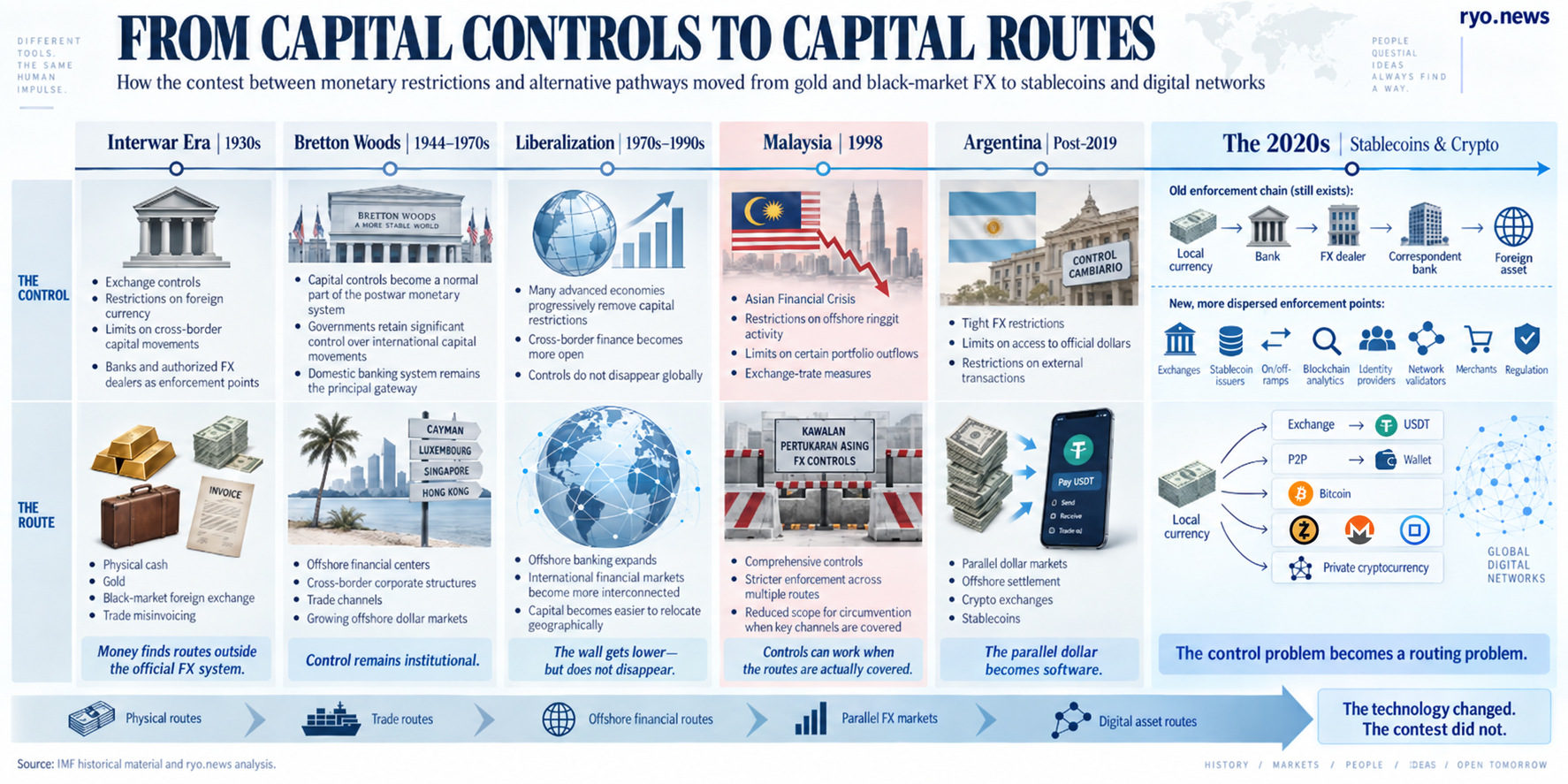
I. Capital Controls Were Once the Default, Not the Exception
The modern debate often treats capital controls as emergency deviations from an otherwise natural world of unrestricted financial movement. Historically, the reverse is closer to the truth.
An IMF study of crisis-era controls notes that restrictions on capital outflows were widely used after the Great Depression. Cross-border financial transactions remained tightly controlled across much of the postwar period, and the Bretton Woods order operated in a world where governments commonly restricted capital movement. Large-scale liberalization accelerated after Bretton Woods collapsed, followed by partial reversals during later crises, including the Asian Financial Crisis and episodes in Southern Europe after the Global Financial Crisis.[2]
This history matters because capital controls are not merely relics of authoritarian economic management. Their logic can be defensive. A country facing destabilizing outflows may want time to protect reserves, slow a currency collapse or prevent a domestic banking crisis from becoming a balance-of-payments crisis.
The IMF’s current Institutional View reflects that nuance. It recognizes that capital flow management measures can be useful in limited circumstances, including inflow surges and disruptive outflows, while stressing that they should not replace necessary macroeconomic adjustment.[1]
But one distinction is essential.
Capital controls are not the same thing as foreign-exchange restrictions, sanctions, anti-money-laundering rules or cryptocurrency regulation.
| Mechanism | What it primarily controls | Typical enforcement point |
|---|---|---|
| Capital flow management measure | Certain cross-border capital inflows or outflows | Banks, securities markets, transfer and settlement rules |
| Foreign-exchange / exchange restriction | Access to foreign currency or the terms on which it can be obtained and used | Authorized dealers, banks, central-bank rules |
| Sanctions | Transactions or assets involving designated jurisdictions, sectors, entities or persons | Banks, correspondent networks, trade controls, asset-freeze regimes |
| Crypto regulation | Access, custody, intermediation, reporting or permitted uses of digital assets | Exchanges, custodians, service providers, regulated institutions |
| Centralized stablecoin issuer control | The token contract, identified addresses and redemption relationship | The issuer |
These mechanisms can overlap in the same country and the same transaction. But collapsing them into one category produces bad analysis.
A sanctioned payment is not automatically a capital-control transaction. A foreign-exchange restriction is not automatically a crypto ban. An exchange KYC rule is not the same thing as a prohibition on self-custody.
The relevant question is more precise:
Which route is being controlled, and where can the rule actually be enforced?
Featured in the Ryo Directory
Businesses accepting RYO
II. The Old Routes Around the Wall
Every control regime creates incentives to find paths outside the controlled perimeter.
Long before cryptocurrency, governments confronted parallel foreign-exchange markets, unrecorded cross-border balances, trade-payment manipulation, physical movement of stores of value and offshore financial structures. An IMF study published in 1994 described trade misinvoicing as an important channel through which capital controls could be circumvented and noted that unrecorded private capital movements complicated both enforcement and macroeconomic measurement.[3]
The point is not that controls never work.
Malaysia’s 1998 experience is a useful corrective to that simplistic claim. During the Asian Financial Crisis, Malaysia imposed a package aimed at insulating domestic monetary policy from external volatility, limiting offshore use of the ringgit and restricting certain portfolio outflows. The controls were combined with an exchange-rate peg, macroeconomic stimulus and financial-sector restructuring. The subsequent recovery was strong, although the IMF’s retrospective analysis emphasized that the controls were only one part of a much larger policy package.[4]
That is the historical pattern in miniature.
Controls can be effective when they cover the routes that matter, when institutions can enforce them and when the underlying macroeconomic strategy is credible enough to reduce the incentive to escape.
They weaken when economic pressure creates a large enough price difference between the official route and the alternative one.
Crypto did not invent the route around the wall.
It digitized the route, compressed the distance and changed who can coordinate it.
III. Stablecoins Turn Monetary Borders Into Routing Problems
Stablecoins matter because they reproduce one of the most demanded monetary assets in the world—the U.S. dollar—inside a different settlement architecture.
In August 2026, IMF First Deputy Managing Director Dan Katz described a stablecoin market of roughly $300 billion, with nearly 99% of stablecoins denominated in U.S. dollars.[5] Their importance is not simply market capitalization. It is access.
A person who cannot easily obtain a dollar bank account may still be able to hold a dollar-denominated token in a digital wallet.
A business that faces friction in correspondent banking may find a digital settlement asset that moves continuously across public networks.
A country that once relied on licensed banks and FX dealers as the main conversion points may discover that conversion increasingly occurs through exchanges, peer-to-peer markets, decentralized exchanges or liquidity pools.
The IMF described the policy consequence unusually clearly: as conversion moves on-chain, some of the friction that gave authorities leverage over capital flows can disappear from traditional intermediaries and reappear at a new perimeter that is harder to monitor and control.[5]
BIS research published in July 2026 reached a related empirical finding. Using data covering more than 130 economies, the authors found that stablecoin flows appeared largely unaffected by broad or specific capital flow restrictions, unlike conventional deposit dollarization. They suggested that one reason is that stablecoins partly circulate outside the regulatory perimeter.[6]
This does not mean stablecoins make controls impossible.
It means the old control map is incomplete.
A capital control is strongest when the state controls the route. Stablecoins multiply the routes.
IV. Argentina: When the Parallel Dollar Became Software
Argentina is one of the clearest examples because the demand for alternative dollars existed long before stablecoins.
Following the return of tight external-transaction restrictions in 2019, the country developed multiple exchange rates and a persistent gap between official and parallel access to foreign currency. The economic incentive was familiar: when the official route cannot satisfy demand for dollars at the official price, an alternative route acquires a premium.
An IMF working paper published in 2024 examined how cryptocurrency markets can function in exactly this environment. Its central argument is more subtle than the claim that crypto simply creates capital flight. Crypto markets can act as marketplaces matching people who want foreign currency with counterparties who already have access to it, including capital that may have left through other channels. In restricted economies, the local crypto premium can therefore become a signal of excess demand for foreign currency and the intensity of the control regime.[7]
Stablecoins fit naturally into that economy because they turn the parallel dollar into software.
Chainalysis reported that stablecoins accounted for 61.8% of Argentina’s crypto transaction volume in its 2024 dataset and that stablecoin trading on one major regional exchange rose following sharp peso declines. That is vendor data rather than an official measure of the entire Argentine economy, but the pattern is consistent with the broader monetary incentive: when confidence in the local unit falls and dollar access is constrained, digital dollar demand increases.[8]
Argentina also demonstrates why the story should not be reduced to technological determinism.
In April 2025, the Central Bank of Argentina removed the $200 individual foreign-exchange cap, lifted a range of restrictions on natural persons, relaxed foreign-trade payment rules and moved the peso into an exchange-rate band.[9]
Crypto did not force those reforms.
But the episode shows something important: a parallel route can become economically meaningful enough that the official system must coexist with it, compete with it or change the conditions that created demand for it.
V. Nigeria: Restrict the Institution, Change the Route
Nigeria is not a perfect capital-control case. Its recent story combines foreign-exchange scarcity, currency depreciation, banking restrictions on crypto activity and a large remittance economy.
That distinction is important.
It is also why Nigeria is useful.
The IMF estimated that Nigeria received about $59 billion in crypto-asset inflows between July 2023 and June 2024 and accounted for roughly 60% of stablecoin inflows into sub-Saharan Africa since 2019. It linked demand to the sharp depreciation of the naira, high inflation and constrained access to foreign exchange.[10]
Then came the institutional lesson.
After the Central Bank of Nigeria restricted banks from servicing crypto exchanges in February 2021, activity shifted toward less-regulated peer-to-peer platforms, according to the IMF’s 2026 assessment.[10]
The policy controlled the bank relationship.
It did not eliminate the underlying demand.
Block the institution and activity may disappear. Or it may change topology.
The IMF’s later conclusion was therefore pragmatic: attempts to suppress stablecoin use are likely to be only partly effective. Stronger domestic macroeconomic credibility, appropriate regulation and better reporting may matter more than assuming that cutting off one intermediary removes the route itself.[10]
VI. Russia: Sovereign Settlement Without Sovereign Citizens
Russia reveals a different dimension of the same problem.
Here the pressure is not primarily ordinary households seeking dollar access. It is a state attempting to reduce dependence on financial infrastructure that geopolitical rivals can influence.
Russia first opened an experimental legal regime for exporters and importers to use cryptocurrency in cross-border settlements in 2024.[11] Its 2026 framework went further: the Bank of Russia said exporters and importers could use cryptocurrency directly or through intermediaries, with all types of wallets and cryptocurrencies, while ordinary domestic payment in cryptocurrency remained prohibited.[20]
That combination appears contradictory only if “crypto-friendly” and “crypto-hostile” are treated as the only categories.
Russia is doing something more specific.
It is separating the strategic usefulness of cryptocurrency for external settlement from the question of who controls money inside the domestic economy.
A government can want sovereign settlement without wanting to surrender monetary sovereignty at home.
This is the same distinction examined in Private From Washington, Visible to Beijing. China wants payment infrastructure that reduces dependence on Washington while preserving Beijing’s supervisory authority. Russia is willing to use permissionless assets more directly, but it still regulates the gateways around them.
State sovereignty and individual monetary sovereignty are not the same objective.
Our September analysis, Russia Didn’t Ban Privacy Coins. It Built a Gate Around Them., showed the next step in that architecture: protocol privacy can remain legally possible while identity, custody, recordkeeping and transaction analysis become concentrated at regulated interfaces.
Russia has not eliminated the chokepoint.
It has moved it.
VII. Iran: The Quiet Relaxation That Exposes the Paradox
Iran makes the routing problem more explicit because several forms of control are operating at once.
There are domestic foreign-exchange rules.
There are U.S. sanctions and secondary-sanctions risks.
There are restrictions on conventional banking access.
There are crypto exchanges and digital-asset networks that can settle value outside correspondent banking.
And there are centralized stablecoin issuers that remain capable of freezing assets on their own token contracts.
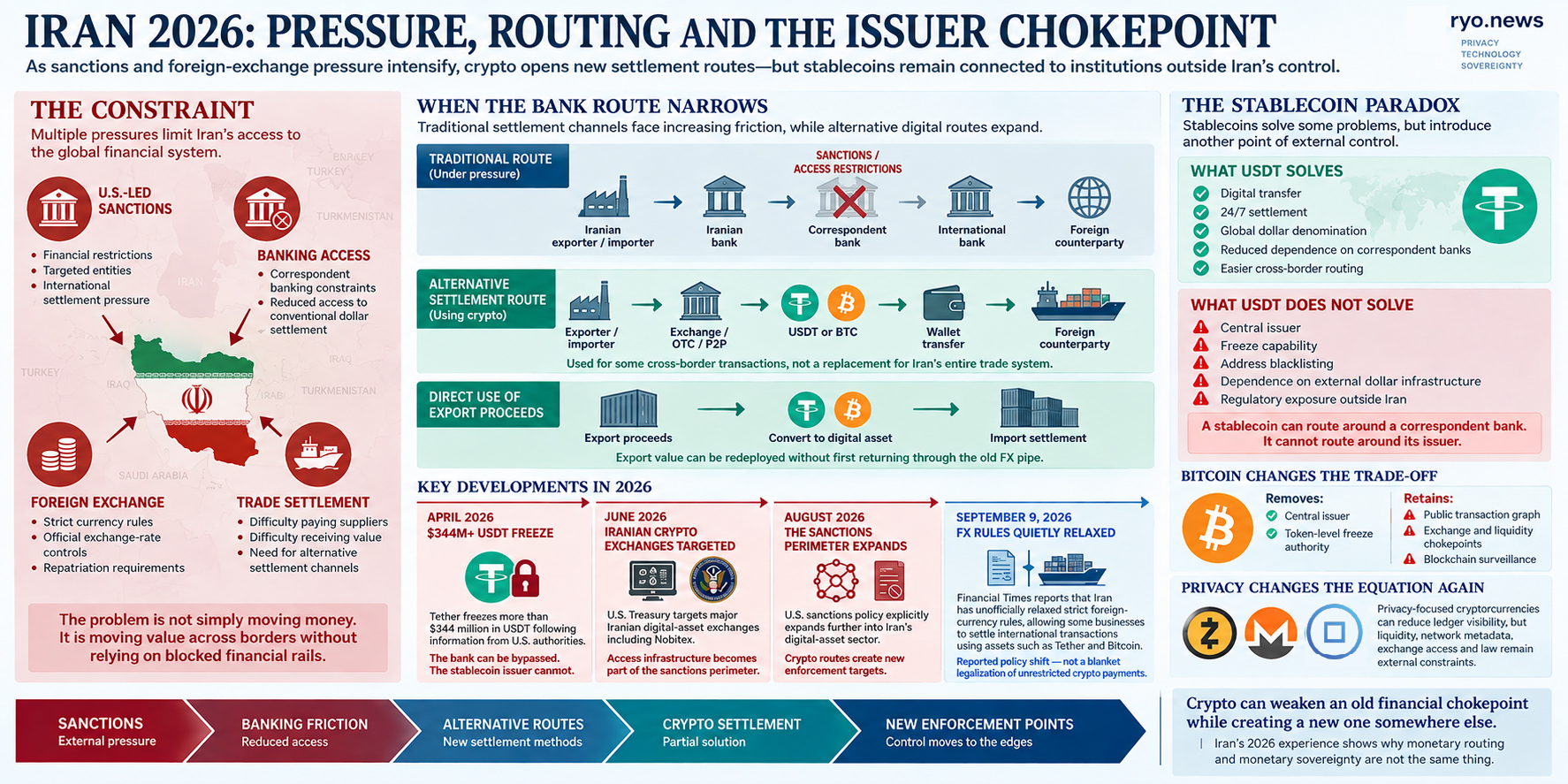
On September 9, 2026, the Financial Times reported that Iran’s central bank had unofficially relaxed strict foreign-currency rules as the country increasingly turned to cryptocurrency to keep international trade moving under intensified sanctions and blockade pressure. According to the report, businesses were being allowed greater use of digital assets including Tether and bitcoin for cross-border settlement, while traders could use export proceeds more flexibly rather than routing everything through the older official structure.[12]
That report should be read carefully.
It is not evidence that Iran abolished capital controls.
It is not evidence that bitcoin became legal tender.
It does not erase sanctions law.
It describes a reported, unofficial relaxation of parts of the foreign-exchange architecture because the existing routes had become economically constraining.
The external pressure moved in the opposite direction.
On August 24, the U.S. Treasury launched “Operation Economic Outcast” and expanded the categories of Iran-related activity exposed to sanctions, explicitly including the digital-asset sector. Treasury said the Iranian regime was increasingly turning to cryptocurrency for sanctions evasion.[13]
Earlier, on June 2, Treasury designated Nobitex and three other Iranian digital-asset exchanges. It alleged that Nobitex processed more than half of Iranian digital-asset inflows in 2025 and helped the Central Bank of Iran access hundreds of millions of dollars in stablecoins.[14]
Then there is the stablecoin paradox.
On April 23, Tether announced that it had supported U.S. authorities in freezing more than $344 million in USDT across two addresses. Tether’s own announcement did not identify Iran or the Central Bank of Iran, but it made the control mechanism explicit: when an address is identified in connection with sanctions evasion or other unlawful activity, the issuer can restrict the assets.[15]
TRM Labs subsequently reported that the two wallets had been designated as property of the Central Bank of Iran and that Tether had frozen approximately $344.2 million across them.[16]
What the Evidence Does — and Does Not — Support
The Financial Times report supports the claim that Iran has unofficially relaxed parts of its foreign-currency regime and is permitting greater use of crypto in cross-border trade. Treasury independently supports the broader claim that Iranian state-linked actors and institutions have used digital assets and that U.S. enforcement is increasingly targeting those channels. Tether’s announcement demonstrates issuer-level freezing power. TRM provides the specific attribution connecting the April freeze to Central Bank of Iran-linked wallets.
The available evidence does not establish that Iran has enacted unrestricted cryptocurrency settlement, abandoned capital or exchange controls, or adopted bitcoin as sovereign money.
That distinction is the story.
Iran is discovering that crypto can route around parts of the traditional financial system at the same time that the United States is extending sanctions enforcement into the digital-asset perimeter.
And a centralized dollar stablecoin can help bypass a correspondent bank while still remaining governable by the issuer.
VIII. The Stablecoin Sovereignty Trap
Stablecoins deserve to be taken seriously precisely because they are useful.
They can give people faster access to dollar-denominated value.
They can reduce payment friction.
They can provide a practical hedge where local currency is unstable.
They can move around the clock without requiring every transfer to pass through a correspondent bank.
But convenience and sovereignty are not the same property.
A dollar stablecoin carries at least three structural dependencies.
First, the unit of account remains the dollar. A country or individual escaping a weak local currency may become more dependent on U.S. monetary conditions rather than less.
Second, a centralized issuer retains administrative power over the token. Tether’s own description of its April freeze makes this explicit.[15]
Third, the major stablecoin networks are generally public ledgers. The transfer can leave the banking system while becoming part of an observable on-chain graph.
This is the contradiction explored in Bolivia, USDT and the Battle for Monetary Sovereignty.
A country can gain easier access to digital dollars and still outsource important monetary power to a foreign unit, a private issuer and a public information architecture.
A stablecoin can route around a correspondent bank. It cannot route around its issuer.
The bank chokepoint has been bypassed.
The issuer chokepoint remains.
IX. Bitcoin Removes the Issuer, Not the Observation Layer
Bitcoin changes one of those dependencies completely.
There is no centralized company that issues bitcoin and can blacklist a token balance at the protocol level.
That is a profound difference.
But the Bitcoin architecture makes a different tradeoff.
The original whitepaper states that transactions must be publicly announced so the network can agree on their order. Its privacy section then explains that the public can see transactions between public keys even if the real-world identities behind those keys are not directly revealed. It also warns that if the owner of a key becomes known, linking can reveal other transactions belonging to the same owner.[17]
Pseudonymity is not confidentiality.
The public graph exists before the investigator arrives.
Blockchain analytics then adds attribution: exchange deposit addresses, known services, sanctioned entities, clustering heuristics and external identity data. None of those techniques is omniscient. Attribution can be incomplete and heuristics can be wrong.
But the observation layer begins with a dataset that is already public.
That matters for capital controls because a state does not always need the power to stop a transaction at the protocol level. It may be enough to identify where value entered, where it exited, which regulated service touched it or which real-world identity can be attached to a visible history.
As From Database to Doorstep examined from a different angle, public financial graphs become more consequential when they can be joined with identity records, exchange data and other external information.
Bitcoin removes the issuer.
It does not remove the observer.
X. Privacy Changes the Capital-Control Problem Again
Default-private cryptocurrencies alter the control architecture in a different way.
On a transparent chain, the ledger exposes a graph and the analyst tries to interpret it.
On a default-private chain, the protocol attempts to prevent the universal graph from existing in readable form in the first place.
This does not make users invisible.
An exchange can still know its customer.
A bank can still record a fiat transfer.
A merchant can still know who ordered a product.
A device can still leak identifying information.
A network observer may still learn from IP addresses, timing or traffic patterns if those layers are not protected.
Liquidity can still be a chokepoint. Software distribution can be a chokepoint. Governance can be a chokepoint. Law can make regulated institutions unwilling to support an asset even when the protocol itself remains reachable.
That is why The End of the Ring argued that a serious privacy system must be evaluated as a stack rather than a single cryptographic feature, and why ProxyMark and Monero over Tor showed how privacy can fail between otherwise private layers.
Still, hiding the ledger graph changes the starting assumption.
A transparent system says:
Publish the transaction history, then decide who is suspicious.
A private system asks:
What specific fact must actually be proved?
That difference matters beyond individual privacy. It changes the economics of mass observation.
When every transaction is public, surveillance can begin with the entire population and narrow downward.
When transaction relationships and amounts are concealed by default, investigators and regulated institutions must rely more heavily on information from gateways, counterparties, devices, legal process or selective evidence supplied by the parties involved.
Privacy therefore does not abolish the control perimeter.
It denies one especially powerful assumption: that the ledger itself should provide a permanently readable map of everyone’s economic relationships.
| Monetary rail | Central issuer freeze? | Public transaction graph? | Major remaining chokepoints |
|---|---|---|---|
| Bank deposit | The institution can restrict or freeze account access | No public blockchain | Bank, regulator, correspondent network, custody |
| USDT / centralized stablecoin | Yes, the issuer can restrict identified token balances | Generally yes on major public chains | Issuer, exchanges, on/off ramps, analytics, liquidity |
| Bitcoin | No central issuer | Yes | Exchanges, custodians, analytics, network metadata, liquidity |
| Default-private cryptocurrency | No central token issuer | Transaction details are concealed by design | Exchanges, liquidity, network metadata, software and governance, legal perimeter |
XI. Ryo and the Design Problem
Ryo is relevant to this debate because it makes a different architectural choice from both stablecoins and transparent cryptocurrency.
The current network uses Ring Confidential Transactions with a default ring size of 25, according to the project’s repository and official site. It also uses CryptoNight-GPU proof of work.[18][19]
That does not mean Ryo solves every capital-control, sanctions or privacy problem.
No cryptocurrency does.
Ryo still depends on software, network connectivity, counterparties, exchanges and liquidity. An exchange can identify its users. A jurisdiction can regulate service providers. Network metadata can matter even when ledger data is concealed. A private asset with insufficient liquidity may be technically uncensorable at the protocol level and practically difficult to use at meaningful scale.
The project also describes a planned move away from RingCT toward Halo 2 zero-knowledge proofs. That is a development objective, not the privacy system currently deployed on mainnet.[18][19]
Its relevance to the capital-control debate is therefore architectural: it is an attempt to design digital money in which fewer parties possess privileged information or unilateral control over ordinary transactions.
That approach becomes more interesting when paired with selective disclosure.
As our Russia analysis explained, Ryo’s existing wallet architecture supports view-only access and forms of transaction, spend and reserve proof. Those mechanisms do not automatically satisfy any particular regulator. They demonstrate a broader principle: verification does not always require publishing the complete financial graph.
A compliance system can ask for evidence of a specific fact.
It does not logically follow that every unrelated transaction must become public forever.
That is the design problem privacy projects should be judged against.
Not whether they promise “untraceability.”
Not whether a roadmap contains advanced cryptography.
But which chokepoints the deployed architecture actually removes, which information it protects, which evidence it can selectively reveal—and which dependencies remain.
XII. Governments Are Not Powerless. The Perimeter Is Moving.
It would be a mistake to read any of this as the end of financial regulation.
Governments retain enormous power.
They regulate banks.
They license exchanges.
They control tax systems.
They can pressure custodians and stablecoin issuers.
They can impose reporting duties.
They can regulate merchants and companies.
They can sanction counterparties.
They can use blockchain analytics where public data exists.
They can make access to fiat, securities, property and regulated commerce conditional on compliance.
The IMF’s 2026 stablecoin analysis points in this direction. If capital-flow rules were designed around traditional intermediaries, authorities may need to extend the policy perimeter toward domestic crypto intermediaries, foreign service providers and the on-chain conversion points through which local money becomes foreign-currency stablecoins.[5]
That is not the same as controlling the protocol.
It may not need to be.
The future of capital controls is likely to be less about one wall and more about pressure applied across a stack:
- the bank account;
- the exchange account;
- the stablecoin issuer;
- the merchant;
- the liquidity pool;
- the public transaction graph;
- the network connection;
- the legal identity at the edge.
The state does not need every chokepoint to be perfect.
It needs enough of them to make the alternative route costly, risky or illiquid.
Users do not need every route to be invisible.
They need enough independent routes that a single institution can no longer determine whether value may move at all.
That is the new contest.
XIII. From Capital Controls to Capital Routes
The twentieth-century capital-control system was built for a world in which money moved primarily through institutions.
The twenty-first-century system is being forced to govern networks.
Argentina showed how an old parallel-dollar economy can become digital.
Nigeria showed how demand can migrate when the banking route is restricted.
Russia showed how a state can use crypto for sovereign external settlement while preserving domestic monetary control.
Iran now shows the paradox in its sharpest form: pressure on conventional routes can push trade toward cryptocurrency at the same time that sanctions enforcement follows it into exchanges, issuers and digital-asset networks.
Stablecoins sit in the middle of that transition. They are powerful because they are portable dollars. They are limited because they remain dollars with owners.
Bitcoin goes further by removing the issuer, but it turns the ledger into a public history.
Privacy cryptocurrencies go further again by reducing what the ledger reveals, while leaving other layers of the system exposed to regulation, observation and market constraint.
The evolution is not from controlled money to uncontrollable money. It is from one control system to a contest between many.
Capital controls are not disappearing.
Sanctions are not disappearing.
States are not disappearing.
But the assumption beneath all three—that value must travel through a small number of controllable institutions—is weakening.
Money now has routes.
Every route has chokepoints.
And monetary sovereignty, for states and individuals alike, increasingly depends on knowing where they are.
Further Reading from ryo.news
Everything Is a Chokepoint: Hormuz, Helium, Gold and the Architecture of Monetary Escape
The broader framework for understanding how control concentrates at narrow points in energy, logistics, finance, information and money.
Russia Didn’t Ban Privacy Coins. It Built a Gate Around Them.
How regulation can migrate from the protocol toward custody, identity, transaction analysis and institutional gateways.
Private From Washington, Visible to Beijing: China, Privacy Coins and Financial Sovereignty
Why state monetary sovereignty and neutral money are not the same objective.
Bolivia, USDT and the Battle for Monetary Sovereignty
How digital dollars can solve an immediate currency problem while introducing issuer, dollar and surveillance dependencies.
The End of the Ring: Privacy Coins and the Architecture of Digital Sovereignty
Why private money must be evaluated across ledger, network, consensus, distribution and governance layers.
ProxyMark and Monero over Tor: How Privacy Can Fail Between Layers
Why a private ledger cannot compensate automatically for exposed network metadata or weak surrounding infrastructure.
From Database to Doorstep: 153 Million Driver’s Licenses, Crypto Data Leaks and the KYC Paradox
How public financial data becomes more dangerous when it can be fused with leaked identity and location information.
References
- International Monetary Fund, “Review of Institutional View on the Liberalization and Management of Capital Flows — FAQs,” updated framework following the 2022 review.
- Apoorv Bhargava et al., “Capital Controls in Times of Crisis — Do They Work?”, IMF Working Paper 2023/067, March 17, 2023.
- “The Impact of Controls on Capital Movements on the Private Capital Accounts of Countries’ Balance of Payments,” IMF Working Paper, 1994.
- International Monetary Fund, Malaysia: From Crisis to Recovery, IMF Occasional Paper No. 207, including “Capital Controls in Response to the Asian Crisis,” 2001.
- Dan Katz, IMF First Deputy Managing Director, “Stablecoins: Promise, Risks, and Policy Choices for Emerging Markets,” August 7, 2026.
- Boris Hofmann, Aaron Mehrotra and Jan Paulick, “Dollarisation and monetary control: what lessons for the rise of stablecoins?”, BIS Working Paper No. 1370, July 21, 2026.
- Clemens M. Graf von Luckner, Robin Koepke and Silvia Sgherri, “Crypto as a Marketplace for Capital Flight,” IMF Working Paper 2024/133, June 28, 2024.
- Chainalysis, “2024 LATAM Crypto Adoption: The Rise of Stablecoins,” 2024. Vendor data; cited as an industry dataset rather than an official measure.
- Central Bank of Argentina, “Beginning of stage 3 of the economic program with relaxation of currency restrictions and an exchange rate to float within a band,” April 11, 2025.
- Axel Schimmelpfennig and Bo Zhao, IMF, “Stablecoins in Nigeria: A Growing Cross-Border Channel,” June 16, 2026.
- Bank of Russia, “Cryptocurrencies and digital rights: new regulation phase,” July 30, 2024.
- Financial Times, “Iran turns to crypto to get around sanctions,” September 9, 2026.
- U.S. Department of the Treasury, “Treasury Launches Unprecedented Campaign Against Iranian Regime on Economic D-Day,” August 24, 2026.
- U.S. Department of the Treasury, “Economic Fury Targets Iran’s Largest Digital Asset Exchange for Terror Finance and Sanctions Evasion,” June 2, 2026.
- Tether, “Tether Supports Freeze of More Than $344 Million in USD₮ in Coordination with OFAC and U.S. Law Enforcement,” April 23, 2026.
- TRM Labs, “OFAC Sanctions Crypto Addresses Associated with the Central Bank of Iran, Freezes USD 344 Million,” April 24, 2026. Used for the wallet-attribution claim.
- Satoshi Nakamoto, Bitcoin: A Peer-to-Peer Electronic Cash System, 2008, especially Section 10, “Privacy.”
- Ryo Currency, official GitHub repository and README: current RingCT architecture, default ring size 25, CryptoNight-GPU and stated plan to replace RingCT with second-generation zero-knowledge proofs.
- Ryo Currency official website: current privacy and mining architecture and stated future transition toward Halo 2 zero-knowledge proofs.
- Bank of Russia, “Cryptocurrency Market Regulation Established in Russia,” July 21, 2026.
This article is for research and informational purposes only. It does not constitute investment, legal, financial or sanctions advice.