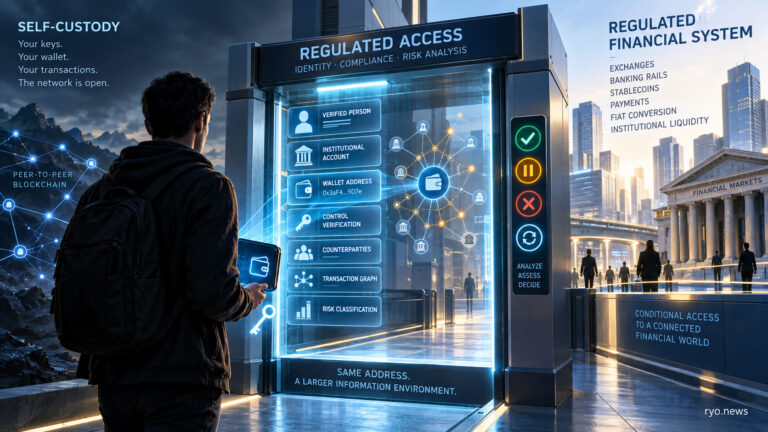


Featured image showing leaked identity records and crypto data flowing from a breached database toward a residential address, with Ryo representing a private financial layer that reduces public blockchain exposure.

Privacy Technology · Monetary Sovereignty & Digital Money

From Database to Doorstep: 153 Million Driver’s Licenses, Crypto Data Leaks and the KYC Paradox

How exposed identity documents, exchange records, tax data and transparent blockchains can combine to create digital and physical security risks — and why privacy by default matters.

Executive Summary

A dark-web service called Nexus claimed to offer more than 153 million U.S. and Canadian driver’s-license records, alongside millions of other identity documents. Security journalist Brian Krebs found his own current license in the service and traced several sampled records to real-world identity-scanning events. The FBI’s New Orleans field office subsequently opened an inquiry into the apparent breach. The reported scale is plausible, but the number should not be read as 153 million independently confirmed victims: Nexus supplied the count, duplicate or historical documents may exist, and the full source and scope remain under investigation.[1][2]

The crypto sector demonstrates why such leaks can become more dangerous when datasets are fused. Ledger’s 2020 ecommerce breach exposed approximately 272,000 detailed customer records containing names, postal addresses and telephone numbers while leaving the hardware wallets themselves uncompromised. The 2023 Kroll incident exposed selected FTX claimant identities and account balances. Coinbase disclosed in 2025 that attackers obtained names, home addresses, government-ID images, balance snapshots and transaction history without compromising passwords or private keys. In each case, the cryptographic asset layer and the human identity layer failed differently.[27][29][28]

France provides a more severe illustration of the same compositional risk. A former tax employee is accused of abusing legitimate access to government systems to obtain information on crypto investors and pass information to criminals; separately, France’s FICOBA banking register and DGFiP tax systems suffered large unauthorized-access incidents in 2026, while crypto-tax provider Waltio disclosed exposure of user email addresses, 2024 gains or losses and year-end balances by cryptocurrency. France has simultaneously experienced a major wave of kidnappings, home invasions and attempted abductions targeting crypto holders and their families. Chainalysis has assessed a French tax-data compromise as the likeliest contributor to the country’s surge, but that is an analytical assessment, not proof that any particular kidnapping originated from any particular database.[42][32][34][35][30][33]

The implication for cryptocurrency privacy is broader than “hide your identity.” Some disclosures are voluntary, some are commercially demanded, and some are legally required. The engineering objective is to prevent any one disclosure from becoming a universal key to every other layer of a person’s life. Ryo cannot make a leaked driver’s license secret again, undo a tax disclosure or erase exchange records. Its relevant property is narrower and more defensible: private-by-default transaction design can reduce the amount of additional financial information available to a public ledger observer after identity privacy has already failed.[13]

Key Takeaways

  • The reported 153 million+ figure describes the scale of a marketplace dataset, not a confirmed count of 153 million unique victims.[1]
  • A stolen driver’s license does not cryptographically defeat strong MFA, but it can strengthen impersonation, SIM-swap and account-recovery attacks around it.[5][6]
  • Crypto-specific breaches can add a dangerous wealth signal to ordinary identity exposure; France’s recent violent attacks show why financial privacy can become a physical-security concern.[28][36]
  • Lawful or mandatory disclosure does not eliminate privacy risk. Data entrusted to exchanges, tax systems and other institutions still has to survive insiders, credential theft and external compromise.
  • Ryo cannot undo an identity breach. Its relevance is compartmentalization: a private-by-default ledger can reduce the public financial graph available to be fused with identity and location data.[13]

The Nexus story is a useful starting point because it forces a distinction that ordinary breach reporting often misses. A stolen password is a credential failure. A stolen driver’s license is an identity-layer failure: the exposed object contains attributes that other institutions may use to decide who you are.

For cryptocurrency holders, that distinction matters more than it first appears. The danger is not confined to fraudulent credit applications or phishing. Once an identity record can be joined to exchange data, tax records, hardware-wallet customer data or a transparent blockchain, the same person can become associated with a home address, a crypto relationship and an estimate of wealth.

France’s recent experience shows why that combination deserves to be treated as a personal-security problem, not merely a data-protection problem. The country has suffered a wave of kidnappings, attempted abductions and violent extortion directed at crypto holders and their families. The public record does not establish that a particular leaked database caused a particular attack. It does establish that identity, location and financial information are valuable targeting inputs once they leave their intended context.

This article therefore asks a broader question than who breached whom: how much damage can one disclosure do when every other layer of the financial system is designed to reveal more?

1. What the Evidence Establishes

Before moving from the breach itself to its implications, the evidence needs to be separated into three categories: what has been directly established, what current security standards show to be technically plausible, and what remains inference. The table below is the evidentiary baseline used throughout the article.

That distinction is especially important for the 153 million figure and for the later discussion of physical attacks. Both subjects invite headlines that outrun the underlying record.

Claim Evidence Correct interpretation
Nexus advertised 153M+ driver’s-license records. Krebs observed the service, obtained his own record and found the searchable result space broadly consistent with the claimed order of magnitude.[1] A credible reported dataset scale, not a verified count of 153 million unique victims.
The records appear connected to real ID-scanning events. Sampled records matched consenting individuals and, in several cases, the timing of travel, rental-car or other identity-verification events. Krebs’s own record included multiple document images, including infrared and ultraviolet captures.[1] The incident concerns reusable identity artifacts, not merely a spreadsheet of names and addresses.
A stolen license can strengthen impersonation attacks. NIST treats driver’s licenses as identity evidence, while FinCEN has warned that fraudulent identity documents and stolen personal data are being combined with generative AI to circumvent identity verification.[3][4][8] The document can improve an attacker’s evidence package; it does not guarantee successful impersonation.
Identity exposure can create risk around 2FA. NIST recognizes repeated identity proofing as an account-recovery mechanism, and U.S. agencies warn that SIM swapping can defeat SMS-based codes after control of a phone number is transferred.[5][6][7] Identity data can attack recovery and telecom workflows around MFA; it does not mathematically break TOTP, passkeys or hardware keys.
Crypto-service breaches can expose both identity and indicators of wealth. Ledger exposed names and home addresses; Kroll exposed selected FTX claimant balances; Coinbase disclosed identity documents, addresses, balance snapshots and transaction history.[27][29][28] A breach can reveal that a known person at a known address has a crypto relationship even if no private key is stolen.
Lawful or mandatory financial disclosure still creates a security asset that must be protected. France requires reporting of specified crypto accounts and has expanded service-provider reporting. In 2026, separate incidents affected FICOBA, DGFiP systems and Waltio, while a former tax employee remained accused of abusing government access to obtain information on crypto investors.[40][41][34][35][30][32] Tax compliance and data-security risk are separate questions. A legal obligation to disclose does not make the resulting database harmless if compromised.
France has experienced a documented wave of physical attacks on crypto holders and relatives. French authorities have responded with dedicated security measures, and Chainalysis documented a sharp increase in kidnappings and home invasions, including attacks on relatives.[36][38][33] The physical-security problem is established. Attribution of a specific attack to a specific leaked database generally is not.
Ryo reduces public financial linkability, not identity exposure itself. Ryo currently uses private-by-default RingCT-based transactions, while Halo 2 and a high-latency mixnet remain roadmap objectives.[13][14] Ryo should be evaluated as one compartment in a broader privacy stack, not as a remedy for every external identity leak.

2. The Breach Is Not Merely a Breach

Data-breach reporting tends to compress unlike events into one vocabulary. An email address leaks. A password hash leaks. A credit-card number leaks. A government identity document leaks. All become “records.” Their security properties are not equivalent.

A password can be rotated. A card number can be cancelled. An authentication token can be revoked. A face, date of birth and historical identity record are much harder to replace. A driver’s license can also contain or encode a residential address, document number, physical characteristics, signature and machine-readable information, depending on jurisdiction. The Nexus material reportedly went further: Krebs found six images associated with his record, including front and back captures in ordinary, infrared and ultraviolet imaging modes.[1]

That distinction matters because the document is valuable not only for what can be read from it, but because other systems are trained to trust it.

The current NIST Digital Identity Guidelines define a driver’s license as identity evidence: documentation supporting the real-world existence of a claimed identity. NIST’s proofing model then separates resolution, validation and verification. Attributes can be checked against authoritative sources such as state departments of motor vehicles; the claimant may also be asked to establish that the person presenting the evidence is its rightful owner.[3]

This is why a high-quality license scan is better understood as a reusable identity artifact. It can carry several pieces of mutually reinforcing information in one object: a name, a face, a government identifier, an address and the visual grammar of an authentic credential.

Infographic showing how a leaked driver’s license can expose identity, residential address and authentication data, creating risks including identity fraud, account recovery abuse, SIM swapping, KYC impersonation, phishing and physical targeting.

Figure 1. What a Driver’s License Exposes. A driver’s license is not a single data point. It is a concentrated identity package whose fields can reinforce one another in downstream impersonation, account-recovery and physical-targeting attempts.

3. From Identity Document to Attack Surface

The obvious risks are familiar. The U.S. Federal Trade Commission warns that exposed driver’s-license information can be used to impersonate the holder and recommends contacting the issuing motor-vehicle authority and protecting credit files when such information is compromised.[9] Credit fraud, fraudulent account opening and targeted social engineering are direct applications.

The more consequential problem is that leaked identity data can be combined with data from other breaches. A criminal does not need one perfect database if several imperfect databases can be joined. A license image can be matched with an email address from one breach, a telephone number from another, a password reuse event from a third and a public social profile that supplies context for convincing impersonation.

Generative AI lowers the cost of packaging those fragments into something coherent. In 2024, the U.S. Treasury’s Financial Crimes Enforcement Network reported increased suspicious-activity reporting involving deepfake media and specifically highlighted fraudulent identity documents used to circumvent identity verification and authentication. The agency described schemes combining falsified or altered documents with stolen personally identifiable information and synthetic identities.[8]

This does not mean that possession of a driver’s license scan is sufficient to pass a competent modern proofing process. NIST recommends validation against authoritative sources, biometric comparison and controls for forged or manipulated media. It means only that the attacker starts with better source material.

4. The Strong Front Door and the Recovery Door

Security advice often ends with “enable 2FA.” That is good advice, but authentication is a system rather than a checkbox.

An account protected by a strong password and a hardware security key may still need a procedure for the day its legitimate owner loses the key. NIST SP 800-63B explicitly recognizes repeated identity proofing as one class of account-recovery method. After successful recovery, a subscriber may bind new authenticators to the account.[5]

That creates an unavoidable engineering question: is the recovery path at least as resistant to impersonation as the normal login path?

The answer depends on the implementation. A properly designed recovery process does not simply accept a photograph of a license. It may require authoritative validation, a live biometric comparison, recovery codes, previously verified contact channels, waiting periods and independent notifications. But weaker systems and human support processes exist, and identity-rich leaks improve the material available to attack them.

A stolen driver’s license does not necessarily give an attacker the key to an account. It may help the attacker convince a system to issue a new key.

Infographic showing how strong password and hardware-key authentication can be undermined by weaker account-recovery paths using leaked identity data, SIM-swap attempts, support-desk impersonation and credential resets.

Figure 2. The Strong Front Door and the Recovery Door. Identity exposure does not cryptographically defeat strong MFA. The risk appears in surrounding recovery, telecom and support systems that can reset credentials, redirect SMS authentication or bind a new authenticator.

SIM Swapping and 2FA: What the License Can — and Cannot — Do

The distinction is especially important for SMS-based second factors.

U.S. cybersecurity guidance has repeatedly warned that SMS and voice codes are vulnerable to number-porting and SIM-swap attacks. In a successful SIM swap, the attacker persuades or compromises a carrier process so that the victim’s telephone number is reassigned to a SIM or device under the attacker’s control. Incoming text messages and calls then follow the number.[6][7]

Identity data is useful here because telecom fraud frequently contains a social-engineering component. The attacker may know a legal name, address, date of birth, account context and other attributes before contacting a carrier or attempting recovery elsewhere. A driver’s-license scan can strengthen that pretext. It does not guarantee that a carrier will accept it, and modern carrier controls are intended to resist precisely this class of attack.

The technical conclusion should therefore be stated narrowly:

  • SMS 2FA can be undermined if an attacker successfully gains control of the telephone number.
  • TOTP authenticator codes are not derived from the driver’s license and are not cryptographically broken by its disclosure.
  • FIDO2/passkeys and hardware security keys remain substantially stronger against phishing and remote account takeover when recovery is designed to the same standard.
  • The weakest recovery mechanism can dominate the effective security of the account if it allows stronger authenticators to be replaced.

This is a recurring privacy-engineering pattern. A system can be strong at one layer and weak at the junction between layers. The ProxyMark analysis reached a related conclusion in a different domain: ledger privacy and transport privacy cannot be evaluated as isolated properties when information from several layers can be fused.[10]

5. Crypto-Specific Breaches Change the Threat Model

The Nexus dataset is alarming because a driver’s license can identify a person. Cryptocurrency-specific breaches can add another variable: why that person may be worth targeting.

This distinction changes the threat model. A generic consumer breach may reveal a home address. A crypto-service breach may reveal a home address plus evidence that the resident purchased a hardware wallet, held an exchange account, filed a cryptocurrency claim or had a particular account balance. The private key can remain perfectly secure while the information surrounding its owner becomes more dangerous.

Incident Data exposed What was not necessarily compromised Security significance
Ledger, 2020 More than 1 million email addresses and approximately 272,000 detailed customer records containing names, postal addresses and telephone numbers were ultimately disclosed.[27] Ledger stated that its hardware wallets, payment information and users’ crypto assets were not compromised by the ecommerce breach.[27] A residential address could be associated with a person known to have purchased dedicated cryptocurrency-security hardware.
Kroll / FTX claimants, 2023 Affected records could include name, email, mailing address, FTX account number, account balance, phone number and other claim details; later notices said some claim amounts, coin holdings/balances and limited dates of birth may also have been accessible.[29] Kroll said FTX KYC data submitted through the claims portal was not stored in its systems, and the incident did not itself compromise FTX digital assets.[29] Identity and location data could be paired with an account-balance or claim signal.
Coinbase, 2025 Coinbase disclosed names, addresses, phone numbers, emails, government-ID images, masked financial identifiers, balance snapshots and transaction history after support personnel were paid to collect data from internal systems.[28] Coinbase said passwords and private keys were not compromised and the implicated personnel could not access customer funds.[28] The exposed package combined identity, home address, government documentation and direct indicators of crypto account activity.
Waltio, 2026 Waltio said attackers accessed user email addresses, 2024 gains or losses and the balance per cryptocurrency used for tax calculations as of December 31, 2024.[30] Waltio said the incident did not expose public wallet addresses, private keys, API keys, identity documents, postal addresses or banking data.[30] A dataset need not contain a home address to be dangerous if an email and balance information can later be joined to another leak containing identity and location.

The Hardware-Wallet Paradox: The Keys Can Be Safe While the Owner Is Exposed

Ledger’s incident makes the distinction clear: the hardware wallets remained uncompromised and private keys were not extracted, yet the ecommerce breach associated approximately 272,000 customers with names, addresses and telephone numbers.[27]

The wallet can perform its narrow job correctly while another system exposes its owner. Security can succeed at the key-management layer while failing at the identity layer.

The Coinbase incident demonstrates an even richer version of the same asymmetry. Its SEC filing says private keys and passwords were not compromised, but government-ID images, physical addresses, balance snapshots and transaction history were among the data taken. Coinbase itself warned that the material could be used in social-engineering attempts.[28]

That is no longer merely a phishing list. It can resemble a target dossier.

Infographic showing how identity records, crypto exchange data, hardware-wallet customer information and tax or financial data can be linked through persistent identifiers to reveal identity, location, crypto affiliation and wealth signals.

Figure 3. The Crypto Target Dossier. No single breach must contain everything. Persistent identifiers such as names, emails, telephone numbers and addresses can allow separate datasets to be fused into a more complete target profile.

The central privacy problem is therefore not that one database knows everything. It is that many databases know different things about the same person, and persistent identity fields provide the join keys.

The danger is not that one database knows everything about you. It is that every database knows something about you — and your identity can join them together.

6. The KYC Paradox

Now consider the cryptocurrency user who reads about a dataset containing more than 153 million reportedly exposed driver’s-license records and reaches a reasonable conclusion: I should disclose less identity data.

The user decides to acquire a privacy coin.

The exchange responds: upload your driver’s license.

That is the KYC paradox. The user seeks stronger financial privacy by first creating another copy of the credential whose replication created the security problem.

This is not an argument that customer due diligence has no legitimate purpose. Financial institutions and regulated virtual-asset service providers operate under anti-money-laundering, sanctions and customer-identification obligations that vary by jurisdiction. The Financial Action Task Force continues to press jurisdictions to implement its standards for virtual assets and VASPs, including risk-based customer due diligence and information-sharing requirements.[11][12]

The engineering consequence nevertheless remains: every additional party that collects a reusable identity artifact becomes another custodian of that artifact.

This matters even more after the crypto-specific incidents above. Coinbase demonstrates that a single centralized service can hold identity documents, home addresses and account-level financial information at the same time. Where identity collection is optional, minimizing it reduces the breach inventory. Where disclosure is legally required, the obligation shifts toward strict purpose limitation, segmentation, retention controls and accountability.

The security objective should therefore not be “collect everything and promise never to lose it.” It should be to collect the minimum information required for the stated purpose, retain it for no longer than necessary, separate it from unrelated activity and avoid creating identity repositories where the service can function without them. NIST’s own identity-resolution guidance begins with collection of the minimum amount of identity evidence and attributes needed for the proofing task.[3]

Infographic showing how a person seeking financial privacy may be asked by a crypto exchange to upload a driver’s license, creating another centralized identity repository and additional data-breach risk.

Figure 4. The KYC Paradox. Privacy can be weakened before the first private transaction occurs if access to the asset requires a new centralized copy of the user’s identity document.

7. Mandatory Disclosure Does Not Make Data Harmless

The privacy discussion becomes harder when disclosure is not optional.

France requires French tax residents to report certain qualifying crypto-asset accounts held abroad to the tax administration. Current implementing rules require account declarations to include identifying information about the declarant and, where applicable, the account holder or beneficial party.[40] France has also implemented expanded reporting obligations for crypto-asset service providers. A December 2025 decree states that the new provider-reporting regime applies to transactions beginning January 1, 2026, with reports beginning in 2027; the underlying law requires providers to report identifying information and transaction data to the tax administration.[41]

These requirements have a legitimate public-law purpose, but they also create a security fact: tax authorities and reporting intermediaries may hold unusually sensitive combinations of identity and financial information. The conclusion is not to conceal legally reportable assets. Tax compliance and privacy engineering are separate questions. Required data should still be tightly segmented, access-controlled, audited and not unnecessarily replicated.

The Alleged French Tax-Insider Case

That distinction is no longer theoretical in France. A former employee of the French tax administration in Bobigny, identified in reporting as Ghalia C., remains accused of abusing internal tax software to obtain information outside the scope of her work and passing information to criminals. Le Parisien reported that investigators found searches involving cryptocurrency specialists among other targets; Protos reported that she admitted passing information to men later involved in a violent attack on a prison officer, while disputing knowledge of how the information would be used.[42][32]

Chainalysis’s August 2026 review of violent crypto crime describes the alleged tax-data compromise more broadly, saying dossiers on high-net-worth crypto holders included names, addresses, holdings, telephone numbers and tax records and were allegedly sold through criminal intermediaries. Chainalysis characterizes that compromise as the “likeliest culprit” behind France’s subsequent surge in violent crypto attacks.[33]

That latter conclusion should be treated as an analytical assessment rather than a judicial finding. The ongoing criminal case does not establish that every French attack came from tax records, nor does the public record demonstrate that the tax administration as an institution sold information. The allegation concerns abuse by an employee with legitimate access.

But the security lesson is already clear: authorization is not the same thing as safety. A firewall is designed to keep an outsider out. It is less useful when the person querying the database already possesses valid credentials and abuses the access entrusted to them.

Separate Compromises of French Government Data

In February 2026, the Direction générale des Finances publiques disclosed unauthorized access to FICOBA, France’s national bank-account register. Compromised official credentials were used to access bank-account details, account-holder identities and addresses affecting approximately 1.2 million accounts.[34]

In August 2026, DGFiP disclosed separate unauthorized accesses involving credentials belonging to a tax employee and an authorized third party. The Finance Ministry said data concerning 678,000 individuals and businesses was consulted or extracted, including tax-income, household, withholding-rate and cadastral information; ordinary public tax-portal passwords were not compromised.[35]

The two incidents are distinct. Neither should be misdescribed as a leak of every French taxpayer’s complete crypto portfolio. Their relevance is structural: financial and tax databases can contain identity, address, income and asset-related context that may become valuable when combined with other sources.

Waltio provides a parallel private-sector example. The French crypto-tax service disclosed that an attacker accessed users’ email addresses, 2024 gains or losses and balances per cryptocurrency used in year-end tax calculations. Waltio said wallet addresses, transaction histories, identity documents and postal addresses were not part of the exposed data.[30] France’s Cybermalveillance.gouv.fr separately confirmed that an investigation into the Waltio incident was underway and warned of fraud attempts impersonating crypto operators and bank anti-fraud teams.[31]

Each dataset is partial. Joined through persistent identifiers, however, those partial disclosures can become a much fuller profile.

8. France: When Financial Data Becomes Physical-Security Data

Privacy discussions in cryptocurrency often stop at surveillance, profiling and account compromise. France demonstrates why that boundary is too narrow.

On January 21, 2025, Ledger co-founder David Balland and his partner were kidnapped from their home in central France. French gendarmerie says the captors demanded a ransom in cryptocurrency; both victims were recovered and ten suspects were arrested within days.[37]

In May 2025, the father of a wealthy cryptocurrency entrepreneur was kidnapped in Paris and later rescued. Days later, a masked group attempted to abduct the daughter of Paymium chief executive Pierre Noizat in broad daylight in Paris. Reuters described the incidents as part of a series of violent attacks that had pushed French crypto executives to change routines and consider personal-security measures.[39]

The response moved beyond ordinary cybersecurity advice. On May 16, 2025, France’s Interior Ministry convened crypto-sector representatives and announced measures including priority contact with police, home-security consultations and additional protection for professionals and their relatives.[36] By January 2026, the ministry publicly warned that the threat had evolved beyond entrepreneurs and industry professionals to include private crypto holders, advising people not to display holdings or gains online and to remain discreet about crypto activity.[38]

Chainalysis’s August 2026 dataset places that escalation in broader context. It recorded 19 publicly known violent crypto incidents in France during 2025 and 30 by mid-2026, while noting that Interior Minister Laurent Nuñez had said authorities had documented more than 70 crypto-related violent incidents. Chainalysis also found that more than 40% of the French incidents in its dataset targeted a relative rather than the crypto holder directly.[33]

These are no longer only account-security events. They are examples of a threat model in which a person’s perceived control of portable, self-custodied wealth can affect the safety of a household.

Infographic showing how exposed identity, home address, crypto affiliation and wealth signals can combine into a higher-value target profile, leading to digital threats such as phishing and account recovery abuse or physical threats such as extortion, home invasion, kidnapping and family targeting.

Figure 5. From Database to Doorstep. A high-level threat model for how financial and identity data can become targeting intelligence. The diagram illustrates a possible pathway; it does not assert that any specific French attack originated from a particular breach.

What the Evidence Does — and Does Not — Connect

The public evidence generally does not permit a straight line from the Ledger, Coinbase, Waltio or government-data incidents to a specific kidnapping. Target selection can come from public posts, insider knowledge, business relationships, surveillance, open-source research, stolen databases or combinations of those sources.

What can be said is narrower and stronger: the attacks are real, the compromised datasets are real, and several contain exactly the attributes that can reduce the cost of target selection — identity, location, crypto affiliation and wealth indicators. Chainalysis has assessed the French tax-data compromise as a likely contributor to the national surge, but that remains an analytical assessment rather than case-by-case attribution.[33] Privacy engineering asks whether an information architecture creates dangerous capabilities when data changes hands; it does not require proving that one database produced one particular crime.

When identity, location and wealth can be joined, a privacy failure can stop being informational and become physical.

9. When Identity Exposure Meets a Transparent Ledger

A leaked identity database is dangerous on its own. A transparent financial database is dangerous in a different way. The combination can be more informative than either source independently.

The France cases add a physical-security dimension to this data-fusion problem. An attacker does not need perfect knowledge of a person’s holdings to benefit from a public financial graph. Even an approximate indication that a known resident controls substantial liquid crypto wealth can change the economics of targeting.

Suppose an observer has a record containing a person’s name, face, date of birth and residential address. That still does not reveal the person’s cryptocurrency holdings. Suppose the observer separately sees a public blockchain address with balances, incoming payments, counterparties and timestamps. That still does not necessarily reveal the address owner.

The problem changes when an exchange withdrawal, merchant record, reused address, seized device, public donation, invoice or other external source creates a reliable bridge between the two datasets.

Identity-side data Ledger-side data Possible result after linkage
Name, photograph, home address Visible account or UTXO balances A real person associated with an estimate of wealth
Telephone, email or exchange account Deposits, withdrawals and timing Attribution of selected blockchain activity to an external identity
Residential location Large visible holdings or recurring payments More precise targeting for phishing, extortion, coercion or physical theft
Known identity relationships Counterparty graph Inferences about employers, customers, donors, merchants or associates

This is the same unequal-observer problem that appears throughout cryptocurrency privacy research. A passive public observer and an exchange holding customer records do not possess the same ground truth. Once external labels are added to a ledger, previously ambiguous transactions can become easier to interpret.

Infographic comparing exposed identity data linked to a transparent blockchain with Ryo’s private-by-default ledger, showing how public balances, transactions and counterparties can become financial exposure while Ryo reduces public sender, receiver and amount visibility.

Figure 6. When Identity Meets a Transparent Ledger. Identity exposure becomes more consequential when external records can be joined to a transparent financial graph. Private-by-default ledger design reduces the information available for that join; it does not erase records held by exchanges, devices or counterparties.

10. Where Ryo Fits: Compartmentalization, Not Identity Erasure

Ryo should not be described as a tool that “fixes” an exposed identity. It cannot remove a driver’s-license image from a criminal dataset. It cannot stop a carrier employee from being socially engineered. It cannot secure a compromised laptop, repair a weak exchange recovery process or delete records already retained by an intermediary.

Its role is narrower: reduce the public financial information that can be attached to that identity.

Ryo currently uses private-by-default Ring Confidential Transactions with a default ring size of 25, together with one-time address mechanisms and confidential amounts. The official Ryo website describes amounts, origins and destinations as concealed by default and separately describes a transition toward zero-knowledge proofs as future work.[13]

For this article, the important current property is simpler: Ryo reduces the public ledger information available to an outside observer. Future privacy upgrades should remain clearly separated from capabilities deployed on mainnet today.

This distinction is important. A privacy system is strongest when it minimizes information at several separate points:

  • the identity disclosed before acquisition;
  • the records retained by the exchange or swap provider;
  • the information visible on the ledger;
  • the network metadata surrounding transaction broadcast;
  • the information exposed by the user’s wallet, device and counterparties.

Ryo addresses the ledger layer today. That does not remove exchange records, device compromise, counterparties or network metadata; it limits one major source of universally available financial intelligence.

If criminals already know where you live, the blockchain should not tell them what you are worth.

Your identity may already exist in databases you cannot control. That is an argument for exposing less of your financial life — not more. The security objective is compartmentalization: a failure in identity privacy should not automatically reveal a financial graph, and a failure in financial privacy should not automatically reveal a home address.

11. Identity-Minimizing Access: Non-KYC Markets and Decentralized Liquidity

The KYC paradox raises a practical question: if unnecessary identity replication is part of the risk, how can a privacy-conscious user acquire RYO without simply creating another copy of the same identity dossier? Ryo’s current exchange footprint is relevant here. The official Ryo website lists NonKYC, CEXSwap, Nonlogs and NoirTrade as RYO markets, while the ryo.news market page independently monitors those venues and their RYO pairs.[13][15]

The relevant property is not the label on an exchange. It is the data model: what identity is collected, what operational records are retained, who controls custody and what remains visible on-chain.

Venue RYO markets listed by Ryo Identity / data model What remains
NonKYC RYO/BTC, RYO/USDT[13] Listed by Ryo among its privacy-friendly exchange options; users should verify current account, identity and jurisdictional terms before use. Centralized custody and trading/withdrawal records may remain.
Nonlogs RYO/USDT[13] Its August 2026 privacy policy says it does not request government ID, KYC profiles, phone numbers, residential addresses, legal names or dates of birth.[16] It retains credentials, trading records, wallet activity and operational/network metadata.[17]
NoirTrade RYO/BTC, RYO/USDT[13] Its privacy policy states that it does not collect KYC documents, names, addresses, phone numbers or required email verification, and does not retain raw IP addresses long-term.[18] Trading and deposit/withdrawal records remain; infrastructure providers may process request metadata.[18]
CEXSwap RYO/BTC, RYO/LTC, RYO/XMR; ryo.news also monitors CEXSwap AMM markets.[13][15] The spot/AMM venue is listed by Ryo among its privacy-friendly options; users should verify current identity, account and jurisdictional terms before use.[13] Operator, custody and platform-record risks remain.

Avoiding routine identity-document collection reduces the breach inventory: a platform that never receives a driver’s-license scan cannot later leak that scan. But no KYC is not the same as no data; centralized venues may still hold custody and retain trading or withdrawal records. Policies, liquidity and legal access can change, and these listings are not endorsements or guarantees of solvency. Ryo’s own site recommends moving RYO to an official self-custody wallet rather than treating an exchange account as the final privacy environment.[13]

Beyond No-KYC: Decentralized Liquidity Removes a Different Layer of Trust

Removing identity-document collection and removing centralized exchange trust are separate steps. A custodial venue can avoid routine KYC while still holding funds and observing deposits and withdrawals; a decentralized protocol can remove the conventional account and custodian while leaving activity visible on transparent chains.

No KYC, non-custodial, decentralized and private are not synonyms. Each removes a different source of information or control.

Infographic comparing KYC exchanges, no-KYC exchanges, peer-to-peer markets, non-custodial cross-chain swaps and privacy-preserving liquidity, with RyoDAX shown as a roadmap anonymous, self-hosted, privacy-focused exchange.

Figure 7. The Privacy Liquidity Ladder. Removing identity collection and removing centralized custody are separate architectural steps. A system can achieve one without the other.

The ecosystem already illustrates distinct models. BasicSwap uses atomic swaps and decentralized messaging instead of a conventional custodial trading account, but remains beta software and still depends on client, protocol, chain and liquidity conditions.[19] Haveno / RetoSwap use peer-to-peer trading, Tor and Monero multisig escrow; fiat rails and dispute processes can still expose identity.[20][21]

THORChain removes the conventional signup/KYC account for supported native swaps but remains transparent on-chain; as of September 5, 2026, its announced Monero and Zcash integrations were delayed.[22][23][24] Serai targets decentralized cross-chain liquidity but remains pre-mainnet, so its intended privacy and security properties are not deployed guarantees.[25][26] Privacy must still survive the other chain, network metadata and any fiat endpoint.

RyoDAX: Anonymous, Self-Hosted Exchange on the Roadmap

RyoDAX has been described by the Ryo team as an anonymous, self-hosted exchange. The project is intended to reduce dependence on identity-intensive exchange infrastructure, with further technical and architectural details to be released as development progresses.[14]

12. The Privacy Stack After Identity Compromise

Once identity data escapes, security changes from prevention to containment. The correct response is not to declare privacy impossible. It is to stop one compromised layer from automatically exposing every other layer.

Layer Objective What it does not solve
Data minimization Avoid creating unnecessary copies of government identity evidence. Copies already leaked or legally required elsewhere.
Mandatory-disclosure compartmentalization Where tax or regulatory disclosure is legally required, limit reuse, replication and access to the specific institutional purpose. The fact that the authority or provider must possess some information in the first place.
Phishing-resistant authentication Reduce dependence on SMS and reusable secrets. Weak identity-based recovery or compromised endpoints.
Identity-minimizing acquisition Avoid creating another identity-document repository where lawful and available. Custody, exchange metadata or counterparty risk.
Self-custody Remove exchange control over the final asset. User-device compromise, backups or operational mistakes.
Ryo ledger privacy Reduce public transaction-graph information and conceal ordinary transaction details by default. Exchange-side records, network metadata, device compromise or voluntary disclosure.
Decentralized liquidity Reduce dependence on centralized custodians and identity gatekeepers. Protocol bugs, chain transparency, liquidity limits or legal obligations at external fiat endpoints.

Infographic showing a layered privacy strategy after identity exposure, including data minimization, phishing-resistant authentication, identity-minimizing acquisition, self-custody, Ryo private-by-default transactions and decentralized liquidity.

Figure 8. The Privacy Stack After Identity Compromise. Privacy is a layered containment strategy. Failure at one layer should not automatically reveal the information protected by every other layer.

13. What to Do If Your License Data May Be Exposed

The defensive response should begin outside cryptocurrency.

  • Treat the license as compromised identity evidence, not merely a lost card number. Follow the issuing authority’s process for exposed or stolen license information and determine whether a replacement identifier is appropriate.[9]
  • Protect credit files. Monitor for new accounts and use freezes or fraud alerts where available and appropriate.[9]
  • Harden the mobile account. Use the carrier’s strongest available account PIN, port-out protection or number-transfer lock, and do not rely on biographical information as a secret.[7]
  • Prefer phishing-resistant MFA. Hardware security keys and passkeys are preferable for high-value accounts; avoid SMS as the only recovery path where stronger alternatives are offered.[6]
  • Review recovery mechanisms. The authentication method advertised on the login screen is not the entire account-security model.[5]
  • Stop unnecessary ID replication. When a lawful service offers an alternative credential or a method that reveals fewer attributes, use the minimum evidence required for the transaction.[3]
  • Separate identity from financial visibility. Self-custody and private-by-default transaction systems can reduce the amount of public financial information available to be joined with an already exposed identity.[13]
  • Treat public displays of crypto wealth as a physical-security decision. French authorities now explicitly advise holders not to publish holdings or gains online and to remain discreet about crypto activity.[38]
  • Protect household information as well as wallet information. The French attack pattern shows that relatives can become targets even when they do not control the assets themselves.[33]

14. Privacy After the Leak

The most dangerous conclusion from a breach of permanent identity data is that privacy no longer matters.

The opposite is true.

If a password is exposed, rotate the password. If a card number is exposed, cancel the card. If a face, date of birth, home address and government identity document are copied into a dataset beyond the holder’s control, there may be no equivalent reset button. The rational response is therefore to reduce the number of additional systems that can be joined to that identity.

Here private money becomes a security property, not merely an aesthetic preference. In a threat model of extortion, home invasion and kidnapping, financial confidentiality becomes part of physical-security hygiene.

A transparent ledger can turn one successful identity attribution into a window onto balances, counterparties and transaction history. Private-by-default money reduces that public graph; identity-minimizing acquisition, self-custody and decentralized exchange architecture protect different layers around it. None makes the user invulnerable. The correct model is compartmentalization.

A privacy breach does not make privacy pointless. It makes privacy everywhere else more important.

If someone already knows your name, your face, your date of birth and where you live, the last thing a public database should automatically reveal is how much money you hold, where it came from and where it goes. The same principle applies when identity or financial information must be disclosed to a tax authority: lawful disclosure to one institution does not create a technical necessity for the same information to become visible to every observer.

Ryo cannot take a leaked driver’s license back.

It can help keep that leaked identity from becoming a public map of your financial life.

Privacy by Default. Freedom by Design.


Editorial note: This article analyzes privacy and security architecture, not methods for evading lawful customer-identification, sanctions, tax or financial-reporting obligations. Exchange availability, terms, identity requirements and liquidity can change by jurisdiction and over time. RyoDAX remains a roadmap product described as an anonymous, self-hosted exchange, with further technical details to be released as development progresses. Ryo’s transition toward zero-knowledge proofs also remains future work rather than a mainnet capability today.

Primary Sources and Further Reading

  1. Brian Krebs, “FBI Probes Service Selling 153M+ Drivers Licenses,” KrebsOnSecurity, September 1, 2026.
  2. BleepingComputer, “IDScan sued over alleged data breach affecting 153 million drivers,” September 4, 2026.
  3. NIST SP 800-63A, Digital Identity Guidelines: Identity Proofing.
  4. NIST SP 800-63A, Identity Evidence Requirements.
  5. NIST SP 800-63B, Digital Identity Guidelines: Authentication and Authenticator Management, Account Recovery.
  6. Cybersecurity and Infrastructure Security Agency, Implementing Phishing-Resistant MFA.
  7. Federal Bureau of Investigation, “FBI San Francisco Warns the Public of the Dangers of SIM Swapping.”
  8. Financial Crimes Enforcement Network, “FinCEN Issues Alert on Fraud Schemes Involving Deepfake Media Targeting Financial Institutions,” November 13, 2024.
  9. U.S. Federal Trade Commission, IdentityTheft.gov, “What To Do If Your Information Is Lost or Stolen.”
  10. Dr. Max Anon, “ProxyMark and Monero over Tor: How Privacy Can Fail Between Layers,” ryo.news, August 6, 2026.
  11. Financial Action Task Force, Seventh Targeted Update on Implementation of the FATF Standards on Virtual Assets/VASPs, July 16, 2026.
  12. Financial Action Task Force, Updated Guidance for a Risk-Based Approach to Virtual Assets and Virtual Asset Service Providers.
  13. Ryo Currency, official website: current privacy architecture, wallets and listed RYO markets.
  14. Ryo Currency, official FAQ and roadmap; RyoDAX roadmap entry.
  15. ryo.news, Ryo Currency Market Data: exchange pairs, market structure and liquidity monitoring.
  16. Nonlogs, Privacy Policy, updated August 2026.
  17. Nonlogs, Data & Logs Policy, updated August 2026.
  18. NoirTrade, Privacy Policy, updated April 2026.
  19. BasicSwap Documentation, “What is BasicSwap DEX?”
  20. Haveno Documentation, “Overview of Haveno.”
  21. RetoSwap, official website.
  22. THORChain, “How To: Walletless Swaps,” August 12, 2026.
  23. THORChain, “How to read a transaction on THORChain?” April 22, 2026.
  24. THORChain, “THORChain Puts Stability First: Monero & Zcash Delayed,” August 27, 2026.
  25. Serai Documentation, protocol overview and current development status.
  26. Serai, “Distributed Key Generation Protocol Audited by Least Authority,” August 19, 2026.
  27. Ledger, “Message by Ledger’s CEO — Update on the July data breach,” December 21, 2020.
  28. Coinbase Global, Inc., Form 8-K, Item 1.05 Material Cybersecurity Incident, filed May 15, 2025.
  29. Kroll / FTX, Security Incident Involving Claimant Data: notices and FAQ, 2023.
  30. Waltio, “Questions & Answers — Security Incident,” updated July 24, 2026.
  31. Cybermalveillance.gouv.fr, “Violation de données personnelles dans le secteur des crypto-actifs : situation, risques et recommandations,” updated June 8, 2026.
  32. Protos, “No release for French tax agent who gave crypto investor details to gangs,” January 9, 2026.
  33. Chainalysis, “Estimated $30 Million Stolen in Violent Crypto Attacks in 2026 as France Emerges as Hotspot,” August 6, 2026.
  34. Direction générale des Finances publiques, “Accès illégitimes au fichier national des comptes bancaires (FICOBA),” February 18, 2026, updated March 3, 2026.
  35. French Ministry of Economy and Finance, “Accès illégitimes au système d’information de la Direction générale des Finances publiques,” August 14, 2026.
  36. French Ministry of the Interior, “Réunion des acteurs du secteur crypto avec le ministère de l’Intérieur : prévenir, dissuader et protéger la filière,” May 16, 2025.
  37. Gendarmerie nationale, “Enlèvement de David Balland : un engagement massif et complet de la gendarmerie nationale,” January 24, 2025.
  38. French Ministry of the Interior, “Crypto-actifs : protéger les particuliers,” January 22, 2026.
  39. Reuters, “Fear and anger in France’s crypto community after spate of kidnappings,” May 16, 2025.
  40. Légifrance, Code général des impôts, annexe III, Articles 344 G decies – 344 G undecies: declaration of crypto-asset accounts held abroad, version in force July 1, 2026.
  41. Légifrance, Décret n° 2025-1276 du 19 décembre 2025: reporting and due-diligence obligations for crypto-asset service providers, effective January 1, 2026.
  42. Le Parisien, “L’agente du fisc ciblait gardiens de prison et investisseurs en cryptomonnaie pour un mystérieux commanditaire,” January 6, 2026.
Diagram showing an encrypted Monero transaction moving through wallet, ledger, P2P and Tor layers, with adversarial nodes correlating a timing watermark to a source IP address.

ProxyMark and Monero over Tor: How Privacy Can Fail Between Layers

By Dr. Max Anon

A July 2026 research preprint presents ProxyMark, a multi-stage technique intended to associate transactions originated by certain Monero nodes operating through Tor with their source IP addresses. The work does not break Monero’s transaction cryptography or decrypt Tor circuits. Instead, it examines how application-layer forwarding rules, peer selection, Tor relay positioning and traffic patterns can interact to expose network metadata.

The study illustrates a broader privacy-engineering problem: protecting transaction contents does not automatically protect the communications surrounding a transaction. A cryptocurrency may conceal amounts, addresses and ownership relationships on its ledger while still exposing information through message direction, peer selection, timing, packet frequency or differences between locally created and relayed transactions.

These layers should not be evaluated independently. A probabilistic blockchain heuristic, a network-origin observation or an exchange record may be inconclusive on its own. When several signals refer to the same transaction, however, they may reinforce one another and materially reduce an investigator’s uncertainty.

For Ryo Currency, the research provides relevant context for its planned high-latency mixnet. It supports the architectural case for treating network anonymity as a dedicated privacy layer. It does not, by itself, establish that any proposed mixnet is secure—or that every Monero transaction sent through Tor can be traced.

What the evidence establishes

Established by the reported experiments: The researchers demonstrated the individual components of ProxyMark under specified test conditions. These included node-role identification, adversarial occupation of hidden-service peer connections, manipulation of proxy-selection probability and recovery of traffic watermarks at an adversarial Tor entry relay.

Required for end-to-end attribution: The target must use the Monero-over-Tor behavior analyzed in the paper. Adversarial Monero hidden-service peers must obtain suitable positions among the target’s outgoing peers. The adversary must receive the originated transaction, and a malicious or cooperating Tor relay must occupy the required entry-guard position.

Not established: The research does not demonstrate universal traceability of Monero-over-Tor transactions, defeat Monero’s RingCT or stealth-address cryptography, decrypt Tor traffic or automatically associate every Monero transaction with a real-world identity.

Still requiring verification: The experiments used Monero v0.18.3.1 for several attack stages. The paper does not report a complete reproduction against later Monero releases, heterogeneous real-world configurations or arbitrary targets without the required adversarial Tor position.

The ProxyMark research and its scope

The paper, Deanonymizing Monero Transactions in Tor Network, was submitted to arXiv on July 8, 2026 by Ruisheng Shi, Shihan Zhang, Yulian Ge, Lina Lan, Qingfeng Zhang and Qin Wang. An earlier and shorter version of the work appeared in the Companion Proceedings of The Web Conference 2024.

The expanded paper describes a framework called ProxyMark. According to the authors, it combines three operations:

  1. Node-role identification: Distinguishing a Monero Tor hidden-service node from a Tor client node and, where applicable, recovering the node’s onion address.
  2. Originated-transaction identification: Increasing the probability that adversarial hidden-service peers receive transactions created by the target.
  3. Node-location deanonymization: Using a traffic watermark and an adversarial Tor relay to associate a Tor-level identifier with a source IP address.

The researchers evaluated these stages through component-specific experiments involving Monero testnet, Monero mainnet, controlled hidden-service deployments and the live Tor network. This is not the same as measuring the ordinary end-to-end success rate of ProxyMark against randomly selected live Monero users.

The central finding is compositional: the claimed leakage arises where Monero’s application-layer behavior meets Tor’s connection and traffic model. It is not presented as a cryptographic break of Monero or Tor.

How Monero transactions are routed through internal Tor connections

Monero supports more than one way of using Tor. ProxyMark concentrates on nodes using Monero’s anonymity-network mode while maintaining outgoing connections to Monero peers operating as Tor hidden services.

Under the behavior analyzed by the researchers, a node continues to use public peers for blockchain synchronization and eventual clearnet propagation while using hidden-service peers as an initial protected route for transactions created locally by that node.

The paper reports that an originated transaction is initially sent to two selected outgoing Tor hidden-service peers, described as proxy nodes. Those peers subsequently introduce the transaction into clearnet propagation through Dandelion++.

Transactions that the node merely relays are treated differently. The researchers argue that this asymmetry allows a hidden-service peer receiving a transaction through an incoming internal-Tor connection to infer that the transaction was created by the peer on the other side, rather than merely forwarded by it.

Monero’s own anonymity-network documentation describes Tor and I2P integration as experimental and acknowledges configurations in which privacy can leak. It also explains that locally originated transactions can be directed specifically to anonymity-network peers.

How ProxyMark builds the attack chain

1. Identifying the node’s role

The first stage analyzes peer lists exchanged through Monero’s periodic Timed Sync messages.

According to the paper, a hidden-service node repeatedly includes its own onion address in a predictable position in responses sent to certain outgoing hidden-service peers. A Tor client node does not display the same self-advertisement behavior.

By comparing multiple responses, the researchers attempted to classify the remote participant as either a hidden-service node or a Tor client. In the hidden-service case, the same behavior could expose the onion address associated with the connection.

In a controlled experiment involving 300 independent connections, the researchers reported 100% precision and 100% recall for this classification stage. The authors characterize this result as arising from deterministic differences in protocol behavior within the tested configuration—not as a statistical result applicable to every possible Monero setup.

2. Increasing access to originated transactions

Identifying a target does not automatically reveal its transactions. An adversary must become one of the target’s outgoing hidden-service peers and then be selected as one of the two proxy nodes used for originated-transaction forwarding.

ProxyMark attempts to improve those odds through two mechanisms.

First, adversarial peers provide the target with numerous attacker-controlled onion addresses. The objective is to place these addresses into the target’s peer lists and progressively occupy a large share of its outgoing hidden-service connections.

Second, adversarial peers report artificially fresh blockchain heights. Because proxy eligibility is influenced by reported synchronization height, attacker-controlled peers may be selected as transaction proxies more frequently than they would under unbiased selection.

In the paper’s scaled connection-occupation experiments, adversarial identities reportedly occupied between 7 and 11 of 12 outbound hidden-service connections after repeated restarts. Under a separate periodic-replacement configuration, they occupied between 8 and 10 of 10 connections.

In the proxy-selection experiment, one adversarial connection among 12 outgoing hidden-service peers was selected as one of the proxies in 15.3% of baseline observations. After the adversarial peer reported a manipulated blockchain height, the observed selection rate increased to 35.7%.

These figures describe the authors’ configured experiments. They do not establish how frequently an adversary could obtain the required network position across the live Monero network.

3. Associating a Tor identifier with an IP address

Receiving an originated transaction from a target initially provides the attacker with a Tor-level connection or onion identifier—not necessarily the target’s underlying IP address.

ProxyMark’s third stage encodes an identifier into the timing and frequency of selected Monero P2P request messages. A malicious Tor relay positioned as the target’s entry guard observes the resulting traffic pattern and attempts to recover the watermark.

The paper reports 100% precision and average recall of 93.8% for hidden-service targets and 91.4% for Tor-client targets in its watermarking experiments.

Those results were measured with a controlled guard configuration in which the adversarial relay occupied the required Tor position. The experiment therefore tests watermark recovery and identifier-to-IP linking conditional on successful entry-relay placement. It does not show that the adversary will automatically become a target’s guard.

The complete attack requires all of the following:

  • The target uses the relevant Monero anonymity-network configuration.
  • Adversarial Monero peers interact with the target and influence its hidden-service peer lists.
  • One or more adversarial peers become outgoing connections and transaction proxies.
  • The adversary receives a transaction through a path that identifies it as locally originated.
  • A malicious or cooperating Tor relay is selected in the target’s entry-guard path.
  • The protocol behavior needed to transmit and recover the watermark remains available.

Without the required Tor-side position, the adversary may associate a transaction with an onion address or Tor-level identifier without learning the target’s underlying IP address.


Diagram showing the conditional stages required for the ProxyMark Monero-over-Tor deanonymization attack and how network-origin information may be combined with other evidence.

Click the diagram to view it full screen.

ProxyMark requires a chain of successful Monero peer-positioning and Tor relay conditions. Breaking any required link can prevent end-to-end attribution.

What ProxyMark does not prove

It does not break Monero’s transaction cryptography

ProxyMark does not recover private keys, reveal confidential amounts, undo stealth addresses or identify the true spend inside a ring signature through cryptographic analysis. Its objective is to associate a transaction’s initial network broadcast with the infrastructure from which it originated.

Network attribution can still be consequential. An adversary that associates a transaction with a particular IP address or server may obtain information about its creator even when the blockchain does not reveal conventional sender, receiver or amount relationships.

It does not decrypt Tor traffic

The proposed attack does not remove Tor’s encryption. It uses application behavior and traffic characteristics that can remain observable despite encryption.

The Tor Project’s documentation explains that low-latency anonymity systems cannot eliminate every form of timing and volume correlation. Tor’s original design also states that an adversary observing both relevant ends of a communication may confirm a relationship using distinctive timing or volume patterns, while an active adversary may attempt to create such patterns.

It does not establish universal Monero-over-Tor traceability

The target must use a relevant configuration. The adversary must obtain specific Monero peer positions, influence proxy selection and occupy or cooperate with a suitable Tor entry relay. The paper therefore presents ProxyMark as a feasibility result under stated adversarial capabilities—not automatic deanonymization of every Monero-over-Tor transaction.

The tested software version matters

The researchers used Monero v0.18.3.1 for target nodes in the role-identification, proxy-bias and watermarking experiments. Some of the mainnet measurements were conducted in 2024.

Monero v0.18.5.1 was released on July 8, 2026—the same date on which the expanded ProxyMark preprint was submitted. The study does not report reproducing its complete attack chain against that later release.

The paper therefore establishes the behavior of the versions and configurations tested by the authors. Determining which components remain reproducible requires updated source-code review, testing against current releases and independent technical scrutiny.

Probabilistic evidence is not deterministic proof

Privacy research frequently uses words such as “trace,” “identify” or “deanonymize” for findings with very different levels of certainty. Separating these categories is essential when evaluating both ledger analysis and network-layer attacks.

Type of conclusion What it means What it does not necessarily mean
Deterministic identification A protocol rule, cryptographic fact or valid elimination process leaves only one candidate under the stated assumptions. That the candidate has been associated with a real-world person.
Probabilistic ranking One candidate is assigned a higher likelihood than the alternatives. That all other candidates have been eliminated or that the highest-ranked candidate is certainly correct.
Network-origin attribution A transaction broadcast is associated with a node, connection, onion address or IP address. That the observer knows the transaction’s recipient, amount or complete on-chain history.
Identity attribution A node, wallet, account or transaction is associated with a known organization or person. That every transaction controlled by that identity can be reconstructed.
End-to-end tracing Multiple observations connect transaction construction, network origin, blockchain activity and an external identity. That a single privacy mechanism was cryptographically defeated.

ProxyMark contains both deterministic and probabilistic elements. The researchers describe node-role identification as arising from deterministic differences in protocol behavior within the tested setup. Peer occupation, proxy selection, Tor guard placement and watermark recovery, however, involve probabilities, resource assumptions and environmental conditions.

Precision and recall must also be interpreted in context. A detector can perform well in a controlled experiment in which the adversary already occupies the required observation position without demonstrating how often that position can be obtained against ordinary users.

Four separate layers of cryptocurrency privacy

ProxyMark demonstrates why cryptocurrency privacy should not be reduced to one feature, ring size or anonymity score.

Privacy layer Information it is intended to protect Examples of remaining risks
Ledger privacy Amounts, addresses, ownership relationships and transaction-graph information recorded on-chain Statistical heuristics, decoy-selection biases, implementation defects, disclosure by counterparties and weaknesses in the cryptographic construction
Wallet privacy Keys, balances, transaction construction, wallet queries and local user activity Malicious remote nodes, telemetry, device compromise, wallet fingerprints and query correlation
P2P broadcast privacy Which node first introduced a transaction and how it propagated through the cryptocurrency network Adversarial peers, topology inference, peer-set occupation, first-spy observations and asymmetric forwarding rules
Transport and traffic-analysis resistance Source IP addresses, communication timing, packet volume and relationships between endpoints Traffic correlation, malicious relays, watermarking, broad observation and active flow manipulation

A system may provide strong ledger privacy while exposing network metadata. Conversely, hiding an IP address through Tor does not correct information leaked by the cryptocurrency protocol operating through it.

Ground truth, data fusion and the unequal observer

A public blockchain observer and a participating exchange do not possess the same information. They may examine the same ring, transaction or network event while reaching different conclusions because one party holds private labels that the other does not.

The unequal-observer principle: An anonymity set is observer-relative. A public observer may see 16 possible ring members, while a sender, recipient, exchange or investigator may know facts that eliminate some candidates or assign them different probabilities. There is therefore no single universal “effective anonymity set” that applies equally to every observer.

This distinction is examined in the 2024 Cypher Stack review, History and State of Monero Security Analysis. The review describes adversaries that participate in the Monero economy and combine public blockchain data with information obtained through exchanges, counterparties, other blockchains or network observation.

Observer Potentially available information Possible analytical contribution
Public blockchain observer Ring members, key images, output creation times, transaction structure, fees and block timing Probabilistic heuristics and elimination of outputs independently established as spent
Transaction sender Recipient output, sent amount, transaction time, selected inputs and change information Ground truth about outputs created and spent in the sender’s own transactions
Transaction recipient Received output, amount and approximate payment time Ground truth about one side of a payment relationship
Exchange or payment service Customer records, deposits, withdrawals, amounts, times and outputs created for users Labelled data connecting selected transaction activity with accounts or external identities
P2P or transport observer Peer relationships, initial broadcast time, node identifiers, onion addresses or IP information Evidence concerning transaction origin and relationships among network broadcasts
Device or wallet investigator Keys, wallet records, transaction history, logs and application artefacts Direct ground truth capable of validating or rejecting other hypotheses

The exchange–Alice–exchange problem

The Cypher Stack review models one class of unequal-observer attack as the exchange–Alice–exchange, or EAE, game.

An exchange sends XMR to a customer and therefore knows the output it created for that customer, the amount and the withdrawal time. The customer subsequently conducts other activity. Later, the same customer—or another customer known to the exchange—deposits XMR back to the exchange.

The exchange then asks whether the returning funds may descend from the funds it originally sent. It can compare ring membership, transaction ancestry, known outputs, timing, fees and information from other transparent blockchains. Some conclusions may remain probabilistic. Other outputs may be eliminated deterministically when the exchange knows that they belong to a different customer or were already spent elsewhere.

This does not make the Monero blockchain globally transparent. It shows that a participant with extensive private transaction data may possess a substantial informational advantage over a passive public observer.

Key images do not reveal their source outputs by themselves

Monero publishes a key image for each spent input to prevent the same output from being spent twice. A key image does not, by itself, disclose which member of the associated ring was the real spend.

The difficult analytical step is establishing a reliable mapping between a key image and its source output. Such a mapping may come from deterministic historical conditions, wallet records, exchange data, a cooperating counterparty, a seized device or another source of ground truth. Merely observing a key image does not automatically provide that mapping.

Known-spent outputs can produce recursive elimination

Once an output is reliably known to have been spent in one transaction, it cannot be the true spend in any other ring in which it appears. It may therefore be removed as a candidate elsewhere.

This is the basis of known-spent-output elimination and historical chain-reaction analysis. A high-confidence identification can affect more than the transaction in which it was first made because the same output may appear as a decoy in other rings.

The recursive property also creates a major methodological risk. If an analyst incorrectly treats a probabilistic guess as a deterministic mapping, the false identification can contaminate downstream conclusions. A flawed label may cause valid candidates to be removed from other rings, creating an artificial chain reaction that appears more certain as it expands.

Confidence must not be upgraded by repetition: A hypothesis appearing in several dependent calculations is not equivalent to several independent confirmations.

Any claimed large-scale tracing method should therefore report more than selected examples or headline accuracy. It should disclose its ground truth, sampling method, precision, recall, false-positive rate, false-negative rate, confidence calibration and the effect of erroneous labels on later deductions.

Machine learning can rank hypotheses, but it cannot manufacture ground truth

Machine-learning systems can combine observable features such as output age, transaction structure, fees, periodicity, consolidation behavior and known service labels. They may then rank candidates or cluster transactions that appear statistically related.

A 2020 study, Simulated Blockchains for Machine Learning Traceability and Transaction Values in the Monero Network, created simulated Monero economies with known ground truth and extracted structural features from their public transaction graphs. The researchers reported that machine learning could assist with identifying individuals or groups in the simulations and used labels leaked through the ShapeShift API to identify likely ShapeShift-related activity on the real Monero blockchain. The method did not recover hidden transaction values.

The study demonstrates the importance of labels. A model can learn patterns from simulated or externally identified activity, but it does not transform an unlabelled, ambiguous blockchain into a fully known transaction history. Its output remains conditional on its training data, assumptions and validation procedure.

Different adversaries create different privacy risks

Privacy claims should identify the adversary against which they apply. A system resistant to a public passive observer may be weaker against an adversary that actively participates in the network or controls an exchange.

Adversary class Capabilities Principal limitation
Public passive observer Observes public blockchain data without privileged labels or a special network position Usually lacks ground truth needed to validate uncertain transaction relationships
Participating observer Sends or receives transactions and therefore knows selected amounts, outputs and counterparties Direct knowledge is initially limited to its own transactions
Active P2P adversary Runs peers, manipulates connections, advertises false information, changes message timing or attempts watermarking Must obtain a useful position in the target’s peer or routing environment
Ecosystem adversary Operates an exchange, merchant, swap service, mining pool, remote node or wallet infrastructure Its knowledge depends on the scale and quality of its service-side data
Multi-source institutional adversary Combines blockchain data, exchange records, network observation, seized devices and conventional investigative evidence Must combine heterogeneous evidence without allowing false assumptions to cascade

ProxyMark is most consequential in the final two threat models. It could provide network-origin evidence to an adversary that already possesses exchange records, wallet information, counterparties or probabilistic ledger hypotheses.

How weak evidence can become stronger across layers

Consider three hypothetical observations:

  1. A ledger-analysis model ranks one ring member as more likely to be the true spend than the other members.
  2. A network observer associates the transaction’s initial propagation with a specific node or IP address.
  3. An exchange or merchant possesses private records connecting that IP address, withdrawal time or payment request to a known user.

None of these observations may be conclusive individually. Together, they may substantially narrow the set of plausible explanations.

This is where the Monero Project’s OSPEAD research becomes relevant.

At the time of the OSPEAD publication, Monero used a ring size of 16: one real spend and 15 decoys. A uniform guess would therefore have a 1-in-16 probability of selecting the true spend.

The OSPEAD article reported that differences between actual user spending patterns and Monero’s decoy-selection distribution could allow a Maximum A Posteriori decoder to rank the correct spend first with an estimated probability of approximately 1-in-4.2.

This does not mean that an analyst can deterministically eliminate approximately 12 ring members, or that Monero’s literal effective ring size is always 4.2. The highest-ranked candidate would still be incorrect in most individual cases. OSPEAD describes a probabilistic advantage over random guessing, not certainty, and the Monero Project noted that the research had not yet been formally peer-reviewed.

FCMP++ would change the ledger analysis—but not the network problem

Monero is developing Full-Chain Membership Proofs++, or FCMP++, as a major replacement for its current fixed-size ring-membership model. Instead of proving that the real spend is one member of a selected ring of 16 outputs, FCMP++ is intended to prove that the consumed output belongs to the full eligible set of outputs represented by the blockchain’s membership structure.

If successfully deployed, FCMP++ would substantially change the ledger-layer analysis discussed above. Decoy selection would no longer determine which 15 alternative outputs appear beside the real spend, removing the specific probability-distribution mismatch that OSPEAD is designed to address. Many conventional ring-member ranking, known-decoy and decoy-elimination techniques would therefore not apply to post-FCMP++ transactions in the same form.

FCMP++ would not, however, conceal where or how a transaction enters the peer-to-peer network. A transaction could possess full-chain sender privacy at the ledger layer while still exposing its originating node, onion identity, source IP address or traffic pattern through the network layer. ProxyMark therefore concerns a privacy problem that FCMP++ is not designed to solve.

As of August 2026, FCMP++ remains under development and integration rather than active on Monero mainnet. Its expected protections should therefore be described as planned properties until the final consensus implementation, wallet integration, deployment and independent review are complete.

The Monero OSPEAD article itself emphasizes that probabilistic guessing becomes more relevant when combined with other deanonymizing attacks. A network-origin signal could help an investigator validate, reject or reweight a probabilistic ledger hypothesis. Likewise, private exchange or merchant records may provide context unavailable from the public blockchain.

Cross-layer evidence fusion: A weak ledger signal plus a weak network signal may produce a stronger conclusion than either signal alone, particularly when combined with external identity, timing or counterparty data. This remains a probabilistic inference unless the combined evidence establishes a deterministic relationship.

This does not prove that combined analysis will succeed against arbitrary Monero transactions. It explains why privacy systems must minimize leakage at every layer rather than assuming that uncertainty in one layer will compensate for information exposed in another.

Where Dandelion++ fits—and where it does not

Dandelion++ was designed to make it more difficult for ordinary P2P observers to identify which node originated a cryptocurrency transaction. It separates propagation into a stem phase, in which a transaction follows a limited path, and a fluff phase, in which it diffuses more broadly.

This can improve origin privacy compared with immediate network-wide broadcasting. It is not equivalent to a general-purpose mixnet, and it does not eliminate every threat involving colluding peers, topology knowledge, connection manipulation or active attacks.

A 2023 NDSS analysis of P2P anonymity schemes modeled Dandelion, Dandelion++ and the Lightning Network using Bayesian inference. Its authors concluded that the evaluated configurations provided limited anonymity under adversarial observation and that increasing network size did not necessarily increase the effective set of possible transaction originators.

That research is not a reproduction of ProxyMark and should not be presented as evidence of the same attack. It instead demonstrates that lightweight transaction-propagation schemes have their own threat models and measurable limits.

A subsequent NDSS 2025 study of Monero’s P2P network introduced a connection-reset technique intended to replace a target’s benign connections with attacker-controlled connections. The researchers evaluated the method against Monero mainnet and reported that differences in Dandelion++ stem and fluff propagation could be used as part of the connection-reset process.

The eclipse study and ProxyMark are distinct attacks. Together, however, they show why connection management, peer diversity and application-layer message handling belong inside the network-privacy threat model.

A timeline of Monero traceability and network-privacy research

Research findings must be interpreted according to the protocol version and period studied. Early Monero results should not be applied directly to current transactions, while newer findings should not be assumed to affect configurations that were not tested.

Year Research development Correct interpretation
2017–2018 Empirical analysis of early Monero traceability documented chain-reaction analysis and temporal weaknesses in historical decoy selection. The findings applied heavily to Monero’s early transaction history and motivated protocol and decoy-selection improvements. Their headline percentages should not be applied directly to modern Monero.
2018–2019 Cross-chain traceability research examined information leaked through Monero forks and reassessed earlier heuristics. The researchers found only a small amount of cross-chain-traceable inputs and reported that known heuristics did not significantly outperform random guessing for then-recent transactions, indicating that earlier countermeasures had been effective.
2020 Simulation-based machine-learning research used known-ground-truth economies to classify entities and applied external ShapeShift labels to real Monero activity. Machine learning assisted classification under the study’s assumptions but did not reveal confidential amounts or establish universal transaction traceability.
2023 NDSS research on P2P anonymity schemes analyzed Dandelion and Dandelion++ under colluding-node observation. The work evaluated network-origin anonymity rather than Monero’s on-chain cryptography. It showed that network size alone does not guarantee a proportionally larger originator anonymity set.
2024 Research into wallet bugs, mining outputs, Mordinals and P2Pool-related heuristics measured the historical applicability of several methods through October 2023. Some heuristics achieved high precision in limited contexts, particularly where wallet behavior or identifiable output types created ground truth. This did not make every ring deterministically traceable.
2024 The initial conference version of the Monero-over-Tor deanonymization work was published in The Web Conference Companion. It introduced the node-location concept later expanded into the three-stage ProxyMark framework.
2024–2026 FCMP++ development progressed toward replacing fixed-size rings with full-chain membership proofs. FCMP++ is intended to remove decoy-selection and fixed-ring limitations at the ledger layer. It does not address transaction-broadcast origin, IP exposure or traffic-analysis attacks such as ProxyMark, and was not yet active on mainnet as of August 2026.
2025 OSPEAD estimated that temporal distribution differences could improve a best-candidate guess from approximately 1-in-16 to 1-in-4.2. This is a probabilistic ranking advantage, not proof that rings contain only 4.2 viable members or that the correct spend can usually be identified with certainty.
2025 NDSS eclipse-attack research demonstrated a connection-reset approach against Monero’s P2P network. The research concerned malicious control of node connections and showed that network-position attacks remain a distinct problem from ledger traceability.
2026 ProxyMark combined role identification, adversarial proxy positioning and Tor traffic watermarking. The work presents a conditional, multi-stage network-deanonymization framework. It does not establish universal transaction tracing or a cryptographic break of Monero.

The ProxyMark authors’ proposed mitigations

The researchers outline protocol changes intended to interrupt each stage of their framework.

  • Remove the repeated onion-address fingerprint: Advertise a node’s own onion address only during the initial handshake rather than repeatedly placing it in a predictable timed-sync position.
  • Make originated and relayed traffic less distinguishable: Extend stem-style forwarding across hidden-service connections so that a transaction arriving through an internal-Tor connection could be either originated or relayed.
  • Harden peer-list handling: Verify onion-address reachability and limit the number of addresses accepted through peer-list messages.
  • Verify synchronization claims: Compare heights reported by hidden-service peers with a network height independently verified through public peers.
  • Constrain message timing: Enforce fixed rates for messages used by the watermarking channel and disconnect peers that violate those limits.
  • Require completed handshakes: Reject relevant protocol messages before handshake completion, reducing opportunities for low-noise watermark injection.

The paper distinguishes between mitigations that remove a root cause and measures that only raise the attacker’s cost. Making originated and relayed transactions indistinguishable addresses the central forwarding asymmetry more directly than simply reducing the probability that an adversarial peer is selected.

What ProxyMark means for Ryo’s high-latency mixnet

Ryo’s planned privacy architecture separates ledger confidentiality from network-layer anonymity. Its proposed Halo 2 transition is intended to protect transaction information, while the proposed high-latency mixnet is intended to conceal broadcast origin, communication timing and routing metadata.

This architectural separation is technically justified. A zero-knowledge proof system may validate a transaction without exposing protected ledger information, but it does not determine how that transaction reaches the network. Transport and propagation remain separate sources of observable metadata.

Ryo’s earlier analysis, How Halo 2 and a Mixnet Protect Against Timing and Metadata Attacks, describes the intended complementary roles:

  • Halo 2: Protect transaction validity and concealed ledger information through zero-knowledge proofs.
  • High-latency mixnet: Disrupt observable relationships between transaction origin, network timing, routing and eventual broadcast.

ProxyMark supports the rationale for this layered design. It does not prove that Ryo’s eventual implementation will resist equivalent attacks.

The relevant question is therefore not whether Ryo plans to use a mixnet. The question is whether the completed design can demonstrate specific, testable security properties.

Testable engineering requirements for Ryo’s mixnet

Engineering requirement Question the implementation must answer Evidence required
Origin and relay indistinguishability Can an immediate mixnet peer determine whether a message was created by its predecessor or merely relayed through it? Protocol analysis, packet captures and adversarial classification tests showing that originated and relayed messages do not expose reliable role-specific differences
Message-size normalization Can packet length or fragmentation identify message type, transaction size or protocol state? A documented packet format, padding policy and measurements of residual size leakage under realistic traffic
Batching and delay distribution Does the system mix messages with other traffic, or does it merely add an independent random delay to each message? Published batching rules, delay distributions, simulation results and analysis against timing correlation
Active-watermark resistance Can a malicious peer encode a recognizable pattern by changing message frequency, direction, delay or protocol-control traffic? Adversarial experiments using timing, dropping, delaying, duplication and rate-modulation attacks
Sybil and route-concentration resistance How difficult is it for one entity to control a substantial share of a user’s entry routes, relay paths or candidate peers? A node-admission model, cost analysis, route-diversity rules and simulations under varying levels of malicious network participation
Entry-node protection Can repeated connections or route rebuilding help an adversary discover or monopolize a user’s first-hop relays? A documented entry-selection and rotation policy tested against predecessor, churn and repeated-route attacks
Cover-traffic indistinguishability Can an observer distinguish real transaction traffic from dummy traffic through timing, acknowledgement or relay behavior? Statistical classification tests comparing real and cover traffic from multiple network positions
Replay and tagging resistance Can an attacker modify, replay or selectively alter a message and recognize the result later in the route? Cryptographic packet integrity, replay protection and active-tagging security analysis
Protection of control traffic Do handshakes, synchronization messages, peer advertisements or error responses expose a separate fingerprint? Analysis covering the complete protocol—not only transaction payloads—with explicit rate limits and normalization rules
Behavior under churn and failure Does node failure, congestion or route timeout force a message onto a more identifiable fallback path? Failure-mode tests under node churn, delayed relays, partial partitions and denial-of-service conditions
Cross-layer data-fusion resistance Does residual mixnet metadata improve an adversary’s ability to classify, link or rank ledger transactions when combined with exchange, wallet or counterparty ground truth? Controlled experiments comparing ledger-only inference with ledger-plus-network inference, reporting precision, recall, false-positive rates and changes in adversarial uncertainty
Compromise containment If one transaction, wallet session, entry relay or route is identified, what additional past or future activity becomes linkable? Forward- and backward-linkability tests under compromised relays, exposed wallet records and known transaction-origin events
Evaluation calibration Do reported confidence scores correspond to actual success probabilities, particularly at network scale? Ground-truth test environments, confusion matrices, base-rate-aware evaluation and explicit measurement of false-positive propagation
Defined adversary model Is the system intended to resist local observers, malicious peers, colluding relays, autonomous-system observers or a global passive adversary? A public threat model stating which adversaries are covered, partially covered or outside the design scope
Independent reproducibility Can external researchers reproduce the claimed anonymity properties and attempt the same attacks? Open specifications, test tooling, simulation code, reproducible benchmarks and independent security review

These requirements move the discussion beyond promotional labels. “High latency,” “cover traffic” and “mixnet” describe design components, not measured security outcomes.

A credible implementation should publish the adversary it is designed to resist, the assumptions on which its protection depends and the conditions under which anonymity degrades.

The correct interpretation

The most accurate conclusion from the new research is neither “Tor has failed” nor “Monero is completely traceable.”

The stronger conclusion is that privacy can fail at the interfaces between otherwise valuable systems.

Tor may hide a node’s IP address from its Monero peers. Monero may conceal amounts and transaction relationships on-chain. Dandelion++ may make ordinary first-spy analysis more difficult. Yet the composition can still leak information if application roles, peer lists, control messages and forwarding paths remain distinguishable.

Likewise, a ledger heuristic may be too uncertain to identify a true spend by itself. A network-origin observation may be insufficient to reconstruct a payment. An exchange record may reveal only one endpoint. When these observations are combined, however, their joint evidentiary value may be substantially greater.

The practical privacy of a transaction therefore depends not only on what is publicly visible, but also on:

  • What the adversary already knows
  • Which network or economic positions the adversary controls
  • Whether the available signals are independent or derived from one another
  • How accurately uncertain evidence is calibrated
  • Whether an initial false attribution can contaminate later deductions

For cryptocurrency developers, ProxyMark reinforces several principles:

  • Encrypted traffic can still expose metadata.
  • Protocol-control messages belong inside the privacy threat model.
  • Origin privacy depends on peer selection as well as packet routing.
  • Locally originated and relayed traffic should not expose reliable behavioral differences.
  • A key image does not reveal its corresponding output without additional information.
  • Probabilistic evidence must not be described as deterministic identification.
  • Anonymity sets are observer-relative when some participants possess private ground truth.
  • Machine-learning outputs require ground-truth validation and false-positive measurement.
  • Improvements to ledger privacy do not automatically protect transaction-broadcast origin.
  • Anonymity claims should identify the adversary and assumptions against which they apply.
  • Findings against one software version should be retested against current implementations.
  • Privacy must be evaluated across the ledger, wallet, P2P and transport layers together.

Conclusion

ProxyMark presents a technically significant claimed attack against specific Monero-over-Tor behavior. Its experiments indicate that an adversary with suitable Monero peer positions and Tor entry-relay visibility may be able to identify originated transactions and associate them with a source IP address.

The research does not establish that all Monero-over-Tor transactions are traceable. It does not defeat Monero’s transaction cryptography or decrypt Tor circuits. Its experiments evaluate separate attack components under defined configurations, including controlled Tor guard placement, and use Monero v0.18.3.1 for several stages.

Nevertheless, the research exposes an important architectural concern: ledger confidentiality, wallet privacy, P2P propagation and IP-hiding transport are different security layers. Protection at one layer does not neutralize metadata leaked by another.

The OSPEAD findings provide a parallel lesson at the ledger layer. Ring members may remain cryptographically valid candidates while still receiving unequal probabilities from an analyst. A network-origin observation could then strengthen or weaken that probabilistic inference.

FCMP++ is intended to remove the fixed-ring and decoy-selection structure underlying that form of ledger analysis. It would not, however, prevent a network observer from studying where a transaction entered the network or how its traffic propagated. The distinction further demonstrates why ledger privacy and network anonymity must be engineered separately.

The ground-truth problem makes this more consequential. A public observer, exchange, recipient, network operator and device investigator may each possess different information about the same transaction. A privacy system must therefore be evaluated against unequal observers—not only against an outsider examining the public blockchain in isolation.

This is why full-stack privacy cannot be established through one headline metric, one anonymity network or one cryptographic primitive. It depends on ensuring that separate components do not expose signals that become decisive when combined.

For Ryo, ProxyMark supports the decision to treat network anonymity as a dedicated component of its future architecture. It also creates a demanding benchmark. Ryo’s eventual high-latency mixnet should be judged by a published threat model, originated-versus-relayed message indistinguishability, route-concentration resistance, active-watermark testing, cross-layer data-fusion experiments, compromise-containment analysis, reproducible simulations and independent review.

A privacy roadmap becomes credible when its security claims can be translated into tests—and when external researchers are able to try to break them.

Primary sources and further reading