


Privacy Technology · Monetary Sovereignty & Digital Money
When the Math Breaks: AI, Crypto’s Bunker Mode, and Ryo’s Safe-Haven Test
Justin Drake and Vitalik Buterin have reopened the question of what protects digital money when cryptographic assumptions change. Ryo’s privacy roadmap belongs in that debate—but a credible safe haven must preserve ownership, monetary integrity and confidentiality through the transition.
By Dr. Max Anon · October 8, 2026
Executive Summary
The latest cryptographic warning concerns the pace of discovery. Justin Drake argues that AI-assisted mathematics could shorten the time available to prepare for attacks on exposed public keys. Vitalik Buterin extends the concern to lattice-based systems and the long-term exposure created by permanent encrypted records. These are calls for preparation; neither post demonstrates a break of the signature schemes securing major cryptocurrencies.[1][2]
Ryo’s current privacy-by-default design and proposed Halo 2, high-latency mixnet and private Proof-of-Stake evolution address several important layers of financial sovereignty. Their value depends on the security assumptions and engineering of each layer. Halo 2’s name alone establishes no post-quantum guarantee.[5][7][8]
Zcash supplies a concrete lesson. Its 2026 Orchard counterfeiting vulnerability showed how an implementation error can threaten hidden monetary state. Ironwood’s quantum-recoverable notes and Shielded Labs’ Epoch initiative address different parts of the preparation problem: preserving a migration path and researching stronger cryptography.[10][12][14]
Ryo can make a serious case as a candidate for resilient private money. Earning that position requires demonstrated privacy, supply integrity, secure migration and usable infrastructure—not a promise that today’s mathematics will last forever.
Key Takeaways
- Separate three threats. AI-assisted software discovery, hypothetical classical cryptanalytic breakthroughs and quantum attacks require different evidence and responses.
- Privacy by default is a meaningful starting point. Long-term privacy also depends on what future adversaries can extract from today’s records.
- Zero-knowledge and post-quantum security are distinct properties. Proof systems must be assessed through their actual cryptographic constructions.
- Private money must prove its monetary rules. Hiding transaction details increases the importance of sound proofs and rigorous supply accounting.
- A migration path is part of security. Legitimate holders need a way to retain control when algorithms, wallets and consensus rules change.
- The safe-haven claim must be earned. A privacy roadmap also needs delivery, independent scrutiny and practical access to counterparties.
Conceptual continuity: Our earlier quantum-computing analysis raised the problem of privacy across time. Beyond the Private Key examined the authorities between intent and settlement. Here, the question reaches the cryptographic foundations beneath that entire path. Privacy architecture, consensus design and post-quantum resistance require separate evaluation.
I. The Warning Before the Quantum Computer
Cryptocurrency transferred part of the power over money from institutions to cryptographic rules. A valid signature could authorize a payment without a banker deciding whether its owner deserved access. That was a profound change. It also placed extraordinary weight on the difficulty of certain mathematical problems.
The private key feels absolute because the wallet presents it as the final boundary of ownership. Beneath that boundary sit algorithms, implementations and assumptions about an adversary’s capabilities. Their continued strength is an engineering responsibility.
On October 7, Ethereum Foundation researcher Justin Drake urged calm preparation for what he called “bunker mode.” His concern was that AI-assisted mathematical advances could make private-key recovery from exposed elliptic-curve public keys practical before a cryptographically relevant quantum computer arrives. His suggestion of months in a worst case was a risk scenario, not an established countdown.[1]
Original X post · Justin Drake
Read Justin Drake’s original post (@drakefjustin) · October 7, 2026
Drake proposed controlled movement toward fresh addresses whose public keys remain hidden behind a hash, and warned against rushing. That proposal depends on the address and transaction format actually providing that concealment. It cannot be treated as a universal remedy for every blockchain.[1]
Vitalik Buterin’s response widened the discussion. He questioned whether AI-driven mathematics might weaken the concrete security of some lattice-based constructions, favored hash-based approaches where suitable, and urged privacy protocols to consider delivering encrypted notes off-chain. He also emphasized the danger of losing funds through a rushed, misconfigured migration.[2]
Original X post · Vitalik Buterin
Read Vitalik Buterin’s original post (@VitalikButerin) · October 7, 2026
Their warnings deserve examination without converting an uncertain attack timeline into a fact. A security plan must work with incomplete knowledge. An article must be equally disciplined about what its evidence establishes.
Featured in the Ryo Directory
Businesses accepting RYO
II. Three Threats That Should Not Be Confused
The immediate backdrop was OpenAI’s October 6 release of mathematical research produced by an internal frontier model. The collection contains hundreds of manuscripts and supporting proof artifacts, including Lean formalizations for some results. Its documentation explicitly distinguishes stages of verification and acknowledges that unformalized results may contain problems.[3][4]
That release provides material for evaluating AI-assisted research. It does not demonstrate an efficient attack against cryptocurrency’s deployed elliptic-curve systems. The implications for cryptanalysis remain a question to investigate.
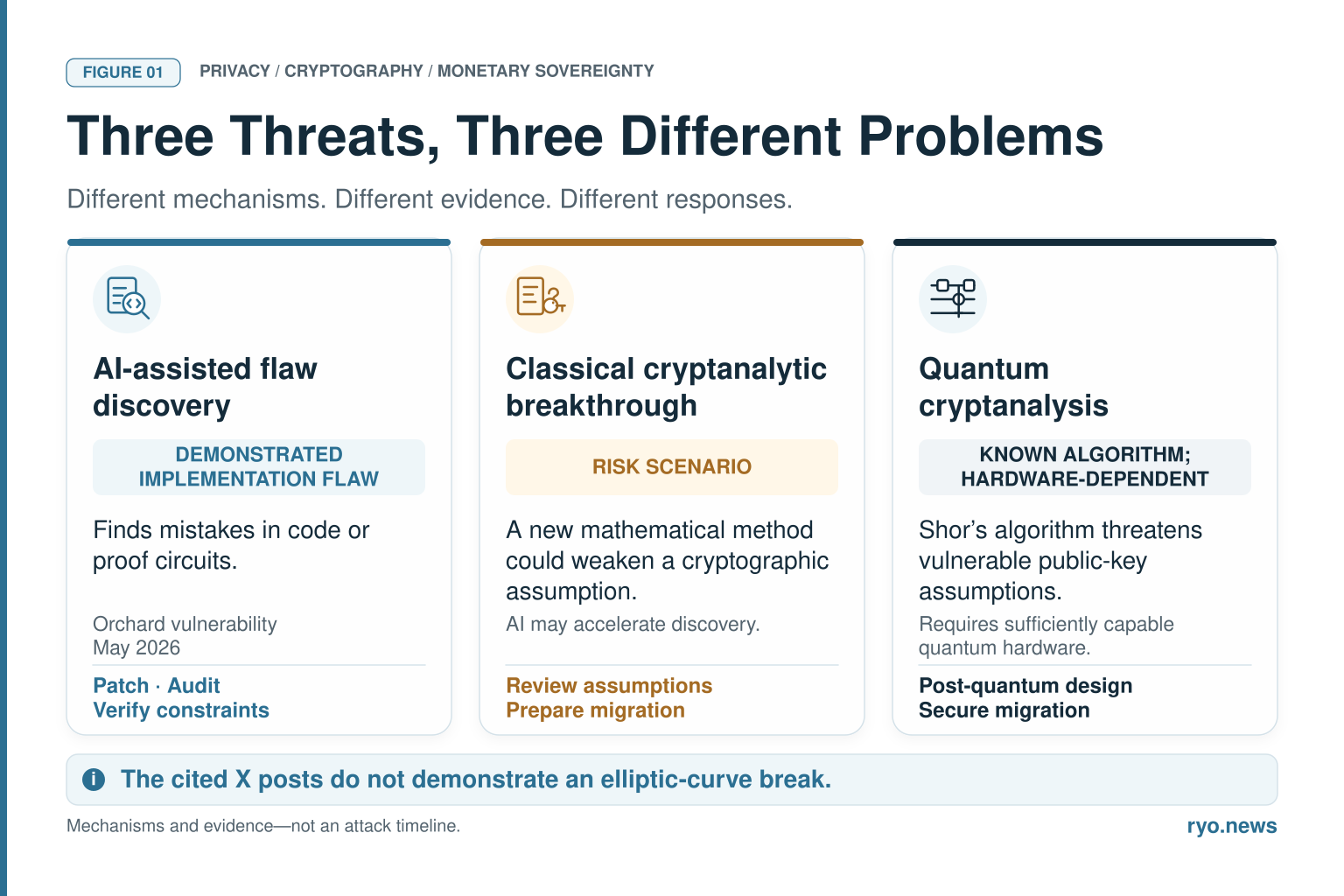
Three mechanisms belong on separate lines:
- AI-assisted discovery of implementation flaws. A model can help researchers find missing checks, unsafe code or under-constrained proof circuits. An exploit can work even when the underlying mathematical assumption remains intact.
- A new classical cryptanalytic method. A mathematical discovery could reduce the cost of attacking a particular construction on ordinary computers. Drake and Buterin are discussing this possibility; their posts do not supply a demonstrated break.
- A quantum attack. Known algorithms such as Shor’s threaten discrete-logarithm-based systems if sufficiently capable quantum hardware becomes available. The algorithmic vulnerability and the arrival of a practical attacker are different questions.[17]
The distinction determines the remedy. Repairing a circuit does not replace a vulnerable mathematical foundation. Selecting a new signature algorithm does not automatically repair wallet software. Migrating a blockchain while leaving its historical secrets exposed can preserve funds and still fail its users.
III. Privacy by Default Is a Monetary Choice
A financial system can fail its users while every signature remains valid. Employers, competitors, stalkers and governments can extract power from information about who pays whom, what they hold and how their economic relationships develop. Public transaction records supply material for that power.
Privacy by default changes the ordinary condition of participation. People should be able to transact without routinely publishing their financial lives or first acquiring the technical expertise to choose a special private route. That is a question of monetary citizenship as much as wallet design.
Ryo currently uses Ring Confidential Transactions, with a ring size of 25 documented in its source repository. Its CryptoNote-family architecture combines decoy-based spending privacy with one-time destination techniques and concealed amounts. The project’s proposed transition toward zero-knowledge proofs reflects its own recognition that ring-based privacy has limitations.[5][6]
Those protections operate under cryptographic assumptions. Ryo’s current elliptic-curve dependencies remain relevant to the threat being discussed. Moreover, CryptoNote-family outputs publish one-time public keys; a new wallet address does not by itself erase that exposure. This is why fresh-address guidance requires a protocol-specific analysis.[5][16]
What is current, and what is proposed?
The public Ryo overview presents Halo 2, a high-latency mixnet and private staking as an architectural evolution. The following map separates those objectives from current operation. The boundaries in the final column are this article’s assessment.[7]
| Layer | Mechanism | Status | Boundary to examine |
|---|---|---|---|
| Transactions today | RingCT and one-time destinations | Current | Elliptic-curve assumptions and transaction analysis |
| Future transaction proofs | Halo 2 | Roadmap | Proof assumptions, circuit correctness and supply integrity |
| Network privacy | High-latency mixnet | Roadmap | Traffic correlation, relay control and message encryption |
| Consensus participation | Private Proof of Stake | Roadmap | Stake concentration, consensus safety and validator authentication |

IV. Halo 2 Strengthens a Privacy Design Under Specific Assumptions
Zero-knowledge proofs allow a verifier to check a claim while concealing the private information used to establish it. In a monetary protocol, the intended claim includes legitimate ownership, balanced value and compliance with spending rules. A well-designed system can verify these conditions without publishing the underlying financial relationships.
Ryo’s proposed move beyond ring decoys is therefore consequential. It changes how the protocol establishes privacy. The size of the effective anonymity set, the information revealed by transaction structure and the security of the complete design would still require analysis.
The crucial qualification concerns the construction. Zcash’s Halo 2 implementation uses an inner-product polynomial commitment built from group operations; its Orchard ecosystem uses elliptic curves. That design is not inherently resistant to an attacker capable of defeating its relevant discrete-logarithm assumptions. A different commitment construction would require its own evaluation.[8][9]
The planned avoidance of a traditional trusted setup addresses another dependency. It removes a particular initialization concern from the intended architecture. It does not establish resistance to every future mathematical attack.[7]
There is a second obligation. A proof system verifies the statement encoded by its circuit. If that statement fails to constrain something essential, a proof may satisfy the implementation while violating the intended monetary rule. Strong cryptography and correct monetary logic have to meet in the same implementation.
Private money must prove two things at once: that financial relationships remain confidential, and that the concealed monetary state remains legitimate.
V. Zcash’s Lesson: Protect the Supply and the Path to Recovery
On May 29, 2026, Taylor Hornby discovered a critical counterfeiting vulnerability in Zcash’s Orchard circuit during security work for Shielded Labs. The published disclosure describes AI-assisted investigation and an exploit demonstrated in a local test environment. An under-constrained circuit element could permit counterfeit ZEC. An emergency response closed the vulnerability in early June.[10]
This was an implementation failure in the proof circuit. It did not demonstrate that AI had solved the elliptic-curve discrete logarithm problem. Shielded Labs assessed prior exploitation as unlikely, while explaining that Orchard’s records could not cryptographically establish that exploitation had never occurred.[10]
That uncertainty matters. In a confidential monetary system, participants must be able to verify the rules governing hidden value without relying on someone’s reassurance about what happened inside the hidden state.
Supply integrity needs an enforceable boundary
Ironwood introduces a new shielded pool and accounting controls around the old Orchard pool. Its turnstile limits value leaving that pool to the amount legitimately available under the accounting rules. This is a mechanism for enforcing the supply boundary; it is not a retrospective identification of every possible counterfeit note.[11][20]
For Ryo’s future proof-based design, the engineering standard should include explicit monetary invariants, independent review, adversarial testing and formal verification of critical properties. Formal verification can establish claims about a specified model or implementation within its scope. It cannot make an unproven hardness assumption true or remove every risk outside that scope.
Quantum recoverability prepares a different boundary
Ironwood notes also use a format intended to support recovery into a future protocol if today’s elliptic-curve-based protocol must be disabled. ZIP 2005 describes the note-level changes; the Ironwood documentation explicitly distinguishes this forward compatibility from a fully post-quantum shielded protocol.[12][13]
The underlying issue reaches beyond signatures. A note commitment is supposed to bind a concealed record to particular contents. If a sufficiently capable attacker can open the same commitment as different notes, monetary integrity can fail even after the proof system has been replaced. ZIP 2005 addresses that problem through changes to note construction ahead of a future recovery procedure.[12]
The lesson for Ryo is an engineering question: what must be established about existing funds today so that legitimate ownership can still be demonstrated under tomorrow’s cryptography? A future upgrade cannot safely assume that every needed recovery property will be available after an emergency begins.
Epoch makes the research obligation explicit
On October 1, Shielded Labs announced Epoch to research high-assurance post-quantum cryptography and formal verification for Zcash. It targets a production-ready cryptographic implementation by the end of 2027 that could form the basis of a later upgrade. That target is a research and implementation milestone, rather than a promise of completed network deployment by that date.[14]
Ryo need not copy Zcash’s architecture to learn from these developments. It should apply the same discipline: define the threat, preserve legitimate value and explain how the transition could work.
VI. The Permanent Ledger and the Temporary Secret
A blockchain preserves records on a timescale that can exceed the useful life of their cryptographic protection. An observer can collect material today and revisit it when tools improve. Upgrading the software later does not delete copies already held by an adversary.
Monero’s earlier post-quantum research work explicitly treated retrospective deanonymization as a distinct concern. This is the durable idea worth carrying forward from our own earlier quantum discussion: the time horizon of financial privacy can be much longer than the time horizon of a payment.[17]
Historical exposure depends on the construction and the information available to the attacker. Orchard’s note-encryption keys use elliptic-curve operations. Compromising relevant key-agreement assumptions could undermine the confidentiality of retained encrypted notes under the necessary conditions. That does not justify declaring every historical shielded transaction automatically traceable.[9]
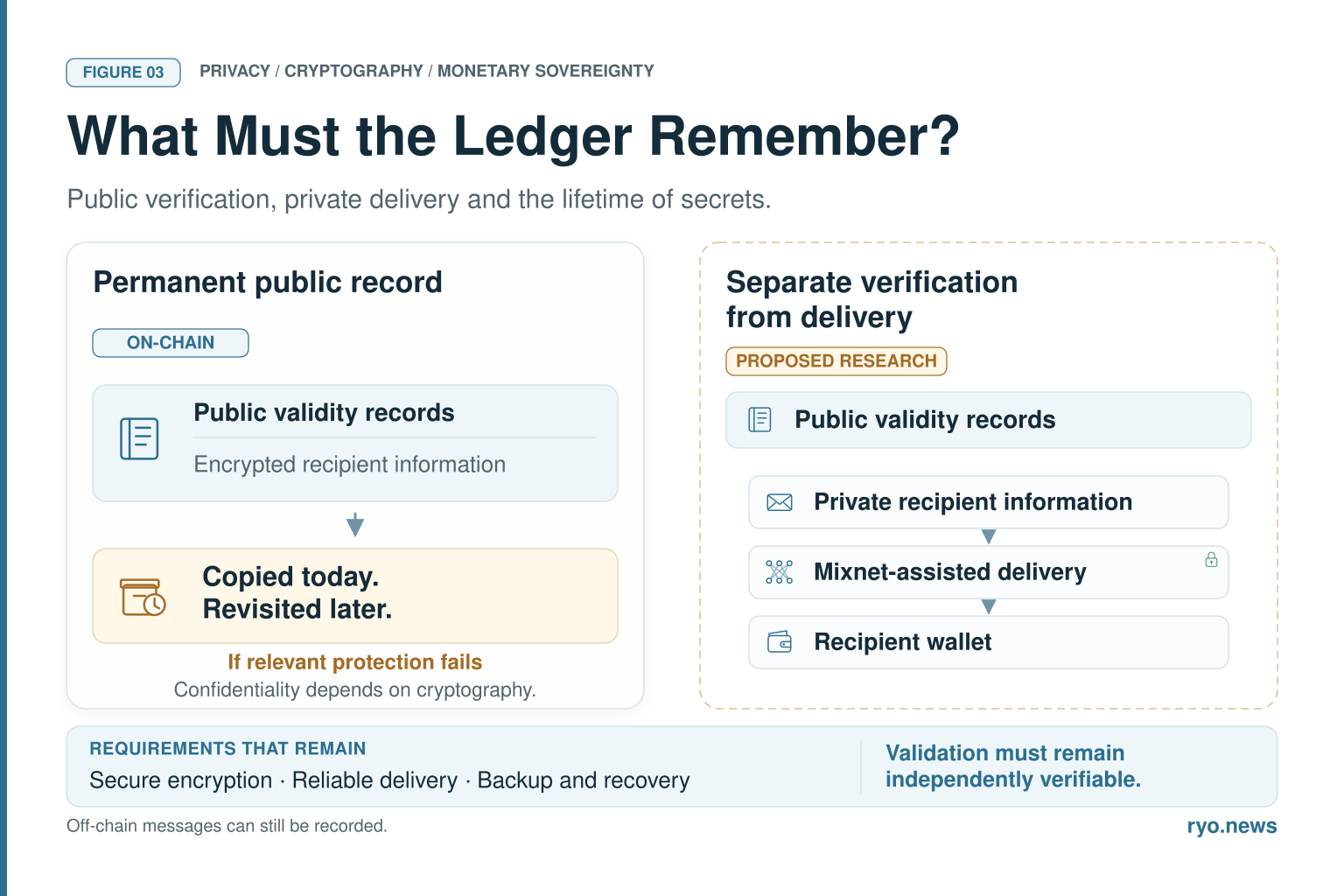
Buterin’s suggestion about off-chain note delivery raises a useful design question for Ryo. What must remain publicly available to verify consensus, and what sensitive information could instead reach its recipient through a private delivery mechanism?[2]
A future Ryo design could investigate separating public validity records from private recipient information, with a mixnet supporting delivery. This is an architectural possibility proposed here. Establishing it would require specification of message encryption, recipient discovery, offline receipt, wallet restoration, backups and reliable availability.
Reducing permanent public ciphertext can reduce one form of exposure. Adversaries may still record off-chain traffic, and recipients still need their recovery information. Traffic mixing and post-quantum message confidentiality remain separate requirements.
VII. The Mixnet: Defending Against the Power to Observe
A confidential transaction can still travel through an observable network. IP addresses, timing patterns and repeated communication can give an adversary information that the ledger itself conceals. Financial privacy therefore requires attention to the transmission path.
Ryo’s proposed high-latency mixnet addresses this layer. In a mixnet, relaying, randomized delays and message mixing can make it harder to correlate incoming and outgoing traffic. Established mixnet designs also use cover traffic to obscure when real messages are being sent.[7][19]
Delay serves a purpose here. Immediate forwarding can preserve timing relationships that an observer uses to join one end of a communication to the other. Sacrificing some speed can create uncertainty about that relationship. The result still depends on the design, traffic volume, adversarial relay control and behavior at the endpoints.
For Ryo, those conditions become practical deployment questions. What traffic would be mixed? What happens when usage is low? How are relays selected and funded? How do wallet delivery, transaction propagation and consensus continue to work under disruption?
A mixnet’s success would strengthen protection against observation. Compromised spending authorization or broken message encryption would still need their own remedies. The layers have to support one another without being assigned powers they do not possess.
VIII. Private Proof of Stake and the Distribution of Monetary Power
A private network also faces a political economy. Who obtains the asset? Who can participate in securing the chain? What resources become necessary to influence the system?
Ryo’s official materials emphasize no ICO and an extended mining distribution. Its source repository also records the burning of the inherited Sumokoin premine and an 8 million RYO development fund scheduled for emission over six years. CryptoNight-GPU is designed for GPU participation and ASIC resistance. These choices concern access to distribution and the economics of current Proof of Work.[5][6][18]
Mining access is not a guarantee of equal ownership. Electricity prices, hardware access, operating scale and subsequent trading can concentrate holdings. The meaningful question is how much opportunity the distribution mechanism provides, and what the resulting ownership looks like in practice.
Ryo’s roadmap envisages private staking after its GPU-distribution phase. If implemented successfully, that would change the resource used to participate in consensus and could reduce reliance on continuous mining computation.[7]
Confidential staking would still have to establish legitimate eligibility and prevent the same stake from supporting incompatible claims. Its design would need to address concentration, validator accountability, conflicting histories and the ability of ordinary participants to verify consensus rules.
Concealing stake does not dissolve its economic power. Nor does switching consensus systems secure a transaction key against cryptanalytic attack. A post-quantum strategy must cover the cryptography used by validators as well as the cryptography used by people spending money.
IX. The Missing Requirement: The Ability to Change Cryptography
The combined lesson is cryptographic adaptability: a network needs a credible way to replace assumptions while preserving the monetary state and the people entitled to use it.
A future Ryo security program should make five research obligations explicit:
- Map every assumption. Identify the primitives protecting spending authorization, proof soundness, commitments, note encryption, network messages and validator authentication. State what each assumed attacker could compromise.
- Preserve legitimate ownership and supply. Specify how existing outputs or notes could enter a replacement system, how double-spending remains excluded and how an attacker is prevented from manufacturing recoverable value.
- Protect confidentiality across time. Examine retained public records, key exposure and off-chain delivery. Record what migration can protect prospectively and which historical risks remain.
- Make recovery practical for users. Define the required seeds, keys and backups; support offline holders; and test wallet restoration and migration under realistic failures. A recoverability claim must become a procedure people can complete.
- Rehearse the transition. Publish specifications, obtain independent review, test consensus and monetary invariants, and explain activation and contingency rules. Protecting users requires both secure code and credible coordination.
There are established primitives to investigate. NIST’s FIPS 205 standardizes SLH-DSA, a stateless hash-based signature scheme derived from SPHINCS+. It supplies a concrete post-quantum authorization option for evaluation. It does not by itself provide anonymous transactions, secure commitments, note delivery or a blockchain migration mechanism.[15]
Hash-based approaches still require appropriate parameters, secure hash functions and careful implementation. Candidate designs must be evaluated for proof size, verification cost, wallet performance and the privacy properties the monetary system needs.
A proposed extension to Ryo’s security agenda
The program above is this article’s recommendation. The cited roadmap establishes privacy objectives; it does not establish that Ryo has completed a comprehensive post-quantum migration design. Publishing assumptions, open questions and research milestones would make the long-term proposition more concrete.
X. What Would Make Ryo a Safe Haven?
The term should describe an outcome that users can assess. For private digital money, I would apply five tests. Together they examine whether the system protects a person’s economic life through ordinary use, surveillance, failures and upgrades.
1. Confidentiality that survives scrutiny
Ordinary use should conceal sensitive relationships and amounts under a documented threat model. Claims about future attackers must identify the assumptions, records and auxiliary information involved.
2. Monetary integrity that users can verify
Participants need enforceable limits on issuance and spending, with rigorous assurance that hidden value satisfies those limits. The absence of visible inflation is insufficient evidence when the design can conceal it.
3. Ownership that can survive a transition
Legitimate holders need a reviewed route into replacement cryptography. Recovery requirements, eligibility and deadlines must be clear before an emergency leaves users competing with an attacker.
4. Network and consensus resilience
Protecting traffic patterns must coexist with reliable message delivery and independently verifiable consensus. Private participation needs a security model that accounts for concentration and adversarial control.
5. Practical control and usable exit
People need functioning wallets, recoverable backups, access to the network and counterparties willing to transact. Exchanges, custodians and other services introduce dependencies that protocol privacy alone cannot remove.
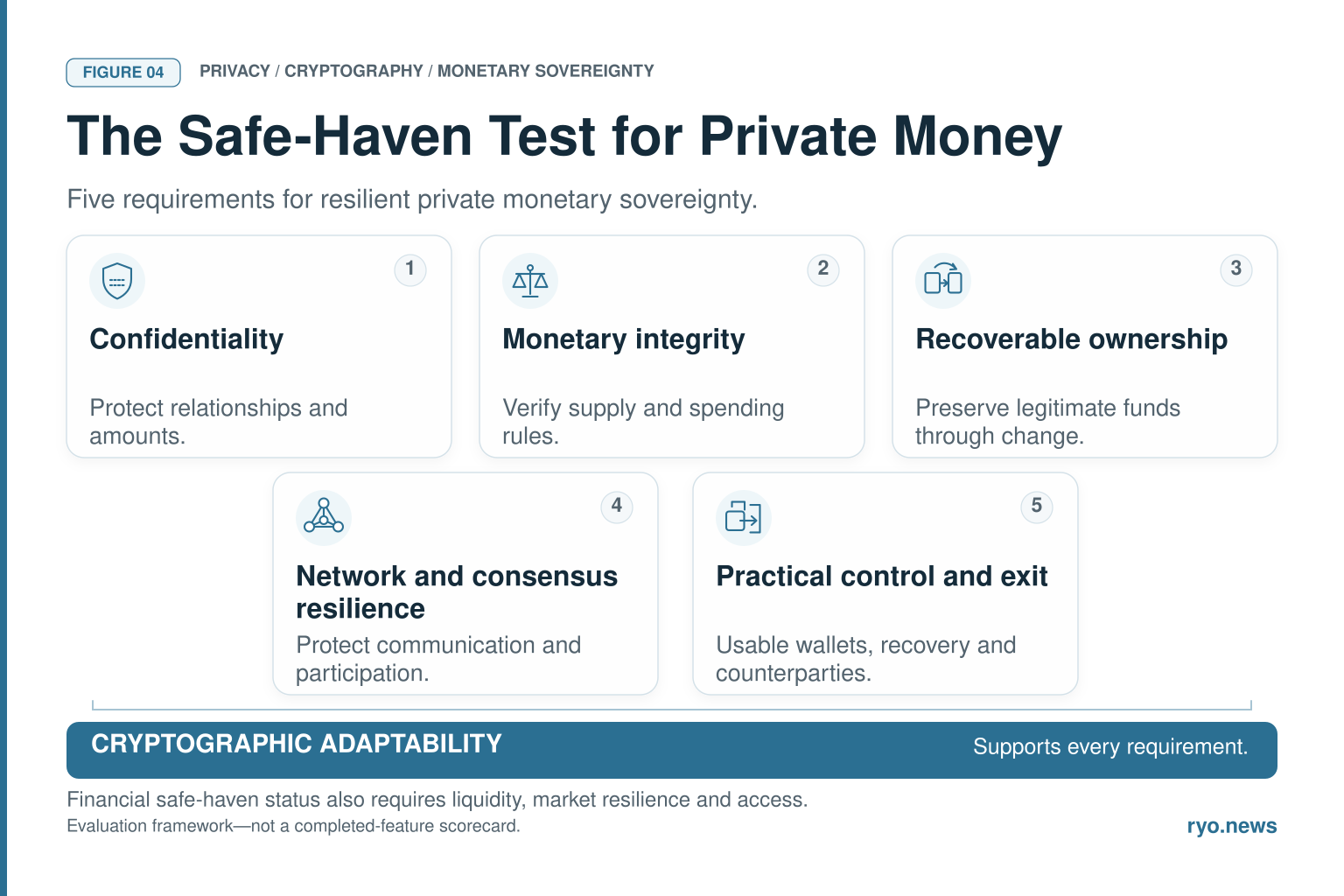
These tests explain why Ryo deserves attention. Its privacy-first direction engages several of the relevant problems. They also explain what the roadmap cannot establish on its own: implementation quality, secure migration, durable decentralization and dependable use under stress.
Financial safe-haven status adds another test. An asset’s behavior during market stress depends on liquidity, demand, volatility and access to trading or payment routes. Strong privacy does not establish capital preservation. Ryo’s potential as private monetary infrastructure should be judged on its evidence, with market resilience evaluated separately.
XI. Security Has to Survive Its Own Evolution
The industry has become comfortable treating a private key as a permanent answer to the question of ownership. Drake and Buterin are asking how long the assumptions beneath that answer will remain adequate. Zcash’s recent experience shows why the question includes both mathematical foundations and implementation discipline.
For privacy currencies, the obligation reaches further. A holder needs control of funds today and protection against the future exploitation of records created while using them. The network must preserve its monetary rules while keeping financial relationships confidential.
Ryo’s roadmap offers a coherent direction: stronger transaction proofs, protection against network observation and an eventual change in consensus participation. Turning that direction into durable monetary sovereignty requires delivery and a public strategy for replacing cryptography safely.
The opportunity is to make that work visible. Specifications, independent review, tested recovery paths and candidly stated limitations would give users something they can evaluate. A smaller network can contribute serious ideas; it earns trust by demonstrating that they work.
The safe-haven test is whether legitimate ownership and financial privacy can survive the replacement of the cryptography that protects them.
Privacy by Default. Freedom by Design. The promise gives Ryo a purpose. Making that promise endure is the work ahead.
Technical and editorial scope: Sources were reviewed for this article on October 8, 2026. Current features, roadmap objectives and the author’s research proposals are identified separately. The cited discussion does not demonstrate a break of deployed elliptic-curve cryptography. Quantum recoverability is a preparation for future migration, not a statement that current shielded transactions are post-quantum secure.
Sources and Technical References
- Justin Drake. Original X post on “bunker mode” preparations. October 7, 2026. Personal risk assessment and migration proposal; not evidence of a demonstrated cryptographic break.
- Vitalik Buterin. Original X response on AI mathematics, cryptographic assumptions and privacy protocols. October 7, 2026. Attributed proposals and caution about rushed upgrades.
- OpenAI. Sharing AI progress in mathematics. October 6, 2026. Research release and supporting proof artifacts.
- OpenAI. Mathematical research repository. Verification stages, formalizations and revision policy. Catalogue counts can change as the collection is revised.
- Ryo Currency. Official source repository and project documentation. Current RingCT description, ring size of 25, elliptic-curve dependencies, burned inherited premine and development-fund emission schedule.
- Ryo Currency. Official project overview. Privacy, mining, distribution claims and development direction.
- Ryo News. Ryo Currency: technology stack and evolution path. Public roadmap presentation; prospective features are distinguished from current capabilities.
- Zcash. The Halo 2 Book: polynomial commitment using an inner product argument. Group-based commitment construction and proof assumptions.
- Zcash. The Orchard Book: keys and addresses. Elliptic-curve keys and note-encryption key agreement.
- Zooko Wilcox, Jason McGee and Taylor Hornby. The Orchard Counterfeiting Vulnerability—And Next Steps. June 4, 2026. Discovery, local exploit, remediation and uncertainty about prior exploitation.
- Shielded Labs. Ironwood. Shielded-pool replacement, turnstile accounting and circulating-supply protections.
- Daira-Emma Hopwood and Jack Grigg. ZIP 2005: Ironwood Quantum Recoverability. Note construction and security analysis for a future recovery protocol.
- Zcash. The Ironwood Book: quantum recoverability. Forward compatibility and the distinction from a complete post-quantum shielded protocol.
- Jason McGee, Shielded Labs. Epoch: Future-Proof Cryptography for Zcash. October 1, 2026. Research scope, formal-verification objectives and the end-2027 implementation target.
- National Institute of Standards and Technology. FIPS 205: Stateless Hash-Based Digital Signature Standard. SLH-DSA, based on SPHINCS+; a signature standard rather than a complete private monetary protocol.
- Monero. Moneropedia: stealth addresses. One-time destination keys in the CryptoNote-family construction; used to explain public-key exposure, not to equate all Monero and Ryo implementations.
- Insight / Monero Community Crowdfunding System. Research post-quantum strategies for Monero. May 20, 2020. Historical research agenda covering quantum threats and retrospective privacy; not a statement of Monero’s complete current implementation.
- Ryo Currency. CryptoNight-GPU. GPU-oriented mining design and intended ASIC resistance.
- Nym. Packet Mixing. Random delays, packet reordering, cover traffic and latency. Used for general mixnet mechanisms, not as a specification of Ryo’s proposed network.
- Zcash Foundation. Zebra 6.0.0 Release. July 10, 2026. Mainnet NU6.3 support and Ironwood consensus integration.