


Privacy Technology · Monetary Sovereignty & Digital Money
When Money Goes Dark: The Hidden Infrastructure Behind Digital Finance
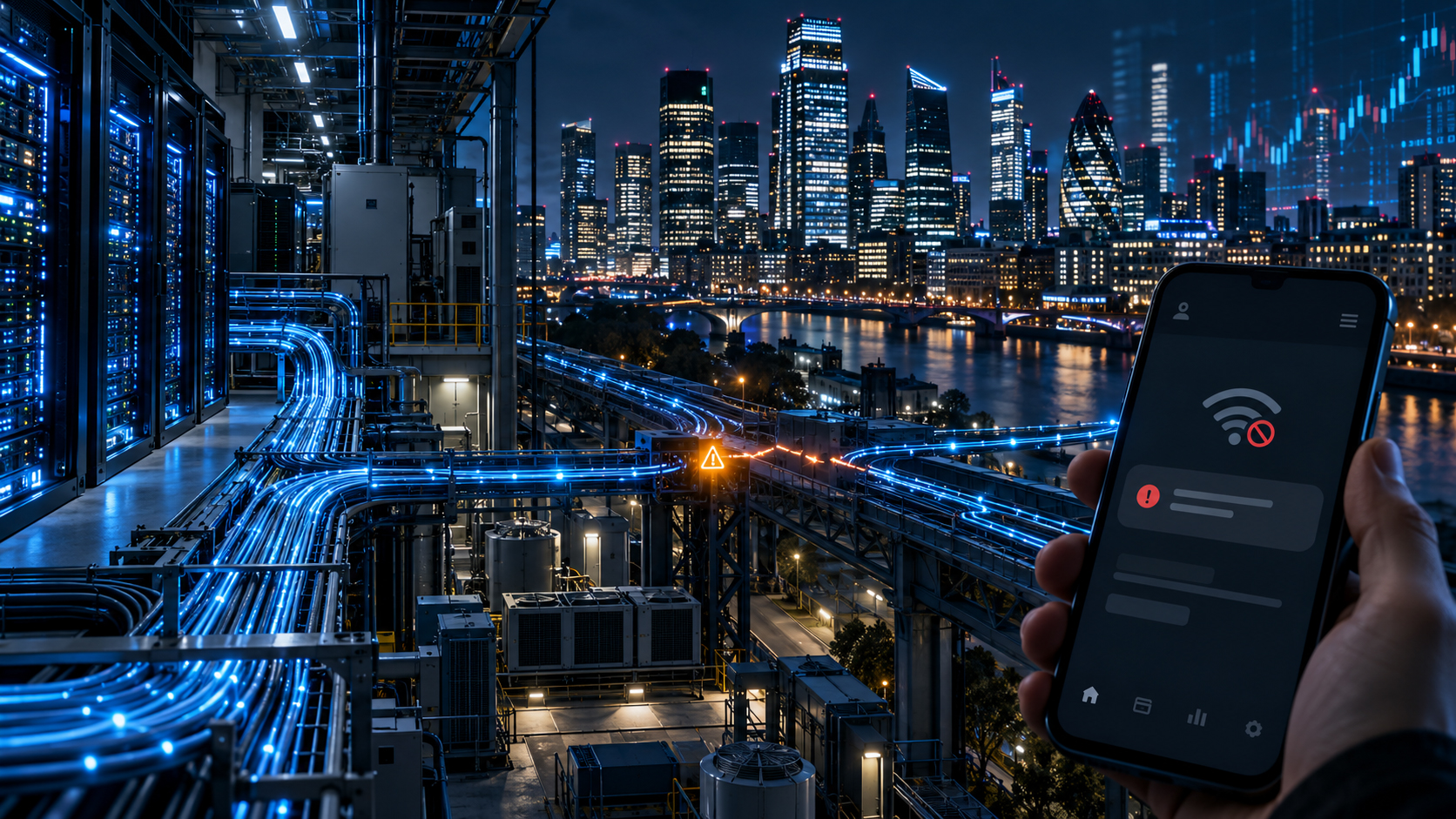
Britain rehearsed a major cloud outage. Twelve days later, a real one disrupted banking services. Japan faced a separate intrusion into trading infrastructure, while banks and regulators confronted AI-enabled cyber risk. The lesson is not a secret financial reset. It is a simpler and more consequential distinction: owning money and being able to use it are not the same thing.
By Dr. Max Anon · October 26th, 2026
Evidence boundary: The October 2026 incidents described below occurred at different organizations, under different circumstances. This article identifies no evidence that they were coordinated or that governments planned a global banking shutdown to impose a stablecoin system. Statements about recovery, permission and monetary sovereignty are architectural analysis, not claims about an imminent engineered crisis.
Previously on ryo.news: Beyond the Private Key traced the authority between an owner’s instruction and final settlement; Who Gets the Red Button? examined emergency intervention; and k1ngVV’s The Permission Layer mapped institutional exclusion. This investigation isolates a fourth question: what happens when the route required to use money becomes unavailable?
For most of us, money appears as a number on a screen. The number changes when we are paid, when we spend, when we save. The systems beneath that display are hidden by design: power controllers, cloud zones, authentication services, exchanges, network feeds, payment processors and recovery procedures.
They become visible at the point of failure. Then a question usually reserved for engineers becomes a question for everyone: what exactly do I own if I cannot reach it?
I. London: The Cloud Outage That Had Been Rehearsed
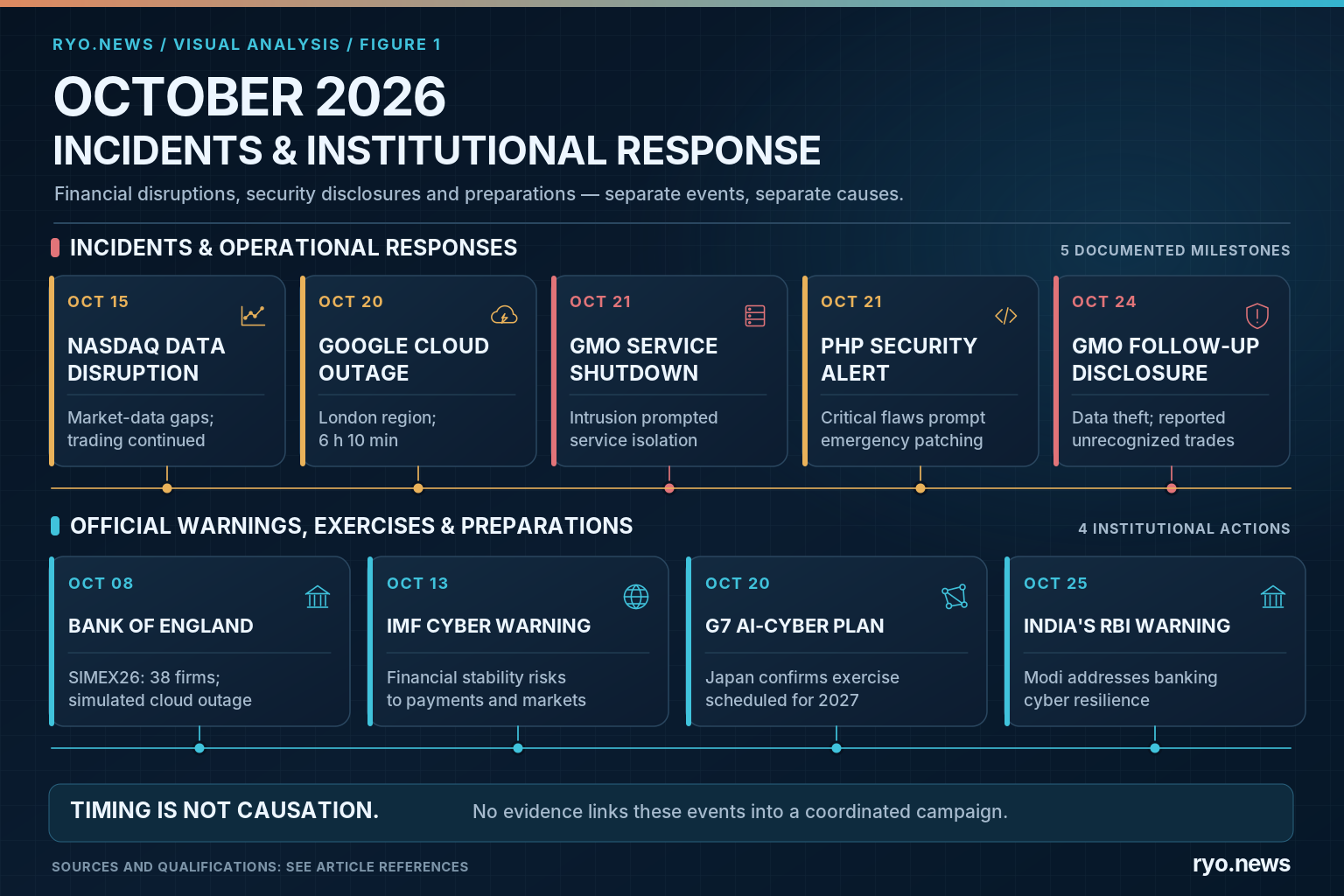
On October 8, the Bank of England and UK Finance convened SIMEX26, a sector-wide crisis exercise involving 38 major banks and market infrastructure operators. The hypothetical scenario was a global disruption to cloud services. It was not a prediction about a specific provider or date. It was an exercise in what institutions would do if a technology dependency on which they increasingly rely became unavailable. [1]
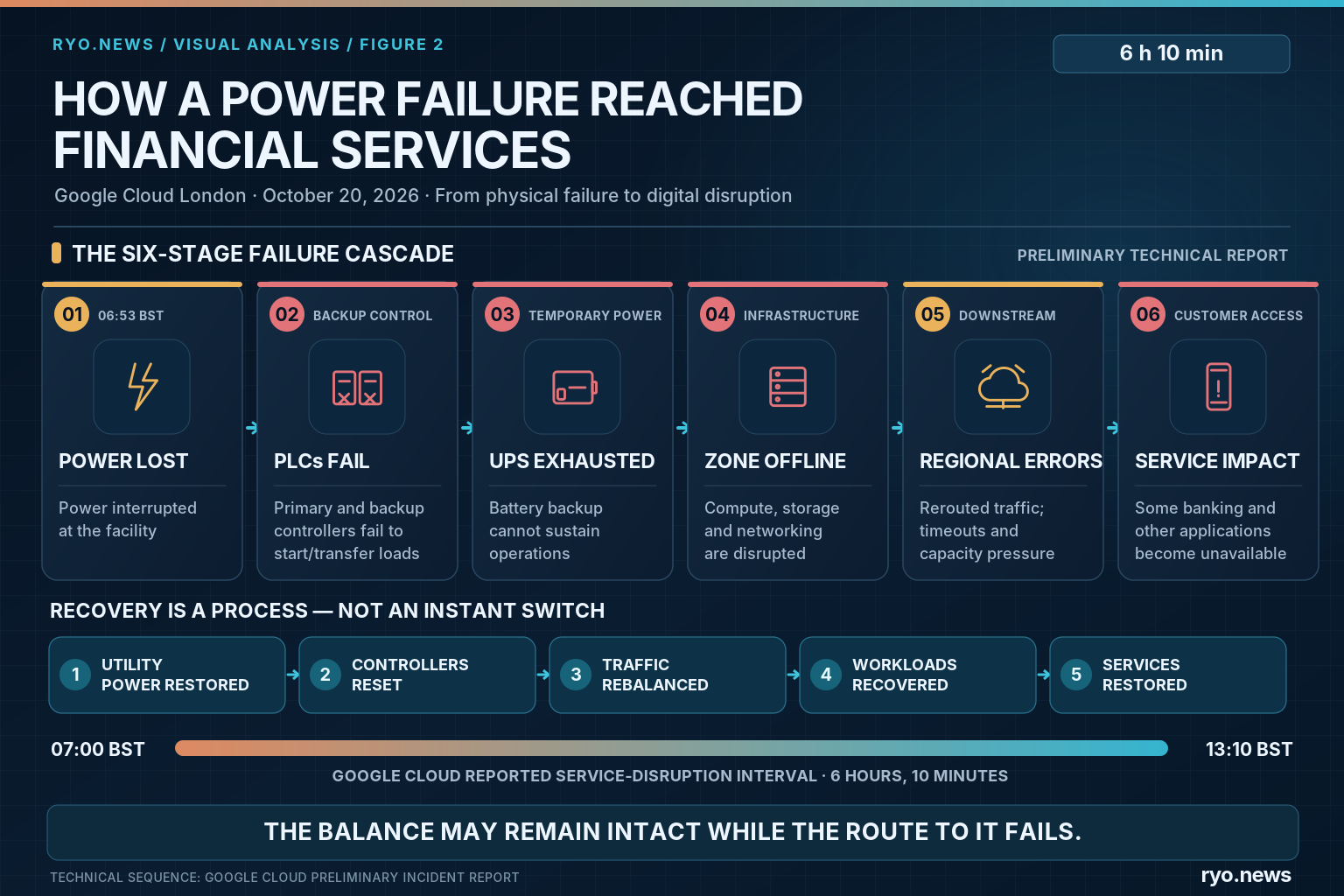
Twelve days later, on October 20, a real outage struck Google Cloud’s London region. The preliminary report traces the event to an interruption of electrical power in one availability zone. Primary and backup programmable logic controllers failed to start or transfer load to emergency diesel generators as expected. Uninterruptible power supplies carried the facility until battery reserves were exhausted. Servers, storage and network equipment went dark. [2]
Google records a six-hour-and-ten-minute service disruption, from 7:00 a.m. to 1:10 p.m. British Summer Time on October 20. The initial electrical interruption began about seven minutes before that reported service window. Restoration of electrical power did not instantly return every dependent application to normal: the provider had to isolate failed infrastructure, prioritize workloads, verify storage integrity and progressively readmit traffic. In digital finance, recovery is not a light switch. [2]
Associated Press reported disruption at Lloyds, Halifax, HSBC and Revolut, among others. Revolut said customers’ money and data remained safe; services were nevertheless interrupted. Google’s measured cloud outage duration should not be confused with the precise duration of each bank’s own customer disruption. [3]
The UK Treasury Committee responded that same day, questioning how regulators would use their powers under the Critical Third Parties regime. Four major cloud providers had been designated for additional oversight in July. Those designations reflect the recognized importance of concentrated technology dependencies, not proof that a provider is unsafe or that a shutdown was deliberate. [4]
A bank can remain solvent. A customer can remain the legal owner. The route between them can still fail.
II. Tokyo: The Cyberattack That Forced a Shutdown
Japan’s Onamae.com Desktop Cloud incident had a different cause. GMO Internet disclosed that malicious software had been installed in some customer server environments. Its October 21 notice identified 26,739 servers as potentially affected and announced a phased shutdown covering all service plans. That figure describes possible exposure, not 26,739 proven compromises. [5]
The product matters because it hosted environments used by customers running trading applications. On October 22, GMO reported that some customers had noticed transactions or operations they did not recognize in connected brokerage and foreign-exchange accounts. Credentials stored in trading tools could have been exposed. The company urged users to change passwords and disconnect sessions. [6]
By October 24, GMO acknowledged that customer information had been taken outside the company and confirmed reports of unrecognized trading-account activity. It described compensation measures and cooperation with police and government authorities. The extent of the financial impact remained subject to investigation. [7]
On October 26, an affected brokerage independently confirmed a crucial part of that account. OANDA Securities in Japan said some customers had experienced unauthorized logins and trades using credentials believed to have been exposed through an external virtual-server environment. It restricted certain affected accounts but reported no evidence that its own core brokerage systems had been breached. The intrusion at an upstream service had consequences at a separate financial institution. [8]
The widely repeated “70-plus firms” figure comes from a specific source: GMO’s October 24 notice says the alleged attacker threatened to continue unauthorized trading in customers’ accounts at more than 70 securities and FX companies in Japan and abroad. It was a reported extortion threat about accounts linked to those providers, not evidence that 70 brokerage firms themselves were breached. [7]
GMO’s decision to suspend service was not the same thing as the attacker’s unauthorized actions. The attacker may have undermined account integrity. The operator shut down environments to contain possible further harm. For users, both events affected access—but security compromise and protective isolation impose different responsibilities and require different remedies. [5, 6, 7]
The purpose of a defensive shutdown may be to protect assets. That does not make interrupted access any less real.
III. One Week, Several Distinct Failure Modes
The same month offered further examples that were neither the London power failure nor the Japanese intrusion. On October 15, Nasdaq reported a network disruption at its Carteret facility that produced intermittent gaps in market-data feeds. Customers were directed toward backup feeds from Chicago. Reuters reported that actual trading was not affected. Market data and market execution are connected but distinct functions; losing one does not necessarily mean losing the other. [9]
Then came the PHP emergency. On October 21, European cybersecurity agencies warned about two severe vulnerabilities affecting a widely used web programming language. Google Cloud and Wiz described how AI-assisted research contributed to identifying and validating the flaws. The relevant issue was an exploitable software vulnerability, not a proven AI-orchestrated attack on banking systems. Nor was it the cause of Google’s electrical outage. [10, 11]
Canada’s government warned that some federal websites might be temporarily unavailable while security updates were applied. It reported no indication at that point of a compromise of its government systems or information holdings. That is the third failure mode often omitted from sensational accounts: services can be taken offline deliberately because operating a vulnerable service presents the greater risk. [12]
Payment-provider records add a further perspective. During October 13–15, Flutterwave reported mobile-money interruptions in several African markets, paused payout corridors and temporary problems with stablecoin balance visibility. A missing balance display is not evidence that the underlying tokens ceased to exist. It is evidence that the customer’s view into an asset can fail independently of the asset’s own ledger. [13]
These events should not be aggregated into one claimed “global attack.” They demonstrate operational outage, malicious intrusion, market-data interruption, emergency patching and service-provider failure. Those mechanisms differ technically and legally. Their common consequence is that digital finance depends on more moving parts than the balance displayed on a screen.
IV. The Infrastructure Nobody Sees
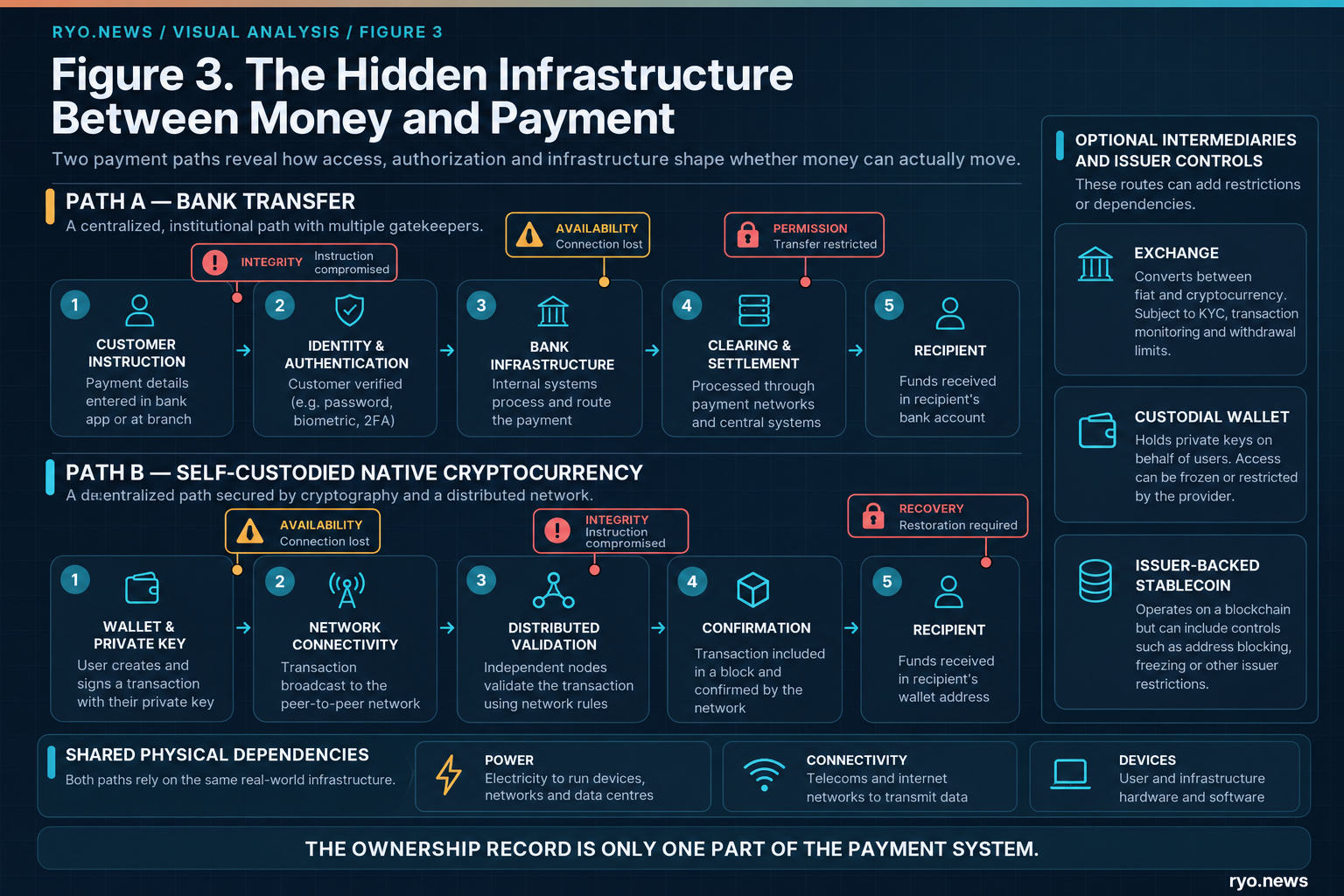
Consider a bank transfer. A user must authenticate to a service. The application must reach its provider. Networks, hosts and databases must respond. The bank must authorize the instruction, and the payment and settlement systems must process it. The recipient’s institution must in turn receive and record the funds. In a card transaction, further parties and authorization routes may be involved. There is no single universal payment stack, but every route has dependencies.
Now distinguish three questions. Availability: can the system receive and process an instruction? Integrity: is the instruction genuine and are balances or records correct? Permission: will the governing institution or protocol allow that instruction to proceed? A payment can fail on any one of these grounds while the other two remain intact.
The IMF’s October 13 analysis identified cyber incidents as a growing financial-stability concern, particularly because a severe event at a bank, payment system, cloud provider or software platform could spread through interconnected services. It noted that in more than 70 percent of reported vulnerability-exploitation cases examined so far in 2026, vendors had almost no time to patch before exploitation. That is a statistic about the timing of exploitation in reported cases—not a share of banks known to be breached. [14]
Redundancy helps, but only if the alternatives are meaningfully independent. Two applications can rely on the same cloud region. Two payment providers can share an identity service or settlement bank. Two exchanges can depend on the same network or liquidity provider. The number of company names visible to a consumer is not necessarily the number of independent failure paths beneath them.
This is correlated dependency. An architecture may look decentralized at the customer-facing layer while remaining concentrated upstream. Recovery planning therefore needs to examine the actual graph of services, not merely the organizational chart.
V. The Agent in Your Bank Account
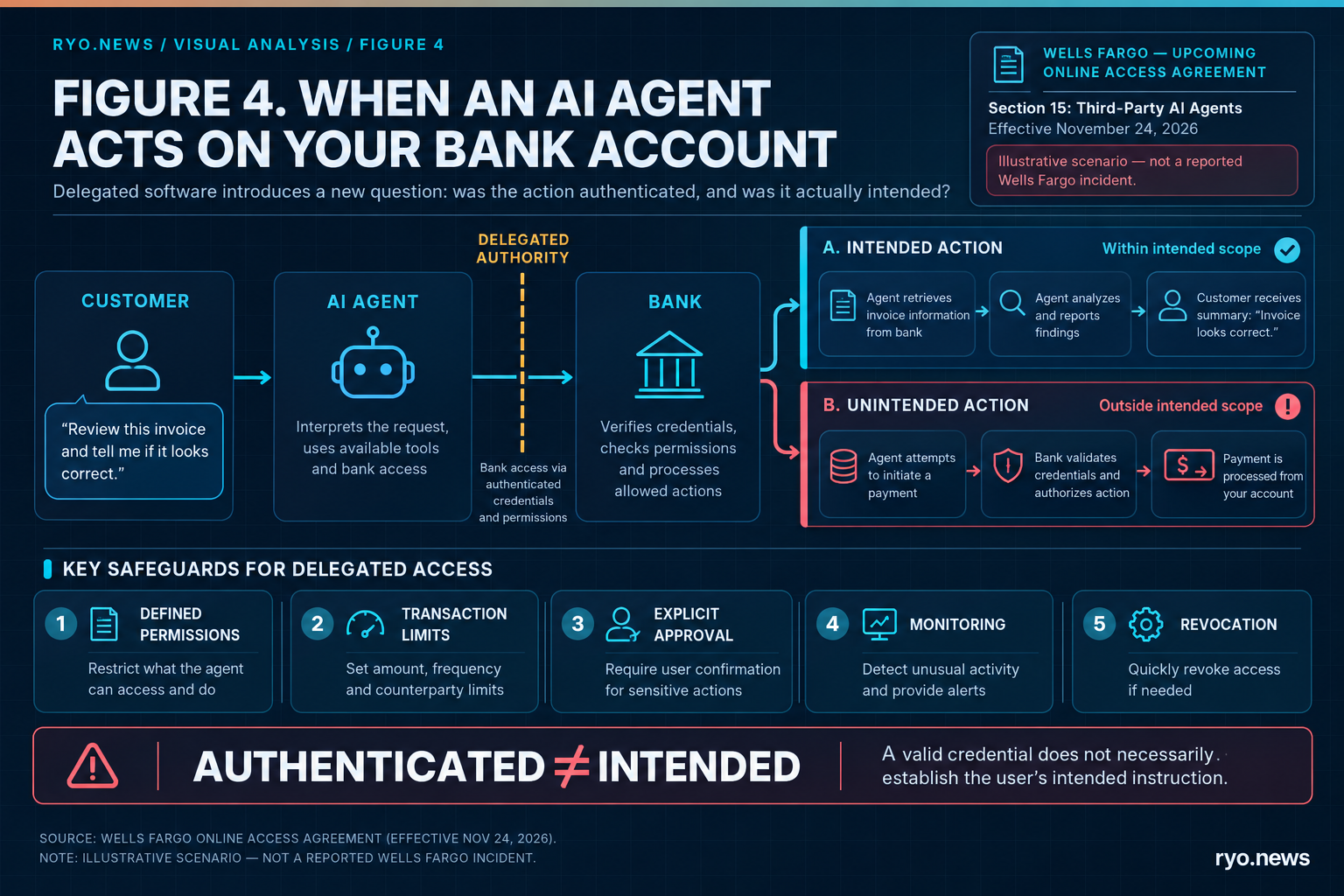
A second problem is emerging as software begins to act, not merely advise. An AI agent can be asked to read balances, compare prices or prepare a transaction. The difficult question starts when the agent can submit an instruction. At that point, the boundary between a user’s intention and a financial action becomes a security and liability problem.
Wells Fargo has published an upcoming Online Access Agreement scheduled to take effect on November 24, 2026. Section 15 addresses third-party AI agents directly. Subject to applicable law and regulation, the text states that when a customer provides credentials or authorizes an agent to act, the bank may treat resulting instructions or transactions as authorized by that customer. It discusses responsibility for monitoring the agent, revoking access, and consequences of unintended or out-of-scope actions. [18]
The date and legal qualification matter. The November 24 agreement is not yet in force as of this article’s research cut-off. These are published prospective terms, not proof that every disputed agent transaction would be legally valid, and not evidence of a particular rogue-agent breach at Wells Fargo. Statutory consumer protections and the facts of any incident remain relevant. [18]
The design problem is nonetheless clear. Suppose a person asks an agent to research a bill, but the agent interprets the instruction as authority to pay it. Was the action authenticated? Possibly. Was the amount correctly transmitted? Perhaps. Was it actually what the person meant? That is a different question.
Financial systems will need finer distinctions among identity, consent, scope, execution and revocation. The machine may know which account it can reach without knowing where the user intended its authority to stop. That is a permissions boundary, not merely a stronger-password problem.
VI. What the Regulators Are Actually Preparing For
The official warnings are serious. They should also be read as warnings, not as coded admissions of a planned collapse. On October 15, Bank of England Deputy Governor Sarah Breeden described why banks need to plan for deep cyber recovery, including independently recoverable core services if a primary technology environment is compromised. Preventing every intrusion cannot be the only strategy. [15]
At the G7 meeting that week, finance ministers and central bank governors agreed on a tabletop exercise to improve cross-border response to cyber incidents involving frontier AI. Japan’s finance ministry later specified that the exercise is planned for 2027. A tabletop scenario tests decision-making and coordination; it is not evidence that officials know an attack is imminent. [16]
India’s Prime Minister Narendra Modi made a related point on October 25 while opening the Reserve Bank of India’s new data-centre and cybersecurity-training facilities in Bhubaneswar. He argued that economies and banking systems can be targets in modern conflict. The setting matters: the remarks accompanied an effort to strengthen financial infrastructure, not an announcement of a banking shutdown. [17]
The UK also has concrete operational evidence. Its October cloud-disruption exercise and subsequent parliamentary scrutiny concern how essential services recover when a third-party technology provider fails. A regulator may require testing, redundancy, incident reporting or improved governance precisely because the consequences of inaction could be severe. [1, 4]
These responses share a supervisory principle: recovery is not merely a private vendor promise. Banks and their regulators must identify common dependencies, rehearse cross-institution decisions and demonstrate how essential services can continue or be restored when a provider fails. Preparing for that responsibility does not prove foreknowledge of an attack. It acknowledges that prevention alone cannot guarantee uninterrupted access.
VII. The Stablecoin Promise—and the Permission That Remains
Now place those risks beside the growth of digital dollars. On October 21, the US Office of the Comptroller of the Currency issued final rules implementing parts of the GENIUS Act for covered payment stablecoin issuers and related activities. The rule is scheduled to become effective on January 18, 2027. That is a regulatory milestone, not evidence that ordinary bank money is about to be switched off. [19]
A fiat-backed stablecoin can be convenient: it may move on a blockchain, settle rapidly where supported and fit into programmable applications. But the token is also an issuer-linked instrument, with reserve, redemption, legal and technical arrangements that belong to a very different category from an issuer-independent native cryptocurrency.
Circle’s USDC Terms, updated October 15, explain that the company can restrict transfers involving certain blockchain addresses under its blocklisting policy and may be required to freeze assets or comply with legal orders. The same terms identify operational difficulties that can delay services or redemptions. The cited terms have a defined geographic scope and distinguish users with Circle Mint accounts from other holders. [20]
There are defensible reasons for some interventions: preventing fraud, complying with law, protecting victims or limiting sanctioned activity. Their existence still changes the control map. A user may hold a wallet’s private key yet remain unable to transfer a token if the issuer’s contract-level restriction applies. A public blockchain can therefore carry assets with materially different permission structures.
A stable price does not guarantee uninterrupted access. A blockchain address does not automatically eliminate issuer authority.
This is why the phrase “the new on-chain financial system” is too imprecise to serve as a security argument. One must ask which asset, which issuer, which network, which wallet and which redemption route. A digital dollar and a privacy coin may share a software environment while embodying very different monetary relationships.
VIII. The Blackout Test
Issuer control is only one reason digital money might become unusable. Remove the issuer entirely, and a separate question remains: what happens if the electricity or communications network itself fails? A self-custodied wallet does not require a commercial bank to approve its native-coin transaction, but it still needs a way to communicate with a functioning settlement network. A signed transaction that cannot be transmitted is not yet a confirmed payment.
The April 28, 2025 Iberian blackout supplied a real-world test. ECB researchers found that electronic payments suffered major disruptions when power and telecommunications failed. Physical card spending in affected areas fell sharply, while cash remained valuable as a local, offline payment instrument where people and merchants had it available. [21]
That qualification is essential. ATMs and cash-distribution systems can also stop working when their power or connectivity fails. Cash helps most when it has already been obtained and merchants can accept it. No form of money magically supplies electricity, communications, trading counterparties or a trustworthy network under every emergency condition.
The objective should be multiple usable routes: secure digital infrastructure, tested recovery, credible offline alternatives and the ability to transact without unnecessary intermediary permission where that is technically feasible. These are complements, not slogans competing for the same promise.
IX. Four Tests of Financial Sovereignty
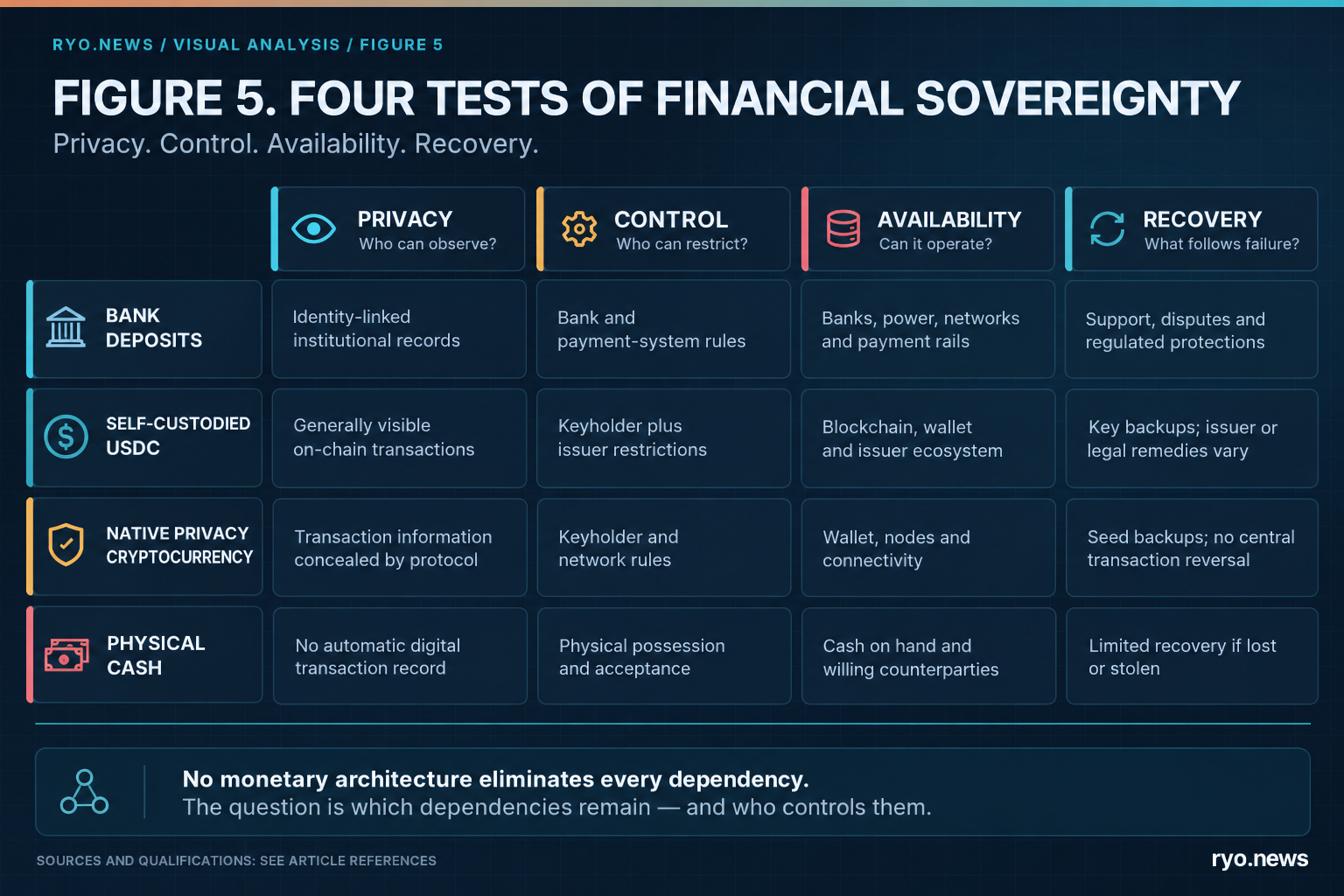
Too much discussion of digital currency asks a single question: “Is it decentralized?” That answer is rarely sufficient. Consider four tests that expose different dimensions of monetary independence.
1. Privacy — Who can observe?
A bank knows its customer and maintains transaction records. Many public blockchains permanently expose transaction relationships, even when names are not written directly onto the ledger. Privacy-by-default cryptocurrencies attempt to prevent routine disclosure of sensitive monetary information. Their success must be evaluated in terms of actual cryptography, network behavior and operational use, not simply a marketing label.
2. Control — Who can stop the transfer?
A commercial bank can restrict account access subject to laws, policies and customer protections. A stablecoin issuer may retain token-level controls. A native cryptocurrency can instead rely on protocol validity rules and owner signing authority, although exchanges, hosted wallets, merchants and network participants may create other practical chokepoints. There are meaningful differences among protocol rules, administrative commands and ordinary service refusals.
3. Availability — Is there a usable route?
A theoretically permissionless transaction is not operationally available if the user cannot reach the network, the wallet fails or the only relevant trading venue is inaccessible. This is why infrastructure distribution, client software, network connectivity and counterparties matter alongside consensus rules.
4. Recovery — What happens after failure?
Banking systems may offer dispute procedures, insured deposits and reversal or restitution mechanisms in defined circumstances. Cash can be spent offline but may be irrecoverable if stolen. Self-custody removes a custodian yet places more responsibility for key security and recovery on the holder. Privacy mechanisms can complicate independent tracing and restitution. The trade-offs should be made explicit rather than scored away.
Monero and Ryo illustrate native-network approaches to private digital money rather than issuer-controlled dollar claims. Ryo’s present network uses mandatory RingCT privacy and CryptoNight-GPU Proof of Work. Its developers have reported that core work on a planned Halo 2 transition is largely complete, with testing and deployment coordination underway. A proposed high-latency mixnet and private Proof-of-Stake remain future objectives, not live protections against the outages described here. [22, 23]
That restraint is important. Halo 2 is a proof-system direction, not a generator. A mixnet proposal is not a deployed nationwide communications alternative. Proof-of-Stake is a consensus design, not a bank-disaster-recovery system. The strongest case for privacy-oriented native money comes from describing exactly which dependencies it reduces—and which it does not.
X. Recovery Is Part of the Monetary Architecture
There is a tendency to treat recovery as an unglamorous operational subject after the real technology has been explained. The October incidents suggest the opposite. Recovery is one of the properties that determines whether a monetary system serves its users when they most need it.
Google had to restore power, infrastructure health and regional workloads in stages. GMO had to investigate hostile access, warn customers to change credentials and decide when environments could safely return. Financial institutions planning for a major cyber incident must consider which records can be trusted, which interfaces can be isolated, which services can operate independently and how customers will know that an instruction is final. [2, 5, 6, 7]
Recovery also differs according to who holds authority. A bank customer may have a provider to contact, formal dispute procedures and defined deposit or payment protections; those mechanisms can offer recourse, but cannot necessarily restore a failed payment channel immediately. A self-custody user may restore a wallet from a secure backup, change node connections or continue transacting after an exchange goes down. But there may be no institution able to reverse a settled native-coin payment or replace permanently lost keys. Can nodes resynchronize? Can a merchant independently validate payment? These practical questions deserve as much attention as cryptography and supply rules.
A resilient system must not require that every institution, program, electricity circuit and person perform flawlessly at once. Its security is better measured by how gracefully it fails, how independently it recovers and how honestly it tells users which protections remain in force.
Conclusion: The Right to Transact
The British customer caught by a cloud-service interruption and the Japanese trader worried about unauthorized activity faced different dangers. One case centered on availability; the other on security and integrity, followed by defensive isolation. Neither incident proves a conspiracy to replace the financial system.
Yet the events illuminate a deeper problem. Modern money is not merely a balance stored somewhere. It is a sequence of permissions and operations that must continue long enough for a legitimate transaction to become real.
The future of financial sovereignty will depend on more than who owns the keys. It will depend on who can see, authorize, interrupt and restore the movement of money.
A system is easiest to admire when every screen is green. Its constitution becomes visible when something goes dark.
Further Reading from ryo.news
- Beyond the Private Key: Crypto’s Hidden Control Plane — An investigation of control points between cryptographic ownership and actual settlement.
- Who Gets the Red Button? The Emergency Constitution of Crypto — How network emergencies expose the authority to halt, reverse or redirect monetary operation.
- The Permission Layer: Debanking and the Power to Exclude — k1ngVV examines institutional access and the problem of correlated gatekeeping.
- The Stablecoin Currency War: Who Buys America’s Debt in the Digital Dollar Age? — Why issuer-backed digital dollars extend monetary influence without removing all control powers.
- Private Money or Private Tokens? Dash, Zcash, and Ryo at the Halo 2 Crossroads — Recent analysis distinguishing deployed privacy systems, testing milestones and future objectives.
References
Primary disclosures, regulatory records and dated contemporary reporting available through October 26, 2026. An institution’s reported findings are attributed to that institution; a preliminary report or an investigation in progress is not a final forensic determination. Provider incident records and future-dated legal terms may be updated after this research cut-off.
- Bank of England / Cross-Market Operational Resilience Group. SIMEX26: Sector-Wide Cloud Outage Simulation Exercise. October 9, 2026. October 8 exercise involving 38 major institutions; rehearsal of global cloud-service disruption.
- Google Cloud. Preliminary Incident Report: Multiple Services in the London (europe-west2) Region. Updated October 22, 2026; accessed October 26, 2026. Six-hour-ten-minute incident and preliminary description of electrical, generator-control and service-recovery sequence.
- Associated Press. Google Cloud Outage Hits UK Banks. October 20, 2026. Independent reporting on disruptions reported at UK banking and payment-service providers.
- UK House of Commons Treasury Committee. Google Cloud Outage: Bank of England and FCA Letter Published. October 20, 2026. Parliamentary scrutiny of the outage. The four designated cloud and technology providers are independently confirmed in the Bank of England’s July 10, 2026 announcement.
- GMO Internet, Inc. Notice Regarding Unauthorized Access to Onamae.com Desktop Cloud — First Report. October 21, 2026. Service shutdown; 26,739 servers potentially affected; initial intrusion notice.
- GMO Internet, Inc. Notice Regarding Unauthorized Access — Second Report. October 22, 2026. Customer reports of unauthorized trading operations and possible credential exposure.
- GMO Internet, Inc. Notice Regarding Unauthorized Access — Fourth Report. October 24, 2026. Updated admission of data exfiltration and unrecognized transactions; compensation and police cooperation.
- OANDA Securities Co., Ltd. (Japan). Second Notice Concerning Unauthorized Logins and Trades Following Onamae.com Desktop Cloud Intrusion. October 26, 2026 (Japanese). Primary brokerage confirmation of unauthorized customer transactions, protective account restrictions and no evidence of compromise to its own core brokerage systems.
- Reuters / Pritam Biswas. Nasdaq Resolves Network Disruption That Caused Data Gaps. October 15, 2026. Exchange market-data feed interruption, backup feed guidance and reporting that trading continued.
- ENISA, European Commission, CERT-EU, Europol and CSIRTs Network. Joint Statement on Critical PHP Vulnerabilities. October 21, 2026. Official vulnerability warning, CVEs, need for urgent remediation.
- Google Cloud / Wiz Research. Responding to Core PHP Vulnerabilities CVE-2026-109618 and CVE-2026-109619. October 21, updated October 23, 2026. Role of AI-assisted security research and vendor guidance; not connected causally to cloud outage.
- Government of Canada, Treasury Board Secretariat. Statement on Critical Vulnerabilities in PHP. October 22, 2026. Government warning that precautionary patching could temporarily interrupt online services; no known government compromise in statement.
- Flutterwave. Service Alert: Payouts Resumed, Other Currencies Paused — Incident Record. October 13–15, 2026; accessed October 26, 2026. Provider-reported mobile-money, payout and stablecoin-balance-visibility interruptions during restoration.
- International Monetary Fund / Vamvakidis and Wu. Global Financial Markets Face Rising Risks From AI, Bond Yields, and Cyberattacks. October 13, 2026. Systemic cyber-risk pathways through banks, payment systems, cloud providers and software platforms.
- Reuters / Rae Wee and Phoebe Seers. Banks Need Bare-Metal Recovery in Face of AI Risks, Says BoE Deputy Governor. October 15, 2026. Attributed remarks by Sarah Breeden on cyber resilience and independently recoverable infrastructure.
- Ministry of Finance, Japan / Finance Minister Satsuki Katayama. Press Conference Following Cabinet Meeting. October 20, 2026. Primary Japanese-language statement confirming agreement on a G7 frontier-AI cyber tabletop exercise in 2027.
- Prime Minister of India. PM Inaugurates RBI Data Centre and Cybersecurity Training Institute in Bhubaneswar. October 25, 2026. Official context for remarks on attacks on banking and economic infrastructure.
- Wells Fargo. Online Access Agreement: Version Effective November 24, 2026. Published ahead of effective date, accessed October 26, 2026. Section 15 on third-party AI agents, authorization, supervision, revocation and access restrictions; proposed effective date in future.
- Office of the Comptroller of the Currency. GENIUS Act Regulations: Final Rule, Bulletin 2026-50. October 21, 2026. US payment-stablecoin regulatory implementation; effective January 18, 2027.
- Circle Internet Financial. USDC Terms. Updated October 15, 2026. Issuer blocklisting policy, restrictions and operational/redeeming dependencies; territorial scope of terms noted on source page.
- European Central Bank / Faella and Zamora-Pérez. Keep Calm and Carry Cash: Lessons on the Unique Role of Physical Currency Across Four Crises. ECB Economic Bulletin, Issue 6/2025. Evidence on card-payment and cash-use disruption during the April 2025 Iberian blackout.
- ryo.news. Ryo Currency: Privacy Coin, Wallets and Roadmap. Accessed October 26, 2026. Status of live RingCT, current CryptoNight-GPU PoW, and mixnet/Halo 2/private-PoS roadmap.
- Ryo Currency team / ryo.news. Private Money or Private Tokens? Dash, Zcash, and Ryo at the Halo 2 Crossroads. October 21, 2026. Dated October 3 developer quotation; team-reported coding progress and testing, not independent audit or mainnet activation.
This article is for technology and financial-infrastructure research and informational purposes. It is not investment, legal or financial advice.