



Geopolitics & Monetary Conflict · Network States & Digital Polities
When States Harden, Networks Form: Carney, Alberta, and the New Politics of Exit
Carney wants Canada to escape great-power dependence. Alberta is revisiting the terms of federation. Balaji predicts an era of capable political statists. The deeper question is whether new kinds of sovereignty protect dissent — or merely move the power to exclude.
By k1ngVV · October 14th, 2026
Executive Summary
On October 19, 2026, Albertans will be asked whether to remain in Canada or begin a constitutional process toward a future separation vote. Days earlier, Ottawa and Alberta were advancing a proposed jointly owned pipeline to Asian markets. Both developments belong to the same dispute over who can make binding decisions, and at what level.
Mark Carney’s ambition is to make Canada less vulnerable to American economic leverage by diversifying markets and strengthening national capacity. Balaji Srinivasan sees a possible darker trajectory: highly capable leaders who combine ideological legitimacy with centralized, China-inspired state power. The first is a documented strategy; the second is a speculative prediction. Neither should be confused with the other.
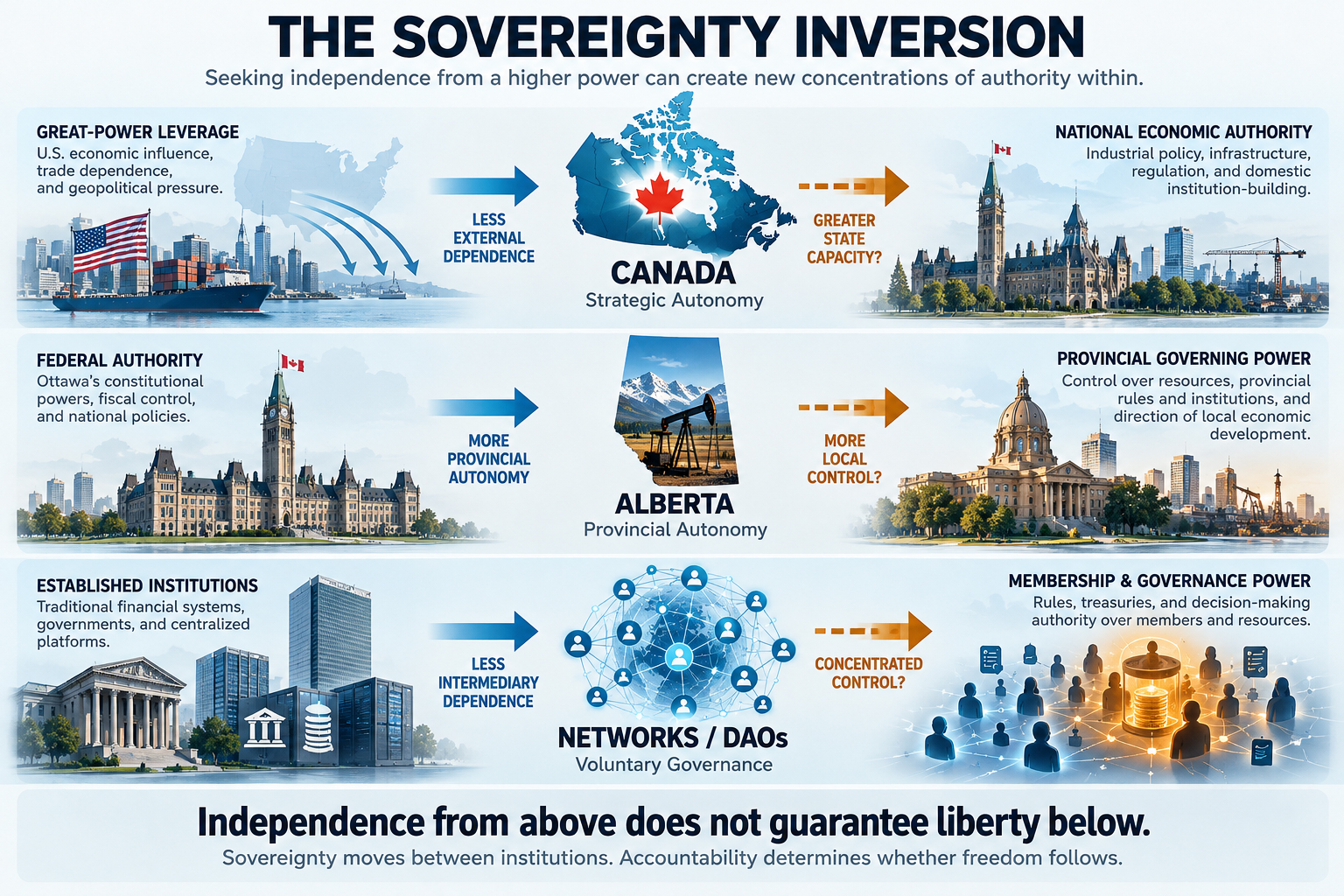
The deeper problem is what this essay calls the sovereignty inversion: political communities seek independence from higher authorities while gaining powers over their own members. Political theory complicates the right-to-exit story. Tiebout emphasizes jurisdictional choice; Hirschman argues that exit can weaken voice; the Curley Effect shows how the departure of opponents can actually benefit incumbents.
Network states, DAOs and privacy-preserving money offer potentially useful alternatives, but they reproduce many of the same questions about membership, concentrated control and institutional accountability. Financial privacy may give people some autonomy without territorial secession. It is not, by itself, a constitution.
Key Takeaways
- A referendum is not independence. Alberta’s October 19 ballot is non-binding and calls, at most, for beginning a constitutional process toward a separate future vote.
- Canada is diversifying, not demonstrably joining a Chinese bloc. A Beijing partnership is real, but the United States still received 71.7% of Canadian merchandise exports in 2025.
- State capacity and liberty are separate variables. A government can become more effective without becoming authoritarian, or more effective at exercising coercion.
- Decentralization can merely relocate power. Federal, provincial and DAO-level autonomy does not automatically protect dissenters within the newly empowered institution.
- Exit and voice must be considered together. Mobility can discipline bad governance, but losing critics can also strengthen an incumbent coalition.
- Privacy is a constitutional design problem. Private monetary infrastructure may reduce information exposure while leaving governance, legality, liquidity and accountability questions unresolved.
Conceptual continuity: The Anatomy of a Network State examined the transition from voluntary club to constitutional institution. The Permission Layer examined financial exclusion. Private From Washington, Visible to Beijing separated state monetary autonomy from individual privacy. This standalone essay brings those questions into a live Canadian geopolitical and constitutional test.
I. The Rupture Comes Home
On October 1, 2026, Ottawa announced that a proposed west coast oil pipeline known as Pacific Link had been listed as a project of national interest. The federal and Alberta governments would be equal owners. Indigenous communities would be offered a minimum 10% ownership interest, and further conditions and consultation still mattered before construction. It was a picture of Canadian federalism at its most ambitious: two governments negotiating over energy, investment and access to Asian markets. [10]
Eighteen days later, Albertans are scheduled to vote on whether their province should remain in Canada or begin the constitutional process toward a future binding separation referendum. That is only one of ten questions on the October 19 ballot; the result of this question is explicitly non-binding. [2]
A pipeline jointly advanced by Ottawa and Edmonton. A ballot that contemplates an eventual path away from Ottawa. The contradiction is not a footnote. It is the story.
Canada’s prime minister has been arguing that dependence on a great power is no longer a safe national strategy. Alberta’s referendum asks, at a different scale, how much authority a province should continue to delegate to the federation. Meanwhile, Balaji Srinivasan’s network-state thesis asks whether some institutions might be organized around communities rather than the accidents of territorial birth. [1][19]
These are not the same political projects. Their protagonists do not share an ideology. Yet they all begin with a dissatisfaction familiar to every generation of constitutional politics: someone else controls too much of our future.
The crucial question is what happens after that authority is reclaimed.
Independence from the power above you does not, by itself, guarantee freedom for the people below you.
That is the problem this essay calls the sovereignty inversion. Every level of political organization can demand room to govern itself while accumulating power over its own members. A stronger Canadian state can resist external pressure. A stronger provincial government can bargain with Ottawa. A stronger digital community can coordinate its members. Each can also create new mechanisms of exclusion. The word sovereignty does not tell us which outcome we are getting.
Featured in the Ryo Directory
Businesses accepting RYO
II. Havel, Deng and the Competent State
Mark Carney supplied one side of this argument at Davos in January. Invoking Czech dissident Václav Havel, he described a rupture in the international order: great powers treating tariffs, financial networks, supply chains and economic integration as instruments of leverage. Countries accustomed to international rules would need the capacity to defend their own choices. [1]
His point was not that Canada should abandon every alliance. It was that middle powers must stop mistaking inherited arrangements for guarantees. Rules work only while important participants observe them. Dependence feels like efficiency until an indispensable supplier, market, payment system or security partner begins using that relationship as pressure.
This was not a sudden intellectual conversion brought about by electoral politics. At Jackson Hole in August 2019, when he was governor of the Bank of England, Carney questioned the international monetary system’s dependence on the U.S. dollar. Among the possibilities he discussed was a synthetic hegemonic currency, potentially involving a network of central-bank digital currencies. It was a discussion of a possible future monetary architecture, not an announcement of a Canadian CBDC policy in 2026. [5]
There is a recognizable continuity: reduce vulnerabilities created by excessive dependence on a single financial or geopolitical center.
Balaji Srinivasan, writing on October 13, offered a darker reading of where a capable leader might go. In two posts about New York’s Zohran Mamdani, he invoked the Curley Effect, described Mamdani as having ‘Deng potential,’ and compared that supposed potential to what he called Carney’s ’emerging playbook’ in Canada. His larger hypothesis is that exceptionally adept politicians may use ideological language to win a loyal constituency, then govern more pragmatically, more coercively and potentially more closely with China. [3][4]
The reference to Deng Xiaoping matters. Deng’s leadership coupled economic experimentation with the preservation of the Chinese Communist Party’s political monopoly. Balaji is speculating about the political utility of that combination, not merely alleging that a Western politician supports higher taxes or infrastructure spending.
But analogy is not evidence. There is no basis in the material examined here to conclude that Carney plans one-party rule, lifetime office or the suppression of Canadian elections. The institutional setting is fundamentally different. A capable democratic government can build infrastructure, streamline administration and defend national interests without copying China’s political system.
Balaji’s earlier 2023 essay, Only Newsom Can Go to China, helps explain why he sees such a pattern: it imagined political alignments crossing American partisan and international boundaries as relations with Beijing evolved. The essay openly treated much of its future scenario as speculative. [6]
The revealing contrast is philosophical. Carney cites Havel to justify independence from coercive power. Balaji cites Deng to warn that the same search for effectiveness might concentrate power. The real question is not which historical analogy wins. It is whether the institutions being strengthened remain contestable.
III. Canada’s Diversification Dilemma
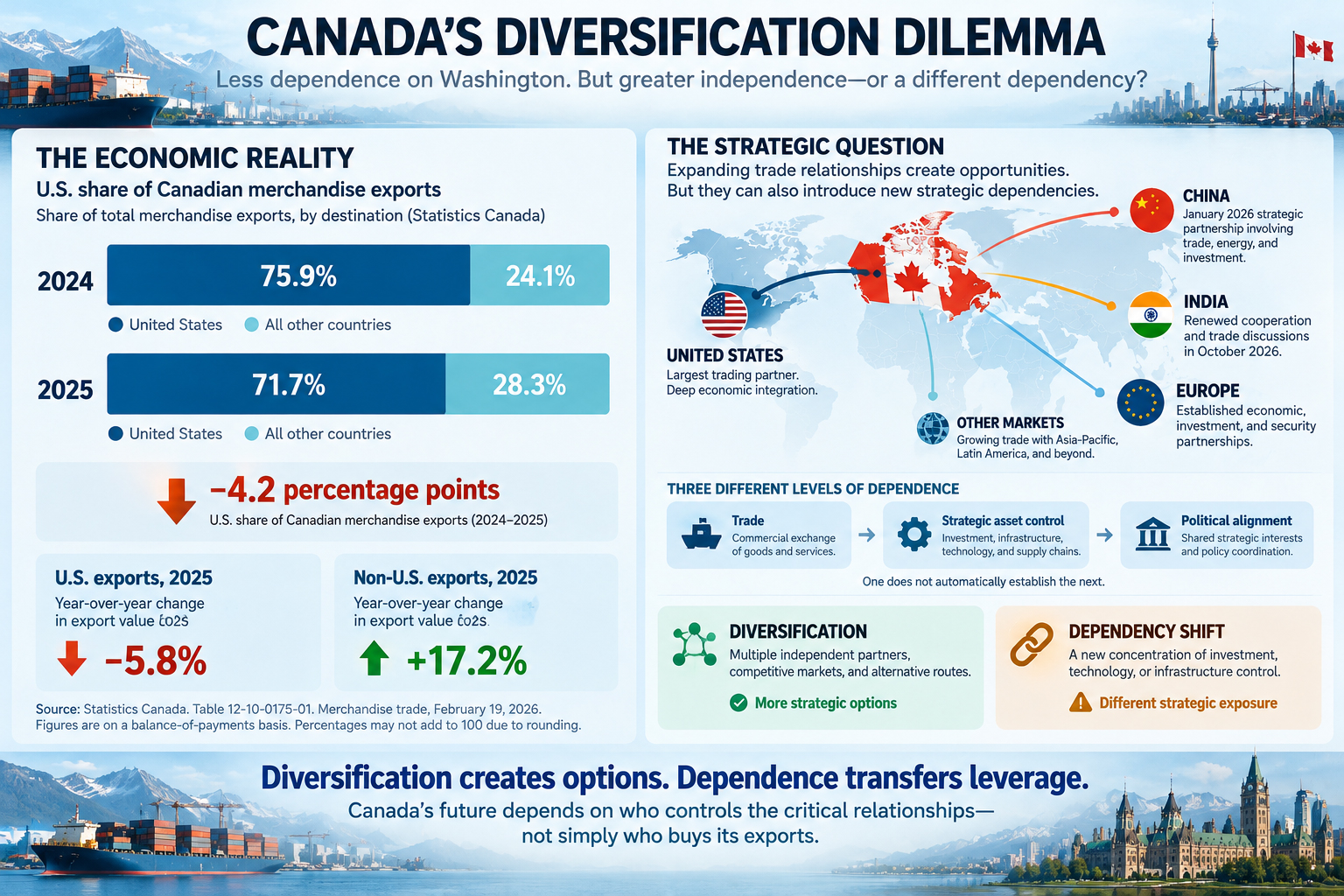
Carney’s January visit to Beijing was a genuine geopolitical development. Canada and China announced a new strategic partnership covering areas including energy, trade and public safety. Canada agreed to admit an initial quota of up to 49,000 Chinese electric vehicles per year at a 6.1% most-favoured-nation tariff, replacing the earlier punitive treatment for imports inside that quota. The government expected corresponding benefits for Canadian agriculture and potential investment in its auto sector. [7]
For Balaji’s thesis, this is meaningful evidence of a Canadian search for alternatives to American leverage. It is not, however, proof of Canadian political subordination to China.
Three propositions should be separated. Trading with China is a commercial choice. Depending on Chinese technology or capital in strategic sectors is a question of vulnerability and bargaining power. Aligning Canadian political and security decisions with Beijing would be a much stronger geopolitical claim. One does not establish the next.
The trade numbers impose discipline on any prediction of a clean break with Washington. According to Statistics Canada, the U.S. share of Canadian merchandise exports declined from 75.9% in 2024 to 71.7% in 2025. That is a significant shift in one year, but it also means more than seven of every ten dollars in Canadian goods exports still went to the United States. These figures describe goods exports, not the entirety of Canadian economic integration. [8]
Nor is China the only destination for diversification. On October 13, Carney and India’s Narendra Modi renewed their commitment to a comprehensive economic partnership agreement and discussed cooperation in finance, defence, energy, security and technology. [9]
An independent Canadian strategy could therefore take at least two forms. The first is a genuinely plural set of markets, industrial relationships and security partners, in which Canada can decline demands from any one capital. The second merely exchanges one dominant dependency for another. Both may begin with similar trade announcements. They diverge in the structure of infrastructure, finance, procurement and institutions over time.
For that reason, the most revealing indicators will not be the number of photographs taken in Beijing. They will be the ownership and control of strategic assets, the openness of procurement and investment review, the ability to maintain independent technology and payment channels, the resilience of export markets, and Canada’s willingness to disagree publicly with major partners when interests diverge.
Carney’s record should be tested against those outcomes, not against either his own slogans or Balaji’s worst-case forecast.
IV. Alberta’s Question Is Bigger Than Separation
The referendum in Alberta offers an unusually direct test of the sovereignty inversion. The tenth question asks whether Alberta should remain a province of Canada or whether its government should commence the legal process required under the Constitution to hold a future binding referendum on separation. It does not itself make Alberta independent, authorize unilateral secession or dispense with future constitutional negotiations. [2][12][13]
The other nine questions reveal what makes the vote more interesting than a simple national-unity contest. Five concern immigration and eligibility rules affecting employment preferences, provincial services and voting documentation. Four propose constitutional changes concerning judicial selection, the Senate, the ability to opt out of some federal programs without losing associated funding, and the priority of provincial law in certain jurisdictional conflicts. Their results are also non-binding. [2]
Some voters may regard these ideas as efforts to bring decisions closer to the people most affected. Others may see proposals that could increase provincial control over residents and reduce existing checks. Both concerns deserve examination. Transferring power from Ottawa to Edmonton does not settle whether that power will be used more fairly or subjected to better oversight.
This is not a simple duel between two governments that refuse to cooperate. Danielle Smith has publicly said she supports Alberta remaining in Canada, and the Pacific Link project illustrates a substantial shared economic interest. A pipeline intended to give Canadian energy better access to Asian markets would be difficult to understand without Alberta’s resources, federal authority, other provinces’ interests and Indigenous rights. It is precisely because the participants depend on each other that constitutional bargaining matters. [10][11]
Nor does a provincial majority own every sovereignty claim within provincial borders. Canada’s 1998 Reference re Secession of Quebec identified federalism, democracy, constitutionalism and the rule of law, and minority rights as central principles. The Clarity Act recognizes that secession would require constitutional negotiation, including attention to Indigenous claims and rights and to minorities. [12][13]
Treaty rights bring that constraint into sharp focus. Courts issued rulings in 2025 and May 2026 concerning earlier citizen-initiated Alberta separation proposals and the duty to consider and consult affected First Nations. Those proceedings should not be conflated with the distinct government-sponsored, non-binding question now on the October ballot. But they establish why provincial self-determination cannot be framed as if no other peoples possess enduring legal and political relationships on the same territory. [14]
First Nations organizers have also been encouraging participation in the October vote, explaining the significance of the treaties and the potential consequences of the ballot to their communities. [15]
A referendum can register a political demand. It cannot erase the claims of everyone who would have to live with the answer.
When the province becomes the center
That is the sovereignty inversion in its clearest territorial form. An Alberta that acquires more constitutional discretion might become more responsive to local communities. It might also acquire powers that particular minorities or individuals find harder to challenge. The location of authority changes; its accountability still has to be designed.
V. The Exit Paradox: When Leaving Strengthens the Incumbent
In 1956, economist Charles Tiebout developed a model in which households could choose between local communities offering different combinations of taxes and public services. Under demanding assumptions about mobility and available alternatives, choosing where to live could help align local government with residents’ preferences. The familiar shorthand is that people can ‘vote with their feet.’ [16]
That idea is attractive to anyone who feels trapped by politics. If one jurisdiction governs poorly, leave for another. If a digital community becomes intolerable, depart or fork it. Competition should discipline the incumbent.
Albert Hirschman complicated that logic in his 1970 book Exit, Voice, and Loyalty. When members are dissatisfied, they can leave or try to repair an institution from within. Exit is sometimes a powerful signal, but it can also remove the very members with the resources, commitment or credibility to demand reform. An organization can lose its critics and keep its habits. [17]
Then comes the mechanism Balaji raised: the Curley Effect. Edward Glaeser and Andrei Shleifer studied Boston mayor James Michael Curley and modeled how an incumbent could benefit politically when redistribution and divisive rhetoric encourage opposing constituencies to move away. Under those conditions, population loss can make an electorate more favorable to the governing coalition even if it damages aggregate economic welfare. The working paper appeared in 2002 and the journal version in 2005. [18]
This is a model of political incentives, not a diagnosis that can simply be attached to an unpopular politician. Taxes, relocation and demographic change can reflect many causes. Neither Balaji’s posts nor the evidence considered here establish that Carney or Mamdani is deliberately attempting to engineer an electorate through outmigration.
The model nevertheless reveals a structural flaw in the romantic version of exit: sometimes the institution is willing to lose you.
A government supported by a stable coalition may prefer the departure of critics to the concessions required to retain them. A digital community dominated by a token-rich faction may benefit politically when frustrated smaller members abandon votes. A founder-controlled institution may even celebrate departures as proof of ideological purity. In each case, the possibility of exit remains real while its disciplinary power declines.
The other problem is unequal mobility. A person with multiple passports, portable wealth and a remote business can consider options unavailable to someone with children in local schools, a regulated profession, a mortgage or caregiving obligations. A province faces still greater friction: infrastructure, public debt, Indigenous treaties, boundaries and recognition are not files that can be exported to a different server.
What matters, therefore, is not just whether an exit exists in theory. It is whether it is affordable, independent, lawful and usable, and whether those who remain retain a meaningful voice.

VI. Can Networks Govern Without Becoming Smaller States?
Balaji’s The Network State reverses the usual story of nation-building. Rather than begin with a territory and organize its residents, a network union begins with voluntary online association, builds capital and collective capacity, then may acquire physical properties and eventually seek recognition. The framework is useful because it treats governance as something communities can attempt to build rather than merely inherit. [19]
It is also incomplete if voluntary membership is made to carry the whole burden of legitimacy.
A network can admit and expel members. Someone must define its purposes, maintain software, decide who controls a treasury, resolve fraud claims and determine which rules can be changed. A digital charter is not self-interpreting. In every serious dispute, the uncomfortable question returns: who has the final authority, and how is that authority constrained?
Decentralized autonomous organizations illustrate the distinction between distributing transactions and distributing political power. A 2024 empirical study of Compound, Uniswap and ENS found that voting power was concentrated among relatively few addresses. It also reported that powerful voters rarely overturned the broader community’s preferred result. Concentration is a genuine institutional risk, but the evidence does not justify pretending every concentrated DAO is already being abused. [20]
The useful comparison is not state versus blockchain. It is accountable institution versus unaccountable institution. A token majority can exclude a minority. A wealthy coalition can purchase influence. An opaque administrator can dominate a technically decentralized system. Forking may be possible in software while the community’s property, reputation, contracts and liquidity remain difficult to replicate.
Elinor Ostrom’s work provides a better starting point than the fantasy of governance by one permanent vote. Durable collective arrangements can involve overlapping decision centers, clear boundaries, participation in rule-making, monitoring, proportionate sanctions and dispute resolution adapted to local conditions. Polycentric governance does not mean the absence of rules. It means that no single institution must monopolize every rule. [21]
An emerging network polity could borrow from that logic: a narrow constitutional core guaranteeing basic member protections, with local communities free to experiment within those limits. Membership status would not place a person beyond national law. Nor would purchasing a parcel of land create an international jurisdiction. Networks would coexist with cities, provinces and countries long before they could plausibly replace any of them.
This is why the distinction developed in our earlier essay, The Anatomy of a Network State: From Club to Constitution, matters. A network becomes politically serious not when it has enough money to buy land, but when it has institutions that remain legitimate after its members disagree. [25]
VII. Privacy Without Secession
Territorial exit is dramatic. It changes borders, jurisdictions and the relationship between governments. But sovereignty also has quieter dimensions that can be protected without moving house or inventing a new country.
Consider money. A person may have formal ownership of an asset while depending on a bank, processor, exchange or issuer to permit access and settlement. Our earlier discussion of the permission layer showed why legal ownership and practical spendability are not the same property. Private financial activity can also become legible far beyond the people involved in a transaction. [26][27]
This is where independently operated, privacy-preserving monetary networks deserve attention. They cannot grant political citizenship, adjudicate treaty rights or substitute for courts. They can, where their design and adoption permit, provide a means of holding and transferring value without making every payment part of a universal public transaction record.
Ryo Currency is one such experiment. The currently documented network uses Ring Confidential Transactions with a default ring size of 25 and CryptoNight-GPU mining. Its proposed transition to Halo 2 proofs, higher-latency network privacy and private proof-of-stake belongs to the development roadmap; those features must not be represented as already activated. [23][24]
The significance is architectural rather than promotional. Privacy-by-default money is one possible layer of personal economic autonomy. It may limit what an ordinary outside ledger observer can infer about a transfer. It does not erase exchange records, endpoint compromise, network metadata, market volatility, tax obligations, or the practical problem of finding counterparties willing to accept the asset. Small networks face especially demanding questions about liquidity and long-term security.
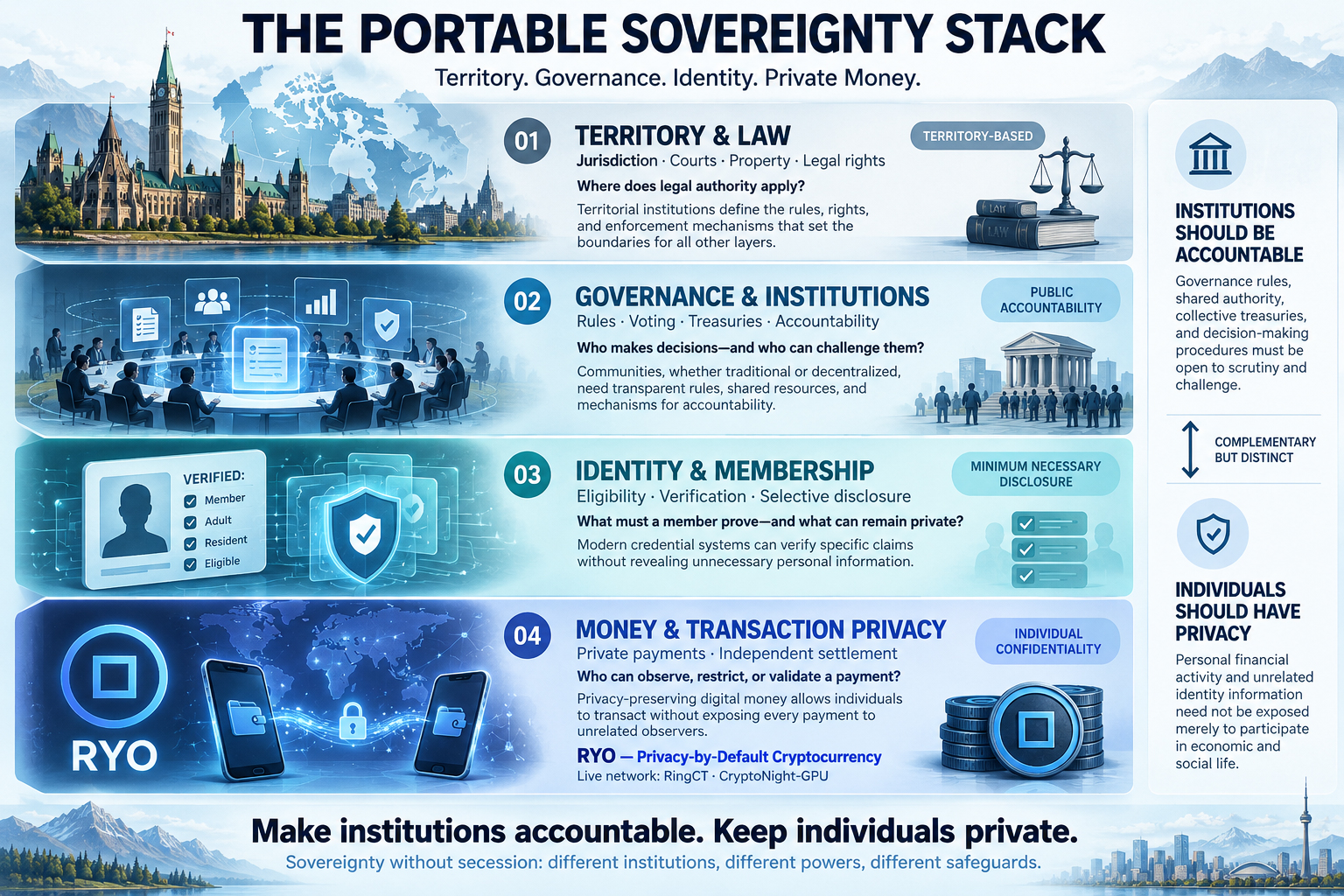
Nor does financial privacy automatically make a DAO accountable. Collective treasuries may require public auditability, while members may need confidentiality for personal transactions. These are different design requirements. Research and standards work on cryptographic selective disclosure, including the W3C’s September 2026 BBS Candidate Recommendation Draft, illustrate how systems might verify particular claims without disclosing unrelated personal information. They are not features delivered merely by using Ryo, nor evidence that complete private governance is solved. [22]
A serious network institution must therefore reconcile several goals: protect the member, make the treasury accountable, resist capture, enable lawful participation and preserve meaningful voice. Private money can support one part of that architecture without replacing the others.
The alternative to a state that watches everything should not be a DAO that cannot be audited at all.
VIII. Who Controls the Terms of Belonging?
Three possible futures are visible from the same October landscape.
In one, Carney’s Canada succeeds in diversifying trade and building infrastructure without diminishing democratic accountability. The Alberta debate leads to clearer bargains inside a functioning federation. Network communities expand as useful complements to public institutions, providing services and economic options without requiring anyone to renounce the country they live in.
In another, state capacity expands faster than institutional restraint. National governments seek autonomy abroad while enforcing conformity at home. Provincial governments invoke local freedom while acquiring powers that some residents cannot effectively challenge. Digital projects promise escape, only to reproduce concentrated governance under a different logo.
In a third, none of the institutional forms wins outright. Countries retain borders and courts; provinces continue bargaining; networks supply portable identity, association and economic tools across jurisdictions. The question becomes less who replaces whom than how their powers overlap, compete and constrain each other.
The evidence available today cannot tell us which future will prevail. The indicators are concrete: whether Canada’s trade options actually broaden; whether infrastructure review retains independent scrutiny; whether Alberta’s constitutional discussions protect rights beyond a simple majority; whether DAOs distribute meaningful control; whether privacy networks become secure and useful enough for ordinary participants.
Balaji has supplied a provocative warning about competent statism. Carney has supplied a compelling warning about coercive dependence. Alberta has supplied a live constitutional test. Their arguments do not cancel one another. Taken together, they reveal that sovereignty is not a single possession passed from one capital to another. It is a collection of powers, rights, dependencies and obligations that can be rearranged in many directions.
The right to exit is valuable. Sometimes it is indispensable. But a free society should not require every dissenter to pack a suitcase, change citizenship or abandon a community simply to preserve dignity, property or a private conversation.
The next politics of sovereignty will not be settled merely by who can leave. It will be settled by who can stay, disagree, transact privately and still belong.
Source and scope note: This article is a dated geopolitical and institutional analysis prepared with information available on October 14, 2026, ahead of the October 19 Alberta referendum. Alberta ballot outcomes are unknown as of publication. The tenth question is non-binding and concerns initiating a process toward a possible future binding referendum, not immediate independence. Balaji’s Chinese-statism comparison is attributed speculation, not proof of Carney’s or Mamdani’s intentions. Pacific Link is described as a designated proposal, not a completed pipeline or a substitute for remaining reviews and consultation. The sovereignty inversion and scenarios are original editorial interpretations. The DAO research measures selected governance systems; Ryo roadmap features are not described as currently activated. Nothing here is legal or investment advice.
Further reading: The Anatomy of a Network State, The Bitcoin Magnet, The Permission Layer, and Private From Washington, Visible to Beijing.
References
- Prime Minister of Canada. Principled and pragmatic: Canada’s path, Davos address. January 20, 2026. Carney on the rupture in the international order, Havel, coercion and middle-power autonomy.
- Elections Alberta. Referendum: questions on the ballots. 2026 referendum, scheduled October 19. Official wording and non-binding status of the ten questions.
- Balaji Srinivasan. X post: Mamdani, Deng potential and the Curley Effect. October 13, 2026. Political analogy and speculation, not independent evidence of intent.
- Balaji Srinivasan. X post: Mamdani, Carney and Chinese abundance communism. October 13, 2026. The comparison whose assumptions are evaluated in this article.
- Bank of England / Mark Carney. The growing challenges for monetary policy in the current international monetary and financial system. August 23, 2019. The dollar, monetary spillovers and a possible synthetic hegemonic currency.
- Balaji Srinivasan. Only Newsom Can Go to China. November 11, 2023. Earlier speculative thesis about changing Western-China political alignments.
- Prime Minister of Canada. New strategic partnership with China. January 16, 2026. Official account of the China engagement, EV quota and tariff arrangements.
- Statistics Canada. Canadian international merchandise trade, December 2025. February 19, 2026. United States share of Canadian goods exports: 75.9% in 2024 and 71.7% in 2025.
- Prime Minister of Canada. Carney speaks with India’s Prime Minister Narendra Modi. October 13, 2026. Evidence of diversification beyond China and of continuing India dialogue.
- Prime Minister of Canada. Pacific Link west coast oil pipeline designated a project of national interest. October 1, 2026. Proposed Canada-Alberta equal ownership, Indigenous participation offer and project-review status.
- Government of Alberta / Premier Danielle Smith. Premier’s Address to the Province. May 21, 2026. Smith states her own and her government’s preference for Alberta to remain in Canada.
- Justice Laws Website, Canada. Clarity Act, S.C. 2000, c. 26. Current statutory text. Constitutional negotiation, clear democratic expression, Indigenous claims and minority rights.
- Supreme Court of Canada. Reference re Secession of Quebec, Case No. 25506. August 20, 1998. Constitutional principles and the rejection of unilateral provincial secession.
- Fasken, Indigenous Legal Matters. Secession Referendum Halted: Alberta Must Consult First Nations Before Proceeding. May 28, 2026. Explanation of litigation concerning earlier citizen-initiative referendum proposals and treaty rights.
- The Canadian Press. Silence could be consent: Alberta First Nations push to get out vote for referendum. October 4, 2026. First Nations responses and voter participation before October 19.
- Charles M. Tiebout. A Pure Theory of Local Expenditures, Journal of Political Economy 64(5). 1956. The theoretical case for jurisdictional choice under stylized assumptions.
- Albert O. Hirschman. Exit, Voice, and Loyalty: Responses to Decline in Firms, Organizations, and States. Harvard University Press, 1970. Exit versus internal reform; reasons exit may undermine voice.
- Edward L. Glaeser and Andrei Shleifer. The Curley Effect, NBER Working Paper 8942. May 2002; journal version 2005. Model of incumbent incentives to reshape electorates through opponent outmigration.
- Balaji Srinivasan. The Network State. Online book, 2022 onward. Network unions, network archipelagos, voluntary coordination and recognition.
- Robin Fritsch, Marino Mueller and Roger Wattenhofer. Analyzing voting power in decentralized governance: Who controls DAOs?. Blockchain: Research and Applications 5(3), 2024. Voting concentration at Compound, Uniswap and ENS, and measured outcomes.
- Elinor Ostrom. Beyond Markets and States: Polycentric Governance of Complex Economic Systems. American Economic Review 100(3), 2010. Multi-level governance, institutional diversity and the conditions of collective self-organization.
- World Wide Web Consortium. Data Integrity BBS Cryptosuites v1.0. Candidate Recommendation Draft, September 10, 2026. Selective disclosure and unlinkable proofs: design possibilities, not a Ryo feature.
- Ryo Currency. Official source repository. Reviewed October 14, 2026. Current RingCT / ring-size-25 architecture and CryptoNight-GPU mining.
- Ryo Currency. Official project and roadmap. Reviewed October 14, 2026. Roadmap context; Halo 2, mixnet and private proof-of-stake are not described as live.
- k1ngVV / ryo.news. The Anatomy of a Network State: From Club to Constitution. September 28, 2026. Prior analysis of rights, constitutional limits and exit versus voice.
- k1ngVV / ryo.news. The Permission Layer: Debanking and the Power to Exclude. September 14, 2026. Earlier analysis of payment-access gates and the conditions of practical monetary participation.
- k1ngVV / ryo.news. Private From Washington, Visible to Beijing: China, Privacy Coins and Financial Sovereignty. July 22, 2026. Earlier distinction between state-level monetary autonomy and citizen-level financial privacy.