


Network States & Digital Polities · Building the Network State
The Network Archipelago: How Digital Communities Build Places That Last
A network becomes more than a gathering when its places support livelihoods, share the gains of development and make lasting commitments possible. The next step is to make those places useful together.
Building the Network State, Article 4. The territory.
Imagined Communities 2.0 examined shared identity. The Bitcoin Magnet examined economic gravity. The Anatomy of a Network State examined institutions. This chapter asks what those institutions can help people build in physical places and across them. Article 5, The Sovereignty Threshold: When Networks Meet States and Peoples, takes up authority, consent and recognition.
I. A Community Can Arrive Together
The first test of a network state may be a business licence.
On July 21, 2026, Johor’s government supported the Iskandar Puteri City Council’s decision to revoke NS0 Malaysia’s business licence and order its Forest City activities to stop from July 22. The official explanation referred to inspections, noncompliance and the legal process. A project organized across borders encountered a decision about what could happen at a particular address. [1]
Kazakhstan subsequently supplied a different setting. Its government reported Network School’s launch at Alem.ai in Astana, describing a community with learning, work, events and provision for families. The organization continued under its existing identity while establishing a new physical and institutional base. [2]
What could travel was a set of relationships: collaborators, professional knowledge, reputation and a reason to gather. What had to be secured locally included premises, operating permissions, services and working relationships with the institutions receiving the community. The contrast exposes both the power and the limits of organizing online. People can arrive with a shared purpose, while the place still determines much of what they can do.
At the October 9 conference in Singapore, Balaji Srinivasan presented cooperation between networks and governments as an increasingly important route forward. His opening described a complementary exchange between a state’s physical and institutional capabilities and a network’s ability to assemble talent, capital and international relationships. [3]
That exchange gives the project an economic starting point. A developer normally has to persuade prospective occupants that a place will become useful. A network can begin with people who already want to work together. Their shared demand could make a training program, workspace or specialized facility more feasible. The host, in turn, supplies access to capabilities the group would struggle to reproduce on its own.
The possibility is larger than a collection of remote workers renting adjacent rooms. A community might train people for a particular industry, help firms find complementary skills, or support research that needs sustained access to equipment. Its contribution becomes visible through what participants accomplish and through the relationships they build with the surrounding economy.
Srinivasan’s original model describes an online community developing collective capacity, acquiring physical footholds and linking them into a network archipelago. The stricter definition of a network state also includes diplomatic recognition. An operating campus, shared treasury or development agreement therefore represents an earlier and more limited achievement, with potential value of its own. [4]
Every foothold remains subject to its host’s rules. Owning premises, providing a service and admitting members are different from exercising public jurisdiction. For this chapter, the immediate test is what the arrangement lets people accomplish and which commitments support their decision to stay.
For the people involved, their practical interaction matters most. Can a household obtain a dependable home? Can an enterprise use the facilities it needs? Can a qualification be accepted elsewhere? Can local businesses participate? The territorial chapter begins when a network can answer those questions through working arrangements. Its ambition becomes credible as a place acquires reasons for people to stay.
II. Why a Host Says Yes
A host has a reason to engage when the network can coordinate activity that would otherwise be difficult to assemble. The offer may include professional relationships, potential customers, training demand and people willing to establish businesses. The value lies partly in connecting these elements before each participant has to make the decision alone.
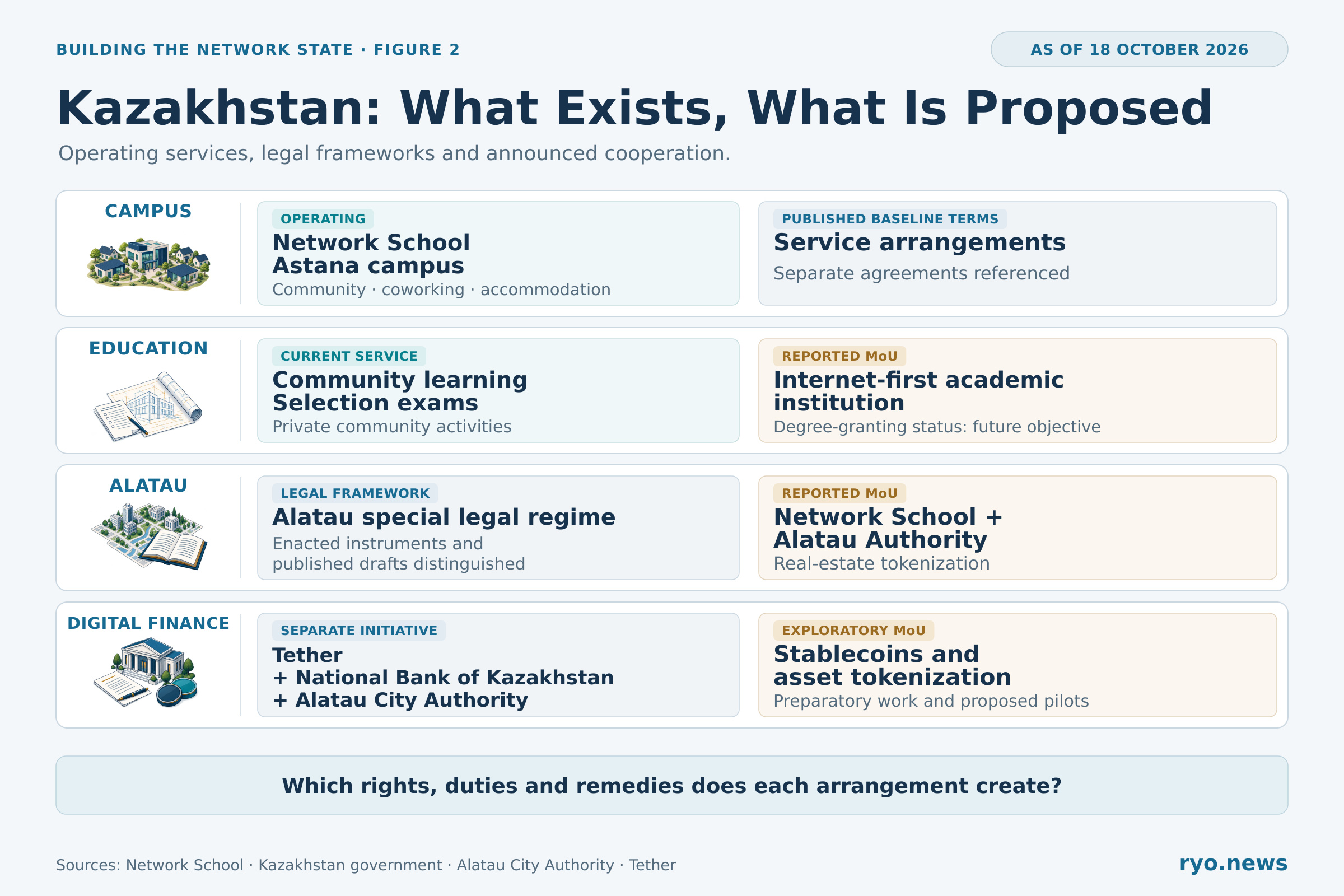
Kazakhstan’s official account places Network School within ambitions for education, entrepreneurship and an international technology community. Its operating Astana base and its proposed academic institution sit at different stages. The campus gives the relationship a present address; the university and development proposals describe capabilities the partners intend to create. [2]
An operating campus is a starting point
The ministry describes an existing Astana base alongside plans for an online-first academic institution, with degree-granting status as a future objective. It also reports a financing round at a $2 billion valuation. These describe different achievements: a present location, an intended institution and fundraising terms. The valuation does not establish how much money is available for construction or continuing services. [2]
Alatau has an adopted special-regime framework with implementation phased through July 2027. Network School’s announced development and tokenization cooperation belongs within that wider setting; the particular rights and obligations still depend on the applicable instruments. Neither a city-wide framework nor an announcement specifies every entitlement of a future participant. [5, 6]
The sequence could create useful capacity. A campus reveals demand and produces operating experience. An academic institution could develop qualifications accepted by employers. A development partnership could provide room for longer commitments. The connections between those stages must be built, financed and used; they do not follow from sharing a project name.
Network School’s published terms distinguish membership and longer-term arrangements, refer to separate agreements and identify some independently operated services. They also state that the current services do not award academic qualifications. A participant needs to know which provider is responsible for each important commitment; the proposed academic institution is a separate future undertaking. [7]
The host’s own capacity matters as much as the network’s appeal. Parag Khanna’s conference presentation emphasized infrastructure, grid reliability, affordability and climate resilience in choosing locations. He also directed attention toward existing cities as places in which new activity can be embedded. [8]
This broadens the territorial opportunity. A network might find its most useful home in an existing university district, a rural town with available space, or a neighborhood whose businesses can support new demand. A functioning road, electricity connection or local supplier can shorten the distance between an idea and an operating enterprise. The decision should account for what already works, what needs investment and who will maintain it.
The host relationship has three participants. Public institutions provide permissions and the wider operating environment. The incoming community brings coordinated demand, skills and investment. Existing residents and businesses supply local knowledge, labor, customers and an inhabited place. Their contribution matters to the economics of the project, even when they never join the network.
An invitation becomes more valuable when cooperation reaches beyond the founding group. Local applicants might gain access to training; suppliers might serve the campus; shared facilities might support established businesses. These are possible arrangements to negotiate and assess, rather than benefits that should be assumed from the arrival of new investment.
The aim is a place that its participants and its neighbors have reasons to maintain. That requires attention to the costs as well as the opportunities: additional housing demand, infrastructure use and pressure on services all need a place in the operating account.
A separate October 7 MoU between Tether, the National Bank of Kazakhstan and Alatau City Authority explores stablecoin and tokenization models. It is distinct from Network School’s announced cooperation. Figure 2 preserves that distinction. [9]
III. From a Campus to a Neighborhood
A temporary gathering can establish whether people enjoy working and living near one another. Permanence asks a different set of practical questions. Someone has to maintain the facilities between events. Businesses need customers after the initial cohort leaves. A household needs confidence that the services it relies on will continue through the next school term and the next change of staff.
The smaller builders at the conference made these questions concrete. Lauren of 4Seas described a permanent Chiang Mai location supporting temporary communities while trying to become useful to people already in the city. The presentation asked how a physical node could grow through connected activities, including a library and children’s space. The operator’s website describes two bases, coworking, gatherings and sustained stays. [10]
The important development is a network of relationships around the premises. A local business might serve both established residents and visiting participants. A shared learning space could become a point of contact between communities. A permanent team could help recurring events function without recreating every local relationship each time.
That changes what success looks like. A busy building is one result. A place that supports continuing activity around it is another. The latter asks the operator to understand existing routines, needs and institutions. Local knowledge becomes part of the productive capacity of the project, and participation can extend beyond people who share its original online identity.
Ridgerunner approaches permanence through property development in Tennessee and Kentucky. Josh Abbotoy’s presentation focused on households with businesses, children in school, civic relationships and accumulated social capital. He described them as difficult to attract and valuable over the long term. The company’s own FAQ locates its developments in existing communities and says its properties are available to the general public without an application or vetting process. [11]
This makes the family with many commitments central to the economics of settlement. Such a household may bring a business, dependable demand and a willingness to improve its surroundings. Those contributions take time. The decision to move can be difficult precisely because the household already knows how much value resides in relationships that cannot be recreated overnight.
Once the family arrives, its growing attachment is evidence that the place is succeeding. It is also a reason to make obligations more dependable. A resident who has established a workshop, friendships and a child’s education has invested in much more than access to a shared room. The operator benefits from that investment and should account for it when changing services or making plans to withdraw.
A place becomes valuable through commitments that are expensive to move.
The point is reciprocal. Founders and developers need enough discretion to build, solve ordinary problems and take risks before demand is certain. Residents need commitments they can understand and remedies appropriate to what they have put at stake. The arrangement should become more substantial as the project asks for more of people’s lives.
Noma Collective adds the dimension of time. Daniel Thompson’s presentation describes digital nomadism as one stage in a longer journey that can include several home bases, family priorities and multiple generations. Its published ecosystem roadmap extends existing curated stays toward permanent hubs and additional services; parts of that broader system remain planned. [12]
A network built around one stage of life may lose people when their needs change. A wider range of services could allow relationships to continue as members settle, have children or spend more time near older relatives. That does not require every location to provide everything. It does require clarity about which needs the network can support and where dependable local institutions already exist.
The practical challenge is to combine continuity with room for independent activity. A neighborhood can contain separate employers, housing providers, schools and associations. Their cooperation may improve life without placing every relationship under one membership decision. As more functions become connected, the people using them should still be able to identify their provider, relevant rules and available alternatives.
These accounts reveal different approaches to supporting an inhabited place. They are evidence of the builders’ models and stated ambitions, not independent findings that every local conflict has been resolved. The common practical question is how a community moves from attracting participants to providing reasons for them to return, establish relationships and eventually stay.
IV. What Makes a Place Prosper?
The earlier chapter on capital asked what gives a network economic gravity. Territory adds a different test: what happens after that capital attracts people to a particular place? A settlement needs useful activity and continuing demand to support the facilities and services on which its residents rely.
Education can be part of that account. In the conference’s closing address, Kazakhstan’s higher-education minister described plans for an institution organized around continuing learning, examinations and links to employment. Balaji connected the broader proposal to recruiting talent and developing companies. These were descriptions of the intended model, with further institutional work required. [6, 2]
The proposed sequence is understandable. A learning community helps people acquire and demonstrate useful skills. Employers and collaborators find one another more easily. Their activity supports demand for workspaces, housing and services. Local firms gain potential customers, and some participants may establish businesses of their own. Each connection requires evidence: a course that improves capability, an employer willing to hire, a product with customers, or a service people will continue paying for.
Proximity could improve those connections. People can inspect equipment together, exchange practical knowledge and develop trust through repeated work. Shared facilities can become feasible when several users commit to paying for them. The advantage should be assessed against the cost of assembling the community, maintaining its premises and coordinating its activities.
A place needs an operating model
Consider the basic account a proposed campus would need to explain. Initial capital can secure premises and fit out a workshop. Recurring receipts must cover the people who operate it, utilities and ordinary maintenance. Equipment replacement and periods of weak demand require a further provision. Combining those obligations into a single optimistic valuation would hide the work of keeping the place usable.
Different services may have different payers. A training provider might receive course payments or contracted support from employers. Workspace users might pay for access and supervision. Housing income might support accommodation costs. Some facilities could be shared with local institutions under separate arrangements. The task is to identify who pays for each continuing promise and whether the expected demand is credible.
The model should also distinguish local circulation from the income sustaining it. Residents buying from one another can make daily life convenient, but the plan still needs to explain what supports their spending: outside employment, customers for local firms, paying visitors, committed institutional funding or another defined source. A community should be able to describe the work or service for which someone beyond its own promotional audience is willing to pay.
A useful stress test is a quieter year. Which expenses continue if fewer members arrive? Which services depend on a subsidy with an end date? Can a workshop remain open if one major user leaves? These are questions for a proposed operating plan, not forecasts about the projects discussed here. Answering them makes a claim of permanence more credible.
Development creates several kinds of value
Balaji’s closing remarks also proposed a link between community formation and land value. He said Network School had signed with Alatau City Authority to issue a coin intended to help bootstrap the city, then used a university-and-landholding analogy to explain how participants might share in the value their presence creates. The separate Alatau presentation described a wider tokenization ambition and its supporting arrangements. [6, 13]
The underlying question is worth examining. When a place becomes more desirable because people teach, build firms, improve services and form a community, who receives the gains? Some benefits may appear as higher earnings, better opportunities or useful facilities. Others may accrue to owners through rents or property values. A claim that the community benefits needs to identify which people receive which kind of benefit.
An economic stake could give participants an interest in successful development beyond their own home. Its effect would depend on the rights attached to it and the choices those rights support. A token representing a revenue entitlement, a share in an asset-owning entity or access to a service creates a different relationship in each case. The name of the token cannot establish the underlying property, payment or decision rights.
The incentive argument remains a hypothesis. An owner with exposure to gains across a wider area might support some improvements that would otherwise appear costly. That possibility does not establish that housing will become affordable or that every useful development will gain support. Renters, local workers and residents without an ownership stake may experience the same increase in demand principally through higher costs.
Appreciation and operating finance therefore need separate explanations. An economic stake can allocate a claim on future value; teachers, maintenance staff and service providers need an identified payment source. A project promising both capital gains and dependable services should show how each is supported, including the consequences of weaker demand.
New York offers a concise comparison in how a public benefit can be specified. Its October 14 announcement for NYU’s planned Quantum Fabrication Facility couples a city award with three seats on the Executive Advisory Board and 15% of specified NYU Central Administration proceeds from intellectual property created at the facility using city-funded tools. The facility is expected to open in 2030. The arrangement identifies particular representation and proceeds rather than an undefined promise to share success. [14]
A network settlement could use different arrangements. The relevant discipline is the same: identify contributors, obligations and channels through which benefits reach them. That includes the existing population whose services, knowledge and public infrastructure help make the new activity possible.
The gains beyond the founding group
Christian Henrik Nesheim offered a broader argument at the conference. He suggested that a relatively small but economically significant population with credible exit options can pressure states to improve their treatment of people, including those unable to leave. This is an argument about the effects of competition; the presentation alone does not establish that those benefits occur in every host. [15]
A host could respond by improving services and administration broadly. It could also negotiate advantages largely confined to the incoming group. The difference should be investigated through what the arrangement makes available: access to training, opportunities for local suppliers, useful infrastructure, published public costs and institutions through which affected people can influence decisions.
Financial returns are only one channel. A local worker may gain through a better job; a business through continuing customers; a household through a more useful public facility. These gains can coexist with costs that fall elsewhere. Looking at both makes the assessment more informative than relying on the value of property or the number of wealthy arrivals.
The conference also exposed uncertainty about the economic environment. Curtis Yarvin challenged whether an AI-heavy future would generate broad demand for human labor, while Balaji emphasized amplified skills and new forms of work. Niall Ferguson separately argued that AI’s physical and industrial requirements could reinforce large existing states. These competing views make the productive model more important: a settlement should explain the activities that sustain it across changing conditions. [16, 17]
The host bargain becomes stronger when the project develops capabilities worth keeping. A training pathway, an established supplier relationship or a facility with continuing users can leave something durable in the place. The essential question is whether the community’s growing value is accompanied by opportunities and institutions that more of its contributors can use.
V. What Connects the Islands?
A group of places becomes more useful as a network when cooperation between them enables something each would struggle to provide alone. That is the archipelago’s practical purpose. Its connections need to carry access, responsibilities and opportunities that people can rely on.
The conference brought together many independent experiments. A common event or a shared vocabulary does not establish agreements among their operators. A functioning archipelago requires further work: deciding what participating locations will provide to one another, how those commitments will be funded and how disagreements will be resolved.
Specialization gives that work a reason to exist. One location might be well suited to training, another to testing a product, and a third to connecting enterprises with customers. A network could coordinate access without demanding that each site duplicate every expensive facility. Shared demand might also support services that a single small community could not sustain.
The benefit has to survive the cost of coordination. Travel, accommodation, administration, language and differing professional rules can make cooperation expensive. In some cases, an established institution nearby will be the better partner. The network should be assessed by the useful relationships it creates, including with organizations outside its membership.
A working example
Consider a hypothetical enterprise formed by members of a network to develop a water-quality sensor. A training campus helps prepare the team. A specialist facility on a second campus provides equipment for testing the product. A commercial partner at a third location helps the enterprise reach customers. An engineer and their family establish a home near the testing facility, where the work requires continuing physical presence.
The network’s first contribution is to make complementary capabilities discoverable. Its more substantial contribution comes through agreements. The testing facility agrees which training it accepts for access to its equipment. The enterprise reserves time and pays for maintenance and supervision. The training provider receives an agreed payment for its work. The commercial partner defines what it will supply and how it will be compensated.
These relationships give the arrows between the locations meaning. A credential is useful because a receiving institution has agreed what it will accept. Access to a machine is useful because capacity has been reserved and the responsibilities for safe operation are known. A professional introduction becomes a commercial relationship through the parties’ actual commitments.
Verifiable credentials can help transmit an issuer’s claims and support appropriate checks. Their technical verification does not oblige a recipient to accept them or establish every underlying claim as true. The receiving institution still applies its own policies. That distinction matters when the claim concerns competence, equipment access or regulated work. [18]
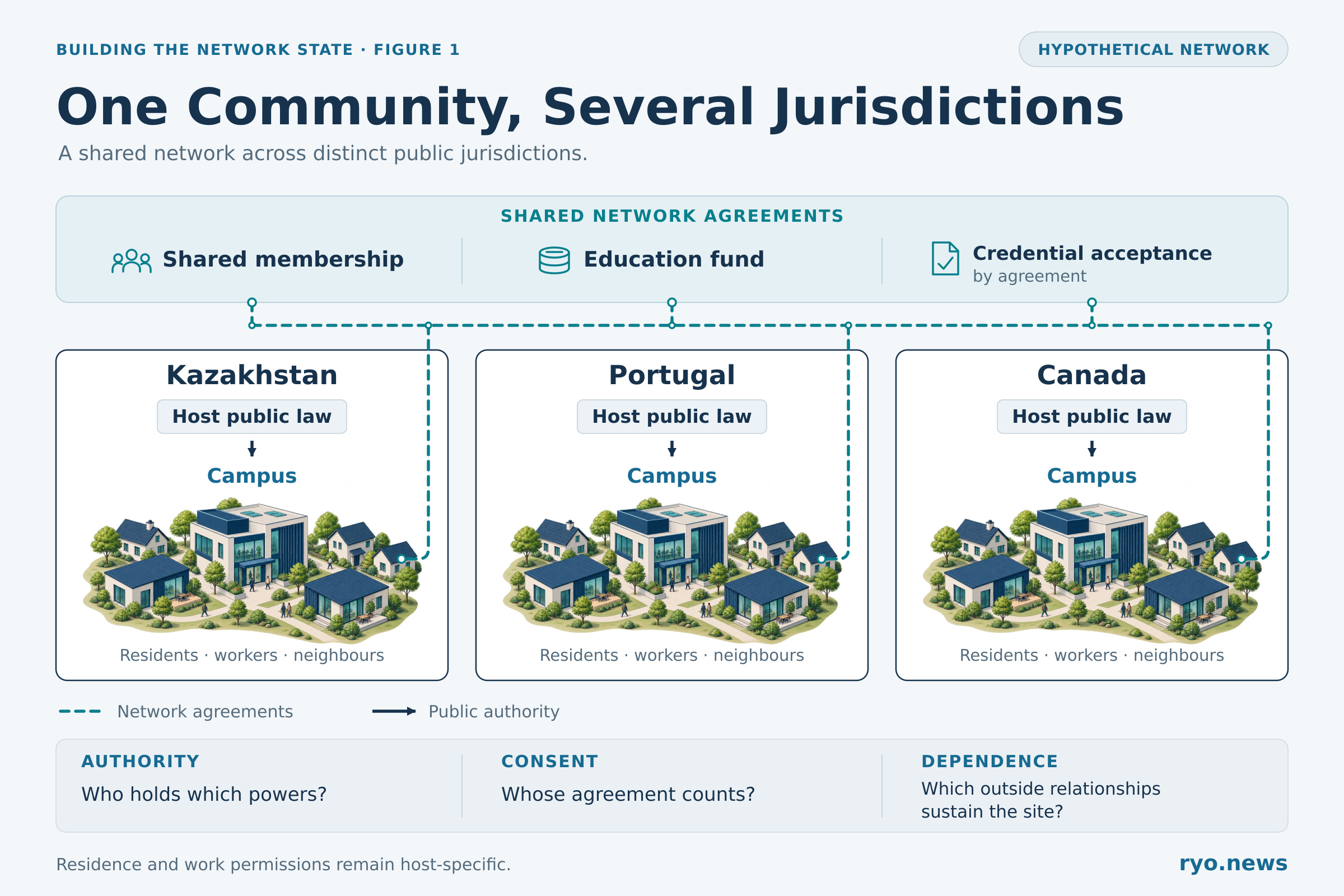
The engineer’s home introduces another set of relationships. Housing comes from a particular provider. A child’s education depends on a particular institution. Residence and work permissions remain subject to the host’s rules. The network can help people understand and arrange those commitments, but it cannot establish their legal effect simply by issuing membership.
Other participants need not move. Someone can contribute to the enterprise from an existing home, attend a short training period or supply a specialized service locally. The archipelago becomes valuable when it expands practical opportunities across those different patterns of life.
Cooperation that people can rely on
Four elements would make the hypothetical arrangement usable. First, participants need a clear description of what each location provides and who is eligible. Second, providers need dependable ways to allocate capacity and receive payment. Third, records and outstanding commitments need to remain intelligible when a person moves or an organization changes. Fourth, disagreements require a forum and a remedy suited to the particular obligation.
A common fund could pay for some shared facilities or assistance, provided its purpose and contributors’ obligations were defined. A network body could represent participating members on common questions. Local providers would retain responsibility for local activities within the authority they actually hold. The arrangement’s value would come from making these relationships easier to use and maintain.
A successful cluster is not automatically a political community. For a network seeking that additional role, members would need standing in decisions about common institutions and shared resources, rather than being only customers of a brand. The practical connections described here give them something concrete to cooperate over. Whether their association acquires legitimate public authority is a further question, addressed in Article 5.
Several sites can also share vulnerabilities. The same operator, funding source, bank, digital platform or credential issuer might be indispensable across the network. Specialization can increase the value of cooperation while making one facility particularly important. Geographic distribution helps only with the risks it actually distributes.
That makes continuity part of the design from the beginning. Participants should know whether another location can perform a function, what replacing it would cost and which capabilities have no ready substitute. A second address is valuable when it supplies a real option. Where work must remain tied to one place, the stronger commitment is to keep that place functioning.
VI. What Survives a Change of Founder or Host?
Long projects and settled households require arrangements that remain usable beyond the founding moment. The concern here is operational: who keeps a facility functioning when its founder steps back, its operator changes or a local arrangement ends?
Vitalik Buterin pressed this distinction in his conference discussion with Balaji. He asked about the future of the particular Kazakhstan institution, distinguishing it from the wider ambition to develop many Network Schools. Balaji described growing community independence and the cultivation of more leaders, while acknowledging that the original institution’s eventual succession arrangements remained undecided. [19]
Both considerations matter. More independent projects can make a movement less dependent on any one founder. People established at a particular site still need that site’s responsibilities to continue. Vitalik’s example of a rocket company made the physical dimension explicit: some ambitions require commitments to land and hardware lasting more than a decade. [19]
The distinction should shape what a project promises. A short gathering can end successfully when its participants depart. A facility supporting years of work needs arrangements that match that duration. A place that attracts families should account for the transition costs it has helped create. The required commitments grow with the role the institution assumes in people’s lives.
The same enterprise, after an interruption
Return to the hypothetical enterprise linking training, testing and commercial activity across three locations. Its product has customers, and the engineer’s household has established a home near the testing facility. The campus operator at that location now announces that it will withdraw. The family and business face decisions on a timetable they did not choose.
Some relationships may continue. The commercial partner can still serve customers. The training provider can maintain records and support new staff. The enterprise may retain its equipment, intellectual property and funds. Those connections show the value of the wider network. They leave unresolved the physical arrangements for testing, housing and everyday services.
The first task is to identify what depends on the withdrawing operator. A landlord, a testing provider and a school may have separate agreements, yet share premises, utilities or access arrangements. Contractual separation makes obligations clearer; physical interdependence still needs coordination. The outcome cannot be inferred from the community’s name.
The proposed response must follow the actual responsibilities of the parties involved. Independent providers can simplify some transitions, but sharing premises or utilities can still leave them exposed to the same interruption. A separate contract is useful only when the service it describes remains feasible.
An operating continuity plan
Before asking for long commitments, participating providers could agree an operating continuity plan. The following is a proposed design for the hypothetical enterprise, not a description of protections already adopted by Network School or another named project. The commitments would be limited to the services and risks the parties actually undertake.
Identify the obligations. Name the providers responsible for premises, testing, utilities, records and outstanding payments. Define the notice that a withdrawal triggers, so the enterprise and household can discover what continues without rebuilding the corporate structure themselves.
Plan for a local handover. Establish what a capable successor would need: access to equipment and records, trained staff, premises and any required permission. The plan must identify whose agreement is necessary; it cannot assume that a new operator automatically inherits a lease or licence.
Fund the limited promises. A reserve, prepaid handover arrangement or another defined mechanism could support a transition. State who controls those resources and when they become available. A future claim against a departing operator does not provide cash to keep a service running today.
Make transfer practical. Where local continuity fails, specify how records, equipment access and outstanding commitments are handled. Another location needs capacity and must agree to accept the work. Cross-border movement still requires the relevant permissions.
Provide a route to resolve disputed obligations. Identify who coordinates the handover, how providers and users receive updates, and where disagreements about the promised services and payments can be heard. This concerns a workable transition, not authority over every aspect of a resident’s life.
In this example, a prepared successor might allow testing and housing to continue locally. Otherwise, a funded transition could preserve the enterprise’s records and commercial relationships while a new physical arrangement is made. The family would know which services remain available and the limits of any assistance. Neither outcome should be advertised as guaranteed without the capacity to deliver it.
Continuity belongs within the economic proposition. An enterprise can undertake more demanding work when its supporting facilities are dependable. A household can establish deeper roots when the provider accepts responsibilities proportionate to the time and resources it asks people to commit.
VII. Measuring Progress, Protecting Private Lives
An archipelago needs evidence that its connections produce useful results. A large online audience establishes interest. A busy event establishes attendance. A settlement requires additional evidence about continuing activity, dependable services and the contribution made to the place around it.
In his discussion with Vitalik, Balaji proposed cumulative person-months, supported by proof of human presence and location, as a future metric for communities. The measure would record time spent together. It offers a starting point for assessing physical participation, with further questions about what that participation enables. [19]
The following dimensions are this article’s proposed framework. They do not assign scores to the projects discussed here. Their purpose is to make different achievements visible without compressing them into a single measure of success.
| Dimension | Evidence to examine | Question it helps answer |
|---|---|---|
| Presence and return | Time spent at a location, repeat visits and continuing participation. | Are relationships continuing beyond an initial gathering? |
| Livelihoods | Continuing employment, customers, productive projects and viable services. | What supports the people and operating costs of the place? |
| Everyday reliability | Delivery of promised services, interruption records and resolution of complaints. | Can households and enterprises plan around the arrangements? |
| Local contribution | Access to training and facilities, supplier participation, public costs and useful infrastructure. | Which benefits and burdens reach the surrounding population? |
| Useful connections | Fulfilled agreements for learning, work, facilities and service transfers across locations. | What does being part of the wider network make possible? |
| Continuity | Delegated responsibility, available transition resources and outcomes during leadership or provider changes. | What remains dependable when circumstances change? |
These measures need context. A temporary research gathering can be successful without becoming a residential community. A settled neighborhood may create value that a growth ranking misses. Comparisons should begin with the commitments a project makes and the functions it undertakes.
Those results should not require a public dossier of every participant. Attendance, qualifications, housing and payment records each answer different questions. A sensible reporting system would establish which results need to be verified, by whom, and at what level of detail, then publish only what is needed to assess the institution.
Present practice should also remain distinct from a proposal. Network School’s privacy policy describes approximate IP-derived location and says it does not collect precise device geolocation. The proposed presence measure should not be treated as evidence that continuous physical tracking is already deployed. [20]
In the sensor-enterprise example, the testing facility needs evidence that the engineer satisfies its access requirements. It need not obtain an unrelated payment history or every original examination record. The W3C’s verifiable-credentials guidance distinguishes technical verification from acceptance and addresses data minimization, selective disclosure and correlation risks. The protection available depends on the particular design. [18]
A progress report could similarly distinguish completed training, delivered services and productive collaborations without making each person’s itinerary public. Authorized reviewers may need underlying records; the whole audience does not necessarily need them. Even aggregate reporting requires care where a small group or unusual event makes someone identifiable.
Private payments within a connected community
The hypothetical enterprise also has financial relationships beyond the campus: independent suppliers, contractors and customers. A household might receive temporary support from a common fund. The parties need records relevant to those transactions, but a useful payment system need not expose the same details to every observer of a public ledger.
Ryo’s relevance is to that limited payment-privacy function. The project describes protocol-level transaction confidentiality, intended to limit public exposure of amounts and counterparties. In this illustration, such a payment instrument could be considered where both parties accept it and can meet their accounting and other obligations. This is a possible application, not a claim that any of the communities discussed has adopted Ryo. [21]
The boundary matters. Payment privacy does not verify someone’s presence or qualifications, conceal a supplier’s own invoice, or establish who controls a fund. Nor does it make a currency price-stable or ensure that a provider accepts it. Those are separate operating questions. The purpose is to protect the financial relationships people retain as more of their lives become connected through the network.
A common fund would still need an intelligible budget, spending rules and appropriate review. Its managers should be able to demonstrate that resources reached the promised purposes without unnecessarily publishing beneficiaries’ private circumstances. Confidentiality and accountability have to be designed together.
The aim is an institution whose performance can be assessed while participants retain independent lives. That is a practical requirement for a place people may eventually rely on for work, friendship and support, rather than a feature added only after the community becomes large.
VIII. An Archipelago Before a Country
The physical promise of the network state begins with a useful combination. People organize around a shared purpose before choosing where to gather. A host supplies capabilities they cannot readily reproduce. Existing residents and businesses contribute to the place they enter. Cooperation across locations can then extend what any one community is able to accomplish.
The conference offers material with which to examine that possibility, rather than proof that it has already been achieved. Kazakhstan links a present community campus to larger educational and development ambitions. The smaller builders explore permanent neighborhoods and different stages of life. Their approaches can be judged by the work they support, the services they deliver and the relationships that continue beyond a launch.
An effective archipelago would turn those relationships into practical options. An engineer could reach a specialist facility without every campus having to build one. A local supplier could gain continuing customers. A family could establish a home while retaining useful connections elsewhere. Members who never move could still benefit from shared learning, work and common institutions.
The test is not endless expansion. A smaller network of dependable places may deliver more than a rapidly growing list of addresses. Its institutions should be able to identify the income that supports their promises, the people who share in their success and the limits of the assistance available when circumstances change. Those answers give a long-term commitment something firmer than enthusiasm to rest on.
This is a meaningful territorial achievement before any claim to statehood succeeds. It is also an achievement that need not lead every participating community toward the same political destination. Some may remain educational, commercial or civic associations; others may seek a continuing political role. Their practical success and the legitimacy of that role require distinct judgments.
Article 5, The Sovereignty Threshold: When Networks Meet States and Peoples, takes up that distinction. Once a network has useful places, institutions and people willing to commit to them, what authority can it legitimately claim—and whose agreement must count? The question begins where economic performance alone stops supplying the answer.
An archipelago becomes worth building when its islands are places worth staying in, and its connections let people do more than they could alone.
References
Conference links below open the official individual sessions. Times labeled livestream refer to the supplied 8-hour-35-minute archive. Times labeled individual clip refer to the linked session. The references retain the October 18, 2026 research cut-off.
- Media Digital Johor / Government of Johor. MBIP cancels licence and orders Network School activities to stop. July 21, 2026; official statement in Malay. The effective date stated is July 22. The notice attributes the action to enforcement and legal process.
- Kazakhstan Ministry of Artificial Intelligence and Digital Development. Official announcement of Network School’s launch in Astana · Network School investment announcement and academic plans · Expanded English ministry account, October 12 item. Official accounts of the Alem.ai campus, financing at a $2 billion valuation, prospective academic institution and development cooperation. The first two releases are in Russian; the final link is the English news feed.
- Network State Podcast / Balaji Srinivasan. Opening Address. Network State Conference, October 9, 2026. Relevant livestream passage: 00:35:35–00:38:58, on cooperation between networks and existing states.
- Balaji Srinivasan. The Network State in One Thousand Words · The Network State in One Sentence. Primary descriptions of a network archipelago and the stricter definition including diplomatic recognition.
- Presidency of Kazakhstan; Alatau City Authority. Presidential notice of the Alatau special-regime law · Implementation phases of the Alatau constitutional law. Law signed May 8, 2026. The Authority describes phases beginning July 1, 2026 and January 1, 2027, with full entry into force July 1, 2027. The presidential notice is in Russian.
- Network State Podcast / Balaji Srinivasan, with Sayasat Nurbek. Closing Address. October 9, 2026. Individual-clip times: approximately 05:37–09:55 for the educational proposal and employment links; 12:45–13:59 for the announced Alatau coin and the land-value analogy. These are proposals and attributed announcements.
- Network School. Terms of Service. Updated September 8, 2026; accessed October 18. Especially the services and user-category provisions, separate agreements, academic-status statements and examination terms.
- Network State Podcast / Parag Khanna. Conference presentation on choosing locations. October 9, 2026. Livestream: 07:53:49–07:57:09. Site selection, infrastructure and the role of existing cities; numerical forecasts are not used here.
- Tether. MoU with the National Bank of Kazakhstan and Alatau City Authority. October 7, 2026. A signatory’s account of exploratory stablecoin and asset-tokenization cooperation, separate from Network School’s arrangements. Included to substantiate the distinction retained in Figure 2.
- Network State Podcast / Lauren of 4Seas; 4Seas. Zuzalu Chiang Mai presentation · 4Seas: locations, gatherings and shared learning. Conference livestream: 05:03:10–05:07:27, especially 05:05:11 onward. Permanent nodes, relations with existing communities and connected services; operator descriptions accessed October 18, 2026.
- Network State Podcast / Josh Abbotoy; Ridgerunner. Why Place Still Matters · Ridgerunner frequently asked questions. Conference livestream: 04:40:15–04:45:50. The FAQ describes property development, local infrastructure and availability to the general public. These sources establish the operator’s model and claims, rather than independent impact findings.
- Network State Podcast / Daniel Thompson; Noma Collective. Building a Multigenerational Network Society · Noma Collective ecosystem and roadmap. Conference livestream: 05:18:36–05:24:18. The operator’s current stays and broader plans are distinct; the article does not treat every proposed hub or service as operational.
- Network State Podcast / Bayan Konirbayev. Alatau City Authority presentation. October 9, 2026. Individual-clip time: approximately 01:15–04:15. Tokenization ambitions and supporting arrangements; future targets are not described as delivered results.
- New York City Mayor’s Office. Announcement of NYU’s planned Quantum Fabrication Facility. October 14, 2026. Defines the city award, advisory representation and narrowly specified share of NYU Central Administration IP proceeds. The expected opening is 2030.
- Network State Podcast / Christian Henrik Nesheim. From Subjects to Customers. October 9, 2026. Livestream: 08:02:54–08:04:38. Argument that credible exit by an economically significant minority can improve treatment more broadly; numerical generalizations are not adopted.
- Network State Podcast / Curtis Yarvin and Balaji Srinivasan. Conference discussion. October 9, 2026. Livestream: approximately 07:03:36–07:07:07. Competing arguments about AI, labor demand and the economic foundations of new settlement.
- Network State Podcast / Niall Ferguson and Balaji Srinivasan. Conference discussion. October 9, 2026. Individual-clip time: approximately 24:45–27:10. Ferguson’s argument about AI, physical infrastructure and large-state power; presented as an argument rather than an established forecast.
- World Wide Web Consortium. Verifiable Credentials Data Model v2.0. W3C Recommendation, May 15, 2025. Verification and acceptance are distinct; privacy guidance addresses data minimization, selective disclosure and correlation risks.
- Network State Podcast / Vitalik Buterin and Balaji Srinivasan. Conference discussion. October 9, 2026. Livestream: 03:13:54–03:15:17 for the proposed presence metric; 03:19:32–03:25:28 for founder dependence, succession and long physical commitments.
- Network School. Privacy Policy. Updated August 17, 2026; accessed October 18. Includes examination data and approximate location, and expressly distinguishes those practices from precise device geolocation.
- Ryo Currency. Official project website. Primary description of the project’s payment-privacy focus. The article does not infer institutional deployment, partnerships or completed roadmap features.