



Privacy Technology
Your Computer. Their Network: Plex2Shell and the Shadow Economy of Hijacked Devices
A compromised device is valuable for more than the files it holds. The question is whose work it performs — and who bears the consequences.
By Dr. Max Anon · October 20th, 2026
Evidence boundary: The October 17 exploitation was recorded on a deliberately vulnerable research honeypot. It does not establish how many ordinary Plex installations were compromised.
Conceptual continuity: The Permission Layer examined institutional access and exclusion; Beyond the Private Key mapped hidden control paths in digital assets; and Everything Is a Chokepoint explored concentrated dependencies. This article applies the same question to the device itself: who can make a machine act after its owner has already paid for it?
You can own the computer, pay the electricity bill and still be working for someone else.
On October 17, a researcher operating a deliberately vulnerable Plex honeypot reported successful exploitation. Mining software appeared; a later update recorded a program called myawesomeproxy. The honeypot was a decoy designed to record attacks, providing a direct view of what arrived after the vulnerability was exploited. [1]
The interesting question begins where a routine security bulletin ends. When an intruder can make your machine perform useful work, what exactly have you lost?
Not necessarily possession. The box can remain on your shelf. What changes is the allocation of authority: who decides which work it performs, whose traffic it carries and which interests it serves. The receipt still names you. The instructions may come from elsewhere.
I. The Warning Before the Exploit
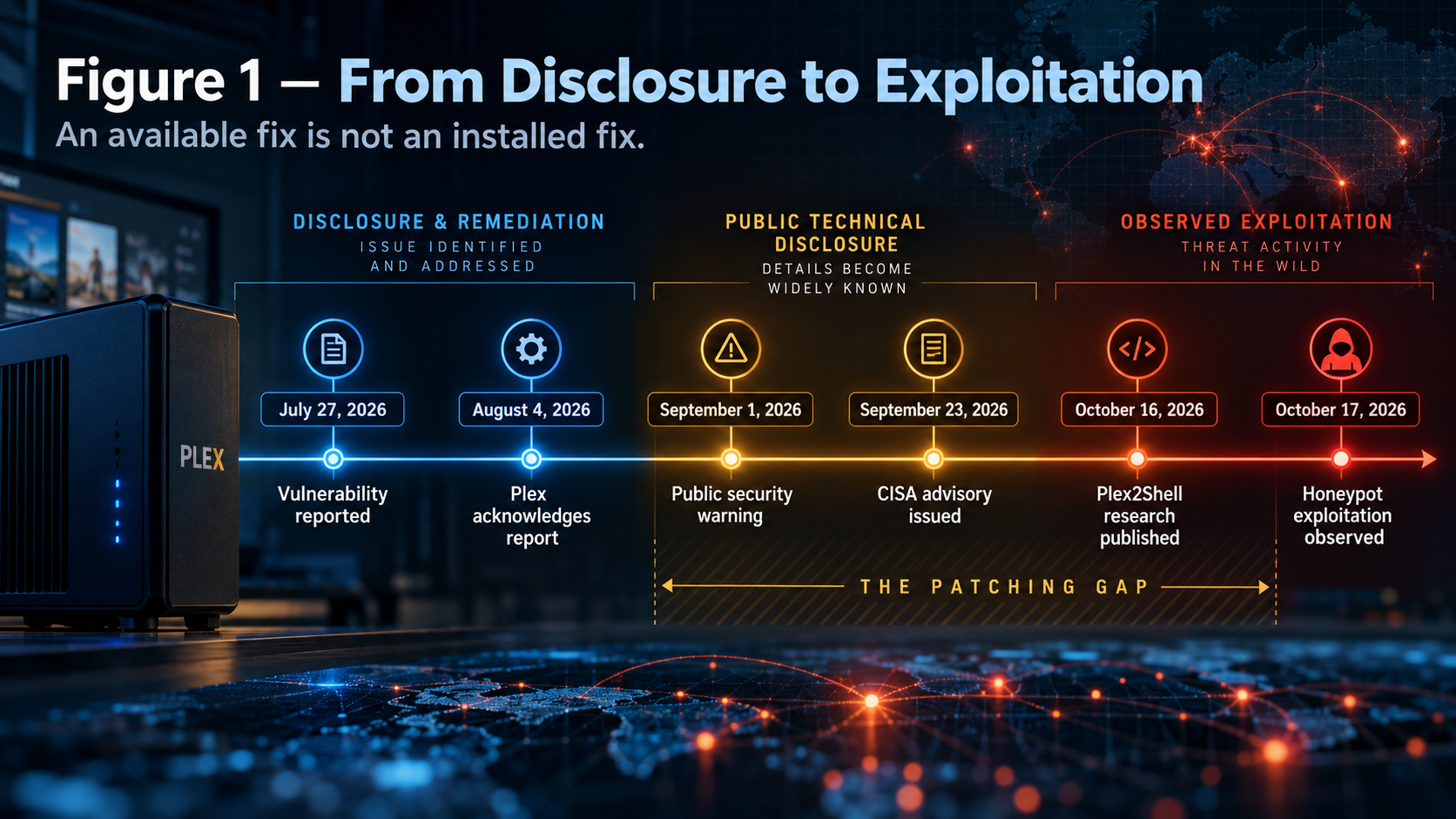
The warning did not arrive after the public exploit. Plex urged server owners to update on September 1, saying security fixes had already been released. Its notice also identified a practical obstacle: some network-attached storage devices might not yet offer the updated package through their usual package manager. Manual installation could be necessary. [2]
Zach Main’s disclosure chronology records a July 27 report to Plex, acknowledgement and a bounty on August 4, and public research on October 16. CISA’s September 23 advisory identifies 1.43.3.10861 as a fixed Plex Media Server build. That is a historical fix identifier, not a reason to prefer an old release over a newer supported one. [3, 4]
The sequence matters. A fix existing, a warning reaching the owner and the corrected software actually running are three different events. An update button is not evidence that the deployed service has changed. The NCSC accordingly recommends monitoring update status, rather than treating automatic-update settings as the end of the process. [15]
On October 19, Plex added a follow-up to its original advisory. It said these flaws were being actively and widely exploited against unpatched internet-facing servers, including deployments of miners and proxy software. That vendor report establishes activity beyond the research honeypot, but it does not provide an independently verified total of compromised installations. Plex urged owners of potentially affected internet-exposed systems to check for signs of compromise and, where necessary, rebuild from a clean installation rather than assume patching alone had removed the intrusion. [2]
This case therefore points toward a problem of maintenance as much as discovery. The distance between a vendor’s release and a user’s running installation is where an otherwise avoidable exposure can persist. Public exploit research makes that gap harder to ignore; it does not create the underlying defect.
II. Four Weaknesses, One Transfer of Control
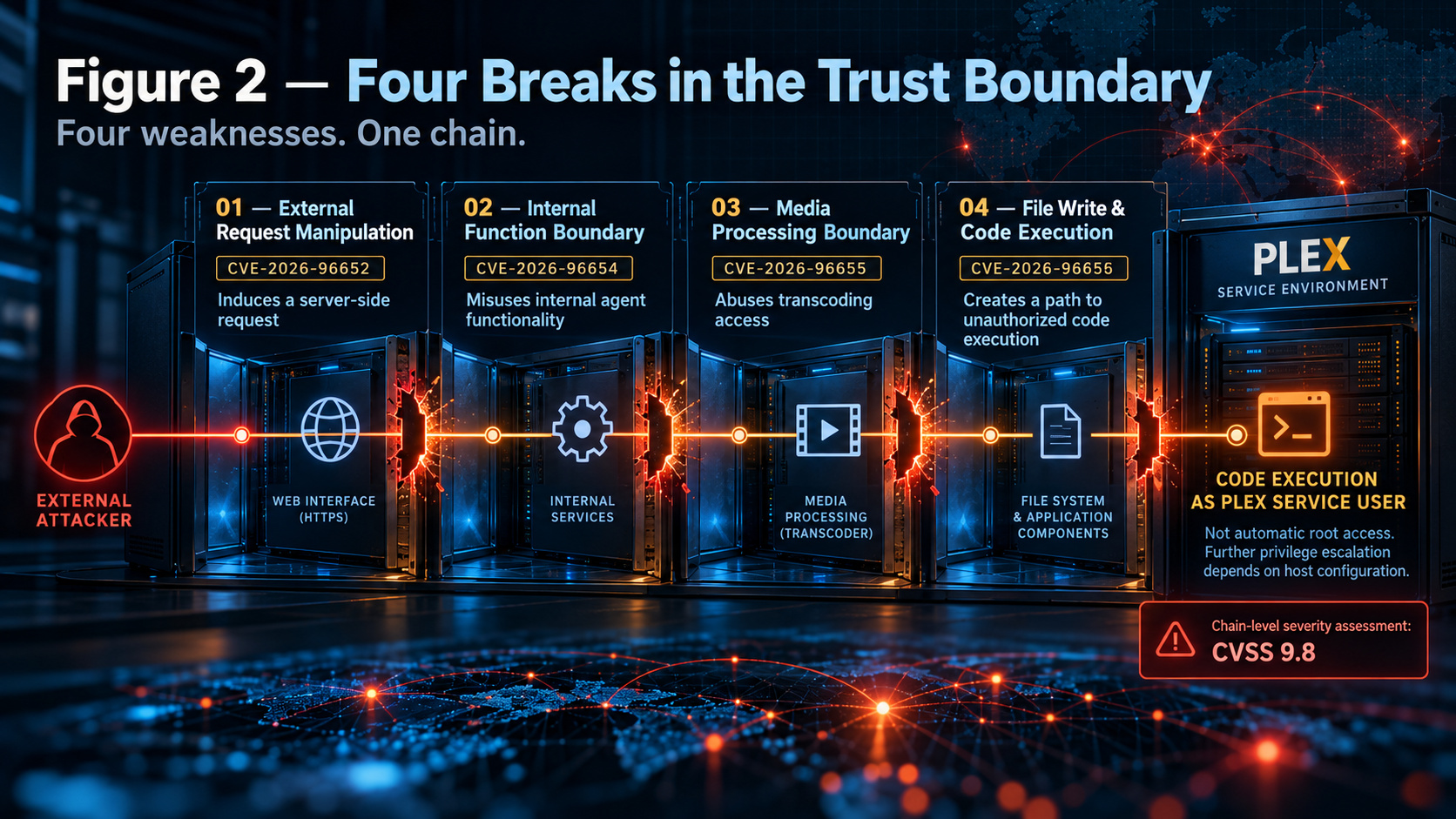
Plex2Shell combines four vulnerabilities: CVE-2026-96652, CVE-2026-96654, CVE-2026-96655 and CVE-2026-96656. Main’s repository describes an unauthenticated remote-code-execution chain and assigns it a combined CVSS 3.1 score of 9.8. That is the researcher’s assessment of the chain, not the score of every individual flaw. [5]
The broad mechanism is a succession of misplaced trust. CVE-2026-96652 concerns server-side request forgery: an outsider can induce the server to make a request. CVE-2026-96654 mishandles URLs inside internal agent functionality, allowing access to operations that should remain restricted. CVE-2026-96655 lets an authenticated transcoder request contact arbitrary hosts. CVE-2026-96656 permits an administrator-authorized file write that can lead to code execution when a file is loaded. Plex’s October 19 update also identifies owner-level administrative-token exposure as a consequence of the chain. Together these defects permit later privileged operations to be reached from an unauthenticated starting point. [3, 4, 5]
The important word is succession. A restriction that assumes an earlier check has already established trust may fail when that earlier check can be bypassed. An operation intended only for an owner becomes dangerous when an outsider can manufacture the owner’s authority.
The demonstrated Linux result runs as the Plex service user, not as the operating-system root account. Whether an intruder can escalate privileges or reach other services depends on the permissions and configuration of the affected host. [3]
This is why the security of a system cannot be read from a list of isolated vulnerability scores. The useful question is how the components interact: which boundary one flaw crosses, and which assumption the next component makes about whoever has crossed it.
III. The Machine Starts Earning for Someone Else
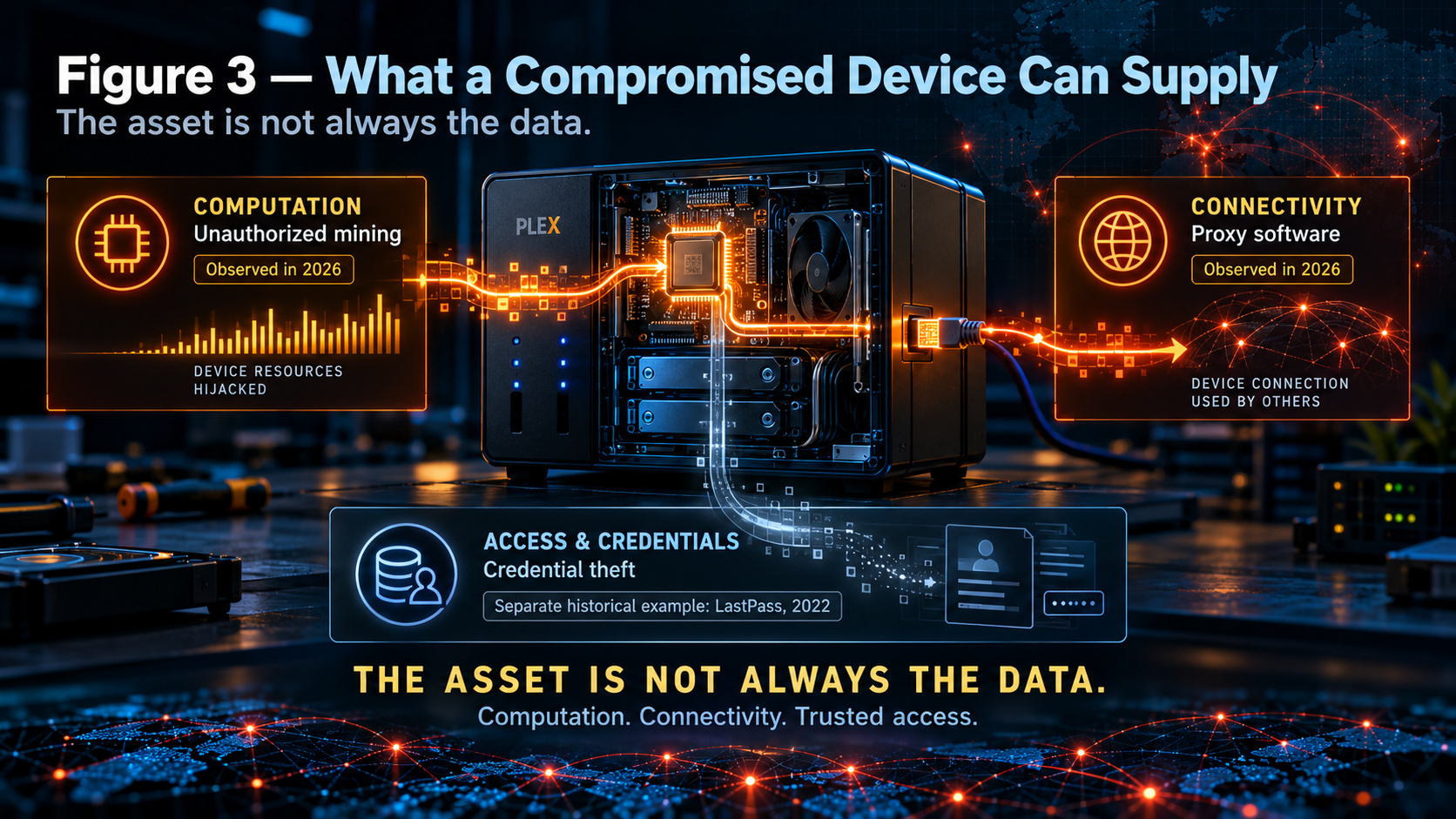
A miner is a straightforward way to misuse a captured machine. MITRE classifies unauthorized use of computing resources and sale of network bandwidth under resource hijacking; attackers can employ more than one form at once. The service may keep functioning while some of its capacity is diverted. [7]
XMRig itself is legitimate open-source mining software with support for multiple algorithms. Its presence does not make voluntary mining malicious, identify the asset mined in every case, or demonstrate a failure of any cryptocurrency’s consensus rules. The decisive distinction is authorization: whose resources are being used, and who agreed to their use? [6]
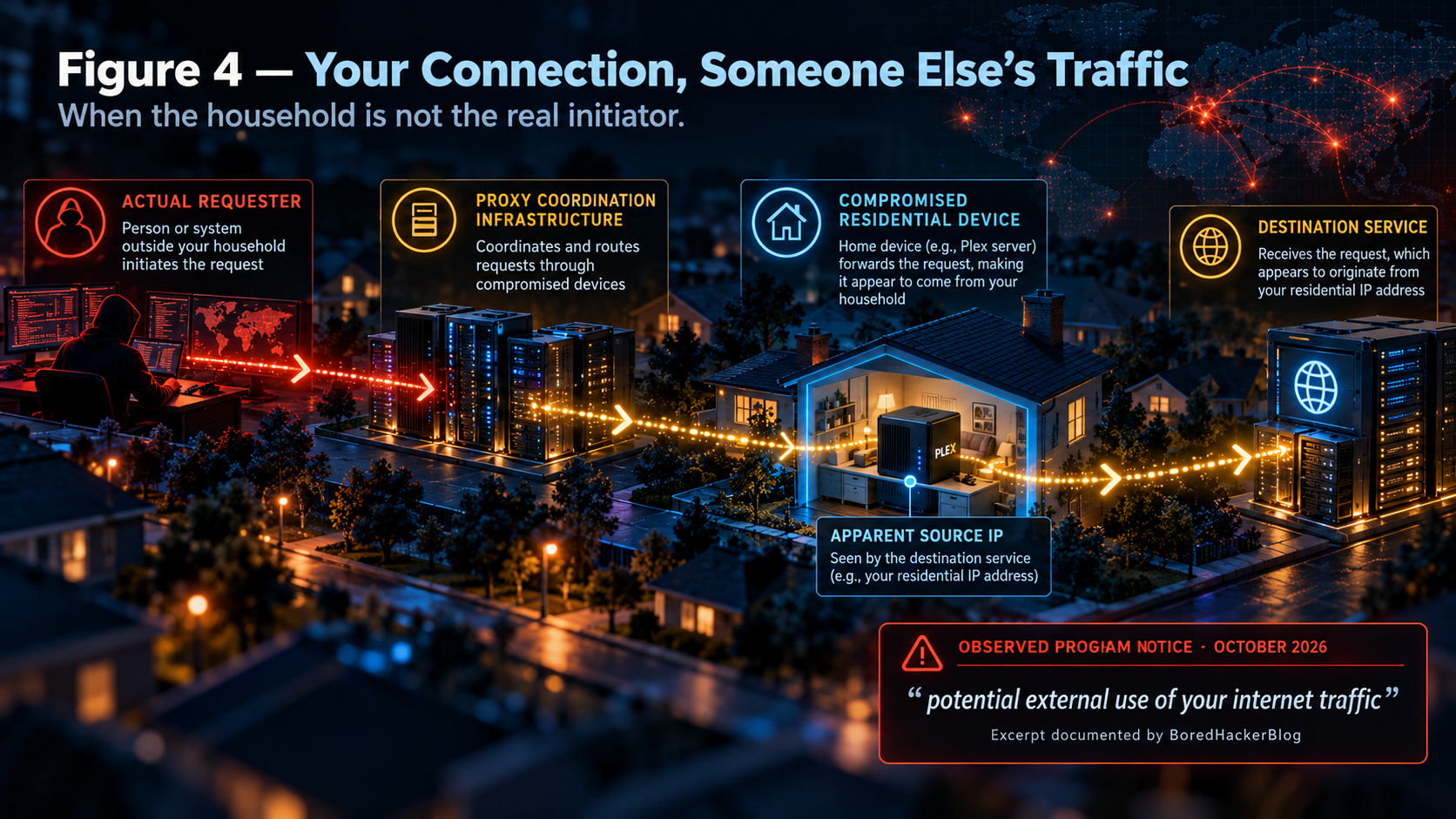
The proxy observation adds a second resource. BoredHackerBlog reported that myawesomeproxy displayed a notice referring to “potential external use of your internet traffic.” The researcher also cautioned that collection was incomplete and had not fully analyzed the program. [1]
A notice printed by software an intruder installed cannot substitute for the owner’s decision. This is the inversion at the heart of the case: control has changed hands, while the costs and outward association remain attached to the original device.
The two workloads also suggest different questions for an investigation. Unauthorized computation asks what the processor is doing. Unauthorized relay asks whose requests the connection is carrying. Neither question is answered by checking whether personal documents have disappeared.
IV. Your IP Address Is Part of the Product
A residential proxy routes a customer’s requests through another device’s internet connection. To the destination, the visible source can be a household address rather than the infrastructure from which the customer is actually operating. GreyNoise describes both voluntary bandwidth-sharing arrangements and their abuse through unauthorized installation. [8]
That distinction separates a service from an intrusion. A person may knowingly choose to participate in a network. An attacker may instead enroll someone else’s equipment and direct the benefit elsewhere. The software category alone does not tell us whether that choice was made.
On October 15, GreyNoise documented a separate campaign that compromised at least 143 devices across 34 countries and installed Pawns.app on the attacker’s behalf. In another investigation described in the same report, apparently plausible residential sign-in locations initially complicated the assessment of enterprise account activity. These are independent examples, not Plex victim counts. [8]
The economic logic is worth following. Ordinary connectivity can acquire value precisely because it appears ordinary. A machine need not contain a valuable document to offer a useful place from which to send requests. The marketable resource can be its position in the network, rather than its storage.
In that model, the owner absorbs obligations the outsider avoids: keeping the connection alive, maintaining the equipment and dealing with the consequences when its activity is questioned. We should not assume that an IP address identifies the person directing a request. Nor should we leap from that uncertainty to the claim that network evidence is worthless. It is a clue whose meaning depends on the path behind it.
Bitsight’s separate Aisuru research documents proxy capabilities and infrastructure. BoredHackerBlog noted a related domain in the Plex-associated traffic. That overlap is an investigative lead, not enough to name the Plex operator or establish a common campaign. Actual sales of Plex victims’ bandwidth are not demonstrated by the material reviewed here. [1, 9]
The narrower conclusion is already consequential: a captured device can be useful as someone else’s route onto the internet. The absence of a spectacular data theft would not make that transfer of control harmless.
The connection remains yours to pay for. Its apparent identity can become someone else’s instrument.
V. The LastPass Warning
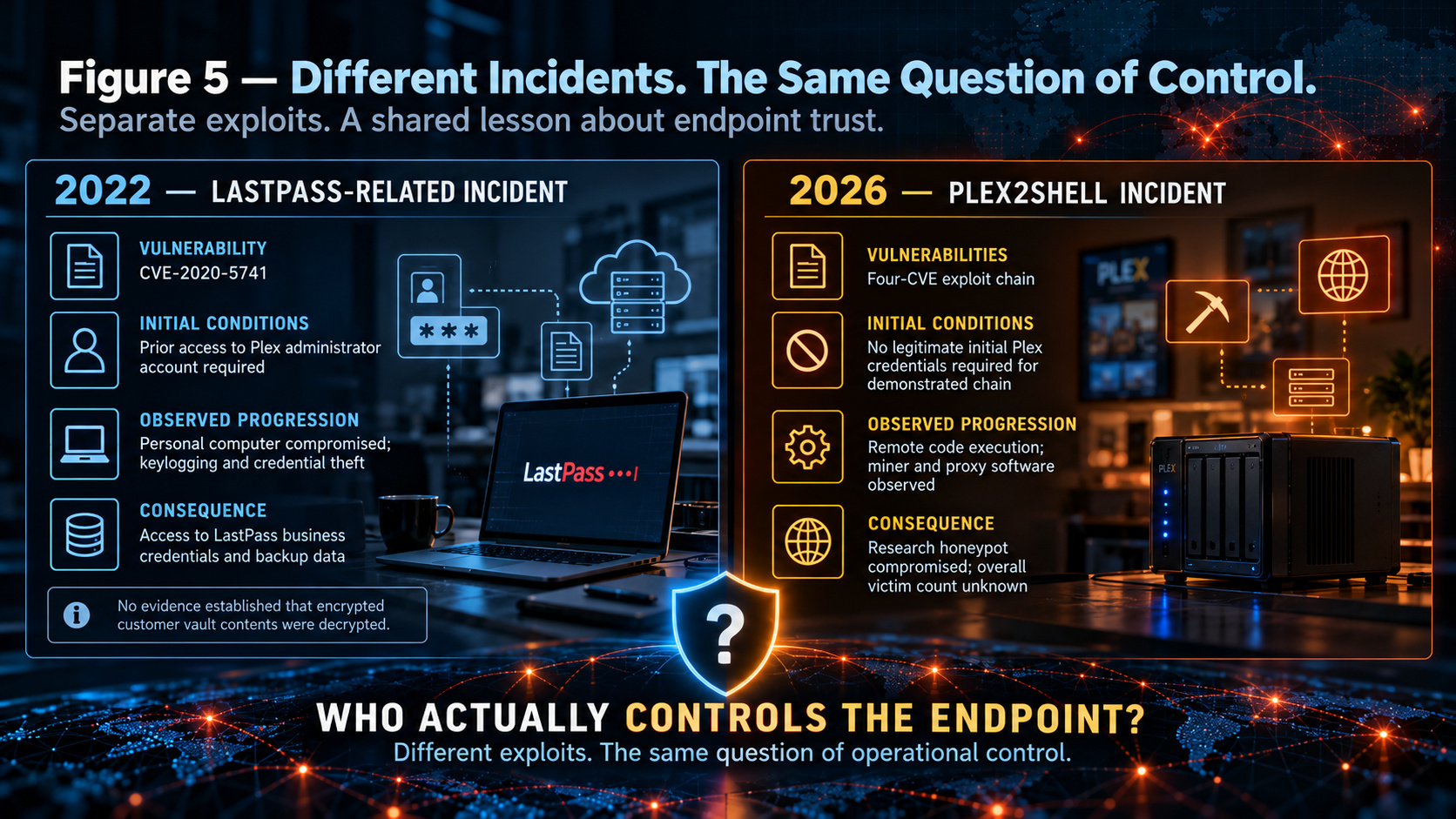
There is a reason to take the apparently mundane media server seriously. A different Plex vulnerability already appears in the official record of a much larger breach.
The UK’s Information Commissioner’s Office states that a senior LastPass engineer’s personal computer was compromised on August 12, 2022 through a vulnerable Plex installation. The penalty notice’s supporting reference identifies CVE-2020-5741. Attackers installed keylogging malware and captured the engineer’s master password. [10]
This was not Plex2Shell. Plex’s May 2020 advisory said the older flaw required prior access to the server administrator’s Plex account. It described a route from that access to malicious file execution and announced mitigations beginning in version 1.19.3. The initial access requirements differ from the unauthenticated 2026 chain. [11]
LastPass’s own March 2023 account supplies the wider sequence. An initial compromise of a developer’s corporate laptop exposed source code and internal information. The subsequent targeting of a senior engineer led to unauthorized access to cloud backups. Those backups contained company secrets and both encrypted and unencrypted customer information. [12]
The regulatory record explains the intervening trust failure. The engineer’s personal and business vaults were linked. A captured password and stolen trusted-device cookie enabled access to the business vault, which held credentials and decryption material needed to reach the backups. The cookie mattered: the attacker was exploiting an existing trusted relationship, not merely guessing a password at a login screen. [10]
A media application had become one link in a chain reaching corporate secrets. That does not make the application’s developer responsible for every subsequent design choice. It does make the separation between personal computing and privileged business access a substantive security boundary, rather than an administrative preference.
The ICO imposed a £1,228,283 penalty in its November 2025 notice. Its public account described effects on approximately 1.6 million UK users and reported no evidence that encrypted customer passwords had been decrypted. The regulator’s findings criticized organizational controls, including personal-device access and linked accounts. [10, 13]
The encryption distinction must survive the headline. Access to a backup and access to every customer’s readable vault are different things. LastPass states that sensitive vault contents were separately protected using keys derived from customers’ master passwords, which it did not store. The engineer’s stolen password was not a universal password for all customers. [12]
The ICO’s no-evidence finding should likewise remain a statement about its investigation, not a promise that stolen ciphertext can never be attacked. The defensible lesson is neither “encryption failed” nor “encryption made the breach irrelevant.” Different protections guarded different layers, with different results.
Blaming one person’s entertainment software would miss the institutional question: why did a machine permitted to run personal services also have a trusted path to secrets with consequences for so many other people? The 2022 and 2026 attacks differed in method and observed impact. What they share is more fundamental: the security of an endpoint determines which other promises of trust an attacker may be able to inherit.
VI. Encryption Cannot Secure a Hostile Endpoint
Encryption protects information under defined conditions. It cannot certify that the device issuing an instruction is still acting for its owner.
The NCSC’s personal-device guidance explains the problem. Compromised browsers may expose displayed data, credentials and session tokens. Remote desktops can reduce local storage of sensitive material, yet endpoint malware may still record keystrokes, capture screens or inject input. Moving an application elsewhere does not guarantee the integrity of the machine controlling it. [14]
Private digital money faces the same boundary. A confidential ledger can protect transaction details from public observation; it cannot, by itself, protect the computer constructing the transaction, the interface approving it or the network metadata around its broadcast. This is a technical implication, not a finding that the Plex payloads targeted any cryptocurrency wallet.
That does not make privacy technology futile. It makes its scope essential. Protocol confidentiality, network privacy and endpoint integrity answer different questions, and none automatically proves the others.
The LastPass record makes the distinction concrete: customer-vault encryption could remain unbroken while stolen credentials and a trusted session exposed a different path to sensitive backups. The failure was not identical at every layer. [10, 12]
The objective is not only to keep outsiders from reading your data. It is to keep them from issuing instructions through devices you trust.
VII. The Self-Hosting Paradox
Self-hosting expresses a reasonable ambition: choosing the machinery on which part of your digital life depends. A software vulnerability does not discredit that ambition, but it does reveal the responsibilities attached to it.
But we should distinguish ownership from operational control. Ownership says who bought the box. Operational control asks who can issue commands, change its behavior, inspect what it is doing and recover it when trust is lost. An owner can retain the first while losing part of the second.
This defeats two comforting stories: that a service becomes sovereign merely by moving into your home, and that moving it into a corporate cloud necessarily makes it secure. Neither tells us who has access, how authority is limited, or what happens after compromise.
Consider two self-hosted systems. One limits exposed services, verifies updates and separates sensitive accounts. The other combines media, credentials, financial activity and remote access on a seldom-inspected machine. Calling both arrangements self-hosting tells us little about their respective failure paths.
The remedies have a governance dimension. NCSC guidance notes that corporate management of personal devices can improve assurance while giving employers powers the device’s owner may reasonably find intrusive. Greater institutional control is not automatically greater personal autonomy. [14]
For sensitive business work, a separate managed device may be preferable to extending employer control across someone’s entire private computer. For home infrastructure, the equivalent principle is least privilege: limit what any exposed service can reach. Both are choices about boundaries, not demands for surveillance.
Independence also requires a credible recovery path. Who verifies failed updates? Who can isolate a compromised service? Which credentials must be replaced? A system its owner cannot maintain may promise autonomy while making it difficult to exercise.
Digital sovereignty is not the absence of dependencies. It is the ability to understand, limit and recover from them.
VIII. Reclaiming the Machine
The response should follow the actual boundaries of the incident, not simply the name of the first suspicious process.
Verify the running build. Plex owners should follow the vendor’s platform-specific instructions and install the latest supported release. CISA identifies 1.43.3.10861 as a fixed build for these vulnerabilities. Check the server’s reported version after installation; do not confuse a current client application or downloaded package with an updated server. [2, 4, 15]
Reduce the authority at risk. Review whether direct remote access is needed and which router mappings or access rules expose the service. Run it with only the permissions it requires, and keep sensitive credentials outside its accessible environment. These are containment recommendations derived from the demonstrated service-level execution and the personal-device risks described by the NCSC, not a substitute for patching. [3, 14]
Look beyond performance. MITRE’s detection guidance combines abnormal resource usage with suspicious processes and outbound connections. Heavy CPU use by itself is not a diagnosis, especially on a server that legitimately transcodes video. Conversely, normal performance does not certify a clean host. Use the researcher’s detection resources alongside the system’s own logs and configuration. [5, 7]
Distinguish prevention from recovery. Updating vulnerable software closes a known route in; it does not establish that earlier intruders or their changes have disappeared. Where compromise is suspected, isolate the affected system from normal use and seek appropriate help. Business operators should preserve relevant evidence before destructive cleanup. NCSC recovery guidance includes reinstallation when malware cannot be reliably removed and restoration from a known-good backup. [16]
Recover the accounts as well as the machine. Review credentials and sessions that could have been exposed. Make necessary changes from a known-clean device, revoke affected sessions or tokens through the relevant service, and follow the provider’s recovery process. Changing a password while leaving trusted sessions active can leave unfinished work. [17]
The point is not to prescribe the same expensive response to every unusual process. It is to avoid declaring victory because the fans have quietened down. Recovery needs to restore a defensible account of who can still command the system, and which outside services may continue to trust it.
Conclusion: Who Gives the Orders?
The computer does not have to disappear for control to be taken. It can remain in its familiar place while serving instructions its owner never approved.
Plex2Shell brings that possibility into focus through ordinary software. The separate LastPass history shows why the consequences depend on what the compromised machine is trusted to reach. Neither story supports abandoning privacy or self-hosting. Both demand that we take the machinery beneath those ambitions seriously.
The meaningful test comes after the purchase and beyond the login screen. Can the owner limit a service’s privileges, verify its condition and reclaim it when something goes wrong? Self-hosting does not require perfect security, nor does the alternative require surrendering one’s whole digital life to a platform. It requires choosing boundaries that can be defended and restored.
A machine can have one legal owner and a different operational master. The question is not simply who owns the hardware, but who has the power to make it obey.
Further Reading from ryo.news
- Beyond the Private Key: Crypto’s Hidden Control PlaneHow keys, signing interfaces and execution routes can distribute effective control over a digital asset.
- ProxyMark and Monero over Tor: How Privacy Can Fail Between LayersWhy confidential transactions can still expose information through networks, endpoints and traffic behavior.
- From Database to Doorstep: 153 Million Driver’s Licenses, Crypto Data Leaks and the KYC ParadoxHow identity data, location and financial information can become security risks when different databases are joined.
References
Primary research, vendor notices, regulatory findings and institutional security guidance. Historical statements retain their original dates; current security decisions should use the latest applicable vendor guidance.
- BoredHackerBlog. Plex vulnerabilities being exploited in the wild to drop a cryptominer. October 17, 2026; subsequent updates through October 18. Original honeypot observations; not a population-wide infection survey.
- Plex. Important Security Update for Plex Media Server v1.43.2 and earlier. September 1, 2026; updated October 19, 2026. Vendor warning, updated active-exploitation report and platform-specific response guidance.
- Zach Main. Plex2Shell: Unauthenticated RCE in Plex Media Server — research repository. October 16, 2026. Original technical research, disclosure chronology and service-privilege execution result. Also see the author’s technical write-up (may be inaccessible to automated readers).
- US Cybersecurity and Infrastructure Security Agency. Plex Media Server: VA-26-266-01. September 23, 2026. Official machine-readable advisory; affected versions, vulnerability descriptions and fixed build 1.43.3.10861. For an accessible independent summary, see SecurityWeek’s October 19 overview.
- Zach Main / code-zm. Plex2Shell research repository. Original researcher’s chain-level severity assessment and defensive detection resources. The article does not reproduce exploit instructions.
- XMRig. Official project website. Primary description of the open-source mining software and its supported algorithms.
- MITRE ATT&CK. Resource Hijacking, T1496. Compute and bandwidth hijacking, possible concurrent use, and defensive detection indicators.
- GreyNoise. skynox7: Proxyjacking Edge Devices Into Residential Proxies. October 15, 2026. Independent proxyjacking investigation and a separate enterprise sign-in investigation; neither is attributed here to the Plex attackers.
- Bitsight TRACE. Who invited Aisuru to the LAN party?. Original analysis of botnet and proxy capabilities. Infrastructure similarities do not establish attribution of the Plex activity.
- Information Commissioner’s Office. Penalty Notice: LastPass UK Limited. November 20, 2025. Especially paragraphs 46-49 and footnote 74 (printed pages 18-19), the personal-device and account-linking findings, and the penalty decision.
- Plex Security Team. Security: Regarding CVE-2020-5741. May 7, 2020. Original prerequisites and mitigation for the older, separate vulnerability.
- LastPass. 03-01-2023: Security Incident Update and Recommended Actions. March 1, 2023. Company account of the two incidents, the stolen data, encryption boundaries and remedial actions.
- Information Commissioner’s Office. Password manager provider fined £1.2m by ICO for data breach. December 11, 2025. Public enforcement summary, UK impact and the regulator’s finding on evidence of password decryption.
- UK National Cyber Security Centre. Bring your own device: Action 4 — Deployment approaches. Endpoint compromise, browser credentials and security tokens, remote-desktop limitations, and the trade-offs of device management.
- UK National Cyber Security Centre. Keeping devices and software up to date. Guidance on update deployment, monitoring and device compliance.
- UK National Cyber Security Centre. How to recover an infected device. Malware assessment, removal, reinstallation where necessary, and restoring known-good backups.
- UK National Cyber Security Centre. Recovering a hacked account. Credential changes, ending existing sessions, account recovery and additional authentication.