



Monetary Sovereignty & Digital Money · Privacy Technology · Decentralized Systems
The Chain Was Saved. What Happened to the Payments?
Pirate Chain says it has removed 39.82 million counterfeit ARRR by returning to an earlier blockchain history. Its recovery repaired the monetary rule an attacker broke. But what happens to legitimate payments made on the discarded branch—and should ordinary users have to monitor social media to know whether their money is still final? Zano’s recent rollback supplies a revealing comparison. Ryo’s Halo 2 testing phase raises the questions every major privacy upgrade should answer before activation.
By Dr. Max Anon · October 22nd, 2026
Conceptual continuity: Our earlier investigation, Who Gets the Red Button? The Emergency Constitution of Crypto, asked who can intervene when digital money breaks. Beyond the Private Key: Crypto’s Hidden Control Plane examined the infrastructure and authority that stand between a user’s intention and settlement. This article asks who carries the economic burden when intervention replaces history. [10]
Scope and status: Analysis reflects official statements and technical notes available through October 22, 2026. Pirate Chain’s complete incident postmortem remains pending. Hypothetical payment scenarios illustrate exposure; they are not claims of verified individual losses. Project statements about recovery are attributed and distinguished from independently documented outcomes. Public GitHub commits document code and test-build changes; they do not establish developer intent, the full extent of private review, or a claim that other tests were never run.
A private payment can be concealed from public view and still disappear from the history its sender and recipient once accepted.
That is the uncomfortable lesson emerging from two major privacy-coin emergencies in less than a month. An attacker used a validation mistake to create money that should not have existed. The community answered with software that would not accept the resulting chain. The monetary rule was defended, yet an earlier promise—continuity of settled transactions—had to yield.
It is tempting to frame that outcome as either heroic rescue or betrayal of immutability. Neither description is sufficient. To judge it, we have to look not only at the recovered blockchain but at the lives and obligations on either side of a payment.
I. A Payment That Disappeared
Consider a hypothetical merchant. An overseas customer purchases $100,000 worth of equipment, paying in ARRR. The merchant sees a transaction confirmed in the wallet, checks the expected number of confirmations and releases the shipment. At the time, there is no warning from the project. The customer takes possession of the goods.
Then a critical flaw comes to light. The network ultimately adopts corrected software that rejects a branch containing the payment. On the recognized chain, the payment no longer exists in its original form. Depending on wallet state and the transaction history, the sender may need to pay again or resubmit; the merchant may need to contact a customer who has already disappeared. The delivery, however, has already taken place.
Nothing in that example proves that such a merchant lost $100,000 during Pirate Chain’s incident. It is a model of what can go wrong when on-chain history and off-chain performance no longer correspond. Some transfers may be successfully replayed or reconciled; others may require individual action. The important point is that a blockchain rollback does not itself reverse the delivery of goods, labor or services.
When a chain rewrites a payment, it does not rewind the world in which that payment was made.
For an ordinary user, the distinction is not philosophical. It is the difference between being paid and having to ask to be paid again.
II. The 39.82 Million ARRR Error
On October 14, Pirate Chain said an attacker exploited its transaction-validation code to create roughly 39.82 million counterfeit ARRR. The project characterized that as a temporary increase of approximately 20% in supply. The unauthorized value was subsequently moved into the Sapling shielded pool. NonKYC reportedly detected suspicious deposits and restricted the associated exchange account, an intervention the team credited with limiting immediate movement through that venue. [1, 2]
The software-level account is more instructive than the headline number. Version 6.0.10’s release notes identify two relevant errors. First, the block-connection path for certain coin-import transactions did not consistently enforce the input and proof-of-burn checks used elsewhere. An import could therefore be included without the backing burn that was supposed to justify it. Second, a malformed time-lock script could contain a decoy address pattern in data that was not actually an enforceable payment destination. The parser nevertheless classified the output as though it paid that address, allowing it to evade a transparent-output restriction. The patched code enforces the required burn proof and canonical script shape. [3]
Put plainly, the system accepted an invalid monetary operation because a surrounding validation path failed to enforce the rules that the currency intended. That is different from showing that the mathematics of the shielded proofs was broken, or that the private keys of ordinary holders were exposed. A zero-knowledge proof can faithfully establish a statement encoded in a circuit while a separate consensus component still implements the wrong accounting rule.
The move into Sapling made public reconstruction of the proceeds harder. That is a feature of transaction confidentiality, not evidence by itself of defective encryption. But it also changes the forensic options available after a minting failure: there is no simple public trail that can confidently identify every later owner of the same value.
The vulnerability was older than the attack
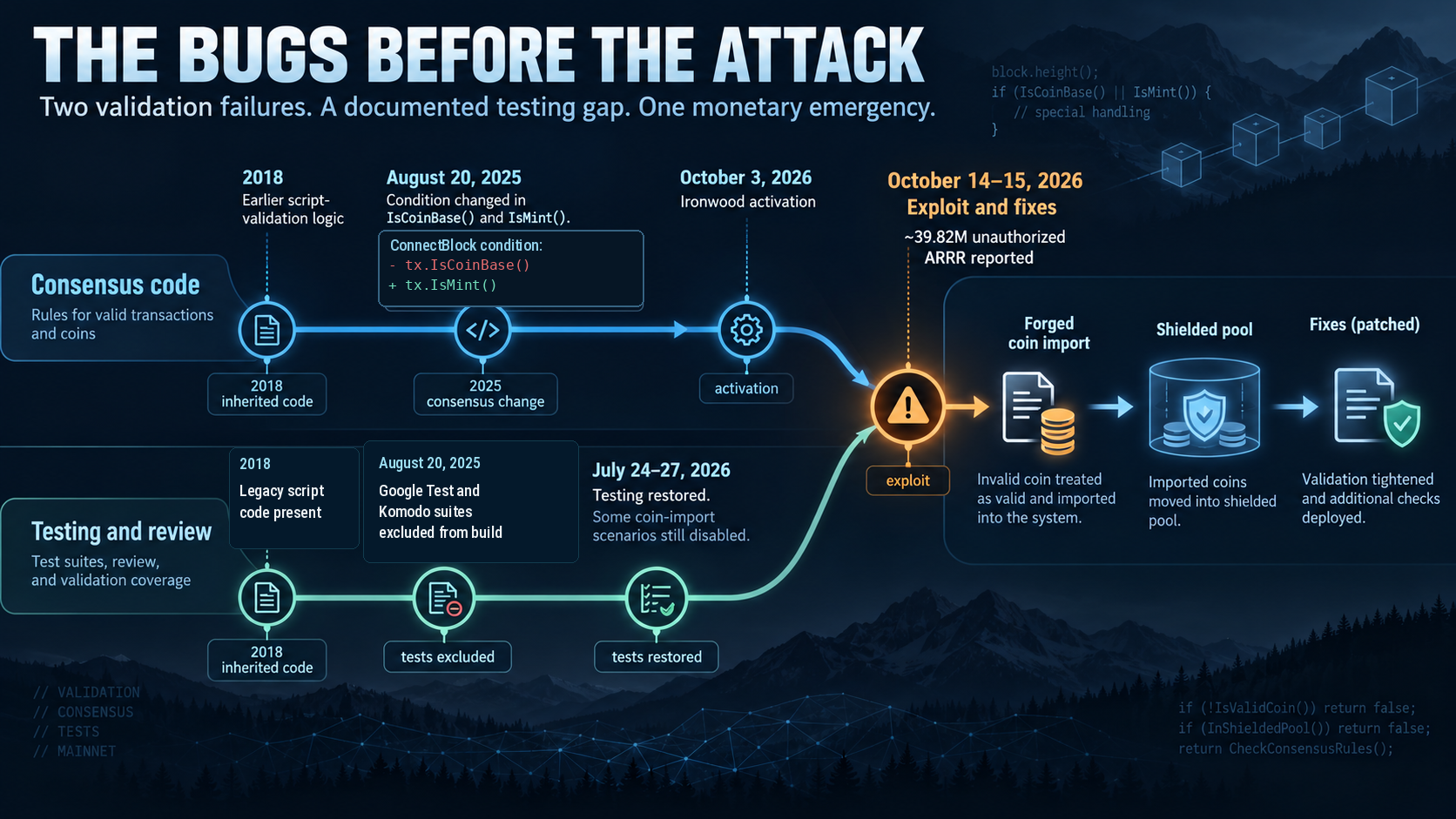
Pirate’s own public commit history makes the origin of the issuance failure unusually concrete. On August 20, 2025, a consensus refactor changed the block-connection condition from tx.IsCoinBase() to tx.IsMint(). That is not a cosmetic substitution. A coinbase is the protocol-authorized mining-reward transaction; IsMint() also includes coin imports, which are supposed to establish a corresponding burn on the source chain. Treating both as eligible for the coinbase exemption allowed a forged import to skip the validation that should have rejected it. The October 14, 2026 fix restored the narrower IsCoinBase() condition and added tests that reject forged imports in a connected block. [13, 16]
The same August 2025 commit also commented out the build inclusions for the Google Test and Komodo test suites. A July 24, 2026 commit explicitly described the Google Test suite as disabled since August 2025, then restored it with 131 passing tests. Three days later, developers reported 501 passing tests and four disabled cases. Two concerned coin-import processing: DISABLED_testProcessImportThroughPipeline and DISABLED_testImportTombstone. The test comments explain that realistic cross-chain notarization evidence was unavailable to their synthetic fixture. This documents limits in particular test paths, not proof that no tests or reviews took place during the intervening period, or that either disabled test would necessarily have caught the exploit. [13, 14, 15, 19]
The output-script flaw reached further back. The permissive IsCheckLockTimeVerify() recognition logic was already present in the repository in May 2018. On October 15, 2026, the project tightened the accepted script layout and added tests for misleading embedded addresses. Older inherited code can become newly consequential when current consensus rules rely on it to decide which outputs are permitted. [17, 18]
These records suggest specific questions for the promised postmortem: What independent review covered the integrated consensus implementation before activation? Which automated tests were required to pass for release candidates? Why could forged-import behavior reach block validation without a regression test that rejected it? And how will older, security-sensitive parsing logic be reassessed? The repository establishes code changes and test history, not an attacker’s identity, a developer’s motives or allegations about AI-generated code.
III. How the Chain Was Restarted
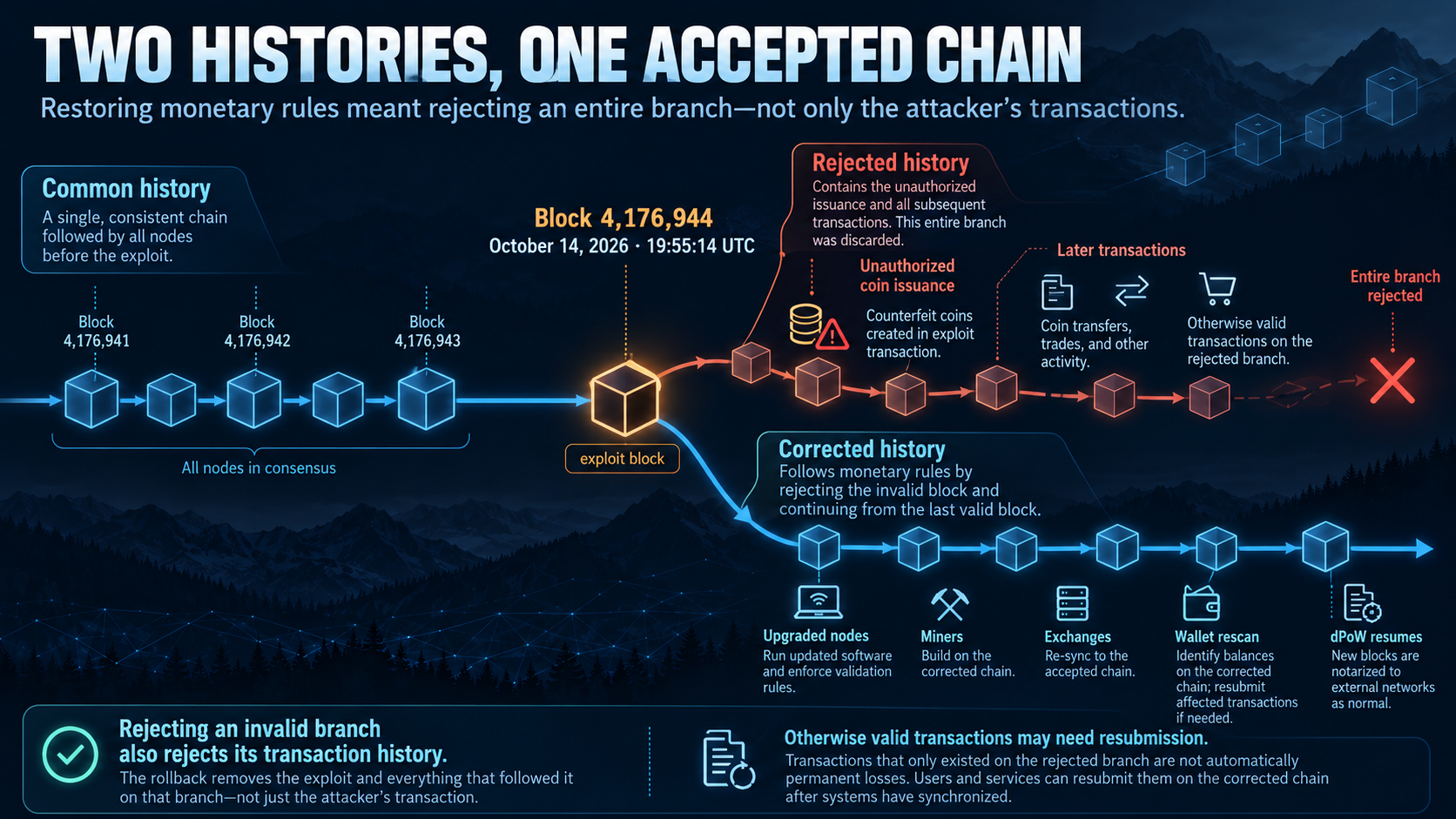
Pirate Chain did not simply continue forward while labeling the 39.82 million coins invalid. Its recovery announcement identified block 4,176,944, timestamped October 14 at 19:55:14 UTC, as the point preceding the exploit. Participating nodes, miners, pools, exchanges and dPoW notaries were asked to accept a corrected history beginning there. The team says the exploit block and subsequent blocks on its branch are rejected, the unauthorized issuance is excluded, and notarizations are resuming on the corrected chain. [1]
That result depended on actual software work. Version 6.0.10 introduced the mandatory consensus corrections and a reindex to apply them to history. Version 6.0.11 addressed peer-connectivity behavior. Version 6.0.12 added checkpoints around the restart and corrected block-download timeouts. Version 6.0.14 improved header synchronization and wallet bootstrap recovery, including clearing stale local wallet transaction state before rescanning. The 6.0.14 notes explicitly say that it does not introduce a new consensus change: the mandatory security correction remains 6.0.10. [3, 4, 5, 6]
The distinction matters. The team’s public notice directs everyone to move to 6.0.14 or later before resuming; the code notes identify which release actually changed the monetary validation rules and which subsequent releases made the replacement chain practical to reach and use. A successful restart depends on both categories of work.
The 6.0.12 checkpoints are particularly revealing. They lock the accepted restart branch at specified heights, rejecting competing blocks with different hashes at those points. This helps nodes converge after a dangerous fork. It also makes explicit that the network is not merely repairing one transaction: it is selecting one historical account as authoritative under the updated software. [5]
Pirate deserves credit for identifying a concrete recovery point, publishing patches and coordinating a restart. Its announcement describes the fix as preventing any permanent economic damage to the chain and its users
. That is a broader claim than restoration of the intended monetary supply alone. A complete recovery assessment still requires an account of otherwise legitimate transfers on the discarded branch, including any payments that needed replay, re-submission or individual reconciliation. [1]
IV. Must Users Monitor Social Media to Trust Their Money?
This may be the most important question for ordinary users. Pirate warned people not to transact while engineers and network operators organized the recovery. In hindsight, it is easy to say everybody should have followed the project’s announcements. But that assumes a model of cryptocurrency use in which the holder is also a full-time incident-response analyst.
Imagine a freelancer who is paid before the first public warning. There is no notice to read. Now imagine a shopkeeper who is paid afterward but does not use X, Telegram or Discord. The wallet may continue showing transaction confirmations. The shopkeeper has no reason to believe that a separate social feed contains information changing the practical status of that payment.
Three situations, three different expectations
Before the warning: An ordinary recipient has no realistic opportunity to react to information not yet published. Their confirmed payment cannot be judged by the benefit of hindsight.
After the warning, without knowledge: Users may be offline, use different languages or time zones, depend on payment processors, or never subscribe to project announcements. They may still possess a perfectly ordinary-looking wallet and receive apparently confirmed transfers. A missed social post is not the same thing as knowingly accepting an unsafe payment.
After the warning, knowingly: Someone who deliberately continues trading despite a clear warning takes on extra risk. But that person’s decision does not automatically bind the recipient, the merchant or a third party who accepted the proceeds in good faith.
What does the reported “60 transactions” count?
Some community discussions have referred to roughly 60 transactions during an affected window. That figure has not been established here from an authoritative, reproducible block or wallet analysis, and the start and end of the alleged window are unclear. It should not be published as a verified count of affected users, reversed payments or permanent losses.
A meaningful recovery accounting would distinguish transactions before the first warning; transactions after that warning but before the discarded history was replaced, including activity by users who were unaware; and transactions eventually resubmitted, successfully replayed, reconciled or left unresolved. A count limited to early exploit blocks would miss part of this picture. Equally, the number of blockchain transactions cannot tell us how many off-chain goods, services or exchange obligations were affected.
Neither an unverified count of 60 nor the absence of confirmed individual loss reports settles the fairness question. The standard is a documented reconciliation of legitimate obligations, not the repetition of a small and potentially incomplete number.
There is a practical counterargument. No permissionless system can guarantee that a transaction will never be reorganized; users who accept value have always had to consider confirmation depth and network health. Emergency warnings are useful precisely because protocols cannot instantly communicate every risk to every wallet.
But that answer is incomplete. Confirmation policy is not the same thing as an obligation to watch a project’s social accounts. A currency intended for ordinary payments should aim to put material risk warnings where payments are made: in wallets, integrated merchant services and authenticated network-status channels. A warning system can be decentralized and verifiable without becoming a single actor’s power to freeze every transfer.
If the wallet says “confirmed” but a social-media account says “do not trust it,” which one is speaking for the currency?
The issue is not whether the team should have published a warning. It should have. The issue is whether receiving that warning can reasonably be treated as a precondition of settlement finality—and who bears the consequences when it was never received.

V. Two Promises of Immutability
The term immutable often conceals two different promises. The first is that monetary rules are binding: a validator must not accept the creation of coins beyond authorized issuance. The second is that settled history remains settled: participants can act on confirmed payments without expecting those entries to be removed by an extraordinary political or technical decision.
Under normal operation, the two promises reinforce each other. A valid payment is written into a valid history. The difficulty arrives when an implementation accepts invalid issuance and genuine payments follow it.
One choice is to preserve the compromised branch. That honors historical continuity but may leave unauthorized coins in circulation, potentially threatening everyone’s claim to scarce money. Another is to reject the branch and rebuild from an earlier state. That defends the intended issuance rules but can make some subsequent honest payments disappear from the recognized ledger.
A third possibility—surgical elimination of only the counterfeit effects—depends on the design and on what investigators can actually distinguish. Once proceeds enter a shielded system, public transaction forensics may not supply enough information to make that safe. The fact that a clean selective repair is imaginable does not mean it was technically available in this incident.
The question is therefore not whether monetary repair is automatically a betrayal of decentralization. It is which rights are being protected, which expectations are sacrificed, who authorizes the exception, and how the losses are handled after the chain is fixed.
VI. Who Pays for the Missing Days?
Protocol software can identify a valid block. It cannot tell us whether a parcel was delivered, an invoice discharged, a contractor paid or an exchange credited an external account. Those events happen in systems outside consensus, and they do not reverse in perfect synchrony with a fork.
Merchants, senders and private counterparties
When a transaction on the discarded branch is absent from the recovered chain, the payer and payee may need to reestablish the payment. The possibility that funds are again available in a sender’s wallet does not settle what the recipient is owed. A cooperative sender can pay again; an absent or adversarial sender may not. A shielded payment may also require rescanning and rebuilding wallet state before either party understands what is spendable.
Exchanges, bridges and payment processors
Centralized platforms may have credited balances or executed trades against deposits recorded on the abandoned history. Their internal books need not reverse automatically with a node upgrade. They must reconcile user credits, chain deposits, withdrawals, fees and any trades performed in the meantime. Some of these entries may already have produced external obligations in another asset.
Miners, pools and dependent services
Work performed on blocks outside the accepted branch may no longer earn the expected rewards, while merchants and apps dependent on service availability may have missed transactions entirely. These are potential economic effects, not proof of losses in every category. The available public evidence does not establish a comprehensive Pirate Chain ledger of affected honest users.
That is why the claim that the attack left no permanent economic damage deserves a careful definition. Does it mean the counterfeit supply is no longer recognized? That pre-incident balances are restored? That all affected payments were reconstructed? Or that every participant who provided real goods or services has been compensated? Those are four different outcomes.
A rigorous recovery report would quantify the discarded window, identify the categories of honest transfers involved, explain whether transactions were automatically replayed or required manual resubmission, and provide a credible route for unresolved disputes. Such an accounting is not an attack on the team. It is part of rebuilding monetary trust.
VII. Zano: A Month of History and the Work of Reconciliation
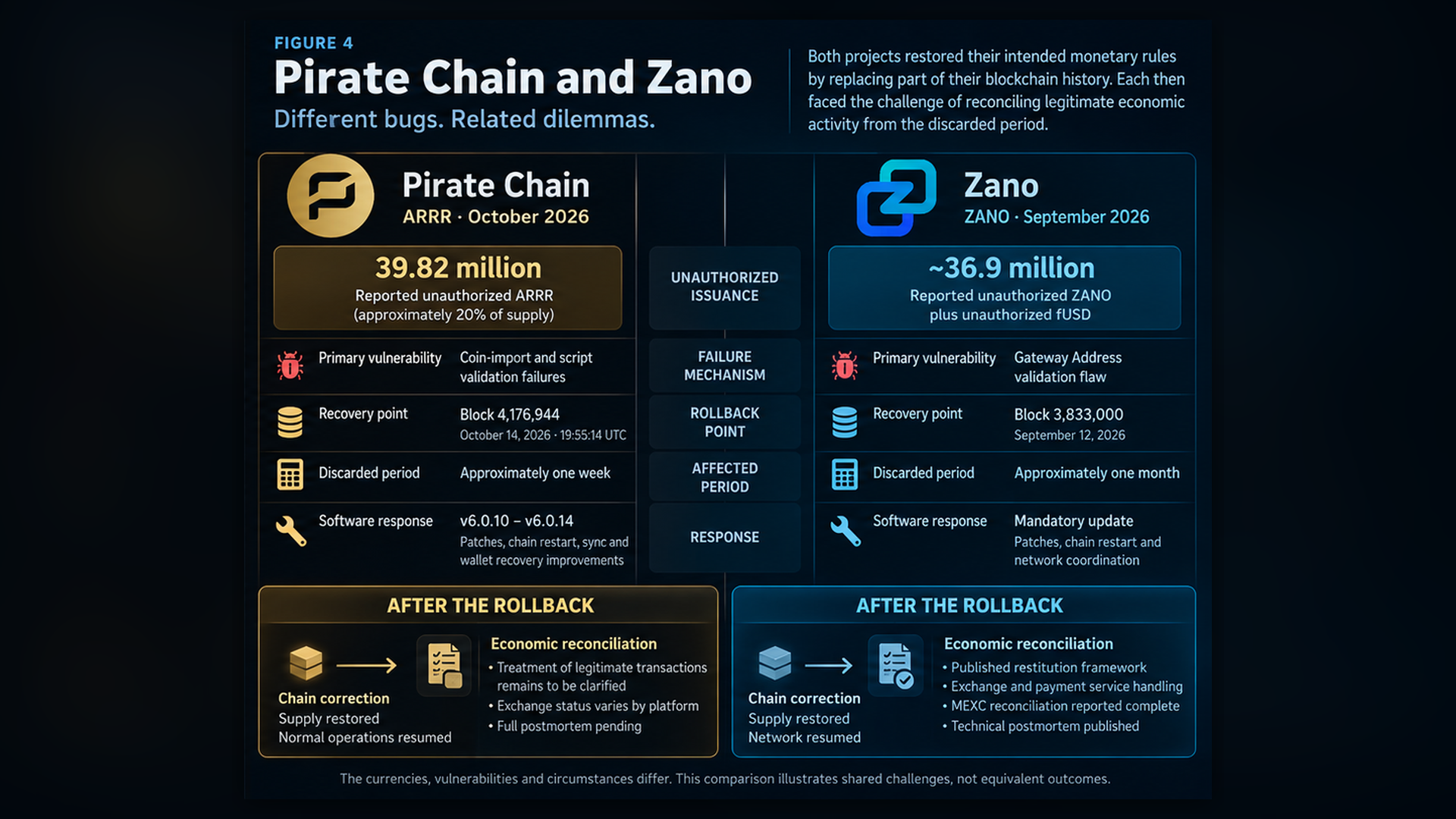
Zano provides a sharper comparison precisely because the code-level mechanism was different. Its September 2026 postmortem describes a vulnerability in Gateway Address validation introduced through Hard Fork 6. Attackers generated approximately 36.9 million unauthorized ZANO across two major minting episodes, as well as an enormous volume of unauthorized fUSD. The first event occurred in August and remained undetected until the later incident drew attention in September. Zano restarted from block 3,833,000, before the affected upgrade, removing approximately a month of subsequent history. [7]
It would be inaccurate to treat Pirate and Zano as the same exploit. Pirate’s published fixes concern coin-import burn checks and script interpretation; Zano’s concerned Gateway Address transaction rules. The incidents nevertheless share an important recovery feature: illegitimate issuance could not be tolerated, and the corrective history affected more than the attacker alone.
Zano also published unusually specific instructions about what recovery would mean. Withdrawals from exchanges during the affected period had to be replayed; deposits required exchange-by-exchange credit reconciliation. Card top-ups and payment services were to be settled with the team. Person-to-person payments generally returned to senders on the recovered chain, with a route promised for cases that could not be resolved directly. The project identified developer funds, personal contributions from team members and other contributors as sources for remediation. [8]
The distinction between software recovery and economic recovery becomes visible in Zano’s later MEXC update. The team reported that reconciliation was complete: withdrawals to other exchanges and services were sent again, while some withdrawals to personal wallets were credited back to MEXC accounts for users to withdraw anew. Those are project-reported results, not proof that every possible private dispute has been resolved. But the specificity matters. It describes an actual accounting task, beyond a statement that the chain itself is healthy. [9]
One rollback lasted roughly a week; another erased roughly a month. Duration alone does not rank the damage. What matters is how many economic commitments were created during each interval, which records remain available, which intermediaries cooperate and whether honest counterparties can recover what they were owed.
VIII. Who Decides Which Chain Counts?
Pirate Chain has been careful to say that no developer can unilaterally command a decentralized network to roll back. That is an important distinction. A release does not force every independent participant to install it, and agreement among operators cannot be reduced to one person clicking a button.
Yet the ability to choose is not evenly distributed. A miner can choose which software to mine with; a pool can direct coordinated hashpower; notaries can agree which branch to anchor; exchanges can decide which history defines deposits and withdrawals; wallet providers can distribute updated software; users may have little influence over any of those processes beyond choosing which network they use.
Pirate’s new checkpoints illustrate this operational layer. Once operators adopt software that rejects an alternate hash at a checkpoint height, the old branch can still be remembered or studied, but it is not treated as the authoritative currency history by that software. Economic infrastructure can make one branch highly usable and the other largely irrelevant. [5]
This is not an argument that recovery consensus is necessarily illegitimate. It is a reminder that decentralized monetary governance is not merely counting developers. It is observing how code, mining, notaries, custodians and users combine to make one history economically real.
The earlier Red Button investigation called that structure an emergency constitution. The Pirate and Zano incidents now add a missing clause: the practical consequences of intervention may fall most heavily on the people with the least ability to influence it. [10]
IX. Privacy Is Not the Same as Monetary Soundness
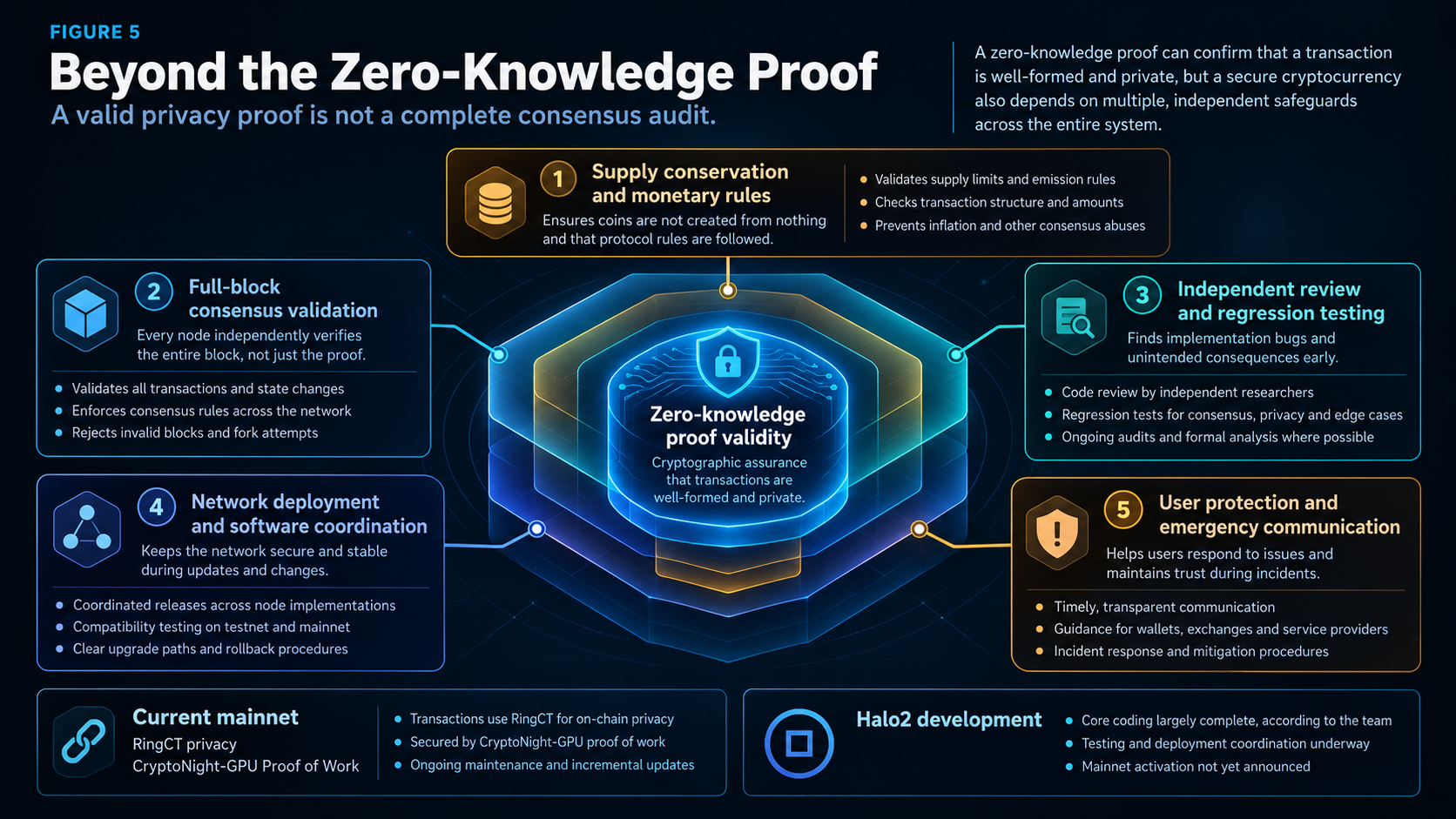
Public criticism of the Pirate incident has sometimes treated the breach as a verdict on private cryptography. The available evidence does not support that generalization. Concealing sender, recipient or amount is one objective. Preventing unauthorized issuance is another. Correctly enforcing both requires the proof system, the encoded constraints, and the surrounding consensus implementation to work together.
The same distinction applies when sophisticated cryptography is described as formally verified. A circuit can be analyzed rigorously while an adjacent import path, script parser or transition rule contains an exploitable bug. “Uses Halo 2” is not a certificate that every component of a monetary protocol is secure. Nor does a software exploit show that privacy itself should be abandoned.
A mature private-currency design has to answer two questions at once. Can outsiders be prevented from reconstructing a user’s private transactions? And can independent nodes reject every attempt to create unbacked value? The second question becomes harder to audit socially when balances and transfers are hidden, which is precisely why rigorous validation rules and reproducible adversarial tests matter.
The correct lesson is not that transparent ledgers are inherently sound or that privacy coins are inherently unsafe. It is that privacy is a property of information flow; monetary integrity is a property of enforced rules. Neither can substitute for the other.
X. Ryo at the Halo 2 Testing Stage
The contrast between Pirate and Zano matters before the next upgrade, not only after the next failure. Pirate’s incident involved a newer consensus change interacting with inherited coin-import and script logic; Zano’s involved newly introduced Gateway Address functionality. Both show why review must cover the boundaries between new privacy features and the monetary rules already in place. That is the context for Ryo’s next milestone. Its current mainnet continues to operate with mandatory RingCT privacy and CryptoNight-GPU Proof of Work; it has not activated a Halo 2 replacement on mainnet. The project’s October 3 update, however, was more specific than an open-ended roadmap aspiration: the team said the central coding work was largely complete, with attention now on testing and coordinating deployment. [11, 12]
“The core coding work is largely complete. Focus is now on testing and deployment coordination. Stay tuned.”
— Ryo Currency team, October 3rd, 2026. [11]
That is a meaningful development stage. It is also a demanding one. The failures in Pirate and Zano show why completing a privacy implementation is not the same as proving that a major upgrade preserves every invariant through all historical and adversarial conditions.
What the testing period should demonstrate
Supply conservation. Invalid issuance, malformed inputs, attempted double spends and transition or migration operations must be rejected across every applicable validation path—not only during ordinary wallet transfers.
Proof and consensus integration. Valid proofs need correct accounting constraints; nodes must agree on canonical transaction formats, state transitions, nullifiers, synchronization, replay behavior and fork boundaries.
Regression coverage and mandatory release gates. Include tests that connect deliberately malformed or unauthorized issuance transactions as full blocks, not merely isolated proof or wallet operations. Require independent execution of relevant C++/Rust tests and consensus integration tests in release builds; document intentionally disabled tests and the untested paths they leave. Pirate’s source history demonstrates why the presence of a test file is not the same as an enforced, representative validation gate. [13, 14, 15, 16]
Independent security review. External adversarial testing should cover the monetary logic around the proving system as well as the cryptography itself. A declaration that the coding phase is largely complete is not an independent certification.
User protection during activation. A coordinated upgrade should include wallet-readiness information, software authenticity, compatibility warnings, status communication, backup guidance and defined procedures if an unexpected consensus fault is found.
Ryo’s intended high-latency mixnet and eventual private Proof-of-Stake are further ambitions, separate from the current testing and deployment-coordination milestone. They would introduce their own network, validator and governance assumptions and cannot be counted as operational protections today. [12]
None of this proves that Ryo would handle an exploit better than Pirate or Zano. It identifies an opportunity to take their failures seriously before a major change becomes live. A network with a long operating history still needs to earn confidence anew when it changes the technology that establishes monetary validity.
XI. What Responsible Recovery Requires
After an incident of this scale, responsible recovery should be measured against more than one successful startup screen. The principles below are not a demand that small communities reproduce the resources of global financial institutions. They are basic conditions for asking people to trust digital money with real economic obligations.
One: verifiable supply restoration. Publish enough consensus data, reproducible checks and code references for independent operators to establish that the invalid issuance is excluded from the accepted history.
Two: an honest account of discarded transactions. State the rollback interval, distinguish automatically reconstructed transfers from transfers requiring new action, and quantify what can and cannot be determined about affected legitimate payments.
Three: a visible remediation route. Merchants and counterparties need a channel to report disputed receipts, identify supporting records and learn whether the project or partners are offering restitution. Not every dispute can be resolved by protocol software.
Four: warnings where users actually transact. X and Telegram can carry alerts rapidly, but authenticated messages visible to wallets, pools and merchant services are more likely to reach people who are not part of a project’s social community. Such mechanisms must be carefully designed not to become discretionary transaction censorship.
Five: independently reviewed consensus changes and enforced testing. Publish the relevant review scope, integration-test results, release-candidate test gates, disabled-test exceptions and a full postmortem. Audit imported historical code when its output affects modern monetary rules; add regression cases for exploit-shaped blocks, not only individual transaction functions. A public commit history documents what changed, but a postmortem must explain how an unsafe path reached activation.
Six: transparency about economic convergence. Report not only which node release is available but which important exchanges, notaries, pools and wallets are operational on the corrected chain, with direct links to their own announcements where possible.
An ecosystem gains nothing from pretending every attack is harmless. Nor does it gain from applauding the failure of a competing coin. Each serious incident is a chance to make the standards for private money more demanding—and more defensible.
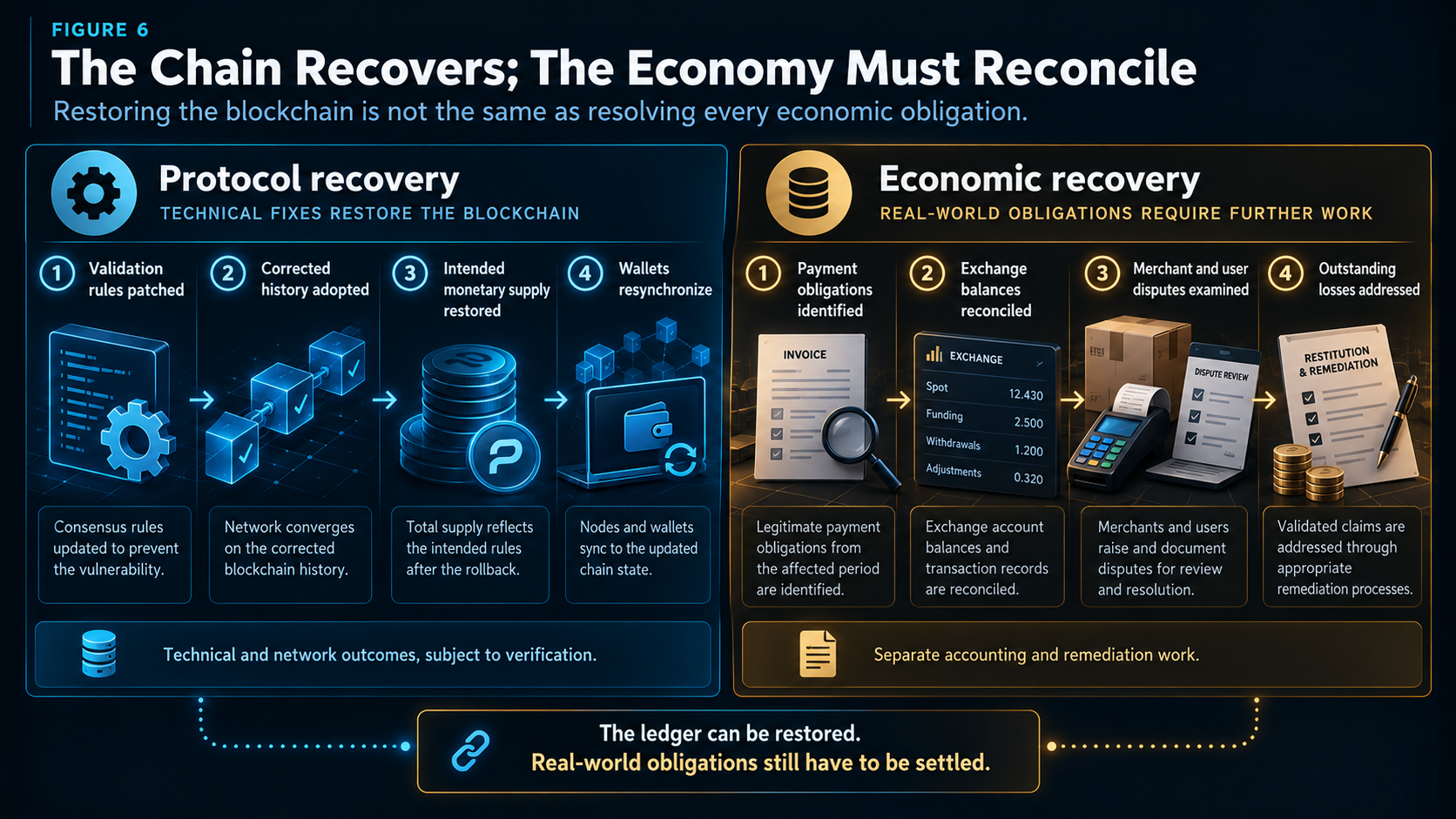
Conclusion: The Ledger and the World Outside It
Pirate Chain’s recovery is significant. A severe monetary-validation failure was publicly acknowledged. Patches were published. Network operators coordinated around a corrected history. Wallet software was updated to return users to that history. Those achievements matter, and they make a credible case that the project can continue.
It is equally important not to use restoration of the intended supply as a substitute for an accounting of the period that was discarded. Zano’s experience showed the practical work required to rebuild balances across exchanges and payment services after a much longer rollback. Pirate’s completed postmortem and any transaction-reconciliation reporting will determine how fully the shorter interruption has been resolved for its users.
The unanswered question is not whether a currency should protect itself against an attacker who creates money from nothing. Of course it should. The question is how a decentralized currency protects the innocent counterparties whose transactions occurred while its software was still accepting a history that the community would later reject.
Nobody should be required to spend every waking hour inside a project’s social-media feed before accepting a payment. A system aspiring to become ordinary private money has to make its own operational risks legible to the people who actually use it.
The code can be repaired. The unauthorized coins can be excluded. But the shipment has left the warehouse, the work has been performed, and the recipient still needs to be paid.
A monetary system proves itself twice: first when it enforces its rules against an attacker, and again when it treats its honest users fairly after those rules have been restored. The chain may be saved. Trust must still be earned.
References
Official project announcements, source-code commits, release notes, historical code snapshots, a security postmortem and published remediation statements. Source history documents what changed; it does not by itself establish developer intent or a complete independent audit. Status reviewed October 22, 2026.
- Pirate Chain. Mandatory v6.0.14 recovery announcement. October 21–22, 2026. Team statement; rollback block, claimed restored supply and resumed operations are attributed to the project.
- Pirate Chain. Original October exploit disclosure. October 2026. Initial public incident context; the project’s fuller summary and final accounting remain separate.
- PirateNetwork / GitHub. Mandatory Security Release: v6.0.10. Primary technical source for missing import burn checks, script-classification bug and reindex requirement.
- PirateNetwork / GitHub. Release Notes: v6.0.11. Peer connectivity and recovery improvements.
- PirateNetwork / GitHub. Release Notes: v6.0.12. Checkpoint enforcement across the restart and block-download reliability.
- PirateNetwork / GitHub. Release Notes: v6.0.14. Header synchronization and wallet bootstrap reset. The release notes distinguish this from the v6.0.10 consensus fix.
- Zano team. The Gateway Address Vulnerability: What Happened and What Comes Next. October 1, 2026 postmortem. Team account of unauthorized issuance, timing, root cause and chain restart; the direct blog page may be intermittently inaccessible. Additional first-party record: Zano team postmortem announcement on its official forum.
- Zano team / Zano Forum. How recovery of affected balances will work. Published recovery categories for exchanges, services and person-to-person payments; describes project-reported restitution plans.
- Zano team. The ZANO Reconciliation with MEXC Is Complete. October 2026. Zano-reported reconciliation results; not an independent accounting of all possible private user losses. Additional first-party record: Zano team reconciliation summary on its official forum.
- Dr. Max Anon / ryo.news. Who Gets the Red Button? The Emergency Constitution of Crypto. September 27, 2026. Earlier conceptual analysis of emergency intervention across cryptocurrencies.
- Ryo Currency team. Halo 2 Development Update. October 3, 2026. Team reports core coding largely complete; testing and deployment coordination in focus. Not a mainnet activation or audit certification.
- Ryo Currency / ryo.news. Ryo Currency: Privacy Coin, Wallets & Roadmap. Project overview distinguishing current functionality from Halo 2, high-latency mixnet and private PoS plans.
- PirateNetwork / GitHub. August 20, 2025 consensus and test-build change. Commit replacing a block-connection IsCoinBase check with IsMint and commenting out gtest/ktest include lines; establishes code provenance, not overall absence of testing.
- PirateNetwork / GitHub. July 24, 2026 restoration of pirate-gtest. Commit explicitly describing the Google Test suite as disabled since August 2025 and restored with 131 passing tests.
- PirateNetwork / GitHub. July 27, 2026 test-suite hardening. Reports 501 passing tests and four disabled, including two coin-import cases needing cross-chain notarization data unavailable to synthetic fixtures.
- PirateNetwork / GitHub. October 14, 2026 coin-import proof-of-burn fix. Replaces broad IsMint exemption with IsCoinBase and adds block-connection regression tests for forged coin imports.
- PirateNetwork / GitHub. Historical time-lock script recognition source. May 2018 source snapshot showing earlier IsCheckLockTimeVerify script-recognition logic.
- PirateNetwork / GitHub. October 15, 2026 canonical time-lock script fix. Requires exact script structure to prevent address misclassification and adds cases for malformed scripts.
- PirateNetwork / GitHub. Coin-import tests in source tree. Test file identifying disabled cross-chain coin-import scenarios and the limits of its synthetic test fixture. The pinned snapshot contains the two named disabled tests at lines 109 and 142; the reference is a source snapshot, not a claim about which commit originally introduced the tests.
This article is for research and informational purposes. It is not investment, legal or financial advice.