


What is Decentralization in Cryptocurrency?
Decentralization refers to the dispersion of authority, resources, and control across a network of independent participants, rather than concentrating them in the hands of a single entity like a government, corporation, or elite group. In cryptocurrency, this ensures no single party can unilaterally alter the ledger, manipulate the supply, or disrupt operations. Decentralization bolsters security by eliminating single points of failure, promotes inclusivity by empowering global participation, and aligns with the goal of trustless, peer-to-peer systems.
The value of a decentralized network lies in its resilience and trustworthiness. A highly decentralized cryptocurrency resists censorship, attacks, and manipulation, making it a robust store of value and medium of exchange. This value grows over time as the network expands, attracting participants who reinforce its decentralized foundation.
Decentralization of Supply
The Concept
Decentralization of supply refers to how a cryptocurrency’s total coin supply is distributed among its users over time. A centralized supply—where a few hold the majority of coins—undermines the democratic ethos of cryptocurrency, concentrating wealth and influence. A decentralized supply, conversely, ensures broad dispersion, reducing the risk of market manipulation and fostering equitable access.
Emission as a Mechanism
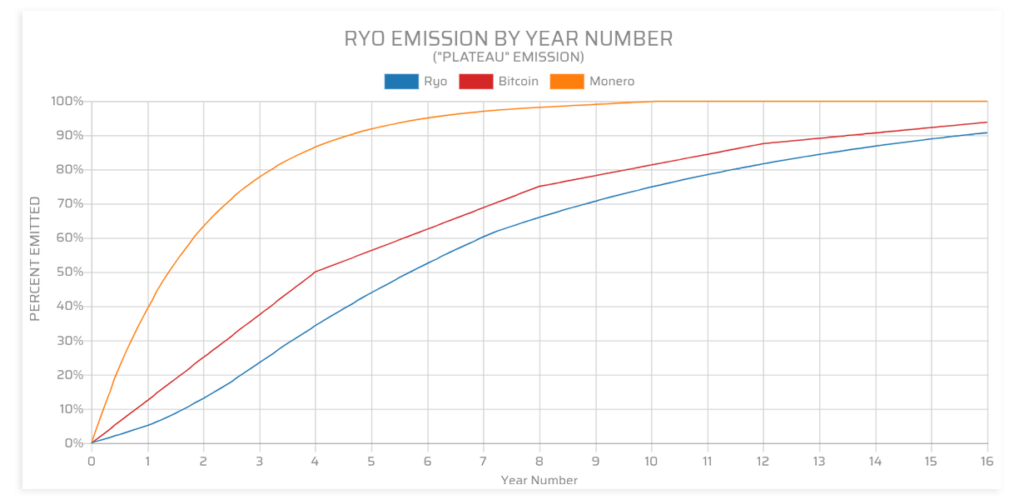
Supply decentralization hinges on a coin’s emission schedule—the rate at which new coins enter circulation. Emission can occur rapidly (e.g., quick issuance to early adopters) or gradually (e.g., slow, predictable release over decades). The pace and structure of emission profoundly affect supply decentralization.
- Rapid Emission: Coins like Monero and Pirate Chain illustrate rapid emission models. Monero emitted roughly 80% of its 18.4 million XMR supply within four years (by 2018), after which it entered a “tail emission” phase of 0.6 XMR per block indefinitely. Pirate Chain, launched in 2018, completed its full emission of 200 million ARRR by mid-2021 due to its accelerated block reward schedule. This rapid emission, combined with its Equihash algorithm, favored a small group of early ASIC miners, leading to a concentrated supply among those with access to specialized hardware. While these designs prioritize privacy and immediate usability, rapid emission risks centralizing ownership among early adopters or well-resourced miners.
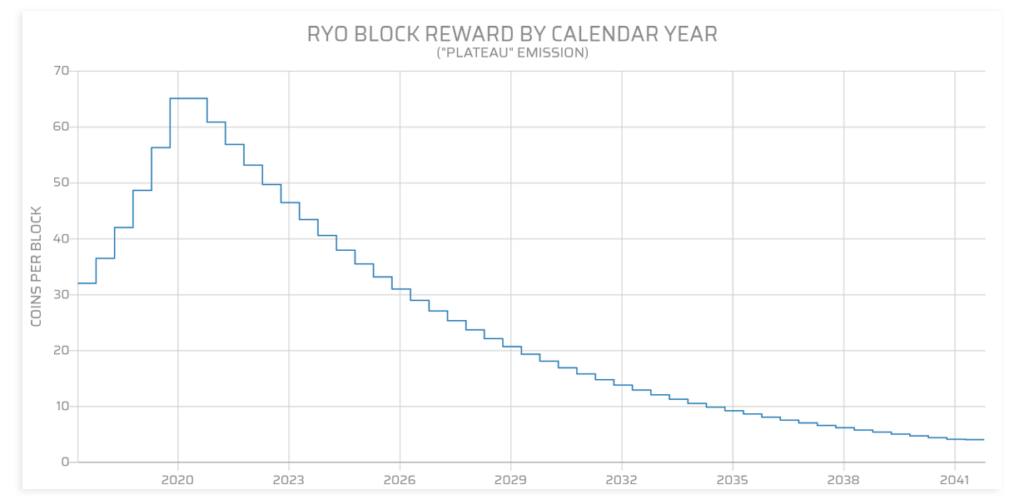
- Gradual Emission: Bitcoin and Ryo Currency exemplify slower emission models. Bitcoin’s supply is capped at 21 million BTC, released via halving events every four years, extending emission until ~2140. As of March 9, 2025, about 19.6 million BTC (93% of total supply) are in circulation, with the remainder trickling out over decades. This gradual pace incentivizes long-term participation and prevents early hoarding. Ryo Currency, a privacy coin with a total supply of 88.8 million RYO, also employs a gradual emission curve. By March 2025, Ryo’s emission remains ongoing, with about 61.8% of the supply currently in circulation, emphasizing fairness and accessibility over rapid completion.
Comparative Impact
Gradual emission, as seen in Bitcoin and Ryo, fosters supply decentralization by allowing diverse participants—across time and regions—to acquire coins through mining or purchase before the supply is fully emitted. Rapid emission, as in Monero or Pirate Chain, may accelerate adoption but risks concentrating supply among early adopters or those with significant resources at launch. Pirate Chain’s rapid emission to a few ASIC miners exemplifies this trade-off. Over time, gradual emission better aligns with equitable distribution, mitigating the “first-mover advantage” and encouraging sustained network growth.
Decentralization of Network
The Concept
Network decentralization refers to the distribution of computational power and decision-making across a cryptocurrency’s nodes and miners. A centralized network—where a few entities dominate mining power or nodes—introduces vulnerabilities like 51% attacks, censorship, or coordinated shutdowns. A decentralized network ensures no single actor can dominate, enhancing security and resilience.
Mining Algorithms and Hardware
Network decentralization is shaped by the mining algorithm and the hardware it supports. Algorithms favor specific devices—ASICs, CPUs, or GPUs—each with distinct implications for accessibility and cost.
- ASIC Mining: Application-Specific Integrated Circuits (ASICs) are specialized, efficient devices tailored to algorithms like Bitcoin’s SHA-256 or Pirate Chain’s Equihash (in its early phase). Bitcoin started with CPU mining (2009–2012), accessible to anyone with a standard PC, but shifted to ASICs by 2013. By 2025, Bitcoin mining is dominated by large pools and industrial operations, centralizing network control despite its decentralized supply. Pirate Chain’s rapid emission similarly benefited early ASIC miners, concentrating network power until community efforts pushed for broader participation.
- CPU Mining and Botnets: CPU-friendly algorithms, like Monero’s original Cryptonote and later RandomX (adopted in 2019), aim to democratize mining. However, CPU mining is vulnerable to botnets—networks of compromised devices controlled by malicious actors. Operation Endgame, a 2024 law enforcement action targeting botnets, revealed that a single botnet controlled up to 40% of Monero’s network hashrate at its peak, exposing a significant centralization risk. While RandomX resists botnet dominance through memory-intensive computations, this incident underscores CPU mining’s limitations.
- GPU Mining: Graphics Processing Units (GPUs) offer a balanced approach. Algorithms like Ryo Currency’s Cryptonight-GPU (adopted to resist ASICs and botnets) favor GPUs, which are widely available in modern PCs and gaming rigs. Unlike ASICs, GPUs don’t demand massive investment, and unlike CPUs, they’re less susceptible to botnet exploitation due to their specialized architecture. GPU mining is often hailed as the optimal path to network decentralization due to its accessibility and cost-effectiveness.
Accessibility in Practice
Ryo Currency leverages Cryptonight-GPU to achieve exceptional network decentralization in 2025. Anyone with a modern PC—whether a modest desktop or gaming rig—can mine RYO, echoing Bitcoin’s early CPU era. This ASIC- and botnet-resistant algorithm ensures broad participation, contrasting with Bitcoin’s ASIC-dominated landscape, where mining requires significant capital. Monero’s RandomX keeps it CPU-accessible but vulnerable to botnets, as Operation Endgame demonstrated. Pirate Chain, initially ASIC-friendly, has shifted toward broader participation, though its early concentration persists. GPU mining’s prevalence in consumer hardware makes it a powerful decentralizing force, as seen in Ryo’s design.
The Exponential Effect of Supply and Network Decentralization
When supply and network decentralization align, their impact is exponential, not merely additive. A widely distributed supply ensures democratic ownership, while a decentralized network prevents control by any single entity. Over time, this synergy strengthens security, adoption, and value.
- Early Stage: Gradual emission allows new participants to join as miners or buyers, while accessible mining (e.g., GPU-based) distributes network power. Bitcoin’s early years and Ryo’s ongoing model exemplify this.
- Maturity: As the network grows, slow emission prevents supply concentration, and widespread mining (e.g., Ryo’s Cryptonight-GPU) fortifies the network against attacks. This dual decentralization builds trust and resilience.
- Long-Term: Over decades, this interplay creates a self-reinforcing cycle: a decentralized supply attracts users, who contribute to network security, further distributing supply and power.
This exponential effect can be quantified (see the next section for a “Decentralization Index”), but qualitatively, it’s evident in Bitcoin’s enduring value—despite its ASIC shift—due to gradual emission, and in Ryo’s potential as a privacy coin with equitable supply and GPU-driven network decentralization.
Quantification of the Decentralization Index (DI) for Bitcoin, Monero, Pirate Chain, and Ryo Currency
The Framework
The Decentralization Index (DI) provides a mathematical framework to quantify the interplay between supply and network decentralization in cryptocurrencies. As outlined in prior analysis, the DI is calculated as:
DI(t) = M × E(t)
Where:
- M: Mining algorithm decentralization factor (ranging from 0 to 1), reflecting the accessibility and distribution of mining power.
- E(t): Fraction of emitted coins distributed in a decentralized manner at time t, adjusted for factors like pre-mines or developer allocations.
This section applies the DI to Bitcoin (BTC), Monero (XMR), Pirate Chain (ARRR), and Ryo Currency (RYO) as of March 9, 2025, using data from the prior sections and tailoring M and E(t) to each coin’s specifics. We then explore the exponential divergence in decentralization over time.
Assigning M and E(t) Values
- Bitcoin (BTC)
- Mining Algorithm: SHA-256, dominated by ASICs since 2013. Mining is centralized among large pools and industrial operations, warranting a low M score.
- M = 0.2 (reflecting high centralization due to ASIC dominance).
- Emission: 21 million BTC cap, with ~19.6 million (93%) emitted by March 2025. Bitcoin has no pre-mine or developer allocation, so E(t) is the fraction of total supply emitted.
- E(16) = 19.6 / 21 ≈ 0.933 (16 years since 2009 launch).
- DI Calculation: DI(16) = 0.2 × 0.933 = 0.1866.
- Monero (XMR)
- Mining Algorithm: RandomX (CPU-friendly since 2019), designed to resist ASICs but vulnerable to botnets. Operation Endgame (2024) revealed a single botnet controlled up to 40% of Monero’s hashrate, akin to ASIC-level centralization.
- M = 0.3 (comparable to ASIC coins due to botnet concentration).
- Emission: ~18.4 million XMR emitted by 2018 (80% in 4 years), now in tail emission (0.6 XMR/block). No pre-mine, so E(t) reflects emitted fraction. By 2025 (11 years since 2014 launch), nearly all coins are circulating, adjusted for tail emission.
- E(11) ≈ 1.0 (assuming full emission plus tail).
- DI Calculation: DI(11) = 0.3 × 1.0 = 0.3.
- Pirate Chain (ARRR)
- Mining Algorithm: Equihash, initially ASIC-friendly, leading to early concentration among a few miners. Community efforts have broadened participation, but centralization persists.
- M = 0.3 (per prior analysis, reflecting ASIC influence).
- Emission: 200 million ARRR, fully emitted by mid-2021 (3 years post-2018 launch). No pre-mine, so E(t) = 1.0 after emission completes. By 2025 (6.5 years):
- E(6.5) = 1.0.
- DI Calculation: DI(6.5) = 0.3 × 1.0 = 0.3.
- Ryo Currency (RYO)
- Mining Algorithm: Cryptonight-GPU, resistant to ASICs and botnets, favoring widely accessible GPUs. This maximizes network decentralization.
- M = 1.0 (per prior analysis, reflecting optimal accessibility).
- Emission: 88.8 million RYO, with ~13.56% developer allocation excluded from decentralized emission. By March 2025 (7 years since 2018 launch), assume ~61.8% of total supply emitted (based on gradual curve data).
- Total emitted: 0.618 × 88.8 = 54.87 million.
- Decentralized fraction: 0.8644 × 54.87 / 88.8 ≈ 0.534 (excluding 13.56%).
- E(7) ≈ 0.534.
- DI Calculation: DI(7) = 1.0 × 0.534 = 0.534.
DI Comparison Table (March 2025)
| Cryptocurrency | Years Since Launch | M | E(t) | DI(t) |
|---|---|---|---|---|
| Bitcoin (BTC) | 16 | 0.2 | 0.933 | 0.1866 |
| Monero (XMR) | 11 | 0.3 | 1.0 | 0.3 |
| Pirate Chain (ARRR) | 6.5 | 0.3 | 1.0 | 0.3 |
| Ryo Currency (RYO) | 7 | 1.0 | 0.346 | 0.534 |
Exponential Divergence Over Time
The DI’s exponential impact emerges when comparing coins over extended periods, as gradual emission and accessible mining compound decentralization. Using the logarithmic ratio:
R(t) = DI_RYO(t) / DI_Other(t)
log R(t) = log DI_RYO(t) - log DI_Other(t)
- Ryo vs. Pirate Chain (t = 10 years):
- DI_RYO(10) = 0.6359
- DI_ARRR(10) = 0.3 (fully emitted, M = 0.3).
- R(10) = 0.6359 / 0.3 ≈ 2.12.
- log R(10) ≈ 0.326.
- Ryo vs. Monero (t = 11 years):
- DI_RYO(11) ≈ 0.5 (interpolated).
- DI_XMR(11) = 0.3.
- R(11) = 0.5 / 0.3 ≈ 1.67.
- log R(11) ≈ 0.223.
- Ryo vs. Bitcoin (t = 16 years):
- DI_RYO(16) ≈ 0.8 (projected).
- DI_BTC(16) = 0.1866.
- R(16) = 0.8 / 0.1866 ≈ 4.29.
- log R(16) ≈ 0.632.
By 28 years:
- DI_RYO(28) = 0.9971, while DI_BTC ≈ 0.2, DI_XMR = 0.3, DI_ARRR = 0.3.
- R(28)_RYO/BTC ≈ 4.99, log R(28) ≈ 0.699.
- R(28)_RYO/XMR ≈ 3.32, log R(28) ≈ 0.521.
Interpretation
- Bitcoin: Low DI (0.1866) reflects ASIC centralization, despite gradual emission. Its network decentralization has eroded over time.
- Monero: Moderate DI (0.3) is constrained by botnet risks (40% hashrate exposure), akin to ASIC coins, despite full emission.
- Pirate Chain: DI (0.3) plateaus due to rapid emission and early ASIC concentration, limiting long-term growth.
- Ryo Currency: Highest DI (0.534 in 2025, rising to 0.9971 by 28 years) benefits from GPU mining and gradual emission, showing exponential growth in decentralization.
The logarithmic ratios demonstrate that Ryo’s advantage over Bitcoin, Monero, and Pirate Chain grows exponentially, driven by its optimal M = 1.0 and sustained E(t) increase. This quantifies the article’s assertion: supply and network decentralization together amplify a coin’s security, resilience, and fairness over time, with Ryo leading the pack by 2025 and beyond.
Conclusion: The Value of Decentralization
Decentralization distinguishes cryptocurrency from traditional finance. A decentralized supply prevents wealth hoarding, while a decentralized network thwarts control by any single entity. Bitcoin and Ryo Currency demonstrate how gradual emission and accessible mining (via GPUs) create a virtuous cycle of participation and resilience. Rapid-emission coins like Monero and Pirate Chain, while innovative, face supply concentration risks—Pirate Chain’s early ASIC miners and Monero’s botnet exposure (e.g., Operation Endgame’s 40% revelation) highlight these challenges. ASIC-dominated networks like Bitcoin’s further underscore the pitfalls of centralized mining power.
Beyond these core principles, second-degree factors such as marketing and adoption can also influence decentralization. For instance, Bitcoin’s adoption as legal tender in El Salvador in 2021 broadened its user base and node distribution, enhancing its resilience. Similarly, Monero’s widespread use on darknet marketplaces has driven adoption, though it also ties its network to niche, potentially centralized ecosystems. This article does not delve into these second-degree factors—such as how marketing or regulatory acceptance can improve or worsen decentralization—but instead focuses on the two foundational pillars: coin emission and mining algorithms.
A decentralized cryptocurrency’s value lies in its ability to empower individuals, resist censorship, and endure. By uniting supply and network decentralization, it transcends speculation to become a trustless, global system where power resides with the many. As of March 9, 2025, projects like Ryo, with its Cryptonight-GPU algorithm and gradual emission, exemplify this dual approach, positioning them as leaders in realizing cryptocurrency’s decentralized promise.