
Ryo Currency and Zano logos within a futuristic privacy network evolving from a cryptographic ring into zero-knowledge proofs, private consensus and network anonymity.

The End of the Ring: Privacy Coins and the Architecture of Digital Sovereignty

FCMP++, Halo 2, private proof-of-stake, network anonymity and the emerging competition to build a complete privacy sovereignty stack.

By Privacy Coin Report

Executive Summary

Privacy coins are entering a new architectural era. The challenge is no longer only to conceal who paid whom and for how much. A private monetary system must also consider what its consensus mechanism reveals, how coins were distributed, whether network traffic exposes users, whether staking and assets remain confidential, and whether governance turns economic and political power into a public map.

The major projects are approaching this problem from different directions. Monero is developing FCMP++ to move beyond fixed rings. Ryo is pursuing a separate Halo 2 architecture within a roadmap that also includes a high-latency mixnet, proof-of-stake and native DAO governance. Zano already combines private transactions, Zarcanum private staking, Confidential Assets and anonymous voting, while its Zenith design targets pure private PoS. Zcash has deployed Ironwood after the 2026 Orchard circuit incident and is also exploring hybrid PoW/PoS through Shielded Labs’ Crosslink proposal. Dash has introduced an optional Halo 2 shielded pool, while Pirate Chain is moving from mandatory Sapling privacy directly toward Ironwood.[4][7][17][9][35][12][15]

The result is a shift from transaction privacy toward a broader privacy sovereignty stack. Zano has already deployed more components of a private economic system, while Ryo proposes an unusually broad integration of GPU-based distribution, Halo 2, network anonymity, private PoS and governance, but with lower liquidity, a smaller ecosystem and major components still to be delivered. Zcash adds another possible path by combining continued mining with stake-based finality. The emerging contest is not simply over which coin has the strongest cryptography. It is over whether privacy can survive across every layer where observation can become power.


Conceptual continuity:
This analysis builds on
ProxyMark and Monero over Tor: How Privacy Can Fail Between Layers,
The Bitcoin Magnet: How Network Assets Create Economic Gravity,
Private From Washington, Visible to Beijing,
and
From Network Union to Network State.
The shared question is no longer whether one transaction can be hidden. It is whether a digital economic system can remain verifiable without becoming universally observable.

CryptoNote’s ring may be approaching the end of its historical role.

That does not mean CryptoNote failed. It means its central invention succeeded long enough to expose the next problem.

The original ring-signature model overturned one of Bitcoin’s foundational assumptions. Bitcoin requires the network to learn exactly which previous output is being spent. CryptoNote allowed a spender to prove that one member of a public set was authorised without revealing which member was real. Stealth addresses obscured recipients. Key images prevented double-spending without identifying the consumed output. Ring Confidential Transactions later concealed amounts.

For more than a decade, the industry improved the construction by enlarging rings, improving decoy selection, reducing proof size and tightening wallet behaviour.

Yet the ring retained one unavoidable property.

It was still a ring.

It remained a small public set containing one real spend and a collection of alternatives. That fact created an entire analytical discipline around the question of whether those alternatives were equally plausible.

Now the architecture is changing.

Monero wants to replace the ring with full-chain membership. Ryo wants to replace its RingCT model with a programmable Halo 2 proof architecture. Zano is researching full-chain membership within a system that already combines private assets and private staking. Zcash has moved from Orchard toward Ironwood. Pirate Chain intends to follow it. Dash has imported Orchard technology into Evolution.

The privacy-coin landscape is no longer organised around one question.

The defining question of the next privacy era is not “Which coin hides a transaction best?” It is “Which architecture reveals the least unnecessary information while still allowing the system to prove that its rules were obeyed?”


I. CryptoNote’s Breakthrough and the Limit Hidden Inside the Ring

The 2013 CryptoNote whitepaper, published under the name Nicolas van Saberhagen, formalised two privacy objectives that still define the field: untraceability, meaning an observer should not know which possible signer authorised a transaction, and unlinkability, meaning an observer should not be able to prove that separate outputs belong to the same recipient.[1]

Its mechanisms were elegant. One-time destination keys prevented recipients from repeatedly exposing one public address. Ring signatures placed the true spend beside unrelated historical outputs. Key images revealed whether the same secret had been used twice without revealing which public output generated the image.

Original CryptoNote did not yet provide modern confidential amounts. RingCT arrived later. Monero subsequently added mandatory RingCT, improved ring signatures, better decoy selection, Bulletproofs and other refinements.

Ryo followed the CryptoNote lineage through Sumokoin and eventually expanded its default ring size to 25. Monero currently uses a ring size of 16.

The structural problem is not that 16 is too small and 25 is large enough.

The problem is that both remain selected subsets.

If an analyst acquires external knowledge showing that one ring member is already known spent, that candidate becomes less plausible as the true input elsewhere. If the real-spend age distribution differs from the wallet’s decoy distribution, some members may become statistically more likely than others. If an exchange knows which outputs it created for a customer, it holds ground truth unavailable to an ordinary public observer.

Historical Monero research showed how zero-mixin transactions and weak decoy selection could create recursive traceability effects in early transaction history.[2] Modern Monero corrected many of those conditions, which is why early traceability percentages should not be projected blindly onto current transactions.

The more recent OSPEAD research is more instructive because it demonstrates the difference between anonymity in protocol notation and anonymity against an informed observer. At a ring size of 16, a uniform guess would identify the true spend with probability 1 in 16. OSPEAD estimated that differences between real spending behaviour and the decoy-selection distribution could allow a maximum-a-posteriori decoder to rank the true spend first at roughly 1 in 4.2 under the studied assumptions.[3]

That does not mean Monero has an effective ring size of exactly 4.2. It does not mean twelve decoys can be deterministically removed. The highest-ranked candidate remains wrong most of the time.

It means something subtler.

An anonymity set is not merely a number embedded in consensus rules. It depends partly on what the observer knows.

The unequal-observer principle: A public observer, an exchange, a transaction counterparty, a P2P adversary and an investigator with a seized wallet can examine the same blockchain event while possessing radically different information. Privacy therefore cannot be measured by one universal anonymity-set number that applies identically to every observer.

This is the conceptual limit that full-chain approaches are attempting to escape.

Do not select better decoys.

Stop publishing the small decoy set.

II. Two Roads Beyond Fixed Rings

Monero and Ryo now represent two different strategies for leaving the fixed-ring era.

Both use zero-knowledge techniques.

Both aim to remove the analytical weakness created by a small public ring.

They differ in what they are trying to preserve and how much of the transaction architecture they are prepared to redesign.

Monero: FCMP++ as an evolutionary successor

FCMP++ stands for Full-Chain Membership Proofs plus Spend Authorization plus Linkability. Instead of publishing a ring of 16 candidate outputs, the spender is intended to prove in zero knowledge that the consumed output belongs to the complete eligible output structure represented by the chain, that the spender possesses the necessary authority, and that the required public linkability tag has been generated correctly.[4]

The verifier learns that an eligible output was spent.

It does not learn which eligible output.

Decoy selection therefore disappears from the core sender-privacy problem. There is no list of fifteen public alternatives whose plausibility must survive statistical scrutiny.

This is an evolutionary strategy in the strongest sense of the word. Monero is attempting to remove one of its oldest structural weaknesses without discarding the ledger model, wallet ecosystem and monetary philosophy that have grown around the project since 2014.

Monero’s roadmap still lists Full-Chain Membership Proofs and CARROT as work in progress as of August 2026.[5] FCMP++ should therefore be discussed as a major developing architecture, not as a feature already active on mainnet.

Ryo: Halo 2 as a programmable successor

Ryo is pursuing a broader redesign.

Halo 2 is not a privacy protocol by itself. It is a proving framework. Protocol designers specify a circuit that defines what must be true about hidden transaction state before the verifier accepts the proof.[6]

A shielded transaction architecture can require proof that an old note exists in an authorised commitment structure, that the spender knows the required secret, that the nullifier has been generated correctly, that the note has not already been spent, that hidden values balance and that new output commitments satisfy protocol rules.

The verifier sees proof of validity without seeing the hidden witness that made the statement true.

This distinction is important for Ryo.

Ryo’s established plan is not to derive its future privacy architecture from Zcash’s Ironwood upgrade. It is to build a separate Halo 2 implementation for its own chain. Zcash and Ryo may use the same general proving framework while implementing different state models, circuits, migration rules and consensus assumptions.

The proving system is not the protocol. The circuit is the law that the proof enforces.

Ryo’s public project material identifies the transition to Halo 2 as a major future privacy upgrade, while its roadmap also places the chain on a path toward proof-of-stake, network-layer anonymity and broader governance capabilities.[7][8]

This larger design surface creates possibilities that a narrowly specialised membership proof does not necessarily target.

It also creates more ways to make a mistake.

Dimension FCMP++ path Halo 2 shielded-state path
Primary objective Full-chain membership, spend authorisation and linkability without a small visible ring. Programmable proof of a hidden transaction or state transition.
Ledger object CryptoNote-style outputs represented by a global membership structure. Typically shielded notes or commitments referenced through a tree or equivalent state structure.
Double-spend prevention Public linkability tag analogous in purpose to a key image. Nullifier or equivalent unique spend marker derived from hidden state.
Migration philosophy Preserve as much of the existing CryptoNote model as practical. Potentially redesign more of the transaction state and encode additional rules in circuits.
Principal advantage Removes decoy selection while keeping architectural scope relatively focused. Greater programmability and the ability to prove multiple hidden conditions inside one validity architecture.
Principal risk New specialised cryptography, global data structures, integration and proving performance. Underconstrained circuits, migration complexity, proving cost and a wider specification surface.
Does not automatically solve IP exposure, traffic analysis, wallet compromise or external identity information. IP exposure, traffic analysis, optional-use leakage, wallet compromise or governance centralisation.

III. The Orchard Incident: When a Valid Proof Proves the Wrong Rules

The most important Halo 2 lesson of 2026 came from Zcash.

On 29 May, security researcher Taylor Hornby discovered a critical soundness vulnerability in the Orchard Action circuit. The Zcash ecosystem responded with an emergency soft fork that temporarily disabled Orchard actions, followed by NU6.2 on 3 June, which re-enabled Orchard using a corrected circuit.[9]

The Zcash Foundation reported no known exploitation and no unauthorised value creation. Its turnstile accounting showed that total ZEC supply remained intact. The vulnerability could, however, have permitted invalid Orchard state transitions and potentially double-spending inside the affected pool.[9]

The philosophical lesson is more important than the incident timeline.

A zero-knowledge proof can verify perfectly relative to the circuit it was given.

If the circuit omits a necessary rule, verification does not magically restore that rule.

The system can prove the wrong statement with mathematical certainty.

Cryptographic validity is only as meaningful as the statement being proved.

This should permanently end the habit of treating “uses Halo 2” as a complete security argument.

Halo 2 provides machinery. Security depends on the circuit specification, implementation, test coverage, review process, consensus integration and the operational discipline surrounding upgrades.

Zcash’s response also deserves equal weight. NU6.3 introduced the Ironwood shielded pool at block height 3,428,143 on 28 July 2026.[10] Ironwood retained the Halo 2 proving foundation while adding a new pool, transaction format and associated state structures.

Project Tachyon’s formal-verification programme then produced more than 2,700 Lean theorems supporting Ironwood’s balance integrity and knowledge-soundness argument.[11]

The most intellectually honest part of that work is its boundary.

The authors explicitly state that the proof addresses balance integrity and counterfeiting soundness, while Ironwood’s privacy guarantees are separate properties outside the scope of that formal proof.[11]

This is what mature privacy engineering looks like.

Not “formally verified, therefore secure.”

Instead:

This exact property was proved under these assumptions. These other properties remain separate.

Ryo should be evaluated by the same standard when its own Halo 2 architecture becomes public. The correct questions will include:

  • What exact transaction statement does the circuit prove?
  • What conditions prevent unauthorised value creation?
  • How are spend uniqueness and nullifiers defined?
  • What properties have machine-checked specifications?
  • Which components remain dependent on conventional audit?
  • How are migration, circuit upgrades and emergency recovery handled?
  • Which privacy claims are proven, and which are threat-model assumptions?

Architectural independence from Zcash is valuable only if it is followed by independent scrutiny.

IV. Privacy by Default Is a Policy, Not a Proof System

There is another industry mistake almost as common as treating all zero-knowledge systems as equivalent.

It is treating access to privacy as equivalent to privacy by default.

Zcash has some of the strongest privacy cryptography in production, yet the protocol historically permits both transparent and shielded activity. Dash now provides a second clear example. Shielded transactions went live on Dash Evolution in August 2026 using an Orchard-derived Halo 2 architecture.[12]

That is a significant technical achievement.

It does not convert all Dash activity into mandatory privacy.

Dash’s own documentation describes its shielded pool as an optional privacy layer. Activity inside the pool can conceal balances and counterpart relationships, while entry and exit operations still interact with visible Platform or L1 surfaces. Observers can also see that a shield, unshield or shielded transfer operation occurred even when they cannot see the hidden side of the transaction.[13]

This distinction matters because privacy participation itself becomes information.

If only a small fraction of users shield funds, the shielded population is the relevant privacy crowd. If privacy is standard for ordinary activity, using it does not mark the user as exceptional.

A recent Dash discussion around privacy by default therefore points toward a policy question rather than a cryptographic one.[14]

Orchard cannot decide whether everyone uses Orchard.

Halo 2 cannot decide whether transparent transfers remain socially normal.

The protocol and wallet experience decide that.

Pirate Chain represents almost the opposite position. Its ordinary user transactions are shielded rather than optionally private. The project still relies on Sapling today, but in July 2026 it announced that it would skip Orchard and move directly toward Ironwood.[15]

This comparison produces a useful rule:

Privacy technology and privacy policy are different layers. A modern proving system can coexist with optional transparency. An older proving system can coexist with mandatory privacy. A serious comparison must evaluate both.

V. Privacy Can Fail Between Layers

The most important privacy research of 2026 may ultimately be remembered not for a new proof system, but for demonstrating once again that excellent ledger cryptography does not guarantee network anonymity.

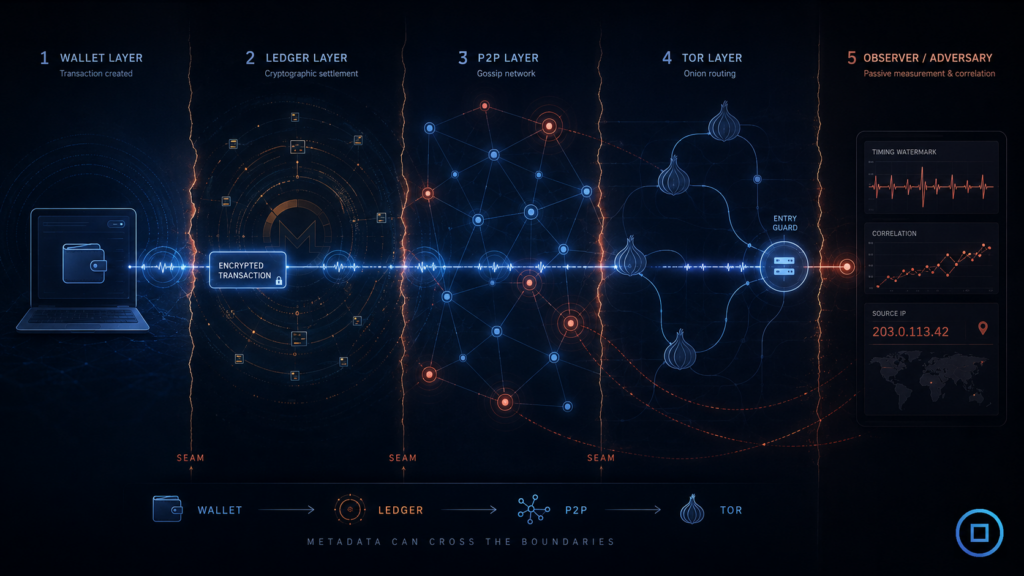
The July 2026 ProxyMark preprint examines Monero transactions routed through particular Tor configurations. The researchers do not claim to break RingCT, reveal confidential amounts or decrypt Tor. Instead, they exploit interactions between Monero’s application-layer forwarding behaviour, adversarial peer positioning, proxy selection and Tor traffic watermarking.[26]

The chain is conditional. The adversary must obtain useful Monero peer positions. The target must use the relevant Tor behaviour. A suitable Tor-side relay position is required for the IP-linking stage. The experiments used particular Monero versions and environments.

Those limitations are important.

So is the general lesson.

Our earlier analysis of ProxyMark described the problem as compositional. Ledger privacy, wallet behaviour, P2P forwarding and transport anonymity cannot be evaluated as isolated compartments.[27]

An investigator does not need every layer to fail completely.

Weak evidence can combine.

A probabilistic ledger heuristic may rank one candidate above others. A network observation may associate the transaction with a particular node or IP range. An exchange may hold withdrawal records and customer identity information. A seized device may reveal wallet history.

Individually, each observation may be incomplete.

Together, they can reduce uncertainty far more than any individual signal.

Cross-layer evidence fusion: A weak ledger signal plus a weak network signal can become materially stronger when combined with timing, exchange records, counterparty information or device evidence. Privacy therefore has to minimise leakage at every layer rather than assuming uncertainty in one layer will compensate for information exposed elsewhere.

A 2025 NDSS study of Monero’s P2P network reached a related conclusion from another direction, presenting a practical connection-reset approach for eclipse attacks and showing that connection management itself belongs inside the privacy threat model.[28]

FCMP++ can eliminate fixed-ring decoy analysis.

It cannot conceal where a transaction enters the network.

Halo 2 can prove a hidden transaction valid.

It cannot, by itself, prevent an observer from correlating message timing.

Private staking can hide balances.

It can still leak information if repeated block production is associated with a stable IP address.

Zano’s own staking recommendations acknowledge this category of risk, warning that block-production frequency observed from a public IP can reveal information about a staking wallet and providing configurable networking protections.[19]

This is why network anonymity belongs in the same conversation as transaction cryptography.

Ryo’s planned high-latency mixnet is an attempt to address that separate layer. Zano has already shipped configurable P2P privacy tools for stakers and its roadmap lists a further networking privacy upgrade focused on peer obfuscation and traffic-analysis resistance.[17]

The existence of a roadmap item is not proof of security.

The architectural separation is nevertheless correct.

The transaction proof and the transport path answer different questions.

VI. Mining Hardware Is Constitutional History

Mining is usually discussed as an energy or profitability issue.

For a network that may later transition to proof-of-stake, that treatment is incomplete.

Proof-of-work determines who receives newly issued monetary units during the distribution phase. When ownership later becomes part of the consensus mechanism, mining history becomes part of the political economy inherited by the staking system.

Mining hardware is not merely infrastructure. Over a long enough period, it becomes constitutional history.

Ryo: a long GPU distribution phase

Ryo’s CryptoNight-GPU is designed around commodity graphics processors and intentionally attempts to reduce the efficiency advantage available to ASICs, FPGAs and ordinary CPU fleets.[20]

Its significance is not that GPU mining guarantees decentralisation. It does not. Large farms can accumulate GPUs. Electricity costs differ by region. Hardware supply is unequal.

The narrower point is that the same general class of hardware used for gaming, graphics, rendering and compute can participate in monetary issuance.

As of August 2026, Ryo has preserved that GPU orientation rather than visibly migrating into an ASIC-dominated mining market.

If Ryo ultimately moves to proof-of-stake, its PoW period can be interpreted as more than a temporary consensus algorithm. It becomes a long distribution interval before ownership begins participating directly in block-production authority.

Ryo’s monetary history also deserves accurate context. The inherited Sumokoin premine was burned, while the later Ryo development fund was introduced through community governance and emitted separately from ordinary miner rewards. Describing the launch simply as “no premine” is defensible only when the inherited burn and later development allocation are not hidden from the reader.[21]

Zano: GPU mining plus private staking

Zano currently operates hybrid PoW/PoS consensus. Its proof-of-work side uses ProgPoWZ, a GPU-oriented algorithm designed to reduce specialised-hardware advantage, while its proof-of-stake side uses Zarcanum to hide staked balances.[18][22]

This makes Zano unusually relevant to Ryo’s future architecture.

Zano already lives in the transition zone between commodity GPU distribution and private stake-based block production. Its Zenith research now proposes removing the PoW half entirely while retaining the privacy foundations established by Zarcanum.[18]

Monero: CPU accessibility and the botnet paradox

Monero’s RandomX takes the opposite commodity-hardware approach. It is optimised for general-purpose CPUs and designed to discourage ASIC specialisation. Monero can be mined with CPUs and GPUs, but CPUs are substantially more efficient for RandomX.[23]

This produces a real decentralisation advantage. The hardware required to participate already exists in millions of ordinary computers.

It also creates a distinct abuse economy.

A compromised CPU can mine Monero without its owner purchasing specialised hardware.

During Europol’s Operation Endgame in May 2024, major malware and dropper infrastructure was disrupted. BitcoinBlog.de subsequently noted that Monero’s reported network hashrate fell sharply over the same period and argued that the timing suggested a material cryptojacking connection.[24]

That correlation does not prove what fraction of Monero hashrate was controlled by any particular botnet. Europol did not make such an attribution.

The economic point is sufficient: hardware accessibility can decentralise legitimate participation while simultaneously lowering the hardware barrier for unauthorised mining.

Zcash and Dash: GPU beginnings, ASIC industrialisation

Zcash launched around Equihash, a memory-oriented proof-of-work algorithm selected partly because custom hardware was expected to be difficult to optimise economically. Commercial Equihash ASICs arrived anyway. By 2018, Zcash developers and the Foundation were openly debating whether ASIC resistance should remain a protocol priority.[25]

Dash followed a similar industrial path through X11. Dash documentation now treats specialised X11 ASICs as the normal mining equipment for proof-of-work.[30]

Both histories illustrate the same principle.

Commodity-hardware accessibility at launch does not guarantee commodity-hardware accessibility forever.

Pirate Chain: mandatory privacy in an ASIC-capable mining environment

Pirate Chain uses Equihash-based delayed proof-of-work. Its official mining material supports both GPUs and ASICs.[31]

ARRR launched in 2018, after commercial Equihash ASICs had already entered the market.

This makes Pirate useful as a counterexample to simplistic privacy rankings.

It can enforce strong transaction privacy while operating in a mining environment where specialised hardware is available.

Transaction privacy and issuance decentralisation are separate dimensions.

VII. The New Contest: Private Consensus

Once proof-of-stake enters the architecture, privacy moves into a more politically sensitive domain.

Ordinary transaction privacy asks who paid whom.

Private consensus asks who possesses enough economic weight to help decide the chain’s future.

Transparent proof-of-stake systems can expose validator identities, stake balances, reward histories and recurring operational behaviour. Even when addresses are pseudonymous, stable validator activity can become a long-lived graph of economic power.

Zano has already demonstrated that staking does not need to reveal the amount being staked. Zarcanum introduced hidden staking balances in the 2024 network upgrade, while the chain remained hybrid PoW/PoS.[16]

This is not the same thing as pure private PoS.

Half of Zano’s present consensus still involves proof-of-work.

The Zenith design published in July 2026 establishes the next step: a pure proof-of-stake architecture built on Zarcanum’s privacy foundations.[18]

Zano’s roadmap currently places Zenith testnet implementation and mainnet rollout in future stages. Those dates are estimates, not guarantees.[17]

Ryo’s public roadmap separately establishes its own transition toward proof-of-stake.[7] Ryo-focused project material describes that future era as a private staking model following the GPU distribution phase.[8]

Zcash also belongs in this discussion, although its direction is less settled. Electric Coin Company previously researched a staged transition in which Zcash could move from proof-of-work to hybrid PoW/PoS and potentially later to pure proof-of-stake.[34] The concrete proposal now being developed by Shielded Labs is Crosslink, which takes the intermediate architecture seriously as a destination in its own right: miners continue producing and validating blocks while stake-weighted finalizers provide assured finality and earn protocol rewards.[35]

Crosslink has not been adopted by Zcash consensus and would require the standard governance process and strong community support before mainnet activation. Nor should Crosslink be described as an announced transition to pure PoS. Shielded Labs currently states that it strengthens rather than replaces Zcash’s PoW foundation and that there is no present indication that Crosslink activation would necessarily lead to full proof-of-stake.[36]

Zcash should therefore be classified as PoW today, with an actively developed hybrid PoW/PoS proposal and a longer history of research into possible PoS evolution, rather than as either permanently committed to PoW or committed to pure PoS.

The important point is not to predict which project will activate a completed private pure-PoS architecture first.

There is not enough public engineering evidence to make that prediction responsibly.

The important point is that the consensus landscape itself is branching.

Monero is preserving proof-of-work while radically changing transaction privacy.

Zano and Ryo are pursuing stake-based private consensus from different cryptographic and monetary starting points.

Zcash is exploring whether staking and assured finality can be layered onto proof-of-work without immediately abandoning mining.

Consensus now has evolutionary paths just as privacy cryptography does.

Dimension Zano Ryo
Current transaction privacy Private by default using d/v-CLSAG, stealth addresses, hidden amounts and asset confidentiality. Private by default using RingCT, stealth addresses and a default ring size of 25.
Beyond fixed rings Research completed: FCMP research and prototyping for Zarcanum and Confidential Assets. Roadmap: separate Ryo-specific Halo 2 implementation intended to replace the existing decoy-based model.
Current consensus Hybrid GPU-oriented ProgPoWZ plus private Zarcanum PoS. CryptoNight-GPU proof-of-work.
Private staking Live: staking balances hidden through Zarcanum. Future architecture: proof-of-stake follows the GPU distribution era; detailed public consensus specification remains outstanding.
Pure PoS Design completed: Zenith; implementation and rollout still ahead. Roadmap direction: PoS transition confirmed; detailed public protocol and activation schedule remain to be published.
Asset privacy Live: Confidential Assets, private DEX functionality and related ecosystem tooling. Native RYO privacy today; broader programmable asset model depends on future architecture.
Governance privacy Live: anonymous on-chain voting for major decisions. Roadmap: native DAO governance with broader network-state ambitions.
Network-layer privacy Tor support and configurable staker P2P privacy tools live; peer-obfuscation and traffic-analysis upgrade planned. High-latency mixnet planned as a dedicated transaction-origin and timing privacy layer.
Ecosystem maturity Growing multi-wallet ecosystem, DEX, Confidential Assets, bridges, staking and application infrastructure. Smaller ecosystem centred on Ryo wallets, mining, exchange access and developing infrastructure.
Liquidity Materially deeper than Ryo, though still far below the largest cryptocurrency markets. Major weakness: relatively thin liquidity and limited market depth.
Distinctive thesis Build a private digital economy in which assets, staking, voting, trading and applications inherit base-layer confidentiality. Build a private sovereignty stack connecting long GPU distribution, Halo 2, network anonymity, private PoS and native political governance.

Zano and Ryo should therefore be understood as increasingly occupying the same strategic territory.

Zano enters that territory from a private-economy platform that already has confidential assets, private staking and anonymous voting.

Ryo enters from a monetary network whose roadmap explicitly connects transaction privacy, mining distribution, network anonymity, stake-based consensus and native governance.

The difference is not simply “Zano is further ahead” or “Ryo is more ambitious.”

Those slogans flatten the architecture.

Zano has shipped more components of the private economic stack.

Ryo proposes a particularly explicit integration of the transport layer and network-state governance into its future design.

Which architecture proves stronger will depend on code, review, adoption and the interaction between layers.

VIII. The Privacy Sovereignty Stack

The phrase “privacy coin” is now too small for the systems being built.

A useful framework must include at least eight separate layers.

Layer What must remain private? Typical failure
Ledger privacy Amounts, recipients, spend relationships and transaction graph. Transparent outputs, weak decoys, circuit flaws, known-output analysis.
Wallet privacy Keys, balances, queries, transaction construction and local activity. Remote-node correlation, telemetry, device compromise, wallet fingerprints.
P2P broadcast privacy Which node first introduced a transaction. First-spy analysis, malicious peers, topology inference, eclipse attacks.
Transport privacy IP address, timing, volume and communication relationships. Traffic correlation, watermarking, malicious relays, global observation.
Consensus privacy Validator wealth, recurring block-production identity and staking relationships. Public validator balances, stable addresses, IP correlation and reward histories.
Distribution Not necessarily private, but structurally decisive: who had realistic access to new issuance? ASIC capture, hidden mining optimisation, inaccessible hardware, botnet extraction or concentrated initial allocations.
Asset privacy Asset type, balances, issuance, transfers and trading relationships. Private native coin surrounded by transparent tokens, bridges or DEX activity.
Governance privacy Membership, voting, delegation, treasury relationships and political coalitions. Public voting histories, visible factions, treasury mapping, donor exposure and coercion.

This stack explains why there can be no single “best privacy technology.”

FCMP++ primarily transforms the ledger layer.

Halo 2 primarily provides a framework for proving hidden state transitions.

A high-latency mixnet addresses transport and timing.

Zarcanum addresses staking privacy.

Crosslink illustrates another consensus approach: stake-weighted finality layered over continued proof-of-work rather than an immediate replacement of mining.

CryptoNight-GPU, ProgPoWZ and RandomX shape distribution economics.

Confidential Assets extend privacy beyond the native monetary unit.

Anonymous voting or private DAO infrastructure extends it into collective decision-making.

A project can be exceptional at one layer and exposed at another.

This is the central insight inherited from the ProxyMark analysis.

Privacy is compositional. The adversary is allowed to combine what the protocol designers chose to separate.

IX. Six Privacy Coins, Compared Without a Single Score

The table below is deliberately qualitative. It is not a price ranking, a market-cap ranking or a declaration of one universal winner.

It compares the principal architectural dimensions that matter when a privacy currency is evaluated not only as digital cash, but as potential infrastructure for private economic coordination.

Dimension Monero Zano Ryo Zcash Dash Pirate Chain
Ordinary transaction privacy Mandatory RingCT with ring size 16. Private by default with hidden amounts, addresses and asset types. Mandatory RingCT with ring size 25. Strong shielded privacy available; transparent activity remains possible. Transparent Core plus optional CoinJoin and optional Evolution shielded pool. Mandatory shielded user transactions.
Current privacy architecture CLSAG/RingCT, stealth addresses, Bulletproofs. d/v-CLSAG, Bulletproofs+, Zarcanum, Confidential Assets. RingCT, stealth addresses, uniform payment IDs. Sapling, Orchard legacy state and Ironwood shielded architecture. CoinJoin plus Orchard-derived Halo 2 shielded credits on Evolution. Sapling shielded transactions.
Next-generation direction FCMP++ and CARROT. FCMP research completed; Zenith; P2P privacy upgrade; Execution Layer. Ryo-specific Halo 2 architecture, high-latency mixnet, PoS and DAO governance. Ironwood live; Crosslink hybrid PoW/PoS finality and staking under development; longer-term consensus architecture remains subject to Zcash governance. Expansion of Evolution shielded functionality and shielded asset capabilities. Direct migration from Sapling to Ironwood.
Consensus today RandomX PoW. Hybrid ProgPoWZ PoW plus private Zarcanum PoS. CryptoNight-GPU PoW. Equihash PoW. Crosslink proposes adding a parallel PoS finality layer while retaining PoW block production. X11 PoW plus masternode Proof of Service. Equihash-based delayed PoW.
Mining hardware profile CPU-oriented commodity hardware. GPU-oriented PoW alongside staking. GPU-oriented and designed to reduce ASIC, FPGA and CPU advantage. Originally GPU-accessible; now ASIC-capable and industrialised. X11 ASIC mining. ASIC mining.
Private staking No PoS roadmap. Live. Zarcanum hides staking balances. Planned direction. Public detailed consensus design still awaited. Under active development. Crosslink proposes ZEC staking and PoS finalizers alongside the existing PoW chain. The current design uses privacy-preserving batching and quantisation, but finalizer stake totals remain publicly observable; Crosslink is not yet approved for mainnet.[35][36] No private PoS. Masternodes are collateralised service nodes. No.
Network metadata strategy Dandelion++, Tor/I2P support; active research continues to expose layer-specific risks. Tor support, configurable staker privacy tooling; further peer-obfuscation and traffic-analysis upgrade planned. Dedicated high-latency mixnet planned. Separate networking protections required beyond shielded proofs; Crosslink changes finality and staking rather than solving transport anonymity. Shielded pool does not itself hide general network-origin metadata. Shielded transactions do not by themselves solve transport-level observation.
Private assets Native XMR focus. Live Confidential Assets with private exchange infrastructure. Native RYO today; future programmability depends on planned architecture. Native ZEC focus at L1. Shielded token functionality announced for Evolution. Native ARRR focus.
On-chain governance No native holder-voting DAO; project governance remains social/off-chain. Anonymous on-chain voting live. Native DAO governance planned. ZIP and community governance structures, not a native private token-voting DAO. Any Crosslink activation would itself require Zcash governance and broad community consensus. Mature native DAO/budget system through masternodes, but governance is not designed around ballot privacy.[29] Community-driven governance and crowdfunding rather than a native private DAO.
Ecosystem and liquidity Largest and most established dedicated privacy-currency ecosystem of this group. Growing ecosystem with multiple wallets, DEX, assets, staking and application infrastructure. Limited relative to peers. Thin liquidity, fewer integrations and smaller developer/application ecosystem. Established infrastructure and institutional cryptography ecosystem. Established payments, governance and masternode infrastructure. Smaller privacy niche with active community infrastructure.
Principal current weakness Fixed rings remain live until FCMP++ deploys; network metadata remains a separate attack surface. Pure PoS is not live; FCMP integration remains future work; broader platform complexity increases attack surface. Major roadmap components are not yet deployed; liquidity and ecosystem depth remain comparatively weak. Privacy remains optional at the protocol level; the Orchard incident demonstrated circuit-specification risk; Crosslink remains a proposal rather than adopted consensus. Shielded privacy is optional and isolated from transparent L1 activity; ASIC mining is specialised. Current Sapling architecture is older; ASIC-capable mining; Ironwood migration still ahead.

The table makes one conclusion unavoidable.

There is no single privacy-coin leaderboard.

Monero is strongest where long-term private digital cash adoption and liquidity matter.

Zcash is strongest as a production laboratory for advanced zero-knowledge systems and formal assurance. Crosslink also makes it an increasingly important laboratory for a different question: whether PoW and PoS can coexist as complementary security layers rather than being treated as mutually exclusive consensus ideologies.

Dash has one of cryptocurrency’s oldest native governance systems and has now added a modern optional shielded architecture.

Pirate Chain combines mandatory shielded policy with a willingness to migrate directly toward Ironwood.

Zano has assembled perhaps the broadest set of currently operating private economic primitives: transactions, assets, staking, trading and anonymous voting.

Ryo’s significance lies in a different combination: a long GPU-oriented distribution era followed by a planned architecture that explicitly connects Halo 2, network anonymity, proof-of-stake and native governance.

Its weakness is equally clear.

Architecture without liquidity, users, applications and public implementation evidence remains potential rather than power.

X. From Private Money to Private Institutions

The privacy debate becomes politically more consequential once a blockchain stops being only a payment network.

Consider a DAO treasury.

A transparent ledger may expose reserves, salaries, contractors, donor relationships, operational spending and treasury runway.

Transparent voting can reveal political factions, influential delegates and the preferences of identifiable members.

Delegation can expose who trusts whom.

Repeated governance participation can create a public map of organisational power.

For a hobbyist DAO, some of that transparency may be desirable.

For a commercial organisation, activist network, politically exposed community or future network state, it can become an intelligence product.

This is why private governance cannot mean simply “hide the vote.”

A credible design needs to separate several properties:

  • membership eligibility;
  • ballot secrecy;
  • double-vote prevention;
  • verifiable tallying;
  • delegation;
  • treasury authority;
  • selective disclosure;
  • and institutional accountability.

The wider zero-knowledge field has already demonstrated that several of these components are technically practical. Semaphore allows a user to prove group membership and submit a verifiable anonymous signal or vote without revealing identity.[32]

Kite, a 2025 research protocol, extends the problem to private DAO delegation. It allows voting power to be delegated, revoked and redelegated without revealing the delegator’s chosen representative.[33]

Neither system is a Ryo implementation.

Neither proves that private governance is solved.

They demonstrate that “private DAO” is not a mystical concept. It decomposes into cryptographic and institutional subproblems that can be specified and tested.

Zano has already crossed part of this boundary with anonymous on-chain voting.[17]

Dash already demonstrates the opposite governance strength: a mature, long-running on-chain budget and proposal system, but one built around masternode voting rather than privacy-preserving political participation.[29]

Ryo’s roadmap goes further conceptually by linking native DAO governance to its future privacy stack.

The opportunity is significant.

So is the danger.

Privacy can protect minorities from retaliation.

It can also conceal oligarchy.

A DAO whose ballots are private but whose voting power is controlled by a handful of large holders is not automatically decentralised. A system that hides political coalitions may protect participants from surveillance while also making capture harder to detect.

The objective must therefore be narrower and more defensible:

Private governance should make valid collective decisions verifiable without forcing every participant’s identity, wealth and political behaviour into a permanent public archive.

XI. Network States and the Intelligence Problem

This is where the argument leaves the privacy-coin category and enters the theory of digital sovereignty.

The Bitcoin Magnet argued that a digital community needs independent capital before it can build durable institutions. Capital attracts infrastructure. Infrastructure supports contributors. Contributors make institutions possible.

That process was described as economic gravity.

The stronger form was sovereign gravity: network capital becoming the material base around which governance capacity can form.

Yet a transparent network-state treasury creates a paradox.

The community may possess money that no foreign central bank can issue.

It may still publish its entire economic nervous system to foreign intelligence services.

Private From Washington, Visible to Beijing developed this distinction through the concept of observer neutrality. A monetary system can be resistant to one state’s direct control while remaining easily legible to another state’s surveillance apparatus.

Issuer neutrality is therefore not enough.

A network state also needs to ask:

  • Can an observer map the treasury?
  • Can salaries reveal leadership?
  • Can donations identify sympathisers?
  • Can voting reveal political factions?
  • Can network metadata identify where members operate?
  • Can staking behaviour reveal concentrated economic power?
  • Can public asset issuance expose internal commercial relationships?

A transparent blockchain answers many of these questions for the adversary automatically.

A private blockchain does not make the adversary powerless.

It changes the burden.

The investigator must obtain information from endpoints, counterparties, exchanges, network observation, legal process or operational mistakes rather than receiving the complete transaction graph as a free protocol output.

That distinction is politically enormous.

A transparent network state may be sovereign in issuance while remaining colonised in information.

This is why the private-sovereignty-stack competition between Zano and Ryo deserves attention beyond ordinary privacy-coin tribalism.

Zano is building toward a private economy in which assets, staking, trading and voting inherit confidentiality.

Ryo is building toward an architecture in which private money is intended to connect to network anonymity, private consensus and native governance after a long GPU distribution phase.

They are not identical systems.

They are increasingly asking the same civilisational question.

Can a network enforce rules without turning participation into surveillance?

XII. Why Ryo’s Weaknesses Matter

A serious Ryo-focused publication should not hide the project’s present disadvantages.

Ryo’s liquidity is limited.

Its exchange footprint is smaller than the major assets discussed here.

Its wallet and application ecosystem is less developed than Monero’s or Zano’s.

It does not yet have the advanced privacy architecture described by its own roadmap.

Its high-latency mixnet is not yet a demonstrated production anonymity system.

Its future PoS design has not yet been exposed to the level of public specification and cryptographic review that Zano’s Zenith research has begun receiving.

Its native DAO architecture remains future work.

These are not footnotes.

They are the central execution risk.

A protocol with extraordinary architecture but insufficient liquidity cannot support a large treasury without severe market impact.

A private network without enough active users produces a smaller crowd in which to hide.

A technically elegant chain without developers, merchant integrations, wallets and applications cannot generate sovereign gravity.

The Bitcoin Magnet already established the relevant principle:

technical distinction does not automatically create economic gravity.

Ryo must convert architectural ambition into users, liquidity, software, integrations and institutions.

That is a harder problem than writing a roadmap.

It is also the only path through which the roadmap can become historically important.

XIII. Why Zano’s Strengths Should Not Be Underplayed

The same intellectual discipline requires correcting the opposite distortion.

Zano is not merely “another CryptoNote coin considering PoS.”

Its present architecture already combines several layers that privacy-coin discussions often treat as separate future concepts.

  • Private-by-default transactions are live.
  • Zarcanum hides staking balances.
  • Confidential Assets are live.
  • Zano Trade provides private exchange functionality for native assets.
  • Anonymous on-chain voting has shipped.
  • Configurable P2P privacy tooling exists for stakers.
  • FCMP research and prototyping for Zarcanum and Confidential Assets is marked complete.
  • The Zenith pure-PoS design is complete, while implementation remains future work.
  • A further P2P privacy upgrade targeting peer obfuscation and traffic-analysis resistance is planned.

That is a substantial private-economy stack.[17]

Ryo’s distinctive claim is therefore not that Zano lacks architectural integration.

It does not.

The more accurate distinction is scope and design emphasis.

Zano has already integrated private assets, staking, voting and exchange infrastructure into a working ecosystem and is now deepening consensus and network privacy.

Ryo’s roadmap places unusual emphasis on the sequence from long GPU distribution to Halo 2, then to a dedicated high-latency mixnet, stake-based consensus and native DAO architecture designed around broader digital-sovereignty use cases.

These approaches may ultimately converge more than they diverge.

That possibility is more interesting than declaring an early winner.

XIV. What Each Project Is Really Optimising For

Monero: minimise architectural change while eliminating the ring

Monero’s greatest strength is that it does not need to become a private application platform to remain important.

Its mission is narrower: private peer-to-peer money.

FCMP++ is consistent with that philosophy. Remove a major sender-privacy weakness without turning the monetary protocol into a general governance machine.

That narrower scope may prove to be an advantage. Every feature not placed inside consensus is one less consensus feature that can fail.

Zano: build a private economy

Zano’s architecture says that private money alone is not enough.

Assets, staking, exchange, voting and applications should inherit confidentiality rather than forcing users to leave the private base layer whenever they do something more complex than a transfer.

Zarcanum and Confidential Assets already make that thesis visible on mainnet.

Ryo: build a private sovereignty stack

Ryo’s thesis goes further into the relationship between money, communications and governance.

Its future architecture is intended to combine private-by-default monetary state with a separate network-anonymity layer, then change the consensus resource from GPU work to stake and extend the system into native collective governance.

This architecture is potentially powerful because it recognises that surveillance does not stop at the transaction boundary.

Its weakness is that most of the defining future components still have to be publicly specified, implemented and reviewed.

Zcash: prove that programmable shielded systems can survive reality

Zcash’s historical contribution is not only invention.

It is production experience.

The Orchard incident exposed the danger of circuit specification mistakes. Ironwood’s formal-verification programme demonstrated how the industry can respond by raising the assurance standard.

Crosslink now extends Zcash’s experimental role into consensus architecture. Instead of treating PoW and PoS as an unavoidable binary choice, it proposes retaining miners for block production while adding a stake-weighted finality system alongside them.[35]

This is not yet Zcash consensus. Crosslink remains subject to testing, productionisation, governance and community approval. Nor is it evidence that Zcash has decided eventually to become a pure-PoS chain.[36]

Zcash therefore supplies both the warning and the methodology: advanced cryptography and consensus innovation should be judged by exactly what has been implemented, exactly what has been proved and exactly what the community has actually adopted.

Dash: integrate privacy without abandoning a broader payments architecture

Dash has never been designed as a pure privacy coin in the Monero or Pirate sense.

Its strength lies in combining payments, deterministic settlement, masternode infrastructure and one of cryptocurrency’s longest-running native governance systems.

The new Evolution shielded pool adds advanced privacy technology to that wider architecture.

The trade-off is optionality.

Pirate Chain: enforce shielded policy and modernise the proof system

Pirate’s defining feature is policy clarity.

Ordinary transfers are shielded.

The project is now attempting to replace the older Sapling foundation directly with Ironwood rather than pass through Orchard.

Its central trade-off sits elsewhere: mining infrastructure and the smaller economic ecosystem.

XV. The End of the Ring Is Not the End of Surveillance

Suppose FCMP++ works perfectly.

The ring disappears.

Suppose Halo 2 circuits are formally verified.

The hidden transaction state becomes cryptographically sound.

Suppose Zarcanum or another private PoS design conceals validator balances.

None of those achievements prevents a compromised wallet from exposing keys.

None prevents an exchange from identifying a withdrawal.

None prevents an IP address from leaking through poor network behaviour.

None prevents a governance system from concentrating power among wealthy holders.

None creates liquidity.

None creates institutional legitimacy.

This is why the next generation of privacy systems must become less impressed by isolated cryptographic primitives and more demanding about architecture.

The privacy question has to be asked repeatedly:

What information does this layer force the participant to reveal?

Then again at the next layer.

And again.

Until the entire system has been examined.

Conclusion: From Private Transactions to Private Civilisation

The first privacy-coin era was built around hiding a transaction.

The second is being built around hiding relationships that the system does not need to know.

Monero’s FCMP++ asks whether sender membership can be proved without publishing a small decoy set.

Ryo’s Halo 2 path asks whether a CryptoNote-descended network can move to a broader programmable hidden-state architecture without importing another chain’s transaction design.

Zano asks whether staking, assets, trading and voting can become private properties of one economic system.

Zcash asks two increasingly important questions at once: how far formal methods can push assurance in general-purpose shielded circuits after a real production failure, and whether PoW block production can coexist productively with stake-weighted assured finality through a system such as Crosslink.

Dash asks how advanced shielded technology fits inside a broader transparent payments and governance network.

Pirate asks what mandatory privacy looks like when a Sapling-era chain jumps directly toward Ironwood.

None has completed the full problem.

That is what makes this moment historically interesting.

The category is expanding.

Privacy is moving from rings to full-chain proofs.

From payment confidentiality to asset confidentiality.

From hidden balances to hidden staking power.

From probabilistic consensus to experiments with stake-weighted finality.

From ledger anonymity to network anonymity.

From private money to private institutions.

The emerging Ryo-Zano overlap may prove especially important. Zano already demonstrates that private staking, private assets and anonymous voting can belong to a single operating ecosystem. Ryo proposes a complementary extension in which a long commodity-GPU distribution phase feeds into Halo 2, a high-latency mixnet, private stake-based consensus and native DAO governance.

Zcash adds another important possibility. The eventual consensus landscape need not consist only of projects that remain permanently proof-of-work and projects that abandon mining entirely. Crosslink asks whether PoW and PoS can protect different properties of the same chain, with miners producing blocks while stake-backed finalizers create stronger finality. Whether Zcash ultimately adopts that architecture, modifies it, remains with PoW, or someday revisits a fuller PoS transition remains a governance question rather than a settled roadmap conclusion.[34][36]

There is no reason to pretend the race is decided.

Zano’s Zenith implementation is still ahead.

Ryo’s defining future architecture is still ahead.

Monero’s FCMP++ is still ahead.

Zcash’s Crosslink remains a proposal under active development rather than adopted mainnet consensus.

Pirate’s Ironwood migration is still ahead.

Even Zcash, the most mature Halo 2 deployment environment in this group, has just demonstrated how much engineering remains after the mathematics appears settled.

The correct standard is therefore not optimism or cynicism.

It is verification.

Bitcoin asked whether money could exist without a sovereign issuer.

Privacy coins asked whether money could exist without a public transaction history.

The architectures now emerging ask a more difficult question:

Can an entire digital economic system verify rules without first turning its participants into data?

That question applies to payments.

It applies to staking.

It applies to markets.

It applies to treasuries.

It applies to political organisation.

Eventually, it may apply to the digital communities that attempt to become institutions, and to the institutions that attempt to become states.

A sovereign network should not need to know everything about the people who obey its rules.

The end of the ring is therefore not the end of privacy engineering.

It is the point at which privacy stops being a transaction feature and becomes a theory of how digital society should be built.


Further Reading from ryo.news

ProxyMark and Monero over Tor: How Privacy Can Fail Between Layers
Why ledger privacy, wallet behaviour, P2P forwarding and transport anonymity have to be evaluated together.

The Bitcoin Magnet: How Network Assets Create Economic Gravity
How network capital attracts infrastructure, institutions and eventually governance capacity.

Private From Washington, Visible to Beijing: China, Privacy Coins, and Financial Sovereignty
Why issuer independence is incomplete without observer neutrality.

From Network Union to Network State: How Ryo Currency Powers the Digital Nations of Tomorrow
The progression from online community to capital, coordination and digital political organisation.

Halo 2 Zero-Knowledge Proofs and Ryo Currency
Background on the proving architecture planned for Ryo’s transition beyond RingCT.

Ryo Currency’s High-Latency Mixnet vs. Tor and VPNs
Why hiding transaction contents and hiding communication metadata are separate engineering problems.

References

  1. Nicolas van Saberhagen, CryptoNote v2.0, 2013.
    CryptoNote whitepaper.
  2. Malte Möser, Kyle Soska, Ethan Heilman et al., “An Empirical Analysis of Traceability in the Monero Blockchain.”
    arXiv.
  3. Monero Project, “OSPEAD – Optimal Ring Signature Research.”
    Monero Project.
  4. Monero Project, “Full-Chain Membership Proofs Development.”
    Monero Project.
  5. Monero Project, development roadmap.
    Official roadmap.
  6. The Halo 2 Book, proving-system design documentation.
    Halo 2 documentation.
  7. Ryo Currency, official FAQ and roadmap.
    Official Ryo website.
  8. ryo.news, “Ryo Currency | Privacy Coin, Wallets & Roadmap.”
    Ryo project overview.
  9. Zcash Foundation, “Zebra 4.5.3 and 5.0.0: Emergency Soft Fork and NU6.2 Activation,” 3 June 2026.
    Incident report.
  10. Zcash Foundation, “Zebra 6.0.0 Release,” 10 July 2026.
    Ironwood activation documentation.
  11. Sean Bowe and Tal Derei, Project Tachyon, “Formal Verification of Zcash Ironwood Completed,” 28 July 2026.
    Formal verification report.
  12. Dash, “Shielded Transactions Are Live on the Dash Evolution Mainnet,” 4 August 2026.
    Official Dash announcement.
  13. Dash Platform Documentation, “Shielded Pool.”
    Official documentation.
  14. Dash privacy-by-default discussion, 2026.
    View on X.
  15. Pirate Chain, “Pirate Chain Skips a Generation: ARRR Moves Directly to Ironwood,” 27 July 2026.
    Official announcement.
  16. Zano, “Introducing Zarcanum: Revolutionizing Blockchain Privacy for Mass Adoption.”
    Official Zarcanum article.
  17. Zano, official project roadmap.
    Zano roadmap.
  18. Zano, “Zenith: Zano’s Move to Pure Proof of Stake,” 16 July 2026.
    Official Zenith announcement.
  19. Zano Documentation, staking recommendations and network privacy considerations.
    Zano Docs.
  20. Ryo Currency, CryptoNight-GPU documentation and project overview.
    CryptoNight-GPU.
  21. Ryo Currency, historical FAQ covering the Sumokoin chain fork, burned premine and community development-fund changes.
    Ryo historical FAQ.
  22. Zano Documentation, “Mining Zano” and ProgPoWZ specifications.
    Zano mining documentation.
  23. Monero Project, “Mining Monero.”
    Official RandomX mining documentation.
  24. Christoph Bergmann, BitcoinBlog.de, “Largest Crackdown Against Botnets by Europol – Monero Hashrate Drops Significantly,” 5 June 2024.
    Article.
    See also
    Europol’s Operation Endgame release.
  25. Electric Coin Company, historical Equihash and ASIC discussion.
    Why Equihash?
    and
    Zcash Company Statement on ASICs.
  26. Ruisheng Shi, Shihan Zhang, Yulian Ge, Lina Lan, Qingfeng Zhang and Qin Wang, “Deanonymizing Monero Transactions in Tor Network,” 8 July 2026.
    arXiv.
  27. Dr. Max Anon, “ProxyMark and Monero over Tor: How Privacy Can Fail Between Layers,” ryo.news, 2026.
    ryo.news analysis.
  28. NDSS Symposium 2025, “Eclipse Attacks on Monero’s Peer-to-Peer Network.”
    NDSS.
  29. Dash Documentation, “Governance.”
    Dash governance documentation.
  30. Dash Documentation, “Mining.”
    Dash X11 mining documentation.
  31. Pirate Chain, “Mining.”
    Official mining page.
  32. Semaphore, “What Is Semaphore?”
    Semaphore documentation.
  33. Kamilla Nazirkhanova, Vrushank Gunjur, X. Pilli Cruz-De Jesus and Dan Boneh, “Kite: How to Delegate Voting Power Privately,” 2025.
    arXiv.
  34. Nathan Wilcox, Electric Coin Company, “The Trailing Finality Layer: A Stepping Stone to Proof of Stake in Zcash,” 18 July 2023.
    ECC research.
  35. Shielded Labs, Crosslink project and implementation roadmap.
    Crosslink overview
    and
    Crosslink roadmap.
  36. Shielded Labs, “Crosslink FAQ.”
    Crosslink FAQ.
Diagram showing an encrypted Monero transaction moving through wallet, ledger, P2P and Tor layers, with adversarial nodes correlating a timing watermark to a source IP address.

ProxyMark and Monero over Tor: How Privacy Can Fail Between Layers

By Dr. Max Anon

A July 2026 research preprint presents ProxyMark, a multi-stage technique intended to associate transactions originated by certain Monero nodes operating through Tor with their source IP addresses. The work does not break Monero’s transaction cryptography or decrypt Tor circuits. Instead, it examines how application-layer forwarding rules, peer selection, Tor relay positioning and traffic patterns can interact to expose network metadata.

The study illustrates a broader privacy-engineering problem: protecting transaction contents does not automatically protect the communications surrounding a transaction. A cryptocurrency may conceal amounts, addresses and ownership relationships on its ledger while still exposing information through message direction, peer selection, timing, packet frequency or differences between locally created and relayed transactions.

These layers should not be evaluated independently. A probabilistic blockchain heuristic, a network-origin observation or an exchange record may be inconclusive on its own. When several signals refer to the same transaction, however, they may reinforce one another and materially reduce an investigator’s uncertainty.

For Ryo Currency, the research provides relevant context for its planned high-latency mixnet. It supports the architectural case for treating network anonymity as a dedicated privacy layer. It does not, by itself, establish that any proposed mixnet is secure—or that every Monero transaction sent through Tor can be traced.

What the evidence establishes

Established by the reported experiments: The researchers demonstrated the individual components of ProxyMark under specified test conditions. These included node-role identification, adversarial occupation of hidden-service peer connections, manipulation of proxy-selection probability and recovery of traffic watermarks at an adversarial Tor entry relay.

Required for end-to-end attribution: The target must use the Monero-over-Tor behavior analyzed in the paper. Adversarial Monero hidden-service peers must obtain suitable positions among the target’s outgoing peers. The adversary must receive the originated transaction, and a malicious or cooperating Tor relay must occupy the required entry-guard position.

Not established: The research does not demonstrate universal traceability of Monero-over-Tor transactions, defeat Monero’s RingCT or stealth-address cryptography, decrypt Tor traffic or automatically associate every Monero transaction with a real-world identity.

Still requiring verification: The experiments used Monero v0.18.3.1 for several attack stages. The paper does not report a complete reproduction against later Monero releases, heterogeneous real-world configurations or arbitrary targets without the required adversarial Tor position.

The ProxyMark research and its scope

The paper, Deanonymizing Monero Transactions in Tor Network, was submitted to arXiv on July 8, 2026 by Ruisheng Shi, Shihan Zhang, Yulian Ge, Lina Lan, Qingfeng Zhang and Qin Wang. An earlier and shorter version of the work appeared in the Companion Proceedings of The Web Conference 2024.

The expanded paper describes a framework called ProxyMark. According to the authors, it combines three operations:

  1. Node-role identification: Distinguishing a Monero Tor hidden-service node from a Tor client node and, where applicable, recovering the node’s onion address.
  2. Originated-transaction identification: Increasing the probability that adversarial hidden-service peers receive transactions created by the target.
  3. Node-location deanonymization: Using a traffic watermark and an adversarial Tor relay to associate a Tor-level identifier with a source IP address.

The researchers evaluated these stages through component-specific experiments involving Monero testnet, Monero mainnet, controlled hidden-service deployments and the live Tor network. This is not the same as measuring the ordinary end-to-end success rate of ProxyMark against randomly selected live Monero users.

The central finding is compositional: the claimed leakage arises where Monero’s application-layer behavior meets Tor’s connection and traffic model. It is not presented as a cryptographic break of Monero or Tor.

How Monero transactions are routed through internal Tor connections

Monero supports more than one way of using Tor. ProxyMark concentrates on nodes using Monero’s anonymity-network mode while maintaining outgoing connections to Monero peers operating as Tor hidden services.

Under the behavior analyzed by the researchers, a node continues to use public peers for blockchain synchronization and eventual clearnet propagation while using hidden-service peers as an initial protected route for transactions created locally by that node.

The paper reports that an originated transaction is initially sent to two selected outgoing Tor hidden-service peers, described as proxy nodes. Those peers subsequently introduce the transaction into clearnet propagation through Dandelion++.

Transactions that the node merely relays are treated differently. The researchers argue that this asymmetry allows a hidden-service peer receiving a transaction through an incoming internal-Tor connection to infer that the transaction was created by the peer on the other side, rather than merely forwarded by it.

Monero’s own anonymity-network documentation describes Tor and I2P integration as experimental and acknowledges configurations in which privacy can leak. It also explains that locally originated transactions can be directed specifically to anonymity-network peers.

How ProxyMark builds the attack chain

1. Identifying the node’s role

The first stage analyzes peer lists exchanged through Monero’s periodic Timed Sync messages.

According to the paper, a hidden-service node repeatedly includes its own onion address in a predictable position in responses sent to certain outgoing hidden-service peers. A Tor client node does not display the same self-advertisement behavior.

By comparing multiple responses, the researchers attempted to classify the remote participant as either a hidden-service node or a Tor client. In the hidden-service case, the same behavior could expose the onion address associated with the connection.

In a controlled experiment involving 300 independent connections, the researchers reported 100% precision and 100% recall for this classification stage. The authors characterize this result as arising from deterministic differences in protocol behavior within the tested configuration—not as a statistical result applicable to every possible Monero setup.

2. Increasing access to originated transactions

Identifying a target does not automatically reveal its transactions. An adversary must become one of the target’s outgoing hidden-service peers and then be selected as one of the two proxy nodes used for originated-transaction forwarding.

ProxyMark attempts to improve those odds through two mechanisms.

First, adversarial peers provide the target with numerous attacker-controlled onion addresses. The objective is to place these addresses into the target’s peer lists and progressively occupy a large share of its outgoing hidden-service connections.

Second, adversarial peers report artificially fresh blockchain heights. Because proxy eligibility is influenced by reported synchronization height, attacker-controlled peers may be selected as transaction proxies more frequently than they would under unbiased selection.

In the paper’s scaled connection-occupation experiments, adversarial identities reportedly occupied between 7 and 11 of 12 outbound hidden-service connections after repeated restarts. Under a separate periodic-replacement configuration, they occupied between 8 and 10 of 10 connections.

In the proxy-selection experiment, one adversarial connection among 12 outgoing hidden-service peers was selected as one of the proxies in 15.3% of baseline observations. After the adversarial peer reported a manipulated blockchain height, the observed selection rate increased to 35.7%.

These figures describe the authors’ configured experiments. They do not establish how frequently an adversary could obtain the required network position across the live Monero network.

3. Associating a Tor identifier with an IP address

Receiving an originated transaction from a target initially provides the attacker with a Tor-level connection or onion identifier—not necessarily the target’s underlying IP address.

ProxyMark’s third stage encodes an identifier into the timing and frequency of selected Monero P2P request messages. A malicious Tor relay positioned as the target’s entry guard observes the resulting traffic pattern and attempts to recover the watermark.

The paper reports 100% precision and average recall of 93.8% for hidden-service targets and 91.4% for Tor-client targets in its watermarking experiments.

Those results were measured with a controlled guard configuration in which the adversarial relay occupied the required Tor position. The experiment therefore tests watermark recovery and identifier-to-IP linking conditional on successful entry-relay placement. It does not show that the adversary will automatically become a target’s guard.

The complete attack requires all of the following:

  • The target uses the relevant Monero anonymity-network configuration.
  • Adversarial Monero peers interact with the target and influence its hidden-service peer lists.
  • One or more adversarial peers become outgoing connections and transaction proxies.
  • The adversary receives a transaction through a path that identifies it as locally originated.
  • A malicious or cooperating Tor relay is selected in the target’s entry-guard path.
  • The protocol behavior needed to transmit and recover the watermark remains available.

Without the required Tor-side position, the adversary may associate a transaction with an onion address or Tor-level identifier without learning the target’s underlying IP address.


Diagram showing the conditional stages required for the ProxyMark Monero-over-Tor deanonymization attack and how network-origin information may be combined with other evidence.

Click the diagram to view it full screen.

ProxyMark requires a chain of successful Monero peer-positioning and Tor relay conditions. Breaking any required link can prevent end-to-end attribution.

What ProxyMark does not prove

It does not break Monero’s transaction cryptography

ProxyMark does not recover private keys, reveal confidential amounts, undo stealth addresses or identify the true spend inside a ring signature through cryptographic analysis. Its objective is to associate a transaction’s initial network broadcast with the infrastructure from which it originated.

Network attribution can still be consequential. An adversary that associates a transaction with a particular IP address or server may obtain information about its creator even when the blockchain does not reveal conventional sender, receiver or amount relationships.

It does not decrypt Tor traffic

The proposed attack does not remove Tor’s encryption. It uses application behavior and traffic characteristics that can remain observable despite encryption.

The Tor Project’s documentation explains that low-latency anonymity systems cannot eliminate every form of timing and volume correlation. Tor’s original design also states that an adversary observing both relevant ends of a communication may confirm a relationship using distinctive timing or volume patterns, while an active adversary may attempt to create such patterns.

It does not establish universal Monero-over-Tor traceability

The target must use a relevant configuration. The adversary must obtain specific Monero peer positions, influence proxy selection and occupy or cooperate with a suitable Tor entry relay. The paper therefore presents ProxyMark as a feasibility result under stated adversarial capabilities—not automatic deanonymization of every Monero-over-Tor transaction.

The tested software version matters

The researchers used Monero v0.18.3.1 for target nodes in the role-identification, proxy-bias and watermarking experiments. Some of the mainnet measurements were conducted in 2024.

Monero v0.18.5.1 was released on July 8, 2026—the same date on which the expanded ProxyMark preprint was submitted. The study does not report reproducing its complete attack chain against that later release.

The paper therefore establishes the behavior of the versions and configurations tested by the authors. Determining which components remain reproducible requires updated source-code review, testing against current releases and independent technical scrutiny.

Probabilistic evidence is not deterministic proof

Privacy research frequently uses words such as “trace,” “identify” or “deanonymize” for findings with very different levels of certainty. Separating these categories is essential when evaluating both ledger analysis and network-layer attacks.

Type of conclusion What it means What it does not necessarily mean
Deterministic identification A protocol rule, cryptographic fact or valid elimination process leaves only one candidate under the stated assumptions. That the candidate has been associated with a real-world person.
Probabilistic ranking One candidate is assigned a higher likelihood than the alternatives. That all other candidates have been eliminated or that the highest-ranked candidate is certainly correct.
Network-origin attribution A transaction broadcast is associated with a node, connection, onion address or IP address. That the observer knows the transaction’s recipient, amount or complete on-chain history.
Identity attribution A node, wallet, account or transaction is associated with a known organization or person. That every transaction controlled by that identity can be reconstructed.
End-to-end tracing Multiple observations connect transaction construction, network origin, blockchain activity and an external identity. That a single privacy mechanism was cryptographically defeated.

ProxyMark contains both deterministic and probabilistic elements. The researchers describe node-role identification as arising from deterministic differences in protocol behavior within the tested setup. Peer occupation, proxy selection, Tor guard placement and watermark recovery, however, involve probabilities, resource assumptions and environmental conditions.

Precision and recall must also be interpreted in context. A detector can perform well in a controlled experiment in which the adversary already occupies the required observation position without demonstrating how often that position can be obtained against ordinary users.

Four separate layers of cryptocurrency privacy

ProxyMark demonstrates why cryptocurrency privacy should not be reduced to one feature, ring size or anonymity score.

Privacy layer Information it is intended to protect Examples of remaining risks
Ledger privacy Amounts, addresses, ownership relationships and transaction-graph information recorded on-chain Statistical heuristics, decoy-selection biases, implementation defects, disclosure by counterparties and weaknesses in the cryptographic construction
Wallet privacy Keys, balances, transaction construction, wallet queries and local user activity Malicious remote nodes, telemetry, device compromise, wallet fingerprints and query correlation
P2P broadcast privacy Which node first introduced a transaction and how it propagated through the cryptocurrency network Adversarial peers, topology inference, peer-set occupation, first-spy observations and asymmetric forwarding rules
Transport and traffic-analysis resistance Source IP addresses, communication timing, packet volume and relationships between endpoints Traffic correlation, malicious relays, watermarking, broad observation and active flow manipulation

A system may provide strong ledger privacy while exposing network metadata. Conversely, hiding an IP address through Tor does not correct information leaked by the cryptocurrency protocol operating through it.

Ground truth, data fusion and the unequal observer

A public blockchain observer and a participating exchange do not possess the same information. They may examine the same ring, transaction or network event while reaching different conclusions because one party holds private labels that the other does not.

The unequal-observer principle: An anonymity set is observer-relative. A public observer may see 16 possible ring members, while a sender, recipient, exchange or investigator may know facts that eliminate some candidates or assign them different probabilities. There is therefore no single universal “effective anonymity set” that applies equally to every observer.

This distinction is examined in the 2024 Cypher Stack review, History and State of Monero Security Analysis. The review describes adversaries that participate in the Monero economy and combine public blockchain data with information obtained through exchanges, counterparties, other blockchains or network observation.

Observer Potentially available information Possible analytical contribution
Public blockchain observer Ring members, key images, output creation times, transaction structure, fees and block timing Probabilistic heuristics and elimination of outputs independently established as spent
Transaction sender Recipient output, sent amount, transaction time, selected inputs and change information Ground truth about outputs created and spent in the sender’s own transactions
Transaction recipient Received output, amount and approximate payment time Ground truth about one side of a payment relationship
Exchange or payment service Customer records, deposits, withdrawals, amounts, times and outputs created for users Labelled data connecting selected transaction activity with accounts or external identities
P2P or transport observer Peer relationships, initial broadcast time, node identifiers, onion addresses or IP information Evidence concerning transaction origin and relationships among network broadcasts
Device or wallet investigator Keys, wallet records, transaction history, logs and application artefacts Direct ground truth capable of validating or rejecting other hypotheses

The exchange–Alice–exchange problem

The Cypher Stack review models one class of unequal-observer attack as the exchange–Alice–exchange, or EAE, game.

An exchange sends XMR to a customer and therefore knows the output it created for that customer, the amount and the withdrawal time. The customer subsequently conducts other activity. Later, the same customer—or another customer known to the exchange—deposits XMR back to the exchange.

The exchange then asks whether the returning funds may descend from the funds it originally sent. It can compare ring membership, transaction ancestry, known outputs, timing, fees and information from other transparent blockchains. Some conclusions may remain probabilistic. Other outputs may be eliminated deterministically when the exchange knows that they belong to a different customer or were already spent elsewhere.

This does not make the Monero blockchain globally transparent. It shows that a participant with extensive private transaction data may possess a substantial informational advantage over a passive public observer.

Key images do not reveal their source outputs by themselves

Monero publishes a key image for each spent input to prevent the same output from being spent twice. A key image does not, by itself, disclose which member of the associated ring was the real spend.

The difficult analytical step is establishing a reliable mapping between a key image and its source output. Such a mapping may come from deterministic historical conditions, wallet records, exchange data, a cooperating counterparty, a seized device or another source of ground truth. Merely observing a key image does not automatically provide that mapping.

Known-spent outputs can produce recursive elimination

Once an output is reliably known to have been spent in one transaction, it cannot be the true spend in any other ring in which it appears. It may therefore be removed as a candidate elsewhere.

This is the basis of known-spent-output elimination and historical chain-reaction analysis. A high-confidence identification can affect more than the transaction in which it was first made because the same output may appear as a decoy in other rings.

The recursive property also creates a major methodological risk. If an analyst incorrectly treats a probabilistic guess as a deterministic mapping, the false identification can contaminate downstream conclusions. A flawed label may cause valid candidates to be removed from other rings, creating an artificial chain reaction that appears more certain as it expands.

Confidence must not be upgraded by repetition: A hypothesis appearing in several dependent calculations is not equivalent to several independent confirmations.

Any claimed large-scale tracing method should therefore report more than selected examples or headline accuracy. It should disclose its ground truth, sampling method, precision, recall, false-positive rate, false-negative rate, confidence calibration and the effect of erroneous labels on later deductions.

Machine learning can rank hypotheses, but it cannot manufacture ground truth

Machine-learning systems can combine observable features such as output age, transaction structure, fees, periodicity, consolidation behavior and known service labels. They may then rank candidates or cluster transactions that appear statistically related.

A 2020 study, Simulated Blockchains for Machine Learning Traceability and Transaction Values in the Monero Network, created simulated Monero economies with known ground truth and extracted structural features from their public transaction graphs. The researchers reported that machine learning could assist with identifying individuals or groups in the simulations and used labels leaked through the ShapeShift API to identify likely ShapeShift-related activity on the real Monero blockchain. The method did not recover hidden transaction values.

The study demonstrates the importance of labels. A model can learn patterns from simulated or externally identified activity, but it does not transform an unlabelled, ambiguous blockchain into a fully known transaction history. Its output remains conditional on its training data, assumptions and validation procedure.

Different adversaries create different privacy risks

Privacy claims should identify the adversary against which they apply. A system resistant to a public passive observer may be weaker against an adversary that actively participates in the network or controls an exchange.

Adversary class Capabilities Principal limitation
Public passive observer Observes public blockchain data without privileged labels or a special network position Usually lacks ground truth needed to validate uncertain transaction relationships
Participating observer Sends or receives transactions and therefore knows selected amounts, outputs and counterparties Direct knowledge is initially limited to its own transactions
Active P2P adversary Runs peers, manipulates connections, advertises false information, changes message timing or attempts watermarking Must obtain a useful position in the target’s peer or routing environment
Ecosystem adversary Operates an exchange, merchant, swap service, mining pool, remote node or wallet infrastructure Its knowledge depends on the scale and quality of its service-side data
Multi-source institutional adversary Combines blockchain data, exchange records, network observation, seized devices and conventional investigative evidence Must combine heterogeneous evidence without allowing false assumptions to cascade

ProxyMark is most consequential in the final two threat models. It could provide network-origin evidence to an adversary that already possesses exchange records, wallet information, counterparties or probabilistic ledger hypotheses.

How weak evidence can become stronger across layers

Consider three hypothetical observations:

  1. A ledger-analysis model ranks one ring member as more likely to be the true spend than the other members.
  2. A network observer associates the transaction’s initial propagation with a specific node or IP address.
  3. An exchange or merchant possesses private records connecting that IP address, withdrawal time or payment request to a known user.

None of these observations may be conclusive individually. Together, they may substantially narrow the set of plausible explanations.

This is where the Monero Project’s OSPEAD research becomes relevant.

At the time of the OSPEAD publication, Monero used a ring size of 16: one real spend and 15 decoys. A uniform guess would therefore have a 1-in-16 probability of selecting the true spend.

The OSPEAD article reported that differences between actual user spending patterns and Monero’s decoy-selection distribution could allow a Maximum A Posteriori decoder to rank the correct spend first with an estimated probability of approximately 1-in-4.2.

This does not mean that an analyst can deterministically eliminate approximately 12 ring members, or that Monero’s literal effective ring size is always 4.2. The highest-ranked candidate would still be incorrect in most individual cases. OSPEAD describes a probabilistic advantage over random guessing, not certainty, and the Monero Project noted that the research had not yet been formally peer-reviewed.

FCMP++ would change the ledger analysis—but not the network problem

Monero is developing Full-Chain Membership Proofs++, or FCMP++, as a major replacement for its current fixed-size ring-membership model. Instead of proving that the real spend is one member of a selected ring of 16 outputs, FCMP++ is intended to prove that the consumed output belongs to the full eligible set of outputs represented by the blockchain’s membership structure.

If successfully deployed, FCMP++ would substantially change the ledger-layer analysis discussed above. Decoy selection would no longer determine which 15 alternative outputs appear beside the real spend, removing the specific probability-distribution mismatch that OSPEAD is designed to address. Many conventional ring-member ranking, known-decoy and decoy-elimination techniques would therefore not apply to post-FCMP++ transactions in the same form.

FCMP++ would not, however, conceal where or how a transaction enters the peer-to-peer network. A transaction could possess full-chain sender privacy at the ledger layer while still exposing its originating node, onion identity, source IP address or traffic pattern through the network layer. ProxyMark therefore concerns a privacy problem that FCMP++ is not designed to solve.

As of August 2026, FCMP++ remains under development and integration rather than active on Monero mainnet. Its expected protections should therefore be described as planned properties until the final consensus implementation, wallet integration, deployment and independent review are complete.

The Monero OSPEAD article itself emphasizes that probabilistic guessing becomes more relevant when combined with other deanonymizing attacks. A network-origin signal could help an investigator validate, reject or reweight a probabilistic ledger hypothesis. Likewise, private exchange or merchant records may provide context unavailable from the public blockchain.

Cross-layer evidence fusion: A weak ledger signal plus a weak network signal may produce a stronger conclusion than either signal alone, particularly when combined with external identity, timing or counterparty data. This remains a probabilistic inference unless the combined evidence establishes a deterministic relationship.

This does not prove that combined analysis will succeed against arbitrary Monero transactions. It explains why privacy systems must minimize leakage at every layer rather than assuming that uncertainty in one layer will compensate for information exposed in another.

Where Dandelion++ fits—and where it does not

Dandelion++ was designed to make it more difficult for ordinary P2P observers to identify which node originated a cryptocurrency transaction. It separates propagation into a stem phase, in which a transaction follows a limited path, and a fluff phase, in which it diffuses more broadly.

This can improve origin privacy compared with immediate network-wide broadcasting. It is not equivalent to a general-purpose mixnet, and it does not eliminate every threat involving colluding peers, topology knowledge, connection manipulation or active attacks.

A 2023 NDSS analysis of P2P anonymity schemes modeled Dandelion, Dandelion++ and the Lightning Network using Bayesian inference. Its authors concluded that the evaluated configurations provided limited anonymity under adversarial observation and that increasing network size did not necessarily increase the effective set of possible transaction originators.

That research is not a reproduction of ProxyMark and should not be presented as evidence of the same attack. It instead demonstrates that lightweight transaction-propagation schemes have their own threat models and measurable limits.

A subsequent NDSS 2025 study of Monero’s P2P network introduced a connection-reset technique intended to replace a target’s benign connections with attacker-controlled connections. The researchers evaluated the method against Monero mainnet and reported that differences in Dandelion++ stem and fluff propagation could be used as part of the connection-reset process.

The eclipse study and ProxyMark are distinct attacks. Together, however, they show why connection management, peer diversity and application-layer message handling belong inside the network-privacy threat model.

A timeline of Monero traceability and network-privacy research

Research findings must be interpreted according to the protocol version and period studied. Early Monero results should not be applied directly to current transactions, while newer findings should not be assumed to affect configurations that were not tested.

Year Research development Correct interpretation
2017–2018 Empirical analysis of early Monero traceability documented chain-reaction analysis and temporal weaknesses in historical decoy selection. The findings applied heavily to Monero’s early transaction history and motivated protocol and decoy-selection improvements. Their headline percentages should not be applied directly to modern Monero.
2018–2019 Cross-chain traceability research examined information leaked through Monero forks and reassessed earlier heuristics. The researchers found only a small amount of cross-chain-traceable inputs and reported that known heuristics did not significantly outperform random guessing for then-recent transactions, indicating that earlier countermeasures had been effective.
2020 Simulation-based machine-learning research used known-ground-truth economies to classify entities and applied external ShapeShift labels to real Monero activity. Machine learning assisted classification under the study’s assumptions but did not reveal confidential amounts or establish universal transaction traceability.
2023 NDSS research on P2P anonymity schemes analyzed Dandelion and Dandelion++ under colluding-node observation. The work evaluated network-origin anonymity rather than Monero’s on-chain cryptography. It showed that network size alone does not guarantee a proportionally larger originator anonymity set.
2024 Research into wallet bugs, mining outputs, Mordinals and P2Pool-related heuristics measured the historical applicability of several methods through October 2023. Some heuristics achieved high precision in limited contexts, particularly where wallet behavior or identifiable output types created ground truth. This did not make every ring deterministically traceable.
2024 The initial conference version of the Monero-over-Tor deanonymization work was published in The Web Conference Companion. It introduced the node-location concept later expanded into the three-stage ProxyMark framework.
2024–2026 FCMP++ development progressed toward replacing fixed-size rings with full-chain membership proofs. FCMP++ is intended to remove decoy-selection and fixed-ring limitations at the ledger layer. It does not address transaction-broadcast origin, IP exposure or traffic-analysis attacks such as ProxyMark, and was not yet active on mainnet as of August 2026.
2025 OSPEAD estimated that temporal distribution differences could improve a best-candidate guess from approximately 1-in-16 to 1-in-4.2. This is a probabilistic ranking advantage, not proof that rings contain only 4.2 viable members or that the correct spend can usually be identified with certainty.
2025 NDSS eclipse-attack research demonstrated a connection-reset approach against Monero’s P2P network. The research concerned malicious control of node connections and showed that network-position attacks remain a distinct problem from ledger traceability.
2026 ProxyMark combined role identification, adversarial proxy positioning and Tor traffic watermarking. The work presents a conditional, multi-stage network-deanonymization framework. It does not establish universal transaction tracing or a cryptographic break of Monero.

The ProxyMark authors’ proposed mitigations

The researchers outline protocol changes intended to interrupt each stage of their framework.

  • Remove the repeated onion-address fingerprint: Advertise a node’s own onion address only during the initial handshake rather than repeatedly placing it in a predictable timed-sync position.
  • Make originated and relayed traffic less distinguishable: Extend stem-style forwarding across hidden-service connections so that a transaction arriving through an internal-Tor connection could be either originated or relayed.
  • Harden peer-list handling: Verify onion-address reachability and limit the number of addresses accepted through peer-list messages.
  • Verify synchronization claims: Compare heights reported by hidden-service peers with a network height independently verified through public peers.
  • Constrain message timing: Enforce fixed rates for messages used by the watermarking channel and disconnect peers that violate those limits.
  • Require completed handshakes: Reject relevant protocol messages before handshake completion, reducing opportunities for low-noise watermark injection.

The paper distinguishes between mitigations that remove a root cause and measures that only raise the attacker’s cost. Making originated and relayed transactions indistinguishable addresses the central forwarding asymmetry more directly than simply reducing the probability that an adversarial peer is selected.

What ProxyMark means for Ryo’s high-latency mixnet

Ryo’s planned privacy architecture separates ledger confidentiality from network-layer anonymity. Its proposed Halo 2 transition is intended to protect transaction information, while the proposed high-latency mixnet is intended to conceal broadcast origin, communication timing and routing metadata.

This architectural separation is technically justified. A zero-knowledge proof system may validate a transaction without exposing protected ledger information, but it does not determine how that transaction reaches the network. Transport and propagation remain separate sources of observable metadata.

Ryo’s earlier analysis, How Halo 2 and a Mixnet Protect Against Timing and Metadata Attacks, describes the intended complementary roles:

  • Halo 2: Protect transaction validity and concealed ledger information through zero-knowledge proofs.
  • High-latency mixnet: Disrupt observable relationships between transaction origin, network timing, routing and eventual broadcast.

ProxyMark supports the rationale for this layered design. It does not prove that Ryo’s eventual implementation will resist equivalent attacks.

The relevant question is therefore not whether Ryo plans to use a mixnet. The question is whether the completed design can demonstrate specific, testable security properties.

Testable engineering requirements for Ryo’s mixnet

Engineering requirement Question the implementation must answer Evidence required
Origin and relay indistinguishability Can an immediate mixnet peer determine whether a message was created by its predecessor or merely relayed through it? Protocol analysis, packet captures and adversarial classification tests showing that originated and relayed messages do not expose reliable role-specific differences
Message-size normalization Can packet length or fragmentation identify message type, transaction size or protocol state? A documented packet format, padding policy and measurements of residual size leakage under realistic traffic
Batching and delay distribution Does the system mix messages with other traffic, or does it merely add an independent random delay to each message? Published batching rules, delay distributions, simulation results and analysis against timing correlation
Active-watermark resistance Can a malicious peer encode a recognizable pattern by changing message frequency, direction, delay or protocol-control traffic? Adversarial experiments using timing, dropping, delaying, duplication and rate-modulation attacks
Sybil and route-concentration resistance How difficult is it for one entity to control a substantial share of a user’s entry routes, relay paths or candidate peers? A node-admission model, cost analysis, route-diversity rules and simulations under varying levels of malicious network participation
Entry-node protection Can repeated connections or route rebuilding help an adversary discover or monopolize a user’s first-hop relays? A documented entry-selection and rotation policy tested against predecessor, churn and repeated-route attacks
Cover-traffic indistinguishability Can an observer distinguish real transaction traffic from dummy traffic through timing, acknowledgement or relay behavior? Statistical classification tests comparing real and cover traffic from multiple network positions
Replay and tagging resistance Can an attacker modify, replay or selectively alter a message and recognize the result later in the route? Cryptographic packet integrity, replay protection and active-tagging security analysis
Protection of control traffic Do handshakes, synchronization messages, peer advertisements or error responses expose a separate fingerprint? Analysis covering the complete protocol—not only transaction payloads—with explicit rate limits and normalization rules
Behavior under churn and failure Does node failure, congestion or route timeout force a message onto a more identifiable fallback path? Failure-mode tests under node churn, delayed relays, partial partitions and denial-of-service conditions
Cross-layer data-fusion resistance Does residual mixnet metadata improve an adversary’s ability to classify, link or rank ledger transactions when combined with exchange, wallet or counterparty ground truth? Controlled experiments comparing ledger-only inference with ledger-plus-network inference, reporting precision, recall, false-positive rates and changes in adversarial uncertainty
Compromise containment If one transaction, wallet session, entry relay or route is identified, what additional past or future activity becomes linkable? Forward- and backward-linkability tests under compromised relays, exposed wallet records and known transaction-origin events
Evaluation calibration Do reported confidence scores correspond to actual success probabilities, particularly at network scale? Ground-truth test environments, confusion matrices, base-rate-aware evaluation and explicit measurement of false-positive propagation
Defined adversary model Is the system intended to resist local observers, malicious peers, colluding relays, autonomous-system observers or a global passive adversary? A public threat model stating which adversaries are covered, partially covered or outside the design scope
Independent reproducibility Can external researchers reproduce the claimed anonymity properties and attempt the same attacks? Open specifications, test tooling, simulation code, reproducible benchmarks and independent security review

These requirements move the discussion beyond promotional labels. “High latency,” “cover traffic” and “mixnet” describe design components, not measured security outcomes.

A credible implementation should publish the adversary it is designed to resist, the assumptions on which its protection depends and the conditions under which anonymity degrades.

The correct interpretation

The most accurate conclusion from the new research is neither “Tor has failed” nor “Monero is completely traceable.”

The stronger conclusion is that privacy can fail at the interfaces between otherwise valuable systems.

Tor may hide a node’s IP address from its Monero peers. Monero may conceal amounts and transaction relationships on-chain. Dandelion++ may make ordinary first-spy analysis more difficult. Yet the composition can still leak information if application roles, peer lists, control messages and forwarding paths remain distinguishable.

Likewise, a ledger heuristic may be too uncertain to identify a true spend by itself. A network-origin observation may be insufficient to reconstruct a payment. An exchange record may reveal only one endpoint. When these observations are combined, however, their joint evidentiary value may be substantially greater.

The practical privacy of a transaction therefore depends not only on what is publicly visible, but also on:

  • What the adversary already knows
  • Which network or economic positions the adversary controls
  • Whether the available signals are independent or derived from one another
  • How accurately uncertain evidence is calibrated
  • Whether an initial false attribution can contaminate later deductions

For cryptocurrency developers, ProxyMark reinforces several principles:

  • Encrypted traffic can still expose metadata.
  • Protocol-control messages belong inside the privacy threat model.
  • Origin privacy depends on peer selection as well as packet routing.
  • Locally originated and relayed traffic should not expose reliable behavioral differences.
  • A key image does not reveal its corresponding output without additional information.
  • Probabilistic evidence must not be described as deterministic identification.
  • Anonymity sets are observer-relative when some participants possess private ground truth.
  • Machine-learning outputs require ground-truth validation and false-positive measurement.
  • Improvements to ledger privacy do not automatically protect transaction-broadcast origin.
  • Anonymity claims should identify the adversary and assumptions against which they apply.
  • Findings against one software version should be retested against current implementations.
  • Privacy must be evaluated across the ledger, wallet, P2P and transport layers together.

Conclusion

ProxyMark presents a technically significant claimed attack against specific Monero-over-Tor behavior. Its experiments indicate that an adversary with suitable Monero peer positions and Tor entry-relay visibility may be able to identify originated transactions and associate them with a source IP address.

The research does not establish that all Monero-over-Tor transactions are traceable. It does not defeat Monero’s transaction cryptography or decrypt Tor circuits. Its experiments evaluate separate attack components under defined configurations, including controlled Tor guard placement, and use Monero v0.18.3.1 for several stages.

Nevertheless, the research exposes an important architectural concern: ledger confidentiality, wallet privacy, P2P propagation and IP-hiding transport are different security layers. Protection at one layer does not neutralize metadata leaked by another.

The OSPEAD findings provide a parallel lesson at the ledger layer. Ring members may remain cryptographically valid candidates while still receiving unequal probabilities from an analyst. A network-origin observation could then strengthen or weaken that probabilistic inference.

FCMP++ is intended to remove the fixed-ring and decoy-selection structure underlying that form of ledger analysis. It would not, however, prevent a network observer from studying where a transaction entered the network or how its traffic propagated. The distinction further demonstrates why ledger privacy and network anonymity must be engineered separately.

The ground-truth problem makes this more consequential. A public observer, exchange, recipient, network operator and device investigator may each possess different information about the same transaction. A privacy system must therefore be evaluated against unequal observers—not only against an outsider examining the public blockchain in isolation.

This is why full-stack privacy cannot be established through one headline metric, one anonymity network or one cryptographic primitive. It depends on ensuring that separate components do not expose signals that become decisive when combined.

For Ryo, ProxyMark supports the decision to treat network anonymity as a dedicated component of its future architecture. It also creates a demanding benchmark. Ryo’s eventual high-latency mixnet should be judged by a published threat model, originated-versus-relayed message indistinguishability, route-concentration resistance, active-watermark testing, cross-layer data-fusion experiments, compromise-containment analysis, reproducible simulations and independent review.

A privacy roadmap becomes credible when its security claims can be translated into tests—and when external researchers are able to try to break them.

Primary sources and further reading

For years, Monero (XMR) was hailed as the gold standard of privacy coins, a cryptocurrency designed to shield users from surveillance and financial tracking. However, the cracks in its armor have grown too large to ignore. From failing privacy guarantees to botnet-driven mining centralization, Monero is no longer the beacon of anonymity it once was. Even its upcoming “Full Chain Membership Proofs” (FCMP++) proposal does little to address these core issues and may, in fact, make things worse.

But not all hope is lost. Ryo Currency ($RYO) took a decentralized approach from day one, choosing GPU mining with CryptoNight-GPU and a fair, egalitarian emission schedule to ensure widespread coin distribution. Now, Ryo is taking another bold step forward, adopting Halo 2 ZK Proofs and a high-latency mixnet to secure financial privacy while maintaining true decentralization. With a revolutionary Proof-of-Stake (PoS) model on the horizon, Ryo offers a glimpse into the future of private, scalable, and censorship-resistant transactions.

The Failure of Monero’s Privacy Model

Monero’s supposed anonymity has long been its selling point, relying on ring signatures, stealth addresses, and confidential transactions. However, recent research has exposed fundamental weaknesses:

Chainalysis Capabilities

Despite Monero’s privacy claims, blockchain analysis firms and intelligence agencies have demonstrated increasing success in tracing transactions. Unlike ZK-Proof-based systems, Monero’s decoy-based ring signatures have a history of being compromised by statistical heuristics and transaction analysis.

Knacc Attack: Monero’s Early Privacy Failure

The Knacc Attack, first demonstrated by Fireice_UK, the lead developer of Ryo Currency, revealed a major flaw in Monero’s transaction obfuscation. The attack exploits the fact that, in many cases, the real input in a Monero transaction is significantly more likely to be the most recent one compared to the decoys. By using statistical analysis on Monero’s blockchain, researchers were able to strip away decoys and isolate real transaction inputs with high accuracy.

While Monero has since increased its ring size to mitigate this specific attack, the fundamental weakness remains: Monero’s privacy is still probabilistic rather than absolute. Chainalysis and other firms have expanded on this method, refining heuristics to de-anonymize Monero transactions with even greater accuracy.

Real-World Evidence of Monero Tracing

  • In 2020, CipherTrace claimed it had developed Monero-tracing capabilities for the U.S. Department of Homeland Security, despite Monero’s claims of untraceability. (Source)
  • Europol’s 2022 report acknowledged that Monero transactions had been successfully traced, indicating that governments are actively developing Monero-tracking techniques.
  • In the “Breaking Monero” research paper, researchers demonstrated how Monero’s ring signature model could be compromised through transaction graph analysis.

EAE Attack: The Exploit That Bypasses Decoys

The Empirical Anonymity Exploit (EAE) Attack takes advantage of weaknesses in Monero’s transaction selection process, particularly with ring signatures. Monero transactions mix the sender’s real inputs with decoys, but this attack identifies real inputs by analyzing spending habits, network timing, and clustering behaviors.

Researchers have shown that by analyzing the way Monero users select mixins (decoy transactions), a large percentage of transactions can be de-anonymized. The key weaknesses exposed by the EAE attack include:

  • Biased Decoy Selection: Older outputs in a transaction ring are often decoys, while newer outputs are real transactions, making it easier to identify the true sender.
  • Linkability Through Spending Patterns: If a user reuses Monero addresses or consolidates funds, their transactions can be linked over time, further degrading privacy.
  • Network-Level Surveillance: The EAE attack also shows that when combined with metadata leaks at the network level, an adversary can effectively correlate Monero transactions.

Ring Signature Limitations

Monero’s privacy depends on hiding a real transaction within a set of fake decoys. The problem? Older transactions have been shown to be mathematically predictable, and newer transactions are still vulnerable to timing and spending patterns.

The FCMP Mirage: A Flawed Solution

Full-Chain Membership Proofs (FCMP++), Monero’s latest stab at salvaging its crumbling privacy model, are being hyped as a revolutionary leap. Touted as an upgrade from the original FCMP concept, it promises to drown transaction origins in a sea of every past blockchain output—over 100 million and climbing.Yet, this isn’t a breakthrough; it’s a desperate, bloated patch that amplifies Monero’s weaknesses while papering over its fatal flaws.

Crushing Computational Load & Network Collapse

FCMP++ swaps Monero’s modest 16-decoys ring signatures for a cryptographic behemoth: proofs spanning the entire blockchain. Transactions now swell to around 4 KB— quadruple the size of current ones—bringing a cascade of pain:

  • Wallet Sync Nightmares: Syncing a wallet will crawl as users churn through these massive proofs. New adopters, already wary of Monero’s complexity, will flee at the sight of multi-hour wait times.
  • Node Centralization Spiral: Full nodes, Monero’s decentralized backbone, are already groaning under a 200 GB+ blockchain. FCMP++ jacks up CPU and storage demands, pushing resource-strapped hobbyists out and leaving the network in the hands of well-funded hubs—a privacy coin’s death knell.
  • Unsustainable Bloat: The blockchain’s growth, already a sore point, accelerates with FCMP++. At this rate, Monero risks becoming a bloated relic, impractical for anyone without industrial-grade hardware.

Developers wave off these concerns, claiming testnet trials (slated for mid-2025) will smooth things out. But the math doesn’t lie: bigger proofs mean bigger problems, and Monero’s scaling woes are only getting uglier.

Privacy Promises That Don’t Hold Up

FCMP++’s grand pitch—an anonymity set of millions—sounds impressive until you dig into what it doesn’t fix:

  • Timing Attacks Still Bite: Transaction propagation remains unchanged. Sophisticated observers, like chain analysis firms, can timestamp when transactions hit the network, linking them to real-world activity. FCMP++’s bigger haystack doesn’t hide the needle—it just delays the inevitable.
  • Metadata Bleeding Continues: IP leaks via flawed Tor integration and transaction merging (where multiple outputs tie back to one wallet) still expose users. FCMP++ ignores these gaping holes, focusing on sender obscurity while the network screams metadata to anyone listening.
  • Statistical Erosion: Sure, 100 million decoys sound uncrackable—until statistical analysis enters the chat. Patterns in spending habits, output ages, and network traffic chip away at the anonymity set. Research from 2024 already showed Monero’s privacy crumbling under sustained statistical assault; FCMP++ just gives analysts more data to chew on.

Even the much-hyped “forward secrecy” (quantum resistance) feels like a gimmick when today’s adversaries—governments and botnets alike—don’t need quantum tech to deanonymize you. They’re already doing it with timing and metadata.

FCMP++: Trading Usability for a False Shield

The cruel irony? FCMP++ doesn’t just fail to plug Monero’s leaks—it makes the user experience worse. Longer syncs, pricier nodes, and a fatter blockchain erode what little usability Monero had left.

This isn’t progress; it’s a mirage. Monero’s sinking ship—riddled with traceable transactions (some estimate 30%+ are partially deanonymized)—can’t be saved by a fancier bucket. FCMP++ heaps technical debt onto a network already buckling under scrutiny from chain analysis tools like CipherTrace, which cracked Monero cases in 2024. Users cling to a false sense of security while adversaries sharpen their knives.

FCMP: A Solution That Makes Monero Worse

The worst part? FCMP not only fails to fix Monero’s privacy issues—it actually makes things worse. By adding heavier cryptographic proofs and slowing down transaction validation, Monero is sacrificing usability without actually solving its privacy leaks. Users will suffer longer wait times, higher resource costs, and reduced efficiency, only to remain vulnerable to blockchain analysis techniques that have already been proven effective.

This is the true FCMP Mirage—a mirage of improved privacy that disappears the moment you examine its technical shortcomings. Instead of making Monero more private, it is only delaying the inevitable collapse of Monero’s anonymity. Monero users are left with a false sense of security, while adversaries continue to refine their de-anonymization techniques. The sinking ship of Monero privacy cannot be patched—it is going down, and FCMP is nothing more than a bucket trying to bail out water from a collapsing hull.

Operation Endgame & Stary Dobry: The Unraveling of Monero

Operation Endgame and Stary Dobry are two examples of global efforts targeting illicit cyber activities, including Monero transactions.

  • Operation Endgame: A collaborative effort by law enforcement agencies to track and shut down cybercriminal networks using privacy coins like Monero. Blockchain forensics, combined with timing attacks and metadata analysis, have been used to trace Monero transactions back to individuals.
  • Stary Dobry: A European cybercrime investigation that revealed the use of Monero in illegal marketplaces, leading to increased scrutiny and efforts to break its anonymity.

To understand the severity of Monero’s botnet problem and its implications for privacy and decentralization, watch this video:

These operations prove that Monero’s so-called untraceable transactions are, in fact, vulnerable to sophisticated tracking techniques.

Monero’s Decentralization Problem: The Botnet Curse

Beyond privacy failures, Monero’s mining ecosystem has become centralized in the worst possible way: through botnets. Instead of large mining farms, Monero’s mining algorithm—RandomX—has enabled a different kind of centralization where infected computers and compromised systems contribute hash power unknowingly.

How Botnets Control Monero Mining

  • Massive Hidden Hashrate: Monero’s botnet mining problem has led to malware-infected computers contributing substantial portions of the network hashrate. Infected machines unknowingly mine for hackers, further centralizing control over Monero’s blockchain.
  • Reduced Real-World Participation: Honest miners cannot compete with botnets running on thousands of compromised machines. As a result, real users who wish to participate in securing the network are disincentivized, further consolidating mining power in the hands of attackers.
  • No Real Decentralization: While Monero avoids ASIC domination, the trade-off has been an environment where shadowy actors—rather than a healthy, distributed miner base—control the network. This is a centralization nightmare wrapped in the illusion of “egalitarian mining.”

Ryo Currency: Designed for True Decentralization from the Start

Unlike Monero, Ryo Currency built its foundation on decentralization from day one.

  • GPU Mining for Everyone: By using CryptoNight-GPU, Ryo ensured that mining was open to a broad range of users rather than favoring botnets or a narrow group of high-end CPU miners.
  • Egalitarian Emission Schedule: Unlike Monero, which launched with a stealthy premine benefiting early adopters, Ryo Currency followed a fair emission schedule that allowed organic distribution.

This commitment to fairness ensured that Ryo’s coin supply was widely distributed, rather than being concentrated in the hands of a select few.

Enter Ryo Currency: The Future of Private Transactions

With Monero failing both in privacy and decentralization, where does that leave the future of private cryptocurrencies? Ryo Currency has stepped up with an innovative approach that will redefine privacy, scalability, and fairness in the crypto space.

Halo 2 ZK Proofs: The End of Transaction Traceability

Unlike Monero’s flawed decoy-based privacy, Ryo Currency is implementing Halo 2 Zero-Knowledge Proofs (ZKPs)—a cryptographic advancement that removes the need for decoys entirely.

  • Absolute Anonymity: ZKPs provide full transaction privacy without the need for rings, eliminating statistical weaknesses.
  • Scalability: Unlike Monero, where larger anonymity sets increase computational complexity, Halo 2 allows for privacy without compromising efficiency.
  • No More Decoy Attacks: Because Halo 2 doesn’t rely on misleading transaction outputs, adversaries cannot exploit heuristics to de-anonymize users.

High-Latency Mixnet: The Ultimate Privacy Shield

Monero transactions are susceptible to timing attacks and network-level surveillance. Ryo Currency’s high-latency mixnet solves this issue by obscuring the origins and destinations of transactions at the network level.

  • Breaking Metadata Analysis: Transactions are relayed through multiple nodes with high latency, making traffic analysis nearly impossible.
  • Defeating Global Adversaries: Even if an entity controls a large portion of the network, the mixnet ensures that no single observer can link sender and receiver.

Proof-of-Stake: Security Without Botnets

To break free from the mining centralization that plagues Monero, Ryo Currency is preparing for a transition to a Proof-of-Stake (PoS) model.

  • Eliminating Botnets: PoS removes the incentive for malware-driven mining, securing the network with honest participation.
  • Energy Efficiency: Unlike Monero’s CPU-heavy mining, which wastes power and fuels botnet expansion, PoS provides security without massive computational waste.
  • Network Governance: PoS allows for on-chain decision-making, reducing the risk of contentious hard forks that have split Monero’s community multiple times.

Conclusion: A New Era of Privacy is Here

Monero’s mission of financial privacy and decentralization has been undermined by its own outdated technology and vulnerability to malicious actors. The failure of its privacy model—combined with the botnet-driven centralization of its mining network—means that Monero is no longer the privacy solution it once claimed to be.

Ryo Currency, built from the start with GPU mining and a fair emission schedule, has proven that true decentralization is possible. Now, with its adoption of Halo 2 ZK Proofs, a high-latency mixnet, and a transition to Proof-of-Stake, Ryo is poised to take privacy cryptocurrency to the next level. The time for broken decoys and centralized botnets is over. The future belongs to truly private, scalable, and decentralized cryptocurrencies—Ryo Currency is leading the way.