GPU Wars: Io.net vs. Crypto Mining – Should You Lend Your GPU or Mine Ryo?

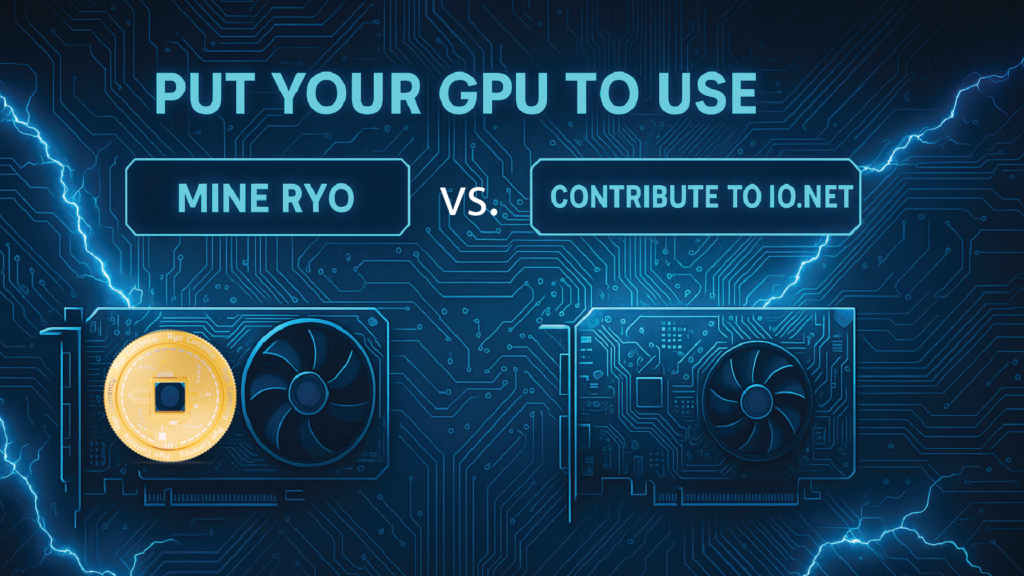
As AI demand explodes, idle GPUs have become hot property. New decentralized networks like io.net promise passive income by renting out your graphics card to machine learning workloads. But if you’re privacy-focused or believe in decentralized money, is it smarter to mine coins like Ryo or Conceal instead?

What Is io.net? A Decentralized GPU Cloud

Io.net is a decentralized GPU compute marketplace built on Solana. It connects idle GPUs from individuals, miners, and data centers to AI developers who rent clusters by the hour using the $IO token.

How It Works

  • GPU owners install the IO Worker software and earn $IO for sharing compute.
  • AI developers pay $IO to access cheap compute, often up to 90% less than AWS.
  • Payments and verification happen on-chain, with instant Solana settlement.

According to Nansen, io.net has surpassed $1M monthly revenue with over 139,000 GPUs in 139 countries.

Why GPU Owners Join

Io.net targets underused crypto mining rigs and idle data center GPUs. It advertises strong $IO incentives.

Tokenomics

$IO has a fixed supply of 800M (500M at launch, 300M mined/staked). A burn mechanism offsets inflation. Rewards scale based on useful compute contributed.

Mining Ryo or Conceal: Still Worth It?

Privacy coins like Ryo and Conceal use the CryptoNight-GPU algorithm — designed for fair GPU mining. Instead of AI jobs, you mine blocks and receive native coins (RYO or CCX).

Ryo Currency Mining Overview

  • Algorithm: CryptoNight-GPU (GPU-only, float32-focused)
  • Reward: ~33.21 RYO per block, decreasing every 6 months
  • Max Supply: 88.19M RYO + tail emission of 263k/year
  • Privacy: Upgrading to Halo 2 ZK proofs for next-gen anonymity

Conceal Network Mining Overview

  • Algorithm: CryptoNight-GPU
  • Reward: 6 CCX per block (fixed)
  • Max Supply: 200M CCX
  • Special Feature: Cold staking with 2.9–6% interest

Side-by-Side Comparison: io.net vs RYO/CCX Mining

Metric Mine RYO/CCX Contribute to io.net
Earnings RYO or CCX coins (direct) $IO tokens (market-dependent)
Usage Constant GPU hashing Dynamic AI/ML workloads
Setup Download miner + join pool Install IO Worker, configure node
Privacy RingCT (RYO soon ZK-SNARK) Public Solana chain payments

Why Ryo May Win in the Long Run

Ryo is transitioning from ring signatures to Halo 2 zero-knowledge proofs. This enables not just anonymous payments but also:

✅ Confidential AI Inference

Run AI models on private data and prove the output without revealing the input.

✅ ZK Analytics

Publish data insights without exposing raw data. Ideal for banks, hospitals, and DAOs.

✅ Verifiable Federated Learning

Prove each training update was legitimate—without sharing any training data.

Conclusion: Split or Stack?

If you want immediate yield and don’t care about privacy and decentralization, io.net offers passive GPU income. But if you believe in private money and trustless computation, mining Ryo Currency is a long-term bet on real crypto utility — especially with ZK proofs coming soon.

A hybrid approach may offer the best of both worlds—renting GPU power to io.net during peak AI demand for higher short-term returns, while switching to mining Ryo or Conceal during idle periods to accumulate long-term, privacy-focused assets. This dynamic strategy maximizes hardware utilization and diversifies earnings.

Join the Ryo community: https://t.me/ryocurrency

Start mining today: https://ryo-currency.com/#mining

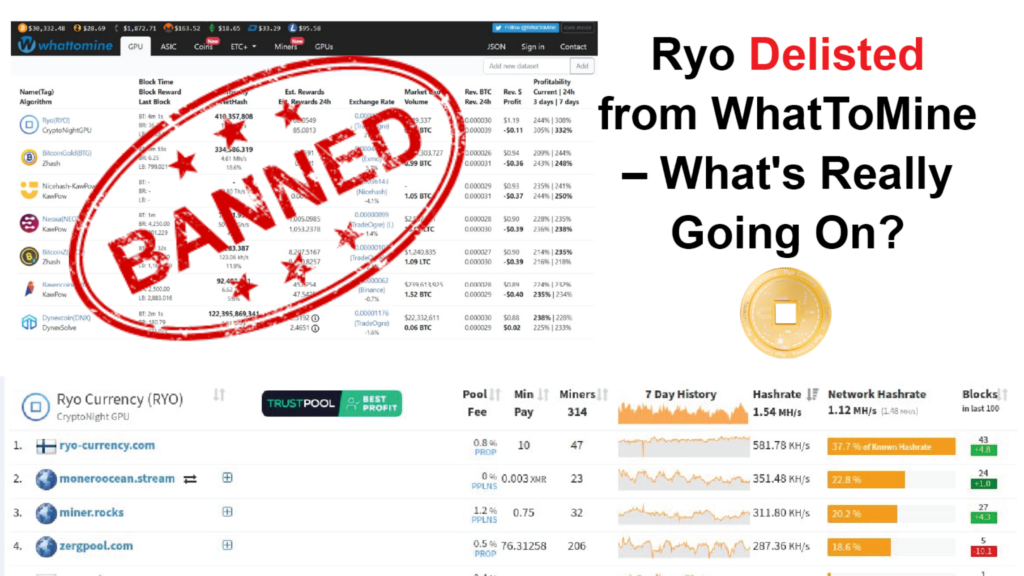
Ryo Currency, a privacy-focused cryptocurrency, has recently faced an unexpected challenge: it has been delisted from WhatToMine, a popular mining profitability calculator, without any explanation. This move has raised questions and concerns within the Ryo community, especially given Ryo’s consistent performance as a top profitable GPU-mineable privacy coin.

The Delisting from WhatToMine

WhatToMine is a vital tool for miners, offering real-time profitability data for various cryptocurrencies. Visibility on this platform drives miner interest and supports network growth. Ryo’s abrupt removal—without communication or justification—despite multiple outreach attempts by the Ryo team, leaves us questioning the motives behind this decision.

The Role of Opportunistic Mining Pools

Lead developer Fireice_uk has provided insight into a possible cause. He notes that approximately 25% of Ryo’s blocks are mined by opportunistic pools. These pools target the most profitable coin at any moment, immediately sell the mined coins, and pay their miners in another cryptocurrency, such as Bitcoin or Ethereum. Their focus is short-term profit, not Ryo’s long-term success.

These pools depend on WhatToMine to pinpoint high-profit coins. When Ryo tops the charts, they direct their hashing power our way. But this support is fleeting—once Ryo drops from #1, they switch elsewhere, often dumping coins and harming the market. This behavior exploits rather than strengthens our ecosystem.

The Silence and Its Implications

WhatToMine’s silence is striking. No response, no transparency—this fuels speculation. A theory within the community suggests these opportunistic pools, or other vested interests, may have influenced WhatToMine to delist Ryo, possibly to favor coins more aligned with their profit-driven agendas. The continued listing of smaller, less active coins like CCX only deepens the mystery.

Community Response and Future Plans

The Ryo community is resilient. Instead of relying on centralized platforms like WhatToMine, we’re exploring the creation of our own profitability tools—transparent, unbiased, and community-driven. This initiative could serve Ryo and potentially the wider crypto mining world by offering a decentralized alternative.

Reintroducing the Developer Fund

To address these challenges, we’re proposing to reintroduce a per-block developer fund at its previous level. This fund will have two key focuses:

  • Development: Enhancing Ryo’s technology to maintain its edge in privacy and security.
  • Marketing: Raising awareness and adoption through strategic outreach.

The fund also aims to reduce the impact of malicious miners. By investing in our network and community, we can make Ryo less appealing to opportunistic pools that thrive on short-term gains. Fireice_uk supports this move, stating:

“We should re-introduce the dev fund to around the level it has been at. Switch pools will move on to whatever is the next #1 most profitable coin. We can spend the money on marketing instead of having switch pools insta-dump it.”

Read more of his thoughts in the Telegram discussion.

Conclusion

Ryo’s delisting from WhatToMine is a hurdle, but it’s also a chance to build something stronger. By reintroducing the developer fund, we can invest in our future, mitigate external manipulations, and reinforce our commitment to privacy and decentralization.

We invite the Ryo community—especially long-standing members—to share your thoughts on this proposal. Join us on Telegram and stay updated at ryo-currency.com.

#MineWithPurpose #RyoCurrency #KeepItPrivate