


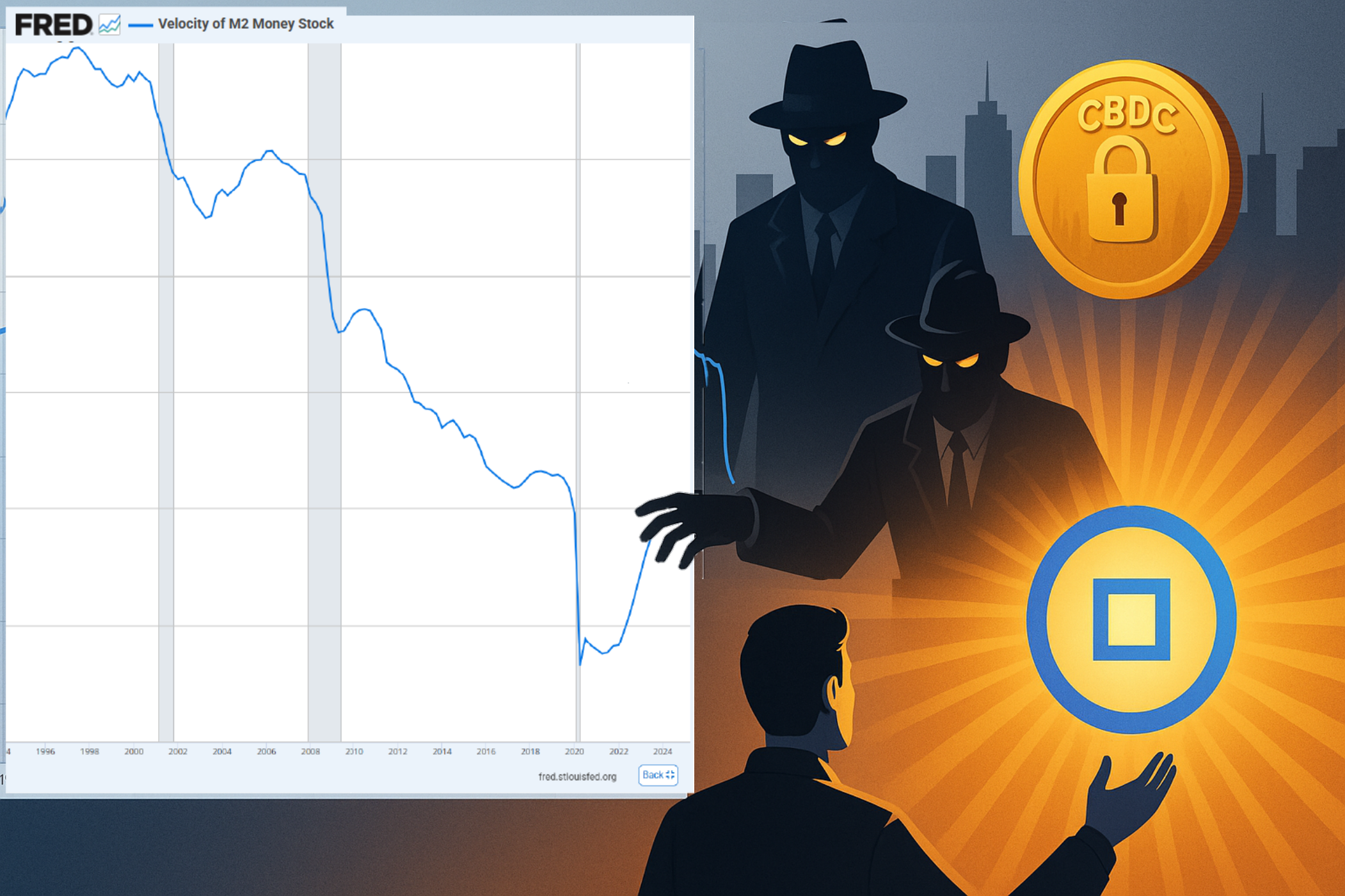
For most of human history, money moved at the speed of trust. People spent, saved, invested, and traded based on their confidence in the future. What economists today call the velocity of money—how fast money circulates through the economy—was never something governments could fully command. Even when kings debased currency or empires decreed fixed prices, they could not force people to spend or hoard. Human psychology always won.
Over time, modern central banks gained immense power over money. They regulate its supply, set interest rates, and shape financial behavior on a global scale. But one thing they have never been able to control is velocity—the collective decision of millions to either spend rapidly or hold tightly. This stubborn limit to central planning has frustrated governments for centuries.
Today, Central Bank Digital Currencies (CBDCs) promise something new—programmable money with expiration dates, forced spending windows, individual spending controls, and limits on saving. For the first time in history, states may gain the ability to manipulate the last uncontrollable variable: how fast people must spend their money.
This raises an urgent question: Have central banks finally achieved total economic control?
Running parallel to this system is a counter-movement of privacy-preserving cryptocurrencies—most notably Ryo Currency, which is preparing to deploy Halo 2 Zero-Knowledge Proofs by default and a high-latency mixnet. This parallel economy represents a radically different vision of the future: an open, decentralized system where individuals—not institutions—decide how they save, spend, and live.
This article explores that clash: the history, the ideology, the technology, and the coming choice facing humanity.
1. The Velocity of Money: The Variable Central Banks Can’t Command
Central banks can print trillions. They can raise or drop interest rates. They can launch quantitative easing programs, buy government bonds, and force new banking rules.
But the velocity of money—the rate at which money moves through the economy—has always been ruled by people’s expectations, trust, fear, and confidence.
Austrian economists like Ludwig von Mises and Friedrich Hayek argued that central planning fails because human actions are too complex to engineer. The economy is a spontaneous order, not a machine with levers.
Historical Proof Across Eras
- The Great Depression (1930s): The Federal Reserve expanded the monetary base, yet velocity collapsed as people refused to spend.
- Japan’s Lost Decades (1990s–present): Zero interest rates failed to stimulate consumption; households continued to hoard cash.
- Global Financial Crisis (2008): Trillions in quantitative easing could not raise velocity—trust had evaporated.
- COVID-19 Era (2020–2022): Even with direct stimulus payouts, lockdown psychology kept velocity low.
Over 300 years, central banks controlled supply, credit, and interest—but never spending behavior itself.
2. CBDCs: The Technological Solution to an Old Authoritarian Dream
CBDCs fundamentally change the nature of money by introducing programmability. Money becomes a tool of behavioral engineering.
What Programmable Money Enables
- Expiring currency: Money that vanishes if not spent by a set date.
- Forced velocity: Stimulus that must be used within 48 hours.
- Individualized interest rates: Financial rewards for “approved” behavior, penalties for “undesirable” behavior.
- Savings caps: Limits preventing capital accumulation.
- Whitelisted/blacklisted merchants: Money spendable only at government-approved outlets.
- Ideological penalties: Funding opposition groups or causes becomes impossible.
- Real-time taxation: Automatic tax deduction from every transaction.
CBDCs complete what central banks have always lacked: total control over the velocity of money. For the first time in history, the state can force individuals to spend at a predetermined pace—or prevent them from saving beyond a controlled limit.
3. The War on Inheritance and Gifting
A growing ideological movement sees inheritance and intergenerational gifting as “unearned privilege.” Many governments are actively increasing inheritance and gift taxes, while political organizations promote even stricter controls.
CBDCs give governments unprecedented power over family wealth:
- Automatic inheritance taxation with no legal workaround.
- Limits on who can receive gifts or how much can be gifted.
- Programmable expiry dates on inherited funds.
- Mandatory approvals for large private transfers.
With CBDCs, inheritance laws become instant, automated, and unavoidable. The state inserts itself directly into family decisions.
Privacy coins like Ryo Currency offer the opposite model: wealth transfers remain private, self-directed, and free from ideological interference. Families—not governments—retain control over generational wealth.
4. Privacy Coins: A Parallel System That Can’t Be Shut Down
While CBDCs represent a system of total surveillance, privacy coins represent voluntary, peaceful resistance. Ryo Currency is a leading example of this vision.
How Ryo is Building a System of Financial Freedom
- Halo 2 Zero-Knowledge Proofs (by default): Hides sender, receiver, and amount cryptographically.
- High-latency mixnet: Obscures network metadata and frustrates surveillance systems.
- Decentralized architecture: No authority can freeze or censor Ryo transactions.
- Censorship resistance: Users cannot be “turned off” for political views, speech, or beliefs.
In a world where CBDCs allow governments to shut down an individual’s economic life with a click, Ryo Currency ensures the opposite: your ability to transact belongs to you, not an institution.
5. Two Parallel Monetary Systems Are Emerging
Humanity is witnessing a monetary bifurcation unlike anything in history.
| CBDCs – Centralized System of Control | Privacy Coins – Decentralized System of Liberty |
|---|---|
| Programmable, surveilled, restricted | Permissionless, private, user-controlled |
| No anonymity or privacy | Strong cryptographic privacy by default |
| Forced spending or forced saving | Individual choice without external pressure |
| Accounts can be frozen instantly | Unstoppable, censorship-resistant |
| Political or ideological compliance required | Immune to political coercion |
These two systems cannot coexist peacefully in the long term. They represent opposing philosophies of governance and human freedom.
6. The Coming Clash: Inevitable and Irreconcilable
CBDCs and privacy coins embody fundamentally incompatible visions:
- Centralization vs. decentralization
- Surveillance vs. privacy
- Control vs. autonomy
- Ideological conformity vs. free expression
As more central banks roll out CBDCs under the guidance of the BIS, the clash with privacy-centric currencies will only intensify.
But privacy coins like Ryo Currency give humanity a choice—a parallel economy where financial autonomy, independence, and dignity remain intact.
Conclusion: The Future of Money Will Decide the Future of Freedom
For centuries, central banks sought the same ultimate power: not just to issue money, but to control how people use it. They succeeded in influencing supply, interest rates, and credit—but never the velocity of money itself.
CBDCs give them the final missing piece. For the first time, authorities can force the pace of spending, control saving, restrict gifting, and regulate inheritance with absolute precision.
But privacy coins present the only viable escape.
Ryo Currency—with its coming adoption of Halo 2 ZK proofs and high-latency mixnet—will create an impenetrable shield around personal financial autonomy. It preserves freedom of saving, spending, inheriting, gifting, and supporting causes without fear of surveillance or punishment.
The future is a choice:
- A world where “money” enforces obedience through surveillance, expiry, and control.
- Or a world where money remains a tool of human liberty.
The time to choose is now.