


📘 Executive Summary
On April 8, 2026, a two‑week ceasefire between the U.S. and Iran brought a fragile pause to a conflict that had closed the Strait of Hormuz for over a month. The reopening of the strait is conditional on Iran’s 10‑point plan, which includes continued Iranian control of the waterway and the acceptance of yuan or cryptocurrency for transit tolls. As geopolitical tensions eased, silver surged past $77 per ounce, and the silver‑oil ratio bounced off a key technical level—a structural signal we first highlighted in The Yuan Ultimatum. Meanwhile, Zcash (ZEC) rallied nearly 35%, the largest single‑day gain among major cryptocurrencies, fueled by speculation that Iran and Oman might accept privacy coins for strait passage. This article examines the ceasefire, the monetary metals signal, the Zcash surge, and why Ryo—with its forthcoming Halo 2 ZK‑proofs (by default) and high‑latency mixnet—is being architected to offer the highest level of privacy for ships transiting the Strait of Hormuz and for the emerging network state economy.
Strait of Crypto: Ceasefire, the Silver‑Oil Ratio, and the Quiet Rise of Privacy Money
⚡ APRIL 8, 2026 – CEASEFIRE DECLARED: President Trump announced a two‑week ceasefire with Iran, effective immediately, after Iran agreed to reopen the Strait of Hormuz. “Based on conversations with Prime Minister Shehbaz Sharif and Field Marshal Asim Munir, of Pakistan, and wherein they requested that I hold off the destructive force being sent tonight to Iran, and subject to the Islamic Republic of Iran agreeing to the COMPLETE, IMMEDIATE, and SAFE OPENING of the Strait of Hormuz, I agree to suspend the bombing and attack of Iran for a period of two weeks” [1]. The ceasefire follows Iran’s rejection of a U.S. 15‑point plan and its submission of a 10‑point proposal delivered via Pakistan [2].
I. The 10‑Point Plan: Control, Yuan, and Crypto
Iran’s Supreme National Security Council confirmed the two‑week ceasefire, but warned that “this does not mean the end of the war” [3]. The 10‑point proposal, published by Mehr News Agency, includes demands that fundamentally reshape the monetary geography of the Gulf:
- Continued Iranian control of the Strait of Hormuz
- Acceptance of Iran’s nuclear enrichment rights
- Lifting of all primary and secondary U.S. sanctions
- Payment of war damages
- Withdrawal of U.S. combat forces from the region
Critically, Iran has already operationalized a formal payment system for strait transit, requiring fees in Chinese yuan or cryptocurrency [4]. The Islamic Revolutionary Guard Corps (IRGC) has established a tiered pricing structure, with a floor of approximately $1 per barrel (up to $2 million for a Very Large Crude Carrier) [5]. Payment is received in yuan or stablecoins; once confirmed, the IRGC issues a pass code and provides a naval escort through the strait.
This is not a symbolic gesture. According to Bloomberg, at least three Chinese ships have already negotiated passage, and Pakistan has secured transit permissions for 20 of its flagged vessels [5]. The Sohar LNG carrier, hugging Oman’s southern coastline, became the first LNG vessel to exit the strait since the conflict began, marking a structural shift in energy trade finance [6].
II. The Monetary Metals Signal: Silver‑Oil Ratio Bounces off Technical Level
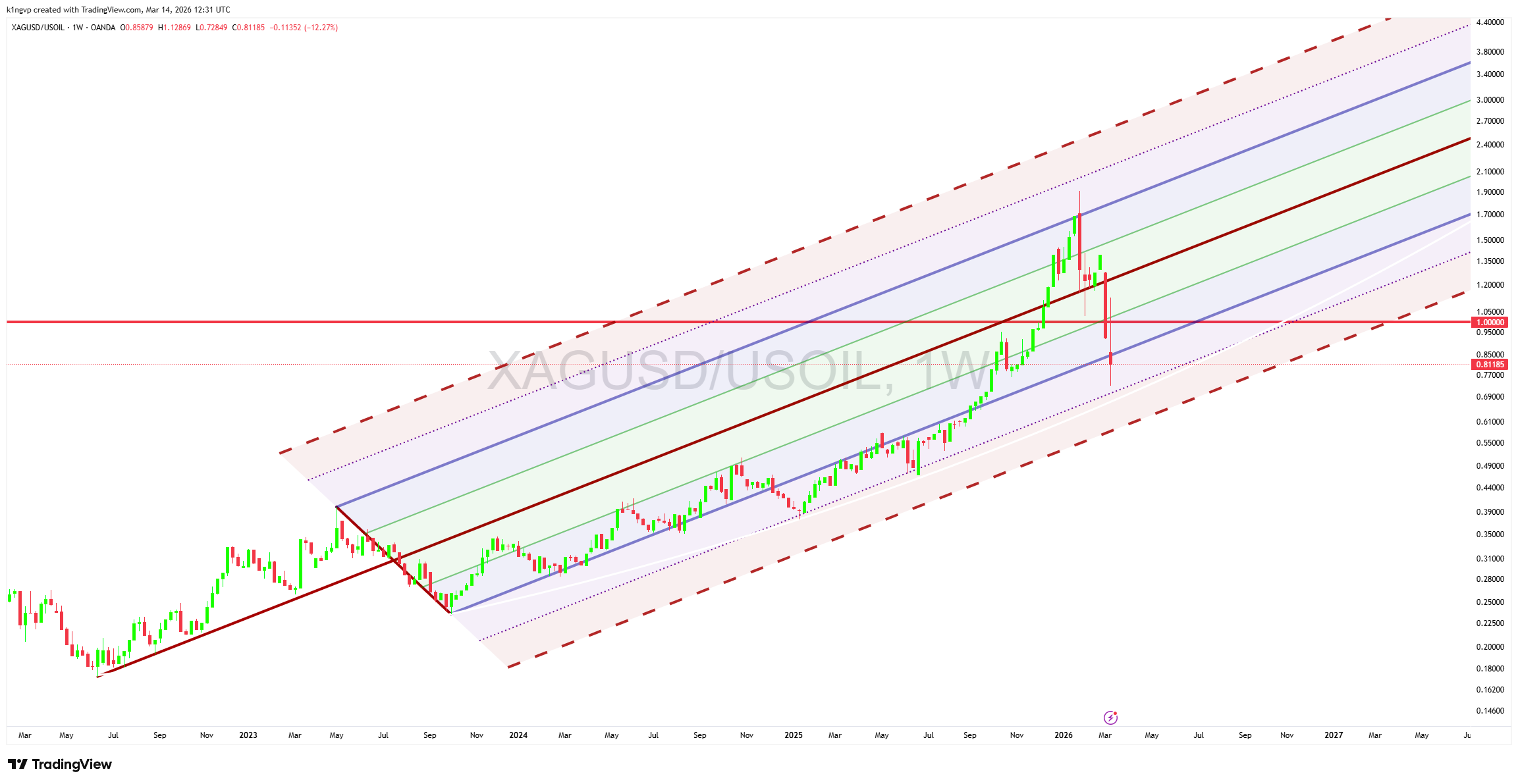
In The Yuan Ultimatum, we highlighted the silver‑oil ratio as a “parabola in progress.” The ratio—the number of barrels of oil one ounce of silver can purchase—was hovering below 1.0, and we noted that if it reversed into support, it would signal a structural repricing of energy against monetary metals. When one ounce of silver buys more than one barrel of oil, it inverts a century‑old relationship. Historically, oil was the “harder” asset; now silver is reasserting its monetary role.
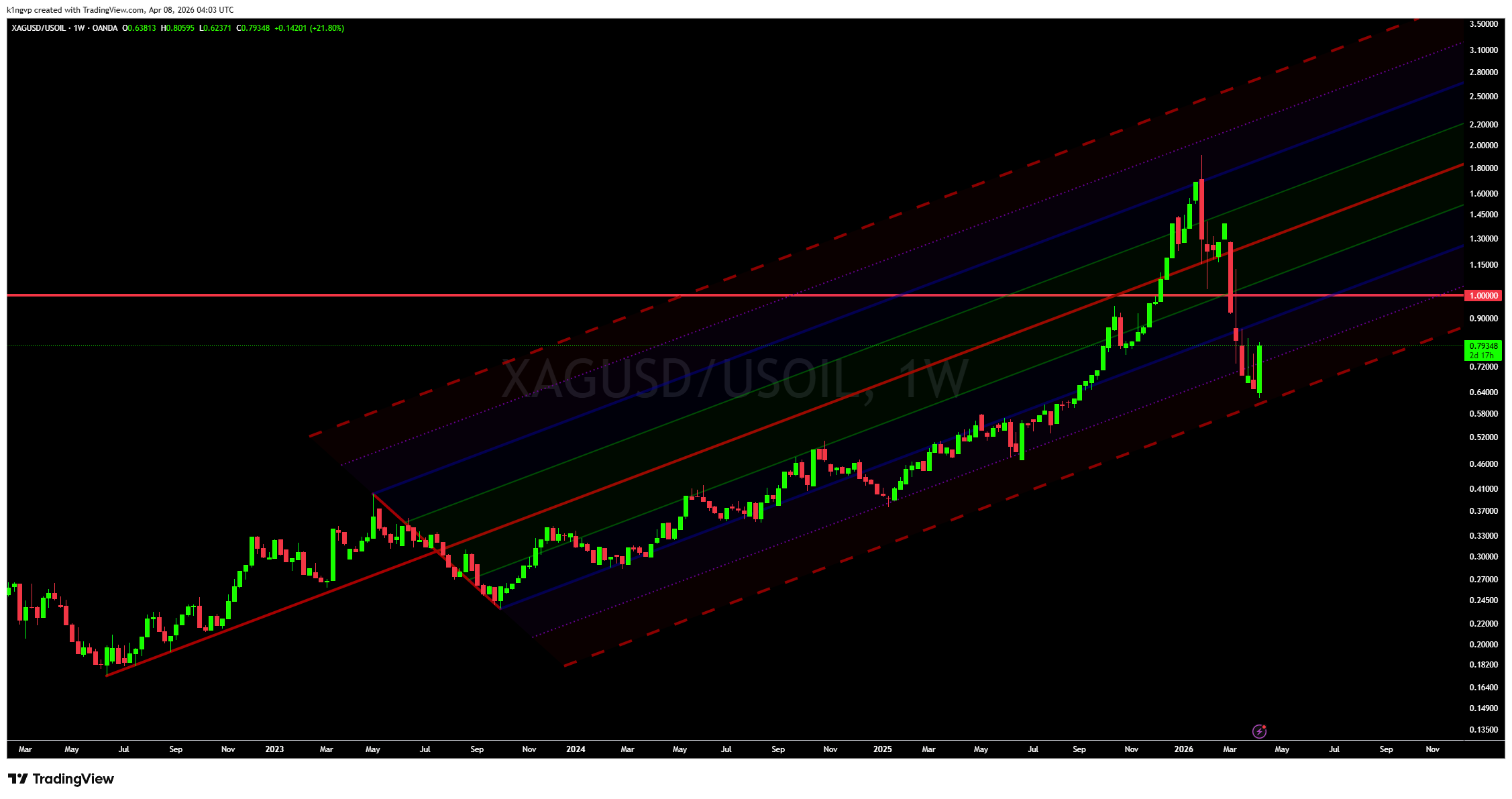
On April 8, 2026, following the ceasefire announcement, silver (XAG/USD) surged past $77 per ounce, a fresh weekly high [7]. At the same time, WTI crude oil prices tumbled over 13% as markets priced in reduced geopolitical risk [8]. The combination of a surging white metal and a collapsing energy benchmark pushed the silver‑oil ratio off the original pitchfork lower warning line, a key technical signal indicating the loss of monetary confidence in the petrodollar.
This is not a speculative anomaly. It is a confirmation of the Neutral Money Doctrine we have traced throughout this series. As Ray Dalio noted, when trust in fiat currencies erodes, capital flows toward assets that cannot be printed, inflated, or sanctioned. Silver—historically both an industrial metal and a monetary metal—is now reasserting its role as a store of value independent of the dollar system. And as we argued in The End of Free‑Floating Fiat, the same forces that drive monetary metals also drive the search for neutral digital assets.
III. The Zcash Pump: Privacy Coins Enter the Geopolitical Arena
On April 7, 2026, Zcash (ZEC) surged nearly 35% in a single day, the largest gain among major cryptocurrencies. Trading volumes spiked, and social media chatter exploded with speculation that Iran and Oman might accept Zcash for strait transit payments [9]. While no official confirmation has emerged, the market’s reaction is itself a signal: the world is beginning to understand that not all cryptocurrencies are equal when it comes to sanctions‑resistant trade.
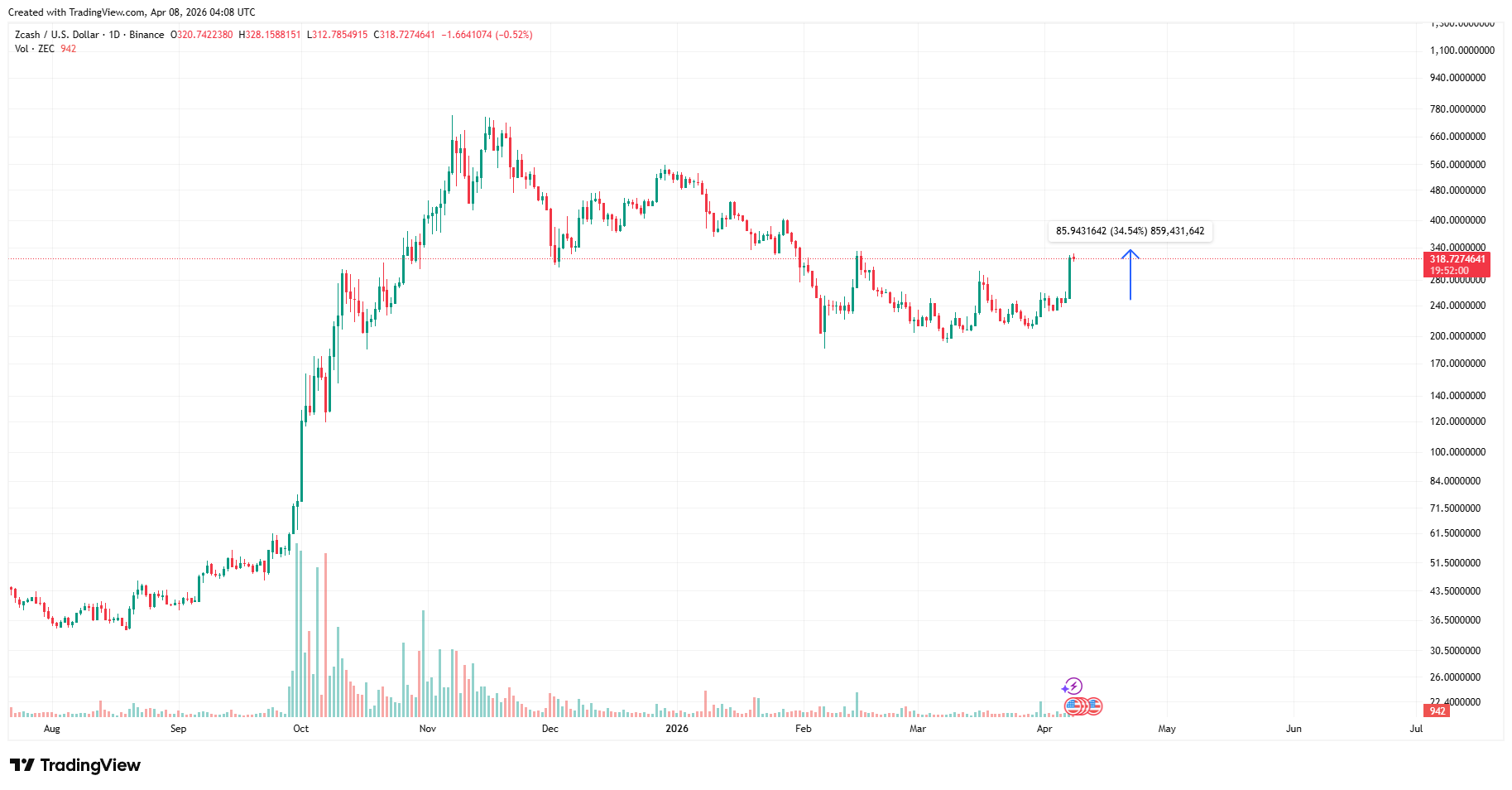
Zcash has long led the charge in zero‑knowledge privacy. Its shielded pool, powered first by zk‑SNARKs and now by Halo 2 (already live as an optional feature), offers transaction confidentiality that Bitcoin and Ethereum cannot match. The market’s 35% rally signals growing recognition that privacy coins are uniquely suited for geopolitical trade.
That said, Zcash’s optional privacy model creates a trade‑off: users can choose between transparent and shielded transactions. For a nation state like Iran, that choice itself becomes a signal. Adversaries can focus surveillance on the subset of transactions that opt for privacy. Zcash’s fully shielded mode is excellent when used exclusively, but the protocol’s transparency‑by‑default means the act of shielding can be observable on the ledger.
This is where Ryo Currency aims to go further. By making privacy default and adding a network‑layer mixnet, Ryo is architected for actors who require maximal anonymity—where even the absence of a choice cannot be detected.
IV. The Case for Ryo: Architecting the Highest Level of Privacy
If Iran were to accept a privacy coin, Zcash would be a natural candidate—it is battle‑tested and respected. But for state‑level adversarial environments, Ryo is being built to an even higher standard. Its roadmap includes two critical privacy upgrades that set it apart:
- Halo 2 Zero‑Knowledge Proofs by Default: Zcash already offers Halo 2 as an optional privacy layer. Ryo is implementing Halo 2 and will make it mandatory for every transaction. This eliminates the transparent‑chain attack surface entirely. No transaction is ever visible on the ledger, and the signaling problem disappears. Halo 2 also removes the trusted setup, making the privacy guarantees mathematically absolute.
- High‑Latency Mixnet: While Zcash and Monero rely on network‑layer obfuscation techniques like Dandelion++, a mixnet provides fundamentally stronger anonymity. By routing traffic through multiple independent nodes with randomized delays, a mixnet makes it computationally infeasible to link an incoming transaction to its outgoing destination—even for an adversary that controls a portion of the network. Unlike probabilistic routing, a mixnet defeats timing attacks.
For a tanker captain transmitting a pass code over VHF radio, or for a shipping company negotiating a $2 million payment in cryptocurrency, the difference between “probably private” and “provably private” is the difference between safe passage and interception. Ryo is being architected to provide the latter.
Moreover, Ryo’s fair distribution—no premine, no ICO—started with 8.79 million coins minted and immediately burned at launch, leaving no founder allocation or insider class that can be coerced. Its ASIC‑resistant Cryptonight‑GPU algorithm keeps mining accessible, preventing the kind of hashpower centralization that would make the network vulnerable to a state‑level attack. And its roadmap toward proof‑of‑stake and DAO integration means that a nation adopting Ryo could eventually govern its own monetary system on‑chain, without relying on external infrastructure.
V. A Future of Neutral Money: Ceasefire, But Not Endgame
The two‑week ceasefire is a pause, not a resolution. Iran has made clear that the war is not over; the 10‑point plan remains the basis for any final agreement. The Strait of Hormuz will remain a chokepoint, and the toll system in yuan and cryptocurrency will remain in place for the foreseeable future.
As negotiations continue in Islamabad, the choice of payment rails will be a central issue. Stablecoins offer convenience but expose payers to freeze risk. Bitcoin is transparent and traceable. Privacy coins offer confidentiality, but only those architected for adversarial environments will survive sustained surveillance.
Ryo Currency is being built for exactly this scenario. Its combination of default privacy (Halo 2 mandatory), network‑layer mixnet anonymity, fair distribution, and future DAO governance makes it one of the few digital assets capable of serving as a truly neutral bridge between the dollar bloc, the yuan bloc, and the emerging network state economy.
The silver‑oil ratio bounced off a key technical level. Zcash has pumped 35%. The Strait of Hormuz has reopened—but only for yuan and crypto. The era of free‑floating fiat is over. What comes next is not written, but the tools are being built. Ryo represents one implementation of those tools.
VI. Call to Action
- Read the full series. The Yuan Ultimatum began with missiles; From Network Union to Network State ended with a blueprint for digital sovereignty. The arc is complete.
- Study the properties of neutral money. Not all crypto is equal. Ryo is one of the assets architected for the network state era.
- Prepare for the next phase. The Strait of Hormuz is only one chokepoint. Digital chokepoints are being designed as you read this. The tools for sovereignty exist. The only question is whether you will use them.
In the age of the Network, sovereignty is no longer granted. It is compiled.
References & Further Reading
- [1] Daily Trust: Iran Agrees To Reopen Strait Of Hormuz As Trump Declares Ceasefire
- [2] Xinhua: Iran rejects U.S. ceasefire offer, issues 10-point plan
- [3] Xinhua: Key points of Iran’s official statement on ceasefire with U.S.
- [4] Edgen: Iran Demands Stablecoin Toll for Oil Transit
- [5] Maritime Executive: Iran’s IRGC Charging Millions in Crypto for Hormuz Transits
- [6] MENA Fintech: First LNG Tanker Exits Strait of Hormuz Along Omani Coast
- [7] AMarkets: Silver Rallies to Fresh Weekly High Above $77.00
- [8] The Quint: Iran and US Agree to a Two-Week Ceasefire
- [9] CoinMarketCap: Zcash (ZEC) Price
- Ryo News: The Yuan Ultimatum (Mar 14, 2026)
- Ryo News: The End of Free-Floating Fiat (Mar 16, 2026)
- Ryo News: The Human Chokepoint (Mar 15, 2026)
- Ryo News: The Prophet and the Hedge Fund King (Mar 16, 2026)
- Ryo News: When Institutions Fail (Mar 19, 2026)
- Ryo News: God, State, and Network (Mar 19, 2026)
- Ryo News: From Network Union to Network State (Mar 19, 2026)
- Ryo News: Strait of Crypto (Apr 2, 2026)
This article is a standalone analysis building on the seven‑part series published in March 2026. Read the full series: The Yuan Ultimatum, The End of Free‑Floating Fiat, The Human Chokepoint, The Prophet and the Hedge Fund King, When Institutions Fail, God, State, and Network, From Network Union to Network State.
“`