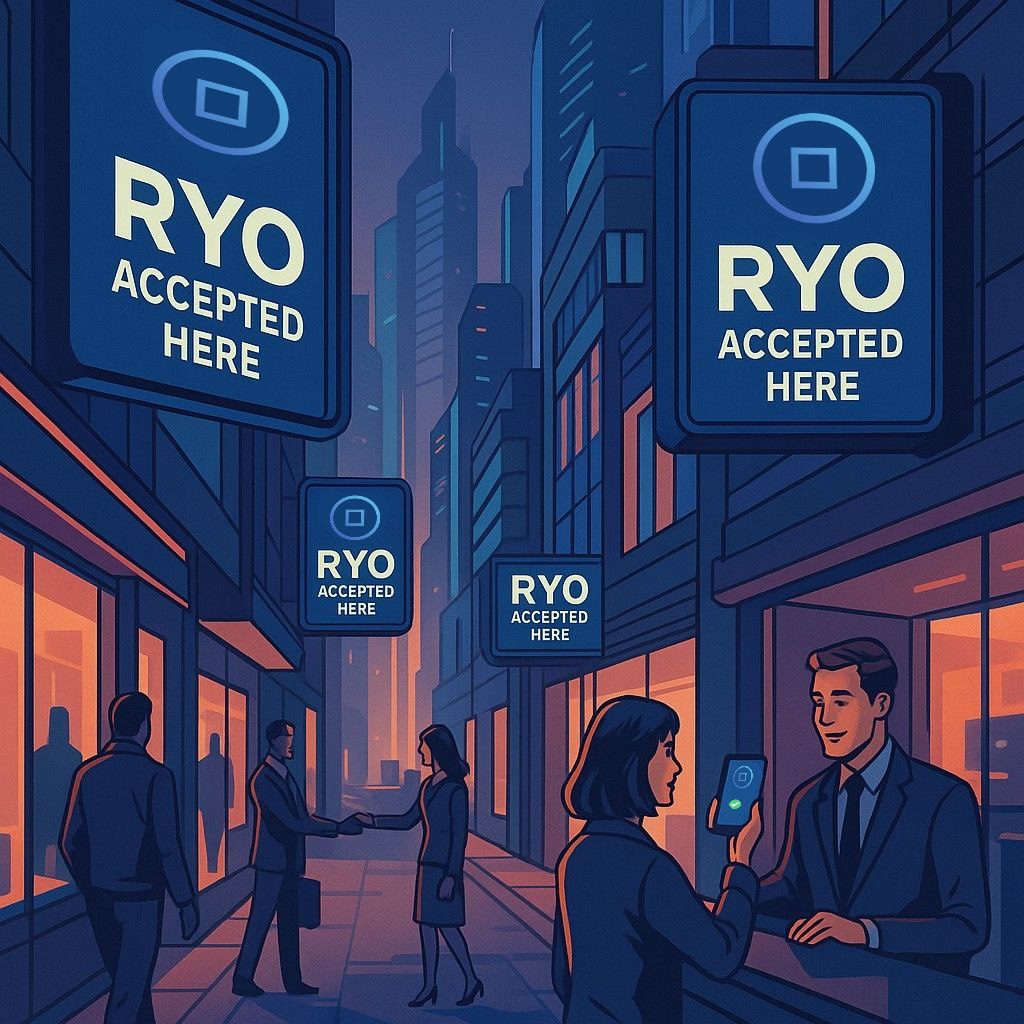



Imagined Communities 2.0: How Digital Networks Are Reshaping National Identity
Part one of an eight‑part series on building network states with Ryo Currency.
In 1983, political scientist Benedict Anderson proposed a radical idea: nations are not primordial or eternal. They are “imagined communities” — socially constructed entities held together not by face‑to‑face interaction, but by shared stories, symbols, and media. A nation exists because its members imagine themselves as part of a collective, bound by common language, culture, or history, even if they will never meet the majority of their compatriots [1].
For centuries, the technologies of the printing press, mass literacy, and broadcast media shaped the boundaries of these imaginations. The “print capitalism” of the 18th and 19th centuries created standardized vernacular languages, enabling millions to envision themselves as French, German, or American. The nation‑state, as we know it, is a product of this industrial‑era imagination.
Today, the infrastructure of imagination has fundamentally shifted. The printing press has given way to the global, interconnected, algorithmic network. And just as the rise of print capitalism enabled the birth of the modern nation‑state, the rise of digital networks is enabling the birth of its successor: the network state.
This article, the first in our eight‑part series on building network states, explores this transformation. We will examine how digital networks forge new types of communities, what this means for sovereignty, and how a community can begin its journey from a scattered online group to a self‑governing entity.
I. The Original Imagined Community
Anderson’s framework is essential because it demystifies the nation. It shows that the deep emotional attachment people have to their country is not natural, but is the product of specific historical and technological conditions. He identified three paradoxes of nationalism that any new form of political community must also contend with [1]:
- Modernity vs. Antiquity: Nations are historically modern constructs, yet they present themselves as ancient, stretching back into a timeless past.
- Universality vs. Particularity: Nationalism claims to be a universal ideal (every people deserves its own state), but each nation is defined by its unique, particular characteristics.
- Power vs. Vulnerability: The nation is imagined as sovereign and powerful, yet its boundaries are inherently limited and its existence is perpetually fragile.
For a network state—a community bound by digital ties rather than contiguous territory—to succeed, it must solve these same paradoxes. It must create a shared origin story (its “antiquity”), define its unique values and culture (its “particularity”), and build resilient systems that can withstand the inherent vulnerabilities of the digital realm (its “power”).
The key innovation of the nation‑state was the ability to create a mass, anonymous, horizontally‑organized community through shared media. The newspaper, for Anderson, was the archetypal artifact: consumed in parallel by thousands of people who would never meet, it created a collective ritual and a shared sense of time [1]. Today, the social feed, the decentralized forum, the DAO governance vote, and the shared open‑source codebase serve a similar function. They are the rituals of the digital age, creating a shared experience that binds individuals across continents into a single, coherent “we.”
II. From Print to Protocol: The Digital Infrastructure of Identity
If Anderson showed that nations were products of industrial‑era media, then the internet represents a new infrastructural condition—one that is fundamentally re‑territorializing identity. Where print capitalism created “homogeneous, empty time”—a shared calendar and narrative—digital capitalism creates “simultaneous, algorithmic space.” A software developer in Bangalore, a privacy activist in Berlin, and a digital artist in Buenos Aires can share a more coherent and meaningful political identity with each other than they do with their territorial neighbors. Their identity is defined not by where they are, but by which networks they participate in, which values they share, and which digital assets they hold.
This shift from physical to digital infrastructure is not merely a change of medium; it is a change in the very ontology of collective identity. In the digital age, identity becomes enforceable through protocols, membership rules, treasury systems, and governance processes. A community’s shared imagination becomes a set of technical constraints: who holds the keys to the treasury, what rules govern membership, how decisions are ratified. This is the bridge from “imagined community” to “network state”—the transformation of a shared idea into a self‑enforcing system.
III. The Network Union: The Seed of Sovereignty
Before a community can become a network state, it must first become a network union [2]. Drawing on the framework established in the previous series’ final article, “From Network Union to Network State,” the network union is the seed stage of digital sovereignty [3]. It is a wholly digital entity, organized for a specific purpose—the equivalent of a startup in the world of nations.
A concrete example helps ground this abstract concept. Consider a hypothetical “Ryo Dev Collective” — a network union of privacy‑focused developers, cryptographers, and security auditors. Their shared identity is a commitment to financial privacy and censorship‑resistant infrastructure. Their initial coordination happens on encrypted forums and Signal groups. They create a shared treasury denominated in a neutral asset to fund open‑source development. They adopt a rough consensus governance model for technical decisions. They do not yet claim sovereignty, but they have all the prerequisites: a clear mission, a membership, a treasury, and a decision‑making process. They are a network union in embryo [2].
The transition from a casual online group to a network union is marked by three critical milestones:
- A shared treasury pooled in a neutral, unfreezable asset.
- A formal governance mechanism (e.g., rough consensus or on‑chain voting).
- A public declaration of principles articulating shared values, mission, and membership criteria. Membership itself must be verifiable—through contribution history, reputation systems, proof‑of‑personhood, or economic stake—to prevent sybil attacks and maintain cohesion.
IV. The Stack: How Identity Becomes Infrastructure
To build a network state, a community must move from imagination to infrastructure. The most effective way to conceptualize this is through the Network State Stack—a layered model that transforms a shared identity into a sovereign system.
The Network State Stack
- Identity Layer: The shared narrative, culture, values, and membership criteria.
- Capital Layer: The economic infrastructure—a neutral, private, and unfreezable currency that serves as treasury and medium of exchange.
- Coordination Layer: Governance mechanisms—DAOs, smart contracts, and dispute resolution systems—that allow collective decision‑making.
- Territorial Layer: The “archipelago”—physical properties, digital spaces, and infrastructure the community acquires and networks together.
- Recognition Layer: Diplomatic recognition from legacy states or other network states, establishing the community as a legitimate actor.
Each layer builds upon the one below it. A community cannot build a robust capital layer without a coherent identity, nor coordinate without a shared treasury, nor acquire territory without coordination. Recognition, the final layer, requires all of the above.
V. From Imagination to Implementation: A Walkthrough
To make this concrete, let’s walk through how a hypothetical community—say, a global collective of independent journalists and digital rights advocates—could begin implementing the Stack.
- Identity Layer: They articulate a clear mission: “to defend freedom of information and protect whistleblowers through secure publishing infrastructure.” They adopt a public manifesto and establish a membership process based on contributions to the field.
- Capital Layer: They seed a treasury with a neutral, private asset. Because they operate in adversarial jurisdictions, they choose a currency that cannot be frozen by any single state and that shields transaction details. Ryo Currency is a strong candidate for this role, but they could also diversify across multiple privacy‑focused assets.
- Coordination Layer: They implement a DAO using smart contracts to manage treasury allocations for grants, legal defense, and infrastructure. Disputes are resolved via a decentralized arbitration protocol like Kleros.
- Territorial Layer: They begin acquiring physical “embassies”—co‑working spaces in crypto‑friendly jurisdictions (e.g., Lugano, Zug) that serve as safe gathering points and operational hubs. They also invest in secure server infrastructure and mesh networks.
- Recognition Layer: They seek a “bootstrap recognizer”—a small nation or special economic zone willing to grant legal status to the DAO in exchange for tax revenue or technological collaboration. This gives them a foothold in the legacy system while they continue to build.
VI. What Could Go Wrong? The Vulnerabilities of Digital Identity
Building a new form of political community is not without profound risks. A credible guide to network states must confront these challenges directly. At the Identity Layer, the risks are particularly acute:
- Sybil Attacks and Identity Fragmentation: How do you prevent a single person from masquerading as thousands to subvert governance? Robust identity systems—proof‑of‑personhood, reputation, or economic stake—are essential [4].
- Capture by Algorithms: A community built on Twitter or Discord is not sovereign; it is a tenant. The path to sovereignty requires moving from rented spaces to self‑owned infrastructure.
- Co‑optation of Narrative: Hostile states or adversaries may seek to co‑opt a community’s identity, spreading disinformation or creating splinter groups. A network state must have robust information defense.
- The “Cool Kids” Problem: Early digital communities often suffer from a crisis of scale. Intimate, high‑trust culture can be diluted, and governance mechanisms (DAOs, tokens) can themselves become vectors for plutocracy or capture [4].
Successfully navigating these vulnerabilities requires more than technology. It requires a conscious, iterative, and resilient community that can learn, adapt, and enforce its own norms. This is the fundamental challenge of the Identity Layer: transforming an imagined community into a self‑governing one.
VII. The Role of Neutral Assets
In the industrial age, the national currency was a powerful symbol of sovereignty and a tool for imagining economic unity. In the digital age, a network state’s currency plays a similar but more profound role. Because a network state is not territorially contiguous, its currency is not merely a symbol; it is the primary mechanism of membership and coordination. For a currency to serve this function, it must meet specific criteria [5]:
- Unfreezable — no single state can block the community’s treasury.
- Private by default — economic activity is shielded from adversarial surveillance.
- Decentralized and uncapturable — no single point of failure or co‑optable class.
- Fairly distributed — no permanent, co‑optable oligarchy.
- Liquid and jurisdictionally neutral — sufficient market depth without control by any single exchange or jurisdiction.
These criteria are the direct technical expression of the need for an imagined community to become a sovereign entity in a hostile world. Without an unfreezable treasury, the community’s capital is at the mercy of legacy states. Without privacy, its members are exposed. Without decentralization, the community is captured.
Ryo Currency is designed to meet these requirements: its Halo 2 ZK‑proofs enable scalable private transactions; its upcoming mixnet provides transaction‑level anonymity; its ASIC‑resistant, fairly‑launched distribution avoids a co‑optable miner class; and its roadmap to proof‑of‑stake and native DAO governance aligns with the needs of a self‑governing community [6]. It is not the only possible choice, but it is one architected to meet the exact requirements of a network state’s capital layer.
VIII. The Path Forward
The journey to a network state begins with turning shared imagination into shared infrastructure. For a community ready to start, the immediate steps are:
- Articulate a clear, shared mission. Define your purpose, values, and the problem you exist to solve.
- Establish a public record. Create a manifesto, a website, a forum. Make your collective imagination tangible.
- Choose a neutral treasury asset. Pool resources in a cryptocurrency that cannot be frozen or surveilled. The principle—unfreezable, private, decentralized—matters more than the specific asset.
- Adopt a governance process. Even an informal one. How will decisions be made? How will disputes be resolved?
The next article in this series, “The Bitcoin Magnet,” will explore the Capital Layer in depth, examining how network assets create economic gravity, concentrating talent and resources around shared digital polities. It will draw on the work of Sunil Aggarwal and his forthcoming analysis of how digital scarcity creates the conditions for the emergence of new, non‑territorial economies.
We are at the beginning of a historic transformation. The infrastructure for imagining community has changed, and with it, the possibilities for human governance. The path is open. It is now up to communities to imagine themselves into being, and then, step by step, to build.
References:
[1] Anderson, Benedict. Imagined Communities: Reflections on the Origin and Spread of Nationalism. Verso, 1983. https://www.versobooks.com/books/2158-imagined-communities
[2] Srinivasan, Balaji. The Network State. 2022. Chapter 5, Section 5.3.1. https://thenetworkstate.com/chapter5#section5-3
[3] Ryo News. “From Network Union to Network State: How Ryo Currency Powers the Digital Nations of Tomorrow.” March 19, 2026. https://ryo.news/from-network-union-to-network-state-how-ryo-currency-powers-the-digital-nations-of-tomorrow/
[4] Buterin, Vitalik. “On Collusion.” Ethereum Blog, 2019. https://vitalik.ca/general/2017/08/27/collusion.html
[5] Ryo News. “When Institutions Fail: Balaji Srinivasan, Network States, and the Architecture of Economic Sovereignty.” March 17, 2026. https://ryo.news/when-institutions-fail-balaji-srinivasan-network-states-and-the-architecture-of-economic-sovereignty/
[6] Ryo Currency. Official FAQ & Roadmap. https://ryo-currency.com/#faq-4
This article is part of the “Building the Network State” series. Read the previous series: The Yuan Ultimatum, The End of Free‑Floating Fiat, The Human Chokepoint, The Prophet and the Hedge Fund King, When Institutions Fail, God, State, and Network, From Network Union to Network State.