


Executive Summary
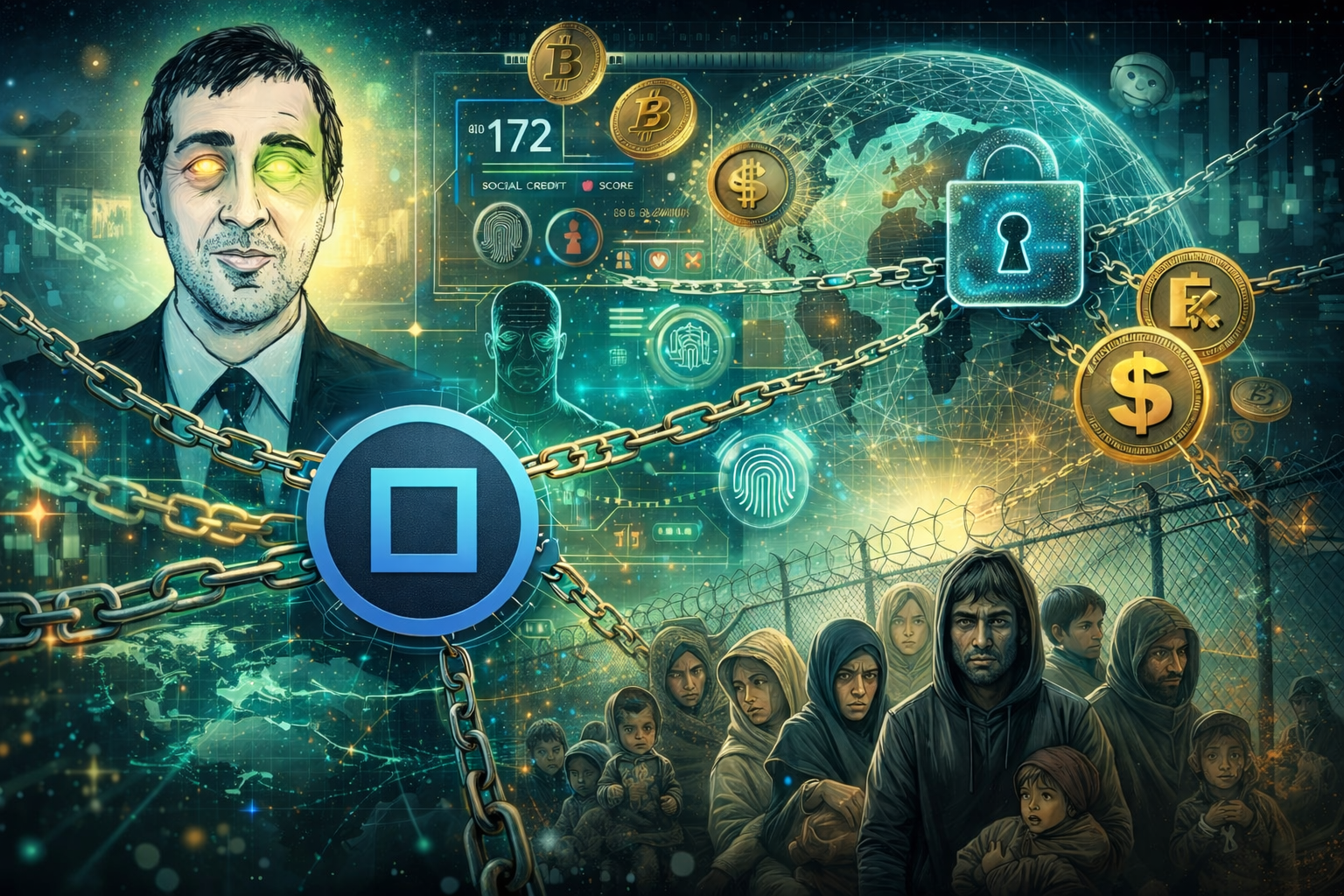
As digital currencies and geopolitical blocs reshape the global monetary system, new forms of sovereign organization are emerging outside traditional states. This article explores how financial censorship, programmable money, and digital infrastructure may give rise to network states — and why privacy-first currencies like Ryo could become foundational economic layers for these decentralized societies, with future DAOs enabling community governance and collective sovereignty.
When Institutions Fail: Balaji Srinivasan, Network States, and the Architecture of Economic Sovereignty
I. Introduction: The Unwritten Future
The free-floating fiat system established in 1971 is entering its terminal phase. The debt supercycle, the weaponization of finance, and the fracturing of global trust have brought us to a crossroads [1]. In The Yuan Ultimatum, we witnessed the triggering event. In The End of Free-Floating Fiat, we traced the systemic collapse. In The Human Chokepoint, we saw who gets hurt. In The Prophet and the Hedge Fund King, we heard the intellectual convergence on neutral assets.
But what actually comes next? The answer is not a single, predetermined path. History teaches that monetary transitions of this magnitude are never smooth. They are accompanied by social chaos, economic restructuring, and the violent devaluation of currencies as populations are forcibly moved from free-floating money to allocated digital systems [2]. The collapse of the Soviet Union and the fracturing of Yugoslavia remind us that states themselves can disintegrate, leaving behind contested territories and competing currencies—newly issued sovereign currencies of successor states, parallel dollarization, and, increasingly, cryptocurrencies operating outside any state’s control [3].
This article maps the possible futures through the framework of one of the most provocative thinkers of our era: Balaji Srinivasan, entrepreneur, investor, and author of The Network State [4]. His core insight—“When institutions fail, cryptocurrency is the backup system”—provides the lens for understanding every scenario ahead. From the collapse of free-floating fiat to the rise of digital blocs, from institutional failure to the emergence of network states, Srinivasan’s vision illuminates both the dangers and the opportunities. And at the intersection of these scenarios lies a single question: what tool will preserve economic sovereignty when all else fails?
II. The Transition: From Free-Floating Fiat to Digital Control—And Its Failure Modes
The end of free-floating fiat does not necessarily mean the disappearance of the dollar, euro, or yuan. It means their transformation into digital, programmable currencies—CBDCs and regulated stablecoins—designed for control rather than freedom [5]. Every major bloc is pursuing this transition: China with its e-CNY [6], the EU with its digital euro, the United States with its hybrid approach of CBDC and regulated stablecoins [7].
But will these systems actually work? History suggests skepticism is warranted. Monetary transitions are never clean. The introduction of the euro required years of preparation and still faced crises. The transition from Soviet republics to independent currencies was chaotic [8]. And digital currency systems face challenges their physical predecessors never encountered: technical failures, cybersecurity vulnerabilities, and perhaps most critically, popular resistance.
Populations do not passively accept the replacement of their money. The backlash against cashless initiatives in Sweden, the protests against demonetization in India, and the widespread rejection of vaccine mandates demonstrate that people resist when they feel their autonomy threatened [9]. A CBDC that expires, that tracks every purchase, that can be frozen at will—this is not money as humanity has known it. It is a tool of control, and it will be resisted.
Some blocs may succeed in implementation. Others will fail. States may fracture under the pressure, as the Soviet Union and Yugoslavia did, leaving behind contested territories and competing currencies. In such a landscape, the currencies competing for allegiance would include:
- New sovereign currencies issued by breakaway republics and successor states, each claiming legitimacy but lacking trust
- Foreign currencies like the dollar or euro, adopted as unofficial substitutes (dollarization)
- Cryptocurrencies—Bitcoin, privacy coins like Ryo—operating entirely outside state control, requiring no issuer trust
- Local scrips and barter systems emerging when official money fails
In this competition, the currency that requires no state backing, no issuer trust, and no institutional infrastructure has a structural advantage. That is cryptocurrency’s role: the backup system that runs when everything else breaks.
III. Balaji Srinivasan’s Framework: The Four-Sided Conflict and the Backup System
To navigate this landscape, we need a map. Few have provided one as compelling as Balaji Srinivasan, whose work spans technology, finance, and political theory. A Stanford-trained engineer, former general partner at Andreessen Horowitz, and former CTO of Coinbase, Srinivasan has spent the past decade developing a framework for understanding the realignment of power in the digital age [10].
The U-Shaped Curve
Srinivasan points to a 2,000-year chart of global GDP centered on Eurasia. Before the Industrial Revolution, Asia enjoyed durable economic parity with the West. Steam power shifted the vector toward Europe and America, reaching its peak in 1950—the “zero point” of the current American-centric establishment. Now, the world is rapidly returning to its pre-1950 state along a “U-shaped curve,” with Asia reasserting its historical economic weight [11].
“I can show many other charts, but the essence is this curve,” Srinivasan explains. “The MAGA movement—and even Build Back Better—is an attempt to go back to 1950. Because that became the ‘zero point’ of the current establishment.” This rebalancing renders obsolete the institutions created after World War II—the UN, the World Bank, the IMF—because “money is where power is, and the West no longer has it” [11].
The Four-Sided Conflict
Srinivasan argues that the old binary of “red vs. blue America” has been superseded by a four-sided conflict: China, the internet, red America, and blue America. China, through advances in robotics and drone manufacturing, threatens red America’s production and military power. The internet, through AI and cryptocurrency, threatens blue America’s control over media and finance [11].
“I think that by 2035–2040—maybe earlier, maybe later—the following will happen: the Democrats will side with the Chinese communists, and the Republicans will become bitcoin maximalists,” he predicts. This is not mere speculation but a recognition of structural alignment: the regulatory and surveillance state appeals to those who seek control, while decentralized technology appeals to those who seek freedom [11].
China is moving into Canada.
Tech is moving out of California.
And the world is moving out of the dollar.
What that adds up to is Communist vs Maximalist.Because after the dollar ends, DC is out of money.
So: Carney, Newsom, Walz, Mamdani turn to Xi.
And MAGA, Elon, Texas,… pic.twitter.com/x20MiFELKs— Balaji (@balajis) January 24, 2026
When Institutions Fail, Crypto Is the Backup
This brings us to Srinivasan’s most important insight: cryptocurrency is not merely an asset class—it is a backup system for when traditional institutions fail [12]. “When institutions fail, cryptocurrency is the backup system,” he argues. In a world where banks lose credibility, political systems are distrusted, and surveillance expands, crypto offers an exit path [12].
He points to the foundational breakthroughs: Bitcoin brought decentralized currency; Ethereum brought programmability; and Zcash solved privacy, which he considers essential for true sovereignty [12]. “If you’re under surveillance, you don’t have sovereignty. If every move is tracked… you lose the element of surprise. You can never act. You can never negotiate privately.”
In his most provocative framing, Srinivasan declares: “The choice is clear. Either Zcash or communism.” With AI amplifying surveillance capabilities, any online information fragment can now be integrated into comprehensive personal profiles. He draws a historical parallel: in 1918, Lenin needed lists of names to target kulaks. If encryption becomes the default, “there are no complete lists. No fixed location. They cannot hit what they cannot see” [13].
IV. The Network State: From Digital Community to Physical Sovereignty
Srinivasan’s book The Network State (2022) extends this framework from money to governance itself. A network state is “a highly aligned online community with a capacity for collective action that crowdfunds territory around the world and eventually gains diplomatic recognition from pre-existing states” [14] [4].
This is not mere theory. In 2024, Srinivasan launched Network School in Forest City, Malaysia—a troubled $100 billion megaproject that became a refuge for crypto entrepreneurs and techno-utopians [15]. Nearly 400 students have participated, building crypto projects and testing whether shared ideology can bind a community [15]. The goal is to create “startup societies” that can eventually gain diplomatic recognition [15].
Critics call it “techno-colonialism”—wealthy Westerners exploiting weaker nations to create libertarian enclaves [16]. Prospera, a “startup city” in Honduras, has become embroiled in legal disputes with its host country [17]. Yet the movement continues, backed by millions from Peter Thiel and other tech billionaires [16].
For our purposes, the significance of the network state movement is not its feasibility but its framing. Srinivasan articulates what many feel: that the nation-state system is failing, that digital communities are real communities, and that technology offers tools for exit. Whether network states succeed or fail, they illuminate the desire for sovereignty that drives the search for neutral money.
V. Scenarios: From Bloc Implementation to Total Collapse
With this framework, we can map the possible futures that lie ahead. In each, Srinivasan’s insight holds: when institutions fail, cryptocurrency becomes the backup system.
Scenario 1: The Bloc System Is Implemented
In this scenario, the major powers succeed in rolling out their digital currencies. The yuan bloc [6], dollar bloc, euro bloc, and BRICS Unit with its mBridge infrastructure [18] function as designed. Economic activity is channeled through programmable money, with all the surveillance and control capabilities that entails [19]. Yet even here, the system is not total. Interstices remain—grey zones where neutral assets can flow. Privacy-preserving digital cash becomes the currency of cross-bloc trade, enabling value to move between controlled systems without surveillance. The blocs coexist with the network, each serving different needs. The institutions have not failed—but those who value sovereignty still have a backup.
Scenario 2: Implementation Fails, States Fracture
History suggests that ambitious monetary transitions often fail. The technical challenges of CBDC rollout are immense. Popular resistance may be fiercer than elites anticipate. Some states may fracture under the pressure, as the Soviet Union and Yugoslavia did [3]. In this scenario, the landscape becomes chaotic—competing currencies, contested territories, and collapsing institutions. Here, Srinivasan’s thesis activates: cryptocurrencies, which require no state backing to function, become the default medium of exchange. Those holding privacy-preserving assets retain the ability to transact; those trapped in failing digital systems lose everything [12].
Scenario 3: Total Institutional Collapse
In the most extreme scenario, the cascade of failures becomes systemic. Sovereign debt defaults trigger bank runs; multinational banking establishments collapse; governments lose the capacity to enforce their rules. This is not the orderly transition to digital blocs but the breakdown of all systems. In this chaos, traditional financial infrastructure fails—but cryptocurrencies continue to operate. Bitcoin’s blockchain runs as long as there is electricity and internet. Privacy protocols continue to process transactions. The world does not revert to barter; it shifts to decentralized, permissionless money by default [12]. Srinivasan’s backup system becomes the primary system.
Scenario 4: The Network State Emerges
Srinivasan’s vision offers a fourth path: the gradual replacement of geographic nation-states with digital communities that achieve sovereignty through technology [14] [4]. In this world, the multinational banking establishment loses relevance. Power localizes to individuals, DAOs, and network states that coordinate through blockchain-based governance. Privacy-preserving digital cash becomes the native currency of these new polities. Here, the backup system doesn’t just replace failing institutions—it creates new ones, built on cryptographic trust rather than state power [20].
VI. The Privacy Imperative: Why Ryo Currency
Srinivasan identifies Zcash as the breakthrough that solved privacy. But the implementation matters as much as the technology. Ryo Currency deploys the same next-generation zero-knowledge proofs—Halo 2—that power the latest privacy innovations, including those employed by Zcash [21]. The critical difference is in the design philosophy.
Zcash offers optional privacy: users can choose between transparent and shielded transactions. This creates a two-tier system where the choice to use privacy becomes a signal, compromising true fungibility [22]. Ryo takes a different approach: privacy by default. Every transaction is private. Every coin is indistinguishable from every other coin. There is no option to be transparent, and therefore no signal in using privacy. This is the foundation of true fungibility—the property that makes money work [23].
Ryo’s architecture goes further. Its Cryptonight-GPU mining algorithm is specifically designed to resist ASICs and botnets, ensuring that mining remains accessible to ordinary participants with consumer GPUs [24]. When the chain forked from Sumokoin, 8.79 million pre-mined coins were permanently burned [25]. No premine. No ICO. No venture capital allocation. The network belongs to its users, not to any insider class [26].
And beyond on-chain privacy, Ryo is developing a high-latency mixnet to obfuscate network-level metadata. IP addresses, timing patterns, and connection logs can reveal transaction origins even if the blockchain is private [27]. The mixnet routes traffic through multiple nodes, adding delays and reordering packets, making traffic analysis impractical.
Looking further ahead, Ryo’s roadmap points toward a transition to proof-of-stake, which would open the door for Decentralized Autonomous Organizations (DAOs)—community-governed entities that operate through smart contracts without central control [28]. A future proof-of-stake Ryo network could enable DAOs to manage treasury funds, govern protocol parameters, and coordinate collective action entirely on-chain, creating the precise infrastructure that network states would need to achieve true sovereignty [4]. In this vision, Ryo would evolve from a privacy-preserving currency into the foundational economic layer for entire digital nations—network states whose governance is conducted through transparent, community-run DAOs, whose treasury is held in uncensorable assets, and whose citizens transact with true financial privacy [20].
VII. The Neutral Money Doctrine: Ryo as Backup System and Network State Foundation
Across all scenarios—bloc implementation, state fracture, total collapse, or network state emergence—one requirement remains constant: the need for a neutral, private, uncensorable asset that can move value between systems and preserve sovereignty when institutions fail.
The thinkers we have encountered throughout this series converge on the same principles:
- From Sergei Glazyev: assets that “no single bloc can freeze” [29].
- From Ray Dalio: assets that cannot be tracked [30].
- From Daniel Lacalle: the shift from debt-based to asset-based reserves [31].
- From Balaji Srinivasan: tools that work in wartime, not just peacetime [32].
Ryo Currency meets these requirements through deliberate architectural choices that align perfectly with Srinivasan’s vision of a backup system. It requires no state backing, no issuer trust, no institutional infrastructure. It runs as long as there is electricity and internet. It preserves privacy even under pervasive surveillance. It cannot be frozen, tracked, or controlled by any bloc [12].
In a bloc world, Ryo serves as the neutral bridge asset—the digital equivalent of international waters where value can move between controlled systems without surveillance. In a fractured world, it becomes the default currency of the grey zones. In a collapsed world, it is one of the few systems still standing. In a network state world, it is the native money of digital polities, with DAOs providing the governance layer for communities that choose sovereignty [20].
VIII. The Road Ahead: Ryo and the Future of Freedom
Srinivasan envisions a future where network states compete for citizens, each offering its own governance and currency. In that world, the currency that offers true privacy—that cannot be frozen, surveilled, or controlled—will attract those who value freedom. The network state that adopts Ryo as its native money will have a competitive advantage over those tied to transparent or controlled systems [20].
Bitcoin maximalism argues that one digital currency will eventually dominate all others. But Bitcoin lacks privacy. Its transparent ledger is a feature for auditors, a fatal flaw for those seeking sovereignty [33]. The future may belong not to Bitcoin maximalism but to a recognition that true economic sovereignty requires true privacy. And in the competition of currencies that will define the coming era—whether between blocs, successor states, or network states—the currency that cannot be controlled has a structural advantage.
This is not mere speculation. The infrastructure already exists. The technology is mature. The only question is adoption. As Srinivasan notes, blockchain infrastructure has quietly matured: scalable smart contracts run continuously, decentralized exchanges function, stablecoins are widely used [12]. The pieces are in place.
And so we end with a thought grounded in the logic of the system: when institutions fail—and they will fail, in some places, in some ways—the backup system activates. Those who have prepared will have tools that cannot be taken from them. Those who have not will be left to the mercy of whatever arises from the chaos. The choice, as Srinivasan would say, is clear: surveillance or privacy, control or sovereignty, dependence on failing institutions or the backup system that runs regardless.
The old world is gone. The new world is being born in uncertainty. The only question is whether you will have the tools to navigate it.
IX. Call to Action
- Read Balaji Srinivasan’s The Network State. Understand the framework for exit and sovereignty in the digital age [10] [4].
- Study the architecture of privacy-preserving digital cash. Not all privacy is equal. Ryo’s by-default privacy, fair distribution, and next-generation technology make it the strongest foundation for true sovereignty.
- Prepare for the scenarios ahead. Hold assets that cannot be frozen, tracked, or controlled. Learn self-custody. Build the tools for exit before you need them.
The era of free-floating fiat is over. The era of blocs, fractures, and network states has begun. The only question is whether you will have the tools to move between them—and whether you choose control or sovereignty.
Read the full series:
1. The Yuan Ultimatum – The catalyst
2. The End of Free-Floating Fiat – Systemic analysis
3. The Human Chokepoint – Who gets hurt
4. The Prophet and the Hedge Fund King – Intellectual validation
5. When Institutions Fail – Four scenarios for the future
6. God, State, and Network – The three Leviathans
7. From Network Union to Network State – The practical path to sovereignty
References & Further Reading
- [1] IMF: The End of the Bretton Woods System
- [2] RAND Corporation: China’s Digital Currency
- [3] Brookings: Yugoslavia Twenty Years On
- [4] Srinivasan, Balaji. The Network State (2022)
- [5] SSRN: Programmable CBDCs and AI
- [6] People’s Bank of China: Progress of Research & Development of E-CNY
- [7] Atlantic Council CBDC Tracker
- [8] IMF: Currency Reform in Former Soviet Republics
- [9] Justice Centre: Public Opposition to CBDCs
- [10] CoinDesk: Balaji Srinivasan Spreading the Network State
- [11] ForkLog: Balaji on Economic Shift
- [12] Bitget: Srinivasan on Crypto as Backup System
- [13] Huobi: Balaji on Zcash vs Communism
- [14] The Observer: Are Network States the Future?
- [15] LA Times: Network School in Forest City
- [16] Gizmodo: Techno-Colonialism and Network States
- [17] The New Yorker: Sovereignty for Sale
- [18] BIS Innovation Hub: Project mBridge
- [19] BIS Quarterly Review: CBDC Programmability
- [20] AB Magazine: The Rise of Network States
- [21] Halo 2 Documentation
- [22] Moneropedia: Fungibility
- [23] CypherHunter: Ryo Currency
- [24] BitcoinTalk: Ryo Currency ANN
- [25] Ryo Currency GitHub Repository
- [26] Bitget Wiki: What is Ryo Currency?
- [27] Cypherphunks: Mix Networks
- [28] Ethereum: Decentralized Autonomous Organizations
- [29] Yerepouni News: Pepe Escobar on BRICS Unit
- [30] Steve Hanke on X: Ray Dalio on Bitcoin
- [31] Hedgeye: Daniel Lacalle on Dedollarization
- [32] Balaji Srinivasan on X: Crypto for Refugees
- [33] Gate.com: Privacy Coins Analysis
Primary Sources
- People’s Bank of China, Progress of Research & Development of E-CNY, official policy paper outlining digital yuan deployment and transaction infrastructure.
https://www.pbc.gov.cn/en/3688110/3688172/4157443/index.html
- Bank for International Settlements Innovation Hub, Project mBridge: Connecting Economies Through CBDC, describing cross-border CBDC settlement pilots involving multiple central banks.
https://www.bis.org/about/bisih/topics/cbdc/mbridge.htm
- Srinivasan, Balaji. The Network State (2022), describing digitally coordinated communities capable of forming sovereign governance structures through blockchain infrastructure.
https://thenetworkstate.com/
This article is the fifth in a seven‑part series. Read the first: The Yuan Ultimatum. Read the second: The End of Free-Floating Fiat. Read the third: The Human Chokepoint. Read the fourth: The Prophet and the Hedge Fund King. Read the sixth: God, State, and Network. Read the seventh: From Network Union to Network State.