

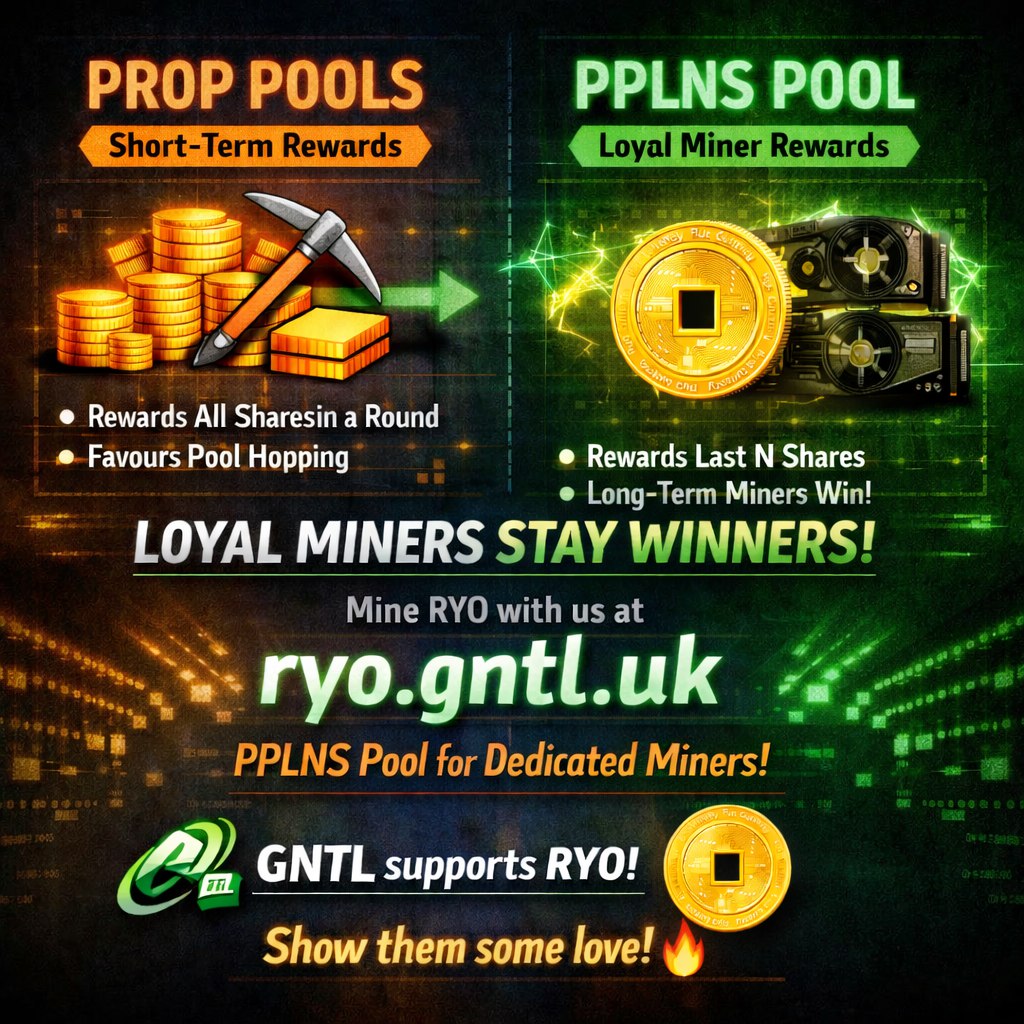
The Ryo Currency mining ecosystem now includes a new independent pool operated by the GNTL project.
The GNTL Ryo pool introduces a PPLNS payout model, offering miners an alternative to the
more common proportional pools currently used on the network.

Pool diversity is not cosmetic. Different payout models create different incentives.
Over time, those incentives shape network behavior, miner loyalty, and decentralization.

The GNTL Ryo pool is available at:
https://ryo.gntl.uk/

PROP vs PPLNS on the Ryo Network

Proportional Pools

Most Ryo miners today use proportional payout pools, including the official Ryo Currency pool.
In a PROP pool, each block is treated as a separate round. When a block is found,
the reward is distributed based on how many shares each miner submitted during that round.

This model is simple and predictable, but it has a known weakness.
Miners can gain an advantage by mining only at the beginning of rounds and leaving
once the round becomes statistically long. This behavior is known as pool hopping.

While not always intentional, pool hopping shifts rewards away from miners who remain
connected consistently.

PPLNS Pools

The GNTL pool uses PPLNS, or Pay Per Last N Shares.
Instead of dividing rewards by round length, payouts are calculated using a fixed window
of the most recent shares submitted to the pool.

Under PPLNS:

  • Round boundaries are irrelevant
  • Pool hopping offers no advantage
  • Consistent miners are rewarded more fairly over time

For miners who run their rigs continuously, PPLNS aligns rewards with actual contribution
rather than timing.

Why the GNTL Pool Matters

The addition of a PPLNS pool strengthens the Ryo mining ecosystem in several ways.

  • Reduces reliance on a single payout model
  • Encourages long term mining participation
  • Improves resistance to opportunistic hashrate movement
  • Supports decentralization through operator diversity

The GNTL pool also enforces TLS encrypted connections, which improves transport security
between miners and the pool server.

Mining Ryo on the GNTL Pool Using XMR-Stak

This guide focuses on pool configuration differences.
General XMR-Stak installation and GPU configuration steps are the same as those used
for the official Ryo pool.

Download XMR-Stak

Use the final stable release of XMR-Stak:

https://github.com/fireice-uk/xmr-stak/releases/tag/2.10.8

Wallet and Worker Naming

You will need a Ryo wallet address.
The GNTL pool uses legacy worker formatting, where the worker name is passed through
the password field.

You may replace the worker name with any identifier you prefer, as long as the format
is preserved.

Primary Pool Configuration

Edit the pools.txt file and add the following configuration.
Replace the wallet address and worker name with your own values.

{
    "pool_address": "ryo.gntl.uk:40001",
    "wallet_address": "YOUR_WALLET_ADDRESS",
    "rig_id": "YOUR_WORKER_NAME",
    "pool_password": "YOUR_WORKER_NAME:EMAIL_ADDRESS",
    "use_nicehash": false,
    "use_tls": true,
    "tls_fingerprint": "",
    "pool_weight": 1
},
"currency": "Ryo"

TLS must be enabled. The GNTL pool does not accept non encrypted connections.

Adding a Backup Pool

XMR-Stak allows multiple pools to be configured with weighted priority.
If the primary pool becomes unreachable, the miner will automatically connect
to the backup pool.

Lower pool_weight values indicate higher priority.
In the example below, the GNTL pool is primary and the official Ryo pool is used as fallback.

{
    "pool_address": "ryo.gntl.uk:40001",
    "wallet_address": "YOUR_WALLET_ADDRESS",
    "rig_id": "YOUR_WORKER_NAME",
    "pool_password": "YOUR_WORKER_NAME:EMAIL_ADDRESS",
    "use_nicehash": false,
    "use_tls": true,
    "tls_fingerprint": "",
    "pool_weight": 1
},
{
    "pool_address": "pool.ryo-currency.com:3333",
    "wallet_address": "YOUR_WALLET_ADDRESS",
    "rig_id": "YOUR_WORKER_NAME",
    "pool_password": "x",
    "use_nicehash": false,
    "use_tls": false,
    "tls_fingerprint": "",
    "pool_weight": 2
},
"currency": "Ryo"

This configuration ensures continuous mining without manual intervention if a pool
temporarily goes offline.

When PPLNS Makes Sense

PPLNS is best suited for miners who operate their hardware consistently and view mining
as a long term activity rather than short term optimization.

For miners aligned with Ryo’s privacy and decentralization goals, supporting a PPLNS pool
is a practical way to reinforce those principles at the infrastructure level.

Conclusion

The GNTL Ryo pool is not intended to replace existing pools.
It expands the ecosystem by introducing a different incentive structure and an
independent operator.

Miners who value fairness, consistency, and decentralization should consider allocating
part or all of their hashrate to the GNTL PPLNS pool.

A resilient network is built not only on hashpower, but on diversity of participation.
The growth of cryptocurrency mining presents challenges in maintaining decentralization and security. Ryo Currency ($RYO), a privacy-focused cryptocurrency, addresses these issues with the Cryptonight-GPU mining algorithm, which optimizes GPU mining while resisting ASIC, CPU, and FPGA influence, thereby supporting a more decentralized network. This article explores the role of GPU mining, the benefits of Cryptonight-GPU, and Ryo’s commitment to accessible, energy-efficient, and secure mining for all.

1. The Role of GPU Mining in Decentralization

Cryptocurrency mining, essential for transaction validation and coin distribution, can involve CPUs, GPUs, or ASICs (specialized circuits). GPU mining, with its balance of performance and flexibility, provides an entry point for individual miners and supports decentralization by lowering barriers to participation.

Advantages of GPU Mining

1. Flexibility: GPUs can mine various cryptocurrencies across different algorithms.

2. Decentralization: Supports a diverse range of participants, reducing reliance on centralized ASIC farms.

3. Cost-Efficiency: More affordable than ASICs, making GPU mining accessible to smaller miners.

For Ryo Currency, which is optimized for Cryptonight-GPU, GPU mining promotes a fairer, more inclusive mining ecosystem.

2. Cryptonight-GPU: Key to Ryo’s Decentralized Mining Vision

Cryptonight-GPU is a GPU-focused variant of the Cryptonight algorithm, designed to resist ASICs through high memory demands, making ASIC mining costly and impractical.

Benefits of Cryptonight-GPU:

  • ASIC Resistance: Prevents ASIC dominance, supporting GPU mining.
  • High Memory Requirement: Discourages centralized ASIC hardware in favor of widely available GPUs.
  • Enhanced Decentralization: Encourages broad participation and aligns with Ryo’s ethos of accessibility.

Benefits of Cryptonight-GPU for Miners

This GPU-centric algorithm makes mining affordable and practical for individual miners, reinforcing Ryo’s focus on decentralization.

3. Energy Efficiency and Value in Ryo’s Proof-of-Work Model

In proof-of-work (PoW) systems, energy expenditure secures the network and adds intrinsic value to the mined cryptocurrency. Ryo’s efficient Cryptonight-GPU algorithm uses energy resources effectively, reinforcing both network security and environmental sustainability.

Understanding Energy Storage in Mining

In PoW, miners expend energy to solve complex mathematical problems. This energy use isn’t wasted but rather stored in the blockchain as a “proof” of the work done. Every mined block represents an investment of energy, making it costly for malicious actors to alter transaction records.

Advantages of Energy Efficiency:

  • Security and Economic Value: Energy invested in PoW adds to the currency’s value by backing it with real resources.
  • Environmental Responsibility: By avoiding energy-intensive ASICs, Ryo minimizes its carbon footprint, supporting sustainable mining practices.

4. ASIC vs. GPU Hardware: Implications for Ryo’s Decentralization Strategy

ASICs, while powerful, lead to centralization by consolidating mining power among a few. In contrast, GPUs offer a more democratic mining approach due to their general availability and versatility.

GPU Benefits Over ASICs:

1. Accessibility: Lower cost of entry compared to ASICs, making mining accessible to a wider audience.

2. Versatility: Miners can easily switch between cryptocurrencies.

3. Resistance to Centralization: Promotes a decentralized mining environment by lowering entry barriers.

Ryo’s preference for GPU mining, rather than ASICs, aligns with its mission to maintain a decentralized, fair mining network.

5. Democratizing Mining: Empowering Smaller-Scale Miners with GPU Access

By lowering entry costs and enhancing flexibility, GPU mining enables a wider range of participants, from hobbyists to small-scale miners, to secure the network.

Empowerment through Accessibility:

  • Affordability: GPUs cost significantly less than ASICs, encouraging more participants.
  • Durability: Unlike ASICs, GPUs can be repurposed beyond mining, offering long-term usability.

This inclusivity fortifies the network, reinforcing Ryo’s decentralized, community-driven approach.

6. Security Advantages: Cryptonight-GPU’s Resistance to Botnets and CPU Exploits

Ryo’s algorithm deters CPU mining, reducing exposure to botnet exploitation—a common issue with CPU-minable coins like Monero (XMR). Cryptonight-GPU’s high memory demand and GPU focus make it impractical for botnet operators, enhancing Ryo’s network security. By resisting CPU mining, Ryo protects against cryptojacking, a tactic where attackers use malicious software to hijack unsuspecting devices for unauthorized mining.

CPU Mining and Botnets: Vulnerabilities in CPU-Friendly Networks

In recent years, CPU-minable cryptocurrencies, particularly Monero, have become attractive targets for botnets due to their compatibility with standard consumer devices. Unlike GPU mining, which often requires dedicated hardware, CPU mining can be conducted on virtually any computer, including compromised personal devices. This makes Monero a popular choice for attackers who seek to harness the power of thousands of compromised machines without the need to install specialized hardware.

Notable Cryptojacking Examples

  • Smominru Botnet: This botnet compromised over 500,000 devices to mine Monero, earning millions of dollars for its operators.
  • WannaMine: A cryptojacking malware that exploited the EternalBlue vulnerability, spreading widely to mine Monero and reinfecting devices persistently.
  • #Opendgame Operation: This operation caused a 40% drop in Monero’s hashrate when a major botnet went offline, revealing network reliance on compromised devices.

Mitigating Botnet Risks:

  • Reduced Botnet Vulnerability: GPU-based mining discourages botnet attacks.
  • Strengthened Network Security: The network remains decentralized and resistant to malicious CPU-based mining.

This approach ensures that Ryo’s mining remains accessible and safe from large-scale botnet interference.

7. Ensuring Decentralization: Cryptonight-GPU’s Resistance to FPGA Mining

Cryptonight-GPU resists FPGA mining, which threatens decentralization by allowing large-scale miners to dominate the network. This resistance upholds Ryo’s goal of an open, accessible network for individual miners.

Decentralization Benefits:

  • Equal Playing Field: Ryo’s resistance to FPGA mining supports GPU miners without costly, specialized hardware.
  • Network Integrity: Reduces risks of network manipulation, sustaining decentralization.

This resistance to FPGA mining is integral to Ryo’s commitment to inclusivity and network stability.

8. Achieving Nvidia and AMD Parity in Cryptonight-GPU

Ryo’s Cryptonight-GPU algorithm equalizes performance between Nvidia ($NVDA) and AMD ($AMD) GPUs, enhancing accessibility across hardware types and ensuring that miners are not restricted by their choice of graphics card.

Implications of Hardware Parity:

  • Encourages Broad Participation: Both Nvidia and AMD users can mine Ryo effectively.
  • Supports Decentralization: Reduces dependence on specific hardware, preventing hardware-based centralization.
  • Environmental and Financial Benefits: Miners avoid unnecessary upgrades, reducing e-waste and costs.

This inclusive approach enhances accessibility, aligning with Ryo’s decentralized mining philosophy.

9. Ryo Currency’s Unique Approach with Cryptonight-GPU

Ryo’s Cryptonight-GPU implementation strategically combines decentralization, security, and sustainability. By resisting ASIC, CPU, and FPGA mining, Ryo avoids the risks of centralized mining, allowing individuals to secure the network without extensive resources.

Fair Emission Schedule: Ryo’s gradual, 20-year emission schedule, similar to that of Bitcoin ($BTC), supports long-term sustainability, avoiding rapid early hoarding and ensuring that late joiners can earn mining rewards. This “Plateau” model mirrors natural resource extraction, fostering long-term network stability.

Advancements in Privacy: Beyond mining, Ryo has contributed significantly to privacy technology, pioneering enhancements that even Monero has adopted such as short seeds, elliptic curve cryptography (ECC), speedy payment IDs, and enhanced payment gateways. Ryo’s planned transition to second-generation ZK-proofs (zero-knowledge proofs) will elevate its privacy capabilities, setting a new standard for privacy in cryptocurrency.

10. Conclusion

Ryo Currency’s strategic focus on decentralization, sustainability, and privacy highlights its vision of a fair, community-centered cryptocurrency. The Cryptonight-GPU algorithm enables secure, accessible mining resistant to centralized ASIC, CPU, and FPGA mining. Its Nvidia and AMD parity further reduces hardware barriers, promoting inclusivity.

With a fair emission model and cutting-edge privacy enhancements, Ryo leads by example in creating a resilient, decentralized cryptocurrency. Through its balanced approach to mining and ongoing commitment to privacy innovation, Ryo is building a sustainable and inclusive future for cryptocurrency.