

In every monetary crisis, one question resurfaces: What form of money survives when institutional trust fractures?

In March 2026, that question is no longer theoretical. Missiles are flying across the Middle East as the U.S.-Israeli conflict with Iran has escalated into open war, with the Strait of Hormuz under repeated threat and commercial shipping under attack.[1][2] The choke point for a fifth of the world’s traded oil has experienced repeated closures, and energy markets are repricing geopolitical risk in real time.[4]

This conflagration collides with a global debt architecture already at late-cycle extremes. U.S. national debt is now approaching 39 trillion dollars, rising at a pace of roughly 2.6 trillion a year.[6] According to updated IMF debt data, total global debt sits just above 235 percent of world GDP, while public debt alone has climbed to nearly 93 percent — a level typically associated with financial repression, inflationary finance, or both.[7][8]

History shows that monetary regimes rarely end in a cinematic collapse. They erode, are reconfigured, and ultimately get replaced as trust migrates to a superior store and medium of value. Metallic coins gave way to banknotes, banknotes yielded to digital ledgers, and now international contracts, collateral, and even law itself are increasingly encoded in software rather than enforced solely by courts and parliaments.

Within this transition, privacy coins form a distinct category: cryptocurrencies engineered to behave like digital cash — fungible, censorship-resistant, and private by default. In a world reorganizing into rival geopolitical and financial blocs, the market is again searching for neutral money. Privacy-preserving cryptocurrencies — exemplified by Ryo Currency — are positioned to become the bridge asset between incompatible systems, the neutral settlement layer beneath competing empires.

A World Splitting into Monetary Blocs

The post–World War II order relied on U.S. dollar primacy: global reserves in Treasuries, energy priced in dollars, and a clearing system anchored in New York and London.[8] That architecture is now being challenged by a rapid move toward multipolarity, intensified by sanctions and open conflict. On one side, the U.S.-led bloc continues to rely on dollar-based payment infrastructure; on the other, the BRICS+ axis—driven by China, Russia, Iran—pushes gold accumulation, local-currency trade, and alternative rails such as China’s e-CNY and cross-border platforms like mBridge, which has already processed tens of billions in CBDC settlements.[9][10]

China’s digital yuan has handled more than 3.4 billion transactions worth roughly 16.7 trillion renminbi (about 2.3 trillion dollars) by late 2025, underscoring how quickly a parallel settlement system can grow once state power commits to it.[9][10] When blocs harden, neutral assets start to matter more than aligned assets. Gold served that role for centuries; in the digital era, privacy coins inherit that function—with orders of magnitude more portability.

The Debt Supercycle and the Post-Fiat Squeeze: Voices from East and West

Macro thinkers from different intellectual traditions converge on one inescapable diagnosis: we are living through the endgame of a long debt supercycle. Ray Dalio has charted how major reserve systems follow multi-decade cycles in which debt compounds far faster than real output, compelling policymakers to engineer a reset through inflation, financial repression, or currency devaluation. Egon von Greyerz describes the entire post-1971 fiat experiment as now entering its terminal phase, where desperate governments will turn to unlimited money printing and face mounting hyperinflation risks. Jim Rickards zeroes in on hidden liquidity traps and the potential for an “ICE9” credit freeze—a sudden, total lock-up of the financial system—forcing dramatic gold repricing as the only viable escape valve. Gregory Mannarino warns of an imminent credit freeze that will paralyze the system, igniting public outrage and possible revolt, while the powerful stand ready with pre-planned “solutions” to impose even greater control. Simon Hunt and fellow analysts stress that these monetary fractures are being violently accelerated by energy and resource shocks—the very disruptions now unfolding as war engulfs major producers and vital shipping lanes.

From the Eurasian perspective, Russian economist Sergei Glazyev—a longtime advisor to Vladimir Putin—argues that the current dollar-centric system is structurally unsustainable and has been weaponized against sovereign states. He advocates for a new international monetary architecture based on a basket of national currencies and commodities, with settlement via digital platforms not controlled by the West. Glazyev envisions a transition to a multipolar financial order where trade is settled in national currencies, gold, or digital assets that no single bloc can freeze.[41] This phrase captures the essence of what neutral money means in an era of financial warfare.

Similarly, Chinese financial analysts and officials emphasize that the digital yuan is not merely a domestic payment tool but a foundational element of a multipolar reserve system. They argue that e-CNY enables trade settlements independent of SWIFT and dollar-based clearing, enhancing monetary sovereignty. The People’s Bank of China has framed the digital currency as a public good that can improve cross-border efficiency, while noting that it operates within a legal framework that ensures stability and security. These views, while emerging from different political systems, converge on the same diagnosis: the old order is fracturing, and new instruments—both state-issued and private—will fill the void.

The United States: From Skepticism to “Crypto President”

In stark contrast to the Eastern push for de-dollarization, the United States has undergone a dramatic political realignment regarding digital assets. President Donald Trump, now in his second term, has declared himself the “Crypto President” and made digital assets a pillar of his economic agenda. The landmark GENIUS Act (Guiding and Establishing National Innovation for U.S. Stablecoins) and the Clarity Act have created a comprehensive federal framework for stablecoins and digital asset markets, replacing the patchwork of state-level regulations. Most significantly, the administration has announced plans for a U.S. Crypto Strategic Reserve, initially funded with Bitcoin seized in law enforcement actions, with proposals to acquire additional assets over time. This reserve is framed as a digital Fort Knox—a hedge against inflation and a signal that the U.S. intends to lead the global crypto economy rather than cede ground to China or the EU. Other nations, including the United Arab Emirates, Singapore, Switzerland, and Japan, have similarly advanced pro-crypto regulatory regimes, competing to become hubs for blockchain innovation.[42][43]

Yet even in this pro-crypto landscape, the money that flows through regulated U.S. exchanges and stablecoins remains tethered to identity and compliance. The GENIUS Act requires robust KYC/AML controls for stablecoin issuers, and the strategic reserve, while Bitcoin-based, is a state-controlled asset. The American approach embraces crypto, but primarily the transparent, traceable, and regulated layers of it. Privacy coins, by contrast, occupy a legal grey area—their very design resists the surveillance that regulators seek to preserve.

China’s Hardline Stance and the Eastern Bloc Grey Zone

While the U.S. pivots toward crypto integration, China maintains its firm anti-crypto stance. Since the 2021 ban on trading and mining, the People’s Bank of China has doubled down on the digital yuan as the only authorized digital currency. All cryptocurrency-related activities remain illegal, and authorities have expanded their blockchain surveillance to detect and block peer-to-peer crypto trades. Yet necessity may force interaction. Chinese firms and individuals seeking to move capital offshore, pay for imports from sanctioned nations, or engage in cross-border e-commerce that cannot be settled in e-CNY may turn to privacy coins despite the ban. The central bank itself, while publicly hostile, could theoretically acquire privacy coins as part of its diversification away from dollar assets—just as it accumulates gold outside official reserves. Holding a neutral, unfreezable asset like Ryo would align with Glazyev’s logic: an asset that no single bloc can freeze is valuable even to a bloc that forbids its citizens from using it. However, any such holding would be covert, never acknowledged, and likely managed through proxies.[44]

The picture is different elsewhere in the Eastern bloc. Russia, despite its own CBDC work (the digital ruble), has legalized crypto for cross-border payments and mining, viewing it as a sanctions-busting tool. India maintains a cautious but de facto tolerant stance: while it taxes crypto heavily and pushes its CBDC, it has not banned private ownership, and retail trading thrives. Iran uses crypto to bypass oil sanctions, and its miners are integrated into the global network. These countries occupy a grey zone: they are not fully crypto-friendly like Singapore or Switzerland, but they tolerate or even encourage crypto as a means of economic survival. For them, privacy coins offer a way to settle trade with counterparties in rival blocs without exposing every transaction to U.S. or Chinese surveillance.

The Neutral Bridge: How Ryo Connects the Blocs

Given this fragmented landscape—the U.S. embracing regulated crypto, China banning private crypto while possibly holding it covertly, and the Eastern grey zone using crypto for sanctions evasion—how would a neutral bridge like Ryo function?

Ryo as the settlement layer between incompatible systems:

  • Hub-and-spoke model: A Russian energy exporter, paid in rubles or digital rupees, wants to acquire U.S. dollars or stablecoins to pay a supplier in a third country. Instead of going through sanctioned channels, it converts local currency to Ryo on a non-custodial exchange, then swaps Ryo for USDT. The U.S. supplier receives stablecoins without ever touching a sanctioned entity—the bridge asset (Ryo) severs the audit trail.
  • Dual-currency circuit: An Indian IT firm provides services to a Chinese client. Neither wants to use e-CNY (surveilled) nor USDT (potentially freezeable). They agree on Ryo as an intermediate: the Chinese firm acquires Ryo (despite the ban, via OTC or overseas entities) and sends it; the Indian firm receives Ryo and converts locally. The transaction is private, final, and cannot be frozen by any central bank.
  • AI-agent native settlement: An autonomous logistics AI, routing cargo through multiple jurisdictions, needs to pay for port fees, fuel, and insurance. It holds a multi-currency portfolio but uses Ryo as the default settlement layer for any leg that crosses bloc boundaries, ensuring that payment history cannot be used to blacklist the cargo or the AI’s owner.

In each case, Ryo acts as the liquidity buffer—it does not replace national currencies or CBDCs but provides a private, final settlement layer between them. Its neutrality is operational: because it belongs to no bloc, it can be used by all blocs without triggering geopolitical alarms. And because it is private, it leaves no permanent record that could later be weaponized.

From an Austrian lens, artificial credit expansion distorts price signals and leads to correction. As energy and food costs spike, governments face a trilemma: protect bond markets, subsidize households, or maintain currency stability. In prior cycles, capital sought refuge in offshore centers; but when missiles, sanctions, and cyber operations reach everywhere, the “offshore” of this cycle is increasingly not a place but a protocol.

CBDCs and Stablecoins: Efficient Rails, Embedded Control

On top of this unstable base, money itself is being re-architected. A closely watched study by the Atlantic Council found that about 130 countries—representing roughly 98 percent of global GDP—are exploring central bank digital currencies, with almost half in advanced development, pilot, or launch phases.[23][24] At least eleven countries have already launched functional CBDCs. China’s e-CNY remains the largest live experiment; India’s retail CBDC pilot has surpassed six million users and introduced offline and programmable features.[26]

Billionaire investor Stanley Druckenmiller captured the technocratic consensus: “the entire payment system will adopt stablecoins within the next 10–15 years,” arguing that fiat-backed stablecoins like USDT and USDC are simply more efficient, faster, and cheaper than legacy rails.[27] Yet CBDCs and institutional stablecoins share a structural feature: they are permissioned liabilities of identifiable issuers. India’s pilot already experiments with programmable conditions on transfers, and Chinese officials highlight the e-CNY’s potential for targeted stimulus and time-limited spending.[10][26] This is not neutral money. It is software that can enforce policy at the transaction level—enabling taxation at source, geofenced spending, or real-time sanctions.

Technocracy, Tokenization, and the Contest for Code

The rise of CBDCs coincides with a broader trend: power migrating from law to algorithms. Commentators like Aaron Day warn that a new technocracy—rule by credentialed experts operating through global institutions—is using climate policy, health regulations, and financial surveillance as pretexts to centralize control. In his framing, CBDCs are the operating system for a programmable compliance regime.[28] At the same time, major crypto firms argue the opposite direction. Coinbase CEO Brian Armstrong has championed tokenization as a way to “strip away a huge amount of unfairness from the system” by opening access to assets that have historically been gated.[29] Both visions run on similar primitives: identity, ledgers, smart contracts, and AI-enhanced analytics. The difference lies in who controls the keys. Public, permissionless blockchains and privacy-preserving protocols can turn tokenization into a tool of inclusion. Centralized, permissioned chains tied to CBDCs can turn it into a tool of control. That is precisely where privacy coins enter the picture.

Intelligence as a Utility: The AI Monetization Race Between Blocs

While monetary infrastructures fragment, a parallel revolution is underway in artificial intelligence—and it will profoundly shape the demand for neutral, private money. Sam Altman, CEO of OpenAI, has articulated a vision that resonates across Silicon Valley and beyond: “We see a future where intelligence is a utility, like electricity or water, and people buy it from us on a meter.”[40] In this model, advanced AI models become infrastructure: you pay for each query, each reasoning token, each automated workflow. The meter runs, and the currency used to settle that meter becomes critical.

But will this “intelligence utility” be delivered uniformly across the globe? The answer depends on which bloc you inhabit. In the U.S.-led sphere, private corporations (OpenAI, Anthropic, Google, xAI) are racing to build frontier models and will likely monetize them via subscriptions, API credits, and metered billing—largely settled in dollars, stablecoins, or corporate tokens. The underlying rails will be the same permissioned stablecoins and CBDCs that Druckenmiller foresees. Your access to intelligence may depend on your credit score, your compliance with KYC, and your government’s foreign policy.

In the rival bloc—China, Russia, and their partners—the approach diverges. Chinese AI development (Ernie, Tongyi Qianwen, SenseTime) is tightly integrated with state priorities and the digital yuan infrastructure. The state could, in principle, provide subsidized or even free AI access to its citizens and allied enterprises, but only within the Great Firewall and under surveillance. Sergei Glazyev and other Eurasian economists have discussed a “socially oriented AI” where the state meters usage for planning, not profit. Access to advanced AI in this bloc may be a tool of statecraft—extended to friendly nations (Belt and Road AI), withheld from adversaries, and always linked to digital identity and CBDC wallets. The question “will China give the same AI to everyone?” answers itself: not without political alignment and not without the ability to switch it off.

The likely outcome is an AI divergence that mirrors monetary fragmentation. In the West, AI will be a corporate metered utility, paid for with programmable money. In the East, AI will be a state-aligned utility, also programmable but with different oversight. Both models, however, share a common feature: they tie access to intelligence to a specific monetary and identity system. If you cannot pay in the accepted token—or if your wallet is blacklisted—you lose access to the most powerful economic tool of the 21st century.

This is where privacy coins, and specifically Ryo, enter the equation. For individuals, small enterprises, or even AI agents operating across blocs, the ability to pay for AI services anonymously and without geopolitical taint becomes essential. An entrepreneur in a non-aligned nation may need to query Western models (for certain tasks) and Eastern models (for others) without revealing their identity or being cut off by sanctions. A neutral, private settlement layer—Ryo—can serve as the universal payment token for AI queries, transcending bloc-specific rails. Furthermore, autonomous AI agents managing supply chains or negotiating energy trades will increasingly seek out payment methods that cannot be frozen based on the agent’s origin or the data it processes. Intelligence as a utility demands money that is itself neutral and private. Ryo’s architecture—privacy-by-default, censorship resistance, and eventual ZK-powered scalability—positions it as the natural “coin for the AI age,” settling microtransactions for inference, training data, or agent-to-agent commerce without exposing the parties to surveillance.

Privacy Coins: Digital Cash in a Surveillance Century

Transparent blockchains like Bitcoin and Ethereum sacrificed cash-like privacy. Every transaction is public, every address linkable. Privacy coins engineer a different outcome. Using tools such as Ring Confidential Transactions, stealth addresses, and zero-knowledge proofs, they validate balances without revealing who paid whom, or how much. They restore three qualities: fungibility (each unit indistinguishable), censorship resistance (no central operator can block), and privacy (financial history stays hidden). In a world where CBDCs and compliant stablecoins are building an ever-denser surveillance net, the very existence of privacy coins keeps an exit door open.

Ryo Currency: Engineered for the Post-Fiat Era

Ryo Currency is a privacy-focused cryptocurrency built from the ground up as digital cash. It emerged in 2018 as a fork in the CryptoNote family, inheriting and extending the privacy research of Monero.[33] From launch, Ryo implemented Ring Confidential Transactions with a default ring size of 25, mixing every transaction with many decoys, concealing amounts, sources, and destinations.[31] The project positions itself around four pillars: privacy, decentralization, fungibility, and fair mining. Ryo uses a GPU-oriented proof-of-work algorithm (Cryptonight-GPU) designed to resist ASICs and botnets, keeping block production accessible.[34][35] With no premine or ICO and an emission curve inspired by real-world resource extraction, Ryo’s distribution model avoids many structural centralization pitfalls.

Crucially, Ryo’s roadmap goes beyond first-generation RingCT. The team has publicly committed to migrating toward second-generation zero-knowledge proofs, building on Halo-style constructions that enable recursive, scalable privacy while eliminating trusted setup assumptions.[36] In parallel, Ryo materials describe a high-latency mixnet to obfuscate network-level metadata and IP information, adding another layer of anonymity on top of on-chain privacy.[37] The result is a design goal: make tracing, monitoring, or linking Ryo transactions and balances practically impossible—on-chain and on the network layer.

The Neutral Money Doctrine

Across history, neutral money tends to outlast politically managed money during periods of systemic stress. Call this pattern the Neutral Money Doctrine: when states stretch their monetary privilege too far, markets gravitate toward instruments that are fungible, portable, and independent of any one issuer’s promises. Gold embodied that doctrine in the physical world. In the digital age, neutral money must satisfy an additional constraint: censorship resistance under pervasive surveillance. That is what privacy coins aim to provide, and what Ryo in particular is architected to maximize.

Table 1: Fungibility Across Monetary Eras
Asset Fungibility Portability Censorship Resistance Historical / Prospective Role
Gold High Low (physical) High (bearer) Neutral settlement between rival empires[12]
Fiat Currencies Medium High (digital banking) Low (issuer-controlled) National control, prone to debasement and sanctions[8][12]
Privacy Coins (e.g., Ryo) High High (digital, borderless) High (cryptographic + network-layer) Neutral bridge asset in a multipolar digital world[31][37]
Table 2: Censorship Resistance in the Digital Age
System Traceability Programmability Cross-Bloc Usability Likely Outcome Under Fragmentation
CBDCs Full (state visibility)[23] High (rules in code)[26] Low (bloc-specific) Fine-grained surveillance, financial repression
Fiat-Backed Stablecoins High (public chain + issuer KYC) Medium (blacklists, freezes) Medium (usable until sanctioned) Efficient payments, vulnerable to policy chokepoints
Privacy Coins (e.g., Ryo) Minimal (on-chain confidentiality + mixnets)[31][37] Low (user-controlled) High (not tied to any nation) Durable economic sovereignty, neutral settlement layer

The Post-Fiat Landscape: Two Paths, One Market Choice

As debt pressures build and blocs harden, the most plausible path is not a single collapse but an era of overlapping crises: chronic inflation, rolling banking stress, intermittent capital controls, and increasingly frequent use of sanctions. Under those conditions, two digital futures compete:

  • CBDC- and stablecoin-centric rails, where “money” is a programmable liability that can be surveilled, throttled, or rescinded.
  • Privacy-preserving, decentralized rails, where money is a protocol-level asset and users retain control over who can see or block their transactions.

In practice, a hybrid landscape is likely. CBDCs will dominate official settlement and tax collection. Privacy coins will handle flows that must remain off the political chessboard: cross-bloc trade, savings for individuals who distrust their own central bank, and high-risk jurisdictions where property rights are precarious.

Privacy Coins in the BRICS+/Global South?

In the emerging BRICS+/Global South bloc, three monetary experiments are visible: multi-CBDC settlement layers like mBridge, commodity-linked units of account, and regional stablecoins. These systems solve dollar dependence but do not deliver neutrality or privacy. Official Chinese statements frame the e-CNY as a tool to enhance monetary sovereignty and facilitate cross-border trade, not as a surveillance instrument. Yet the architecture—centralized, permissioned, and linked to digital identity—reflects a different philosophical foundation: money as an instrument of state policy rather than a neutral bearer asset. This is not a criticism but an observation of design intent. Both Western CBDCs and the Chinese e-CNY are optimized for state visibility; the difference lies in which state holds the keys.

Will these new systems interoperate with privacy coins like Ryo? Technically, it is straightforward: atomic swaps, nonKYC exchanges, DEX-based routing, and layered payment hubs can use Ryo as an intermediate clearing asset between incompatible CBDC systems. Politically, blocs may attempt to block these bridges, but well-designed privacy coins that do not depend on custodial intermediaries are extremely difficult to quarantine.[31][35] Ryo’s neutrality is an emergent property: a chain with strong privacy, decentralized mining, and no central operator can act as a buffer layer between incompatible monetary systems, absorbing flows from both blocs without being captured.

AI Agents and Machine Economies: Who Chooses the Money?

A new actor is entering this landscape: AI agents that can hold assets, execute trades, and negotiate contracts autonomously. These agents will not have patriotic loyalties. Given a goal (minimize fees, maximize privacy, obey or evade rules), they will choose the rails that optimize it. In a machine-driven economy, neutral, protocol-native assets become the lingua franca of autonomous trade. AI systems optimizing supply chains across hostile jurisdictions cannot depend on rails that can be frozen whenever geopolitics shift. They will gravitate toward assets and ledgers whose guarantees are enforced by math, not ministerial decree. Ryo’s design—privacy by default, fungibility, and a roadmap toward scalable ZK-proofs—positions it as a natural settlement layer for such agents. Read more: Autonomous AI Agents Need Private Money: The Infrastructure of Machine Economies

Tokenization on Privacy Coins: Liberation Instead of Panopticon

The same tokenization that Armstrong sees as a cure for market unfairness can either entrench technocracy or undermine it. On highly permissioned CBDC chains tied to digital ID, tokenization can reduce citizens to revocable access rights. On privacy-preserving chains, tokenization takes on a different character: confidential tokens can expand access without exposing every economic decision to analytics. A credit cooperative in a frontier market could issue private claims on productive assets, settle them in Ryo, and allow secondary markets without broadcasting members’ entire financial lives. This points to a crucial design choice: do we want capital markets where every position is traceable forever, or zones of legitimate opacity? Privacy coins provide the substrate for the latter.

Ryo as a Bridge, Bitcoin as a Beacon

It is a mistake to frame privacy coins as competitors to Bitcoin. Bitcoin is increasingly treated as a macro-reserve asset (scarce, transparent, globally recognized). Ryo and similar privacy coins are digital cash and dark liquidity: optimized for medium-of-exchange use, confidentiality, and fungibility. In a post-fiat environment, a plausible stack: base reserves (gold, Bitcoin), official rails (CBDCs, stablecoins), and a neutral bridge layer (privacy coins like Ryo for cross-bloc settlement, sensitive trade, and personal savings). Here Ryo does not need to “win” against state money; it simply needs to exist, remain uncaptured, and offer a superior option wherever privacy and neutrality are valued.

Economic Freedom in Your Pocket

The old model of protection was geographic: move to a safer country. In a world where conflicts and technocratic controls spread rapidly, that playbook is losing reliability. The new model is protocol-native freedom: economic autonomy that you can carry in a seed phrase or hardware wallet, independent of your passport. No elite residency program is required. A street vendor in Tehran, a freelancer in Lagos, a family in Buenos Aires can all access the same cryptographic guarantees—with no gatekeeper. That is the promise embedded in privacy coins, and particularly in projects like Ryo that explicitly design for high anonymity, fair distribution, and decentralization.

As the post-fiat renaissance unfolds, we are not merely upgrading payment rails; we are deciding whether money will be neutral infrastructure or a lever of technocratic control. CBDCs and compliant stablecoins will likely dominate official flows, as Druckenmiller and others anticipate. But the deeper story is that privacy coins like Ryo Currency embody a rival philosophy: money as a neutral, borderless bridge asset that belongs to everyone and answers to no bloc. In a fracturing world, that neutrality is not just a feature—it is the last line of defense for economic freedom itself.

References & further reading

[1] Day 13 of Middle East conflict — global economy disruptions, Iranian attacks spread to sea CNN 12 March 2026

[2] 2026 Strait of Hormuz crisis – Wikipedia https://en.wikipedia.org/wiki/2026_Strait_of_Hormuz_crisis

[4] Iran war paralyzes oil trade, CBS News https://www.cbsnews.com/live-updates/iran-war/

[6] U.S. national debt reached about $38.9 trillion in March 2026 https://www.facebook.com/…

[7] Global debt steady at 235% of GDP as public borrowing rises https://english.ahram.org.eg/News/553247.aspx

[8] Global debt steady at 235% of GDP – DevelopmentAid https://www.developmentaid.org/news-stream/post/200148/global-debt

[9] China’s Digital Yuan Crosses US$2 Trillion in Transactions – MEXC https://www.mexc.com/news/506077

[10] What to watch as China prepares its digital yuan – Atlantic Council https://www.atlanticcouncil.org/blogs/econographics/

[13] Ray Dalio Debt Cycle explained https://www.cgaa.org/article/ray-dalio-debt-cycle

[15] Egon von Greyerz: (Hyper-) inflationary depression https://www.youtube.com/watch?v=uX0-qDtsfmI

[17] Jim Rickards: Massive Fed’s Gold Revaluation https://www.youtube.com/watch?v=qFPBMtK1-dU

[20] Gregory Mannarino: central banks to hyperinflate https://www.youtube.com/watch?v=Q7dCgU_te6w

[23] Study shows 130 countries exploring CBDCs – Reuters https://www.reuters.com/markets/currencies/study-shows-130-countries-exploring-central-bank-digital-currencies-2023-06-28/

[24] Study shows 130 countries exploring CBDCs – China Daily https://www.chinadailyhk.com/hk/article/338236

[26] RBI’s CBDC Retail Pilot Surpasses 60 Lakh Users – ET BFSI https://bfsi.economictimes.indiatimes.com/articles/rbis-cbdc-retail-pilot-surpasses-60-lakh-users

[27] Stablecoins may become the future global payment infrastructure – Longbridge https://longbridge.com/en/news/279070352

[28] Aaron Day: Technocracy, CBDCs, and the Fight for Individual Freedom https://randybock.com/aaron-day-cbdcs-threat-freedom/

[29] Brian Armstrong Pushes Tokenization as a Fix for Market Inequality – MEXC https://www.mexc.co/en-IN/news/517135

[31] Ryo Currency official website https://ryo-currency.com

[33] ryo-currency/ryo-currency: Ryo – Privacy for eveRYOne – GitHub https://github.com/ryo-currency/ryo-currency

[34] 【ANN】【RYO】【Cryptonight-GPU】 RyoCurrency – BitcoinTalk https://bitcointalk.org/index.php?topic=4413010.0

[35] Ryo FAQ https://ryo-currency.com/faq/

[36] Halo 2 ZK Proofs – An Introduction – Ryo YouTube https://www.youtube.com/watch?v=ZRqXzO0koPM

[37] Halo 2 ZK Proofs & High Latency Mixnet – Ryo YouTube https://www.youtube.com/watch?v=JGyQFrwyC00

[40] Sam Altman on AI as a utility – various interviews / OpenAI blog 2025

[41] Sergei Glazyev, “The Global Monetary System in Crisis”, 2024; various speeches.

[42] GENIUS Act and Clarity Act – U.S. Congressional Record, 2025; White House fact sheet on Crypto Strategic Reserve, Jan 2026.

[43] UAE, Singapore, Switzerland, Japan crypto regulatory frameworks – various sources, 2025-2026.

[44] People’s Bank of China statements on crypto; interviews with PBOC officials, 2025.

 

The Ryo Currency mining ecosystem now includes a new independent pool operated by the GNTL project.
The GNTL Ryo pool introduces a PPLNS payout model, offering miners an alternative to the
more common proportional pools currently used on the network.

Pool diversity is not cosmetic. Different payout models create different incentives.
Over time, those incentives shape network behavior, miner loyalty, and decentralization.

The GNTL Ryo pool is available at:
https://ryo.gntl.uk/

PROP vs PPLNS on the Ryo Network

Proportional Pools

Most Ryo miners today use proportional payout pools, including the official Ryo Currency pool.
In a PROP pool, each block is treated as a separate round. When a block is found,
the reward is distributed based on how many shares each miner submitted during that round.

This model is simple and predictable, but it has a known weakness.
Miners can gain an advantage by mining only at the beginning of rounds and leaving
once the round becomes statistically long. This behavior is known as pool hopping.

While not always intentional, pool hopping shifts rewards away from miners who remain
connected consistently.

PPLNS Pools

The GNTL pool uses PPLNS, or Pay Per Last N Shares.
Instead of dividing rewards by round length, payouts are calculated using a fixed window
of the most recent shares submitted to the pool.

Under PPLNS:

  • Round boundaries are irrelevant
  • Pool hopping offers no advantage
  • Consistent miners are rewarded more fairly over time

For miners who run their rigs continuously, PPLNS aligns rewards with actual contribution
rather than timing.

Why the GNTL Pool Matters

The addition of a PPLNS pool strengthens the Ryo mining ecosystem in several ways.

  • Reduces reliance on a single payout model
  • Encourages long term mining participation
  • Improves resistance to opportunistic hashrate movement
  • Supports decentralization through operator diversity

The GNTL pool also enforces TLS encrypted connections, which improves transport security
between miners and the pool server.

Mining Ryo on the GNTL Pool Using XMR-Stak

This guide focuses on pool configuration differences.
General XMR-Stak installation and GPU configuration steps are the same as those used
for the official Ryo pool.

Download XMR-Stak

Use the final stable release of XMR-Stak:

https://github.com/fireice-uk/xmr-stak/releases/tag/2.10.8

Wallet and Worker Naming

You will need a Ryo wallet address.
The GNTL pool uses legacy worker formatting, where the worker name is passed through
the password field.

You may replace the worker name with any identifier you prefer, as long as the format
is preserved.

Primary Pool Configuration

Edit the pools.txt file and add the following configuration.
Replace the wallet address and worker name with your own values.

{
    "pool_address": "ryo.gntl.uk:40001",
    "wallet_address": "YOUR_WALLET_ADDRESS",
    "rig_id": "YOUR_WORKER_NAME",
    "pool_password": "YOUR_WORKER_NAME:EMAIL_ADDRESS",
    "use_nicehash": false,
    "use_tls": true,
    "tls_fingerprint": "",
    "pool_weight": 1
},
"currency": "Ryo"

TLS must be enabled. The GNTL pool does not accept non encrypted connections.

Adding a Backup Pool

XMR-Stak allows multiple pools to be configured with weighted priority.
If the primary pool becomes unreachable, the miner will automatically connect
to the backup pool.

Lower pool_weight values indicate higher priority.
In the example below, the GNTL pool is primary and the official Ryo pool is used as fallback.

{
    "pool_address": "ryo.gntl.uk:40001",
    "wallet_address": "YOUR_WALLET_ADDRESS",
    "rig_id": "YOUR_WORKER_NAME",
    "pool_password": "YOUR_WORKER_NAME:EMAIL_ADDRESS",
    "use_nicehash": false,
    "use_tls": true,
    "tls_fingerprint": "",
    "pool_weight": 1
},
{
    "pool_address": "pool.ryo-currency.com:3333",
    "wallet_address": "YOUR_WALLET_ADDRESS",
    "rig_id": "YOUR_WORKER_NAME",
    "pool_password": "x",
    "use_nicehash": false,
    "use_tls": false,
    "tls_fingerprint": "",
    "pool_weight": 2
},
"currency": "Ryo"

This configuration ensures continuous mining without manual intervention if a pool
temporarily goes offline.

When PPLNS Makes Sense

PPLNS is best suited for miners who operate their hardware consistently and view mining
as a long term activity rather than short term optimization.

For miners aligned with Ryo’s privacy and decentralization goals, supporting a PPLNS pool
is a practical way to reinforce those principles at the infrastructure level.

Conclusion

The GNTL Ryo pool is not intended to replace existing pools.
It expands the ecosystem by introducing a different incentive structure and an
independent operator.

Miners who value fairness, consistency, and decentralization should consider allocating
part or all of their hashrate to the GNTL PPLNS pool.

A resilient network is built not only on hashpower, but on diversity of participation.

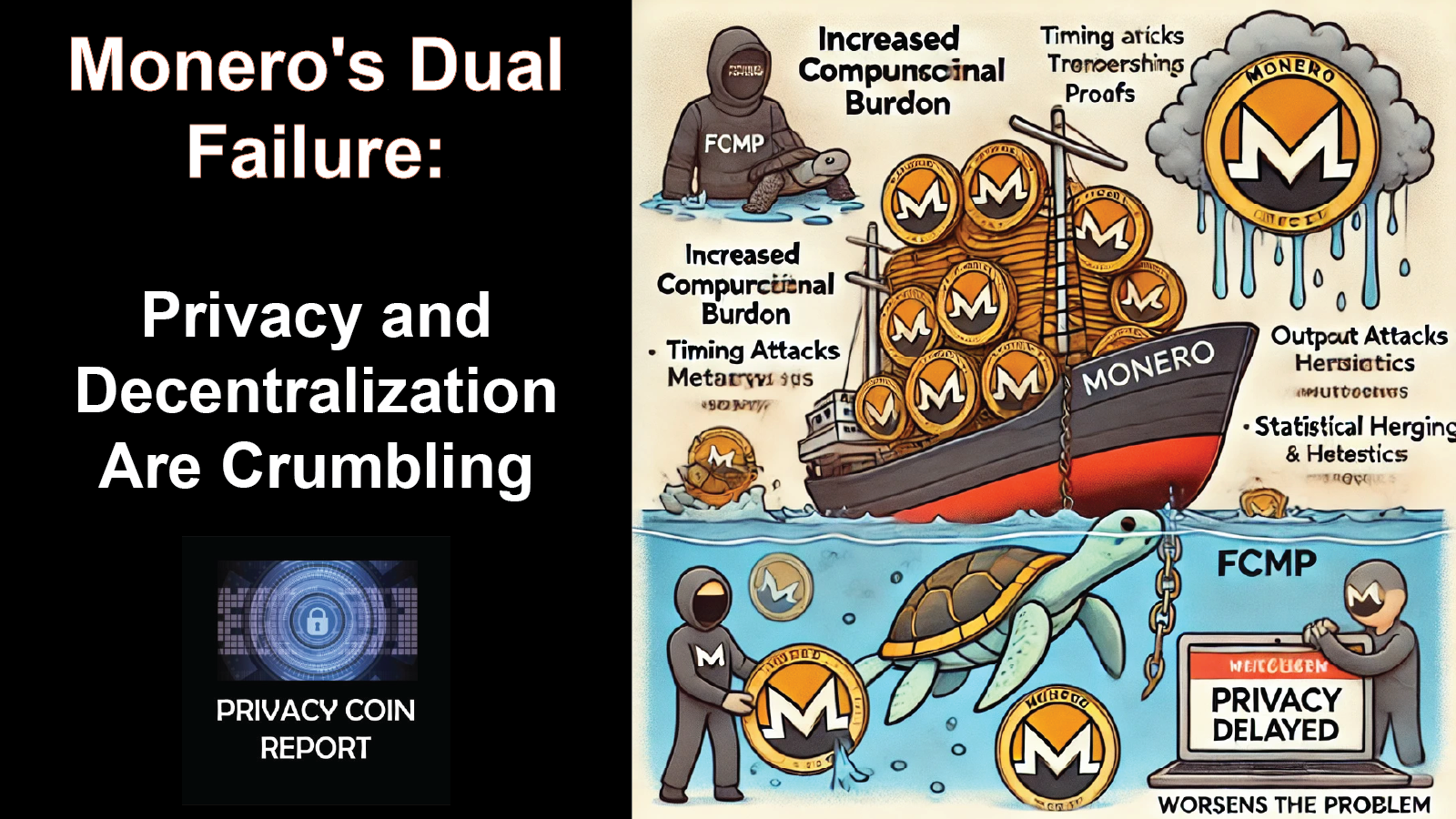
For years, Monero (XMR) was hailed as the gold standard of privacy coins, a cryptocurrency designed to shield users from surveillance and financial tracking. However, the cracks in its armor have grown too large to ignore. From failing privacy guarantees to botnet-driven mining centralization, Monero is no longer the beacon of anonymity it once was. Even its upcoming “Full Chain Membership Proofs” (FCMP++) proposal does little to address these core issues and may, in fact, make things worse.

But not all hope is lost. Ryo Currency ($RYO) took a decentralized approach from day one, choosing GPU mining with CryptoNight-GPU and a fair, egalitarian emission schedule to ensure widespread coin distribution. Now, Ryo is taking another bold step forward, adopting Halo 2 ZK Proofs and a high-latency mixnet to secure financial privacy while maintaining true decentralization. With a revolutionary Proof-of-Stake (PoS) model on the horizon, Ryo offers a glimpse into the future of private, scalable, and censorship-resistant transactions.

The Failure of Monero’s Privacy Model

Monero’s supposed anonymity has long been its selling point, relying on ring signatures, stealth addresses, and confidential transactions. However, recent research has exposed fundamental weaknesses:

Chainalysis Capabilities

Despite Monero’s privacy claims, blockchain analysis firms and intelligence agencies have demonstrated increasing success in tracing transactions. Unlike ZK-Proof-based systems, Monero’s decoy-based ring signatures have a history of being compromised by statistical heuristics and transaction analysis.

Knacc Attack: Monero’s Early Privacy Failure

The Knacc Attack, first demonstrated by Fireice_UK, the lead developer of Ryo Currency, revealed a major flaw in Monero’s transaction obfuscation. The attack exploits the fact that, in many cases, the real input in a Monero transaction is significantly more likely to be the most recent one compared to the decoys. By using statistical analysis on Monero’s blockchain, researchers were able to strip away decoys and isolate real transaction inputs with high accuracy.

While Monero has since increased its ring size to mitigate this specific attack, the fundamental weakness remains: Monero’s privacy is still probabilistic rather than absolute. Chainalysis and other firms have expanded on this method, refining heuristics to de-anonymize Monero transactions with even greater accuracy.

Real-World Evidence of Monero Tracing

  • In 2020, CipherTrace claimed it had developed Monero-tracing capabilities for the U.S. Department of Homeland Security, despite Monero’s claims of untraceability. (Source)
  • Europol’s 2022 report acknowledged that Monero transactions had been successfully traced, indicating that governments are actively developing Monero-tracking techniques.
  • In the “Breaking Monero” research paper, researchers demonstrated how Monero’s ring signature model could be compromised through transaction graph analysis.

EAE Attack: The Exploit That Bypasses Decoys

The Empirical Anonymity Exploit (EAE) Attack takes advantage of weaknesses in Monero’s transaction selection process, particularly with ring signatures. Monero transactions mix the sender’s real inputs with decoys, but this attack identifies real inputs by analyzing spending habits, network timing, and clustering behaviors.

Researchers have shown that by analyzing the way Monero users select mixins (decoy transactions), a large percentage of transactions can be de-anonymized. The key weaknesses exposed by the EAE attack include:

  • Biased Decoy Selection: Older outputs in a transaction ring are often decoys, while newer outputs are real transactions, making it easier to identify the true sender.
  • Linkability Through Spending Patterns: If a user reuses Monero addresses or consolidates funds, their transactions can be linked over time, further degrading privacy.
  • Network-Level Surveillance: The EAE attack also shows that when combined with metadata leaks at the network level, an adversary can effectively correlate Monero transactions.

Ring Signature Limitations

Monero’s privacy depends on hiding a real transaction within a set of fake decoys. The problem? Older transactions have been shown to be mathematically predictable, and newer transactions are still vulnerable to timing and spending patterns.

The FCMP Mirage: A Flawed Solution

Full-Chain Membership Proofs (FCMP++), Monero’s latest stab at salvaging its crumbling privacy model, are being hyped as a revolutionary leap. Touted as an upgrade from the original FCMP concept, it promises to drown transaction origins in a sea of every past blockchain output—over 100 million and climbing.Yet, this isn’t a breakthrough; it’s a desperate, bloated patch that amplifies Monero’s weaknesses while papering over its fatal flaws.

Crushing Computational Load & Network Collapse

FCMP++ swaps Monero’s modest 16-decoys ring signatures for a cryptographic behemoth: proofs spanning the entire blockchain. Transactions now swell to around 4 KB— quadruple the size of current ones—bringing a cascade of pain:

  • Wallet Sync Nightmares: Syncing a wallet will crawl as users churn through these massive proofs. New adopters, already wary of Monero’s complexity, will flee at the sight of multi-hour wait times.
  • Node Centralization Spiral: Full nodes, Monero’s decentralized backbone, are already groaning under a 200 GB+ blockchain. FCMP++ jacks up CPU and storage demands, pushing resource-strapped hobbyists out and leaving the network in the hands of well-funded hubs—a privacy coin’s death knell.
  • Unsustainable Bloat: The blockchain’s growth, already a sore point, accelerates with FCMP++. At this rate, Monero risks becoming a bloated relic, impractical for anyone without industrial-grade hardware.

Developers wave off these concerns, claiming testnet trials (slated for mid-2025) will smooth things out. But the math doesn’t lie: bigger proofs mean bigger problems, and Monero’s scaling woes are only getting uglier.

Privacy Promises That Don’t Hold Up

FCMP++’s grand pitch—an anonymity set of millions—sounds impressive until you dig into what it doesn’t fix:

  • Timing Attacks Still Bite: Transaction propagation remains unchanged. Sophisticated observers, like chain analysis firms, can timestamp when transactions hit the network, linking them to real-world activity. FCMP++’s bigger haystack doesn’t hide the needle—it just delays the inevitable.
  • Metadata Bleeding Continues: IP leaks via flawed Tor integration and transaction merging (where multiple outputs tie back to one wallet) still expose users. FCMP++ ignores these gaping holes, focusing on sender obscurity while the network screams metadata to anyone listening.
  • Statistical Erosion: Sure, 100 million decoys sound uncrackable—until statistical analysis enters the chat. Patterns in spending habits, output ages, and network traffic chip away at the anonymity set. Research from 2024 already showed Monero’s privacy crumbling under sustained statistical assault; FCMP++ just gives analysts more data to chew on.

Even the much-hyped “forward secrecy” (quantum resistance) feels like a gimmick when today’s adversaries—governments and botnets alike—don’t need quantum tech to deanonymize you. They’re already doing it with timing and metadata.

FCMP++: Trading Usability for a False Shield

The cruel irony? FCMP++ doesn’t just fail to plug Monero’s leaks—it makes the user experience worse. Longer syncs, pricier nodes, and a fatter blockchain erode what little usability Monero had left.

This isn’t progress; it’s a mirage. Monero’s sinking ship—riddled with traceable transactions (some estimate 30%+ are partially deanonymized)—can’t be saved by a fancier bucket. FCMP++ heaps technical debt onto a network already buckling under scrutiny from chain analysis tools like CipherTrace, which cracked Monero cases in 2024. Users cling to a false sense of security while adversaries sharpen their knives.

FCMP: A Solution That Makes Monero Worse

The worst part? FCMP not only fails to fix Monero’s privacy issues—it actually makes things worse. By adding heavier cryptographic proofs and slowing down transaction validation, Monero is sacrificing usability without actually solving its privacy leaks. Users will suffer longer wait times, higher resource costs, and reduced efficiency, only to remain vulnerable to blockchain analysis techniques that have already been proven effective.

This is the true FCMP Mirage—a mirage of improved privacy that disappears the moment you examine its technical shortcomings. Instead of making Monero more private, it is only delaying the inevitable collapse of Monero’s anonymity. Monero users are left with a false sense of security, while adversaries continue to refine their de-anonymization techniques. The sinking ship of Monero privacy cannot be patched—it is going down, and FCMP is nothing more than a bucket trying to bail out water from a collapsing hull.

Operation Endgame & Stary Dobry: The Unraveling of Monero

Operation Endgame and Stary Dobry are two examples of global efforts targeting illicit cyber activities, including Monero transactions.

  • Operation Endgame: A collaborative effort by law enforcement agencies to track and shut down cybercriminal networks using privacy coins like Monero. Blockchain forensics, combined with timing attacks and metadata analysis, have been used to trace Monero transactions back to individuals.
  • Stary Dobry: A European cybercrime investigation that revealed the use of Monero in illegal marketplaces, leading to increased scrutiny and efforts to break its anonymity.

To understand the severity of Monero’s botnet problem and its implications for privacy and decentralization, watch this video:

These operations prove that Monero’s so-called untraceable transactions are, in fact, vulnerable to sophisticated tracking techniques.

Monero’s Decentralization Problem: The Botnet Curse

Beyond privacy failures, Monero’s mining ecosystem has become centralized in the worst possible way: through botnets. Instead of large mining farms, Monero’s mining algorithm—RandomX—has enabled a different kind of centralization where infected computers and compromised systems contribute hash power unknowingly.

How Botnets Control Monero Mining

  • Massive Hidden Hashrate: Monero’s botnet mining problem has led to malware-infected computers contributing substantial portions of the network hashrate. Infected machines unknowingly mine for hackers, further centralizing control over Monero’s blockchain.
  • Reduced Real-World Participation: Honest miners cannot compete with botnets running on thousands of compromised machines. As a result, real users who wish to participate in securing the network are disincentivized, further consolidating mining power in the hands of attackers.
  • No Real Decentralization: While Monero avoids ASIC domination, the trade-off has been an environment where shadowy actors—rather than a healthy, distributed miner base—control the network. This is a centralization nightmare wrapped in the illusion of “egalitarian mining.”

Ryo Currency: Designed for True Decentralization from the Start

Unlike Monero, Ryo Currency built its foundation on decentralization from day one.

  • GPU Mining for Everyone: By using CryptoNight-GPU, Ryo ensured that mining was open to a broad range of users rather than favoring botnets or a narrow group of high-end CPU miners.
  • Egalitarian Emission Schedule: Unlike Monero, which launched with a stealthy premine benefiting early adopters, Ryo Currency followed a fair emission schedule that allowed organic distribution.

This commitment to fairness ensured that Ryo’s coin supply was widely distributed, rather than being concentrated in the hands of a select few.

Enter Ryo Currency: The Future of Private Transactions

With Monero failing both in privacy and decentralization, where does that leave the future of private cryptocurrencies? Ryo Currency has stepped up with an innovative approach that will redefine privacy, scalability, and fairness in the crypto space.

Halo 2 ZK Proofs: The End of Transaction Traceability

Unlike Monero’s flawed decoy-based privacy, Ryo Currency is implementing Halo 2 Zero-Knowledge Proofs (ZKPs)—a cryptographic advancement that removes the need for decoys entirely.

  • Absolute Anonymity: ZKPs provide full transaction privacy without the need for rings, eliminating statistical weaknesses.
  • Scalability: Unlike Monero, where larger anonymity sets increase computational complexity, Halo 2 allows for privacy without compromising efficiency.
  • No More Decoy Attacks: Because Halo 2 doesn’t rely on misleading transaction outputs, adversaries cannot exploit heuristics to de-anonymize users.

High-Latency Mixnet: The Ultimate Privacy Shield

Monero transactions are susceptible to timing attacks and network-level surveillance. Ryo Currency’s high-latency mixnet solves this issue by obscuring the origins and destinations of transactions at the network level.

  • Breaking Metadata Analysis: Transactions are relayed through multiple nodes with high latency, making traffic analysis nearly impossible.
  • Defeating Global Adversaries: Even if an entity controls a large portion of the network, the mixnet ensures that no single observer can link sender and receiver.

Proof-of-Stake: Security Without Botnets

To break free from the mining centralization that plagues Monero, Ryo Currency is preparing for a transition to a Proof-of-Stake (PoS) model.

  • Eliminating Botnets: PoS removes the incentive for malware-driven mining, securing the network with honest participation.
  • Energy Efficiency: Unlike Monero’s CPU-heavy mining, which wastes power and fuels botnet expansion, PoS provides security without massive computational waste.
  • Network Governance: PoS allows for on-chain decision-making, reducing the risk of contentious hard forks that have split Monero’s community multiple times.

Conclusion: A New Era of Privacy is Here

Monero’s mission of financial privacy and decentralization has been undermined by its own outdated technology and vulnerability to malicious actors. The failure of its privacy model—combined with the botnet-driven centralization of its mining network—means that Monero is no longer the privacy solution it once claimed to be.

Ryo Currency, built from the start with GPU mining and a fair emission schedule, has proven that true decentralization is possible. Now, with its adoption of Halo 2 ZK Proofs, a high-latency mixnet, and a transition to Proof-of-Stake, Ryo is poised to take privacy cryptocurrency to the next level. The time for broken decoys and centralized botnets is over. The future belongs to truly private, scalable, and decentralized cryptocurrencies—Ryo Currency is leading the way.

The world of privacy-focused cryptocurrencies like Monero ($XMR) has long been celebrated for its commitment to decentralization and anonymity. However, beneath its promise of financial sovereignty lies a troubling vulnerability: botnets. These networks of compromised devices, often controlled by illicit operators, have exploited Monero’s mining ecosystem, raising questions about its security, decentralization, and even its design philosophy. This article explores the interplay between botnets and Monero, the evolution of mining algorithms, high-profile operations like Operation Endgame and Stary Dobry, the risks of a 51% attack, and how Ryo Currency ($RYO) offers a compelling alternative with its botnet-resistant approach and forward-thinking innovations.


Botnets and Monero: A Symbiotic Vulnerability?

Botnets—networks of hijacked computers, phones, and IoT devices—have become a pervasive force in cryptocurrency mining, particularly with Monero (XMR). Monero’s original mining algorithm, CryptoNight, was designed to democratize mining by favoring CPUs over specialized hardware like GPUs or ASICs. The idea was noble: anyone with a basic computer could participate, fostering a decentralized network. However, this CPU-friendly design inadvertently opened the door to botnets, which thrive on exploiting vast numbers of low-powered, compromised devices.

Unlike Bitcoin, where mining is dominated by energy-intensive ASIC rigs, Monero’s accessibility made it a prime target for “cryptojacking”—the unauthorized use of victims’ devices to mine cryptocurrency. Botnet operators could harness thousands, even millions, of CPUs to generate significant hashrate, reaping profits without the overhead of legitimate miners. This dynamic has fueled a persistent debate: does Monero’s design unintentionally favor botnets, and if so, does it undermine the coin’s decentralized ethos?

By contrast, Ryo Currency emerged as a response to these flaws. Built on the CryptoNight-GPU algorithm, Ryo shifts mining away from CPUs and botnets, requiring high memory bandwidth and parallel processing capabilities that GPUs excel at but CPUs—and thus botnets—struggle to match. Ryo’s approach prioritizes ethical, decentralized mining over the exploitable accessibility of Monero’s early design.


The Evolution of Mining Algorithms: From CryptoNight to RandomX

Monero’s mining algorithm has evolved significantly since its inception. CryptoNight, introduced with the CryptoNote protocol, aimed to resist ASICs by leveraging memory-intensive computations suited to general-purpose hardware. However, as ASICs adapted and botnets proliferated, Monero faced a dual threat: centralized hardware dominance and illicit mining networks.

In response, Monero forked its algorithm multiple times, culminating in the adoption of RandomX in 2019. RandomX further emphasized CPU mining by introducing randomized code execution, making it harder for ASICs and GPUs to compete. The goal was to restore fairness and decentralization. Yet, this shift doubled down on CPU accessibility, leaving the door ajar for botnets. Critics argue that RandomX, while ASIC-resistant, inadvertently cemented Monero’s appeal to botnet operators, who could still leverage vast networks of hijacked CPUs.

Ryo Currency took a different path. Its CryptoNight-GPU algorithm, introduced in 2018, targets GPU mining explicitly, sidelining CPUs and their botnet vulnerabilities. By requiring high memory bandwidth and parallel processing, CryptoNight-GPU raises the technical bar for mining, deterring low-effort botnet dominance while remaining resistant to ASICs and FPGAs. This design reflects Ryo’s commitment to fair, decentralized mining without sacrificing security—a stark contrast to Monero’s botnet-friendly evolution.


The Botnet Conspiracy: Does Monero Intentionally Favor Illicit Mining?

A controversial claim within the crypto community suggests that Monero’s developers intentionally designed botnet-friendly algorithms to bolster network security. The argument posits that botnets, by contributing significant hashrate, act as a decentralized “security force,” protecting Monero from 51% attacks by traditional miners or state actors. Proponents might argue that botnets, while illicit, distribute hashrate globally, aligning with Monero’s anti-establishment ethos.

However, this theory lacks evidence and ignores the centralization risks botnets introduce. Operation Endgame, a 2024 Europol-led crackdown on botnet infrastructure, revealed a startling statistic: a single botnet accounted for over 40% of Monero’s hashrate. Far from decentralizing the network, this concentration handed immense power to a single operator, undermining Monero’s core principles. If botnets were a deliberate design choice, it would represent a Faustian bargain—security at the cost of integrity.

Ryo Currency rejects this approach outright. Its developers argue that true decentralization requires fair participation, not reliance on illicit actors. CryptoNight-GPU’s botnet resistance ensures that no single entity—legitimate or otherwise—can dominate the network, aligning Ryo with a purer vision of decentralized mining.


Operation Endgame: A Wake-Up Call for Monero

Operation Endgame, launched in May 2024, was the largest coordinated effort against botnets to date. Targeting “dropper” malware used to deploy Monero miners, the operation disrupted networks responsible for cryptojacking on an industrial scale. Post-operation data showed a dramatic drop in Monero’s hashrate—estimated at 40%—highlighting how reliant the network had become on a single botnet. This event exposed Monero’s vulnerability: its decentralized facade masked a centralized reality, where illicit operators held sway.

The implications were profound. If 40% of the hashrate could vanish overnight, what prevented a coordinated botnet from pushing past 51%? Unlike Monero, Ryo’s CryptoNight-GPU algorithm disperses mining power across GPU users, reducing the risk of such extreme concentration. Operation Endgame underscored the need for botnet-resistant designs—something Ryo had already embraced.


Stary Dobry: Game Torrents Turned Mining Machines

The Stary Dobry attack, uncovered in early 2025 by Kaspersky, further illustrated Monero’s botnet problem. Cybercriminals laced game torrents—popular titles like Garry’s Mod and Dyson Sphere Program—with hidden XMRig miners, transforming players’ PCs into nodes of a massive Monero-mining botnet. This operation, named after a Polish phrase meaning “Old Good,” exploited Monero’s CPU-friendly RandomX algorithm, amassing significant hashrate while raising alarms about network security.

Stary Dobry wasn’t just a profitability scheme; it was a demonstration of Monero’s exploitable design. By contrast, Ryo’s GPU-focused mining would have rendered such an attack far less effective. CPUs infected via torrents lack the computational power to mine CryptoNight-GPU efficiently, limiting the impact of similar schemes and protecting Ryo’s network integrity.


The 51% Attack Threat: What Botnets Could Do

A 51% attack occurs when a single entity controls over half of a network’s hashrate, granting them the ability to manipulate the blockchain. For Monero, this could mean censoring transactions, double-spending coins, or undermining trust in its privacy features. Operation Endgame’s 40% figure suggests that a 51% attack is not hypothetical but plausible, especially if botnet operators collaborate or pool resources.

If botnets achieved majority hashrate, they could:

  • Censor Transactions: Block specific payments, disrupting Monero’s utility.
  • Double-Spend: Spend the same coins twice, defrauding users or exchanges.
  • Erode Trust: Expose Monero’s privacy as contingent on the goodwill of illicit actors.

The cost of such an attack, while high, diminishes when botnets—already profitable—coordinate. Monero’s total hashrate hovers around 2-3 GH/s, meaning a botnet with 1.2 GH/s (as one expert estimated) could tip the scales with allies. Ryo’s botnet resistance raises this threshold, requiring attackers to invest in GPU infrastructure rather than relying on hijacked CPUs—a costlier and less scalable endeavor.


Monero’s Front-Loaded Emission: Botnets and Supply Control

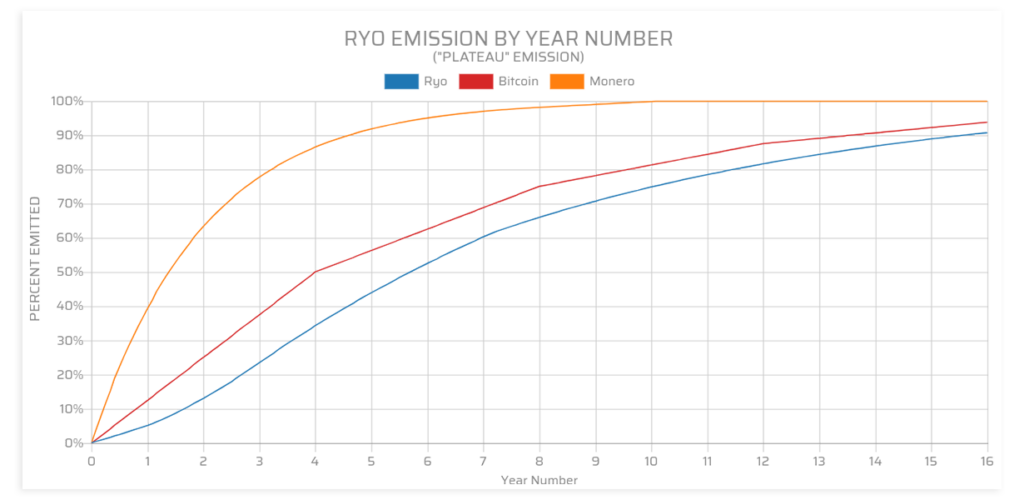
Monero’s emission schedule is front-loaded, with most of its 18.4 million coins mined in the first few years after its 2014 launch. By 2025, the tail emission (0.6 XMR per block) sustains the supply, but early miners—including botnets—reaped disproportionate rewards. Critics argue that botnets, active since Monero’s infancy, now control a significant portion of its circulating supply, centralizing wealth and influence.

Ryo Currency, launched in 2018, opted for a fairer approach: a 20-year emission schedule that gradually distributes its supply. This design prevents early dominance by botnets or whales, ensuring broader participation. While Monero’s front-loaded model rewarded early adopters (and botnets), Ryo’s gradual emission aligns with its ethos of democratization and resilience.


Ryo Currency: A Botnet-Resistant Alternative

Ryo Currency stands out as a privacy coin engineered to avoid Monero’s pitfalls. Its CryptoNight-GPU algorithm targets GPUs, sidelining CPUs and botnets while resisting ASICs and FPGAs. This shift doesn’t eliminate 51% attacks—no coin can—but it disperses power, making dominance harder to achieve. Ryo’s 20-year emission further democratizes its supply, contrasting with Monero’s botnet-favored early distribution.

Beyond mining, Ryo is exploring future-proofing through Proof-of-Stake (PoS) with Halo 2 zero-knowledge proofs. Traditional PoS on CryptoNote compromises privacy by requiring public stake selection, weakening ring signatures. Halo 2 zk-proofs, however, allow private stake validation, hiding amounts, ownership, and participation. This innovation could make Ryo the first fully private PoS privacy coin, blending security with anonymity.


Proof-of-Stake on CryptoNote: Challenges and Innovations

Adding PoS to CryptoNote coins like Monero or Ryo could mitigate botnet influence by reducing reliance on mining hashrate. A hybrid PoW/PoS model—say, 50% of blocks staked—could dilute botnet power while maintaining decentralization. However, PoS introduces privacy risks: stake selection exposes metadata, linking outputs and weakening anonymity.

Projects like Zano ($ZANO) have pioneered hybrid PoS with hidden amounts, but their solutions fall short of full privacy. Ryo’s pursuit of Halo 2 zk-proofs offers a breakthrough, enabling a PoS system where no information leaks. This vision contrasts with Monero’s PoW-only stance, which some defend as “fair” but leaves it exposed to botnets.


Conclusion: A Tale of Two Privacy Coins

Monero’s journey—from CryptoNight to RandomX—reflects a struggle to balance accessibility with security. Yet, Operation Endgame and Stary Dobry reveal a harsh truth: its botnet-friendly design has centralized power in illicit hands, risking 51% attacks and supply control. Ryo Currency, with its CryptoNight-GPU algorithm, fair 20-year emission, and Halo 2 aspirations, offers a counterpoint—a privacy coin that prioritizes decentralization without compromising on ethics or resilience.

As the crypto landscape evolves, the choice between Monero’s accessibility and Ryo’s resistance will shape the future of private, decentralized finance. Botnets may profit in the shadows, but coins like Ryo prove that privacy and fairness need not come at the cost of security.