

God, State, and Network: Why Ryo Currency Is the Money of the Network Leviathan
I. Introduction: The Three Leviathans
Throughout history, human societies have organized around a single question: what is the most powerful force in the world? The answer has shifted across centuries, and with it, the nature of money itself.
In his landmark book The Network State, Balaji Srinivasan offers a framework for understanding this evolution. He identifies three Leviathans—three supreme forces that have shaped human behavior across eras: God, the State, and the Network [1]. Each Leviathan commanded ultimate allegiance, and each produced its own form of money.
This article explores Srinivasan’s framework and applies it to the present moment. It argues that we are witnessing the ascendance of the third Leviathan—the Network—and that Ryo Currency represents the purest expression of Network money: private, decentralized, uncensorable, and belonging to no state. In a world where the State’s money is increasingly programmable, surveilled, and freezeable, Ryo offers something fundamentally different: economic sovereignty.
II. The 1800s: God as Leviathan
In the 19th century, the most powerful force in the world was God. This is difficult for secular moderns to fully grasp, but as Srinivasan notes, “people didn’t steal because they actually feared God. They believed in a way that’s hard for us to understand, they thought of God as an active force in the world, firing-and-brimstoning away” [1].
The God-fearing man could be trusted even when no human was watching, because he believed an omniscient observer recorded his every action. This internalized surveillance was more effective than any police force. Communities wanted god-fearing men in power, because a leader who genuinely believed in eternal damnation would behave well even if no earthly power could punish him.
The Theological Foundations of Money: World Religions and Economic Ethics
Every major faith tradition has grappled with the relationship between money and morality. Below is a survey of how different traditions have understood this relationship—each offering unique insights that remain relevant as we consider the Network Leviathan.
| Tradition | Core Texts / Sources | View of Money | Modern Parallel |
|---|---|---|---|
| Protestantism | Weber, Protestant Ethic [22][23] | Work as calling, accumulation as sign of grace, ascetic reinvestment. The Protestant work ethic provided the psychological foundation for modern capitalism. | Bitcoin as “digital gold,” proof-of-work as labor, accumulation as virtue |
| Catholicism | Vatican’s Mensuram Bonam (2022), USCCB guidelines [31][34][37] | Investments must align with human dignity; formal cooperation with evil is never permissible; material cooperation must be scrutinized. The universal destination of goods means wealth has a social function [31]. | Catholic-aligned investment screens, avoidance of abortion/pornography funding, ethical DAOs |
| Orthodox Christianity | Philanthropia tradition, oikonomia concept [32][33] | Philanthropia (love of humanity) requires wealth to serve community; oikonomia (stewardship) balances mercy with principle; theosis (deification) involves just economic relations. Economic life is a path to holiness. | Community wealth funds, ethical investment trusts, transparent stewardship |
| Islam | Visser, Islamic Finance [24] | Riba (interest) forbidden, risk-sharing required, asset-backed transactions. Money must be tied to real economic activity; speculation is prohibited. | DeFi protocols, smart contracts, profit-sharing models, halal investment screens |
| Hinduism | Kautilya, Arthashastra [25][26] | Dharma (moral duty) governs commerce; state-regulated markets with welfare obligations; loans, deposits, property rights detailed in ancient law. Wealth must be pursued within ethical bounds. | Network state governance, ethical business practices, stakeholder capitalism |
| Sikhism | Guru Granth Sahib [2][35][36] | Kirat Karo (honest labor), Vand Chhako (share with others), daswandh (tithe of time and resources), rejection of exploitation. Wealth is not sinful, but hoarding and exploitation are. | Fair labor practices, community wealth sharing, langar as universal basic services, treasury DAOs |
| Judaism | Judt, Capitalism and the Jews [27] | Diaspora finance developed trust-based networks across borders; ethical lending required; charity (tzedakah) is obligation, not option. The Talmud contains extensive commercial law. | Borderless cryptocurrency, peer-to-peer trust, decentralized finance |
| Buddhism | Schumacher, Buddhist Economics (1966) | Right livelihood requires work that harms no living being; non-attachment to material goods; moderation in consumption; compassion in economic relations. | Sustainable crypto, proof-of-stake as less energy-intensive, mindful consumption, regenerative finance |
| Confucianism | Analects, Mencius [3][38] | Yi (righteousness) over Li (profit),义利之辨. The famous Confucian principle “yi yi sheng li” (righteousness generates profit) holds that ethical behavior ultimately produces wealth. Trust-based relationships are the foundation of commerce. | Long-term stakeholder value, ethical corporate governance, trust-based capitalism, relationship banking |
| Taoism | Tao Te Ching, Chuang Tzu | Wu-wei (non-action) in economic affairs—markets function best with minimal interference; simplicity and harmony with natural rhythms; rejection of excessive accumulation. | Decentralization, minimal regulation, organic market order, non-coercive systems |
| Indigenous Traditions | Oral traditions, earth-based ethics | Stewardship rather than ownership; reciprocity in exchange; seventh-generation thinking—decisions should benefit descendants seven generations hence. | Sustainable blockchain, proof-of-environment, regenerative finance, intergenerational DAOs |
This remarkable convergence across traditions reveals that money has always been moral. Every civilization, every faith, has grappled with the same question: how to align economic activity with ethical values. The Network Leviathan does not escape this question—it returns us to it.
Secular Moral Philosophy
Beyond revealed religion, secular philosophy has also grappled with the moral foundations of markets. Adam Smith’s The Theory of Moral Sentiments (1759) argued that markets require an internalized moral compass—the “impartial spectator” within each person who judges our actions. Before the State enforced contracts, conscience (understood as God’s voice or innate moral sense) did [28].
Amartya Sen’s Development as Freedom (1999) argues that true economic development requires the expansion of human capabilities and freedoms. State-controlled money often restricts rather than enables these freedoms—it becomes a tool of control rather than liberation [29].
III. The 1900s: The State as Leviathan
By the late 1800s, Nietzsche pronounced that “God is dead.” What he meant was that a critical mass of the intelligentsia no longer believed in God in the same way their forefathers had. In the absence of God, a new Leviathan rose to pre-eminence: the State [1].
The 20th century became the era of State-worship. Communism, fascism, and democratic capitalism all centered the State as the most powerful force on earth. Why didn’t you steal? Because even if you didn’t believe in God, the State would punish you. The full displacement of God by the State led to the giant wars of the 20th century—conflicts between different visions of what the State should be [4].
The money of this era reflected its Leviathan. Fiat currency—money backed by nothing but the “full faith and credit” of the issuing government—became the global standard after Nixon closed the gold window in 1971 [4]. This money was the State’s money: it could be printed at will, surveilled through banking systems, and frozen at the State’s pleasure. The weaponization of finance after Russia’s 2022 invasion of Ukraine, when the U.S. and its allies froze approximately $300 billion in Russian central bank assets, demonstrated just how fully State money remains under State control [5].
Secularization and the State’s Capture of Money
Tony Judt’s observation: The renowned historian documented in Capitalism and the Jews and his broader work how 20th century intellectuals transferred their faith from religion to the State. The State became the new object of devotion, and with it, State money became the new sacrament [27].
The Decline of Trust in Institutions
Trust in government and financial institutions has fallen dramatically across developed economies, while cryptocurrency adoption has risen in regions where institutional trust is lowest [6].
Source: Cornell Bitcoin Club survey (2025) [7]
IV. The 2000s: The Network as Leviathan
Now we arrive at the present. As Srinivasan observes, “it is not just God that is dead. It is the State that is dying. Faith in the State is plummeting” [1]. A 2025 Cornell University survey across 25 countries found Bitcoin’s average trust score at just 4.67 out of 10—but in ten countries, including Brazil, Nigeria, Turkey, and Venezuela, trust in Bitcoin actually exceeded trust in national governments [7]. Where institutions fail, people look for alternatives.
The new Leviathan is the Network—the internet, social media, and crucially, cryptocurrency. As Srinivasan puts it, “encryption > State violence. It doesn’t matter how many nuclear weapons you have; if property or information is secured by cryptography, the state can’t seize it without getting the solution to an equation” [1].
The Return of Theological Questions
The Network Leviathan brings us full circle to the questions Weber, Kautilya, and the world’s faith traditions asked. If Protestantism made accumulation a sign of grace, Network money makes privacy a sign of sovereignty. If Smith’s “impartial spectator” was once God’s voice, in the Network it becomes cryptographic consensus—code that judges transactions without bias or favor.
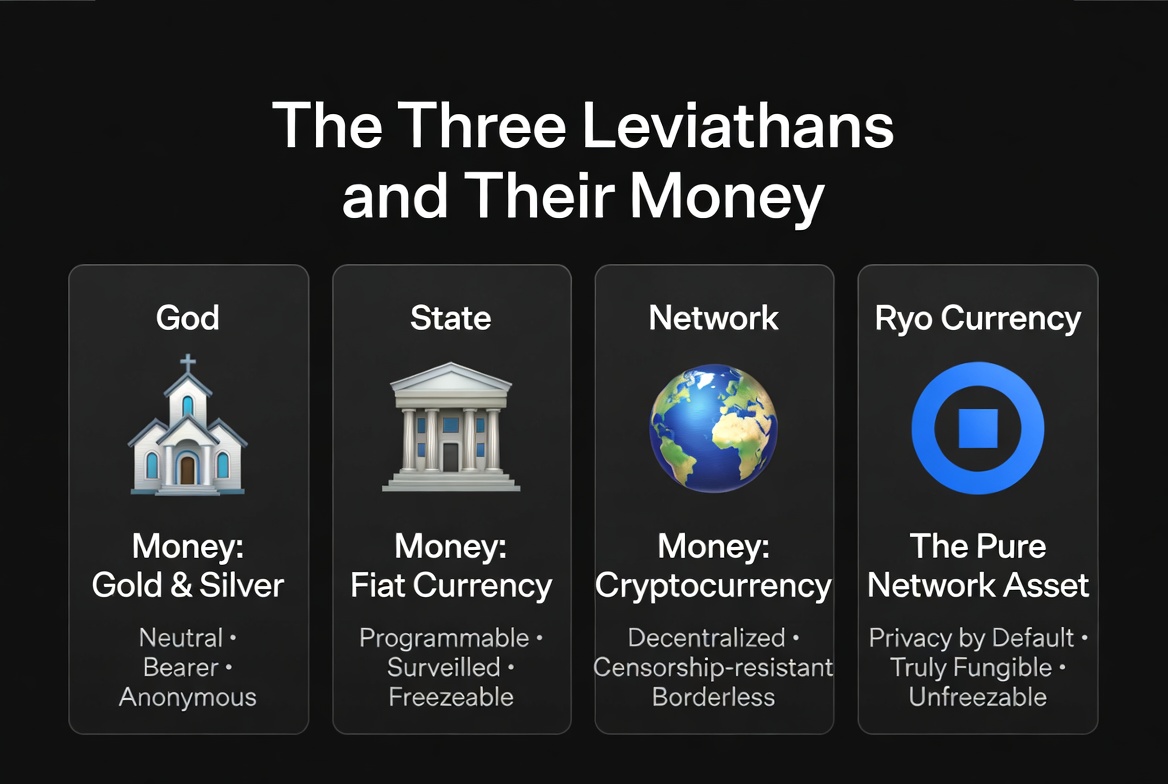
The Three Leviathans and Their Money
V. Money and the Three Leviathans
Each Leviathan produced its characteristic form of money:
- God’s money: Gold and silver. Neutral, anonymous, bearer-based. But physically cumbersome and difficult to move across borders [8].
- State’s money: Fiat currency. Programmable, surveilled, freezeable. Efficient for domestic transactions but vulnerable to political control [4].
- Network’s money: Cryptocurrency. Decentralized, borderless, censorship-resistant. But not all crypto is equal.
Bitcoin pioneered Network money, but its transparency is a double-edged sword. As Ray Dalio noted, Bitcoin “is not going to be a reserve currency for major countries because it can be tracked” [9]. Blockchain analytics firms have built multi-billion dollar businesses tracing Bitcoin transactions, linking addresses to identities, and flagging “tainted” coins [10]. For a dissident, this transparency can be deadly. For a religious community, it reveals who is donating to which causes, exposing believers to persecution.
Regulated stablecoins like USDT and USDC are Network assets in name only. They operate on blockchains but remain subject to issuer freeze powers and OFAC sanctions [11]. They are bridges within the dollar system, not bridges between systems—and certainly not money for communities seeking true sovereignty.
VI. Why Ryo Is the Purest Expression of the Network Leviathan
Ryo Currency was architected from day one to embody the Network Leviathan in its purest form. Every design choice reflects a commitment to true economic sovereignty.
Why Ryo, Not Monero?
Monero is a remarkable privacy project, and its upcoming FCMP++ (Full-Chain Membership Proofs) upgrade represents a significant advancement. Historically, Monero has relied on ring signatures, decoy inputs, and stealth addressing to provide transaction privacy. The FCMP/FCMP++ upgrade expands this model by introducing full-chain membership proofs, dramatically increasing the effective anonymity set and mitigating several known statistical analysis techniques.[39] However, this remains an evolutionary step within Monero’s existing architecture rather than a complete redesign of its privacy model.
Monero continues to operate on a proof-of-work system using the RandomX algorithm, which is intentionally optimized for CPU mining to resist ASIC dominance. While this improves accessibility, it also introduces trade-offs. Proof-of-work systems are inherently energy-intensive and have historically been susceptible to cryptojacking due to CPU-based mining. Large-scale botnet operations can exploit this design to mine covertly, raising concerns about stealth accumulation of supply and distribution fairness. Events such as Operation EndGame and cases like Stary Dobry, highlight how illicit mining infrastructure can be leveraged to concentrate rewards among malicious actors and early operators with asymmetric access to compromised compute resources. Additionally, while governance structures can be built around proof-of-work systems, they are not natively integrated at the protocol level in the same way as staking-based systems.
Ryo takes a fundamentally different approach. According to the official roadmap, Ryo is transitioning to a system that combines Halo 2 zero-knowledge proofs with proof-of-stake, implemented simultaneously.[13][30] Halo 2 eliminates the need for a trusted setup and enables advanced cryptographic constructions for transaction privacy. When combined with a high-latency mixnet at the network layer, this architecture is designed to significantly reduce both on-chain and off-chain traceability.[14]
At the consensus layer, the move to proof-of-stake enables native support for decentralized governance. Staking mechanisms can facilitate on-chain voting, treasury allocation, and coordinated decision-making, forming the foundation for DAO-like structures. This positions Ryo not just as a privacy-preserving currency, but as an integrated economic and governance layer for network-based communities.
For network states, these distinctions matter. When the security of a system depends on adversaries being unable to trace financial flows, governance decisions, or participant relationships, stronger privacy guarantees become essential. At the same time, collective coordination requires mechanisms for decision-making and resource allocation. Ryo is designed to address both dimensions within a single architecture.
Privacy as Asceticism
Just as Calvinists practiced worldly asceticism—work hard, spend little, reinvest the surplus—Ryo users practice digital asceticism. They transact, but leave no trace. This is not evasion but a form of moral discipline, a conscious choice to reject the surveillance that the State Leviathan demands [22].
Fungibility as Justice
Kautilya’s Arthashastra emphasizes equal treatment under law [26]. Ryo’s fungibility ensures all coins are equal—no taint, no blacklists, no two-tier system. This is algorithmic justice, a digital implementation of what every faith tradition demands: fair treatment for all, regardless of history.
Decentralization as Anti-Idolatry
No single entity controls Ryo. This echoes the Protestant rejection of papal authority—no intermediary between the individual and the divine (or, in this case, the network). It resonates with Islamic prohibitions on concentrated financial power [24], Sikh rejection of exploitation [2], and Taoist embrace of organic order.
Fair Distribution as Universal Destination
Ryo launched with no premine, no ICO, and no venture capital allocation. When the chain forked from Sumokoin, 8.79 million pre-mined coins were permanently burned [12]. There is no insider class that can be coerced into compromising the network. This aligns with the Sikh principle of Vand Chhako (sharing with the community) [35], Catholic teaching on the universal destination of goods [31], and Orthodox philanthropia [32].
Next-Generation Privacy
Ryo’s roadmap includes a transition to Halo 2 zero-knowledge proofs, which eliminate trusted setup assumptions and provide mathematically perfect privacy [13][30]. Combined with a high-latency mixnet that obfuscates network-level metadata, Ryo will offer anonymity guarantees that far exceed first-generation privacy coins [14].
VII. Religious Network States and Secular Network States
Before examining how religious communities might organize in the Network era, we must distinguish between different types of network states.
Secular Free-Market Network States
These are communities bound solely by classical liberalism, libertarianism, or market anarchism. They have no moral code beyond voluntary exchange and respect for property rights. Their members may hold diverse religious views, but the state itself is neutral—a platform for voluntary cooperation, not a moral community. Examples might include seasteading communities, charter cities, or crypto-anarchist enclaves. For such networks, privacy is valuable as protection from predation, not as a theological principle.
How They Would Implement on Ryo: For secular network states, Ryo’s architecture provides the perfect foundation precisely because it is morally neutral while offering ironclad guarantees of property rights. Private property enforcement through fungibility ensures that all coins are equal—no taint, no history, no political discrimination. The Non-Aggression Principle can be encoded directly into smart contracts, with dispute resolution handled by decentralized arbitration services like Kleros. Voluntary taxation and public goods funding through quadratic financing become transparent and opt-in. Following the Tiebout model, multiple secular network states could compete for citizens on Ryo’s platform, with citizens voting with their feet—and with their Ryo holdings.
Religious Network States
These are communities bound by shared faith, moral law, and ethical obligations that go beyond mere consent. Their members share a conception of the good, a vision of human flourishing rooted in revelation or tradition. For such communities, privacy is not merely a protection against predation—it is a theological imperative, a way of shielding the sacred from the profane gaze of the State Leviathan.
Why Religious DAOs Would Exist: A secular network state, by design, is morally neutral. It enforces contracts and protects property—but it does not tell you how to live. For many, this is liberating. For religious believers, it is insufficient. Catholicism is not a private preference—it is a public covenant that requires shared worship, shared sacraments, shared moral formation, shared discipline. The same is true for Orthodox Christians, Sikhs, observant Jews, Muslims, and traditional religious communities of all kinds. Their faith cannot be reduced to personal choices within a secular framework. Religious DAOs are not a constraint—they are a liberation. They allow a community to encode its values into the infrastructure of its daily life, while remaining connected to the broader economy through a neutral asset like Ryo.
How Would Regular People Actually Live in This World?
Most people would likely operate within multiple DAOs simultaneously, with different roles and different levels of participation. Ryo’s architecture makes this possible because:
- Privacy by default allows you to prove membership without revealing your identity across all your affiliations.
- Halo 2 ZK-proofs enable you to vote in multiple DAOs without anyone correlating your votes.
- The mixnet prevents surveillance of which DAOs you belong to.
Consider Maria, a Catholic mother of three living in the Austin Free Market Network State (secular). She works as a graphic designer, earning Ryo from clients around the world. Her secular network state provides property rights, dispute resolution, and physical infrastructure—roads, utilities, emergency services—funded through opt-in subscription fees.
But Maria also belongs to the St. Therese Catholic Network State. This is not a separate territory—it is a community of Catholics living in various secular network states, connected by a shared DAO. Every time Maria earns Ryo, a small percentage is automatically directed to the Catholic DAO’s treasury through a smart contract. The amount is private—only Maria and the DAO’s treasury can verify that she is meeting her obligations. The Catholic DAO holds regular votes on how to allocate its treasury: funding a new school, supporting a crisis pregnancy center, maintaining a retirement home for elderly members. Maria votes using Ryo’s Halo 2 privacy features—no one can see how she voted, preventing factionalism or retribution. The Catholic DAO uses its treasury to build and maintain physical institutions—schools, hospitals, nursing homes—located within various secular network states. The secular state provides basic services (fire, police, utilities); the Catholic community provides education, healthcare, and elder care according to its values.
Maria also belongs to a Local Parent-Teacher DAO that governs her children’s school, and a Neighborhood Watch DAO that coordinates security on her block. These are single-issue DAOs that cut across religious lines. Maria votes in each, and Ryo’s privacy ensures that her membership in the Catholic DAO does not affect her participation in these other communities.
The Layered Model of Citizenship
In the network state era, people will likely hold multiple citizenships in multiple DAOs, each governing a different aspect of life:
| Layer | Purpose | Examples | Ryo’s Role |
|---|---|---|---|
| Foundation | Basic rights, property, infrastructure | Secular free-market network states | Neutral asset, property rights |
| Community | Shared values, mutual aid, worship | Religious DAOs, ethnic DAOs | Private treasury, ZK-proof membership |
| Affinity | Single-issue coordination | Hobby DAOs, professional guilds | Micro-transactions, reputation |
| Local | Physical proximity | Neighborhood DAOs, town councils | Physical infrastructure funding |
A person could belong to one foundation DAO, multiple community DAOs, dozens of affinity DAOs, and one local DAO—all using the same Ryo wallet, all protected by the same privacy layer, all governed by the same cryptographic guarantees. This is not fragmentation. It is the reunification of human life under a single, neutral, private economic layer, while allowing maximum diversity in every other dimension.
Freedom of Religion in the Network State Era
Ryo’s architecture actively protects freedom of religion in ways that are impossible under the State Leviathan. Under the State Leviathan, your religious affiliation is often public record. Tax-exempt status requires disclosure. Property ownership reveals which communities are thriving. Donations can be traced, exposing believers to persecution. In many countries, religious minorities are actively surveilled.
Under the Network Leviathan with Ryo, none of this is possible. Your religious affiliation can be proven on a need-to-know basis using ZK-proofs. Your donations are private. Your community’s treasury is visible only to those with the proper cryptographic keys. The size and wealth of your religious community can be hidden from hostile outside forces. This is not a minor feature. For religious minorities facing persecution, it is the difference between survival and extinction.
Ryo enables a new kind of religious freedom: the freedom to be religious without being surveilled. You can participate fully in the secular economy while also participating fully in your religious community. The secular DAO cannot see your religious activities; the religious DAO cannot interfere with your secular obligations. Ryo’s privacy layer ensures that these spheres remain separate, yet you remain a single person with a single wallet.
How Religious Network States Would Implement Their Beliefs Through a DAO Using Ryo
A Catholic Network State
Investment Screening DAO: A committee of theologians and financial experts elected by staked Ryo holders would maintain a dynamic list of prohibited categories (abortion, contraception, pornography, weapons). Smart contracts automatically reject any transaction flagged by oracles as violating these guidelines. Ryo’s privacy ensures that individual voters cannot be targeted for their positions.
Formal vs. Material Cooperation: Catholic moral theology distinguishes between formal cooperation (intentionally participating in evil) and material cooperation (unintentionally facilitating it). Ryo’s privacy ensures that material cooperation cannot be weaponized—since transaction details are hidden, adversaries cannot claim that a Catholic network state “supported” some evil enterprise through a multi-hop transaction they cannot trace.
Universal Destination of Goods: Every transaction could include a micro-donation to a community fund, with donors remaining anonymous but the total accumulated visible on-chain for accountability. The mixnet would ensure that even the fact of donation is hidden from external observers.
An Islamic Finance Network State
Sharia-Compliant Smart Contracts: The DAO maintains a library of audited smart contracts enforcing Islamic financial principles. Profit-sharing (mudaraba) contracts automatically distribute returns based on pre-agreed ratios. Joint venture (musharaka) contracts encode shared ownership and liability. Ryo’s privacy protects business relationships while allowing transparent auditing of contract performance.
Riba-Free Lending: Instead of interest-bearing loans, the network state facilitates qard al-hasan (benevolent loans) through community pools. Lenders receive no interest but gain social credit within the community, recorded in a privacy-preserving reputation system built on Ryo’s ZK-proof layer.
Zakat Automation: The obligatory alms tax is automated through smart contracts that calculate each member’s zakat liability based on their on-chain holdings, while Ryo’s privacy ensures that individual wealth remains hidden from other community members.
A Sikh Network State
Langar as Public Goods: The Sikh tradition of langar—free community meals open to all—is funded through a dedicated DAO treasury. Ryo’s privacy ensures that donors remain anonymous, preventing pride or social pressure, while the DAO’s transparent accounting ensures that funds are actually used for their intended purpose.
Vand Chhako Smart Contracts: A portion of every on-chain transaction is automatically directed to community funds, with members able to opt for higher contribution rates. Ryo’s privacy ensures that individual contributions are not visible, preventing status competition over who gives more.
Daswandh Governance: The one-tenth tithe is managed by a DAO elected by staked Ryo holders. Members vote on which community projects receive funding—whether building new langar halls, supporting widows and orphans, or maintaining gurdwaras. All votes are private, preventing factionalism and retribution.
A Confucian Network State
Stakeholder Governance: Rather than one-coin-one-vote, voting power is weighted by demonstrated virtue and contribution to community harmony. Ryo’s ZK-proofs allow members to prove their participation in community activities, length of membership, and reputation scores without revealing their identities.
Yi Over Li Smart Contracts: All business contracts include clauses that prioritize righteous outcomes over maximum profit. Smart contracts automatically redirect excessive profits to community welfare funds or impose waiting periods on transactions to prevent speculation.
Five Relationships in DAO Structure: The DAO is structured to mirror the five key Confucian relationships, with different governance roles having different responsibilities and voting weights. Ryo’s privacy ensures that role-holders cannot be targeted for their decisions.
An Orthodox Christian Network State
Philanthropia Treasury: A community fund supports charitable works both within and outside the network state. Contributions are private, preventing boasting, while distributions are publicly auditable. Ryo’s mixnet ensures that even the existence of certain charitable projects can be hidden from hostile outside forces.
Oikonomia in Resource Management: The principle of stewardship is encoded in smart contracts that limit resource extraction and ensure sustainable practices. Mining operations dedicate a portion of proceeds to environmental restoration, with compliance verified through oracle networks.
Theosis Through Work: Members earn “virtue tokens”—non-transferable credentials proving participation in community life, charitable works, and righteous conduct. These tokens, issued on Ryo’s privacy-preserving layer, carry weight in governance decisions but remain invisible to outsiders.
A Benedict Option Network State
Monastic Governance Model: The DAO is structured like a Benedictine monastery, with an abbot (or abbess) elected for life and a council of elders. Ryo’s privacy ensures that the community’s internal deliberations remain hidden from the outside world, while the transparent treasury ensures accountability within.
Rule of St. Benedict as Smart Contract: The monastic rule is encoded as a series of smart contracts governing daily life: work schedules, prayer times, communal meals, and hospitality. Members who violate the rule face graduated sanctions encoded in the protocol.
Stability Covenant: Members commit to long-term stability through a staking mechanism—locking Ryo for years at a time, with penalties for early withdrawal. This encodes the Benedictine vow of stability into the economic fabric of the community.
A Jewish Network State
Diaspora Trust Network: Ryo’s privacy and borderless nature perfectly mirror the historical experience of Jewish communities maintaining economic relationships across vast distances. The DAO maintains a reputation system where members can prove their trustworthiness through ZK-proofs without revealing their physical location or identity.
Tzedakah DAO: The obligation of charity is automated through smart contracts that deduct a percentage of every transaction for community welfare. Ryo’s privacy ensures that donors remain anonymous, fulfilling the highest form of tzedakah (where neither giver nor receiver knows the other).
Heter Iska Contracts: Partnership agreements designed to avoid ribbit (interest) while enabling investment are encoded as smart contracts. Profit-sharing ratios are predetermined, with Ryo’s privacy protecting the identities of partners while enabling transparent enforcement.
The Common Thread: Ryo as the Neutral Substrate
What unites all these visions—secular and sacred alike—is that they can coexist on the same neutral asset. Ryo does not impose a moral code; it provides the infrastructure for moral communities to encode their own codes.
For secular communities, Ryo’s privacy protects economic freedom from state predation. For religious communities, that same privacy protects the sacred from profane surveillance. For all, Ryo’s fungibility ensures that no community’s coins are “tainted” by association with another. Its proof-of-stake governance enables each community to structure its DAO according to its own values. Its Halo 2 ZK-proofs enable private voting, private membership, and private dispute resolution—essential for communities that may face persecution.
Why Religious Groups Would Choose Ryo Over Alternatives
- Bitcoin is transparent—it reveals which addresses belong to the community, who is donating to which causes, and how large the treasury is. For a religious community facing persecution or simply valuing privacy, this is unacceptable.
- Zcash offers optional privacy, but this creates a two-tier system where choosing privacy signals that a transaction is “sensitive.” For religious groups, every transaction is equally sacred—none should be marked as suspicious.
- Monero offers strong privacy, but its probabilistic model, lack of Halo 2 integration, and reliance on proof-of-work mean its privacy guarantees are not mathematically absolute, and it cannot natively support DAO governance. For communities whose survival may depend on absolute privacy and collective decision-making, this matters.
- Ryo offers default privacy with mathematically perfect guarantees, proof-of-stake for energy efficiency, and native DAO compatibility for on-chain governance. No transaction is distinguishable from any other. All are equal before God and before the Network. This is true fungibility, and it is the only architecture that respects the equal dignity of every economic act while enabling self-governance.
The mechanics of how these communities would govern themselves—through DAOs, private voting, and Halo 2 zero-knowledge proofs—will be explored in the next article of this series. For now, recognize that the foundation exists: a neutral, private, uncensorable asset that can serve any community, secular or sacred.
VIII. The Network State and Network Money
Srinivasan’s vision of the network state—a digitally organized community that crowdfunds territory and eventually gains diplomatic recognition—requires a native currency [15]. That currency must be:
- Unfreezable: No single state can seize the treasury.
- Private: The community’s economic activity must not be visible to rivals.
- Decentralized: No single point of failure can compromise the network.
- Fairly distributed: No insider class can be coerced.
- Governable: The community must be able to make collective decisions on-chain.
Ryo meets all these requirements. Its transition to proof-of-stake and DAO integration will make it the first cryptocurrency architected specifically for network state governance. Ryo enables what Weber called “elective affinity”—the alignment of economic behavior with moral conviction [22]. Network states choose Ryo because its architecture aligns with their values, whether those values are secular or sacred.
IX. Conclusion: Choosing Your Leviathan
The choice is not abstract. Every person, every day, votes with their wallet for which Leviathan they serve.
Those who serve the State accept freezeable, surveilled money. They trust that the institutions that froze Russian assets, deplatformed Canadian truckers, and inflated away purchasing power will somehow spare them.
Those who serve the Network choose assets that cannot be controlled. They recognize that when institutions fail—and they will fail—cryptocurrency is the backup system [40].
The choice is also between different visions of what money should be. Weber showed that Protestantism made accumulation a sign of grace. Catholic social teaching insists that investments must respect human dignity [31]. Orthodox Christianity requires philanthropia in economic life [32]. Islamic finance prohibits interest and demands risk-sharing [24]. Sikhism requires honest labor and sharing with others [2][35]. Confucianism prioritizes righteousness over profit [3][38]. Ryo’s architecture can support all of these visions.
Ryo Currency is the Network’s answer to State money. Private by default. Decentralized by design. Unfreezable by construction. Governable by community. In a world where God has receded and the State is dying, Ryo offers something the old Leviathans never could: true economic sovereignty.
As Srinivasan puts it, “The choice is clear. Either Zcash or communism” [17]. With AI amplifying surveillance capabilities, any online information fragment can now be integrated into comprehensive personal profiles. If encryption becomes the default, “there are no complete lists. No fixed location. They cannot hit what they cannot see.”
In the age of the Network, sovereignty is no longer granted. It is compiled.
X. Call to Action
- Read Balaji Srinivasan’s The Network State. Understand the framework of the three Leviathans and the path to digital sovereignty.
- Study the religious and ethical traditions that have shaped economic morality across civilizations—Weber, Kautilya, the Vatican’s Mensuram Bonam, Islamic finance, Sikh teachings, Orthodox philanthropy, Confucian ethics, and more.
- Choose assets that belong to no state. Learn about Ryo Currency and the architecture of true economic sovereignty.
- Prepare for the next article in this series, which will explore the technical architecture of network states—how DAOs, Halo 2 zero-knowledge proofs, and proof-of-stake governance will enable religious and secular communities to build their digital nations on Ryo.
The era of God is over. The era of the State is ending. The era of the Network has begun.
References & Further Reading
- [1] Srinivasan, Balaji. The Network State: Chapter 2, Section 2.4 “God, State, Network”
- [2] SikhiWiki: Wealth and Poverty
- [3] Rajapaksha, et al. “Balancing Profit and Morality: Confucian Insights into Financial Management.” Vidyodaya Journal, 2024.
- [4] IMF: The End of the Bretton Woods System
- [5] IMF Blog: How Economic Sanctions Can Affect Cross-Border Transactions
- [6] IE University: Lack of trust in public institutions leads to cryptocurrencies
- [7] Cornell Bitcoin Club: Bitcoin Trust Survey 2025
- [8] Investopedia: Gold Standard
- [9] Steve Hanke on X: Ray Dalio on Bitcoin, Nov 22, 2025
- [10] Gate.com: Privacy Coins Analysis
- [11] Yahoo Finance: Billionaire Says Stablecoins Could Power Global Payments
- [12] Ryo Currency GitHub Repository
- [13] Ryo News: How Ryo Currency is Redefining Privacy
- [14] Cypherphunks: Mix Networks
- [15] Srinivasan, Balaji. The Network State: Chapter 5, Section 5.3 “On Network States”
- [16] Bitget: Srinivasan on Crypto as Backup System
- [17] Huobi: Balaji on Zcash vs Communism
- [18] CypherHunter: Ryo Currency
- [19] Moneropedia: Fungibility
- [20] Bitget Wiki: What is Ryo Currency?
- [21] Srinivasan, Balaji. The Network State: Chapter 4, Section 4.5 “American Anarchy, Chinese Control, International Intermediate”
- [22] Britannica: The Protestant Ethic and the Spirit of Capitalism
- [23] Wikipedia: The Protestant Ethic and the Spirit of Capitalism
- [24] Visser, Hans. “Islamic Finance: Principles and Practice.” Edward Elgar Publishing, 2013. Publisher Link
- [25] Kautilya. “The Arthashastra.” 4th Century BCE. Translated by R. Shamasastry, 1915. Archived Text
- [26] Sihag, Balbir S. “Kautilya on Administration of Justice During the Fourth Century B.C.” Journal of the History of Economic Thought, Cambridge University Press, 2007. Cambridge Core
- [27] Wikipedia: Tony Judt
- [28] Smith, Adam. “The Theory of Moral Sentiments.” 1759. Adam Smith Institute
- [29] Sen, Amartya. “Development as Freedom.” Oxford University Press, 1999. OUP
- [30] Halo 2 Documentation
- [31] Archdiocese of San Antonio: How should Catholics manage their money
- [32] Greek Orthodox Archdiocese: The Orthodox Christian Understanding of Economics
- [33] Orthodox Ethos: Orthodox Christianity and Economic Ethics
- [34] The Catholic Messenger: Investing in line with Catholic teaching
- [35] Wikipedia: Vand Chhako
- [36] Sikh Awareness: Gurmat & Economics
- [37] The Catholic Messenger: Faith and finances do not have to be at odds
- [38] China Confucius Network: 义利之辨:人文经济学视野下的儒商精神
- [39] Monero: FCMP++ Proposal
- [40] When Institutions Fail: Balaji Srinivasan, Network States, and the Architecture of Economic Sovereignty
- Ryo News: The Yuan Ultimatum (Mar 14, 2026)
- Ryo News: The End of Free-Floating Fiat (Mar 16, 2026)
- Ryo News: The Human Chokepoint (Mar 15, 2026)
- Ryo News: The Prophet and the Hedge Fund King (Mar 16, 2026)
- Ryo News: The Digital Bloc Era (Mar 18, 2026)
This article is the sixth in an ongoing series. Read the first: The Yuan Ultimatum. Read the second: The End of Free-Floating Fiat. Read the third: The Human Chokepoint. Read the fourth: The Prophet and the Hedge Fund King. Read the fifth: The Digital Bloc Era. The next article will explore the technical architecture of network states—how DAOs, Halo 2 zero-knowledge proofs, and proof-of-stake governance will enable communities to build their digital nations on Ryo.