


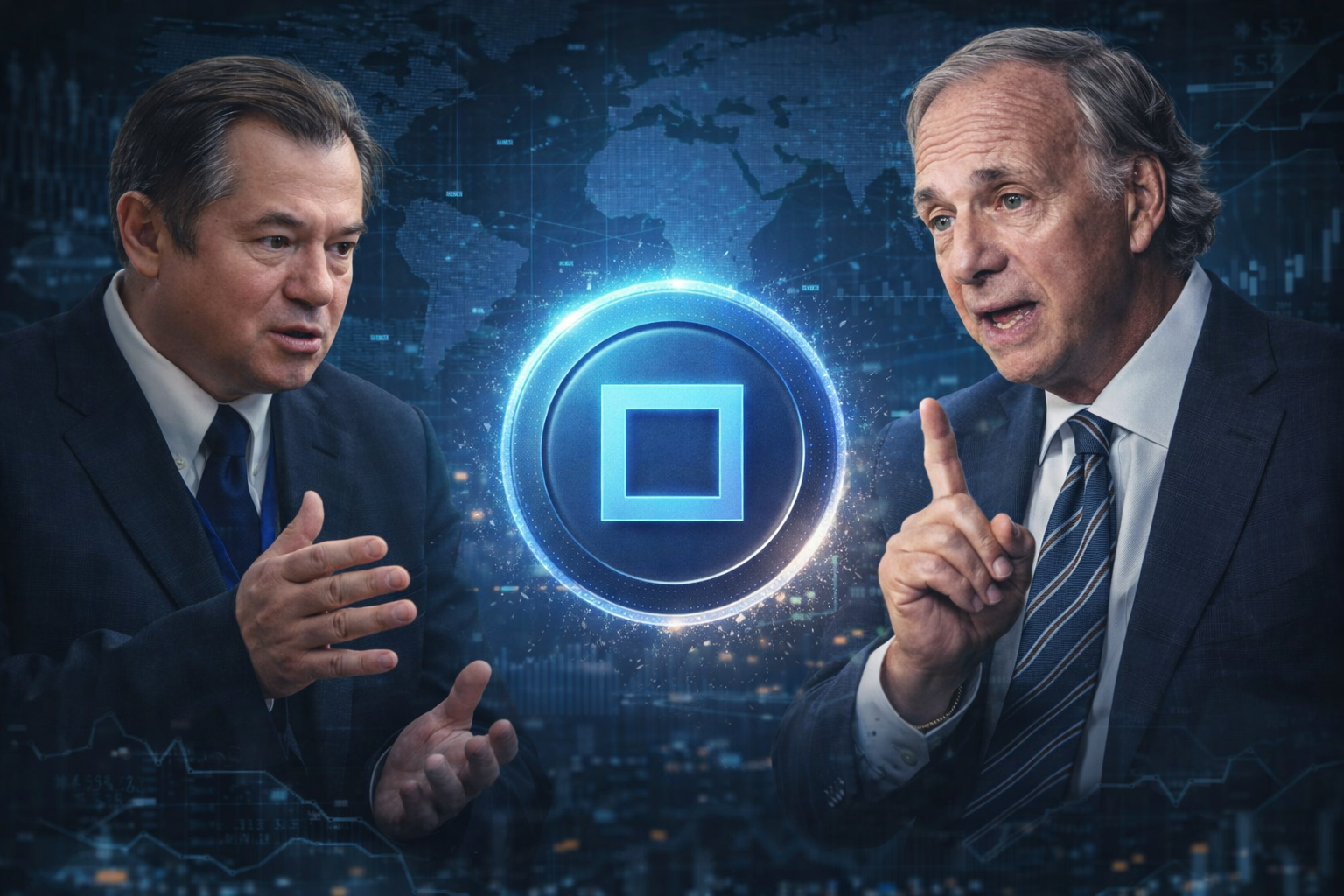
The Prophet and the Hedge Fund King: How Sergei Glazyev and Ray Dalio Are Redefining Central Bank Reserves
I. Introduction: Two Voices, One Warning
On one side of the world, a Soviet-trained economist advises the Kremlin on how to dismantle dollar hegemony and build a new financial architecture for the BRICS nations. On the other, a Connecticut hedge fund manager who built the world’s largest macro fund warns investors that the old order is crumbling and that diversification into real assets is no longer optional.
They have never collaborated. They come from different intellectual traditions, different political systems, different generations. Yet Sergei Glazyev and Ray Dalio have arrived at the same conclusion from opposite directions: the era of dollar-centric reserves is ending, and central banks must diversify into assets that cannot be frozen, tracked, or debased.
This article explores their frameworks, their most recent works, and the striking convergence of their visions. It then argues that Ryo Currency—with its fair distribution, decentralization, and next-generation privacy stack—embodies the principles both thinkers identify as essential for the future of neutral money.
II. Sergei Glazyev: The Architect of Multipolar Finance
Sergei Glazyev is not a typical economist. A graduate of Moscow State University, he served as Minister of Foreign Economic Relations in the early 1990s, then as a member of the Russian State Duma, and later as an advisor to President Vladimir Putin on economic integration. He is a full member of the Russian Academy of Sciences and has authored dozens of books and papers on economic theory, monetary policy, and the transition to a multipolar world order [1].
The Global Monetary System in Crisis
In his seminal work, The Global Monetary System in Crisis, Glazyev lays out a comprehensive critique of the dollar-centric financial architecture. His argument proceeds in three stages:
- Diagnosis: The current system is inherently unstable because it concentrates power in a single issuer, creating perverse incentives for that issuer to abuse its privileged position. The weaponization of the dollar through sanctions is not an aberration—it is the logical outcome of a system designed without checks and balances [1].
- Prescription: A new international monetary architecture must be based on a basket of national currencies and commodities, with settlement via digital platforms not controlled by any single bloc. Glazyev envisions a transition to a multipolar financial order where trade is settled in national currencies, gold, or digital assets that no single bloc can freeze [1].
- Implementation: The BRICS nations are already building the infrastructure. The “Unit” project—a benchmark token anchored in gold and BRICS+ currencies—is emerging as one such initiative, set to launch on the Cardano blockchain. Multi-CBDC settlement layers like mBridge have already processed tens of billions in cross-border transactions [1].
Glazyev’s key phrase—“digital assets that no single bloc can freeze”—has become a rallying cry for those seeking alternatives to the dollar system. It captures the essential requirement for any neutral reserve asset in a fragmented world: it must exist outside the jurisdictional reach of any single power.
“We must ensure a full-fledged switch to national currencies in mutual trade and investment within the EAEU and the CIS, and further—within the BRICS and SCO, the withdrawal of joint development institutions from the dollar zone, the development of their own independent payment systems.” — Sergei Glazyev, Regulations of the Noonomy
Glazyev’s Vision for Central Bank Reserves
For Glazyev, central bank reserves are not merely technical holdings—they are instruments of sovereignty. A nation that holds its reserves in dollars subjects itself to the monetary policy and political whims of the United States. The freezing of Russian assets in 2022 proved that no amount of legal protection can safeguard dollar holdings when geopolitical tensions escalate [2].
The solution, in Glazyev’s framework, is diversification into assets that are:
- Non-sovereign: Not issued or controlled by any single state.
- Commodity-backed: Anchored in real value, not just debt.
- Digitally transferable: Capable of moving across borders without friction.
- Censorship-resistant: Unable to be frozen or seized by any bloc.
These criteria point toward gold, certainly, but also toward a new class of digital assets that combine gold-like neutrality with digital-era portability and privacy.
III. Ray Dalio: The Debt Cycle and the Search for Neutrality
Ray Dalio needs little introduction. Founder of Bridgewater Associates, the world’s largest hedge fund, he has spent five decades studying economic cycles and building algorithms to predict them. His books—Principles, Principles for Dealing with the Changing World Order, and Principles for Navigating Big Debt Crises—have become required reading for investors and policymakers worldwide [3].
The Debt Supercycle Thesis
Dalio’s framework begins with a simple observation: debt cannot compound forever. Every economic cycle brings borrowing, spending, and growth, but each cycle leaves behind higher debt levels. Over decades, these cycles compound into a “supercycle” where debt burdens become unsustainable, forcing policymakers to choose between inflationary money printing and deflationary debt crises [3].
In his most recent writings, Dalio warns that the world is entering the late stages of this supercycle. U.S. national debt has reached approximately $38.9 trillion, rising at a pace of roughly $2.6 trillion per year. Global debt sits at 235% of world GDP—levels historically associated with financial repression, inflationary finance, or default [4].
The Rise of China and the Decline of Hegemony
In Principles for Dealing with the Changing World Order, Dalio applies his cycle framework to geopolitics. He argues that the United States is in a period of relative decline, while China is rising to challenge its hegemony. This is not a political judgment but an observation of historical patterns: empires rise and fall in predictable cycles, and the current transition is following those patterns closely [5].
For investors and central banks, this transition has profound implications. The dollar’s status as the world’s reserve currency—a status it has held since 1944—is not guaranteed. As rival powers develop alternative payment systems and accumulate alternative reserves, the structural demand for dollars will erode.
Evidence of this shift is already visible in global reserve data. According to the IMF’s COFER database, the share of global foreign exchange reserves held in U.S. dollars has declined from roughly 71% in 1999 to around 58% today. While the dollar remains dominant, the long-term trend reflects a gradual diversification by central banks seeking to reduce exposure to a single monetary system.
Dalio on Bitcoin: The Embedded Video
In a November 2025 interview, Dalio addressed Bitcoin directly. His assessment, captured in the video below, is characteristically blunt and analytically precise:
Ray Dalio, founder of the world’s LARGEST hedge fund, on Bitcoin:
“Bitcoin is… not going to be a reserve currency for major countries because it can be tracked and it could be… hacked.”
BITCOIN = HIGHLY SPECULATIVE ASSET WITH NO FUNDAMENTAL VALUE.
pic.twitter.com/8V3DZUMTyL— Steve Hanke (@steve_hanke) November 22, 2025
This assessment is crucial. Dalio does not dismiss Bitcoin out of hand—he acknowledges its role as a speculative asset and a potential store of value. But he identifies two fatal flaws for its use as a reserve currency: traceability and hackability. A reserve asset must be private enough that its holders can transact without revealing strategic intentions. And it must be secure enough that no single point of failure can compromise the network.
Dalio’s Advice to Central Banks
In his investor communications, Dalio consistently advises diversification “internationally rather than relying solely on one currency or economy” and recommends holding “real assets such as gold, commodities, and inflation-linked securities” [3]. The logic is simple: when the old order fractures, assets that are not someone else’s liability retain their value.
IV. The Convergence: What Central Banks Actually Need
Glazyev and Dalio approach the problem from different angles, but their prescriptions converge on a common set of requirements for neutral reserve assets.
From Glazyev: Assets That Cannot Be Frozen
The Russian experience of 2022 proved that dollar holdings are vulnerable to seizure. Central banks that hold reserves in dollars or euros are effectively extending credit to those currency issuers—and credit can be revoked. Glazyev’s insistence on assets that “no single bloc can freeze” reflects this reality. A neutral reserve asset must exist outside the jurisdictional reach of any single power [1].
From Dalio: Assets That Cannot Be Tracked
Dalio’s critique of Bitcoin highlights a different requirement: privacy. A central bank executing large-scale currency operations cannot afford to have those transactions visible on a public ledger. Blockchain analytics firms would detect the activity, markets would react, and strategic intentions would be exposed. For a reserve asset to function, it must offer privacy by default, not optional anonymity [6].
The Four Requirements Synthesized
Combining the insights of both thinkers, we can identify four essential properties that any neutral reserve asset must possess:
- Non-Sovereign: Not issued or controlled by any single state. Cannot be frozen or seized by any bloc.
- Private by Default: Transactions must be confidential, resistant to blockchain analytics, and free from surveillance.
- Decentralized and Secure: The network must be resistant to attack, capture, or coercion by any state or corporate entity.
- Fairly Distributed: No premine, no insider allocation, no venture capital control that could create a central point of failure or coercion.
Gold satisfies some of these criteria and has served as a neutral reserve asset for centuries. However, gold has a structural limitation in the modern financial system: it is difficult to move quickly across borders and cannot be transferred natively through digital settlement networks. In an era defined by real-time global finance, any reserve asset must combine gold’s neutrality with the portability and programmability of digital infrastructure.
V. Why Ryo Currency Meets Both Visions
Ryo Currency was architected from the ground up to meet these requirements. Its design choices, often framed in technical terms, align precisely with the criteria identified by Glazyev and Dalio.
Fair Distribution: No Premine, No Insiders
As detailed in Ryo’s egalitarian emission schedule, the protocol launched with no premine, no ICO, and no venture capital allocation. When the chain forked from Sumokoin, 8.79 million pre-mined coins were burned—permanently removed from circulation [7]. The remaining coins are distributed through mining, with an emission schedule designed for fairness. This means there is no insider class who could be coerced into freezing funds or manipulating the protocol. The network belongs to its users, not to any corporate entity [8].
Decentralization: ASIC Resistance and Global Mining
Ryo uses the Cryptonight-GPU algorithm, specifically designed to resist ASICs (specialized mining hardware) and botnets [8]. This ensures that mining remains accessible to ordinary participants with consumer GPUs, preventing the centralization of hash power that would make the network vulnerable to capture. For a central bank considering Ryo as a reserve asset, this decentralization means that no single government or corporation can shut down the network or freeze its holdings.
Next-Generation Privacy: Halo 2 and the Mixnet
While earlier privacy coins relied on RingCT—a technology that provides reasonable privacy but has known limitations and vulnerabilities to statistical analysis—Ryo’s roadmap looks to the next generation. The protocol is transitioning to generation-2 zero-knowledge proofs (Halo 2), which eliminate trusted setup assumptions and provide mathematically perfect privacy [9].
Halo 2, developed by the Electric Coin Company and adopted by multiple privacy-focused projects, enables recursive zero-knowledge proofs without the need for a trusted setup. This means that transaction privacy is based purely on mathematics, not on assumptions about the honesty of setup participants. For a central bank, this eliminates the risk that a trusted setup could be compromised or coerced [9].
Combined with a high-latency mixnet that obfuscates network-level metadata, Ryo will offer anonymity guarantees that far exceed first-generation privacy coins. The mixnet routes traffic through multiple nodes, adding delays and reordering packets, making traffic analysis impractical. For a central bank executing large-scale currency operations, this means that not only the transaction details but also the fact of the transaction itself can be hidden from surveillance.
Why This Matters for Central Banks
A central bank holding Ryo can execute large-scale currency operations without revealing strategic intentions. It can move value between blocs without triggering surveillance or sanctions. It can hold reserves in an asset that is not someone else’s liability and cannot be frozen by any rival power. These capabilities directly address the concerns raised by both Glazyev and Dalio.
VI. Practical Implications: Ryo as a Reserve Asset
How would central banks actually acquire and hold Ryo? Several channels exist, ranging from direct participation to institutional-grade acquisition methods:
Direct Mining Operations
Central banks could acquire Ryo by operating mining facilities, contributing to network security while accumulating coins through block rewards. This is analogous to how some central banks acquire gold through domestic production or sovereign mining enterprises. A nation with excess energy capacity could establish GPU mining farms as a strategic reserve accumulation mechanism, similar to how China accumulated Bitcoin through mining before the 2021 ban.
Institutional OTC Desks
Large blocks of Ryo can be acquired through over-the-counter markets without moving the spot price. Sovereign wealth funds and central banks routinely use OTC channels for large acquisitions of gold, currencies, and digital assets. Reputable OTC desks with institutional-grade compliance can source liquidity from multiple venues—including decentralized exchanges—while providing the central bank with a single, auditable counterparty.
Bilateral Agreements and Sovereign Swaps
Nations could agree to settle trade imbalances in Ryo, creating demand for the asset as a settlement layer between their respective CBDC systems. Two central banks could establish a swap line denominated in Ryo, using it as a neutral bridge currency without either party needing to acquire it through open markets. This approach mirrors how central banks use swap lines in traditional currencies today.
Proprietary Trading Platforms
A technologically advanced central bank could build its own trading platform to acquire Ryo in a controlled, compliant manner. China’s central bank, for example, has the technical capacity to develop an exchange that connects to global liquidity while maintaining full audit trails and compliance with domestic regulations. This approach gives the central bank maximum control over the acquisition process.
Indirect Exposure Through Sovereign Wealth Funds
Rather than holding Ryo directly on its balance sheet, a central bank could mandate that its sovereign wealth fund allocate a portion of its portfolio to privacy-preserving digital assets. This creates a buffer layer—the central bank maintains deniability while still benefiting from diversification into neutral assets.
Custody and Security
Once acquired, Ryo can be held in wallets controlled by the central bank, with the same security protocols used for other digital assets. The privacy features ensure that the central bank’s holdings and transaction patterns remain confidential—a critical requirement for executing large-scale currency operations without triggering market speculation. Custody solutions could include cold storage in sovereign vaults, with transaction authorization requiring multiple signatories across different government departments.
VII. Conclusion: The Unlikely Consensus
Sergei Glazyev sits in Moscow, advising the Kremlin on how to build a financial system independent of Western control. Ray Dalio sits in Connecticut, managing billions for institutional investors seeking to preserve wealth through the coming transition. They have never met. They speak different languages, literally and metaphorically.
Yet their analysis converges on the same conclusion: the old monetary order is ending, and the new order will require assets that are neutral, private, and resistant to control by any single bloc. Gold meets some of these criteria, but it lacks digital portability. Bitcoin offers portability but fails the privacy test. Regulated stablecoins are part of the problem, not the solution.
Ryo Currency, with its fair distribution, decentralized mining, and next-generation privacy stack—Halo 2 zero-knowledge proofs and a high-latency mixnet—embodies the principles both thinkers identify as essential. It is not a speculative asset for traders. It is infrastructure for a multipolar world.
In the first article of this series, we examined the human stakes of the coming bloc system—the refugees, dissidents, and excluded who will need tools for financial survival [10]. In this second, we have seen the convergence of Eastern and Western thinkers on the need for neutral assets. The next article we will explore the systemic collapse of the free-floating fiat system and the emergence of digital monetary blocs
The old world is gone. The new world requires new tools. The question is whether central banks—and the individuals they serve—will recognize the tools when they see them.
VIII. Call to Action
- Read Sergei Glazyev’s The Global Monetary System in Crisis and Ray Dalio’s Principles for Dealing with the Changing World Order. Understand the frameworks that are shaping the future of money.
- Explore the technology behind Ryo Currency. Study the Halo 2 zero-knowledge proof implementation and the high-latency mixnet architecture.
- Prepare for a world where access to the financial system cannot be taken for granted. Consider what assets you would hold if your own currency were debased, your own wallet frozen, your own transactions surveilled.
The era of free-floating fiat is over. The era of blocs has begun. The only question is whether you will have the tools to move between them.
Read the full series:
1. The Yuan Ultimatum – The catalyst
2. The End of Free-Floating Fiat – Systemic analysis
3. The Human Chokepoint – Who gets hurt
4. The Prophet and the Hedge Fund King – Intellectual validation
5. When Institutions Fail – Four scenarios for the future
6. God, State, and Network – The three Leviathans
7. From Network Union to Network State – The practical path to sovereignty
References & Further Reading
- [1] Pepe Escobar, “How the BRICS+ Unit Project Can Dethrone the Dollar,” Yerepouni Daily News, Nov 2025. https://www.yerepouni-news.com/pepe-escobar-how-the-brics-unit-project-can-dethrone-the-dollar/
- [2] “How Economic Sanctions Can Affect Cross-Border Transactions,” IMF Blog, Mar 2022. https://www.imf.org/en/Blogs/Articles/2022/03/15/blog-how-economic-sanctions-can-affect-cross-border-transactions-031522
- [3] “Ray Dalio Warns the Next Big Debt Crisis Won’t Come From Banks. It’ll Come From Governments,” Barchart, Nov 2025. https://www.barchart.com/story/news/36114784/ray-dalio-warns-the-next-big-debt-crisis-wont-come-from-banks-itll-come-from-governments
- [4] “Global debt steady at 235% of GDP as public borrowing rises,” DevelopmentAid. https://www.developmentaid.org/news-stream/post/200148/global-debt
- [5] Ray Dalio, Principles for Dealing with the Changing World Order, 2021. https://www.principles.com/the-changing-world-order/
- [6] Steve Hanke on X, quoting Ray Dalio on Bitcoin, Nov 22, 2025. https://twitter.com/steve_hanke/status/1992261685613359383
- [7] Ryo Currency GitHub Repository. https://github.com/ryo-currency/ryo-currency
- [8] “What is Ryo Currency?” Bitget Wiki, May 2025. https://www.bitgetapp.com:443/wiki/what-is-ryo-currency
- [9] Ryo News: How Ryo Currency is Redefining Privacy
- [10] Ryo News: The Human Chokepoint (Mar 15, 2026)
- [11] Ryo News: The Yuan Ultimatum (Mar 14, 2026)
- Ryo News: Understanding Ryo’s Egalitarian Emission Schedule
- Ryo News: Ryo Currency & Cryptonight-GPU
- Sergei Glazyev, The Global Monetary System in Crisis, 2024.
- Ray Dalio, Principles for Navigating Big Debt Crises, 2018.
This article is the fourth in a seven‑part series. Read the first: The Yuan Ultimatum. Read the second: The End of Free-Floating Fiat. Read the third: The Human Chokepoint.