


The Ryo Currency mining ecosystem now includes a new independent pool operated by the GNTL project.
The GNTL Ryo pool introduces a PPLNS payout model, offering miners an alternative to the
more common proportional pools currently used on the network.
Pool diversity is not cosmetic. Different payout models create different incentives.
Over time, those incentives shape network behavior, miner loyalty, and decentralization.
The GNTL Ryo pool is available at:
https://ryo.gntl.uk/
PROP vs PPLNS on the Ryo Network
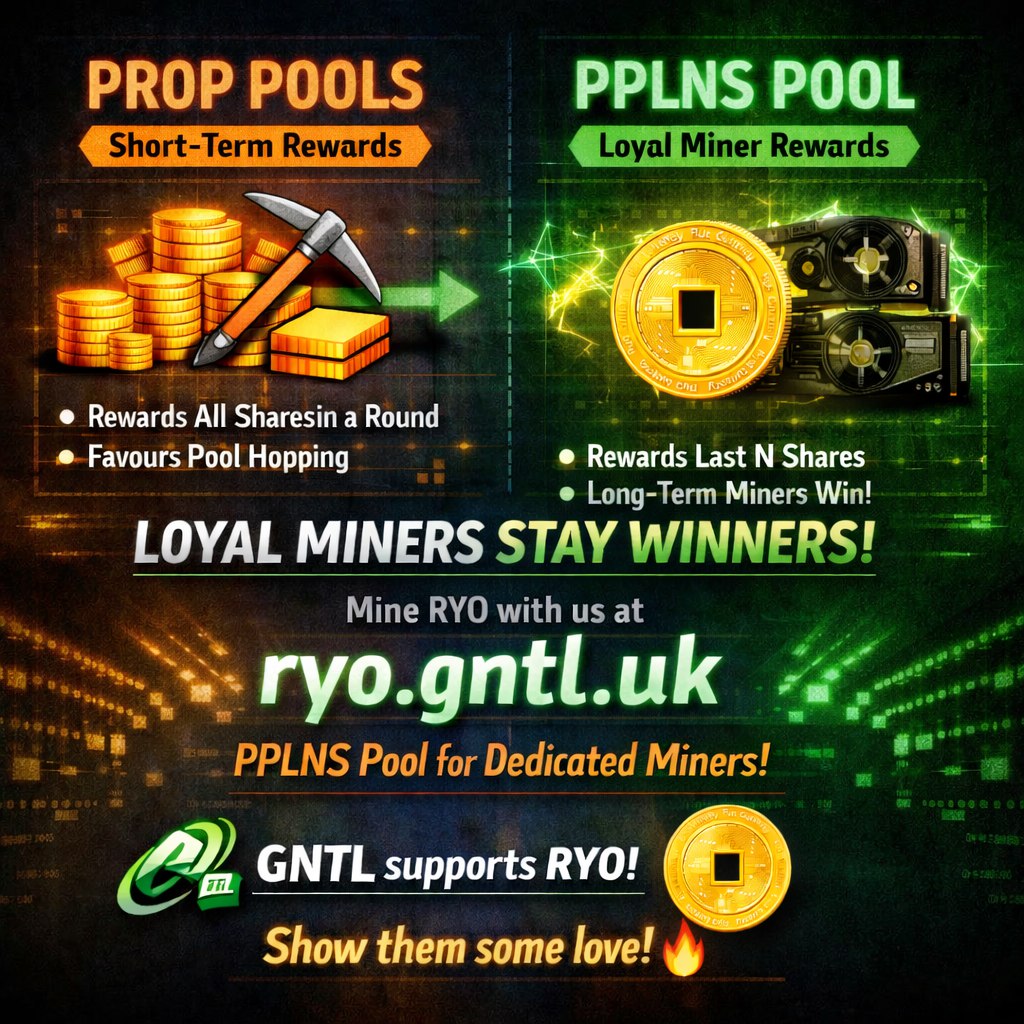
Proportional Pools
Most Ryo miners today use proportional payout pools, including the official Ryo Currency pool.
In a PROP pool, each block is treated as a separate round. When a block is found,
the reward is distributed based on how many shares each miner submitted during that round.
This model is simple and predictable, but it has a known weakness.
Miners can gain an advantage by mining only at the beginning of rounds and leaving
once the round becomes statistically long. This behavior is known as pool hopping.
While not always intentional, pool hopping shifts rewards away from miners who remain
connected consistently.
PPLNS Pools
The GNTL pool uses PPLNS, or Pay Per Last N Shares.
Instead of dividing rewards by round length, payouts are calculated using a fixed window
of the most recent shares submitted to the pool.
Under PPLNS:
- Round boundaries are irrelevant
- Pool hopping offers no advantage
- Consistent miners are rewarded more fairly over time
For miners who run their rigs continuously, PPLNS aligns rewards with actual contribution
rather than timing.
Why the GNTL Pool Matters
The addition of a PPLNS pool strengthens the Ryo mining ecosystem in several ways.
- Reduces reliance on a single payout model
- Encourages long term mining participation
- Improves resistance to opportunistic hashrate movement
- Supports decentralization through operator diversity
The GNTL pool also enforces TLS encrypted connections, which improves transport security
between miners and the pool server.
Mining Ryo on the GNTL Pool Using XMR-Stak
This guide focuses on pool configuration differences.
General XMR-Stak installation and GPU configuration steps are the same as those used
for the official Ryo pool.
Download XMR-Stak
Use the final stable release of XMR-Stak:
https://github.com/fireice-uk/xmr-stak/releases/tag/2.10.8
Wallet and Worker Naming
You will need a Ryo wallet address.
The GNTL pool uses legacy worker formatting, where the worker name is passed through
the password field.
You may replace the worker name with any identifier you prefer, as long as the format
is preserved.
Primary Pool Configuration
Edit the pools.txt file and add the following configuration.
Replace the wallet address and worker name with your own values.
{
    "pool_address": "ryo.gntl.uk:40001",
    "wallet_address": "YOUR_WALLET_ADDRESS",
    "rig_id": "YOUR_WORKER_NAME",
    "pool_password": "YOUR_WORKER_NAME:EMAIL_ADDRESS",
    "use_nicehash": false,
    "use_tls": true,
    "tls_fingerprint": "",
    "pool_weight": 1
},
"currency": "Ryo"
TLS must be enabled. The GNTL pool does not accept non encrypted connections.
Adding a Backup Pool
XMR-Stak allows multiple pools to be configured with weighted priority.
If the primary pool becomes unreachable, the miner will automatically connect
to the backup pool.
Lower pool_weight values indicate higher priority.
In the example below, the GNTL pool is primary and the official Ryo pool is used as fallback.
{
    "pool_address": "ryo.gntl.uk:40001",
    "wallet_address": "YOUR_WALLET_ADDRESS",
    "rig_id": "YOUR_WORKER_NAME",
    "pool_password": "YOUR_WORKER_NAME:EMAIL_ADDRESS",
    "use_nicehash": false,
    "use_tls": true,
    "tls_fingerprint": "",
    "pool_weight": 1
},
{
    "pool_address": "pool.ryo-currency.com:3333",
    "wallet_address": "YOUR_WALLET_ADDRESS",
    "rig_id": "YOUR_WORKER_NAME",
    "pool_password": "x",
    "use_nicehash": false,
    "use_tls": false,
    "tls_fingerprint": "",
    "pool_weight": 2
},
"currency": "Ryo"
This configuration ensures continuous mining without manual intervention if a pool
temporarily goes offline.
When PPLNS Makes Sense
PPLNS is best suited for miners who operate their hardware consistently and view mining
as a long term activity rather than short term optimization.
For miners aligned with Ryo’s privacy and decentralization goals, supporting a PPLNS pool
is a practical way to reinforce those principles at the infrastructure level.
Conclusion
The GNTL Ryo pool is not intended to replace existing pools.
It expands the ecosystem by introducing a different incentive structure and an
independent operator.
Miners who value fairness, consistency, and decentralization should consider allocating
part or all of their hashrate to the GNTL PPLNS pool.
A resilient network is built not only on hashpower, but on diversity of participation.