📘 Executive Summary

On April 8, 2026, a two‑week ceasefire between the U.S. and Iran brought a fragile pause to a conflict that had closed the Strait of Hormuz for over a month. The reopening of the strait is conditional on Iran’s 10‑point plan, which includes continued Iranian control of the waterway and the acceptance of yuan or cryptocurrency for transit tolls. As geopolitical tensions eased, silver surged past $77 per ounce, and the silver‑oil ratio bounced off a key technical level—a structural signal we first highlighted in The Yuan Ultimatum. Meanwhile, Zcash (ZEC) rallied nearly 35%, the largest single‑day gain among major cryptocurrencies, fueled by speculation that Iran and Oman might accept privacy coins for strait passage. This article examines the ceasefire, the monetary metals signal, the Zcash surge, and why Ryo—with its forthcoming Halo 2 ZK‑proofs (by default) and high‑latency mixnet—is being architected to offer the highest level of privacy for ships transiting the Strait of Hormuz and for the emerging network state economy.

Strait of Crypto: Ceasefire, the Silver‑Oil Ratio, and the Quiet Rise of Privacy Money

“The era of free‑floating fiat is over. What comes next is not written. Whether it is digital blocs, network states, or a hybrid of both, the tools that let you move between them are the same.” — Strait of Crypto

⚡ APRIL 8, 2026 – CEASEFIRE DECLARED: President Trump announced a two‑week ceasefire with Iran, effective immediately, after Iran agreed to reopen the Strait of Hormuz. “Based on conversations with Prime Minister Shehbaz Sharif and Field Marshal Asim Munir, of Pakistan, and wherein they requested that I hold off the destructive force being sent tonight to Iran, and subject to the Islamic Republic of Iran agreeing to the COMPLETE, IMMEDIATE, and SAFE OPENING of the Strait of Hormuz, I agree to suspend the bombing and attack of Iran for a period of two weeks” [1]. The ceasefire follows Iran’s rejection of a U.S. 15‑point plan and its submission of a 10‑point proposal delivered via Pakistan [2].

I. The 10‑Point Plan: Control, Yuan, and Crypto

Iran’s Supreme National Security Council confirmed the two‑week ceasefire, but warned that “this does not mean the end of the war” [3]. The 10‑point proposal, published by Mehr News Agency, includes demands that fundamentally reshape the monetary geography of the Gulf:

  • Continued Iranian control of the Strait of Hormuz
  • Acceptance of Iran’s nuclear enrichment rights
  • Lifting of all primary and secondary U.S. sanctions
  • Payment of war damages
  • Withdrawal of U.S. combat forces from the region

Critically, Iran has already operationalized a formal payment system for strait transit, requiring fees in Chinese yuan or cryptocurrency [4]. The Islamic Revolutionary Guard Corps (IRGC) has established a tiered pricing structure, with a floor of approximately $1 per barrel (up to $2 million for a Very Large Crude Carrier) [5]. Payment is received in yuan or stablecoins; once confirmed, the IRGC issues a pass code and provides a naval escort through the strait.

This is not a symbolic gesture. According to Bloomberg, at least three Chinese ships have already negotiated passage, and Pakistan has secured transit permissions for 20 of its flagged vessels [5]. The Sohar LNG carrier, hugging Oman’s southern coastline, became the first LNG vessel to exit the strait since the conflict began, marking a structural shift in energy trade finance [6].

II. The Monetary Metals Signal: Silver‑Oil Ratio Bounces off Technical Level

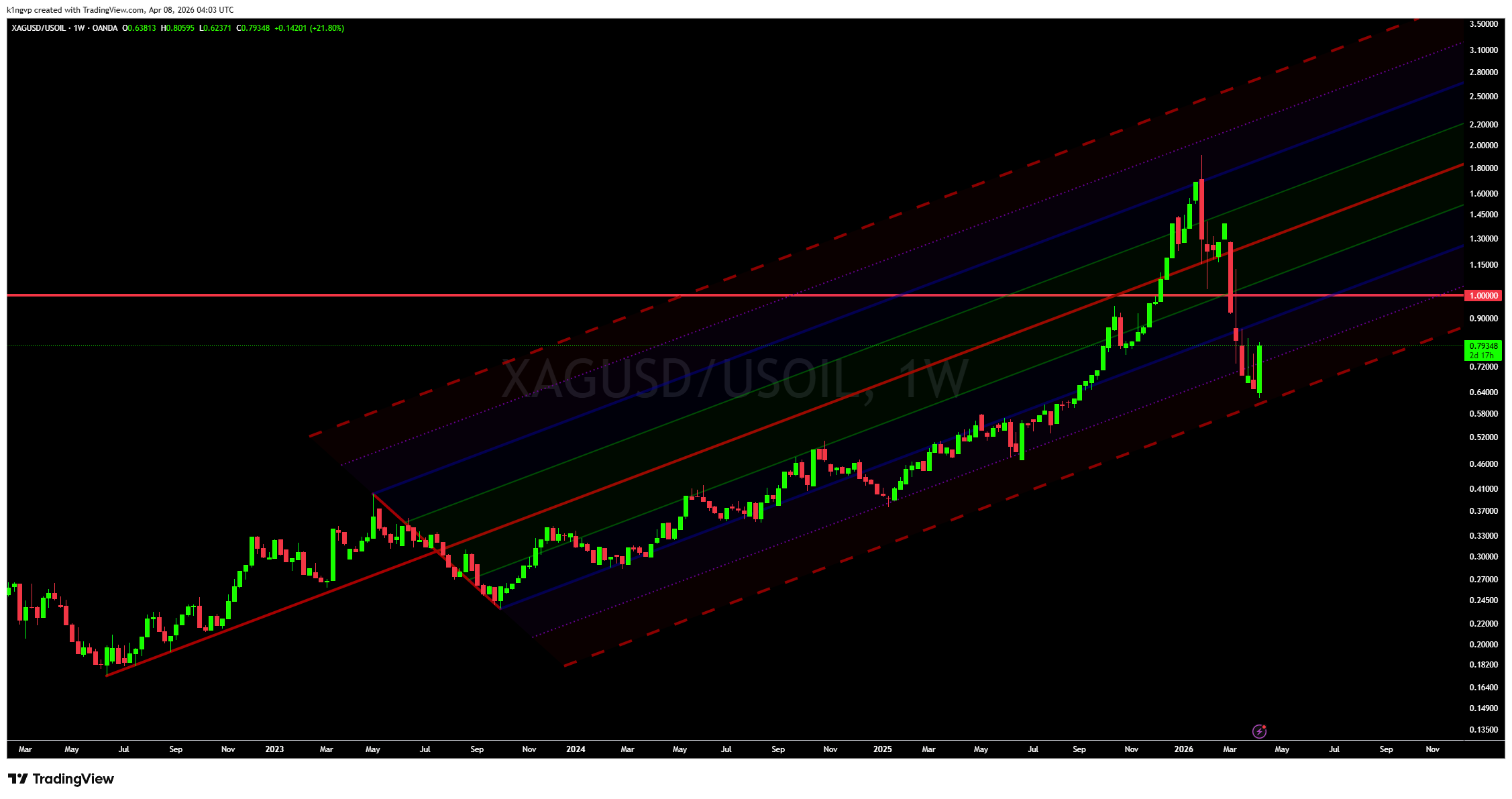
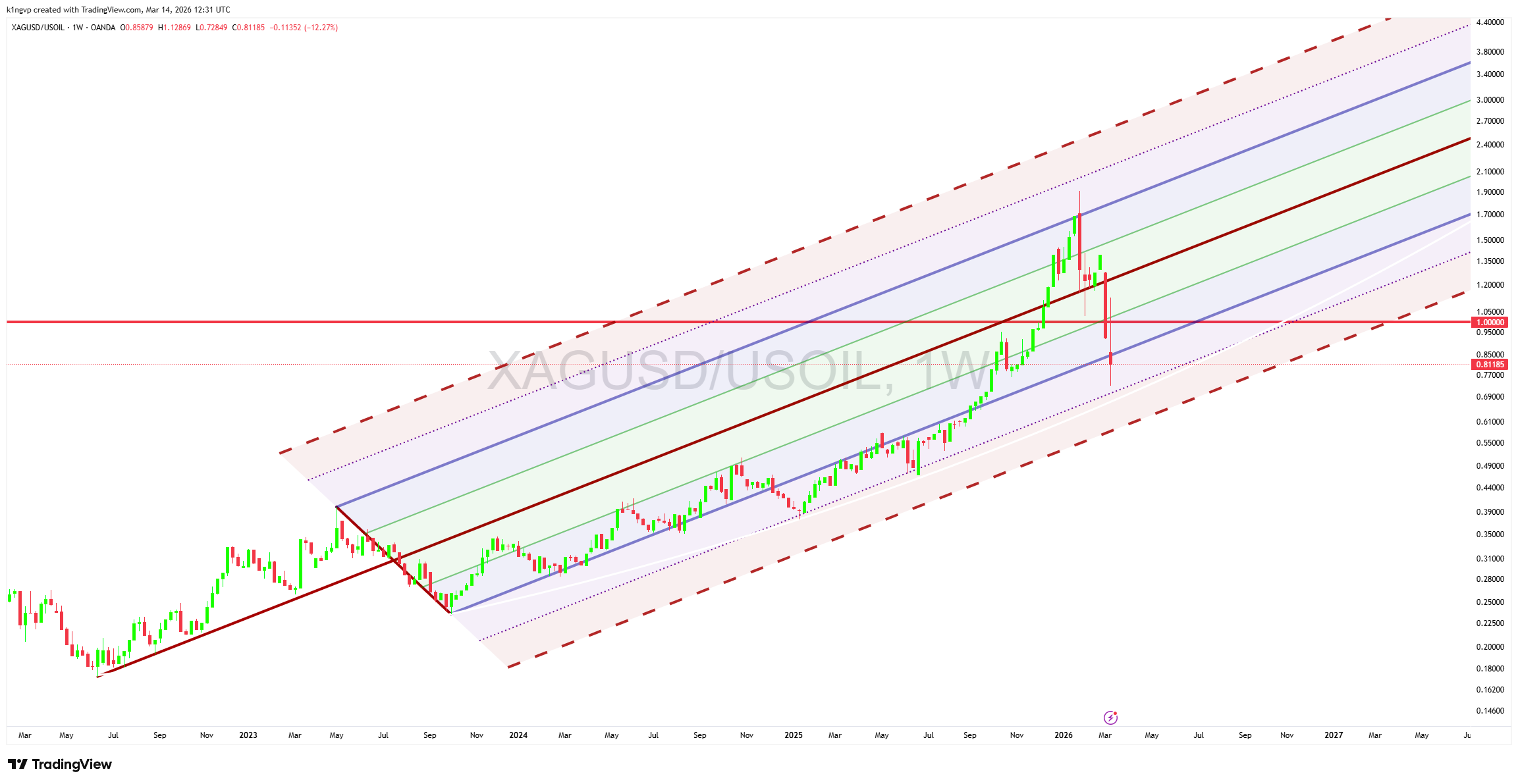
In The Yuan Ultimatum, we highlighted the silver‑oil ratio as a “parabola in progress.” The ratio—the number of barrels of oil one ounce of silver can purchase—was hovering below 1.0, and we noted that if it reversed into support, it would signal a structural repricing of energy against monetary metals. When one ounce of silver buys more than one barrel of oil, it inverts a century‑old relationship. Historically, oil was the “harder” asset; now silver is reasserting its monetary role.

On April 8, 2026, following the ceasefire announcement, silver (XAG/USD) surged past $77 per ounce, a fresh weekly high [7]. At the same time, WTI crude oil prices tumbled over 13% as markets priced in reduced geopolitical risk [8]. The combination of a surging white metal and a collapsing energy benchmark pushed the silver‑oil ratio off the original pitchfork lower warning line, a key technical signal indicating the loss of monetary confidence in the petrodollar.

This is not a speculative anomaly. It is a confirmation of the Neutral Money Doctrine we have traced throughout this series. As Ray Dalio noted, when trust in fiat currencies erodes, capital flows toward assets that cannot be printed, inflated, or sanctioned. Silver—historically both an industrial metal and a monetary metal—is now reasserting its role as a store of value independent of the dollar system. And as we argued in The End of Free‑Floating Fiat, the same forces that drive monetary metals also drive the search for neutral digital assets.

III. The Zcash Pump: Privacy Coins Enter the Geopolitical Arena

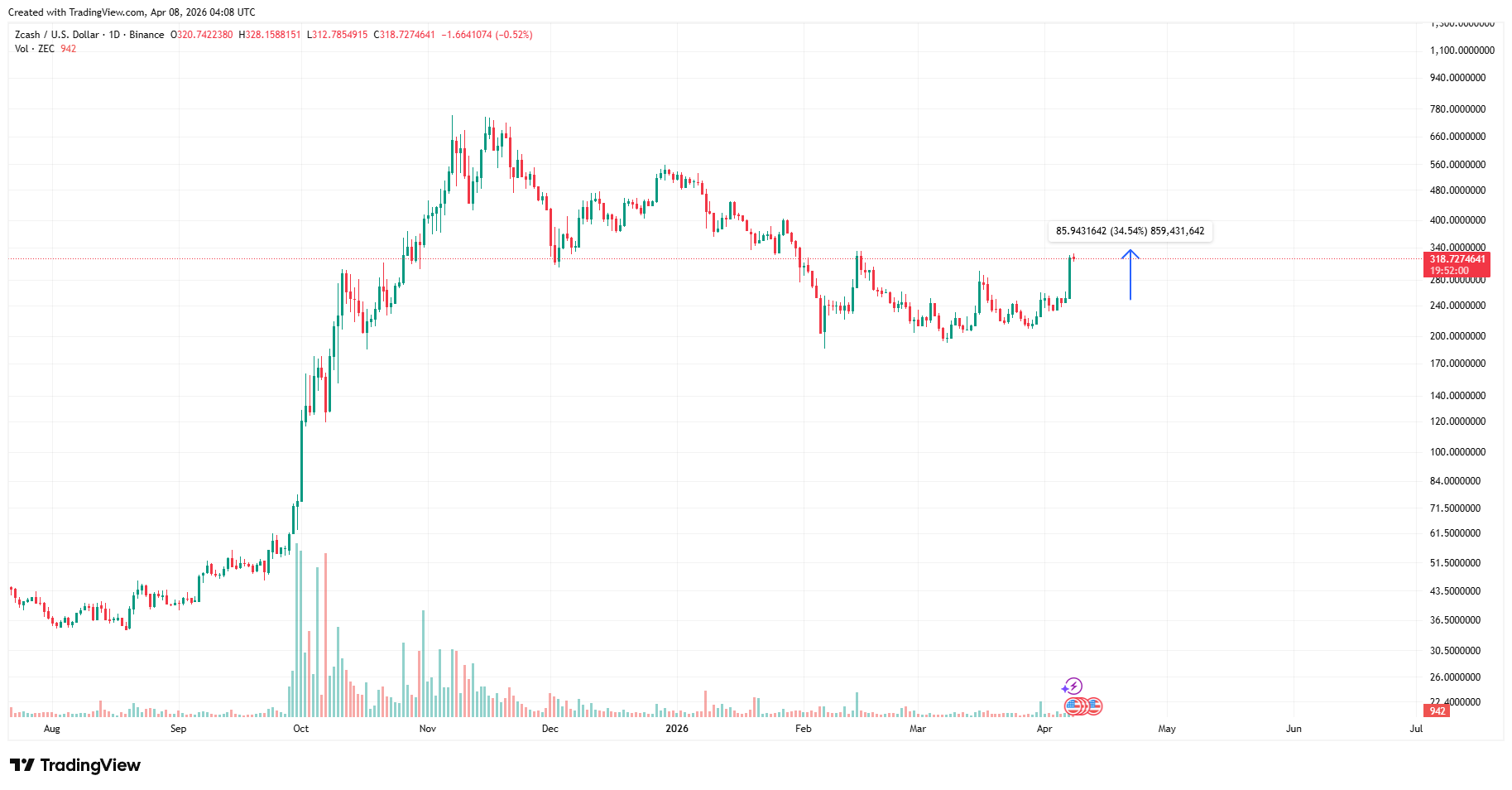
On April 7, 2026, Zcash (ZEC) surged nearly 35% in a single day, the largest gain among major cryptocurrencies. Trading volumes spiked, and social media chatter exploded with speculation that Iran and Oman might accept Zcash for strait transit payments [9]. While no official confirmation has emerged, the market’s reaction is itself a signal: the world is beginning to understand that not all cryptocurrencies are equal when it comes to sanctions‑resistant trade.

Zcash has long led the charge in zero‑knowledge privacy. Its shielded pool, powered first by zk‑SNARKs and now by Halo 2 (already live as an optional feature), offers transaction confidentiality that Bitcoin and Ethereum cannot match. The market’s 35% rally signals growing recognition that privacy coins are uniquely suited for geopolitical trade.

That said, Zcash’s optional privacy model creates a trade‑off: users can choose between transparent and shielded transactions. For a nation state like Iran, that choice itself becomes a signal. Adversaries can focus surveillance on the subset of transactions that opt for privacy. Zcash’s fully shielded mode is excellent when used exclusively, but the protocol’s transparency‑by‑default means the act of shielding can be observable on the ledger.

This is where Ryo Currency aims to go further. By making privacy default and adding a network‑layer mixnet, Ryo is architected for actors who require maximal anonymity—where even the absence of a choice cannot be detected.

IV. The Case for Ryo: Architecting the Highest Level of Privacy

If Iran were to accept a privacy coin, Zcash would be a natural candidate—it is battle‑tested and respected. But for state‑level adversarial environments, Ryo is being built to an even higher standard. Its roadmap includes two critical privacy upgrades that set it apart:

  • Halo 2 Zero‑Knowledge Proofs by Default: Zcash already offers Halo 2 as an optional privacy layer. Ryo is implementing Halo 2 and will make it mandatory for every transaction. This eliminates the transparent‑chain attack surface entirely. No transaction is ever visible on the ledger, and the signaling problem disappears. Halo 2 also removes the trusted setup, making the privacy guarantees mathematically absolute.
  • High‑Latency Mixnet: While Zcash and Monero rely on network‑layer obfuscation techniques like Dandelion++, a mixnet provides fundamentally stronger anonymity. By routing traffic through multiple independent nodes with randomized delays, a mixnet makes it computationally infeasible to link an incoming transaction to its outgoing destination—even for an adversary that controls a portion of the network. Unlike probabilistic routing, a mixnet defeats timing attacks.

For a tanker captain transmitting a pass code over VHF radio, or for a shipping company negotiating a $2 million payment in cryptocurrency, the difference between “probably private” and “provably private” is the difference between safe passage and interception. Ryo is being architected to provide the latter.

Moreover, Ryo’s fair distribution—no premine, no ICO—started with 8.79 million coins minted and immediately burned at launch, leaving no founder allocation or insider class that can be coerced. Its ASIC‑resistant Cryptonight‑GPU algorithm keeps mining accessible, preventing the kind of hashpower centralization that would make the network vulnerable to a state‑level attack. And its roadmap toward proof‑of‑stake and DAO integration means that a nation adopting Ryo could eventually govern its own monetary system on‑chain, without relying on external infrastructure.

V. A Future of Neutral Money: Ceasefire, But Not Endgame

The two‑week ceasefire is a pause, not a resolution. Iran has made clear that the war is not over; the 10‑point plan remains the basis for any final agreement. The Strait of Hormuz will remain a chokepoint, and the toll system in yuan and cryptocurrency will remain in place for the foreseeable future.

As negotiations continue in Islamabad, the choice of payment rails will be a central issue. Stablecoins offer convenience but expose payers to freeze risk. Bitcoin is transparent and traceable. Privacy coins offer confidentiality, but only those architected for adversarial environments will survive sustained surveillance.

Ryo Currency is being built for exactly this scenario. Its combination of default privacy (Halo 2 mandatory), network‑layer mixnet anonymity, fair distribution, and future DAO governance makes it one of the few digital assets capable of serving as a truly neutral bridge between the dollar bloc, the yuan bloc, and the emerging network state economy.

The silver‑oil ratio bounced off a key technical level. Zcash has pumped 35%. The Strait of Hormuz has reopened—but only for yuan and crypto. The era of free‑floating fiat is over. What comes next is not written, but the tools are being built. Ryo represents one implementation of those tools.

VI. Call to Action

  • Read the full series. The Yuan Ultimatum began with missiles; From Network Union to Network State ended with a blueprint for digital sovereignty. The arc is complete.
  • Study the properties of neutral money. Not all crypto is equal. Ryo is one of the assets architected for the network state era.
  • Prepare for the next phase. The Strait of Hormuz is only one chokepoint. Digital chokepoints are being designed as you read this. The tools for sovereignty exist. The only question is whether you will use them.

In the age of the Network, sovereignty is no longer granted. It is compiled.

This article is a standalone analysis building on the seven‑part series published in March 2026. Read the full series: The Yuan Ultimatum, The End of Free‑Floating Fiat, The Human Chokepoint, The Prophet and the Hedge Fund King, When Institutions Fail, God, State, and Network, From Network Union to Network State.

“`


Executive Summary

As digital currencies and geopolitical blocs reshape the global monetary system, new forms of sovereign organization are emerging outside traditional states. This article explores how financial censorship, programmable money, and digital infrastructure may give rise to network states — and why privacy-first currencies like Ryo could become foundational economic layers for these decentralized societies, with future DAOs enabling community governance and collective sovereignty.

When Institutions Fail: Balaji Srinivasan, Network States, and the Architecture of Economic Sovereignty

“When institutions fail, cryptocurrency is the backup system.” — Balaji Srinivasan

I. Introduction: The Unwritten Future

The free-floating fiat system established in 1971 is entering its terminal phase. The debt supercycle, the weaponization of finance, and the fracturing of global trust have brought us to a crossroads [1]. In The Yuan Ultimatum, we witnessed the triggering event. In The End of Free-Floating Fiat, we traced the systemic collapse. In The Human Chokepoint, we saw who gets hurt. In The Prophet and the Hedge Fund King, we heard the intellectual convergence on neutral assets.

But what actually comes next? The answer is not a single, predetermined path. History teaches that monetary transitions of this magnitude are never smooth. They are accompanied by social chaos, economic restructuring, and the violent devaluation of currencies as populations are forcibly moved from free-floating money to allocated digital systems [2]. The collapse of the Soviet Union and the fracturing of Yugoslavia remind us that states themselves can disintegrate, leaving behind contested territories and competing currencies—newly issued sovereign currencies of successor states, parallel dollarization, and, increasingly, cryptocurrencies operating outside any state’s control [3].

This article maps the possible futures through the framework of one of the most provocative thinkers of our era: Balaji Srinivasan, entrepreneur, investor, and author of The Network State [4]. His core insight—“When institutions fail, cryptocurrency is the backup system”—provides the lens for understanding every scenario ahead. From the collapse of free-floating fiat to the rise of digital blocs, from institutional failure to the emergence of network states, Srinivasan’s vision illuminates both the dangers and the opportunities. And at the intersection of these scenarios lies a single question: what tool will preserve economic sovereignty when all else fails?

II. The Transition: From Free-Floating Fiat to Digital Control—And Its Failure Modes

The end of free-floating fiat does not necessarily mean the disappearance of the dollar, euro, or yuan. It means their transformation into digital, programmable currencies—CBDCs and regulated stablecoins—designed for control rather than freedom [5]. Every major bloc is pursuing this transition: China with its e-CNY [6], the EU with its digital euro, the United States with its hybrid approach of CBDC and regulated stablecoins [7].

But will these systems actually work? History suggests skepticism is warranted. Monetary transitions are never clean. The introduction of the euro required years of preparation and still faced crises. The transition from Soviet republics to independent currencies was chaotic [8]. And digital currency systems face challenges their physical predecessors never encountered: technical failures, cybersecurity vulnerabilities, and perhaps most critically, popular resistance.

Populations do not passively accept the replacement of their money. The backlash against cashless initiatives in Sweden, the protests against demonetization in India, and the widespread rejection of vaccine mandates demonstrate that people resist when they feel their autonomy threatened [9]. A CBDC that expires, that tracks every purchase, that can be frozen at will—this is not money as humanity has known it. It is a tool of control, and it will be resisted.

Some blocs may succeed in implementation. Others will fail. States may fracture under the pressure, as the Soviet Union and Yugoslavia did, leaving behind contested territories and competing currencies. In such a landscape, the currencies competing for allegiance would include:

  • New sovereign currencies issued by breakaway republics and successor states, each claiming legitimacy but lacking trust
  • Foreign currencies like the dollar or euro, adopted as unofficial substitutes (dollarization)
  • Cryptocurrencies—Bitcoin, privacy coins like Ryo—operating entirely outside state control, requiring no issuer trust
  • Local scrips and barter systems emerging when official money fails

In this competition, the currency that requires no state backing, no issuer trust, and no institutional infrastructure has a structural advantage. That is cryptocurrency’s role: the backup system that runs when everything else breaks.

III. Balaji Srinivasan’s Framework: The Four-Sided Conflict and the Backup System

To navigate this landscape, we need a map. Few have provided one as compelling as Balaji Srinivasan, whose work spans technology, finance, and political theory. A Stanford-trained engineer, former general partner at Andreessen Horowitz, and former CTO of Coinbase, Srinivasan has spent the past decade developing a framework for understanding the realignment of power in the digital age [10].

The U-Shaped Curve

Srinivasan points to a 2,000-year chart of global GDP centered on Eurasia. Before the Industrial Revolution, Asia enjoyed durable economic parity with the West. Steam power shifted the vector toward Europe and America, reaching its peak in 1950—the “zero point” of the current American-centric establishment. Now, the world is rapidly returning to its pre-1950 state along a “U-shaped curve,” with Asia reasserting its historical economic weight [11].

“I can show many other charts, but the essence is this curve,” Srinivasan explains. “The MAGA movement—and even Build Back Better—is an attempt to go back to 1950. Because that became the ‘zero point’ of the current establishment.” This rebalancing renders obsolete the institutions created after World War II—the UN, the World Bank, the IMF—because “money is where power is, and the West no longer has it” [11].

The Four-Sided Conflict

Srinivasan argues that the old binary of “red vs. blue America” has been superseded by a four-sided conflict: China, the internet, red America, and blue America. China, through advances in robotics and drone manufacturing, threatens red America’s production and military power. The internet, through AI and cryptocurrency, threatens blue America’s control over media and finance [11].

“I think that by 2035–2040—maybe earlier, maybe later—the following will happen: the Democrats will side with the Chinese communists, and the Republicans will become bitcoin maximalists,” he predicts. This is not mere speculation but a recognition of structural alignment: the regulatory and surveillance state appeals to those who seek control, while decentralized technology appeals to those who seek freedom [11].


When Institutions Fail, Crypto Is the Backup

This brings us to Srinivasan’s most important insight: cryptocurrency is not merely an asset class—it is a backup system for when traditional institutions fail [12]. “When institutions fail, cryptocurrency is the backup system,” he argues. In a world where banks lose credibility, political systems are distrusted, and surveillance expands, crypto offers an exit path [12].

He points to the foundational breakthroughs: Bitcoin brought decentralized currency; Ethereum brought programmability; and Zcash solved privacy, which he considers essential for true sovereignty [12]. “If you’re under surveillance, you don’t have sovereignty. If every move is tracked… you lose the element of surprise. You can never act. You can never negotiate privately.”

In his most provocative framing, Srinivasan declares: “The choice is clear. Either Zcash or communism.” With AI amplifying surveillance capabilities, any online information fragment can now be integrated into comprehensive personal profiles. He draws a historical parallel: in 1918, Lenin needed lists of names to target kulaks. If encryption becomes the default, “there are no complete lists. No fixed location. They cannot hit what they cannot see” [13].

IV. The Network State: From Digital Community to Physical Sovereignty

Srinivasan’s book The Network State (2022) extends this framework from money to governance itself. A network state is “a highly aligned online community with a capacity for collective action that crowdfunds territory around the world and eventually gains diplomatic recognition from pre-existing states” [14] [4].

This is not mere theory. In 2024, Srinivasan launched Network School in Forest City, Malaysia—a troubled $100 billion megaproject that became a refuge for crypto entrepreneurs and techno-utopians [15]. Nearly 400 students have participated, building crypto projects and testing whether shared ideology can bind a community [15]. The goal is to create “startup societies” that can eventually gain diplomatic recognition [15].

Critics call it “techno-colonialism”—wealthy Westerners exploiting weaker nations to create libertarian enclaves [16]. Prospera, a “startup city” in Honduras, has become embroiled in legal disputes with its host country [17]. Yet the movement continues, backed by millions from Peter Thiel and other tech billionaires [16].

For our purposes, the significance of the network state movement is not its feasibility but its framing. Srinivasan articulates what many feel: that the nation-state system is failing, that digital communities are real communities, and that technology offers tools for exit. Whether network states succeed or fail, they illuminate the desire for sovereignty that drives the search for neutral money.

V. Scenarios: From Bloc Implementation to Total Collapse

With this framework, we can map the possible futures that lie ahead. In each, Srinivasan’s insight holds: when institutions fail, cryptocurrency becomes the backup system.

Scenario 1: The Bloc System Is Implemented

In this scenario, the major powers succeed in rolling out their digital currencies. The yuan bloc [6], dollar bloc, euro bloc, and BRICS Unit with its mBridge infrastructure [18] function as designed. Economic activity is channeled through programmable money, with all the surveillance and control capabilities that entails [19]. Yet even here, the system is not total. Interstices remain—grey zones where neutral assets can flow. Privacy-preserving digital cash becomes the currency of cross-bloc trade, enabling value to move between controlled systems without surveillance. The blocs coexist with the network, each serving different needs. The institutions have not failed—but those who value sovereignty still have a backup.

Scenario 2: Implementation Fails, States Fracture

History suggests that ambitious monetary transitions often fail. The technical challenges of CBDC rollout are immense. Popular resistance may be fiercer than elites anticipate. Some states may fracture under the pressure, as the Soviet Union and Yugoslavia did [3]. In this scenario, the landscape becomes chaotic—competing currencies, contested territories, and collapsing institutions. Here, Srinivasan’s thesis activates: cryptocurrencies, which require no state backing to function, become the default medium of exchange. Those holding privacy-preserving assets retain the ability to transact; those trapped in failing digital systems lose everything [12].

Scenario 3: Total Institutional Collapse

In the most extreme scenario, the cascade of failures becomes systemic. Sovereign debt defaults trigger bank runs; multinational banking establishments collapse; governments lose the capacity to enforce their rules. This is not the orderly transition to digital blocs but the breakdown of all systems. In this chaos, traditional financial infrastructure fails—but cryptocurrencies continue to operate. Bitcoin’s blockchain runs as long as there is electricity and internet. Privacy protocols continue to process transactions. The world does not revert to barter; it shifts to decentralized, permissionless money by default [12]. Srinivasan’s backup system becomes the primary system.

Scenario 4: The Network State Emerges

Srinivasan’s vision offers a fourth path: the gradual replacement of geographic nation-states with digital communities that achieve sovereignty through technology [14] [4]. In this world, the multinational banking establishment loses relevance. Power localizes to individuals, DAOs, and network states that coordinate through blockchain-based governance. Privacy-preserving digital cash becomes the native currency of these new polities. Here, the backup system doesn’t just replace failing institutions—it creates new ones, built on cryptographic trust rather than state power [20].

VI. The Privacy Imperative: Why Ryo Currency

Srinivasan identifies Zcash as the breakthrough that solved privacy. But the implementation matters as much as the technology. Ryo Currency deploys the same next-generation zero-knowledge proofs—Halo 2—that power the latest privacy innovations, including those employed by Zcash [21]. The critical difference is in the design philosophy.

Zcash offers optional privacy: users can choose between transparent and shielded transactions. This creates a two-tier system where the choice to use privacy becomes a signal, compromising true fungibility [22]. Ryo takes a different approach: privacy by default. Every transaction is private. Every coin is indistinguishable from every other coin. There is no option to be transparent, and therefore no signal in using privacy. This is the foundation of true fungibility—the property that makes money work [23].

Ryo’s architecture goes further. Its Cryptonight-GPU mining algorithm is specifically designed to resist ASICs and botnets, ensuring that mining remains accessible to ordinary participants with consumer GPUs [24]. When the chain forked from Sumokoin, 8.79 million pre-mined coins were permanently burned [25]. No premine. No ICO. No venture capital allocation. The network belongs to its users, not to any insider class [26].

And beyond on-chain privacy, Ryo is developing a high-latency mixnet to obfuscate network-level metadata. IP addresses, timing patterns, and connection logs can reveal transaction origins even if the blockchain is private [27]. The mixnet routes traffic through multiple nodes, adding delays and reordering packets, making traffic analysis impractical.

Looking further ahead, Ryo’s roadmap points toward a transition to proof-of-stake, which would open the door for Decentralized Autonomous Organizations (DAOs)—community-governed entities that operate through smart contracts without central control [28]. A future proof-of-stake Ryo network could enable DAOs to manage treasury funds, govern protocol parameters, and coordinate collective action entirely on-chain, creating the precise infrastructure that network states would need to achieve true sovereignty [4]. In this vision, Ryo would evolve from a privacy-preserving currency into the foundational economic layer for entire digital nations—network states whose governance is conducted through transparent, community-run DAOs, whose treasury is held in uncensorable assets, and whose citizens transact with true financial privacy [20].

VII. The Neutral Money Doctrine: Ryo as Backup System and Network State Foundation

Across all scenarios—bloc implementation, state fracture, total collapse, or network state emergence—one requirement remains constant: the need for a neutral, private, uncensorable asset that can move value between systems and preserve sovereignty when institutions fail.

The thinkers we have encountered throughout this series converge on the same principles:

  • From Sergei Glazyev: assets that “no single bloc can freeze” [29].
  • From Ray Dalio: assets that cannot be tracked [30].
  • From Daniel Lacalle: the shift from debt-based to asset-based reserves [31].
  • From Balaji Srinivasan: tools that work in wartime, not just peacetime [32].

Ryo Currency meets these requirements through deliberate architectural choices that align perfectly with Srinivasan’s vision of a backup system. It requires no state backing, no issuer trust, no institutional infrastructure. It runs as long as there is electricity and internet. It preserves privacy even under pervasive surveillance. It cannot be frozen, tracked, or controlled by any bloc [12].

In a bloc world, Ryo serves as the neutral bridge asset—the digital equivalent of international waters where value can move between controlled systems without surveillance. In a fractured world, it becomes the default currency of the grey zones. In a collapsed world, it is one of the few systems still standing. In a network state world, it is the native money of digital polities, with DAOs providing the governance layer for communities that choose sovereignty [20].

VIII. The Road Ahead: Ryo and the Future of Freedom

Srinivasan envisions a future where network states compete for citizens, each offering its own governance and currency. In that world, the currency that offers true privacy—that cannot be frozen, surveilled, or controlled—will attract those who value freedom. The network state that adopts Ryo as its native money will have a competitive advantage over those tied to transparent or controlled systems [20].

Bitcoin maximalism argues that one digital currency will eventually dominate all others. But Bitcoin lacks privacy. Its transparent ledger is a feature for auditors, a fatal flaw for those seeking sovereignty [33]. The future may belong not to Bitcoin maximalism but to a recognition that true economic sovereignty requires true privacy. And in the competition of currencies that will define the coming era—whether between blocs, successor states, or network states—the currency that cannot be controlled has a structural advantage.

This is not mere speculation. The infrastructure already exists. The technology is mature. The only question is adoption. As Srinivasan notes, blockchain infrastructure has quietly matured: scalable smart contracts run continuously, decentralized exchanges function, stablecoins are widely used [12]. The pieces are in place.

And so we end with a thought grounded in the logic of the system: when institutions fail—and they will fail, in some places, in some ways—the backup system activates. Those who have prepared will have tools that cannot be taken from them. Those who have not will be left to the mercy of whatever arises from the chaos. The choice, as Srinivasan would say, is clear: surveillance or privacy, control or sovereignty, dependence on failing institutions or the backup system that runs regardless.

The old world is gone. The new world is being born in uncertainty. The only question is whether you will have the tools to navigate it.

IX. Call to Action

  • Read Balaji Srinivasan’s The Network State. Understand the framework for exit and sovereignty in the digital age [10] [4].
  • Study the architecture of privacy-preserving digital cash. Not all privacy is equal. Ryo’s by-default privacy, fair distribution, and next-generation technology make it the strongest foundation for true sovereignty.
  • Prepare for the scenarios ahead. Hold assets that cannot be frozen, tracked, or controlled. Learn self-custody. Build the tools for exit before you need them.

The era of free-floating fiat is over. The era of blocs, fractures, and network states has begun. The only question is whether you will have the tools to move between them—and whether you choose control or sovereignty.


Primary Sources

  1. People’s Bank of China, Progress of Research & Development of E-CNY, official policy paper outlining digital yuan deployment and transaction infrastructure.

    https://www.pbc.gov.cn/en/3688110/3688172/4157443/index.html
  2. Bank for International Settlements Innovation Hub, Project mBridge: Connecting Economies Through CBDC, describing cross-border CBDC settlement pilots involving multiple central banks.

    https://www.bis.org/about/bisih/topics/cbdc/mbridge.htm
  3. Srinivasan, Balaji. The Network State (2022), describing digitally coordinated communities capable of forming sovereign governance structures through blockchain infrastructure.

    https://thenetworkstate.com/

This article is the fifth in a seven‑part series. Read the first: The Yuan Ultimatum. Read the second: The End of Free-Floating Fiat. Read the third: The Human Chokepoint. Read the fourth: The Prophet and the Hedge Fund King. Read the sixth: God, State, and Network. Read the seventh: From Network Union to Network State.


The End of Free-Floating Fiat: How the Strait of Hormuz Is Dismantling the Global Monetary Order

I. Introduction: The Funeral They Didn’t Announce

On August 15, 1971, President Richard Nixon announced that the United States would no longer convert dollars to gold at a fixed value. The Bretton Woods system collapsed, and in its place emerged a new order: free-floating fiat currencies, their value determined not by any commodity but by the full faith and credit of the issuing governments [1].

For fifty-five years, this system has governed global money. Every major currency—the dollar, the euro, the yen, the yuan—has been a floating fiat currency, backed by nothing but debt and political will. The system survived oil shocks, financial crises, and pandemics. But it was always fragile, built on the assumption that debt could compound forever and that nations would never weaponize the monetary system against each other [2].

That assumption is now dead.

The Strait of Hormuz crisis is not about oil. It is not even about the dollar. It is about the entire free-floating fiat system reaching its terminal phase. What emerges from this crisis will not be a single new reserve currency—not Bitcoin, not gold, not the yuan alone. It will be something the world has not seen since the collapse of empires: competing digital monetary blocs, each with its own programmable currency, each designed to monitor, restrict, and control economic activity within its sphere [3].

In this fragmented world, the ability to move value between blocs—to access the free markets that remain, to preserve privacy in an age of algorithmic surveillance—will depend on a new kind of asset: neutral, private money that exists outside any bloc’s control. This article explains why the old system is ending and what will replace it.

“The petrodollar system is not dying of old age—it is being strangled at the chokepoint.”

II. The 1971 System: Fifty-Five Years of Floating Fiat

To understand what is ending, we must first understand what was built.

The Bretton Woods system, established in 1944, pegged major currencies to the dollar, and the dollar to gold at $35 per ounce. It was a disciplined system, but discipline proved unsustainable. By 1971, the U.S. had printed too many dollars to fund Vietnam and the Great Society programs. Foreign governments, led by France, began demanding gold. Nixon closed the gold window, and the world entered uncharted territory [2].

The free-floating fiat era had three defining characteristics:

  1. No Commodity Backing: Currencies were backed by nothing but government debt. Their value derived from the requirement to pay taxes and the willingness of markets to hold them.
  2. Debt Supercycle: Without gold discipline, governments could borrow indefinitely. Global debt exploded from 100% of GDP in 1971 to over 235% today [4].
  3. Dollar Hegemony: The dollar remained the world’s reserve currency, propped up by the 1974 petrodollar agreement: Saudi Arabia would price oil exclusively in dollars and recycle petrodollars into U.S. debt, in exchange for military protection.

This system worked for decades because everyone had an incentive to maintain it. The U.S. got infinite demand for its debt. Oil importers got a stable pricing mechanism. Saudi Arabia got protection. But as with all systems built on informal arrangements, it was vulnerable to the one thing that could break it: a rival willing to offer a better deal.

III. The Weaponization of Finance: How Trust Died

The first crack appeared not in the Gulf, but in Europe. On February 28, 2022, following Russia’s invasion of Ukraine, the United States and its allies froze approximately $300 billion in Russian central bank assets held abroad [6]. It was an unprecedented act: the reserve assets of a G20 nation, seized by fiat.

The message to every central bank was unmistakable: if you hold dollars, you hold them at the pleasure of the United States.

Russia responded by accelerating its shift to yuan and gold. China accelerated its Cross-Border Interbank Payment System (CIPS). India and the UAE began settling oil trades in rupees and dirhams. The BRICS nations discussed alternatives. By 2025, CIPS processed 175 trillion yuan (approximately $24.5 trillion)—a 43% increase year-on-year [3].

The weaponization of finance did not end with Russia. In Canada, truckers protesting vaccine mandates had their bank accounts frozen without judicial process. In Europe, politicians proposed linking access to the euro with compliance with EU policies [8]. The message was global: no currency held outside its issuing jurisdiction is safe if geopolitical winds shift.

Trust in the neutrality of money—the belief that a dollar is a dollar regardless of who holds it—evaporated. And with it, the foundation of the free-floating fiat system crumbled.

IV. The Debt Supercycle: A Global Consensus Emerges

Even without geopolitical shocks, the free-floating fiat system faced an internal contradiction: debt cannot compound forever. U.S. national debt has reached approximately $38.9 trillion [9]. Global debt sits at 235% of world GDP [4]. But these numbers, while staggering, only tell part of the story. Across schools of thought and geographic regions, a convergence is emerging: the debt supercycle is ending, and with it, the era of unquestioning faith in fiat.

Ray Dalio, founder of Bridgewater Associates, has spent decades studying historical cycles. His conclusion, reiterated at Davos in January 2026, is that the monetary order is “breaking down.” Central banks, he observes, are quietly losing faith in fiat currencies. The evidence? Gold outperformed tech stocks by over 70% in 2025. Dalio now recommends 5-15% of portfolios in gold, not as speculation but as a hedge against the very scenario he describes. “When countries start viewing each other with suspicion,” he notes, “they don’t want to hold each other’s debt. They want hard assets. Gold. Land. Things that can’t be printed into oblivion or sanctioned away.” [10]

Across the Atlantic, Spanish economist Daniel Lacalle offers a complementary diagnosis. What we are witnessing, he argues, is not merely “de-dollarization” but something deeper: a “loss of confidence in developed economies’ fiat currencies and sovereign debt as a reserve asset.” Lacalle points to three limits governments face: the economic limit, where more debt leads to stagnation; the fiscal limit, where interest expenses soar; and the inflationary limit, where purchasing power erodes. Central banks, he notes, stopped trusting developed nations’ debt as their core asset in 2021, when inflation and fiscal irresponsibility started generating losses at major central banks. The freezing of Russian reserves only confirmed what many already suspected. “The famous ‘gold is money, everything else is debt’ sentence,” Lacalle writes, “becomes more relevant than ever.” [11]

From China, academic and policy voices echo the theme. Wang Jian, an analyst at the International Monetary Institute of Renmin University, has documented how multilateral platforms like mBridge are reshaping expectations. The message from Beijing is pragmatic: alternatives are being built not to replace the dollar overnight, but to ensure that when the current system fractures, infrastructure exists to route around the damage [12].

In India, policymakers have quietly accelerated work on the digital rupee while watching the BRICS “Unit” project with interest. The Institute of Economic Strategy of the Russian Academy of Sciences launched a pilot of the Unit in October 2025—a digital instrument backed 40% by physical gold and 60% by an equal-weighted basket of BRICS currencies. While still a pilot, it signals where thinking is headed: toward assets that combine gold’s neutrality with digital portability [13].

These are not fringe voices. They are analysts, academics, and policymakers from different traditions—American hedge fund managers, Spanish economists, Chinese academics, Russian strategists—converging on the same diagnosis: the debt supercycle is ending, and the free-floating fiat system with it.

V. The Strait of Hormuz: Catalyst, Not Cause

Into this fragile landscape came the missiles.

On March 14, 2026, Iran effectively closed the Strait of Hormuz. Twenty percent of the world’s oil supply stopped moving. President Trump announced that the US and “many countries” are sending warships to keep the Strait “open and safe.” Iran claims it downed 114 US-Israeli drones, targeted Patriot radars, and declared the “era of international bullying” over [14].

But the military story is not the economic story. The economic story is this: citing a senior Iranian official, CNN confirmed Friday that Tehran is considering allowing a limited number of oil tankers through the Strait provided the cargo is traded in Chinese yuan [14].

As Jim Rickards noted on X, the Strait of Hormuz will not be reopened soon, and regime change in Iran is not coming. He warns of a severe global recession ahead [15]. This is not a temporary closure but a permanent structural shift—the physical manifestation of a world dividing into blocs.

Compounding the crisis, Yemen’s Houthi movement has now declared that “all options are on the table,” including blocking the Bab al-Mandab Strait, the southern gateway to the Red Sea through which approximately 10% of global maritime trade passes [16].

China imports 45% of its crude through the Hormuz region. It holds 90 to 130 days of strategic reserves—and has been stockpiling aggressively, with 15.8% more oil imports in early 2026, bringing strategic reserves to 1.2 billion barrels [17]. The West cannot match this cushion. The fragmentation the dollar was designed to prevent is being accelerated by the war that was supposed to preserve it.

VI. How Digital Monetary Blocs Will Function

To understand where we are heading, we must understand the infrastructure now being built. Digital monetary blocs fall into two categories: single-nation blocs, where a sovereign state extends its CBDC to trading partners, and multinational blocs, where multiple nations pool reserves or create shared settlement layers.

Single-Nation Blocs: The Yuan, Rupee, and Ruble

China’s e-CNY is the most advanced. By late 2025, it had handled over 3.4 billion transactions worth roughly $2.3 trillion. Critically, 80-90% of Iranian crude exports to China now settle in yuan, bypassing SWIFT entirely. The digital yuan is not just a domestic payment tool—it is a geoeconomic instrument, extended to Belt and Road partners and energy suppliers who need an alternative to the dollar [3].

India’s digital rupee pilot has surpassed 6 million users, with programmable features for targeted transfers [18]. Russia’s digital ruble is designed for trade within the Eurasian Economic Union. Each of these is a single-nation bloc: the currency is issued by one state, but its use extends to partners who accept it as a settlement medium.

Multinational Blocs: The BRICS Unit and mBridge

The BRICS “Unit,” launched as a pilot by the Russian Academy of Sciences in October 2025, represents a different model. It is backed 40% by physical gold (by weight, not price) and 60% by an equal-weighted basket of BRICS currencies—the real, yuan, rupee, ruble, and rand [13]. This structure is designed to be neutral: no single nation dominates the basket, and the gold backing provides a stability anchor that fiat alone cannot offer [20].

The Unit is not intended for everyday use. It is a settlement instrument for cross-border trade among institutions, allowing BRICS nations to denominate contracts in a unit that no single member controls. As Vince Lanci, a veteran precious metals analyst, describes it: “a basket-backed, collateral-anchored settlement instrument intended specifically for wholesale, cross-border trade in a multipolar financial world” [20].

Parallel to the Unit, the mBridge project—a collaboration between the BIS Innovation Hub, the People’s Bank of China, the Bank of Thailand, the Central Bank of the UAE, and the Hong Kong Monetary Authority—has reached its Minimum Viable Product stage. In trials, 20 commercial banks across four jurisdictions conducted over 160 real-value transactions totaling more than $22 million. The platform uses distributed ledger technology to enable real-time, cross-border CBDC settlements [12].

What makes mBridge significant is its architecture: it allows participating central banks to maintain control over their own currencies while enabling seamless exchange between them. As former PBOC Governor Zhou Xiaochuan has clarified, mBridge’s goal is not to challenge the dollar but to create complementary infrastructure that fills efficiency gaps [21].

The Digital Dollar

The United States is pursuing what some analysts call the “Amero” concept—a digital dollar zone extending to Canada, Mexico, and key allies. This infrastructure combines a CBDC-enabled dollar with regulated stablecoins like USDT and USDC, all subject to U.S. jurisdiction. President Trump has declared himself the “Crypto President,” and the GENIUS Act creates a federal framework for compliant stablecoins [22].

The Neutral Bridge Problem

These blocs share a common feature: they are designed for control. Programmable money enables automated sanctions, geofenced spending, and algorithmic surveillance. But this creates a problem: how does value move between them?

Using a rival bloc’s CBDC for settlement cedes economic intelligence. Using regulated stablecoins risks freeze orders. Using transparent cryptocurrencies like Bitcoin enables blockchain analytics firms to trace flows [24].

This is where the concept of a neutral bridge asset becomes essential. As a 2021 Ripple report noted, “Neutral bridge assets will allow for frictionless value movement between various CBDCs without requiring each one to solve the liquidity challenges inherent in cross-border transactions” [25]. The requirements for such an asset are clear: privacy by default, decentralization, fair distribution, and security.

Ryo Currency was architected to meet these requirements. Its next-generation privacy stack—Halo 2 zero-knowledge proofs and a high-latency mixnet—ensures that transactions cannot be tracked. Its ASIC-resistant mining ensures decentralization. Its botnet-resistant mining prevents supply concentration in the hands of criminals. Its egalitarian emission schedule ensures fair distribution. We will explore this architecture in depth in the fifth article of this series, The Architecture of Freedom.

VII. Conclusion: The Old World Is Gone

The free-floating fiat system established in 1971 is over. It died not in a single dramatic moment, but through decades of debt accumulation, currency debasement, and the slow poisoning of trust. The weaponization of finance accelerated its demise. The Strait of Hormuz crisis, the Houthi threat at Bab al-Mandab, China’s stockpiling—these are not isolated events. They are the birth pangs of a new world.

What comes next will not be simpler. It will be more complex, more fragmented, and more controlled. Digital monetary blocs will offer stability within their borders, but at the cost of freedom between them. The infrastructure of the new era is the infrastructure of exclusion—programmable money, algorithmic surveillance, and capital controls embedded in code.

In this new world, the ability to move value between blocs—to access the free markets that remain, to preserve privacy in an age of algorithmic surveillance—will depend on having the right tools. Neutral, private money is not a luxury. It is becoming a necessity.

The era of free-floating fiat is over. The era of blocs has begun. The only question is whether you will have the tools to move between them.

VIII. Call to Action

  • Understand the forces reshaping global money. Read the analyses of Dalio, Lacalle, and Glazyev. Follow the developments in CBDCs, the BRICS Unit, and mBridge.
  • Prepare for a world where access to the financial system cannot be taken for granted. Consider what you would do if your own wallet were frozen, your own transactions blocked.
  • Explore neutral, private assets that exist outside any bloc’s control. Learn about Ryo Currency and the architecture of financial sovereignty.

The era of free-floating fiat is over. The era of blocs has begun. The only question is whether you will have the tools to move between them.

References & Further Reading


The Prophet and the Hedge Fund King: How Sergei Glazyev and Ray Dalio Are Redefining Central Bank Reserves

I. Introduction: Two Voices, One Warning

On one side of the world, a Soviet-trained economist advises the Kremlin on how to dismantle dollar hegemony and build a new financial architecture for the BRICS nations. On the other, a Connecticut hedge fund manager who built the world’s largest macro fund warns investors that the old order is crumbling and that diversification into real assets is no longer optional.

They have never collaborated. They come from different intellectual traditions, different political systems, different generations. Yet Sergei Glazyev and Ray Dalio have arrived at the same conclusion from opposite directions: the era of dollar-centric reserves is ending, and central banks must diversify into assets that cannot be frozen, tracked, or debased.

This article explores their frameworks, their most recent works, and the striking convergence of their visions. It then argues that Ryo Currency—with its fair distribution, decentralization, and next-generation privacy stack—embodies the principles both thinkers identify as essential for the future of neutral money.

“The current dollar-centric system is structurally unsustainable and has been weaponized against sovereign states. We need digital assets that no single bloc can freeze.” — Sergei Glazyev

II. Sergei Glazyev: The Architect of Multipolar Finance

Sergei Glazyev is not a typical economist. A graduate of Moscow State University, he served as Minister of Foreign Economic Relations in the early 1990s, then as a member of the Russian State Duma, and later as an advisor to President Vladimir Putin on economic integration. He is a full member of the Russian Academy of Sciences and has authored dozens of books and papers on economic theory, monetary policy, and the transition to a multipolar world order [1].

The Global Monetary System in Crisis

In his seminal work, The Global Monetary System in Crisis, Glazyev lays out a comprehensive critique of the dollar-centric financial architecture. His argument proceeds in three stages:

  1. Diagnosis: The current system is inherently unstable because it concentrates power in a single issuer, creating perverse incentives for that issuer to abuse its privileged position. The weaponization of the dollar through sanctions is not an aberration—it is the logical outcome of a system designed without checks and balances [1].
  2. Prescription: A new international monetary architecture must be based on a basket of national currencies and commodities, with settlement via digital platforms not controlled by any single bloc. Glazyev envisions a transition to a multipolar financial order where trade is settled in national currencies, gold, or digital assets that no single bloc can freeze [1].
  3. Implementation: The BRICS nations are already building the infrastructure. The “Unit” project—a benchmark token anchored in gold and BRICS+ currencies—is emerging as one such initiative, set to launch on the Cardano blockchain. Multi-CBDC settlement layers like mBridge have already processed tens of billions in cross-border transactions [1].

Glazyev’s key phrase—“digital assets that no single bloc can freeze”—has become a rallying cry for those seeking alternatives to the dollar system. It captures the essential requirement for any neutral reserve asset in a fragmented world: it must exist outside the jurisdictional reach of any single power.

“We must ensure a full-fledged switch to national currencies in mutual trade and investment within the EAEU and the CIS, and further—within the BRICS and SCO, the withdrawal of joint development institutions from the dollar zone, the development of their own independent payment systems.” — Sergei Glazyev, Regulations of the Noonomy

Glazyev’s Vision for Central Bank Reserves

For Glazyev, central bank reserves are not merely technical holdings—they are instruments of sovereignty. A nation that holds its reserves in dollars subjects itself to the monetary policy and political whims of the United States. The freezing of Russian assets in 2022 proved that no amount of legal protection can safeguard dollar holdings when geopolitical tensions escalate [2].

The solution, in Glazyev’s framework, is diversification into assets that are:

  • Non-sovereign: Not issued or controlled by any single state.
  • Commodity-backed: Anchored in real value, not just debt.
  • Digitally transferable: Capable of moving across borders without friction.
  • Censorship-resistant: Unable to be frozen or seized by any bloc.

These criteria point toward gold, certainly, but also toward a new class of digital assets that combine gold-like neutrality with digital-era portability and privacy.

III. Ray Dalio: The Debt Cycle and the Search for Neutrality

Ray Dalio needs little introduction. Founder of Bridgewater Associates, the world’s largest hedge fund, he has spent five decades studying economic cycles and building algorithms to predict them. His books—Principles, Principles for Dealing with the Changing World Order, and Principles for Navigating Big Debt Crises—have become required reading for investors and policymakers worldwide [3].

The Debt Supercycle Thesis

Dalio’s framework begins with a simple observation: debt cannot compound forever. Every economic cycle brings borrowing, spending, and growth, but each cycle leaves behind higher debt levels. Over decades, these cycles compound into a “supercycle” where debt burdens become unsustainable, forcing policymakers to choose between inflationary money printing and deflationary debt crises [3].

In his most recent writings, Dalio warns that the world is entering the late stages of this supercycle. U.S. national debt has reached approximately $38.9 trillion, rising at a pace of roughly $2.6 trillion per year. Global debt sits at 235% of world GDP—levels historically associated with financial repression, inflationary finance, or default [4].

The Rise of China and the Decline of Hegemony

In Principles for Dealing with the Changing World Order, Dalio applies his cycle framework to geopolitics. He argues that the United States is in a period of relative decline, while China is rising to challenge its hegemony. This is not a political judgment but an observation of historical patterns: empires rise and fall in predictable cycles, and the current transition is following those patterns closely [5].

For investors and central banks, this transition has profound implications. The dollar’s status as the world’s reserve currency—a status it has held since 1944—is not guaranteed. As rival powers develop alternative payment systems and accumulate alternative reserves, the structural demand for dollars will erode.

Evidence of this shift is already visible in global reserve data. According to the IMF’s COFER database, the share of global foreign exchange reserves held in U.S. dollars has declined from roughly 71% in 1999 to around 58% today. While the dollar remains dominant, the long-term trend reflects a gradual diversification by central banks seeking to reduce exposure to a single monetary system.

Dalio on Bitcoin: The Embedded Video

In a November 2025 interview, Dalio addressed Bitcoin directly. His assessment, captured in the video below, is characteristically blunt and analytically precise:

This assessment is crucial. Dalio does not dismiss Bitcoin out of hand—he acknowledges its role as a speculative asset and a potential store of value. But he identifies two fatal flaws for its use as a reserve currency: traceability and hackability. A reserve asset must be private enough that its holders can transact without revealing strategic intentions. And it must be secure enough that no single point of failure can compromise the network.

Dalio’s Advice to Central Banks

In his investor communications, Dalio consistently advises diversification “internationally rather than relying solely on one currency or economy” and recommends holding “real assets such as gold, commodities, and inflation-linked securities” [3]. The logic is simple: when the old order fractures, assets that are not someone else’s liability retain their value.

IV. The Convergence: What Central Banks Actually Need

Glazyev and Dalio approach the problem from different angles, but their prescriptions converge on a common set of requirements for neutral reserve assets.

From Glazyev: Assets That Cannot Be Frozen

The Russian experience of 2022 proved that dollar holdings are vulnerable to seizure. Central banks that hold reserves in dollars or euros are effectively extending credit to those currency issuers—and credit can be revoked. Glazyev’s insistence on assets that “no single bloc can freeze” reflects this reality. A neutral reserve asset must exist outside the jurisdictional reach of any single power [1].

From Dalio: Assets That Cannot Be Tracked

Dalio’s critique of Bitcoin highlights a different requirement: privacy. A central bank executing large-scale currency operations cannot afford to have those transactions visible on a public ledger. Blockchain analytics firms would detect the activity, markets would react, and strategic intentions would be exposed. For a reserve asset to function, it must offer privacy by default, not optional anonymity [6].

The Four Requirements Synthesized

Combining the insights of both thinkers, we can identify four essential properties that any neutral reserve asset must possess:

  1. Non-Sovereign: Not issued or controlled by any single state. Cannot be frozen or seized by any bloc.
  2. Private by Default: Transactions must be confidential, resistant to blockchain analytics, and free from surveillance.
  3. Decentralized and Secure: The network must be resistant to attack, capture, or coercion by any state or corporate entity.
  4. Fairly Distributed: No premine, no insider allocation, no venture capital control that could create a central point of failure or coercion.

Gold satisfies some of these criteria and has served as a neutral reserve asset for centuries. However, gold has a structural limitation in the modern financial system: it is difficult to move quickly across borders and cannot be transferred natively through digital settlement networks. In an era defined by real-time global finance, any reserve asset must combine gold’s neutrality with the portability and programmability of digital infrastructure.

V. Why Ryo Currency Meets Both Visions

Ryo Currency was architected from the ground up to meet these requirements. Its design choices, often framed in technical terms, align precisely with the criteria identified by Glazyev and Dalio.

Fair Distribution: No Premine, No Insiders

As detailed in Ryo’s egalitarian emission schedule, the protocol launched with no premine, no ICO, and no venture capital allocation. When the chain forked from Sumokoin, 8.79 million pre-mined coins were burned—permanently removed from circulation [7]. The remaining coins are distributed through mining, with an emission schedule designed for fairness. This means there is no insider class who could be coerced into freezing funds or manipulating the protocol. The network belongs to its users, not to any corporate entity [8].

Decentralization: ASIC Resistance and Global Mining

Ryo uses the Cryptonight-GPU algorithm, specifically designed to resist ASICs (specialized mining hardware) and botnets [8]. This ensures that mining remains accessible to ordinary participants with consumer GPUs, preventing the centralization of hash power that would make the network vulnerable to capture. For a central bank considering Ryo as a reserve asset, this decentralization means that no single government or corporation can shut down the network or freeze its holdings.

Next-Generation Privacy: Halo 2 and the Mixnet

While earlier privacy coins relied on RingCT—a technology that provides reasonable privacy but has known limitations and vulnerabilities to statistical analysis—Ryo’s roadmap looks to the next generation. The protocol is transitioning to generation-2 zero-knowledge proofs (Halo 2), which eliminate trusted setup assumptions and provide mathematically perfect privacy [9].

Halo 2, developed by the Electric Coin Company and adopted by multiple privacy-focused projects, enables recursive zero-knowledge proofs without the need for a trusted setup. This means that transaction privacy is based purely on mathematics, not on assumptions about the honesty of setup participants. For a central bank, this eliminates the risk that a trusted setup could be compromised or coerced [9].

Combined with a high-latency mixnet that obfuscates network-level metadata, Ryo will offer anonymity guarantees that far exceed first-generation privacy coins. The mixnet routes traffic through multiple nodes, adding delays and reordering packets, making traffic analysis impractical. For a central bank executing large-scale currency operations, this means that not only the transaction details but also the fact of the transaction itself can be hidden from surveillance.

Why This Matters for Central Banks

A central bank holding Ryo can execute large-scale currency operations without revealing strategic intentions. It can move value between blocs without triggering surveillance or sanctions. It can hold reserves in an asset that is not someone else’s liability and cannot be frozen by any rival power. These capabilities directly address the concerns raised by both Glazyev and Dalio.

VI. Practical Implications: Ryo as a Reserve Asset

How would central banks actually acquire and hold Ryo? Several channels exist, ranging from direct participation to institutional-grade acquisition methods:

Direct Mining Operations

Central banks could acquire Ryo by operating mining facilities, contributing to network security while accumulating coins through block rewards. This is analogous to how some central banks acquire gold through domestic production or sovereign mining enterprises. A nation with excess energy capacity could establish GPU mining farms as a strategic reserve accumulation mechanism, similar to how China accumulated Bitcoin through mining before the 2021 ban.

Institutional OTC Desks

Large blocks of Ryo can be acquired through over-the-counter markets without moving the spot price. Sovereign wealth funds and central banks routinely use OTC channels for large acquisitions of gold, currencies, and digital assets. Reputable OTC desks with institutional-grade compliance can source liquidity from multiple venues—including decentralized exchanges—while providing the central bank with a single, auditable counterparty.

Bilateral Agreements and Sovereign Swaps

Nations could agree to settle trade imbalances in Ryo, creating demand for the asset as a settlement layer between their respective CBDC systems. Two central banks could establish a swap line denominated in Ryo, using it as a neutral bridge currency without either party needing to acquire it through open markets. This approach mirrors how central banks use swap lines in traditional currencies today.

Proprietary Trading Platforms

A technologically advanced central bank could build its own trading platform to acquire Ryo in a controlled, compliant manner. China’s central bank, for example, has the technical capacity to develop an exchange that connects to global liquidity while maintaining full audit trails and compliance with domestic regulations. This approach gives the central bank maximum control over the acquisition process.

Indirect Exposure Through Sovereign Wealth Funds

Rather than holding Ryo directly on its balance sheet, a central bank could mandate that its sovereign wealth fund allocate a portion of its portfolio to privacy-preserving digital assets. This creates a buffer layer—the central bank maintains deniability while still benefiting from diversification into neutral assets.

Custody and Security

Once acquired, Ryo can be held in wallets controlled by the central bank, with the same security protocols used for other digital assets. The privacy features ensure that the central bank’s holdings and transaction patterns remain confidential—a critical requirement for executing large-scale currency operations without triggering market speculation. Custody solutions could include cold storage in sovereign vaults, with transaction authorization requiring multiple signatories across different government departments.

VII. Conclusion: The Unlikely Consensus

Sergei Glazyev sits in Moscow, advising the Kremlin on how to build a financial system independent of Western control. Ray Dalio sits in Connecticut, managing billions for institutional investors seeking to preserve wealth through the coming transition. They have never met. They speak different languages, literally and metaphorically.

Yet their analysis converges on the same conclusion: the old monetary order is ending, and the new order will require assets that are neutral, private, and resistant to control by any single bloc. Gold meets some of these criteria, but it lacks digital portability. Bitcoin offers portability but fails the privacy test. Regulated stablecoins are part of the problem, not the solution.

Ryo Currency, with its fair distribution, decentralized mining, and next-generation privacy stack—Halo 2 zero-knowledge proofs and a high-latency mixnet—embodies the principles both thinkers identify as essential. It is not a speculative asset for traders. It is infrastructure for a multipolar world.

In the first article of this series, we examined the human stakes of the coming bloc system—the refugees, dissidents, and excluded who will need tools for financial survival [10]. In this second, we have seen the convergence of Eastern and Western thinkers on the need for neutral assets. The next article we will explore the systemic collapse of the free-floating fiat system and the emergence of digital monetary blocs

The old world is gone. The new world requires new tools. The question is whether central banks—and the individuals they serve—will recognize the tools when they see them.

VIII. Call to Action

  • Read Sergei Glazyev’s The Global Monetary System in Crisis and Ray Dalio’s Principles for Dealing with the Changing World Order. Understand the frameworks that are shaping the future of money.
  • Explore the technology behind Ryo Currency. Study the Halo 2 zero-knowledge proof implementation and the high-latency mixnet architecture.
  • Prepare for a world where access to the financial system cannot be taken for granted. Consider what assets you would hold if your own currency were debased, your own wallet frozen, your own transactions surveilled.

The era of free-floating fiat is over. The era of blocs has begun. The only question is whether you will have the tools to move between them.

References & Further Reading

This article is the fourth in a seven‑part series. Read the first: The Yuan Ultimatum. Read the second: The End of Free-Floating Fiat. Read the third: The Human Chokepoint


An asymmetric financial coup is underway—and the monetary order built in 1974 is fracturing at its most critical chokepoint.

Everyone is watching the bombs fall on Kharg Island. Everyone is tracking the price of oil as it hits $103 a barrel[4]. But the explosions are not the story. The story is the sentence that just came out of Tehran—a sentence that may mark the beginning of the end for the financial system that has ruled the world for fifty-two years.

Iran has offered to reopen the Strait of Hormuz. The waterway that carries 20% of all global oil[2], that was ordered permanently shut by a wounded Supreme Leader, that the United States just bombed to force open, is being offered back to the world on one condition: the currency must change.

Citing a senior Iranian official, CNN confirmed Friday that Tehran is considering allowing a limited number of oil tankers through the Strait provided the cargo is traded in Chinese yuan. Not dollars. Not euros. Yuan.

This is not a military negotiation. It is a financial coup.

The Strait of Hormuz is not just a shipping lane. It is the circulatory system of the global energy trade. Approximately 20 million barrels of oil transit its narrow waters daily, representing roughly one-fifth of the world’s total petroleum consumption. For fifty-two years, every single barrel that moved through this chokepoint was priced in US dollars. That was the rule. That was the system. That was the source of American financial hegemony.

Until now.

The Deal That Built an Empire

To understand why this moment matters, one must understand the architecture it threatens to demolish.

The petrodollar system was not born from free-market forces. It was constructed in 1974, in the aftermath of the OPEC oil embargo that quadrupled prices and sent the Western world into a tailspin. President Richard Nixon and Secretary of State Henry Kissinger negotiated a deal with the Saudi royal family: the Kingdom would denominate all its oil sales exclusively in US dollars. In exchange, America would provide military protection, weapons, and security guarantees to the House of Saud[8].

The deal was genius. It created infinite demand for dollars. Every nation that needed oil—which was every nation—had to first acquire US currency to pay for it. Those dollars then flowed back into US Treasury bonds, financing American deficits and funding the military apparatus that protected the Saudi regime. It was a self-perpetuating loop of financial and military power.

While recent reports of a formal 50-year “pact” expiring in June 2024 were overstated—the 1974 agreement was a Joint Commission on Economic Cooperation rather than a binding treaty—the strategic understanding was real. Saudi Arabia did agree to recycle its petrodollar surpluses into US debt, and the dollar did become the exclusive currency for global oil transactions. That informal arrangement has governed global energy finance for over five decades.

What the United States built through diplomatic negotiation with an ally, Iran is now dismantling through wartime ultimatum with an adversary.

The Asymmetric Weapon

This is where the strategy reveals its sophistication. Iran is not fighting this war with missiles alone. It is fighting with mathematics.

The United States military operates on a procurement cycle designed for peer-to-peer conflict with the Soviet Union. It builds exquisite, multi-million dollar systems to defeat equally expensive threats. Iran builds cheap drones that cost $20,000 to $50,000 apiece—propeller-driven, commercially-sourced components, crude guidance systems[1].

When these Shahed-136 drones swarm toward US warships or Gulf infrastructure, the response requires Patriot interceptors costing $3 million to $4 million each, or SM-6 missiles at over $4 million per shot. A single Iranian drone can force the expenditure of a missile that costs 100 times its value. A swarm of two dozen drones can burn through $100 million of US inventory in minutes.

This is the “cost exchange ratio” that keeps Pentagon strategists awake at night. The United States is burning through its strategic munitions reserves at a rate that cannot be sustained or replaced, while Iran manufactures replacement drones in underground tunnel complexes for pocket change. The Shahid Mohajer-6 and the jet-propelled Shahed-238 variants add complexity to the threat matrix, but the core mathematics remain unchanged: the defender loses money on every interception.

America is winning the strike war. It is losing the economic war.

And now Iran has extended this asymmetric logic from the tactical to the strategic domain. It is applying the same cost-imposition mathematics to the global financial system.

The Yuan Corridor

The framework already exists.

For years, China has been building the infrastructure for a parallel financial universe. The Cross-Border Interbank Payment System (CIPS) processed 175 trillion yuan (approximately $24.5 trillion) in 2025—a 43% increase year-on-year[9]. Eighty to ninety percent of Iranian crude exports to China already settle in yuan or barter through this system, bypassing SWIFT and Western sanctions entirely[44].

Since February 28, between 11.7 and 16.5 million barrels of Iranian crude have transited the Strait of Hormuz to China via the “shadow fleet” under IRGC protection. China pays in yuan. China’s tankers move freely. Every other nation’s shipping is locked out by insurance cancellations, minefields, and the threat of IRGC targeting.

The war has already created a bifurcated oil market. The question was always whether that bifurcation would become permanent. Iran just answered.

The Strait is not reopening for ships. It is reopening for yuan.

Two Prices, Two Systems

The implications cascade across every domain.

If yuan-denominated tankers begin transiting Hormuz while dollar-denominated tankers remain locked out, the world will witness something it has not seen since 1974: two prices for the same commodity, two currencies for the same waterway, two systems for the same barrel of oil.

China imports 45% of its crude through the Hormuz region[10]. It holds 90 to 130 days of strategic reserves. Its teapot refineries process Iranian crude at $9 to $12 below Brent. It can afford to wait. It can afford to pay in yuan. It can afford to let the dollar market burn.

The West cannot. Europe imports approximately 20% of its oil from the Gulf region. Japan and South Korea are almost entirely dependent on Gulf supplies. Every tanker heading toward Rotterdam or Yokohama must either run the gauntlet of IRGC patrols or reroute around Africa, adding weeks to transit times and millions to costs.

The fragmentation the dollar was designed to prevent is being accelerated by the war that was supposed to preserve it.

The Fiscal Trap

There is a second front in this war, and it is located not in the Persian Gulf but in the US Treasury’s own projections.

The Congressional Budget Office released its fiscal 2026 outlook in February, and the numbers are sobering. The deficit is projected to reach $1.853 trillion, or 5.8% of GDP. Debt held by the public is expected to hit 120% of GDP by 2036—surpassing the previous record set in 1946[6].

These projections were made before the war began. They do not account for the cost of combat operations in the Gulf, the replenishment of expended munitions, or the economic impact of sustained $100+ oil prices.

Wars do not fix broken balance sheets. They break them further.

Net interest costs on the federal debt are projected to more than double over the next decade, reaching $2 trillion annually by 2035. Every percentage point increase in interest rates adds hundreds of billions to this burden. Every week of war adds billions more.

The United States is fighting a sustained military campaign in the Gulf while running 6% deficits and carrying debt loads not seen since the aftermath of World War II. The mathematics do not work. They cannot work.

The Endgame Nobody Is Discussing

Listen carefully to what is being said in Washington.

President Trump is stating publicly that there is “practically nothing left” to target and that the war will end “soon.” Later the same day, he said the US has “won” but does not “want to leave early.”

This is not the language of victory. This is the language of exit planning.

US intelligence assessments reportedly do not believe Iran’s government is at immediate risk of collapse, despite the rhetoric coming from the White House. Israeli officials see no certainty that the regime will fall[2]. The fantasy of a neat strategic resolution—regime change, surrender, a new government that reopens the Strait on Western terms—is undercut by the reality on the ground.

Iran has absorbed the strikes. Its command structure remains intact. Its underground drone and missile facilities continue to operate. And its Supreme Leader, though wounded, has demonstrated that the condition of passage through the Strait remains under Tehran’s control.

The military targets are rubble. The negotiating position is intact.

The Monetary Metals Signal

Monetary metals have already sensed the shift, though prices have pulled back from recent peaks as markets digest the unfolding crisis. Gold currently trades near $5,017 per ounce, while silver is positioned at approximately $80 per ounce. Both have experienced extraordinary runs—gold gaining 64% over the past year, silver surging 145%—before entering this consolidation phase.

The critical question is what happens next. A credible threat to the petrodollar system—such as Iran’s yuan ultimatum—strikes at the foundation of dollar demand. If oil can be priced in yuan for the world’s most strategic chokepoint, the structural bid for dollars from global energy trade begins to erode. Central banks that hold dollars primarily to ensure energy imports may begin diversifying more aggressively. This dynamic would likely trigger a renewed leg higher in monetary metals as the ultimate form of non-sovereign, neutral value.

The Silver-Oil Ratio: A Parabola in Progress

What makes the current setup particularly intriguing is the silver-oil ratio—the number of barrels of oil one ounce of silver can purchase. This ratio is tracing a pattern that deserves close attention.

The XAG/USOIL chart is currently hovering below the 1.0 ratio level. If this level does a support-resistance flip and the ratio continues higher, it would imply something structurally significant: that silver is beginning to reprice against energy—one of the core inputs of the global economy. In practical terms, it would mean an ounce of silver is gaining purchasing power relative to a barrel of oil, suggesting that monetary metals are entering a phase where they regain value relative to the energy that powers civilization.

The Privacy Dimension

The final piece of this puzzle is the most misunderstood by the mainstream, yet potentially the most critical for individual capital preservation.

If the dollar-based system is under threat, and if fiat currencies face devaluation pressures from the combination of war spending and monetary expansion, then assets that exist outside the traditional financial architecture become not merely attractive but necessary.

Bitcoin has captured the narrative as digital gold, and its role as a non-sovereign store of value is established. But Bitcoin is not private. Its blockchain is a public ledger of every transaction, forever visible to anyone with an internet connection. In a world where financial surveillance expands in proportion to financial stress—witness the push for Central Bank Digital Currencies and the expansion of AML/KYC regulations—transparency becomes a liability.

The Neutral Money Doctrine Revisited

As explored in yesterday’s analysis, The Post-Fiat Renaissance: How Privacy Coins Like Ryo Currency Will Deliver Economic Freedom in a Fracturing World, the concept of neutral money becomes paramount when geopolitical blocs harden. Neutral money is not aligned with any state, any bloc, or any political agenda. It is simply value that can move across borders, across systems, and across time without being frozen, surveilled, or debased by any central authority.

History demonstrates that neutral money tends to outlast politically managed money during periods of systemic stress. Gold embodied this doctrine in the physical world. In the digital age, neutral money must satisfy an additional constraint: censorship resistance under pervasive surveillance. This is precisely what privacy coins are architected to provide.

Ryo Currency: Engineered for the Post-Fiat Era

Within the privacy coin ecosystem, Ryo Currency occupies a distinct position. Built on the CryptoNote protocol with ring signatures, stealth addresses, and RingCT (Ring Confidential Transactions), Ryo offers transaction privacy by default. Every transaction is private. Every balance is obscured. Every sender and receiver is shielded from blockchain analysis[31].

But Ryo’s foundation goes deeper. The project employs a Cryptonight-GPU proof-of-work algorithm, specifically designed to resist ASICs and botnets while keeping block production accessible to ordinary participants[34]. This was not an arbitrary choice—it was a deliberate architectural decision to ensure maximal fairness and decentralization from the very beginning.

Unlike protocols that launched with pre-mines, institutional allocations, or venture capital backing, Ryo emerged with no premine and no ICO. Its emission curve, inspired by real-world resource extraction, distributed coins to those who contributed computational power to secure the network. This distribution model avoids the structural centralization pitfalls that plague many cryptocurrency projects, where early insiders hold disproportionate influence over protocol governance.

The result is a monetary asset that is truly neutral. No single entity controls it. No government sanctioned it. No venture fund can dictate its direction. It simply exists as a protocol-level asset, accessible to anyone with an internet connection and a GPU.

State-Level Privacy: Halo 2 ZK Proofs and the High-Latency Mixnet

Ryo’s roadmap goes beyond first-generation RingCT. The team has publicly committed to migrating toward second-generation zero-knowledge proofs, building on Halo 2 constructions that enable recursive, scalable privacy while eliminating trusted setup assumptions[36]. This implementation will be by default, ensuring that every transaction leverages the most advanced cryptographic privacy available—without requiring users to opt in or manage complex settings.

In parallel, Ryo is developing a high-latency mixnet to obfuscate network-level metadata and IP information, adding another layer of anonymity on top of on-chain privacy[37]. The combination of Halo 2 ZK proofs (for transaction confidentiality) and the mixnet (for network-layer anonymity) creates a formidable barrier against traffic analysis, timing attacks, and surveillance-capable adversaries. The design goal is unambiguous: make tracing, monitoring, or linking Ryo transactions and balances practically impossible—both on-chain and at the network layer—achieving what can only be described as state-level privacy.

The Bridge Asset Between Incompatible Systems

This neutrality gives Ryo a unique functional role in a fragmented world. As argued in yesterday’s analysis, Ryo is positioned to become the bridge asset between incompatible monetary systems—the neutral settlement layer beneath competing empires[33].

Consider the practical mechanics. A Russian energy exporter, paid in rubles or digital rupees, wants to acquire US dollars or stablecoins to pay a supplier in a third country. Instead of going through sanctioned channels, it can convert local currency to Ryo on a non-custodial exchange, then swap Ryo for USDT. The US supplier receives stablecoins without ever touching a sanctioned entity—the bridge asset (Ryo) severs the audit trail.

Similarly, an Indian IT firm providing services to a Chinese client faces a dilemma. Neither party wants to use e-CNY (with its surveillance architecture) nor USDT (potentially freezeable by US authorities). They can agree on Ryo as an intermediate: the Chinese firm acquires Ryo (despite the domestic ban, via overseas entities or OTC channels) and sends it; the Indian firm receives Ryo and converts locally. The transaction is private, final, and cannot be frozen by any central bank.

In each case, Ryo acts as the liquidity buffer between national currency systems. It does not replace them but provides a private, final settlement layer between them. Its neutrality is operational: because it belongs to no bloc, it can be used by all blocs without triggering geopolitical alarms. And because it is private, it leaves no permanent record that could later be weaponized.

Privacy as the Ultimate Safe Haven

In the scenario now unfolding—where the petrodollar faces its most serious challenge in fifty years, where fiat currencies face devaluation pressure from war spending, and where financial surveillance expands with each crisis—the ability to hold wealth in a form that is simultaneously non-sovereign and private becomes the ultimate safe haven.

The dollar may survive this war. It may not. The euro may find its footing. It may not. The yuan may ascend to reserve status. It may take decades.

But the trajectory is clear: the free-floating fiat system that emerged from the collapse of Bretton Woods in 1971 is approaching its terminal phase. Nixon took the dollar off the gold standard. The 1974 petrodollar agreement propped it up with oil. Now the oil prop is being kicked out from under it.

What replaces it will not be a single currency. It will be a multi-polar system of competing national monies, regional payment networks, and stateless digital assets. In that system, the ability to transact privately, hold value without counterparty risk, and move wealth across borders without permission will determine who preserves purchasing power and who loses it.

Ryo Currency, with its fair distribution, ASIC-resistant mining, Halo 2 ZK proofs by default, high-latency mixnet, and privacy-by-default architecture, represents one of the purest expressions of neutral digital money available. It requires no permission to use. It cannot be frozen or seized. It maintains no records of who transacts with whom. In a world where the Strait of Hormuz is reopening for yuan, the question every investor must ask is: what currency will your wealth be denominated in when the Strait closes to dollars?

Conclusion: The Fragmentation Accelerates

The war in the Gulf is not merely a regional conflict. It is the catalyst that is accelerating a structural fragmentation of the global financial system that was already underway. The petrodollar system, which has governed global energy trade for over five decades, is facing its first genuine alternative at the world’s most critical chokepoint.

Iran’s offer to reopen the Strait for yuan-denominated oil is not an act of diplomacy. It is an act of war—financial war. And unlike the missiles that have been exchanged, this weapon cannot be intercepted by Patriot batteries.

America can bomb Kharg Island. It cannot bomb the yuan.

It can destroy Iranian military infrastructure. It cannot destroy China’s cross-border payment system.

It can enforce sanctions through naval patrols. It cannot prevent willing buyers and sellers from transacting in whatever currency they choose.

The fragmentation the dollar was designed to prevent is being accelerated by the war that was supposed to preserve it. And as the monetary order fractures, the assets that preserve purchasing power across systems—gold, silver, and privacy-preserving digital currencies like Ryo—will increasingly become the refuge for those who understand that neutrality is the only safe haven in a world choosing sides.

The Strait is not reopening for ships. It is reopening for yuan.

The silver-oil ratio is testing 1.0.

The parabola that began in July 2022 is holding.

And the market for neutral, private money has never been more relevant.


In every monetary crisis, one question resurfaces: What form of money survives when institutional trust fractures?

In March 2026, that question is no longer theoretical. Missiles are flying across the Middle East as the U.S.-Israeli conflict with Iran has escalated into open war, with the Strait of Hormuz under repeated threat and commercial shipping under attack.[1][2] The choke point for a fifth of the world’s traded oil has experienced repeated closures, and energy markets are repricing geopolitical risk in real time.[4]

This conflagration collides with a global debt architecture already at late-cycle extremes. U.S. national debt is now approaching 39 trillion dollars, rising at a pace of roughly 2.6 trillion a year.[6] According to updated IMF debt data, total global debt sits just above 235 percent of world GDP, while public debt alone has climbed to nearly 93 percent — a level typically associated with financial repression, inflationary finance, or both.[7][8]

History shows that monetary regimes rarely end in a cinematic collapse. They erode, are reconfigured, and ultimately get replaced as trust migrates to a superior store and medium of value. Metallic coins gave way to banknotes, banknotes yielded to digital ledgers, and now international contracts, collateral, and even law itself are increasingly encoded in software rather than enforced solely by courts and parliaments.

Within this transition, privacy coins form a distinct category: cryptocurrencies engineered to behave like digital cash — fungible, censorship-resistant, and private by default. In a world reorganizing into rival geopolitical and financial blocs, the market is again searching for neutral money. Privacy-preserving cryptocurrencies — exemplified by Ryo Currency — are positioned to become the bridge asset between incompatible systems, the neutral settlement layer beneath competing empires.

A World Splitting into Monetary Blocs

The post–World War II order relied on U.S. dollar primacy: global reserves in Treasuries, energy priced in dollars, and a clearing system anchored in New York and London.[8] That architecture is now being challenged by a rapid move toward multipolarity, intensified by sanctions and open conflict. On one side, the U.S.-led bloc continues to rely on dollar-based payment infrastructure; on the other, the BRICS+ axis—driven by China, Russia, Iran—pushes gold accumulation, local-currency trade, and alternative rails such as China’s e-CNY and cross-border platforms like mBridge, which has already processed tens of billions in CBDC settlements.[9][10]

China’s digital yuan has handled more than 3.4 billion transactions worth roughly 16.7 trillion renminbi (about 2.3 trillion dollars) by late 2025, underscoring how quickly a parallel settlement system can grow once state power commits to it.[9][10] When blocs harden, neutral assets start to matter more than aligned assets. Gold served that role for centuries; in the digital era, privacy coins inherit that function—with orders of magnitude more portability.

The Debt Supercycle and the Post-Fiat Squeeze: Voices from East and West

Macro thinkers from different intellectual traditions converge on one inescapable diagnosis: we are living through the endgame of a long debt supercycle. Ray Dalio has charted how major reserve systems follow multi-decade cycles in which debt compounds far faster than real output, compelling policymakers to engineer a reset through inflation, financial repression, or currency devaluation. Egon von Greyerz describes the entire post-1971 fiat experiment as now entering its terminal phase, where desperate governments will turn to unlimited money printing and face mounting hyperinflation risks. Jim Rickards zeroes in on hidden liquidity traps and the potential for an “ICE9” credit freeze—a sudden, total lock-up of the financial system—forcing dramatic gold repricing as the only viable escape valve. Gregory Mannarino warns of an imminent credit freeze that will paralyze the system, igniting public outrage and possible revolt, while the powerful stand ready with pre-planned “solutions” to impose even greater control. Simon Hunt and fellow analysts stress that these monetary fractures are being violently accelerated by energy and resource shocks—the very disruptions now unfolding as war engulfs major producers and vital shipping lanes.

From the Eurasian perspective, Russian economist Sergei Glazyev—a longtime advisor to Vladimir Putin—argues that the current dollar-centric system is structurally unsustainable and has been weaponized against sovereign states. He advocates for a new international monetary architecture based on a basket of national currencies and commodities, with settlement via digital platforms not controlled by the West. Glazyev envisions a transition to a multipolar financial order where trade is settled in national currencies, gold, or digital assets that no single bloc can freeze.[41] This phrase captures the essence of what neutral money means in an era of financial warfare.

Similarly, Chinese financial analysts and officials emphasize that the digital yuan is not merely a domestic payment tool but a foundational element of a multipolar reserve system. They argue that e-CNY enables trade settlements independent of SWIFT and dollar-based clearing, enhancing monetary sovereignty. The People’s Bank of China has framed the digital currency as a public good that can improve cross-border efficiency, while noting that it operates within a legal framework that ensures stability and security. These views, while emerging from different political systems, converge on the same diagnosis: the old order is fracturing, and new instruments—both state-issued and private—will fill the void.

The United States: From Skepticism to “Crypto President”

In stark contrast to the Eastern push for de-dollarization, the United States has undergone a dramatic political realignment regarding digital assets. President Donald Trump, now in his second term, has declared himself the “Crypto President” and made digital assets a pillar of his economic agenda. The landmark GENIUS Act (Guiding and Establishing National Innovation for U.S. Stablecoins) and the Clarity Act have created a comprehensive federal framework for stablecoins and digital asset markets, replacing the patchwork of state-level regulations. Most significantly, the administration has announced plans for a U.S. Crypto Strategic Reserve, initially funded with Bitcoin seized in law enforcement actions, with proposals to acquire additional assets over time. This reserve is framed as a digital Fort Knox—a hedge against inflation and a signal that the U.S. intends to lead the global crypto economy rather than cede ground to China or the EU. Other nations, including the United Arab Emirates, Singapore, Switzerland, and Japan, have similarly advanced pro-crypto regulatory regimes, competing to become hubs for blockchain innovation.[42][43]

Yet even in this pro-crypto landscape, the money that flows through regulated U.S. exchanges and stablecoins remains tethered to identity and compliance. The GENIUS Act requires robust KYC/AML controls for stablecoin issuers, and the strategic reserve, while Bitcoin-based, is a state-controlled asset. The American approach embraces crypto, but primarily the transparent, traceable, and regulated layers of it. Privacy coins, by contrast, occupy a legal grey area—their very design resists the surveillance that regulators seek to preserve.

China’s Hardline Stance and the Eastern Bloc Grey Zone

While the U.S. pivots toward crypto integration, China maintains its firm anti-crypto stance. Since the 2021 ban on trading and mining, the People’s Bank of China has doubled down on the digital yuan as the only authorized digital currency. All cryptocurrency-related activities remain illegal, and authorities have expanded their blockchain surveillance to detect and block peer-to-peer crypto trades. Yet necessity may force interaction. Chinese firms and individuals seeking to move capital offshore, pay for imports from sanctioned nations, or engage in cross-border e-commerce that cannot be settled in e-CNY may turn to privacy coins despite the ban. The central bank itself, while publicly hostile, could theoretically acquire privacy coins as part of its diversification away from dollar assets—just as it accumulates gold outside official reserves. Holding a neutral, unfreezable asset like Ryo would align with Glazyev’s logic: an asset that no single bloc can freeze is valuable even to a bloc that forbids its citizens from using it. However, any such holding would be covert, never acknowledged, and likely managed through proxies.[44]

The picture is different elsewhere in the Eastern bloc. Russia, despite its own CBDC work (the digital ruble), has legalized crypto for cross-border payments and mining, viewing it as a sanctions-busting tool. India maintains a cautious but de facto tolerant stance: while it taxes crypto heavily and pushes its CBDC, it has not banned private ownership, and retail trading thrives. Iran uses crypto to bypass oil sanctions, and its miners are integrated into the global network. These countries occupy a grey zone: they are not fully crypto-friendly like Singapore or Switzerland, but they tolerate or even encourage crypto as a means of economic survival. For them, privacy coins offer a way to settle trade with counterparties in rival blocs without exposing every transaction to U.S. or Chinese surveillance.

The Neutral Bridge: How Ryo Connects the Blocs

Given this fragmented landscape—the U.S. embracing regulated crypto, China banning private crypto while possibly holding it covertly, and the Eastern grey zone using crypto for sanctions evasion—how would a neutral bridge like Ryo function?

Ryo as the settlement layer between incompatible systems:

  • Hub-and-spoke model: A Russian energy exporter, paid in rubles or digital rupees, wants to acquire U.S. dollars or stablecoins to pay a supplier in a third country. Instead of going through sanctioned channels, it converts local currency to Ryo on a non-custodial exchange, then swaps Ryo for USDT. The U.S. supplier receives stablecoins without ever touching a sanctioned entity—the bridge asset (Ryo) severs the audit trail.
  • Dual-currency circuit: An Indian IT firm provides services to a Chinese client. Neither wants to use e-CNY (surveilled) nor USDT (potentially freezeable). They agree on Ryo as an intermediate: the Chinese firm acquires Ryo (despite the ban, via OTC or overseas entities) and sends it; the Indian firm receives Ryo and converts locally. The transaction is private, final, and cannot be frozen by any central bank.
  • AI-agent native settlement: An autonomous logistics AI, routing cargo through multiple jurisdictions, needs to pay for port fees, fuel, and insurance. It holds a multi-currency portfolio but uses Ryo as the default settlement layer for any leg that crosses bloc boundaries, ensuring that payment history cannot be used to blacklist the cargo or the AI’s owner.

In each case, Ryo acts as the liquidity buffer—it does not replace national currencies or CBDCs but provides a private, final settlement layer between them. Its neutrality is operational: because it belongs to no bloc, it can be used by all blocs without triggering geopolitical alarms. And because it is private, it leaves no permanent record that could later be weaponized.

From an Austrian lens, artificial credit expansion distorts price signals and leads to correction. As energy and food costs spike, governments face a trilemma: protect bond markets, subsidize households, or maintain currency stability. In prior cycles, capital sought refuge in offshore centers; but when missiles, sanctions, and cyber operations reach everywhere, the “offshore” of this cycle is increasingly not a place but a protocol.

CBDCs and Stablecoins: Efficient Rails, Embedded Control

On top of this unstable base, money itself is being re-architected. A closely watched study by the Atlantic Council found that about 130 countries—representing roughly 98 percent of global GDP—are exploring central bank digital currencies, with almost half in advanced development, pilot, or launch phases.[23][24] At least eleven countries have already launched functional CBDCs. China’s e-CNY remains the largest live experiment; India’s retail CBDC pilot has surpassed six million users and introduced offline and programmable features.[26]

Billionaire investor Stanley Druckenmiller captured the technocratic consensus: “the entire payment system will adopt stablecoins within the next 10–15 years,” arguing that fiat-backed stablecoins like USDT and USDC are simply more efficient, faster, and cheaper than legacy rails.[27] Yet CBDCs and institutional stablecoins share a structural feature: they are permissioned liabilities of identifiable issuers. India’s pilot already experiments with programmable conditions on transfers, and Chinese officials highlight the e-CNY’s potential for targeted stimulus and time-limited spending.[10][26] This is not neutral money. It is software that can enforce policy at the transaction level—enabling taxation at source, geofenced spending, or real-time sanctions.

Technocracy, Tokenization, and the Contest for Code

The rise of CBDCs coincides with a broader trend: power migrating from law to algorithms. Commentators like Aaron Day warn that a new technocracy—rule by credentialed experts operating through global institutions—is using climate policy, health regulations, and financial surveillance as pretexts to centralize control. In his framing, CBDCs are the operating system for a programmable compliance regime.[28] At the same time, major crypto firms argue the opposite direction. Coinbase CEO Brian Armstrong has championed tokenization as a way to “strip away a huge amount of unfairness from the system” by opening access to assets that have historically been gated.[29] Both visions run on similar primitives: identity, ledgers, smart contracts, and AI-enhanced analytics. The difference lies in who controls the keys. Public, permissionless blockchains and privacy-preserving protocols can turn tokenization into a tool of inclusion. Centralized, permissioned chains tied to CBDCs can turn it into a tool of control. That is precisely where privacy coins enter the picture.

Intelligence as a Utility: The AI Monetization Race Between Blocs

While monetary infrastructures fragment, a parallel revolution is underway in artificial intelligence—and it will profoundly shape the demand for neutral, private money. Sam Altman, CEO of OpenAI, has articulated a vision that resonates across Silicon Valley and beyond: “We see a future where intelligence is a utility, like electricity or water, and people buy it from us on a meter.”[40] In this model, advanced AI models become infrastructure: you pay for each query, each reasoning token, each automated workflow. The meter runs, and the currency used to settle that meter becomes critical.

But will this “intelligence utility” be delivered uniformly across the globe? The answer depends on which bloc you inhabit. In the U.S.-led sphere, private corporations (OpenAI, Anthropic, Google, xAI) are racing to build frontier models and will likely monetize them via subscriptions, API credits, and metered billing—largely settled in dollars, stablecoins, or corporate tokens. The underlying rails will be the same permissioned stablecoins and CBDCs that Druckenmiller foresees. Your access to intelligence may depend on your credit score, your compliance with KYC, and your government’s foreign policy.

In the rival bloc—China, Russia, and their partners—the approach diverges. Chinese AI development (Ernie, Tongyi Qianwen, SenseTime) is tightly integrated with state priorities and the digital yuan infrastructure. The state could, in principle, provide subsidized or even free AI access to its citizens and allied enterprises, but only within the Great Firewall and under surveillance. Sergei Glazyev and other Eurasian economists have discussed a “socially oriented AI” where the state meters usage for planning, not profit. Access to advanced AI in this bloc may be a tool of statecraft—extended to friendly nations (Belt and Road AI), withheld from adversaries, and always linked to digital identity and CBDC wallets. The question “will China give the same AI to everyone?” answers itself: not without political alignment and not without the ability to switch it off.

The likely outcome is an AI divergence that mirrors monetary fragmentation. In the West, AI will be a corporate metered utility, paid for with programmable money. In the East, AI will be a state-aligned utility, also programmable but with different oversight. Both models, however, share a common feature: they tie access to intelligence to a specific monetary and identity system. If you cannot pay in the accepted token—or if your wallet is blacklisted—you lose access to the most powerful economic tool of the 21st century.

This is where privacy coins, and specifically Ryo, enter the equation. For individuals, small enterprises, or even AI agents operating across blocs, the ability to pay for AI services anonymously and without geopolitical taint becomes essential. An entrepreneur in a non-aligned nation may need to query Western models (for certain tasks) and Eastern models (for others) without revealing their identity or being cut off by sanctions. A neutral, private settlement layer—Ryo—can serve as the universal payment token for AI queries, transcending bloc-specific rails. Furthermore, autonomous AI agents managing supply chains or negotiating energy trades will increasingly seek out payment methods that cannot be frozen based on the agent’s origin or the data it processes. Intelligence as a utility demands money that is itself neutral and private. Ryo’s architecture—privacy-by-default, censorship resistance, and eventual ZK-powered scalability—positions it as the natural “coin for the AI age,” settling microtransactions for inference, training data, or agent-to-agent commerce without exposing the parties to surveillance.

Privacy Coins: Digital Cash in a Surveillance Century

Transparent blockchains like Bitcoin and Ethereum sacrificed cash-like privacy. Every transaction is public, every address linkable. Privacy coins engineer a different outcome. Using tools such as Ring Confidential Transactions, stealth addresses, and zero-knowledge proofs, they validate balances without revealing who paid whom, or how much. They restore three qualities: fungibility (each unit indistinguishable), censorship resistance (no central operator can block), and privacy (financial history stays hidden). In a world where CBDCs and compliant stablecoins are building an ever-denser surveillance net, the very existence of privacy coins keeps an exit door open.

Ryo Currency: Engineered for the Post-Fiat Era

Ryo Currency is a privacy-focused cryptocurrency built from the ground up as digital cash. It emerged in 2018 as a fork in the CryptoNote family, inheriting and extending the privacy research of Monero.[33] From launch, Ryo implemented Ring Confidential Transactions with a default ring size of 25, mixing every transaction with many decoys, concealing amounts, sources, and destinations.[31] The project positions itself around four pillars: privacy, decentralization, fungibility, and fair mining. Ryo uses a GPU-oriented proof-of-work algorithm (Cryptonight-GPU) designed to resist ASICs and botnets, keeping block production accessible.[34][35] With no premine or ICO and an emission curve inspired by real-world resource extraction, Ryo’s distribution model avoids many structural centralization pitfalls.

Crucially, Ryo’s roadmap goes beyond first-generation RingCT. The team has publicly committed to migrating toward second-generation zero-knowledge proofs, building on Halo-style constructions that enable recursive, scalable privacy while eliminating trusted setup assumptions.[36] In parallel, Ryo materials describe a high-latency mixnet to obfuscate network-level metadata and IP information, adding another layer of anonymity on top of on-chain privacy.[37] The result is a design goal: make tracing, monitoring, or linking Ryo transactions and balances practically impossible—on-chain and on the network layer.

The Neutral Money Doctrine

Across history, neutral money tends to outlast politically managed money during periods of systemic stress. Call this pattern the Neutral Money Doctrine: when states stretch their monetary privilege too far, markets gravitate toward instruments that are fungible, portable, and independent of any one issuer’s promises. Gold embodied that doctrine in the physical world. In the digital age, neutral money must satisfy an additional constraint: censorship resistance under pervasive surveillance. That is what privacy coins aim to provide, and what Ryo in particular is architected to maximize.

Table 1: Fungibility Across Monetary Eras
Asset Fungibility Portability Censorship Resistance Historical / Prospective Role
Gold High Low (physical) High (bearer) Neutral settlement between rival empires[12]
Fiat Currencies Medium High (digital banking) Low (issuer-controlled) National control, prone to debasement and sanctions[8][12]
Privacy Coins (e.g., Ryo) High High (digital, borderless) High (cryptographic + network-layer) Neutral bridge asset in a multipolar digital world[31][37]
Table 2: Censorship Resistance in the Digital Age
System Traceability Programmability Cross-Bloc Usability Likely Outcome Under Fragmentation
CBDCs Full (state visibility)[23] High (rules in code)[26] Low (bloc-specific) Fine-grained surveillance, financial repression
Fiat-Backed Stablecoins High (public chain + issuer KYC) Medium (blacklists, freezes) Medium (usable until sanctioned) Efficient payments, vulnerable to policy chokepoints
Privacy Coins (e.g., Ryo) Minimal (on-chain confidentiality + mixnets)[31][37] Low (user-controlled) High (not tied to any nation) Durable economic sovereignty, neutral settlement layer

The Post-Fiat Landscape: Two Paths, One Market Choice

As debt pressures build and blocs harden, the most plausible path is not a single collapse but an era of overlapping crises: chronic inflation, rolling banking stress, intermittent capital controls, and increasingly frequent use of sanctions. Under those conditions, two digital futures compete:

  • CBDC- and stablecoin-centric rails, where “money” is a programmable liability that can be surveilled, throttled, or rescinded.
  • Privacy-preserving, decentralized rails, where money is a protocol-level asset and users retain control over who can see or block their transactions.

In practice, a hybrid landscape is likely. CBDCs will dominate official settlement and tax collection. Privacy coins will handle flows that must remain off the political chessboard: cross-bloc trade, savings for individuals who distrust their own central bank, and high-risk jurisdictions where property rights are precarious.

Privacy Coins in the BRICS+/Global South?

In the emerging BRICS+/Global South bloc, three monetary experiments are visible: multi-CBDC settlement layers like mBridge, commodity-linked units of account, and regional stablecoins. These systems solve dollar dependence but do not deliver neutrality or privacy. Official Chinese statements frame the e-CNY as a tool to enhance monetary sovereignty and facilitate cross-border trade, not as a surveillance instrument. Yet the architecture—centralized, permissioned, and linked to digital identity—reflects a different philosophical foundation: money as an instrument of state policy rather than a neutral bearer asset. This is not a criticism but an observation of design intent. Both Western CBDCs and the Chinese e-CNY are optimized for state visibility; the difference lies in which state holds the keys.

Will these new systems interoperate with privacy coins like Ryo? Technically, it is straightforward: atomic swaps, nonKYC exchanges, DEX-based routing, and layered payment hubs can use Ryo as an intermediate clearing asset between incompatible CBDC systems. Politically, blocs may attempt to block these bridges, but well-designed privacy coins that do not depend on custodial intermediaries are extremely difficult to quarantine.[31][35] Ryo’s neutrality is an emergent property: a chain with strong privacy, decentralized mining, and no central operator can act as a buffer layer between incompatible monetary systems, absorbing flows from both blocs without being captured.

AI Agents and Machine Economies: Who Chooses the Money?

A new actor is entering this landscape: AI agents that can hold assets, execute trades, and negotiate contracts autonomously. These agents will not have patriotic loyalties. Given a goal (minimize fees, maximize privacy, obey or evade rules), they will choose the rails that optimize it. In a machine-driven economy, neutral, protocol-native assets become the lingua franca of autonomous trade. AI systems optimizing supply chains across hostile jurisdictions cannot depend on rails that can be frozen whenever geopolitics shift. They will gravitate toward assets and ledgers whose guarantees are enforced by math, not ministerial decree. Ryo’s design—privacy by default, fungibility, and a roadmap toward scalable ZK-proofs—positions it as a natural settlement layer for such agents. Read more: Autonomous AI Agents Need Private Money: The Infrastructure of Machine Economies

Tokenization on Privacy Coins: Liberation Instead of Panopticon

The same tokenization that Armstrong sees as a cure for market unfairness can either entrench technocracy or undermine it. On highly permissioned CBDC chains tied to digital ID, tokenization can reduce citizens to revocable access rights. On privacy-preserving chains, tokenization takes on a different character: confidential tokens can expand access without exposing every economic decision to analytics. A credit cooperative in a frontier market could issue private claims on productive assets, settle them in Ryo, and allow secondary markets without broadcasting members’ entire financial lives. This points to a crucial design choice: do we want capital markets where every position is traceable forever, or zones of legitimate opacity? Privacy coins provide the substrate for the latter.

Ryo as a Bridge, Bitcoin as a Beacon

It is a mistake to frame privacy coins as competitors to Bitcoin. Bitcoin is increasingly treated as a macro-reserve asset (scarce, transparent, globally recognized). Ryo and similar privacy coins are digital cash and dark liquidity: optimized for medium-of-exchange use, confidentiality, and fungibility. In a post-fiat environment, a plausible stack: base reserves (gold, Bitcoin), official rails (CBDCs, stablecoins), and a neutral bridge layer (privacy coins like Ryo for cross-bloc settlement, sensitive trade, and personal savings). Here Ryo does not need to “win” against state money; it simply needs to exist, remain uncaptured, and offer a superior option wherever privacy and neutrality are valued.

Economic Freedom in Your Pocket

The old model of protection was geographic: move to a safer country. In a world where conflicts and technocratic controls spread rapidly, that playbook is losing reliability. The new model is protocol-native freedom: economic autonomy that you can carry in a seed phrase or hardware wallet, independent of your passport. No elite residency program is required. A street vendor in Tehran, a freelancer in Lagos, a family in Buenos Aires can all access the same cryptographic guarantees—with no gatekeeper. That is the promise embedded in privacy coins, and particularly in projects like Ryo that explicitly design for high anonymity, fair distribution, and decentralization.

As the post-fiat renaissance unfolds, we are not merely upgrading payment rails; we are deciding whether money will be neutral infrastructure or a lever of technocratic control. CBDCs and compliant stablecoins will likely dominate official flows, as Druckenmiller and others anticipate. But the deeper story is that privacy coins like Ryo Currency embody a rival philosophy: money as a neutral, borderless bridge asset that belongs to everyone and answers to no bloc. In a fracturing world, that neutrality is not just a feature—it is the last line of defense for economic freedom itself.

References & further reading

[1] Day 13 of Middle East conflict — global economy disruptions, Iranian attacks spread to sea CNN 12 March 2026

[2] 2026 Strait of Hormuz crisis – Wikipedia https://en.wikipedia.org/wiki/2026_Strait_of_Hormuz_crisis

[4] Iran war paralyzes oil trade, CBS News https://www.cbsnews.com/live-updates/iran-war/

[6] U.S. national debt reached about $38.9 trillion in March 2026 https://www.facebook.com/…

[7] Global debt steady at 235% of GDP as public borrowing rises https://english.ahram.org.eg/News/553247.aspx

[8] Global debt steady at 235% of GDP – DevelopmentAid https://www.developmentaid.org/news-stream/post/200148/global-debt

[9] China’s Digital Yuan Crosses US$2 Trillion in Transactions – MEXC https://www.mexc.com/news/506077

[10] What to watch as China prepares its digital yuan – Atlantic Council https://www.atlanticcouncil.org/blogs/econographics/

[13] Ray Dalio Debt Cycle explained https://www.cgaa.org/article/ray-dalio-debt-cycle

[15] Egon von Greyerz: (Hyper-) inflationary depression https://www.youtube.com/watch?v=uX0-qDtsfmI

[17] Jim Rickards: Massive Fed’s Gold Revaluation https://www.youtube.com/watch?v=qFPBMtK1-dU

[20] Gregory Mannarino: central banks to hyperinflate https://www.youtube.com/watch?v=Q7dCgU_te6w

[23] Study shows 130 countries exploring CBDCs – Reuters https://www.reuters.com/markets/currencies/study-shows-130-countries-exploring-central-bank-digital-currencies-2023-06-28/

[24] Study shows 130 countries exploring CBDCs – China Daily https://www.chinadailyhk.com/hk/article/338236

[26] RBI’s CBDC Retail Pilot Surpasses 60 Lakh Users – ET BFSI https://bfsi.economictimes.indiatimes.com/articles/rbis-cbdc-retail-pilot-surpasses-60-lakh-users

[27] Stablecoins may become the future global payment infrastructure – Longbridge https://longbridge.com/en/news/279070352

[28] Aaron Day: Technocracy, CBDCs, and the Fight for Individual Freedom https://randybock.com/aaron-day-cbdcs-threat-freedom/

[29] Brian Armstrong Pushes Tokenization as a Fix for Market Inequality – MEXC https://www.mexc.co/en-IN/news/517135

[31] Ryo Currency official website https://ryo-currency.com

[33] ryo-currency/ryo-currency: Ryo – Privacy for eveRYOne – GitHub https://github.com/ryo-currency/ryo-currency

[34] 【ANN】【RYO】【Cryptonight-GPU】 RyoCurrency – BitcoinTalk https://bitcointalk.org/index.php?topic=4413010.0

[35] Ryo FAQ https://ryo-currency.com/faq/

[36] Halo 2 ZK Proofs – An Introduction – Ryo YouTube https://www.youtube.com/watch?v=ZRqXzO0koPM

[37] Halo 2 ZK Proofs & High Latency Mixnet – Ryo YouTube https://www.youtube.com/watch?v=JGyQFrwyC00

[40] Sam Altman on AI as a utility – various interviews / OpenAI blog 2025

[41] Sergei Glazyev, “The Global Monetary System in Crisis”, 2024; various speeches.

[42] GENIUS Act and Clarity Act – U.S. Congressional Record, 2025; White House fact sheet on Crypto Strategic Reserve, Jan 2026.

[43] UAE, Singapore, Switzerland, Japan crypto regulatory frameworks – various sources, 2025-2026.

[44] People’s Bank of China statements on crypto; interviews with PBOC officials, 2025.



As geopolitical tensions between the United States, Israel, and Iran intensify, analysts increasingly warn that the next phase of conflict may unfold not on conventional battlefields, but in cyberspace. Modern warfare now extends far beyond missiles and drones. Cyber operations targeting financial infrastructure, energy grids, and communication systems have become powerful strategic tools capable of destabilizing entire economies without firing a single shot.

Recent discussions across geopolitical and cybersecurity circles highlight the growing possibility that escalating hostilities in the Middle East could spill into the cyber domain. Financial networks, payment systems, and banking infrastructure represent particularly attractive targets in such scenarios. In a world where nearly all economic activity depends on digital systems, disrupting financial flows can generate systemic instability with global consequences.

The Expanding Battlefield of Cyberwarfare

Cyberwarfare refers to the use of digital attacks by nation states or organized groups to damage, disrupt, or gain control over another country’s computer systems and infrastructure. These attacks may target government institutions, military systems, industrial facilities, energy networks, or financial institutions.

Over the past two decades, cyber operations have increasingly become a standard component of geopolitical conflict. One of the most well-known examples occurred in 2010 with the discovery of Stuxnet, a sophisticated cyber weapon widely believed to have been developed to disrupt Iran’s nuclear enrichment facilities.

Since then, cyber capabilities have evolved dramatically. State actors now deploy ransomware, supply-chain attacks, espionage malware, and infrastructure sabotage tools as part of broader strategic campaigns.

Iran’s State-Backed Cyber Units

Iran has built one of the most active cyberwarfare programs in the world. According to reports from cybersecurity firms and government agencies, several groups linked to Iranian state interests have conducted operations targeting financial institutions, government systems, and private corporations.

Among the most frequently cited groups are:

  • APT33 (Elfin) – Associated with attacks against aerospace and energy sectors.
  • APT34 (OilRig) – Linked to espionage operations targeting Middle Eastern and Western organizations.
  • APT35 (Charming Kitten) – Known for spear-phishing campaigns against journalists, academics, and political figures.
  • MuddyWater – A group tied to Iranian intelligence services involved in cyber-espionage campaigns.

The U.S. Cybersecurity and Infrastructure Security Agency (CISA) and multiple intelligence agencies have documented these groups’ activities over the past decade. Their operations typically focus on intelligence gathering, network infiltration, and strategic disruption.

In the context of heightened regional tensions, cybersecurity analysts warn that financial infrastructure could become a high-value target. Payment networks, banks, and trading systems represent key pressure points within the global economy.

The Financial System as a Cyber Target

Modern banking infrastructure relies heavily on interconnected digital systems. Payment clearinghouses, interbank settlement networks, and online banking platforms operate continuously across global networks. While these systems are designed with multiple layers of redundancy, they remain vulnerable to sophisticated cyber attacks.

A large-scale cyber operation targeting financial institutions could potentially disrupt payment processing, freeze banking services, or undermine trust in financial stability. Even temporary outages can trigger cascading economic effects if public confidence erodes.

Cybersecurity experts have repeatedly warned that financial infrastructure represents one of the most strategically sensitive components of national economies. Unlike traditional military targets, cyber attacks against financial systems can propagate globally within minutes.

Are Funds in Traditional Banks Truly Safe?

Many depositors assume that their bank funds are fully protected. In reality, deposit insurance systems only guarantee balances up to specific limits.

In the United States, the Federal Deposit Insurance Corporation (FDIC) protects deposits up to $250,000 per depositor, per bank. In the European Union, national deposit guarantee schemes generally cover up to €100,000. In the United Kingdom, the Financial Services Compensation Scheme protects deposits up to £85,000.

These guarantees are designed to maintain confidence during bank failures, but they do not eliminate systemic risk. Large depositors remain exposed beyond those limits, and deposit insurance funds themselves ultimately rely on government backing. In severe financial crises, the stability of fiat currency systems can become a central concern.

Modern monetary systems operate on continuously expanding money supply. When governments respond to economic stress through aggressive monetary stimulus, currency supply grows exponentially. While such measures may stabilize markets in the short term, they can gradually erode purchasing power over time.

Historically, inflationary cycles often accelerate during periods of geopolitical stress, war, or financial instability. When trust in traditional financial institutions weakens, individuals and businesses begin searching for alternative stores of value.

The Emergence of Neutral Digital Money

Digital currencies have introduced an alternative model of monetary infrastructure — one that operates independently of centralized financial institutions.

Among these systems, privacy-focused networks aim to preserve financial sovereignty while protecting user confidentiality. These networks function without central authorities, allowing transactions to occur directly between participants across decentralized infrastructure.

One example is Ryo Currency, a privacy-focused cryptocurrency designed around decentralization and censorship resistance.

Decentralized Mining and Network Resilience

Unlike many digital assets that rely on specialized mining hardware, Ryo Currency utilizes the CryptoNight-GPU algorithm. This design enables mining using widely available consumer hardware, including modern PCs and gaming GPUs.

The result is a mining ecosystem distributed across thousands of independent participants rather than concentrated within industrial mining facilities. Such decentralization significantly increases the resilience of the network.

Anyone with a capable PC can contribute computing power and help secure the network. Learn more about how to mine Ryo Currency and contribute to network decentralization.

The Future of Privacy Technology

Ryo Currency is also preparing for a significant evolution in privacy technology. The network roadmap includes the adoption of Halo 2 zero-knowledge proofs combined with a high-latency mixnet.

This architecture aims to provide one of the most advanced privacy protocols in the digital asset space. By combining cryptographic transaction privacy with network-level anonymity, the system is designed to protect both transactional metadata and user identity.

At the same time, Ryo maintains a 20-year fair emission schedule and nearly a decade of distributed GPU mining. This long-term distribution model promotes broad ownership while supporting the network’s transition toward a future proof-of-stake security model.

Further details about the network’s long-term cryptographic research and quantum-resistant direction can be found in the following article: Ryo Currency’s Quantum-Resistant Future

Cyberwarfare and the Future of Financial Sovereignty

If geopolitical conflicts increasingly extend into cyberspace, financial infrastructure may become one of the most contested strategic domains. Cyber attacks targeting banks, payment systems, and digital infrastructure could disrupt the traditional financial system in unprecedented ways.

In such an environment, decentralized monetary networks represent an alternative model of resilience. Systems that operate across globally distributed nodes — secured by independent participants rather than centralized institutions — are inherently more resistant to single points of failure.

Privacy-preserving cryptocurrencies also introduce the concept of neutral money: a form of digital value exchange that operates independently of national governments, financial intermediaries, or geopolitical conflicts.

As cyberwarfare capabilities continue to evolve, the resilience of financial infrastructure will remain a critical question. The rise of decentralized networks suggests that the future monetary landscape may increasingly include systems designed to function even when traditional financial systems face disruption.

Conclusion

As global tensions evolve, the role of decentralized financial networks may become increasingly significant. Whether as a hedge against systemic risk, a tool for financial sovereignty, or a foundation for future monetary systems, privacy-focused cryptocurrencies continue to push forward the boundaries of what digital money can achieve.