



Everyone is watching the bombs fall on Kharg Island. Everyone is tracking the price of oil as it hits $103 a barrel[4]. But the explosions are not the story. The story is the sentence that just came out of Tehran—a sentence that may mark the beginning of the end for the financial system that has ruled the world for fifty-two years.
Iran has offered to reopen the Strait of Hormuz. The waterway that carries 20% of all global oil[2], that was ordered permanently shut by a wounded Supreme Leader, that the United States just bombed to force open, is being offered back to the world on one condition: the currency must change.
Citing a senior Iranian official, CNN confirmed Friday that Tehran is considering allowing a limited number of oil tankers through the Strait provided the cargo is traded in Chinese yuan. Not dollars. Not euros. Yuan.
This is not a military negotiation. It is a financial coup.
The Strait of Hormuz is not just a shipping lane. It is the circulatory system of the global energy trade. Approximately 20 million barrels of oil transit its narrow waters daily, representing roughly one-fifth of the world’s total petroleum consumption. For fifty-two years, every single barrel that moved through this chokepoint was priced in US dollars. That was the rule. That was the system. That was the source of American financial hegemony.
Until now.
The Deal That Built an Empire
To understand why this moment matters, one must understand the architecture it threatens to demolish.
The petrodollar system was not born from free-market forces. It was constructed in 1974, in the aftermath of the OPEC oil embargo that quadrupled prices and sent the Western world into a tailspin. President Richard Nixon and Secretary of State Henry Kissinger negotiated a deal with the Saudi royal family: the Kingdom would denominate all its oil sales exclusively in US dollars. In exchange, America would provide military protection, weapons, and security guarantees to the House of Saud[8].
The deal was genius. It created infinite demand for dollars. Every nation that needed oil—which was every nation—had to first acquire US currency to pay for it. Those dollars then flowed back into US Treasury bonds, financing American deficits and funding the military apparatus that protected the Saudi regime. It was a self-perpetuating loop of financial and military power.
While recent reports of a formal 50-year “pact” expiring in June 2024 were overstated—the 1974 agreement was a Joint Commission on Economic Cooperation rather than a binding treaty—the strategic understanding was real. Saudi Arabia did agree to recycle its petrodollar surpluses into US debt, and the dollar did become the exclusive currency for global oil transactions. That informal arrangement has governed global energy finance for over five decades.
What the United States built through diplomatic negotiation with an ally, Iran is now dismantling through wartime ultimatum with an adversary.
The Asymmetric Weapon
This is where the strategy reveals its sophistication. Iran is not fighting this war with missiles alone. It is fighting with mathematics.
The United States military operates on a procurement cycle designed for peer-to-peer conflict with the Soviet Union. It builds exquisite, multi-million dollar systems to defeat equally expensive threats. Iran builds cheap drones that cost $20,000 to $50,000 apiece—propeller-driven, commercially-sourced components, crude guidance systems[1].
When these Shahed-136 drones swarm toward US warships or Gulf infrastructure, the response requires Patriot interceptors costing $3 million to $4 million each, or SM-6 missiles at over $4 million per shot. A single Iranian drone can force the expenditure of a missile that costs 100 times its value. A swarm of two dozen drones can burn through $100 million of US inventory in minutes.
This is the “cost exchange ratio” that keeps Pentagon strategists awake at night. The United States is burning through its strategic munitions reserves at a rate that cannot be sustained or replaced, while Iran manufactures replacement drones in underground tunnel complexes for pocket change. The Shahid Mohajer-6 and the jet-propelled Shahed-238 variants add complexity to the threat matrix, but the core mathematics remain unchanged: the defender loses money on every interception.
America is winning the strike war. It is losing the economic war.
And now Iran has extended this asymmetric logic from the tactical to the strategic domain. It is applying the same cost-imposition mathematics to the global financial system.
The Yuan Corridor
The framework already exists.
For years, China has been building the infrastructure for a parallel financial universe. The Cross-Border Interbank Payment System (CIPS) processed 175 trillion yuan (approximately $24.5 trillion) in 2025—a 43% increase year-on-year[9]. Eighty to ninety percent of Iranian crude exports to China already settle in yuan or barter through this system, bypassing SWIFT and Western sanctions entirely[44].
Since February 28, between 11.7 and 16.5 million barrels of Iranian crude have transited the Strait of Hormuz to China via the “shadow fleet” under IRGC protection. China pays in yuan. China’s tankers move freely. Every other nation’s shipping is locked out by insurance cancellations, minefields, and the threat of IRGC targeting.
The war has already created a bifurcated oil market. The question was always whether that bifurcation would become permanent. Iran just answered.
The Strait is not reopening for ships. It is reopening for yuan.
Two Prices, Two Systems
The implications cascade across every domain.
If yuan-denominated tankers begin transiting Hormuz while dollar-denominated tankers remain locked out, the world will witness something it has not seen since 1974: two prices for the same commodity, two currencies for the same waterway, two systems for the same barrel of oil.
China imports 45% of its crude through the Hormuz region[10]. It holds 90 to 130 days of strategic reserves. Its teapot refineries process Iranian crude at $9 to $12 below Brent. It can afford to wait. It can afford to pay in yuan. It can afford to let the dollar market burn.
The West cannot. Europe imports approximately 20% of its oil from the Gulf region. Japan and South Korea are almost entirely dependent on Gulf supplies. Every tanker heading toward Rotterdam or Yokohama must either run the gauntlet of IRGC patrols or reroute around Africa, adding weeks to transit times and millions to costs.
The fragmentation the dollar was designed to prevent is being accelerated by the war that was supposed to preserve it.
The Fiscal Trap
There is a second front in this war, and it is located not in the Persian Gulf but in the US Treasury’s own projections.
The Congressional Budget Office released its fiscal 2026 outlook in February, and the numbers are sobering. The deficit is projected to reach $1.853 trillion, or 5.8% of GDP. Debt held by the public is expected to hit 120% of GDP by 2036—surpassing the previous record set in 1946[6].
These projections were made before the war began. They do not account for the cost of combat operations in the Gulf, the replenishment of expended munitions, or the economic impact of sustained $100+ oil prices.
Wars do not fix broken balance sheets. They break them further.
Net interest costs on the federal debt are projected to more than double over the next decade, reaching $2 trillion annually by 2035. Every percentage point increase in interest rates adds hundreds of billions to this burden. Every week of war adds billions more.
The United States is fighting a sustained military campaign in the Gulf while running 6% deficits and carrying debt loads not seen since the aftermath of World War II. The mathematics do not work. They cannot work.
The Endgame Nobody Is Discussing
Listen carefully to what is being said in Washington.
President Trump is stating publicly that there is “practically nothing left” to target and that the war will end “soon.” Later the same day, he said the US has “won” but does not “want to leave early.”
This is not the language of victory. This is the language of exit planning.
US intelligence assessments reportedly do not believe Iran’s government is at immediate risk of collapse, despite the rhetoric coming from the White House. Israeli officials see no certainty that the regime will fall[2]. The fantasy of a neat strategic resolution—regime change, surrender, a new government that reopens the Strait on Western terms—is undercut by the reality on the ground.
Iran has absorbed the strikes. Its command structure remains intact. Its underground drone and missile facilities continue to operate. And its Supreme Leader, though wounded, has demonstrated that the condition of passage through the Strait remains under Tehran’s control.
The military targets are rubble. The negotiating position is intact.
The Monetary Metals Signal
Monetary metals have already sensed the shift, though prices have pulled back from recent peaks as markets digest the unfolding crisis. Gold currently trades near $5,017 per ounce, while silver is positioned at approximately $80 per ounce. Both have experienced extraordinary runs—gold gaining 64% over the past year, silver surging 145%—before entering this consolidation phase.
The critical question is what happens next. A credible threat to the petrodollar system—such as Iran’s yuan ultimatum—strikes at the foundation of dollar demand. If oil can be priced in yuan for the world’s most strategic chokepoint, the structural bid for dollars from global energy trade begins to erode. Central banks that hold dollars primarily to ensure energy imports may begin diversifying more aggressively. This dynamic would likely trigger a renewed leg higher in monetary metals as the ultimate form of non-sovereign, neutral value.
The Silver-Oil Ratio: A Parabola in Progress
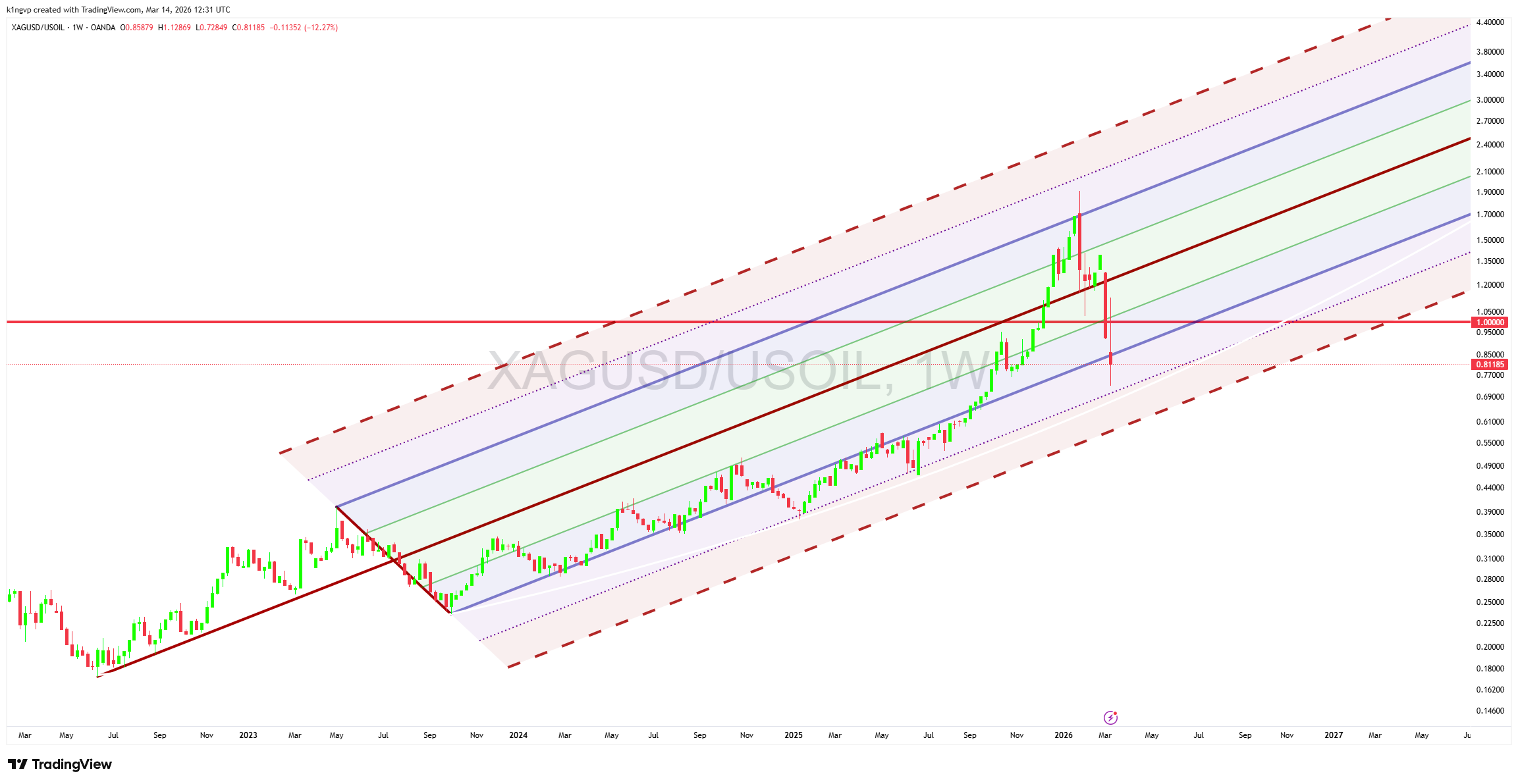
What makes the current setup particularly intriguing is the silver-oil ratio—the number of barrels of oil one ounce of silver can purchase. This ratio is tracing a pattern that deserves close attention.
The XAG/USOIL chart is currently hovering below the 1.0 ratio level. If this level does a support-resistance flip and the ratio continues higher, it would imply something structurally significant: that silver is beginning to reprice against energy—one of the core inputs of the global economy. In practical terms, it would mean an ounce of silver is gaining purchasing power relative to a barrel of oil, suggesting that monetary metals are entering a phase where they regain value relative to the energy that powers civilization.
The Privacy Dimension
The final piece of this puzzle is the most misunderstood by the mainstream, yet potentially the most critical for individual capital preservation.
If the dollar-based system is under threat, and if fiat currencies face devaluation pressures from the combination of war spending and monetary expansion, then assets that exist outside the traditional financial architecture become not merely attractive but necessary.
Bitcoin has captured the narrative as digital gold, and its role as a non-sovereign store of value is established. But Bitcoin is not private. Its blockchain is a public ledger of every transaction, forever visible to anyone with an internet connection. In a world where financial surveillance expands in proportion to financial stress—witness the push for Central Bank Digital Currencies and the expansion of AML/KYC regulations—transparency becomes a liability.
The Neutral Money Doctrine Revisited
As explored in yesterday’s analysis, The Post-Fiat Renaissance: How Privacy Coins Like Ryo Currency Will Deliver Economic Freedom in a Fracturing World, the concept of neutral money becomes paramount when geopolitical blocs harden. Neutral money is not aligned with any state, any bloc, or any political agenda. It is simply value that can move across borders, across systems, and across time without being frozen, surveilled, or debased by any central authority.
History demonstrates that neutral money tends to outlast politically managed money during periods of systemic stress. Gold embodied this doctrine in the physical world. In the digital age, neutral money must satisfy an additional constraint: censorship resistance under pervasive surveillance. This is precisely what privacy coins are architected to provide.
Ryo Currency: Engineered for the Post-Fiat Era
Within the privacy coin ecosystem, Ryo Currency occupies a distinct position. Built on the CryptoNote protocol with ring signatures, stealth addresses, and RingCT (Ring Confidential Transactions), Ryo offers transaction privacy by default. Every transaction is private. Every balance is obscured. Every sender and receiver is shielded from blockchain analysis[31].
But Ryo’s foundation goes deeper. The project employs a Cryptonight-GPU proof-of-work algorithm, specifically designed to resist ASICs and botnets while keeping block production accessible to ordinary participants[34]. This was not an arbitrary choice—it was a deliberate architectural decision to ensure maximal fairness and decentralization from the very beginning.
Unlike protocols that launched with pre-mines, institutional allocations, or venture capital backing, Ryo emerged with no premine and no ICO. Its emission curve, inspired by real-world resource extraction, distributed coins to those who contributed computational power to secure the network. This distribution model avoids the structural centralization pitfalls that plague many cryptocurrency projects, where early insiders hold disproportionate influence over protocol governance.
The result is a monetary asset that is truly neutral. No single entity controls it. No government sanctioned it. No venture fund can dictate its direction. It simply exists as a protocol-level asset, accessible to anyone with an internet connection and a GPU.
State-Level Privacy: Halo 2 ZK Proofs and the High-Latency Mixnet
Ryo’s roadmap goes beyond first-generation RingCT. The team has publicly committed to migrating toward second-generation zero-knowledge proofs, building on Halo 2 constructions that enable recursive, scalable privacy while eliminating trusted setup assumptions[36]. This implementation will be by default, ensuring that every transaction leverages the most advanced cryptographic privacy available—without requiring users to opt in or manage complex settings.
In parallel, Ryo is developing a high-latency mixnet to obfuscate network-level metadata and IP information, adding another layer of anonymity on top of on-chain privacy[37]. The combination of Halo 2 ZK proofs (for transaction confidentiality) and the mixnet (for network-layer anonymity) creates a formidable barrier against traffic analysis, timing attacks, and surveillance-capable adversaries. The design goal is unambiguous: make tracing, monitoring, or linking Ryo transactions and balances practically impossible—both on-chain and at the network layer—achieving what can only be described as state-level privacy.
The Bridge Asset Between Incompatible Systems
This neutrality gives Ryo a unique functional role in a fragmented world. As argued in yesterday’s analysis, Ryo is positioned to become the bridge asset between incompatible monetary systems—the neutral settlement layer beneath competing empires[33].
Consider the practical mechanics. A Russian energy exporter, paid in rubles or digital rupees, wants to acquire US dollars or stablecoins to pay a supplier in a third country. Instead of going through sanctioned channels, it can convert local currency to Ryo on a non-custodial exchange, then swap Ryo for USDT. The US supplier receives stablecoins without ever touching a sanctioned entity—the bridge asset (Ryo) severs the audit trail.
Similarly, an Indian IT firm providing services to a Chinese client faces a dilemma. Neither party wants to use e-CNY (with its surveillance architecture) nor USDT (potentially freezeable by US authorities). They can agree on Ryo as an intermediate: the Chinese firm acquires Ryo (despite the domestic ban, via overseas entities or OTC channels) and sends it; the Indian firm receives Ryo and converts locally. The transaction is private, final, and cannot be frozen by any central bank.
In each case, Ryo acts as the liquidity buffer between national currency systems. It does not replace them but provides a private, final settlement layer between them. Its neutrality is operational: because it belongs to no bloc, it can be used by all blocs without triggering geopolitical alarms. And because it is private, it leaves no permanent record that could later be weaponized.
Privacy as the Ultimate Safe Haven
In the scenario now unfolding—where the petrodollar faces its most serious challenge in fifty years, where fiat currencies face devaluation pressure from war spending, and where financial surveillance expands with each crisis—the ability to hold wealth in a form that is simultaneously non-sovereign and private becomes the ultimate safe haven.
The dollar may survive this war. It may not. The euro may find its footing. It may not. The yuan may ascend to reserve status. It may take decades.
But the trajectory is clear: the free-floating fiat system that emerged from the collapse of Bretton Woods in 1971 is approaching its terminal phase. Nixon took the dollar off the gold standard. The 1974 petrodollar agreement propped it up with oil. Now the oil prop is being kicked out from under it.
What replaces it will not be a single currency. It will be a multi-polar system of competing national monies, regional payment networks, and stateless digital assets. In that system, the ability to transact privately, hold value without counterparty risk, and move wealth across borders without permission will determine who preserves purchasing power and who loses it.
Ryo Currency, with its fair distribution, ASIC-resistant mining, Halo 2 ZK proofs by default, high-latency mixnet, and privacy-by-default architecture, represents one of the purest expressions of neutral digital money available. It requires no permission to use. It cannot be frozen or seized. It maintains no records of who transacts with whom. In a world where the Strait of Hormuz is reopening for yuan, the question every investor must ask is: what currency will your wealth be denominated in when the Strait closes to dollars?
Conclusion: The Fragmentation Accelerates
The war in the Gulf is not merely a regional conflict. It is the catalyst that is accelerating a structural fragmentation of the global financial system that was already underway. The petrodollar system, which has governed global energy trade for over five decades, is facing its first genuine alternative at the world’s most critical chokepoint.
Iran’s offer to reopen the Strait for yuan-denominated oil is not an act of diplomacy. It is an act of war—financial war. And unlike the missiles that have been exchanged, this weapon cannot be intercepted by Patriot batteries.
America can bomb Kharg Island. It cannot bomb the yuan.
It can destroy Iranian military infrastructure. It cannot destroy China’s cross-border payment system.
It can enforce sanctions through naval patrols. It cannot prevent willing buyers and sellers from transacting in whatever currency they choose.
The fragmentation the dollar was designed to prevent is being accelerated by the war that was supposed to preserve it. And as the monetary order fractures, the assets that preserve purchasing power across systems—gold, silver, and privacy-preserving digital currencies like Ryo—will increasingly become the refuge for those who understand that neutrality is the only safe haven in a world choosing sides.
The Strait is not reopening for ships. It is reopening for yuan.
The silver-oil ratio is testing 1.0.
The parabola that began in July 2022 is holding.
And the market for neutral, private money has never been more relevant.
Read the full series:
1. The Yuan Ultimatum – The catalyst
2. The End of Free-Floating Fiat – Systemic analysis
3. The Human Chokepoint – Who gets hurt
4. The Prophet and the Hedge Fund King – Intellectual validation
5. When Institutions Fail – Four scenarios for the future
6. God, State, and Network – The three Leviathans
7. From Network Union to Network State – The practical path to sovereignty
References & Further Reading
[1] Day 13 of Middle East conflict — global economy disruptions, Iranian attacks spread to sea – CNN, March 12, 2026.
[2] 2026 Strait of Hormuz crisis – Wikipedia.
[4] Iran war paralyzes oil trade – CBS News, March 2026.
[6] U.S. national debt reached about $38.9 trillion in March 2026 – CBO Official Report
[8] Global debt steady at 235% of GDP – DevelopmentAid.
[9] China’s Digital Yuan Crosses US$2 Trillion in Transactions – MEXC, 2026.
[10] What to watch as China prepares its digital yuan – Atlantic Council.
[31] Ryo Currency official website
[33] ryo-currency/ryo-currency: Ryo – Privacy for eveRYOne – GitHub.
[34] 【ANN】【RYO】【Cryptonight-GPU】 RyoCurrency – BitcoinTalk.
[36] Halo 2 ZK Proofs – An Introduction – Ryo YouTube.
[37] Halo 2 ZK Proofs & High Latency Mixnet – Ryo YouTube.
[44] People’s Bank of China statements on crypto; interviews with PBOC officials, 2025.