


Quantum computing represents a structural challenge to the cryptographic foundations of modern cryptocurrencies. While timelines for cryptographically relevant quantum computers remain uncertain, the direction is unambiguous: many assumptions underpinning elliptic curve cryptography, discrete logarithms, and signature schemes will eventually fail.

For privacy‑focused cryptocurrencies, the risk is not limited to future transactions. Blockchain data is permanent. Metadata leaked today can be exploited tomorrow. A sufficiently capable quantum adversary does not merely threaten live security; it threatens historical anonymity.

This article examines how different privacy architectures respond to that reality, focusing on Bitcoin, Monero, Zcash, and Ryo Currency. The analysis emphasizes zero‑knowledge proof systems, network‑layer anonymity, consensus design, and the implications of default versus optional privacy in a post‑quantum world.

Quantum Threat Timelines: Uncertain Dates, Asymmetric Risk

Estimates for when quantum computers will break widely deployed public‑key cryptography vary significantly. Some analysts project multiple decades; others argue that state‑level adversaries may achieve cryptographically relevant breakthroughs much sooner.

The critical asymmetry is that attackers can store encrypted and pseudonymous data indefinitely. Once quantum capability exists, historical blockchains can be reanalyzed in their entirety. Systems that leak metadata today accumulate future risk regardless of when quantum hardware becomes operational.

Bitcoin: Transparent by Design, Fragile by Default

Bitcoin’s architecture offers no meaningful privacy and relies on ECDSA signatures vulnerable to Shor’s algorithm. Although post‑quantum signature schemes exist in theory, Bitcoin’s conservative governance and ossified upgrade path make coordinated migration slow and uncertain.

Even without quantum computing, Bitcoin transactions are routinely deanonymized using address clustering, transaction graph analysis, and network observation. Quantum computing would not introduce new privacy failures; it would simply accelerate existing ones.

Monero: Cryptographic Privacy, Weak Statistical and Network Assumptions

Monero is widely regarded as the benchmark for on‑chain privacy due to its use of ring signatures, stealth addresses, and confidential transactions. However, both conventional blockchain analytics and future quantum capabilities expose structural weaknesses that are often underestimated.

Effective Ring Size and Conventional Deanonymization

Although Monero advertises a ring size of 16, multiple empirical studies have shown that the effective anonymity set is much smaller. Due to decoy selection biases, temporal heuristics, and output reuse patterns, conventional blockchain analytics can reduce the effective ring size to approximately 4.2.

For further reading: OSPEAD – Optimal Ring Signature Research

This means that even without quantum computing, Monero transactions are probabilistically traceable at scale. The privacy model relies not on absolute anonymity, but on uncertainty thresholds that can be eroded through improved analytics and long‑term observation.

Quantum Computing and Retrospective Ring Collapse

Quantum computing dramatically worsens this situation. A quantum adversary capable of breaking elliptic curve assumptions could invalidate ring signature security entirely, collapsing anonymity sets retroactively.

More importantly, even before full cryptographic breaks occur, quantum‑accelerated statistical analysis enables correlation attacks across the entire transaction graph. What is today a probabilistic inference problem becomes a deterministic reconstruction problem when computational limits are removed. Under such conditions, the Monero blockchain becomes a historical dataset that can be reprocessed to infer transaction origins, flows, and ownership with high confidence.
Read more: Frontiers in Computer Science 2025 Review – A Novel Transition Protocol to Post-Quantum Cryptocurrency Blockchains

Dandelion++: The “Healthy Node” Fallacy

At the network layer, Monero relies on Dandelion++, which attempts to obscure transaction origin by routing transactions through a stem phase before broadcast.

This design assumes the presence of “healthy” nodes that are not controlled or observed by adversaries. In practice, this assumption is fragile: high‑uptime, well‑connected, low‑latency nodes are disproportionately likely to be operated by exchanges, infrastructure providers, or surveillance entities. The most reliable candidate for a “healthy node” in Dandelion++ is almost always a surveillance node. This is not a quantum problem; it is already observable under conventional computing analysis.

For further reading on Dandelion++ anonymity limitations: On the Anonymity of Peer‑To‑Peer Network Anonymity Schemes Used by Cryptocurrencies

Quantum computing amplifies this weakness by enabling large‑scale traffic correlation, timing inference, and retrospective network graph reconstruction. Dandelion++ provides obfuscation, not anonymity, and its protections degrade rapidly under sustained observation.

FCMP++: Structural Limits to Post‑Quantum Adaptation

Monero’s proposed FCMP++ upgrade replaces ring signatures with a more efficient construction that reduces transaction size. While this addresses scalability concerns, it does not resolve quantum threats.

FCMP++ remains dependent on cryptographic assumptions that are not known to be quantum resistant. More critically, its design does not lend itself easily to recursive proof composition or cryptographic agility. Unlike zero‑knowledge proof systems such as Halo 2, FCMP++ lacks a clear pathway to post‑quantum primitives without a full protocol redesign. This makes long‑term quantum resistance not merely unimplemented, but structurally difficult.

For broader context on quantum impacts on zero‑knowledge systems, see a survey of post‑quantum proof constructions: Zero‑Knowledge Proofs in Blockchain Becoming Quantum Secure (Quantum Canary)

Zcash: Advanced Cryptography Constrained by Optional Privacy

Zcash pioneered the use of zero‑knowledge proofs in cryptocurrency and continues to advance the state of the art through Halo 2. The removal of trusted setup and the introduction of recursive proofs represent genuine progress.

Zcash developers have discussed “quantum recoverability,” a mechanism designed to allow the network — and associated wallets — to pause and upgrade cryptographic primitives if a credible quantum threat materializes, preserving user control during transition. This approach reduces risks compared to rigid cryptographic dependencies but does not itself provide quantum resistance today. For further reading on Zcash’s quantum recoverability strategy: Why Zcash Developers Aren’t Panicking About Quantum and Zcash Quantum Recoverability and PQC Exploration.

However, Zcash’s core limitation is not cryptographic capability but deployment philosophy. Privacy remains optional. Transparent addresses dominate transaction volume due to exchange practices, wallet defaults, and regulatory considerations. This optionality leaks metadata that can be exploited even for shielded users. In a post‑quantum context, mixed ledgers become ideal targets for retrospective analysis.

Zcash is preparing a transition to a hybrid Proof‑of‑Work and Proof‑of‑Stake consensus model, and research into improved network‑layer anonymity is ongoing. These efforts are directionally positive, but not yet decisive.

Ryo Currency: Privacy as a Protocol Invariant

Ryo Currency adopts a fundamentally different approach: privacy is enforced by default. There are no transparent transactions. There is no opt‑out. This design choice has profound implications for post‑quantum security. When every transaction follows the same privacy rules, metadata leakage is minimized at the systemic level.

Halo 2 Zero‑Knowledge Proofs by Default

Ryo’s planned transition to Halo 2 zero‑knowledge proofs leverages the same advanced cryptographic framework used by Zcash, but deploys it universally across all transactions. Halo 2 is part of a broader ecosystem of zk‑SNARKs that are advancing toward post‑quantum research, even though current implementations still rely on discrete‑logarithm assumptions that are vulnerable to quantum algorithms. For further reading on Halo 2’s role and quantum considerations: Zcash Halo2 Repository and a technical analysis of post‑quantum proof research: On the Security of Halo2 Proof System.

High‑Latency Mixnet Integration

Ryo’s roadmap includes the adoption of a high‑latency mixnet for network‑layer anonymity. Unlike low‑latency propagation schemes, mixnets deliberately introduce delay and batching to destroy timing correlations. This is particularly relevant in a quantum context. As computational constraints disappear, timing analysis becomes one of the most powerful deanonymization tools available. High‑latency mixnets are specifically designed to counter this class of attack. For further reading on Ryo’s network anonymity strategy: Ryo Currency’s High Latency Mixnet vs. Tor and VPNs.

CryptoNight‑GPU and Transition to Proof‑of‑Stake

Ryo’s current CryptoNight‑GPU mining algorithm emphasizes memory hardness and commodity hardware, offering resistance to both hardware centralization and quantum speedups. The planned transition to Proof‑of‑Stake further reduces exposure to quantum mining attacks by shifting security from raw computation to economic finality. This transition enhances long‑term adaptability without compromising privacy guarantees.

Conclusion: Post‑Quantum Privacy Is Architectural, Not Incremental

Quantum computing will not instantly invalidate all cryptocurrencies. It will, however, reward systems that were designed with uniform privacy, cryptographic agility, and layered anonymity from the outset.

Monero offers some privacy today but relies on assumptions that degrade under both conventional and quantum analysis. Zcash offers advanced cryptography but weakens it through optional deployment.

Ryo Currency’s coming implementation—by‑default Halo 2 zero‑knowledge proofs, high‑latency mixnet integration, and flexible consensus evolution—aligns more closely with the realities of a post‑quantum threat environment.

In the post‑quantum era, privacy will not be a feature users select. It will be a property protocols either enforce universally or fail to provide at all.

Timing and Metadata Attacks in Cryptocurrency

In the world of cryptocurrency, privacy is a critical feature that users rely on to keep their financial activities anonymous. However, without proper safeguards, attackers can exploit vulnerabilities in transaction systems to uncover these private details. Two common methods attackers use are timing attacks and metadata attacks, both of which threaten the unlinkability of transactions—meaning the ability to keep the connection between a transaction’s origin and its destination hidden.

Understanding Transaction Outputs and Spends

To grasp how these attacks work, let’s start with the basics. A transaction output (TXO) is like a digital coin created by a cryptocurrency transaction. Once generated, this TXO can be spent in a future transaction, where it serves as an input to transfer value to another address. In many cryptocurrency systems, transactions are processed quickly, often within seconds or minutes. This speed, while convenient, creates a predictable pattern that attackers can exploit.

The Threat of Timing Attacks

Imagine this scenario: in an unprotected cryptocurrency system, a TXO is created, and moments later, it’s spent. Because the time gap between creation and spending is so short—say, within one minute—an attacker observing the network might have a 90% chance of linking that spend back to the recent TXO, based purely on timing. This is a timing attack. It’s like watching someone in a busy marketplace: if they buy an item and then sell it again almost immediately, an observer could reasonably assume those two actions are connected. In cryptocurrency, this predictable timing window provides attackers with a powerful clue to trace transactions and compromise user privacy.

The Risk of Metadata Attacks

Beyond timing, attackers can also use metadata attacks to dig deeper. Metadata refers to additional details in a transaction, such as the amount of cryptocurrency involved, the addresses sending or receiving funds, or the specific inputs used. Even if a system hides some information, this metadata can act like fingerprints, allowing attackers to piece together transaction flows and identify relationships between seemingly anonymous activities. Together, timing and metadata attacks form a serious threat to the anonymity that cryptocurrency users expect.

How Ryo Currency Fights Back

Ryo Currency tackles these privacy risks head-on with two advanced technologies: Halo 2 Zero-Knowledge Proofs and a High Latency Mixnet. Here’s how they work together to protect users:

  • Halo 2 Zero-Knowledge Proofs: This cutting-edge cryptographic system hides the details of a transaction—think of it as putting a transaction in a locked box that only reveals it happened, without showing the amount, sender, or receiver. By obscuring this metadata, Halo 2 makes it nearly impossible for attackers to use transaction details to trace activity.
  • High Latency Mixnet: This technology introduces random delays and shuffling to the transaction process. Instead of transactions being broadcast immediately in a predictable order, they’re mixed up and sent out at random times. This breaks the short, traceable timing patterns that attackers rely on, making it exponentially harder to link a spend to a specific TXO.

A Stronger Shield for Privacy

In an unprotected system, an attacker might have a 90% chance of connecting a spend to a recent TXO within a minute. With Ryo Currency’s combination of Halo 2 and the High Latency Mixnet, that probability drops to near insignificance. The random delays and shuffling disrupt timing clues, while zero-knowledge proofs erase the metadata trail. Together, these technologies create an impenetrable defense, ensuring that transactions remain private and unlinkable.

This introduction highlights the dangers of timing and metadata attacks in cryptocurrency and showcases how Ryo Currency’s innovative approach safeguards user privacy. By blending cryptographic obfuscation with intentional timing disruptions, Ryo sets a high standard for anonymity in the digital currency world.

Step 1: The High Latency Mixnet’s Timing Disruption

In an unprotected system, an attacker might observe a predictable time gap—say, a transaction appearing one minute after an output is created—and confidently link them. The High Latency Mixnet upends this by introducing random delays, shuffling, and batching of transactions within a defined window. Suppose the mixnet delays transactions uniformly between 1 and 5 minutes, creating a delay window:

ΔT = 5 - 1 = 4 minutes

Without the mixnet:

An attacker assumes a new output is spent within 1 minute, with a linking probability Plink = 90% based on timing correlation.

With the mixnet (delay only):

The transaction could be broadcast at any point within the 4-minute window. The probability of it appearing in any specific 1-minute interval is:

Pbroadcast = 1 / ΔT = 1 / 4 = 25%

If the attacker still assumes a 90% chance of linking based on timing but must now guess which minute the transaction emerges from, their effective confidence drops:

Plink, delay = 0.9 × 0.25 = 22.5%

This reflects the dilution of timing certainty caused by the random delay alone.

Step 2: Shuffling and Batching Amplify Uncertainty

The mixnet doesn’t just delay transactions—it shuffles and batches them with others, mixing outputs from different times into a single broadcast pool. This increases the number of candidate outputs an attacker must consider. Let’s assume the shuffling and batching process combines outputs from a pool (N), where (N) represents the effective number of transactions mixed together. For simplicity, suppose:

N = 10

(e.g., 10 transactions are batched and shuffled in a given window). The attacker’s chance of correctly identifying the spent output from this pool is divided by the pool size:

Plink, shuffled = Plink, delay / N = 22.5% / 10 = 2.25%

This assumes the attacker has no additional information to narrow the pool, which brings us to Halo 2’s contribution.

Step 3: Halo 2’s Cryptographic Obfuscation

Halo 2 replaces traditional TXOs with cryptographic commitments backed by zero-knowledge proofs, hiding critical details like amounts, sources, and destinations. In a standard system, an attacker might use transaction metadata (e.g., matching amounts) to refine their guess. With Halo 2, this metadata is invisible, leaving the attacker with no way to distinguish one commitment from another in the shuffled pool.

For example, if 10 transactions are batched (each with a commitment), and an attacker observes a spend, they can’t tell which of the:

N = 10

prior outputs it corresponds to beyond random guessing. Halo 2 ensures the probability remains:

Plink, Halo 2 = 2.25%

Without Halo 2, metadata might reduce (N) (e.g., by matching a 100 RYO spend to a 100 RYO output), but the zero-knowledge layer prevents this, locking the attacker’s success rate at the shuffled pool’s baseline.

Step 4: Combined Probability Reduction

Let’s tie it together with a more realistic scenario. Suppose:

  • The mixnet’s delay window is 4 minutes (Pbroadcast = 25%).
  • Shuffling and batching create a pool of N = 20 transactions (a larger, plausible batch size).
  • Halo 2 ensures no metadata leakage.

Starting from the initial 90% linking probability:

Delay effect:
Plink, delay = 0.9 × 0.25 = 22.5%

Shuffling and batching effect:

Plink, shuffled = 22.5% / 20 = 1.125%

Halo 2 effect:

The zero-knowledge commitments prevent further refinement, holding the probability at 1.125%.

Thus, the combined probability of an attacker correctly linking a spend to its output drops to:

Plink, combined = 1.125%

Sensitivity Analysis: Scaling the Pool

If the mixnet processes even more transactions—say, N = 100 (e.g., a busy network)—the probability becomes:

Plink, combined = 22.5% / 100 = 0.225%

This demonstrates how the system scales: larger pools exponentially shrink the attacker’s odds, while Halo 2 ensures no shortcuts exist.

Why It’s Extremely Low

  • Time Randomization: The mixnet’s delays, shuffling, and batching erase timing patterns, forcing attackers to consider outputs from minutes, hours, or even days ago, depending on the window and pool size.
  • Data Obfuscation: Halo 2’s commitments make every transaction indistinguishable, nullifying metadata-based attacks.
  • Compounded Effect: Starting at 90%, the probability plummets to 0.225% (with N = 100)—a 400-fold reduction—rendering successful linking vanishingly unlikely.

Final Thoughts

The synergy of the High Latency Mixnet and Halo 2 transforms a 90% attacker success rate into a fraction of a percent. Random delays and large, shuffled pools dilute timing clues, while zero-knowledge commitments eliminate data leaks. For Ryo Currency, this means privacy is not just strong—it’s mathematically robust, balancing security with the scalability and speed users expect.

The Importance of Decentralization

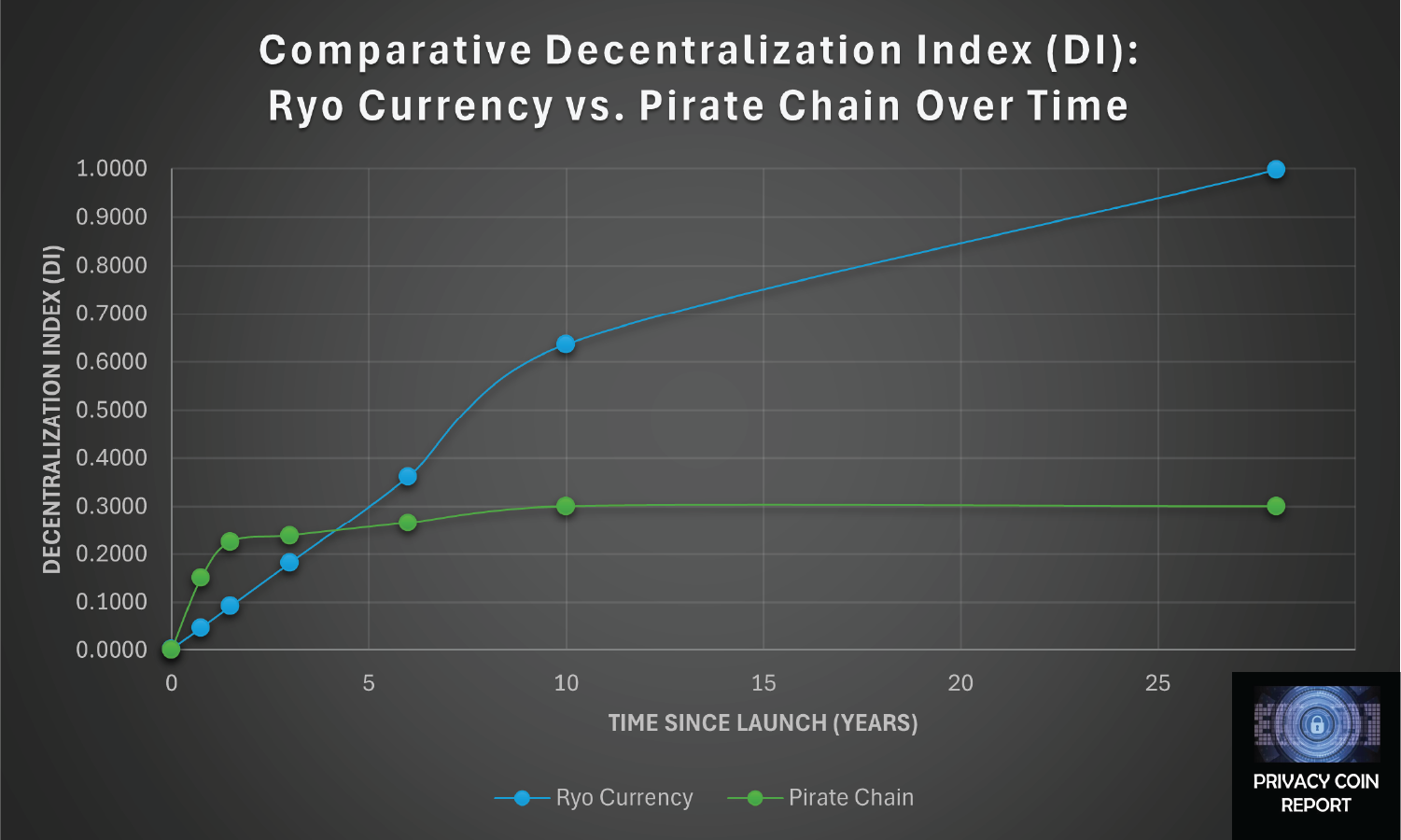
Decentralization is fundamental to cryptocurrency, ensuring trustlessness, security, and censorship resistance. This article explores the Decentralization Index (DI) and compares Pirate Chain (ARRR) and Ryo Currency (RYO) based on emission schedules and mining algorithms.

The Decentralization Index (DI)

The DI is calculated as:

DI(t) = M × E(t)
  • M: Mining algorithm decentralization factor.
  • E(t): Fraction of emitted coins distributed in a decentralized manner.

Pirate Chain uses an ASIC-friendly Equihash algorithm (M = 0.3), while Ryo Currency employs the ASIC-resistant Cryptonight-GPU algorithm (M = 1.0).
The decentralized emission fraction for Ryo excludes the developer allocation (~13.56%).

Comparison of Decentralization Index (DI) Over Time

Years Since Launch Pirate Chain DI Ryo Currency DI
0 0.000 0.0013
0.75 0.150 0.0462
1.5 0.225 0.0912
3 0.238 0.1810
6 0.265 0.3607
10 0.300 0.6359
28 0.300 0.9971

Exponential Differences in Decentralization

To mathematically demonstrate the exponential difference in decentralization between Ryo Currency and Pirate Chain, we compare their Decentralization Index (DI) values over time using a logarithmic ratio:

Logarithmic Comparison of DI Growth

The ratio of decentralization between Ryo Currency (RYO) and Pirate Chain (PC) at a given time t is:

R(t) = DIRYO(t) / DIPC(t)

Taking the natural logarithm to emphasize the exponential nature of the difference:

log R(t) = log DIRYO(t) – log DIPC(t)

1. At 6 Years (t = 6):

DIRYO(6) = 0.3607, DIPC(6) = 0.265

R(6) = 0.3607 / 0.265 ≈ 1.361

log R(6) ≈ log 1.361 ≈ 0.134

2. At 10 Years (t = 10):

DIRYO(10) = 0.6359, DIPC(10) = 0.3

R(10) = 0.6359 / 0.3 ≈ 2.12

log R(10) ≈ log 2.12 ≈ 0.326

3. At 28 Years (t = 28):

DIRYO(28) = 0.9971, DIPC(28) = 0.3

R(28) = 0.9971 / 0.3 ≈ 3.32

log R(28) ≈ log 3.32 ≈ 0.521

These results show that as time progresses, the decentralization ratio between Ryo Currency and Pirate Chain increases exponentially, meaning that RYO becomes exponentially more decentralized than ARRR.

Why This Matters

  • Security: Greater resistance to 51% attacks, as mining power is more widely distributed.
  • Censorship Resistance: No single entity can control or shut down the network.
  • Trust & Resilience: A more decentralized network ensures long-term stability.
  • Economic Fairness: GPU mining allows more participants, avoiding centralization by industrial ASIC miners.

This mathematical model confirms that RYO’s decentralization advantage is not linear, but exponentially greater over time—making it fundamentally more secure, resilient, and fair than Pirate Chain.

Limitations and Final Considerations

While this model focuses on coin emission and mining algorithms, other factors such as marketing, investor interest, and adoption impact decentralization. However, these do not negate the exponential nature of coin distribution and its impact on decentralization.